OHC Exhibit “Voices for the Environment” Curator Q&A

The Oral History Center is excited to announce the opening of Voices for the Environment: A Century of Bay Area Activism, a Bancroft Library Gallery exhibition that was curated by Todd Holmes, Roger Eardley-Pryor, and Paul Burnett. Voices for the Environment traces the evolution of environmentalism in the San Francisco Bay Area across the twentieth century. In three sections, it highlights how Bay Area activists have long been on the front lines of environmental change—from efforts to preserve natural spaces in the wake of the 1906 San Francisco earthquake and fire, to the midcentury fight for state regulations to protect San Francisco Bay shoreline, to more recent demands for environmental justice to address the disproportionate burden of pollution that sickened communities of color around the Bay.

We sat down with Eardley-Pryor and Holmes to ask them about their experience curating the exhibit, bringing the OHC’s interviews to life in The Bancroft Library’s gallery, and what they learned along the way.
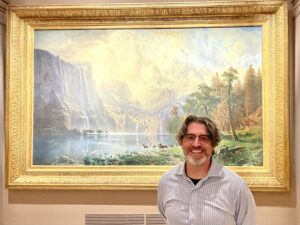
Roger Eardley-Pryor
OHC Historian/Interviewer Roger Eardley-Pryor
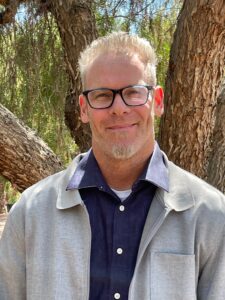
Todd Holmes
OHC Historian/Interviewer Todd Holmes

Q: When you were originally thinking about this exhibit, which spans a century of Bay Area environmental activism, what topics, themes, or events were important for you to include?

 TH: As historians, both Roger and I approached the exhibit through the lens of change over time, essentially asking the question, “How did what we’ve come to recognize as environmentalism evolve and change in the Bay Area over the twentieth century?” Combining our knowledge of both the oral history collection – which was to stand at the heart of the exhibit – and the environmental history of California, we selected the three stories we wanted to highlight fairly quickly.

First, we wanted to tell the story of Hetch Hetchy, the valley in Yosemite National Park that was dammed for San Francisco’s water system. This is a seminal event used in history classes across the nation to highlight the battle between two schools of environmentalism, preservationists like the Sierra Club’s John Muir, and conservationists like Gifford Pinchot of the U.S. Forest Service in the first part of the twentieth century. For the exhibit, we sought to use the Hetch Hetchy story to introduce visitors to preservation as the first form of environmentalism that took root in the Bay Area.

Second, we wanted to tell the story of Save The Bay, the movement initiated by three women from Berkeley to halt bay fill. Ultimately, that movement led to the creation of the San Francisco Bay Conservation and Development Commission (BCDC), a state government agency to regulate development on the bay. Here we wanted to highlight how environmental concerns became embedded within the fold of government by the mid-century. BCDC stands as the first environmental agency in the United States, providing a precedent for other regulatory agencies on the state and federal level in the years that followed, such as the California Coastal Commission. Moreover, BCDC also operated within a framework that sought to balance environmental protection with economic development.  

Third, we wanted to tell the story of environmental justice, a movement in the last part of the twentieth century that sought to put the health of people – particularly communities of color – within the environmental agenda. While environmental justice is fairly common today in discussions of environmental policy, the story of how it developed is not well known, and the Bay Area was one of the central places in the nation from which the movement took root. 

REP: Todd and I worked to ensure that, in this exhibit, environmental activists could speak for themselves, and that visitors to the exhibit could actually hear the voices of activists recorded in their oral history interviews. The Audio Spotlight technology that allow people to hear interview clips in the gallery, the three videos Todd created with rare film footage and photographs, and the three podcast episodes we made with Sasha Khokha of KQED all make this exhibit something special that has never been done before in The Bancroft Library Gallery. For me, the people-power of communities of color demanding environmental justice, and the longtime leadership of women working for environmental protection were really important themes to include. Often, environmental history is told through the actions of men like John Muir, who does deserve credit for his early advocacy to protect nature through its preservation. The legacy of Muir and the ongoing work of the Sierra Club are important, and they remain so today. But Todd and I wanted to tell a deeper and broader history of Bay Area environmentalism, which shows how women and people of color have been central to the expansion and the evolution of environmental action over the course of the 20th century. I hope the stories shared in this exhibit help contextualize and make current environmental issues more meaningful—be it present-day preservation issues in 30 x ’30 campaigns, or conflicts over coastal regulations amid sea-level rise, or ongoing challenges to empower people of color in mainstream environmental movements.


Q: Did the themes you wanted to highlight change during the course of your research?

 REP: We worked hard for over a year to bring this exhibit to life and to my memory, we agreed fairly early on about the three main narratives featured in the exhibit—the preservation of nature, reconciling environment and development, and environmental justice for communities of color. Over the course of our research, we changed the details of which particular oral history segment we might include here or there, or which image or document would best compliment the oral histories featured in each section of the exhibit. But as I recall, the exhibit’s main story arc remained steady from early in our curation process.

TH: Surprisingly, there was no change in the main topics / stories we wanted to highlight in the three sections of the exhibit. What our research did do was help expand on the themes within each to add more depth and nuance around community activism. For instance, in the first section we not only focused on the story of Hetch Hetchy, but connected it to activism around Save the Redwoods, which in turn highlighted the vital – yet often overlooked – role of women in the early preservation movement. Men like John Muir may have become the figureheads of environmentalism, and voted for such policies in government, but it was women who provided the grassroots momentum that put environmental concerns on the table. The same could be said for the third section on environmental justice. Our research uncovered a lot of different groups and experiences in the Bay Area grappling with environmental racism, from toxic sites in Richmond and what became known as the Silicon Valley, to debates with white environmental groups about even using the term “racism.” So in all, our research gave us a number of themes to spotlight and weave together throughout the exhibit


Q: The exhibit begins with the 1906 earthquake. Why did you decide to start there?

TH: This is another example of how research expanded the themes and stories of the three main topics we sought to feature in the exhibit. We wanted to highlight the story of Hetch Hetchy in the first section. Our research of the Hetch Hetchy battle forced us to upstream to the root cause – the 1906 earthquake and fire that destroyed 80 percent of San Francisco. At the time, San Francisco stood as the largest and richest city west of Chicago. In the wake of the disaster, the rebuilding effort posed a tremendous threat to the natural resources of the state. Ancient redwood forests throughout the Bay Area and along California’s north and central coast were targeted for timber, just as the Hetch Hetchy Valley was eyed for water and hydro-electric power. Thus, these rebuilding efforts proved the impetus of the early activism to preserve California’s environment.

REP: The drowning of Hetch Hetchy Valley—despite it being located within Yosemite National Park—is such a powerful and classic story in environmental history, and it occurred because the 1906 earthquake and fire destroyed San Francisco. Amazingly, Todd found several oral histories in our collection with survivors of the earthquake and fire who recall their experiences of it when they were children. In The Bancroft Library, Todd also found historic film footage, recently digitized, that shows San Francisco still aflame just after the earthquake. Putting those oral histories together with this footage make for a captivating start to the exhibit. 

But what I didn’t realize until working on the exhibit was how the preservation of redwoods was also connected to how the earthquake and fire destroyed San Francisco. After the fire, lumber companies promoted California’s fire-resistant coastal redwoods as a means to rebuild the devastated city. In turn, environmentalists redoubled their efforts to preserve special groves of those ancient redwood trees. It suddenly made sense to me how Muir Woods National Monument was established in Marin County just a few years after the 1906 earthquake. Additionally, we wanted our exhibit on Bay Area environmentalism to highlight the Sierra Club, which was founded in San Francisco in 1892 and has since become one of the most influential environmental organizations in the nation. The Oral History Center has conducted oral histories with Sierra Club leaders since the early 1970s, and several activists, like William Colby, Ansel Adams, and David Brower, discussed in their oral histories how the fate of Hetch Hetchy continues to inform ongoing preservation efforts. So, in many ways, the 1906 San Francisco earthquake and fire helped ignite the spirit of preservation that still informs environmental activism, both in the Bay Area and across much of North America.


Q: What role does oral history play in the exhibit?

 REP: Oral history is the beating heart that gives life to this exhibit! We scoured several scores of Oral History Center transcripts for captivating stories about Bay Area environmental activism. David Dunham helped us obtain digitized versions of those oral history recordings. We then used The Bancroft’s traditional paper, photograph, and film collections to complement the oral history narratives that we featured in the exhibit. Christine Hult-Lewis and Lorna Kirwan helped us explore several of those archival collections, and Theresa Salazar pointed us to the excellent Urban Habitat Program Records, 1970-2001, which are displayed in our exhibit. Ultimately, the exhibit offers a multi-sensory experience where visitors can engage audio recordings, film footage, oil paintings, photographs, pamphlets, posters, descriptive text, and they can even hold the hardbound oral history transcripts featured in the exhibit. But certainly, oral history is the centerpiece of the exhibit.

TH: In short, everything! This is the first exhibit curated by the Oral History Center, and the first in-depth effort to showcase both the oral history and other archival collections of The Bancroft Library. Each section features oral histories about the main topic in three ways. Edited oral history segments are played in each section through an Audio Spotlight speaker, and accompanied with a video that shows captions as well as related photographs and archival footage. The oral histories are also available through a three-episode podcast, narrated by Sasha Khokha from KQED San Francisco. The podcast episodes, available online and in the gallery by scanning a QR Code, offer a deeper dive into the stories of each section. Lastly, we used oral histories quotes in the labels of the exhibit material to add further detail and context.


Q: The 1960s and ’70s were two very productive decades in terms of environmental activism. Did the oral histories that you encountered from the OHC’s collection make you think differently about this period, or illuminate something new?

 TH: In my view, the oral histories we used in the exhibit helped place the activism of the 1960s and 1970s in better context. For instance, we often think of the “environmental movement” as arising around the late 1960s / early 1970s. Yet, this view completely overlooks the activism of men and women around preservation in the first couple decades of the twentieth century. It also overlooks the vital work of Sierra Club executive director David Brower, whose activism throughout the 1950s and 1960s staved off numerous developments and led to the establishment of ten new national parks. In many respects, I think the oral histories featured in this exhibit pushed me to think about a “long environmental movement” that gained traction in the halls of government during the 1960s and 1970s. I think the exhibit also highlights how the Civil Rights Movement and environmental movement came to intertwine by the end of the decade to form environmental justice, which was an area I felt fortunate to learn more about through this project.

REP: Actually, rather than the 1960s and 1970s, the oral histories we included in the exhibit helped me realize the importance of the 1980s and 90s to the expansion and evolution of environmentalism. Without a doubt, activity surrounding Earth Day in 1970 was a key inflection point in environmental history, inspiring new environmental laws and a new generation of environmental activists. But the oral histories in our exhibit tell how Bay Area activists laid the early groundwork at least since the early 20th century for later environmental regulations, and how activists in the final decades of the 20th century worked to include all people in environmental protections, especially communities of color who suffered the most from industrial pollution.


Q: You put together additional material, like a podcast and class workbook, to accompany the exhibit. How do you hope people will use these materials?

 TH: For the past couple years, the Oral History Center has been working on ways to get our collection into the K-12 education space. We developed additional materials, such as the class workbook and podcast, to serve as educational resources for K-12 classrooms, as well as undergraduate courses.

REP: The podcasts and educational workbook can be used anywhere—while visiting and experiencing the exhibit in person, or at home or in classrooms. We hope people use those additional materials long after the exhibit closes in November 2024!


Q: What do you hope that people take away from the exhibit?

 REP: I hope exhibit visitors sense the importance, power, and potential of oral history. I hope they see how the Oral History Center’s work to record the lived experiences and reflections of people through oral history creates invaluable records that helps us better understand where we’ve come from and helps us make sense of our experiences today. I also hope visitors realize the importance of Bay Area activists in shaping the evolution of environmentalism over time. And I hope visitors hear how the actions of Bay Area people in the past, as told in their own words, helped define our experiences in the Bay Area today. Given today’s grave threats to our environment and to our democracy, I hope visitors appreciate how environmental activism remains an ongoing process that is shaped and renewed by average people like them who engage in civic activism. I also hope the oral histories featured in this exhibit—and the many, many more that are preserved in the Oral History Center collection—help inspire people to shape and renew environmentalism today and in the future. 

TH: I hope visitors come away from the exhibit with a better understanding of how environmentalism evolved and changed over the century, and that it has a long history in the Bay Area. Moreover, I hope the oral histories featured in the exhibit highlight the change brought on by everyday people. It was the activism of men and women that led to protected redwood forests and the creation of state and national parks. It was the unwavering dedication of three women from Berkeley that stopped fill projects in San Francisco Bay and led to the nation’s first government-run environmental agency. And it was the collective action of communities of color that put justice within the environmental agenda, and on the dockets of policymakers. Ultimately, I hope visitors, young and old, walk away with the idea that change comes about through everyday people.
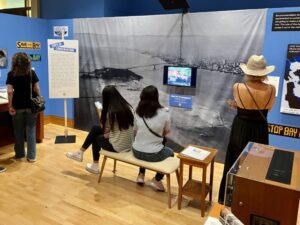
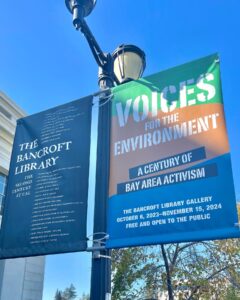
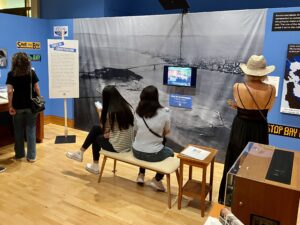
Photo of Voices from the Environment exhibit.
A group of people watch historic footage and listen to clips from oral history interviews in the Voices from the Environment exhibit in The Bancroft Library.

“Voices for the Environment: A Century of Bay Area Activism,” an Oral History Center exhibit in The Bancroft Library Gallery

A green, brown, and blue banner that reads "Voices of the Environment: A Century of Bay Area Activism" hangs on a light post outside The Bancroft Library on UC Berkeley's campus
Banner for “Voices for the Environment” exhibit outside The Bancroft Library

We’re excited to announce the opening of Voices for the Environment: A Century of Bay Area Activism, a Bancroft Library Gallery exhibition that was curated by Todd Holmes, Roger Eardley-Pryor, and Paul Burnett of the Oral History Center. Voices for the Environment traces the evolution of environmentalism in the San Francisco Bay Area across the twentieth century. In three sections, it highlights how Bay Area activists have long been on the front lines of environmental change—from efforts to preserve natural spaces in the wake of the 1906 San Francisco earthquake and fire, to the midcentury fight for state regulations to protect San Francisco Bay shoreline, to more recent demands for environmental justice to address the disproportionate burden of pollution that sickened communities of color around the Bay.

Several people sit and stand in the exhibit space, with some sitting in front of a video display while others stand and look at photographs on the wall of the exhibit
Visitors experience the “Voices for the Environment” exhibit, curated by the Oral History Center, in The Bancroft Library Gallery

Our Voices for the Environment exhibit is the first major effort in The Bancroft Library Gallery to showcase oral history alongside the traditional archival collections of The Bancroft Library, with the oral history collections leading the way. The exhibit still features historic photographs, pamphlets, post cards, and posters selected from several collections of The Bancroft’s physical archives. But for the first time in this gallery, our Voices for the Environment exhibit also includes three installations of special Audio Spotlight technology where you can listen to never-before-heard oral history recordings with Bay Area environmentalists, while simultaneously watching three videos edited by Todd Holmes that feature historic photographs and rare film footage from The Bancroft’s digital collections. Additionally, as a complement to the exhibit, curators Todd Holmes and Roger Eardley-Pryor created an educational workbook, so students of all ages can learn about the environmental movement by engaging with the themes and primary sources on display. Through these efforts, the Oral History Center hopes Voices for the Environment will have a life beyond its yearlong run.

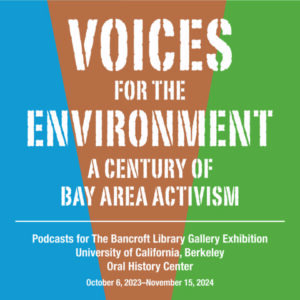
On a blue, brown, and green background is white text that reads "Voices for the Environment A Century of Bay Area Activism, Podcasts for The Bancroft Library Gallery Exhibition, University of California Berkeley, Oral History Center, October 6, 2023–November 15, 2024."
Podcasts for “Voices for the Environment” were produced by Todd Holmes and Roger Eardley-Pryor of the Oral History Center, with help from Sasha Khokha of KQED. The podcast images, and the exhibit space, were designed by Gordon Chun.

For an even deeper dive, you can also scan a QR code in the gallery, or click the following link, to hear three Voices for the Environment podcast episodes produced in partnership with Sasha Khokha of KQED Public Radio and The California Report Magazine. The podcast episode for section 1 of the exhibit, titled “A Preservationist Spirit,” traces the environmental activism that arose amid the rebuilding efforts of San Francisco after the 1906 earthquake and fire, efforts that came to target the state’s ancient redwood forests and the beloved Hetch Hetchy Valley in Yosemite National Park. The episode features historic interviews from the Oral History Center archives including segments from the “Growing Up in the Cities” collection recorded in the late 1970s by Frederick M. Wirt, as well as oral history interviews with Carolyn Merchant recorded in 2022, with Ansel Adams recorded in the mid-1970s, and with David Brower recorded in the mid-1970s. The oral history of William E. Colby from 1953 was voiced by Anders Hauge, and the oral history of Francis Farquhar from 1958 was voiced by Ross Bradford. This first episode also features audio from the film Two Yosemites, directed and narrated by David Brower in 1955. The podcast episode for section 2 of the exhibit, titled “Tides of Conservation,” tells the story of the Save San Francisco Bay movement and the creation of the San Francisco Bay Conservation and Development Commission (BCDC), one the nation’s first environmental regulatory agencies. The episode features segments from oral history interviews with Save The Bay founders Esther Gulick, Catherine “Kay” Kerr, and Sylvia McLaughlin recorded in 1985; as well as interviews with BCDC executive director Joseph Bodovitz and chairman Melvin B. Lane, both recorded in 1984. And the podcast episode for section 3 of the exhibit, titled “Environmental Justice for All,” spotlights efforts by communities of color to place the health of people within the environmental agenda, including creation of new environmental organizations like the West County Toxics Coalition, the Urban Habitat Program, and APEN (Asian Pacific Environmental Network), all founded in the Bay Area. The episode features segments from oral history interviews with Carl Anthony, Pamela Tau Lee, Henry Clark, and Ahmadia Thomas, all recorded in 1999 and 2000.

The Voices for the Environment exhibition space was designed by Gordon Chun and is free and open to the public Monday through Friday between 10am to 4pm from Oct. 6, 2023 to Nov. 15, 2024, in The Bancroft Library Gallery, located just inside the east entrance of The Bancroft Library.

We hope you come to campus and experience it!

ABOUT THE ORAL HISTORY CENTER

The Oral History Center of The Bancroft Library preserves voices of people from all walks of life, with varying political perspectives, national origins, and ethnic backgrounds. We are committed to open access and our oral histories and interpretive materials are available online at no cost to scholars and the public. You can find our oral histories from the search feature on our home page. Search by name, keyword, and several other criteria. Sign up for our monthly newsletter  featuring think pieces, new releases, podcasts, Q&As, and everything oral history. Access the most recent articles from our home page or go straight to our blog home.

Please consider making a tax-deductible donation to the Oral History Center if you’d like to see more work like this conducted and made freely available online. While we receive modest institutional support, we are a predominantly self-funded research unit of The Bancroft Library. We must raise the funds to cover the cost of all the work we do, including each oral history. You can give online, or contact us at ohc@berkeley.edu for more information about our funding needs for present and future projects.


Introduction to Zotero workshops

Introduction to Zotero will be offered Wednesday, November 1 at 10:00, 12:00, and 4:00. This is a 50-minute workshop offered via Zoom.  Intended for new or potential users of Zotero, it explains the features of the citation manager and covers how to import different types of items into your Zotero library, methods for exporting bibliographies into Word or Google Docs, and sharing Zotero resources among groups.

Register at https://tinyurl.com/UCBlibworkshops

If you have a chance, download Zotero and browser connector at www.zotero.org before the workshop.

The Library attempts to offer programs in accessible, barrier-free settings. If you believe you may require disability-related accommodations, please contact Vaughn Egge.


Ebook collection: Oxford University Studies in the Enlightenment ONLINE

Oxford University Studies in the Englightenment Online is made up of two monograph series: Studies on Voltaire and the Eighteenth Century (SVEC) (first published in 1955) and Oxford University Studies in the Enlightenment (955-2016). The collection of 572 volumes provides a broad overview of a variety of subjects relating to the Enlightenment including: history, cultural studies, literature, biography, religious studies, philosophy, and gender studies.


Primary Sources: War Department and Indian Affairs, 1800-1824

The Library recently acquired the digital edition of the War Department and Indian Affairs, 1800-1824. Here is a description from the publisher’s site:

“From 1789 until the Bureau of Indian Affairs was established in 1824, Indian affairs were under the direct control of the Secretary of War. This collection consists of the letters received by and letters sent to the War Department, including correspondence from Indian superintendents and agents, factors of trading posts, Territorial and State governors, military commanders, Indians, missionaries, treaty and other commissioners, Treasury Department officials, and persons having commercial dealings with the War Department, and other public and private individuals. In addition, attachments include vouchers, receipts, requisitions, abstracts and financial statements, certificates of deposit, depositions, contracts, newspapers, copies of speeches to Indians, proceedings of conferences with Indians in Washington, licenses of traders, passports for travel in the Indian country, appointments, and instructions to commissioners, superintendents, agents, and other officials.”


Library Trial: Znamia Digital Archive (Soviet-era periodical)

At the library, we have set up a thirty-day trial of Znamia Digital Archive through November 18, 2023.

The extensive archive of Znamia (Знамя, Banner), a highly regarded Soviet/Russian “thick journal” (tolstyi zhurnal), covers more than nine decades and is a rich source of intellectual and artistic contributions. This monthly publication has been a vibrant platform for literature, critical analysis, philosophy, and, at times, political commentary.

Originally introduced in January 1931 as LOKAF (Локаф), an acronym for the Literary Association of the Red Army and Navy, the journal officially adopted the name Znamia, which translates to “Banner” in English, in 1933. Throughout its history, Znamia has played a crucial role in presenting the works of renowned authors such as Anna Akhmatova, Alexander Tvardovsky, Yevgeny Yevtushenko, Konstantin Paustovsky, Yuri Kazakov, and Yuri Trifonov.

During the era of Perestroika, starting in 1986, Znamia underwent a significant transformation and became one of Russia’s most widely read literary journals, serving as a herald of the Perestroika movement.

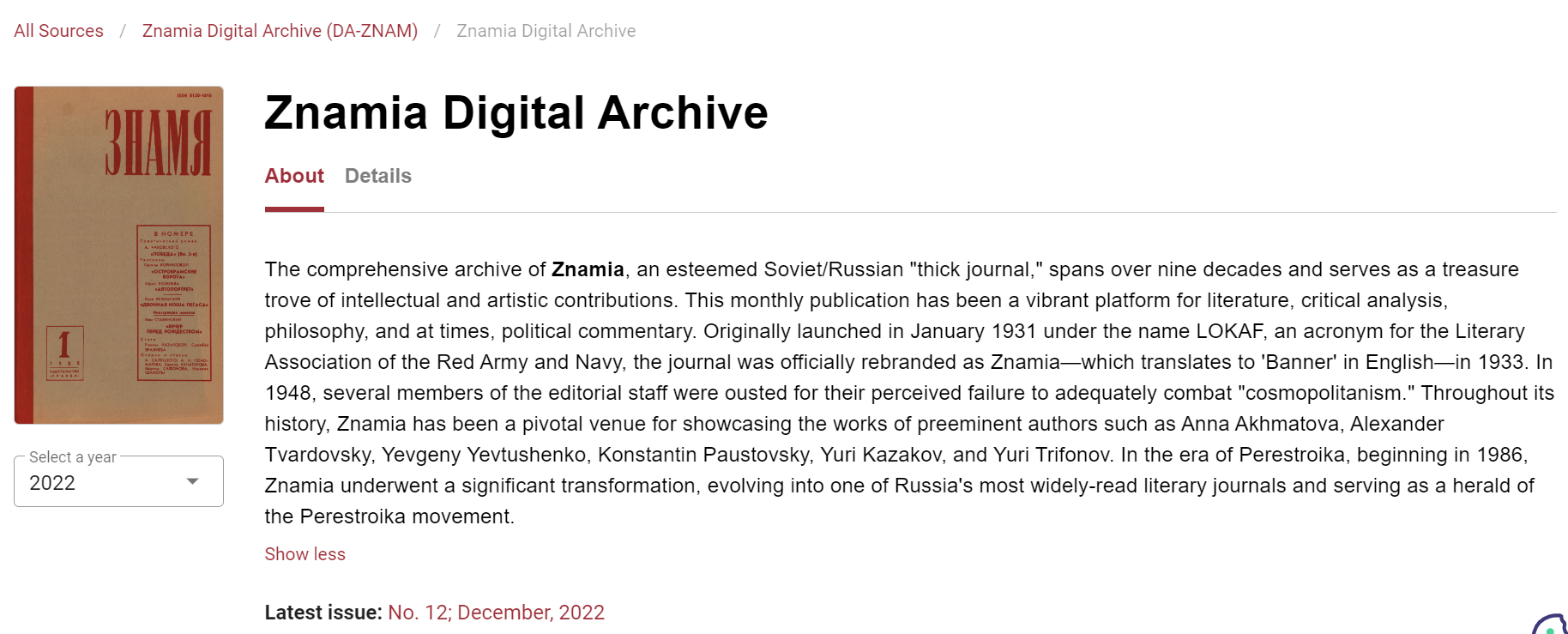
The comprehensive archive of Znamia, an esteemed Soviet/Russian "thick journal," spans over nine decades and serves as a treasure trove of intellectual and artistic contributions. This monthly publication has been a vibrant platform for literature, critical analysis, philosophy, and at times, political commentary. Originally launched in January 1931 under the name LOKAF, an acronym for the Literary Association of the Red Army and Navy, the journal was officially rebranded as Znamia—which translates to 'Banner' in English—in 1933. In 1948, several members of the editorial staff were ousted for their perceived failure to adequately combat "cosmopolitanism." Throughout its history, Znamia has been a pivotal venue for showcasing the works of preeminent authors such as Anna Akhmatova, Alexander Tvardovsky, Yevgeny Yevtushenko, Konstantin Paustovsky, Yuri Kazakov, and Yuri Trifonov. In the era of Perestroika, beginning in 1986, Znamia underwent a significant transformation, evolving into one of Russia's most widely-read literary journals and serving as a herald of the Perestroika movement.
a photo of the landing page of Znamia Digital Archive

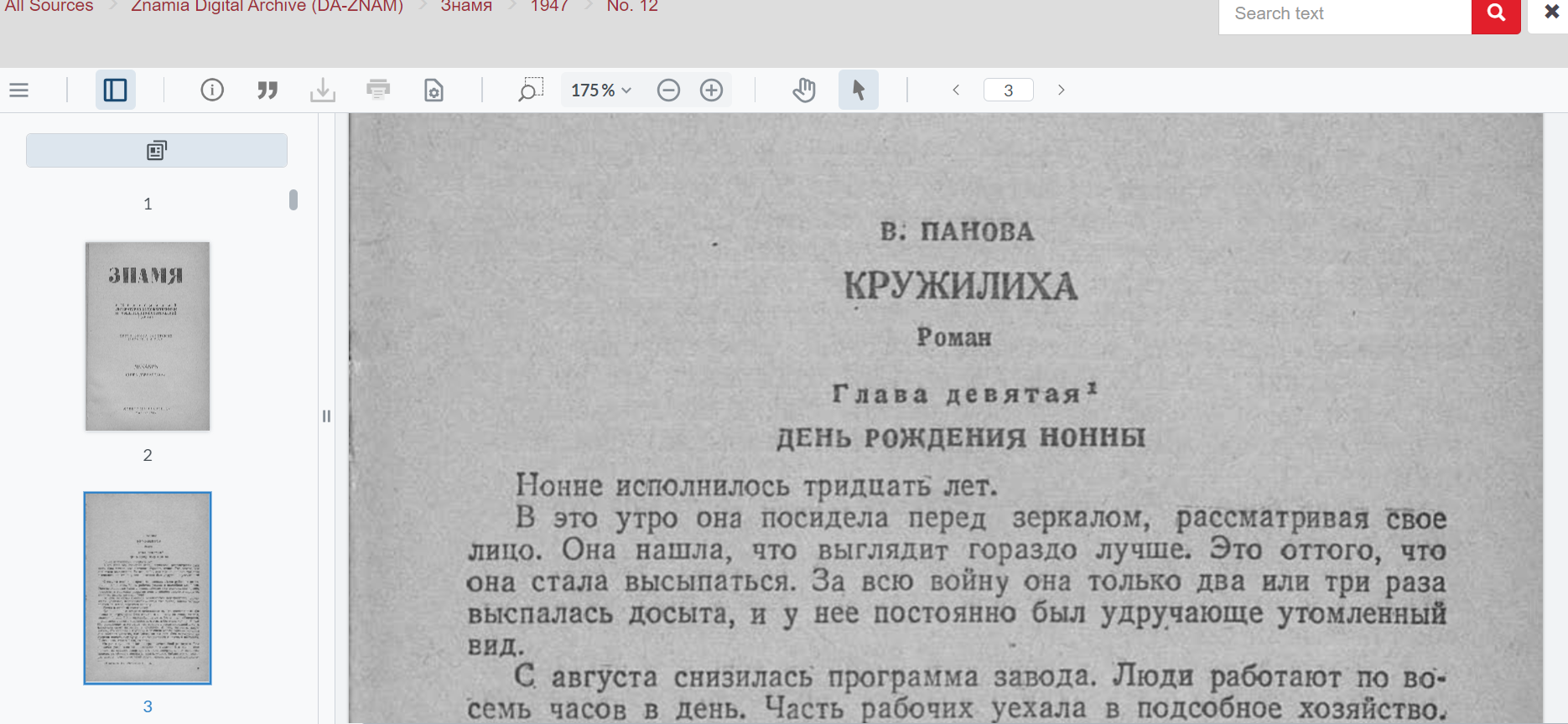
An issue of Znamia for December 1947


Access Link: https://libproxy.berkeley.edu/login?qurl=https%3A%2F%2Fdlib.eastview.com%2Fbrowse%2Fudb%2F6250


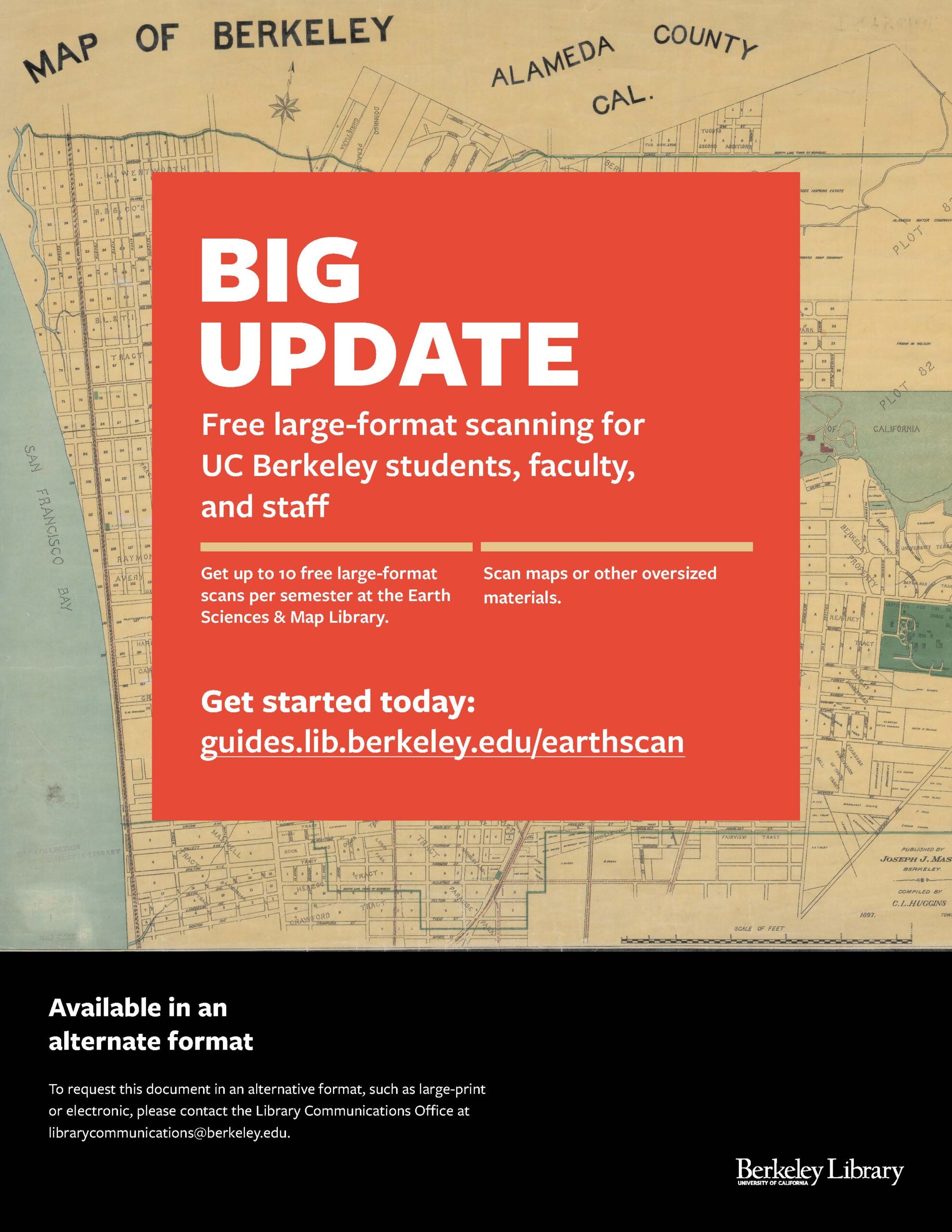
Free large-format scanning for UC Berkeley students, faculty, and staff

Poster advertising large format scanning service. Image in background: Map of Berkeley, California, and Alameda County, circa 1897.Members of the UC Berkeley community can now get up to 10 free large-format scans per semester at the Earth Sciences & Map Library! This can include maps or other large, flat materials. Scans over the free allotment are $10 each. For walk-in patrons not affiliated with the university, the cost is $25 per scan. Get more information about large-format scanning, or visit the library to start your scanning project.

Halloween Picks 2023

Halloween Picks 2023

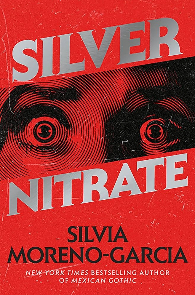
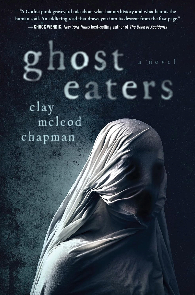
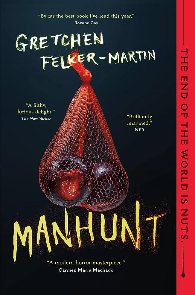
Celebrate this year’s Spooky Season with some of these terrifying and suspenseful titles below. From ghosts to haunted houses and even our own thoughts, check out these books if you’re feeling the Halloween festivities this October.


New Publication from Faculty Julia Bryan-Wilson

Liza Lou
Julia Bryan-Wilson, Doris and Clarence Malo Professor of Modern and Contemporary Art, has a new book out, available at the UC Berkeley Library.

The most comprehensive book on the work of Liza Lou, whose popular and critically acclaimed installations made entirely of beads consider the important themes of women, community, and the valorization of labor.

Liza Lou first gained attention in 1996 when her room-sized sculpture Kitchen was shown at the New Museum in New York. Representing five years of individual labor, this groundbreaking work subverted standards of art by introducing glass beads as a fine art material. The project blurred the rigid boundary between fine art and craft, and established Lou’s long-standing exploration of materiality, process, and beauty. Working within a craft métier has led the artist to work in a variety of socially engaged settings, from community groups in Los Angeles, to a collective she founded in Durban, South Africa. Over the past fifteen years, Lou has focused on a poetic approach to abstraction as a way to highlight the process underlying her work.

In this comprehensive volume that considers the entirety of Lou’s singular vision, curators, art historians, and artists offer important perspectives on the breadth of the work.


“Robert Cox: Sierra Club President 1994-96, 2000-01, and 2007-08, on Environmental Communications and Strategy,” oral history release

New oral history: “Robert Cox: Sierra Club President 1994-96, 2000-01, and 2007-08, on Environmental Communications and Strategy”

Video clip from Robert Cox’s oral history on the Sierra Club’s environmental justice work with Jesus People Against Pollution (JPAP) in 1994

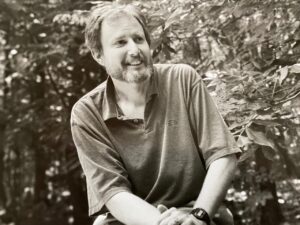
Black and white photograph of Robert Cox wearing a polo-style shirt while standing in front of a wall of leafy bushes
UNC Professor Robert Cox in 1994 upon his first time being elected as president of the national Sierra Club

Robert Cox is a scholar and a gentleman. He also has a fire burning in his belly for protecting nature, confronting injustice, and empowering people, which fueled his long-time leadership in environmental politics, strategy, and influential communication. Robbie Cox served three times as president of the national Sierra Club in 1994-96, 2000-01, and 2007-08. He is Professor Emeritus at the University of North Carolina at Chapel Hill (UNC-CH), and as a scholar of activist rhetoric, Cox helped found the academic field of environmental communication.

Robbie and I recorded nearly eleven hours of his life history over Zoom during five interview sessions in September 2020, during the early months of the COVID-19 pandemic. Robbie’s inspiring stories of environmental activism produced a 253-page transcript, which includes an appendix with several photographs. The stories that Robbie shared in his oral history also emphasized the incredibly high stakes for our present moment of environmental politics, rhetoric, and civic engagement.

Cox was born in September 1945, in Hinton, West Virginia, where his early influences included roaming Appalachian forests and rivers as well as his family’s history of union organizing and work toward social justice. He was recruited to the debate team at the University of Richmond where, from 1963 to 1967, he studied communication, philosophy, history, and religion while also participating in civil rights protests. In 1970, Cox earned his Ph.D. in classical rhetoric studies from the University of Pittsburgh with a dissertation on the rhetorical structures of the Vietnam antiwar movement in which he actively participated. From 1971 to 2010, Cox was a Professor in the Department of Communication at UNC-CH where he helped establish the field of environmental communication and focused his research and teaching on argumentation, rhetorical theory, and social movements. Cox married Professor Julia Wood in 1975 when she also joined the UNC-CH faculty in the Department of Communication.

Video clip from Robert Cox’s oral history on first joining the Sierra Club in 1979

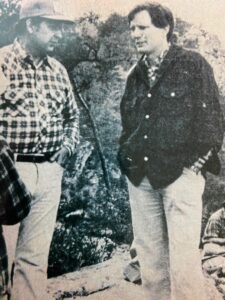
Black and white photograph of Joe Grimsley wearing a flannel shirt and trucker-style baseball hat while talking to a Robbie Cox who is wearing a dark button-up shirt
Robert Cox (right) with North Carolina Secretary of Natural Resources Joe Grimsley (left) discussing what would become the North Carolina Wilderness Act of 1984.

Upon Dr. Wood’s suggestion, Cox joined the Sierra Club in 1979 and, over time, he earned leadership positions at every level in the Club: as chair of the Research Triangle Group, as chair of the North Carolina Chapter, and as an elected member to the national board of directors for most years between 1993 and 2013, including three times as president of the national Sierra Club. Cox made significant contributions to passage in the US Congress of the North Carolina Wilderness Bill, to the Sierra Club’s early engagements in the environmental justice movement, to restructuring both the Club’s internal governance and its volunteer structure, as well as helping lead Sierra Club engagements in national politics, particularly during his times as Club president. In this oral history, Cox discusses all of the above, with a focus on leveraging influential communication and strategy, while also sharing his experiences hiking and trekking in the Himalayas, in the mountains of Europe, and in the Appalachian Mountains.

Robbie Cox’s oral history is significant for detailing the environmental activism and political strategies of one of the most influential volunteers in recent Sierra Club history. Some of the themes throughout Robbie’s oral history include the profoundly democratic nature of the Sierra Club, details on the Club’s geographically diverse grassroots activism, as well as numerous ways that volunteer environmentalists work together to shape state and national legislation. Robbie also reconstructed the ways he balanced his double life as UNC professor with his life as an environmental activist, especially through his work in Sierra Club media campaigns. He recounted his decades as a nationally elected volunteer leader in the Sierra Club, as told through the perspective of an academic scholar of rhetoric and communications. And throughout, Robbie shared stories of direct action for environmental causes at all levels of Sierra Club engagement, from local to national.

Video clip from Robert Cox’s oral history on passing the North Carolina Wilderness Act in 1984

The in-depth, life-history approach used in this oral history reveals ways that Robbie’s personal influences and his engagements in the Sierra Club evolved over time. For instance, Robbie’s family history of labor activism instilled in him the power of people and the importance of social justice. Similarly, his participation on debate teams shaped substantially his education and academic work, while also playing a central role throughout his life as a political and environmental activist. Robbie’s interview also explored the Sierra Club’s and his own personal engagements with environmental justice, including his attendance at the First National People of Color Environmental Justice Leadership Summit in 1991, his leveraging of media in the national Sierra Club’s partnership with “Jesus People Against Pollution” in Mississippi, as well as his experiences on toxic tours of colonias in Matamoro, Mexico, along with other actions against the negative results of neoliberal free trade agreements.

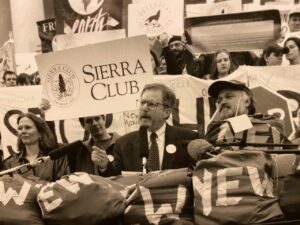
Black and white photograph of Robert Cox wearing a coat and tie and speaking into a microphone while surrounded by environmentalists who hold Sierra Club signs
Robert Cox (center) speaking in November 1995 as Sierra Club president at the US Capitol Building while delivering to House Speaker Newt Gingrich several green bags containing copies of the Environmental Bill of Rights petition signed by more than a million Americans.

Robbie also shared insider details on several significant moments in the Sierra Club’s recent history. He recounted the Club’s severe financial crises in the 1990s that resulted in his work to reorganize the Club’s internal governance through Project Renewal as well as the Club’s volunteer structures via Project ACT. Robbie recounted his central role in the Sierra Club’s efforts to combat the de-regulatory and anti-environmental Congressional agenda in wake of Newt Gingrich’s Republican take-over of Congress in the 1990s, as well as Robbie’s personal role in securing the Sierra Club’s endorsement of Al Gore, for whom Robbie campaigned in 2000. Robbie also detailed the central role he played in the Groundswell Sierra campaign in the early 2000s to resist a take-over of the Sierra Club by anti-immigration and white supremacist forces. And as the world warms and the seas rise, Robbie discussed ways that the Sierra Club has confronted the compounding crises of climate change in the twenty-first century. Robbie’s decades of environmental activism provides a lens on ways the environmental movement has evolved over time from its early focus on wild lands, to concerns about human health, to engagement on issues of environmental justice, to the modern complexities of climate change. Robbie also reflects on the contemporary Sierra Club’s internal and external challenges in its ongoing work for equity, inclusion, and justice.

Video clip from Robert Cox’s oral history on delivering to Congress the Environmental Bill of Rights with 1.2 million signatures in 1995

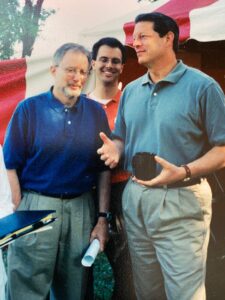
Color photograph of Robert Cox talking with Albert Gore, with both men wearing a collared Polo-style shirt and pleated khaki pants
Robert Cox (left) and US Vice President Al Gore (right) in July 2000 in Grand Rapids, Michigan, delivering the Sierra Club’s public endorsement of Mr. Gore for US President during the 2000 election.

Back in the summer of 2020, when I spoke with Carl Pope, former Sierra Club executive director, to prepare for Robbie’s oral history, Pope recalled Robbie’s exceptional leadership and effectiveness.  When “Professor Cox” first won election to the national Sierra Club board of directors in the 1990s, Pope described Robbie’s presence as “immediately noticeable.” Pope told me how Robbie used his expertise in rhetoric to unify people and advance proposals for environmental action. “You could see Robbie work at a board meeting,” Pope remembered. “When he wanted to get the board to agree, he would offer some initial proposal tentatively, then let folks respond to it and let the room talk. Then he’d come back in and make the same proposal, but he changed two words to see if that worked. He’d keep playing with the proposal and make changes rhetorically, until he got something that would work for everyone.” The Sierra Club’s board of directors come increasingly from a variety of backgrounds across the United States. All directors are volunteers, not employed staff, but like much of the Sierra Club staff, many Club directors consider themselves to be full-time environmental activists. As Carl Pope noted, however, most Sierra Club directors “are not professional communicators. People would talk past each other. Robbie’s skill on the board lubricated that process, which was phenomenally helpful. If anyone wanted to get something done, you asked Robbie.” Indeed, Robbie Cox got things done.

Pope also described Robbie as a kind of environmental philosopher. “He wasn’t ideological,” Pope explained, “but surely, he had his own vision of where the Club should go.” Now, with this publication of Robbie Cox’s oral history, you too can have him tell you in his own words about his visions for the Sierra Club and the ways he mobilized constituencies to make a reality of his visions for environmental protection, political power, and justice.

ABOUT THE ORAL HISTORY CENTER

The Oral History Center of The Bancroft Library preserves voices of people from all walks of life, with varying political perspectives, national origins, and ethnic backgrounds. We are committed to open access and our oral histories and interpretive materials are available online at no cost to scholars and the public. You can find our oral histories from the search feature on our home page. Search by name, keyword, and several other criteria. Sign up for our monthly newsletter  featuring think pieces, new releases, podcasts, Q&As, and everything oral history. Access the most recent articles from our home page or go straight to our blog home.

Please consider making a tax-deductible donation to the Oral History Center if you’d like to see more work like this conducted and made freely available online. While we receive modest institutional support, we are a predominantly self-funded research unit of The Bancroft Library. We must raise the funds to cover the cost of all the work we do, including each oral history. You can give online, or contact us at ohc@berkeley.edu for more information about our funding needs for present and future projects.