SIGLA (States and Institutions of Governance in Latin America, www.sigladata.org) is a multilingual digital database that freely provides information on legal and political institutions in Latin America. The beta version of SIGLA offers data on national-level institutions in Brazil, Colombia, and Mexico, as well as on international institutions. Ultimately, SIGLA will provide cross-nationally comparable, current and historical, qualitative and quantitative data on over 50 legal and political institutions in 20 Latin American countries in English, Spanish, and Portuguese.
Uncategorized
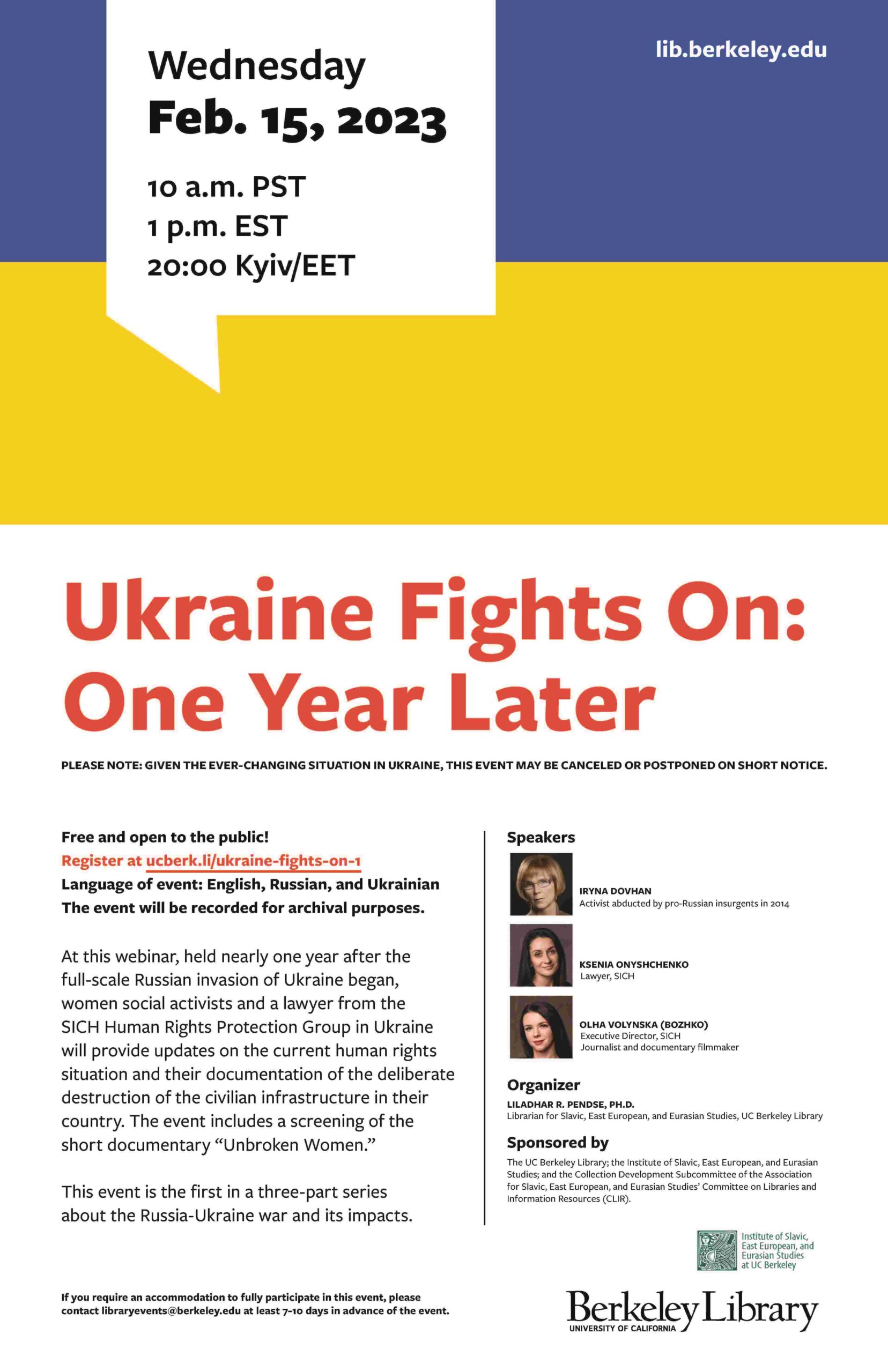
Webinar on February 15: Ukraine Fights On: One Year Later! Episode no. 1
Note: Given the ever-changing situation in Ukraine, this event may be canceled or postponed on short notice.
At this webinar, held nearly one year after the full-scale Russian invasion of Ukraine began, women social activists and a lawyer from the SICH Human Rights Protection Group in Ukraine will provide updates on the current human rights situation and their documentation of the deliberate destruction of the civilian infrastructure in their country. The event includes a screening of the short documentary “Unbroken Women.” This event is the first in a three-part series about the Russia-Ukraine war and its impacts.
The event will be recorded for archival purposes.

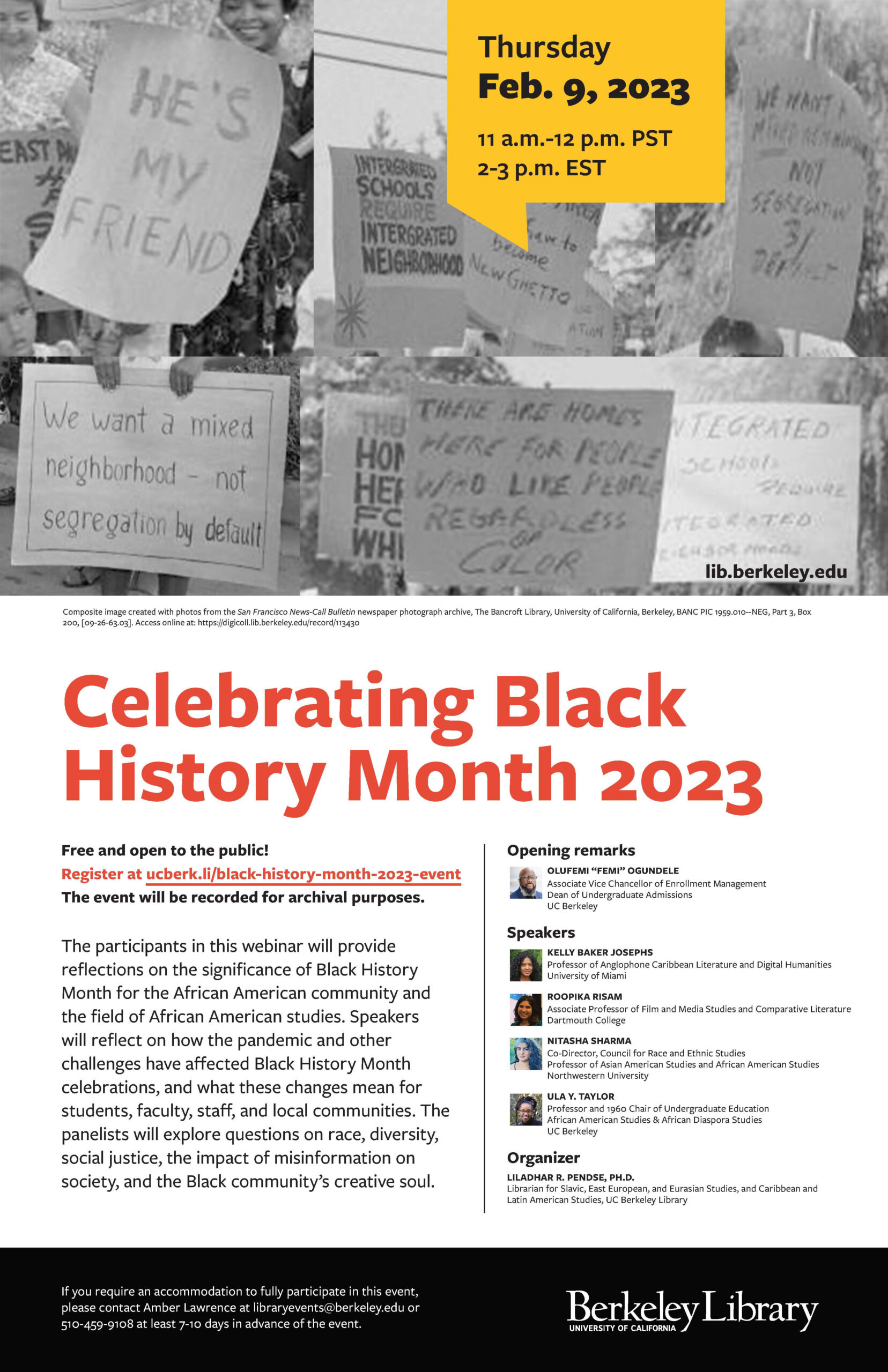
Black History Month Celebration at UC Berkeley Library on Thursday, February 9, 2022 (11 am to noon PST)
Date: February 9th, 2022
Day: Thursday
Time: 11 am to 12 noon PST
Please register here: http://ucberk.li/black-history-month-2023-event
Opening Remarks:
Associate Vice Chancellor of Enrollment Management
Dean of Undergraduate Admissions
Confirmed Speakers:
Professor & 1960 Chair of Undergraduate Education
African American Studies and African Diaspora Studies, UC Berkeley
—
Director, Asian American Studies Program; Co-Director, Council for Race and Ethnic Studies
Professor of Asian American Studies and African American Studies at Northwestern University
Associate Editor, American Quarterly
—
Professor Roopika Risam
Associate Professor of Film and Media Studies and Comparative Literature at Dartmouth College, where she is part of the Digital Humanities and Social Engagement Cluster.
—
Professor Kelly Baker Josephs
Anglophone Caribbean Literature and Digital Humanities, Department of English, University of Miami
Both Professors Risam and Josephs will speak about the Digital Black Atlantic project.

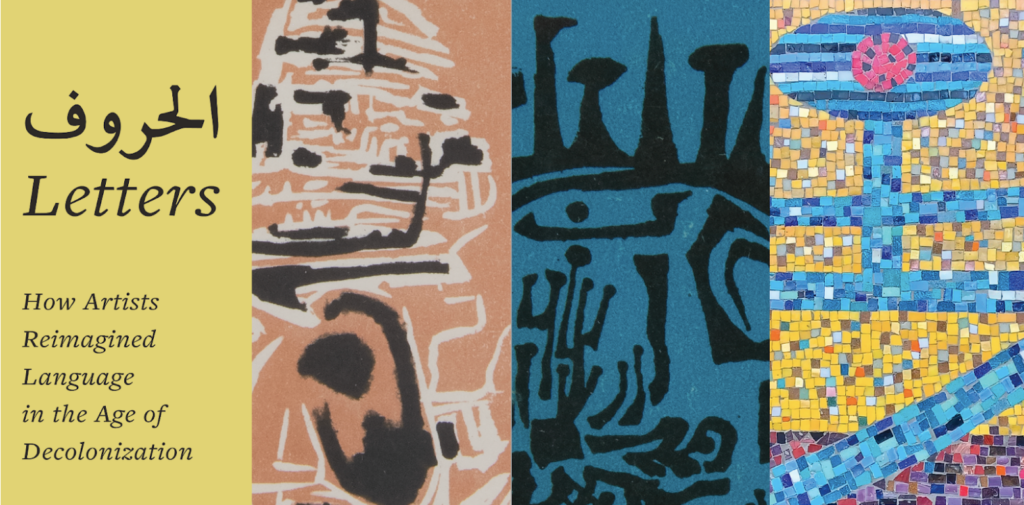
Exhibit: Letters | الحروف How Artists Reimagined Language in the Age of Decolonization
Letters | الحروف How Artists Reimagined Language in the Age of Decolonization

Left to right: art by Mohammed Khadda, Ibrahim El-Salahi, and Bedri Rahmi Eyüboğlu (details)
Letters | الحروف How Artists Reimagined Language in the Age of Decolonization is on exhibit in Doe Library’s Bernice Layne Brown Gallery from March 13 until Aug. 31, 2023. How have modern artists in North Africa, the Middle East, and South Asia made use of their inheritance of a visual cache of Arabic signs and letter-forms, and with what meanings? This exhibition, curated by students in the seminar History of Art 192Cu, “Exhibiting Calligraphic Modernism,” in collaboration with the Library, explores work by dozens of artists in multiple media, from poster design to painting, mosaic, poetry, and animation. A shared backdrop to the artwork on display are the decolonization processes and liberation struggles taking place across Asia, Africa, and Latin America in the 1950s, 1960s, and 1970s, which sparked desires to create cultural futures in resistance to dominant imperial values and official language policies.
Exhibit Curators: Drew Atkins, Riana Azevedo, Lynn Cunningham, Sharan Dulai, Eva Elfishawy, Mohamed Hamed, Teddi Haynes, Murtaza Hiraj, Viv Kammerer, Shanti Knutzen, Marissa Lee, Anneka Lenssen, Val Machado, Jasmine Nadal-Chung, Reyansh Sathishkumar, A. Wara, Alice Xie, Jinyu Xu, Suri Zheng, and Hayley Zupancic
Exhibit dates: March 13 to Aug. 31, 2023
Location: Bernice Layne Brown Gallery, Doe Library
Opening reception
Wednesday, March 15, 2023, 5-6:30 p.m.
Morrison Library
The reception will feature brief remarks by members of the curatorial team. Tours of the exhibition will be led by student-curators beginning at 5:45 p.m. Food and drinks will be served.
A pre-reception event will take place from 2:30-4:30 p.m. in 308A Doe Library, and will include a presentation and Arabic calligraphy workshop by the Bay Area-based calligrapher Zubair Simab. Participants will have an opportunity to try writing Arabic letters with a prepared pen and ink. There are 40 slots available for the workshop. Please register here: http://ucblib.link/calligraphyRSVP.
Both of these events are open to the public.
Details:
Wednesday, March 15, 2023
Pre-reception calligraphy workshop
2:30-4:30 p.m.
308A Doe Library
Register: http://ucblib.link/calligraphyRSVP
Exhibit reception and tours
5-6:30 p.m.
Morrison Library (101 Doe Library)
If you require an accommodation to fully participate in this event, please contact Amber Lawrence at libraryevents@berkeley.edu or 510-459-9108 at least 7-10 days in advance of the program.
Sponsors/contributors: Center for Middle East Studies, Department of History of Art, and UC Berkeley Library
Post-Perestroika Newspapers accessible for the CRL Members
The Post-Perestroika Newspapers collection traces the evolution of post-Soviet Russia, with coverage from 1990 to 2016. Established soon before or soon after the collapse of the Soviet Union, the newspapers in this collection document the changes taking place in Russia, some with breathtaking speed, all the while embracing innovative journalistic methods and standards that were a far cry from the journalism of the Soviet period. These newspapers, some of which had a relatively short lifespan, nevertheless provide essential and critical insight into the events and personalities that defined post-Soviet Russian politics and history (Source:https://gpa.eastview.com/crl/ppn/).
To access these newspapers, please authenticate using the VPN or proxy from an off-campus location.
Trial of Brill’s Revolución y Cultura, 1961–2003 (ending February 21, 2023)
Revolución y Cultura, 1961–2003(Cuba)
Please access the trial through February 21, 2023, here
At UC Berkeley Library, we have several individual issues of Revolución y Cultura, however, Brill has produced a complete digitized archive of it that is searchable. We have set up a trial of this resource through February 21, 2023. We look forward to hearing your comments regarding the utility of this resource in your teaching and research. Please feel free to contact your librarian for the Caribbean and Latin American Studies here.

About:
Revolución y Cultura is a fundamental and often unique resource for the study of more than half a century of Cuban culture. Founded as a biweekly in 1961 under the title Pueblo y Cultura and continued in 1965 as the bilingual magazine Revolution et/and Culture and as RC in 1967, Revolución y Cultura has published uninterruptedly since March 1972. From its foundation until 1977, when the Cuban Ministry of Culture was created, it appeared as the official organ of Cuba’s National Council of Culture.
From 2004 to 2019 it was published both in print and electronically. Since mid-2019, Revolución y Cultura is published online only. Revolución y Cultura is listed in the UNESCO Portal of Culture of Latin America and the Caribbean (Source: Brill)
Tepoztlán Institute 2023: fugitivity, marronage, abolition
TEPOZTLÁN, MORELOS, MÉXICO | July 19 – 26, 2023
Call for participants
DEADLINE TO APPLY: JANUARY 15, 2023Systems of colonization, of exploitation, of citizenship, and of exclusivity produce responses that can be coded as fugitivity and marronage. Those practices of alterity and freedom seek to elude force and violence, but they also invite new forms of placemaking and inclusivity. Abolition – of policing, of carcerality, of national borders, of hierarchical or privileged forms of citizenship – challenges the entrenched forms of the state and opens possibilities for other imaginaries. The Tepoztlán Institute, in its eighteenth year, asks participants to reflect on fugitivity, marronage, and abolition in their many forms in the past, present, and future. How have these practices of freedom been imagined, lived, contested, extended, and reinvented, from the colonial period to the present, across the Americas?
There is a long history of fugitivity and marronage across the Americas. The first maroons in the Americas were Indigenous people fleeing from encomiendas, slavery, and related forms of violence and subjugation in early colonial Hispaniola, and Indigenous practices of flight and assertions of autonomy continued throughout the colonial and national periods. From the quilombos of Brazil and the palenques of Colombia, Panama, Mexico, Peru, and the Spanish-speaking Caribbean, to the maroon societies of Jamaica, Suriname, and the United States, enslaved Africans also engaged strategically in fugitivity and marronage. Though these movements are often siloed, they are not separate: the history of fugitivity and marronage is also one of relationality among Black and Indigenous peoples. Contemporary Black, Indigenous, Latinx, feminist, and queer organizing against state violence and policing and for aesthetic, social, political, and territorial self-determination across the Americas brings these concepts into the present in palpable ways. Fugitivity and marronage have also been central to envisioning past, present, and future liberation.
Like fugitivity and marronage, abolition goes beyond the dismantling of oppressive institutions—it is also the building of autonomy and alternatives that render those oppressive institutions obsolete. In recent years, varied movements and sequences of struggle have forced the politics of abolition into the political mainstream. Many activists, critics, and scholars have framed the abolition of prisons, police, borders, citizenship, and other oppressive institutions as an extension of the struggle that led to the uneven abolition of slavery in the nineteenth century across the Americas. Others have drawn from the long history of fugitivity and marronage to consider the possibilities of escape from and resistance to systems of domination and extraction under racial capitalism, indigenous dispossession, and anti-Black racism. Abolition is one of several important concepts that have been employed within the Americas to imagine different forms of liberation. Taken together, fugitivity, marronage, abolition, and related ideas draw our attention to heterogeneous politics and practices by which another world is built out of and within the ruins of the present.
We invite reflections that address the concepts of, and links between, fugitivity, marronage, and abolition across disciplines, regions, communities, and temporalities. We foresee conversations across scholarly approaches that come from Indigenous studies, Black studies, slavery studies, Latinx studies, and borderlands studies, as well as queer theory and feminisms. Questions may include: Are fugitivity and marronage still applicable to our contemporary moment, or have new concepts supplanted them? What are the limits of bringing the idea of abolition to bear on the present? What is to be left behind or abolished, and what can be saved or repurposed? How have historical and cultural actors navigated the tensions between strategies of fugitivity or escape on the one hand, and inclusion or recognition on the other? How do the concepts of fugitivity, marronage, and abolition help us challenge or reimagine inherited notions of resistance, freedom, liberation, and so on? How can cultural production and representations of Black, Indigenous, and Latinx relationality in studies of fugitivity, marronage, and abolition escape the constrictions of disciplinary knowledge formation? What kinds of cultural production, speculative thought, and activism do fugitivity, marronage, and abolition enable and indeed require? How might movements benefit from more extensive cross-hemispheric dialogue about these issues?
Scholars, activists, and artists may address any historical period, and approaches may draw from a wide range of fields, including but not limited to, history, literature, cultural studies, media studies, art, art history, philosophy, race and ethnic studies, anthropology, and gender and sexuality studies.
IN ADDITION TO THE themes ABOVE, OTHER POTENTIAL THEMES MIGHT include:
● Indigenous, Black, and Latinx coalitions
● Indigenous and Black politics, autonomy, sovereignty, flight, refusal, and recognition.
● Incarceration and decarceration
● Abolitionist feminism
● Migration, detention, and deportation.
● Border abolition
● Asylum and sanctuary
● Fugitivity and patriarchy
● Anarchist theories and practices
● Capture and flight in/from the archives
● Law and legal history
● Queer marronage
● Marronage and sovereignty
● Abolition practices
● Abolitionist geographies
● Speculation/imagination as abolitionist practice
● The politics of policing and police abolition
● Infrastructures for abolitionist practice
● Fugitive thought/science/epistemologies
● Slavery and primitive accumulation
● Marronage and illicit, alternative, and informal economies
● Autonomy and autonomous practices
● Ecological and territorial struggles
The deadline for applications is January 15, 2023. For more information, please consult our website (www.tepoztlaninstitute.org) or write to us at tepoinstitute@gmail.com.
OHC Staff Top Moments of 2022
As another year draws to an end, the OHC team looks back on an eventful year. Here are some of top moments from 2022.
In June 2022, I helped plan and lead a session about university-community relations in the “Race and Power in Oral History Theory and Methodology” Symposium, of which the Oral History Center was a co-sponsor. This symposium was a great opportunity to hear from oral history practitioners from many fields as we move toward best practices for culturally responsive and anti-racist oral history. I was grateful to be a part of this work!
Also in June, I had the opportunity to co-interview D.C.-based artist Sylvia Snowden for the Getty Research Institute’s African American Art History Initiative. Being so close to some of Snowden’s large-scale, textured, and vibrantly-colored pieces was truly a highlight of my year.
I was also very pleased this year to partner with Shanna Farrell to produce a podcast called “Fifty Years of Save Mount Diablo,” based on our oral histories about Save Mount Diablo, an East Bay land conservation organization. Learn more here about this three-part podcast series on the OHC feed The Berkeley Remix.
-Amanda Tewes, Interviewer/Historian
The Oral History Center relies on a talented team of student editors and I’d like to use this opportunity to highlight their contributions. A big thank you to editors Mollie Appel-Turner, William Cooke, Adam Hagen, Shannon White, and Timothy Yue, and researcher/editor Serena Ingalls. The student editors serve critical functions in our oral history production, analyzing entire transcripts to write discursive tables of contents, entering interviewee comments, editing front matter, and writing abstracts. They do the work of professional editors and we would not be able to keep up our pace of interviews without them. Serena also conducts research for our social media outreach, maintains our editorial calendar, and suggests ideas for articles based on historical events. The student team has also helped me evaluate our process, training, and documentation, and provided invaluable suggestions in our department’s quest for continuous improvement. Excellent writers in their own right, the student employees also research and write articles featuring themes in our archive, which this year included Cal Athletics, the Cold War, urban development, and women in politics. These articles have enabled us to better share the wealth of our collection with scholars and the public. Please keep an eye out for their work in future editions of the newsletter.
–Jill Schlessinger, Communications Director/Managing Editor
2022 proved to be another exciting year at the Oral History Center. In April, we released the Chicana/o Studies Oral History Project. I started this project in 2017 with the aim of documenting the history and formation of Chicana/o Studies through in-depth interviews with the first generation of scholars who shaped it. Thanks to the generous support of universities throughout California and the West, the collection includes over a hundred hours of oral histories with the most prominent scholars in the field. You can read the project’s release article here.
Our work with State Archives on the California State Government Oral History Program also proceeded apace. In October, we celebrated the careers of Senators Loni Hancock, Lois Wolk, and Fran Pavley in an online an online event hosted by Secretary of State Shirley Weber, and publicly released their oral histories. I also had the amazing opportunity to conduct the oral history Bill Lockyer, documenting a forty-six-year career in California politics that included offices such as Senate Pro Tem, Attorney General, and State Treasurer.
Last year, we released the oral history of famed Yale Political Scientist James C. Scott, as well as affiliates of his Yale Agrarian Studies Program. I am thrilled to announce that this year we finished work on the OHC’s first, full-length documentary film featuring the life and career of James Scott. You can watch the film’s trailer here. The documentary will be released in Spring 2023.
Here’s to an even more eventful and exciting 2023!
-Todd Holmes, Interviewer/Historian
This has been a big year for me, both professionally and personally. I had the privilege of helping organize a “Race and Power in Oral History Theory and Methodology” Symposium, of which the Oral History Center was a co-sponsor. After months of planning, our committee brought together scholars and oral history practioners from around the country for three days of thoughtful, reflective, and inspiring conversation. I had the opportunity to interview people for several projects, including for the Japanese American Intergenerational Narratives, Anchor Brewing Company, the Getty Research Institute, the East Bay Regional Park District, and Save Mount Diablo. I co-producted a podcast celebrating the 50th anniversary of environmental conservation organization Save Mount Diablo with Amanda Tewes. I also became a mother, giving me a new perspective that I will bring to discussions of family and motherhood in my interviews. As ever, I grateful to be able to do this work, ask questions, and connect with the larger oral history community.
-Shanna Farrell, Interviewer/Historian
Three series of interviews in 2022 were especially memorable for me. First, fellow oral historians Shanna Farrell, Amanda Tewes, and I had the privilege to record over one hundred total hours of interviews with numerous narrators for the OHC’s new Japanese American Intergenerational Narratives (JAIN) oral history project. The JAIN project explores, preserves, and shares family narratives and traumatic legacies of the US government’s unjust confinement of Japanese Americans during World War II through oral histories with descendants of those who survived the race-based prison camps. The stories these narrators shared with us about the intersection of their family histories and their own experiences as Americans were both powerful and deeply personal.
Oral histories with three exceptional women—all exceptionally wise, accomplished, and active in environmental issues—were also among my most memorable moments from 2022. Doris Sloan helped stop a nuclear power plant from being built atop the San Andreas fault at Bodega Head and Harbor in the early 1960s, which later helped inspire her to return to school in her forties and earn an MS and PhD in geology and paleontology from UC Berkeley. Carolyn Merchant became a Distinguished Professor of Environmental History, Philosophy, and Ethics at UC Berkeley, where her research and writings over the past half century significantly influenced the fields of the History of Science, Women’s Studies, and Environmental History. And last summer, Mary Nichols and I finished recording an extensive 26-hour oral history of her life and storied career as an environmental lawyer and public servant, including her appointment as chair of the California Air Resources Board from 1979-1983 and again from 2007-2020, where she implemented vanguard regulations to make California a world leader in improving air quality and reducing emissions that cause climate change.
A third set of memorable interviews for me in 2022 was expanding the OHC’s long standing Sierra Club Oral History Project to record new climate and justice-focused narratives with three activists and organizers—Rhonda Anderson in Detroit, Verena Owen in Chicago, and Bruce Nilles in Oakland—all of whom worked on the Sierra Club’s transformational Beyond Coal campaign. Since its grassroots origins two decades ago, the Beyond Coal campaign stopped more than 200 new coal plants from being built across the United States and secured retirement of two-thirds of the nation’s existing coal plants. This work prevented untold tons of carbon emissions and other toxic pollution from poisoning our air, land, and water, and in doing so, it prevented tens of thousands of premature deaths in communities living near coal plants, often disinvested communities of color. In addition to its commitment to racial justice and grassroots power-building, the coal campaign supported a robust economic transition for coal communities at the state and national level, and it helped midwife our new era of clean energy solutions to further combat climate change.
Throughout 2022 and into this new year, it has been and remains my great honor at the Oral History Center to continue conducting inspired and intriguing interviews with such incredible narrators. I wish you and yours much love, peace, and power at the end of this year and throughout the next.
-Roger Eardley-Pryor, Interviewer/Historian
La Lune et L’Éclipse

Eight days after the fnal issue of La Lune was published, Polo launched the weekly L’Eclipse to replace it which long outlasted the Prussian siege of Paris in 1870-1871 and into the beginning of the Third Republic. While still harassed by government censors, the inexpensive four-page weekly magazine with signature colorful wood engravings on the cover resisted and circulated freely.
Both of the originals can be viewed in print in The Bancroft Library or online through the Bibliothèque nationale de France’s digital platform Gallica.

PhiloBiblon 2022, n. 5 (diciembre): La traducción española de De civitate Dei, un nuevo manuscrito
Nos es muy grato proporcionar nuestro consabido aguinaldo de Navidad para el deleite de nuestros colegas y amigos.
Parece mentira que a estas alturas aún queden manuscritos de primerísima importancia para la literatura medieval española cuya existencia se nos ha escapado no sólo al equipo de PhiloBiblon, sino a toda la comunidad de investigadores. Pero tal es el caso que vamos a tratar en este post: dar a conocer un nuevo manuscrito (en realidad, tres, como se verá más adelante) de la traducción de De civitate Dei de San Agustín, atribuida a Gómez García del Castillo (BETA texid 1531).
Hasta el momento actual se conocían dos manuscritos de esta traducción, ambos conservados en la Biblioteca de El Escorial, esc. A-I-8 (BETA manid 1824) y esc. A-I-9 (BETA manid 1823). El primero contiene los libros 8-17; el segundo, los libros 18-22. Faltaba, por lo tanto el comienzo de la obra. El colofón del códice esc. A-I-9 explica las circunstancias de su confección:
Este libro que se llama la segunda parte de la çibdat de | dios. El qual fizo e ordeno el muy glorioso dotor señor | sant agustin. escriujo para la muy esclaresçida señora Reyna | doña maria fija del muy esclaresçido Rey don ferrãdo de Aragon que aya santa gloria E muger que agora es del | muy exçelente e muy virtuoso señor don iohan Rey de | Castilla e de leon. gomes garçiª del Castillo criado de la | dicha señora Reyna por su Ruego e mandado. E aca|boso [!] de escreujr enla villa de valladolid A xxvij dias del mes de abril del año de j Vcccc.º xxx iiijº Años.

Es evidente que Gómez García del Castillo es el copista, pero queda la duda de sí también fue el traductor del texto, basado en una versión catalana que, a su vez, depende del texto y comentario en francés a cargo del gran humanista galo Raoul de Presles (1316-1382), autor, entre otras destacadas obras, de la traducción al francés de la Biblia.
Debemos a uno de los miembros de BETA, Óscar Perea Rodríguez, la noticia de la existencia de tres nuevas fuentes de la citada traducción de García del Castillo hasta ahora desconocidas para la amplia mayoría de la comunidad académica. Se trata de los manuscritos X.430.2 (lib. 1-9; BETA manid 6371), X.430.1 (lib. 10-17; (BETA manid 6370) y X.430.3 (lib. 18-22; (BETA manid 6369) conservados en el Metropolitan Museum de Nueva York, los cuales, en conjunto, contienen todo el texto de los 22 libros de La ciudad de Dios. Por lo tanto, el primer gran avance que nos proporciona este descubrimiento es que por primera vez podremos examinar el contenido de los libros 1-7, ausente en los dos códices escurialenses conocidos hasta ahora.
Como indica el escudo de armas que figura al inicio del ms. X.430.1 (un castillo con tres torres de oro y azur sobre fondo de gules, coronado con un capelo episcopal), los tres manuscritos se copiaron para Alfonso Carrillo de Acuña, arzobispo de Toledo (1446-1482).


Bosch, Lynette M.F. (1990), “Una atribución nueva a Cano de Aranda, miniaturista toledano”, Archivo Español de Arte, 63 (n. 249), págs. 69-79.