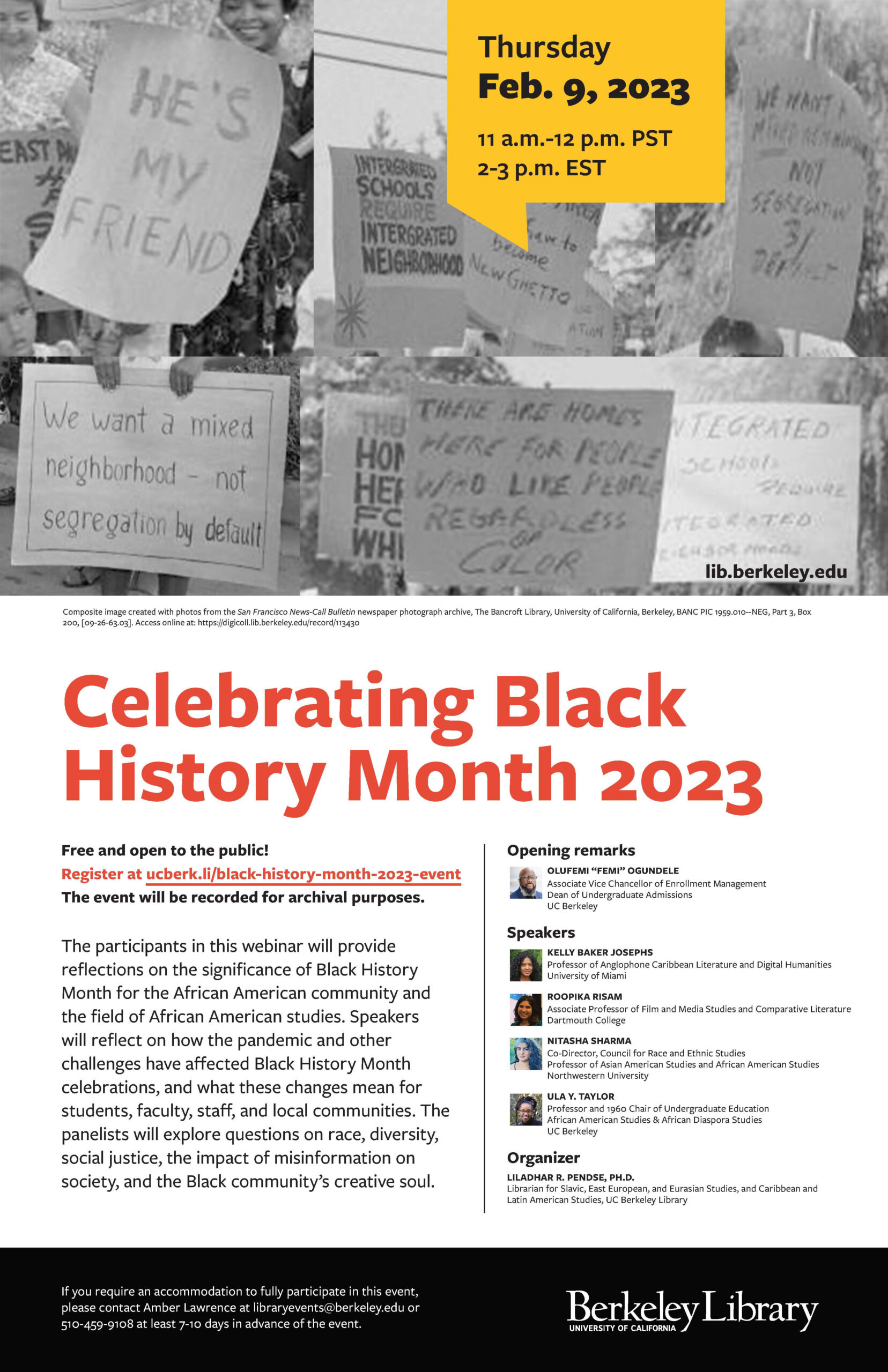
Black History Month Celebration at UC Berkeley Library on Thursday, February 9, 2022 (11 am to noon PST)

Date: February 9th, 2022 

Day: Thursday

Time: 11 am to 12 noon PST

Please register here: http://ucberk.li/black-history-month-2023-event

Opening Remarks:

Olufemi “Femi” Ogundele

Associate Vice Chancellor of Enrollment Management

Dean of Undergraduate Admissions

Confirmed Speakers:

Professor Ula Y. Taylor 

Professor & 1960 Chair of Undergraduate Education

African American Studies and African Diaspora Studies, UC Berkeley

—

Professor Nitasha Sharma

Director, Asian American Studies Program; Co-Director, Council for Race and Ethnic Studies

Professor of Asian American Studies and African American Studies at Northwestern University

Associate Editor, American Quarterly

—

Professor Roopika Risam

Associate Professor of Film and Media Studies and Comparative Literature at Dartmouth College, where she is part of the Digital Humanities and Social Engagement Cluster.

—

Professor Kelly Baker Josephs

Anglophone Caribbean Literature and Digital Humanities, Department of English, University of Miami

Both Professors Risam and Josephs will speak about the Digital Black Atlantic project.


Exhibit: Letters | الحروف How Artists Reimagined Language in the Age of Decolonization
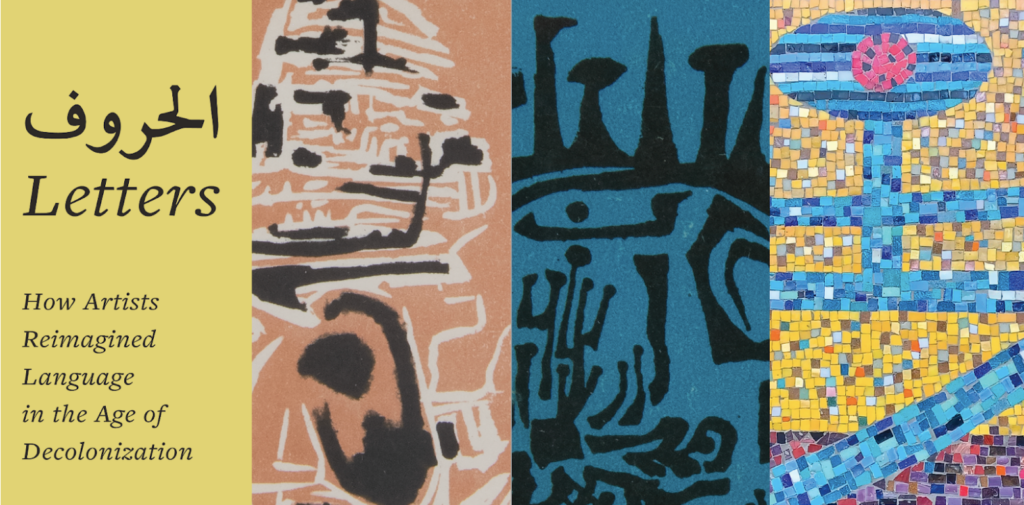
Letters | الحروف How Artists Reimagined Language in the Age of Decolonization

Letters exhibit

Left to right: art by Mohammed Khadda, Ibrahim El-Salahi, and Bedri Rahmi Eyüboğlu (details)

Letters | الحروف How Artists Reimagined Language in the Age of Decolonization is on exhibit in Doe Library’s Bernice Layne Brown Gallery from March 13 until Aug. 31, 2023. How have modern artists in North Africa, the Middle East, and South Asia made use of their inheritance of a visual cache of Arabic signs and letter-forms, and with what meanings? This exhibition, curated by students in the seminar History of Art 192Cu, “Exhibiting Calligraphic Modernism,” in collaboration with the Library, explores work by dozens of artists in multiple media, from poster design to painting, mosaic, poetry, and animation. A shared backdrop to the artwork on display are the decolonization processes and liberation struggles taking place across Asia, Africa, and Latin America in the 1950s, 1960s, and 1970s, which sparked desires to create cultural futures in resistance to dominant imperial values and official language policies.

Exhibit Curators: Drew Atkins, Riana Azevedo, Lynn Cunningham, Sharan Dulai, Eva Elfishawy, Mohamed Hamed, Teddi Haynes, Murtaza Hiraj, Viv Kammerer, Shanti Knutzen, Marissa Lee, Anneka Lenssen, Val Machado, Jasmine Nadal-Chung, Reyansh Sathishkumar, A. Wara, Alice Xie, Jinyu Xu, Suri Zheng, and Hayley Zupancic

Exhibit dates: March 13 to Aug. 31, 2023
Location: Bernice Layne Brown Gallery, Doe Library

Opening reception

Wednesday, March 15, 2023, 5-6:30 p.m.
Morrison Library

The reception will feature brief remarks by members of the curatorial team. Tours of the exhibition will be led by student-curators beginning at 5:45 p.m. Food and drinks will be served.

A pre-reception event will take place from 2:30-4:30 p.m. in 308A Doe Library, and will include a presentation and Arabic calligraphy workshop by the Bay Area-based calligrapher Zubair Simab. Participants will have an opportunity to try writing Arabic letters with a prepared pen and ink. There are 40 slots available for the workshop. Please register here: http://ucblib.link/calligraphyRSVP. 

Both of these events are open to the public.

Details:
Wednesday, March 15, 2023
Pre-reception calligraphy workshop
2:30-4:30 p.m.
308A Doe Library
Register: http://ucblib.link/calligraphyRSVP

Exhibit reception and tours
5-6:30 p.m.
Morrison Library (101 Doe Library)

If you require an accommodation to fully participate in this event, please contact Amber Lawrence at libraryevents@berkeley.edu or 510-459-9108 at least 7-10 days in advance of the program.

Sponsors/contributors: Center for Middle East Studies, Department of History of Art, and UC Berkeley Library

Tepoztlán Institute 2023: fugitivity, marronage, abolition

TEPOZTLÁN, MORELOS, MÉXICO | July 19 – 26, 2023
Call for participants

2023 Application Form
DEADLINE TO APPLY: JANUARY 15, 2023
Systems of colonization, of exploitation, of citizenship, and of exclusivity produce responses that can be coded as fugitivity and marronage. Those practices of alterity and freedom seek to elude force and violence, but they also invite new forms of placemaking and inclusivity. Abolition – of policing, of carcerality, of national borders, of hierarchical or privileged forms of citizenship – challenges the entrenched forms of the state and opens possibilities for other imaginaries. The Tepoztlán Institute, in its eighteenth year, asks participants to reflect on fugitivity, marronage, and abolition in their many forms in the past, present, and future. How have these practices of freedom been imagined, lived, contested, extended, and reinvented, from the colonial period to the present, across the Americas?

There is a long history of fugitivity and marronage across the Americas. The first maroons in the Americas were Indigenous people fleeing from encomiendas, slavery, and related forms of violence and subjugation in early colonial Hispaniola, and Indigenous practices of flight and assertions of autonomy continued throughout the colonial and national periods. From the quilombos of Brazil and the palenques of Colombia, Panama, Mexico, Peru, and the Spanish-speaking Caribbean, to the maroon societies of Jamaica, Suriname, and the United States, enslaved Africans also engaged strategically in fugitivity and marronage. Though these movements are often siloed, they are not separate: the history of fugitivity and marronage is also one of relationality among Black and Indigenous peoples. Contemporary Black, Indigenous, Latinx, feminist, and queer organizing against state violence and policing and for aesthetic, social, political, and territorial self-determination across the Americas brings these concepts into the present in palpable ways. Fugitivity and marronage have also been central to envisioning past, present, and future liberation.

Like fugitivity and marronage, abolition goes beyond the dismantling of oppressive institutions—it is also the building of autonomy and alternatives that render those oppressive institutions obsolete. In recent years, varied movements and sequences of struggle have forced the politics of abolition into the political mainstream. Many activists, critics, and scholars have framed the abolition of prisons, police, borders, citizenship, and other oppressive institutions as an extension of the struggle that led to the uneven  abolition of slavery in the nineteenth century across the Americas. Others have drawn from the long history of fugitivity and marronage to consider the possibilities of escape from and resistance to systems of domination and extraction under racial capitalism, indigenous dispossession, and anti-Black racism. Abolition is one of several important concepts that have been employed within the Americas to imagine different forms of liberation. Taken together, fugitivity, marronage, abolition, and related ideas draw our attention to heterogeneous politics and practices by which another world is built out of and within the ruins of the present.

We invite reflections that address the concepts of, and links between, fugitivity, marronage, and abolition across disciplines, regions, communities, and temporalities. We foresee conversations across scholarly approaches that come from Indigenous studies, Black studies, slavery studies, Latinx studies, and borderlands studies, as well as queer theory and feminisms. Questions may include: Are fugitivity and marronage still applicable to our contemporary moment, or have new concepts supplanted them? What are the limits of bringing the idea of abolition to bear on the present? What is to be left behind or abolished, and what can be saved or repurposed? How have historical and cultural actors navigated the tensions between strategies of fugitivity or escape on the one hand, and inclusion or recognition on the other? How do the concepts of fugitivity, marronage, and abolition help us challenge or reimagine inherited notions of resistance, freedom, liberation, and so on? How can cultural production and representations of Black, Indigenous, and Latinx relationality in studies of fugitivity, marronage, and abolition escape the constrictions of disciplinary knowledge formation? What kinds of cultural production, speculative thought, and activism do fugitivity, marronage, and abolition enable and indeed require? How might movements benefit from more extensive cross-hemispheric dialogue about these issues?
​
Scholars, activists, and artists may address any historical period, and approaches may draw from a wide range of fields, including but not limited to, history, literature, cultural studies, media studies, art, art history, philosophy, race and ethnic studies, anthropology, and gender and sexuality studies.

IN ADDITION TO THE themes ABOVE, OTHER POTENTIAL THEMES MIGHT include:  

●       ​Enslavement and emancipation
​●       Indigenous, Black, and Latinx coalitions
●       Indigenous and Black politics, autonomy, sovereignty, flight, refusal, and recognition.
●       Incarceration and decarceration
●       Abolitionist feminism
●       Migration, detention, and deportation.
●       Border abolition
●       Asylum and sanctuary
●       Fugitivity and patriarchy
●       Anarchist theories and practices
●       Capture and flight in/from the archives
●       Law and legal history
●       Queer marronage
●       Marronage and sovereignty
●       Abolition practices
●       Abolitionist geographies
●       Speculation/imagination as abolitionist practice
●       The politics of policing and police abolition
●       Infrastructures for abolitionist practice
●       Fugitive thought/science/epistemologies
●       Slavery and primitive accumulation
●       Marronage and illicit, alternative, and informal economies
●       Autonomy and autonomous practices
●       Ecological and territorial struggles

The deadline for applications is January 15, 2023. For more information, please consult our website (www.tepoztlaninstitute.org) or write to us at tepoinstitute@gmail.com.
​