Connection, Insight, Inspiration, Truth: Berkeley undergraduates reflect on oral history

“I was just one of thousands of people over the years who have done the little things necessary to create and to pass on personal narratives of the past.” —Mollie Appel-Turner 
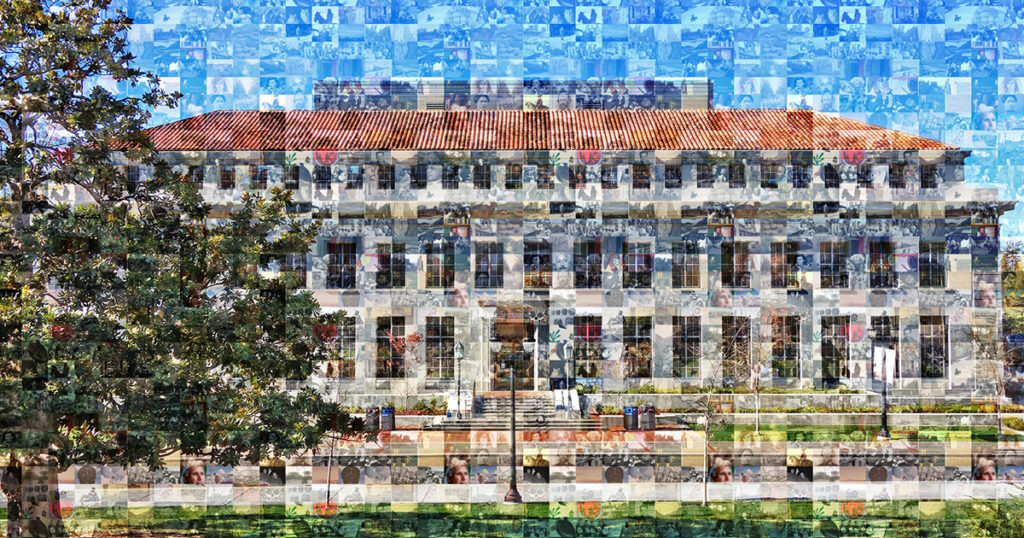
Photo collage where numerous photos that are not individually discernible make up an image of The Bancroft Library, with grass in front and sky above.
Photo collage depicting The Bancroft Library

Introduction: Thoughts on the Production of Oral History and Its Importance

by Serena Ingalls, class of 2023

Like many of my student co-workers at the Oral History Center (OHC), I have recently graduated from UC Berkeley. Graduation from college is a major milestone, and I find myself looking back at all of my different experiences at Cal: classes, clubs, the pandemic, and my job as a student editor and researcher at the Oral History Center. My job in oral history in particular is a point of contemplation, as I’ve spent many hours in this role and it’s a unique experience that only a handful of other students can relate to. I find myself wondering, how has this job impacted me and my view of the world? How has my work in this role contributed to the field of history? 

Before closing the UC Berkeley chapter in our lives and moving on to other post-grad interests, we as the student editors took the time to reflect upon our work at the Oral History Center and what it means to us. We hope that you’ll enjoy stepping into our world as student editors in oral history, just as we have enjoyed the experience of getting to know the many fascinating individuals in our oral history archive. 

Editor’s note: Our team’s student editors serve critical functions in our oral history production, analyzing entire transcripts to write discursive tables of contents, entering interviewee comments, editing front matter, writing abstracts, and more. They do the work of professional editors and we would not be able to keep up our pace of interviews without them.  

Mollie Appel-Turner: Oral History and Connection
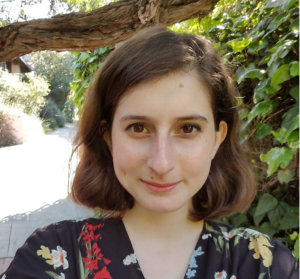
Mollie Appel-Turner - portrait
Mollie Appel-Turner

Working for the Oral History Center of The Bancroft Library while pursuing a history degree was both deeply rewarding and extremely unfamiliar. My area of interest when it comes to history has always been western medieval Europe. While there are plenty of sources from the era where people recount their life experiences, I always had an awareness of the massive separation—temporal, cultural, and physical—between myself and the speaker. At the Oral History Center, I was keenly aware that the work that I was doing on oral histories was with the ultimate goal of preserving knowledge for future generations. But for the time being, that gulf I was used to, which to me practically defined the work I did as history, was simply not present. In my time outside of work, I also spent a fair chunk of time reading people’s personal accounts. While these accounts differed in many ways from the oral histories that I worked on, as time passed, I came to see these different kinds of personal accounts as reflections of one another. I would frequently stop in the middle of my shift, cursor blinking next to a spelling error, and think about how I was just one of thousands of people over the years who have done the little things necessary to create and to pass on personal narratives of the past. The immediacy, and modernity of the accounts that I worked on at the Oral History Center, rather than widening the distance I felt between me and the medieval people I studied, made me feel closer to them in a way that I did not expect.

Mollie Appel-Turner joined the UC Berkeley Oral History Center as a student editor in fall 2021. She recently graduated with a degree in history with a concentration in medieval history. 

Shannon White: Oral History and Inspiration 

In my time at the Oral History Center, I have worked on and witnessed the publication of interviews from an innumerable variety of narrators, including artists, writers, curators, academics, conservationists, and otherwise “ordinary” people with extraordinary stories to tell. I recall the first oral history I worked on upon joining the Center: Thomas Gaehtgens, former director of the Getty Research Institute, whose interview was not only incredibly detailed but also quite interesting to read. More recently, I have helped edit interviews from the Chicana/o Studies Oral History Project, the Japanese American Intergenerational Narratives Oral History Project, and the California State Archives State Government Oral History Program.

 As a member of the OHC’s editorial team, most of my work is behind the scenes and prior to publication. I see these interviews at almost every stage in production. By the time an oral history transcript is finalized, I have generally read through it in its entirety several times and am quite familiar with the contents; as such, I interact with oral history at multiple levels. This experience has ultimately helped form and maintain my view of oral history as an inherently dynamic, interactive record—a form of living history.

The final oral history is a labor of many people to produce, with several rounds of edits and review that heavily draw from the narrator’s own input, and as such possesses a strong sense of the narrator’s personal style: how they speak, what they consider important or even essential for understanding their stories, their sense of humor, and what elements of the initial oral interview they would prefer to keep private.

The result is a distinctively humanizing portrayal of the narrator that arises from the nature of oral history as a lightly edited, audio-based interview format. The reliance on the “oral” aspect of oral history means that, bar serious editing, the published transcripts of interviews from the OHC tend to preserve a great deal of the tone of the original audio recording, including quirks of speech unique to each narrator. My personal favorite detail is always the bracketed notes included by the transcriber to indicate when someone is laughing, a phenomenon that often accompanies the conversation between interviewer and narrator and, in my opinion, highlights the deeply personal nature of these interviews.
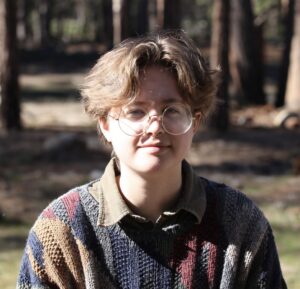
Shannon White in front of trees
Shannon White

By sheer virtue of the volume of in-progress oral histories I interact with, I find that in time they become almost a part of you—there are so many narrators whose words and stories I remember, and whose work I have actively sought out after encountering their oral histories. For example, I became interested in Bay Area arts institutions after reading the interview of a San Francisco Opera board member; my own undergraduate research has been informed in no small part by border theory, a concept I was first introduced to by the narrators of the Chicana/o Studies Oral History Project; and my work on the oral histories of California politicians has contributed to my awareness of the history of the state’s politics. Oral history is intimate and alive, and its existence has the unique ability to inform and inspire those who engage with it.

Shannon White is a recent UC Berkeley graduate in the Department of Ancient Greek and Roman Studies. They were an undergraduate research apprentice in the Nemea Center under Dr. Kim Shelton and a member of the editing staff for the Berkeley Undergraduate Journal of Classics. Shannon worked as an editorial assistant for the Oral History Center.

Serena Ingalls: Oral History and Insight

Before working at the Oral History Center as a student editorial and research assistant, my interactions with oral history were limited. As a history major, it was a topic occasionally mentioned in my classes at Cal. I could understand the value in oral history as a way of filling in gaps in the historical record and giving a voice to those who were excluded from the written record. After I began my work with the OHC, however, I gained a new appreciation for oral history. This change in perspective came after seeing firsthand the immense effort that goes into producing oral histories to be shared with the public, and from reading the oral histories in our archive.

At the Oral History Center, I’ve worked in two roles. One of my roles is as a research assistant. In order to promote our archive and share our interviews with the public, we post on social media about relevant historical anniversaries (25th, 50th, 75th, 100th). I research these anniversaries and then search the archive to see if we have content that references these historical events. It’s surprising how many specific events are mentioned by interviewees, so I never discount an event without checking first with the archive. If there is one event that is very historically significant and has several interviews that reference it, sometimes I’ll write an article on the subject for the OHC. My other role is as an editorial assistant. Editorial assistants are part of the process of readying an oral history for publication. Student editorial assistants have a range of responsibilities during the editorial process which include inputting corrections from narrators, writing the table of contents, and more. Editing the oral history is a collaborative process, and it can take months or even years before an oral history is fully ready for publication. Once an oral history is completed and shared with the public, all who have worked on a particular oral history know the narrator inside and out. 

The OHC has an enormous archive of interviews with narrators who have incredible insight on the history of California and beyond. Their voices provide knowledge, but more critically, they add life to these historical periods. The interviews are at times surprising, heartbreaking, and even funny, and no two interviewees have the same story. Each interview is a unique combination of the mundane and the extraordinary, just like the life of any person. 

“Each interview is a unique combination of the mundane and the extraordinary, just like the life of any person.” —Serena Ingalls

Serena Ingalls recently graduated UC Berkeley with majors in history and French. She is an editorial and research assistant for the Oral History Center. Serena came up with the idea for an article about what it’s like to work on oral histories when she worked on an article about the seventy-fifth anniversary of the tape recorder. 

William Cooke: Oral History and Truth

A few short months ago, I graduated from UC Berkeley. I have completed 12 political science courses; written dozens of sports articles for Berkeley’s independent student newspaper, The Daily Californian; struggled my way through one too many required science classes; and penned more than a few essays en route to a minor in history. 

As a journalist and student, determining and advancing truth was at the heart of everything I did. For example, in order to make a sound political science argument about the role of agency in a democracy, I could not reinvent what Harriet Jacobs wrote in her autobiography, Incidents in the Life of a Slave Girl. Desiderius Erasmus had something specific to say about tyranny. What was it, exactly? Did Cal’s football team run or pass the ball more often on third down? If the United States federal government really did assume a different position towards organized labor after World War II, what evidence supports that claim? 

The answers to my own questions, or the questions my professors asked of me, had to be completely truthful. I certainly couldn’t say that I didn’t have an answer to an essay prompt.  

Oral history is a little bit different. When I first began working here last year, I couldn’t help but be skeptical. An interviewee in her eighties cannot with absolute accuracy remember her childhood years during the Great Depression, or her immediate reaction to the assassination of President Kennedy. Memory fails people all the time. A story might be true on the whole, I thought to myself, but the details might not. And what use was the answer “I don’t know?” That might be the truth, but what good is an oral history in which there are gaps? 

In short, how could a researcher possibly find use in an incomplete, possibly inaccurate story told by someone fifty years after the fact?

Of course, these questions are not on my mind as I write a table of contents or fix formatting issues on a transcript. My work can be tedious at times. As someone whose mind likes to stay busy, I don’t mind. But every now and then I will stop and think critically about what I’m reading and how it relates to my role as a student, journalist, and assistant at the Oral History Center; namely, promoting truth. 

I soon came to terms with the fact that oral histories cannot be totally accurate and that in an important way they are true. While the historian attempts to explain how people in the past saw themselves, their situation or others in very broad terms, the oral history provides insight into how a creator of history currently thinks of her past self, a valuable perspective for social scientists of all stripes. An interviewee might have felt more anxious than nervous at a certain moment in history, but how he remembers the past is also an important part of history. What good is there in knowing the true happenings if we do not know how the living, breathing makers of history think about what happened? 

And for that reason, I have come to realize that oral history isn’t impure, or less true. I do still read the oral histories I work on with a wary eye. But I don’t worry about their truthfulness like I first did back in the spring of 2022. Instead, each time I complete my portion of a project, I feel a sense of gratification for having helped keep history alive. Because true history is not a fixed thing. It lives in the minds of everyone who has experienced it. 

William Cooke recently graduated UC Berkeley with a major in political science and minor in history. In addition to working as a student editor for the Oral History Center, he is a reporter in the Sports department at UC Berkeley’s independent student newspaper, The Daily Californian.

Related Works

Serena Ingalls, Saving the Spoken Word: Audio Recording Devices in Oral History 

Mollie Appel-Turner, Shirley Chisholm, Women Political Leaders, and the Oral History Center collection

William Cooke, Title IX in Practice: How Title IX Affected Women’s Athletics at UC Berkeley and Beyond and Heavy hitters: the modern era of athletics management at UC Berkeley

Shannon White, “I take this obligation freely:” Recalling UC Berkeley’s loyalty oath controversy

Jill Schlessinger, editor, A peaceful silence: Berkeley undergrads reflect on remote employment during the pandemic

About the Oral History Center

The Oral History Center of The Bancroft Library preserves voices of people from all walks of life, with varying perspectives, experiences, pursuits, and backgrounds. We are committed to open access and our oral histories and interpretive materials are available online at no cost to scholars and the public. You can find our oral histories from the search feature on our home page. Search by name, keyword, and several other criteria. Sign up for our monthly newsletter  featuring think pieces, new releases, podcasts, Q&As, and everything oral history. Access the most recent articles from our home page or go straight to our blog home.
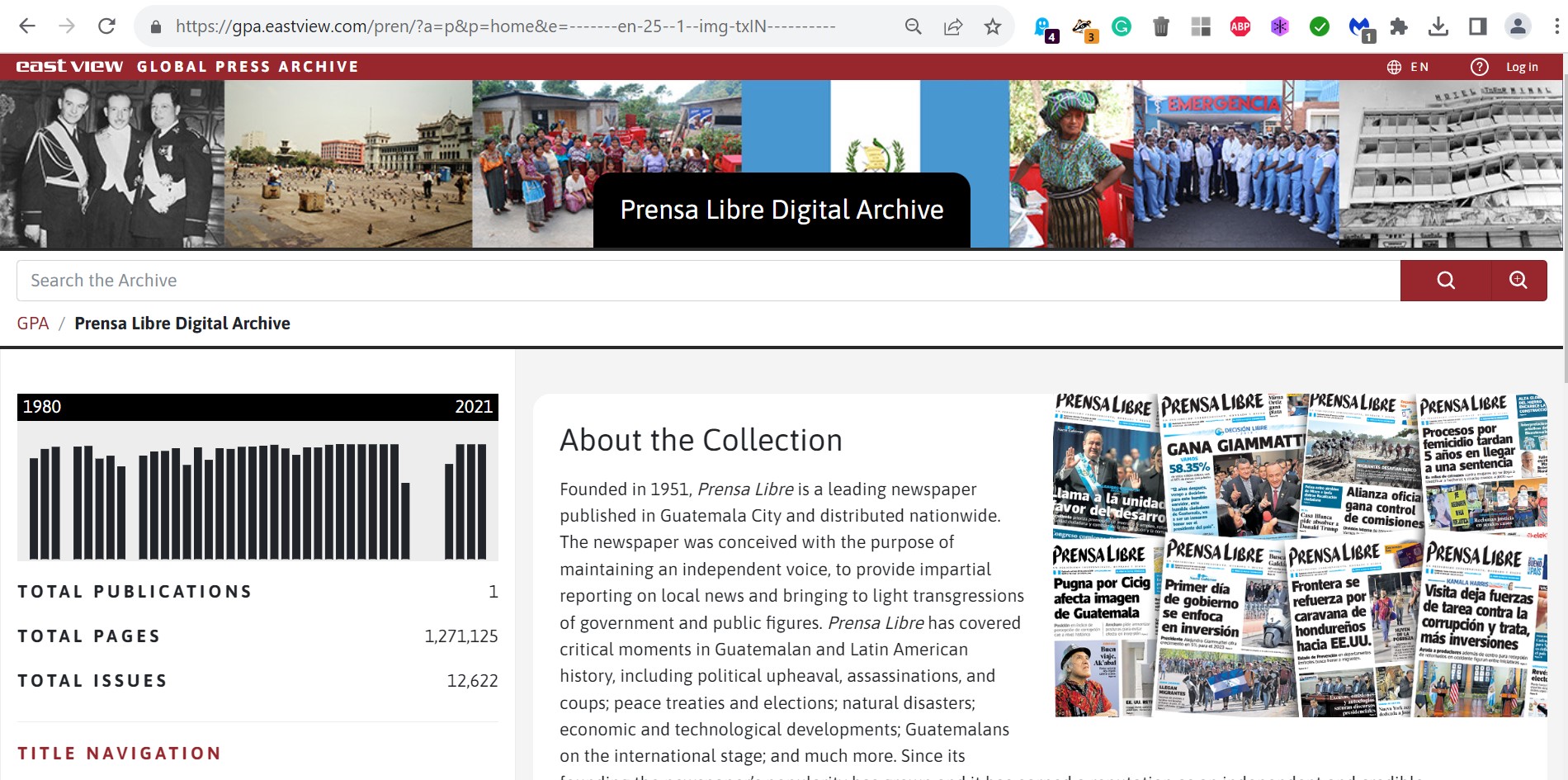
Prensa Libre (Guatemalan Newspaper) Archive Trial at UC Berkeley Library

The Library has started a thirty-day trial of Prensa Libre Newspaper. One can access the resource by authenticating from an off-campus location using the following hyperlink: https://libproxy.berkeley.edu/login?qurl=https%3A%2F%2Fgpa.eastview.com%2Fpren%2F

Currently, the full-text content is available for the issues starting in 1980 through 2022.

This is the landing page of the Presna Libre Newspaper's Digital Archive. Prensa Libre is a Guatemalan newspaper that was established in 1951. It has been digitized by EastVIew and as of September 5, 2023, issues from 1980 through 2022 were accessible.
Prensa Libre Digital Archive’s Landing Page.


Prensa Libre fue fundado el 20 de agosto de 1951 por Pedro Julio García, Álvaro Contreras Vélez, Salvador Girón Collier, Mario Sandoval Figueroa e Isidoro Zarco Alfasa.

Prensa Libre is a Guatemalan newspaper published in Guatemala City by Prensa Libre, S.A. and distributed nationwide. It was formerly the most widely circulated newspaper in the country and as of 2007 it has the second-widest circulation.[1] It is considered a local newspaper of record. It was founded in 1951. (Source: Wikipedia)


Library Orientation for Art Practice and Art History Students

Welcome back students! If you are interested in learning more about the wonderful library arts resources, please join us at one of our upcoming library orientation sessions. Current sessions offered include:

Tuesday, September 5th 1-2
Tuesday, September 5th 4-5
Friday, September 8th 12-1
Friday, September 8th 3-4

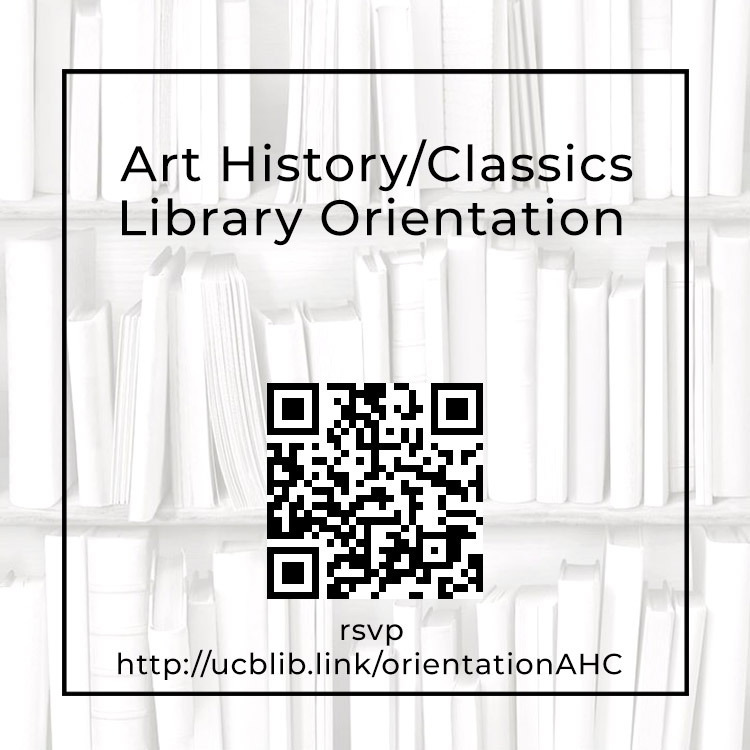
Please rsvp at: http://ucblib.link/orientationAHC

Registration will be capped at 20 students per session. New dates/times will be added to the rsvp form if the current offerings reach capacity. We will meet in the Art History/Classics Library (room 308, 3rd floor Doe Library).

orientationflyer


Follow us on social media
X: @ah_library_ucb
Instagram: berkeley_art_history_library

This week in Summer Reading

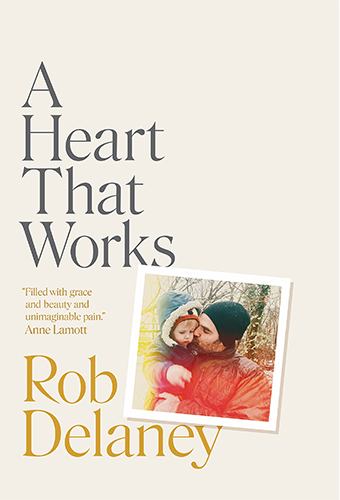
Book cover for A Heart that Works

A Heart That Works
Rob Delaney

A memoir about the death of a 2-year-old from brain cancer should not make you laugh out loud. Yet actor, comedian, and writer Rob Delaney does just that in this loving account of his son Henry, who died before reaching his third birthday. In addition to sharing tender memories of Henry’s bright spirit even in the face of a brutal illness and an even more brutal treatment, this book is a love letter to Delaney’s family. It’s also an homage to the many professionals in the medical and care community who touched Henry’s life — from surgeons and nurses to healthcare assistants and hospice care workers; not to mention the volunteers who gave so much joy to Henry, including Lola the therapy dog and Singing Hands, the musical duo who use a special sign language to help teach non-verbal children how to communicate.

The other lesson in this book: The NHS – the U.K.’s much-beloved national health care service – is a “glorious institution” that enabled the Delaneys, transplants from the U.S., to maximize time spent with their very sick child rather than dealing with the bureaucracy of a multibillion dollar, publicly traded insurance bureaucracy.

MARGARET PHILLIPS
Librarian
Social Sciences Division


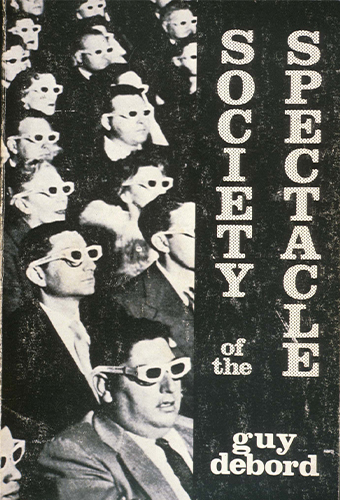
Book cover for Society of the Spectacle

The Society of the Spectacle
Guy Debord

“The spectacle is not a collection of images, but a social relation among people, mediated by images.”

Guy Debord’s La société du spectacle, written in the wake of the student riots in Paris in 1967, is one of the most influential philosophical texts of the latter half of the 20th century that is as relevant today as when it was first published. Like one of his major influences, Karl Marx, Debord critiques our entire society: e.g., our consumption of commodities. But he goes beyond that to consider what predominates our consciousness in our daily lives. Because of the scope of his project, this is a challenging, often confounding, read.

The Society of the Spectacle consists of 221 passages, paragraphs, contained within nine chapters. I had to reread many of these several times before I even got close to something like an understanding of what Debord was trying to say. But this is worth the effort for an ultimately rewarding, no-holds-barred text that will make you rethink your daily experience.

MIKE PALMER
Enrollment Manager
College Writing Programs


Summer Reading 2023

2023 Summer Reading

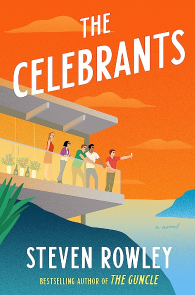
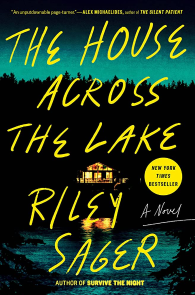
Kick off this summer with these fantastic beach reads! From summer scares to beachside romances, check out Overdrive and the selections below for an irresistible read.


Stanton Glantz: Putting Cardiovascular, Epidemiological, Economic, Political, and Policy Research into Action at UC San Francisco and Beyond

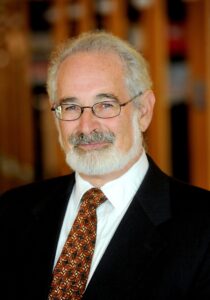
Today we announce the publication of the Oral History Center’s interviews with Dr. Stan Glantz. Dr. Glantz received his doctorate in applied mechanics from Stanford University before embarking on a multi-decade career at UC San Francisco. He contributed engineering concepts to cardiovascular research, biostatistics to epidemiology, and economics to the study of second-hand smoke and policymaking to regulate second-hand smoke, among many other research projects. The oral history explores his political and policy activism, the history of the clean indoor air movement, and his commitments to science and public health, in particular his long struggles with the tobacco industry and efforts to make UC San Francisco a world center for research into second-hand smoke, nicotine addiction, and the broader social determinants of health. His service to UC San Francisco and the University of California is also explored, in particular, his research and advocacy for policy changes on issues ranging from the rights of adjunct faculty to state funding of the UC system. These interviews showcase Glantz’s applied epistemology, his continual reflection on how knowledge is produced and shaped through formal and informal practices for arriving at scientific truth. 


portrait photo of Dr. Stanton Glantz in suit and tie
Dr. Stan Glantz, 2010. Photograph by Noah Berger


Bancroft Quarterly Processing News

The archivists of The Bancroft Library are pleased to announce that in the past quarter (April-June 2023) we have opened the following Bancroft archival collections to researchers.


Western Americana collections:

The role of women in the Black movement conference materials (processed by Marjorie Bryer)

Jonathan Winters collection on campus and East Bay LGBT activism (processed by Marjorie Bryer)

Edward Miyakawa papers (processed by Marjorie Bryer)

YMCA of San Francisco, Chinatown branch records, approximately 1915-2010 (processed by Marjorie Bryer)

Nan Tucker McEvoy collection (processed by Jaime Henderson and Marjorie Bryer)

Joni Jacobs collection of mayoral campaign materials (processed by Lara Michels)

Louise Taber family papers (processed by Lara Michels and student processing assistant Malayna Chang)

Central American Labor Defense Network records (processed by Marjorie Bryer)

Elaine Dorfman papers and oral histories (processed by Presley Hubschmitt)

Oakland-Piedmont Jewish Community Center records (processed by Presley Hubschmitt)

B’nai B’rith, San Francisco Lodge No. 21 records (processed by Presley Hubschmitt)

Rosene Family papers (processed by Lara Michels)

Women’s American ORT, San Francisco Chapter records (processed by Presley Hubschmitt)

Jerome H. Bayer papers (processed by Presley Hubschmitt)

Keesling family collection of John Henry Barbat correspondence, photographs, and realia (processed by Lara Michels)

Joel Bolster correspondence, 1851-1852 (processed by Lara Michels)

Harold Dobbs scrapbooks and photo albums (additional processing and finding aid written by Lara Michels)

Keesling family collection of Stebbins family papers (processed by Lara Michels)

William R. Sanford and Charles T. Forbes correspondence and sketches related to Native American archaeology, Owens Valley, California (processed by Lara Michels)

Presbyterian Church in Chinatown, San Francisco, additions (2019-08-16) (processed by Lara Michels)

Sierra Club mountain registers and records, 1860-2005, additions (processed by Lara Michels)

Robert (Bob) Edward Rooker rodeo archive (processed by Jaime Henderson)

Warren Hinkle papers (digital files) (processed by Christina V. Fidler)

Vivian Low collection of materials on the Military Intelligence Service Language School, Chinese Division, 1945-2017 (digital files) (processed by Christina V. Fidler)

Judith Heumann papers (digital files) (processed by Christina V. Fidler)


Literary and Arts collections: 

Anne S. Perlman papers (processed by Marjorie Bryer)

Robert D. Brotherson collection of the Activist Group of Poets (processed by Marjorie Bryer)

Nancy Karp + Dancers records (processed by Jaime Henderson and Lara Michels)

Claire Van Vliet letters to Frederick W. Hegeman, 1977-1988 (processed by Lara Michels)

Kenneth Perkins papers (processed by Randal Brandt and Sterling Kinnell)


University Archives and Faculty Papers collections:

University of California, Berkeley, Department of Women’s Intercollegiate Athletics records (processed by Jessica Tai)

Harold Biswell papers (processed by Jessica Tai)

Joseph L. Sax papers (processed by Lara Michels)

Robert Tracy papers (processed by Michele Morgan and Lara Michels)

Jaroslav Joseph Polivka papers (processed by Lara Michels)

Lawrence Levine paper (digital files) (processed by Christina V. Fidler)

Jacqueline Ellen Violette de La Harpe papers (additions) (processed by Marjorie Bryer)


Pictorial collections:

Acción Latina and El Tecolote pictorial archive photographic print and poster collection (processed by Isabel Breskin with James Eason)

Fakir Musafar archive (processed by Lori Hines)

John S. Service photograph collection (processed by Isabel Breskin with James Eason)

Photographs from the Noël Sullivan papers (1 unprocessed box)

185 small pictorial collections and single items.


Collections currently in process include:

  • The papers of George Barlow, UC Berkeley ichthyologist, ethologist and evolutionary biologist (processing work by Jessica Tai)
  • The papers of Michael Paul Rogin, UC Berkeley political scientist notable for his critique of American imperialism (processing work by Marjorie Bryer)
  • University of California, Berkeley, American Cultures Center records (processing work by Jessica Tai)
  • Western Jewish History Center records (processing work by Presley Hubschmitt)
  • Acción Latina records (processing work by Marjorie Bryer)
  • Haas-Bransten-Rothman family papers (processing work by Presley Hubschmitt)


PhiloBiblon 2023 n. 5 (julio): Los Lucidarios de Sancho IV y otros manuscritos hispánicos de interés

Mario Cossío Olavide
Universidad de Salamanca/IEMYRhd
University of Minnesota/Center for Premodern Studies

Los Lucidarios

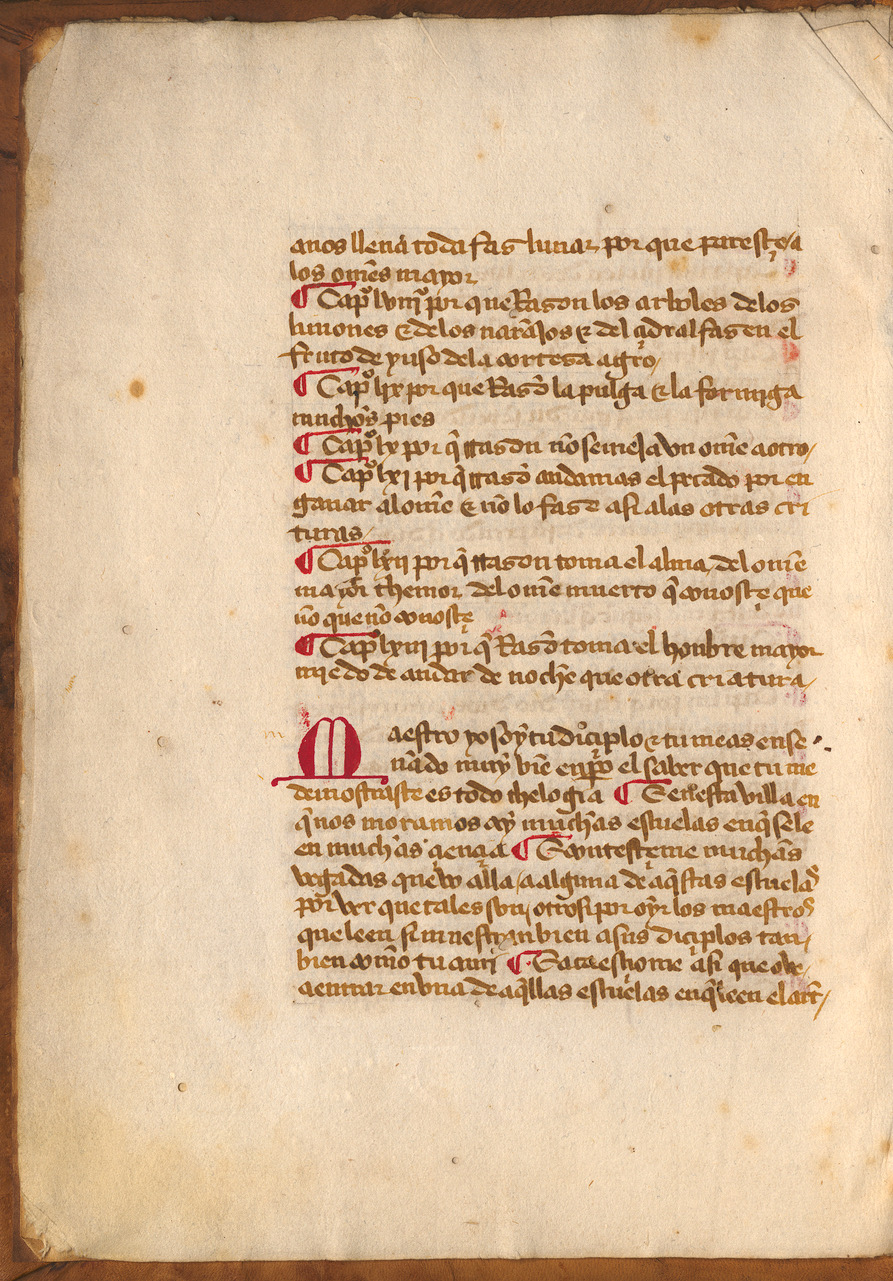
Cuando el célebre inspector de bibliotecas Henri Omont realizó el catálogo de los fondos de las bibliotecas públicas de Rouen, anotó que el manuscrito A283 de la Bibliothèque municipale –hoy Bibliothèque patrimoniale François Villon–, era un texto castellano del siglo XV al que le faltaba el título y que comenzaba en medio de la tabla de rúbricas. Tras la tabla, seguía el contenido de la obra, cuyas primeras líneas copió fielmente: “Maestro, yo soy tu discípulo e tú me as enseñado muy bien” (Catalogue générale, 184). El texto corresponde con el inicio del marco narrativo del Lucidario (BETA texid 1242).

Lucidario

Imagen 1. Rouen: Bibliothèque municipale, Ms A283, f. 2v

El manuscrito transmite el octavo testimonio conocido de esta obra auspiciada por Sancho IV, al que le he dado la sigla H (BETA manid 6360). Se trata de una copia posiblemente realizada en los talleres napolitanos de los reyes de Aragón y que llegó a Rouen gracias a la compra de manuscritos de Federico I de Nápoles realizada por el cardenal Georges d’Amboise durante el exilio del monarca en Tours (para una descripción completa de su contenido, véase Cossío Olavide, “Un nuevo manuscrito”).

A H hay que sumarle un noveno testimonio, I (BETA manid 3067), que identifiqué hace unas semanas. La existencia de este texto también pasó desapercibida por mucho tiempo. Se encontraba en la Biblioteca Ducal de Medinaceli y de él había dado cuenta Antonio Paz y Meliá con una enigmática nota en su parcial catálogo del fondo, entre los “manuscritos curiosos”: “Libro del rey Sancho IV – Diálogo entre maestro y discípulo (Letra del siglo XV)” (Serie 2: 537). Entre todas las obras de Sancho IV, esta descripción solo puede ser aplicada al Lucidario. Después de la venta de la biblioteca en 1964, el manuscrito pasó a la colección de Bartolomé March en Madrid y, tras la muerte de este, fue trasladado, junto al resto de manuscritos, a la Biblioteca de la Fundación Bartolomé March de Palma (sobre este manuscrito, véase Cossío Olavide, “Un nuevo testimonio”).

Resulta interesante resaltar que se trata de un testimonio tardío del Lucidario, de mediados del siglo XVI por su letra y filigranas, mientras que el cuatrocientos acumula seis testimonios de la obra. Hay dos fechados, A (BNE MSS/3369 [BETA manid 1434]) de 1455 y C (Real Bibl. II/793 [BETA manid 1435]) de 1477. D, el códice Puñonrostro (RAE Ms. 15 [BETA manid 1424]), puede ser datado por sus filigranas entre 1450 y 1460 (Cossío Olavide, “D (RAE 15)”). G (RAH Cód. 101 [BETA manid 2285]) es de finales de siglo, mientras que H (Rouen BM A283 [BETA manid 6360]) es de mediados de la centuria.

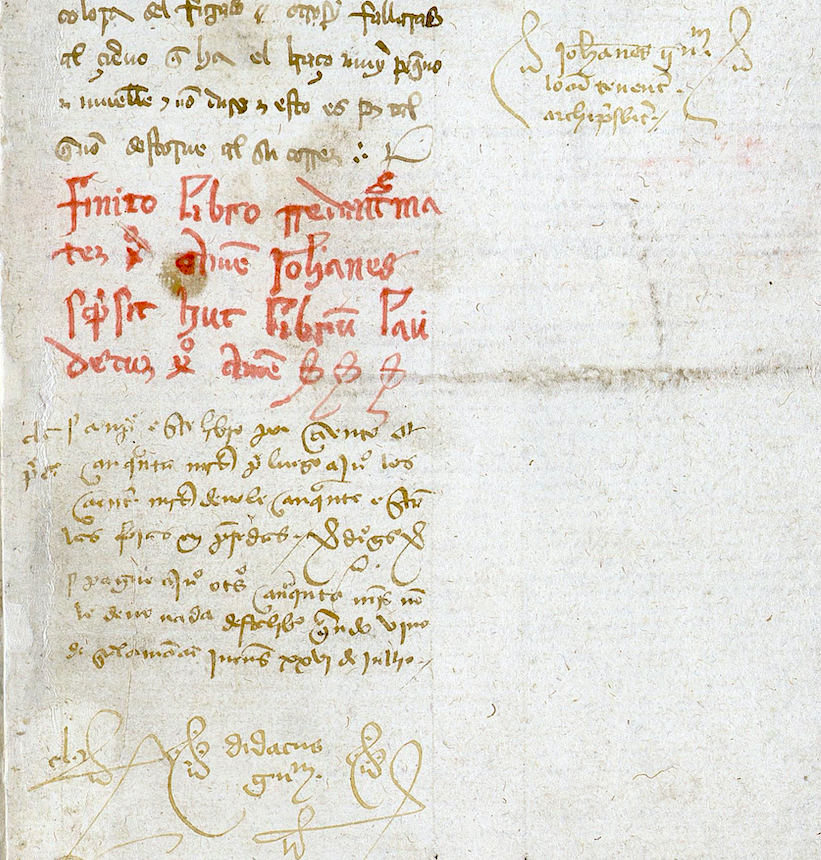
El testimonio B (Salamanca BU Ms. 1958 [BETA manid 1433]) fue durante largo tiempo considerado de este siglo, pero sus filigranas y la letra empleada –muy similar a la cancilleresca– apuntan que fue producido entre 1380 y 1410. Esto es reconfirmado por una nota de compra-venta en los últimos folios, acompañada por las firmas de sus antiguos posesores, dos maestros salmantinos de las primeras décadas del siglo XV. Didacus Gundisalvi, Diego González, catedrático de derecho en la Universidad de Salamanca hacia 1433, y un Johanes Gundisalvi, locum tenentem archipresbiter, que bien podría ser Juan González de Segovia, catedrático de derecho canónico, teólogo y representante de Juan II en el Concilio de Basilea.

Imagen 2. Detalle del fol. 104r del ms. 1958 de la Biblioteca General Histórica de la Universidad de Salamanca

Manuscritos hispánicos en colecciones europeas

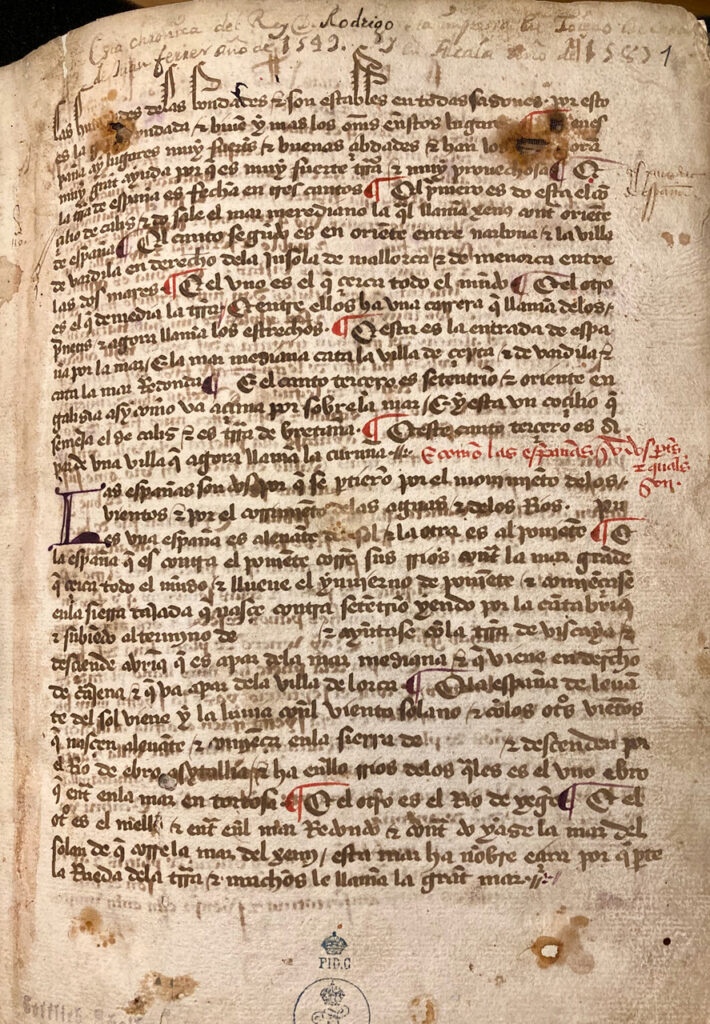
Un manuscrito recientemente redescubierto por Cossío Olavide y Romera Manzanares (“Nuevos testimonios”) es el Series Nova 12736 de la Biblioteca Nacional de Austria (BETA manid 6409), que transmite un testimonio parcial de la mal llamada Crónica del moro Rasis (BETA texid 1400) y de la Crónica sarracina (BETA texid 1462) de Pedro de Corral, datado entre 1460 y 1480.

Fol. 1r del ms. Series Nova 12736 de la Österreichische Nationalbibliothek
Imagen 3. Fol. 1r del ms. Series Nova 12736 de la Österreichische Nationalbibliothek

Además de estos textos, el manuscrito vienés transmite dos romances tempranos en el fol. 36r y la guarda pegada a la contratapa final: Virgilios y ¡Ay de mi Alhama! (o Paséabase el rey moro), según se dará cuenta en Cossío Olavide y Pichel (“Dos romances”).

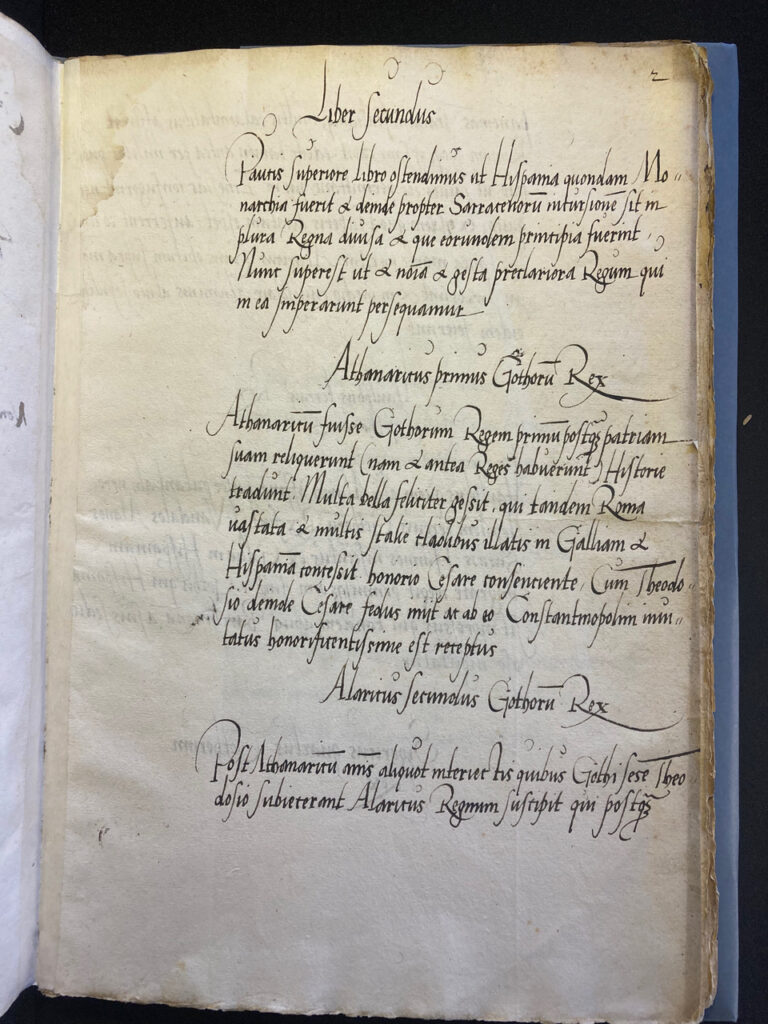
Otro texto de interés es el ms. 9221 de la misma biblioteca, un manuscrito facticio con doble numeración que transmite un repertorio de inscripciones sepulcrales alemanas (fols. 1r-73r) y un breve texto latino de formato analístico sobre los reyes visigodos (fols. 1rbis-10rbis). Aunque se trata de una copia del siglo XIX, parece estar vinculado con el Cronicón de Cardeña.

Fol. 2r-bis del ms. 9221 de la Österreichische Nationalbibliothek
Imagen 4. Fol. 2r-bis del ms. 9221 de la Österreichische Nationalbibliothek

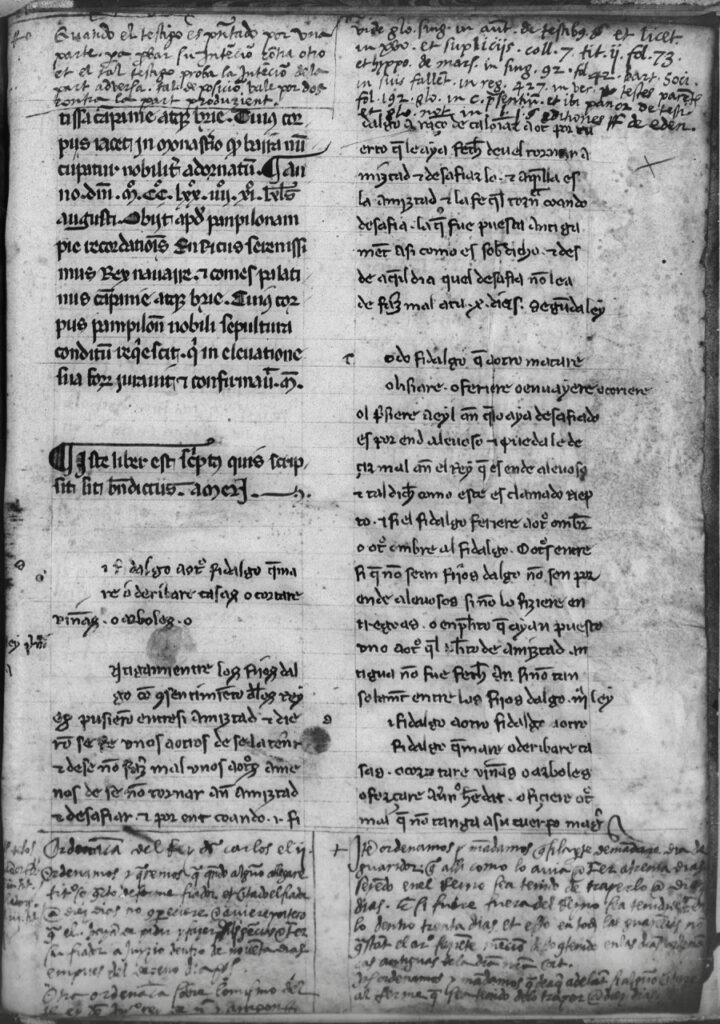
El manuscrito B702 de la Biblioteca Nacional de Suecia (BETA manid 4469) transmite la versión C del Fuero general de Navarra (BETA texid 1195), ampliado con disposiciones y textos legales añadidos, como el Amelloramiento de Philippe d’Evreux III (BETA texid 3192), estructura compartida por otros testimonios del fuero (BNE MSS/248 [BETA manid 1370] y MSS/ 6705 [BETA manid 3392], Biblioteca Regionale Universitaria di Catania ms. U009 [BETA manid 4600] y Real Biblioteca ms. II/1872 [BETA manid 3242]). Como estos, transmite en los fols. 114r-116v, una interpolación navarro-aragonesa del título de los retos del Fuero Real (libro 4, título 19), incorporada para cubrir un vacío legal en materia de justicia nobiliaria del Fuero general (véase Utrilla Utrilla, “Las interpolaciones” y Fradejas Rueda, “Una decepción”).

Fol. 114r del ms. B702 de la Kungliga Biblioteket, Estocolmo
Imagen 5. Fol. 114r del ms. B702 de la Kungliga Biblioteket, Estocolmo


Referencias

Cossío Olavide, Mario y Ricardo Pichel. “Dos romances tempranos en un manuscrito historiográfico del siglo XV: ¡Ay de mi Alhama! y Virgilios (con una nota sobre la lectura del Amadís primitivo).” Actas del VIII Congreso Internacional de la Asociación Convivio, en prensa.

Cossío Olavide, Mario. “D (RAE 15).” Lucidarios. Editando el Lucidario de Sancho IV. 18/01/2023, https://lucidarios.hypotheses.org/testimonios/d

_____. “Un nuevo manuscrito (Rouen, Bibliothèque municipale Villon ms. A283) y una nueva edición del Lucidario de Sancho IV.” e-Spania, vol. 44, 2023. https://doi.org/10.4000/e-spania.46735

_____. “Un nuevo testimonio del Lucidario: I.” Lucidarios. Editando el Lucidario de Sancho IV. 26/05/2023, https://lucidarios.hypotheses.org/2807

Fradejas Rueda, José Manuel. “Una decepción y un hallazgo. Una nueva copia del Fuero de Navarra.” Las Siete Partidas del Rey Sabio: una aproximación desde la filología digital y material, editado por José Manuel Fradejas Rueda, Enrique Jerez y Ricardo Pichel, Iberoamericana, 2021, pp. 138-43. https://doi.org/10.31819/9783968691503-011

Omont, Henri, editor. Catalogue général de manuscrits des bibliothèques publiques de France. Départaments, t. I. Rouen, Imprimerie nationale, 1886.

Paz y Meliá, Antonio. Series de los más importantes documentos del Archivo y Biblioteca del Excelentísimo Señor Duque de Medinaceli. 2 vols. Imprenta alemana e Imprenta de Blass, 1915-1922.

Romera Manzanares, Ana y Mario Cossío Olavide. “Vieron el escrito y mostráronlo. Nuevos testimonios de la Crónica del moro Rasis y de la Crónica sarracina.” Revista de literatura medieval, vol. 34, 2022, pp. 249-68. https://doi.org/10.37536/RLM.2022.34.1.87619

Utrilla Utrilla, Juan. “Las interporlaciones sobre reptorios en los manuscritos del Fuero general de Navarra.” Prínicpe de Viana. Anejo, no. 2-3, 1986, pp. 765-76.


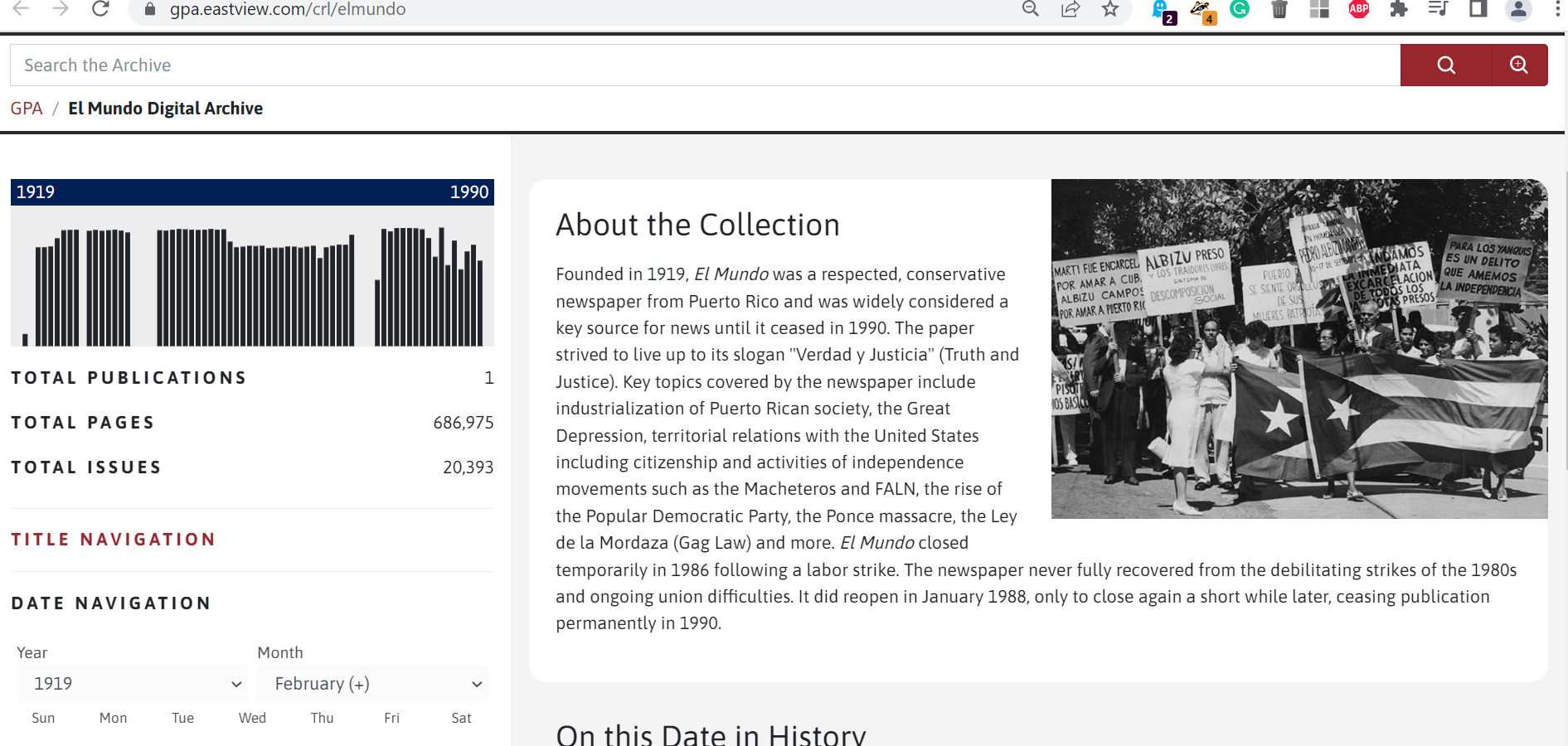
El Mundo Digital Archive (Puerto Rico): 1919-1990 [Open Access]

I am glad to report that the Center for Research Libraries, in collaboration with Eastview’s Global Press Archive platform, has released the full text of El Mundo newspaper published in Puerto Rico from 1919-1990.

Established in 1919, El Mundo was a well-respected and conservative newspaper hailing from Puerto Rico, widely acknowledged as a prominent news source until its cessation in 1990. The publication diligently aspired to uphold its motto of “Verdad y Justicia” (Truth and Justice). El Mundo extensively covered a range of significant topics, including the industrialization of Puerto Rican society, the impact of the Great Depression, territorial relations with the United States encompassing citizenship, activities of independence movements such as the Macheteros and FALN, the emergence of the Popular Democratic Party, the Ponce massacre, the enactment of the Ley de la Mordaza (Gag Law), and more. In 1986 El Mundo temporarily closed due to a labor strike, which inflicted lasting damage on the newspaper. Despite reopening in January 1988, the publication faced ongoing union difficulties and ceased operations permanently in 1990.

Landing page of El Mundo digital archive on the Global Press Archive. This is an open access resource. Please click on the image to go to the archive.


“Doris Sloan: Geologist, Educator, and Environmental Activist,” oral history release

New oral history: Doris Sloan

Video clip from Doris Sloan’s oral history on living in the Bay Area, on deep time, and on thinking like a geologist:

Doris Sloan is a geologist and paleontologist who earned her PhD at UC Berkeley and who taught, wrote, and engaged in environmental activism and education throughout the Bay Area, across California, and beyond. Sloan and I recorded nine hours of her then 92-year life history at her home in Berkeley, California, in May 2022. Our four recording sessions resulted in a 162-page oral history volume that includes an appendix of photographs with family as well as documents from her efforts in the early 1960s to stop PG&E’s construction of a nuclear power plant atop Bodega Head, under which runs the seismic San Andreas fault. Today, the coastal outcrop of Bodega Head is preserved as part of California’s scenic 17-mile-long Sonoma Coast State Park.

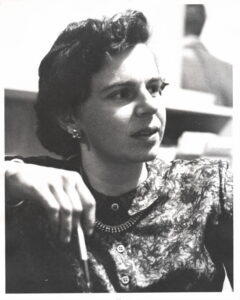
Black and white photograph of Doris Sloan
Doris Sloan in 1963 as the Sonoma County Coordinator of the Northern California Association
to Preserve Bodega Head and Harbor (NCAPBHH).

Sloan’s involvement in the “Battle for Bodega Head” helped inspire her later career as a geologist and teacher—a career she began by returning to graduate school as a mother in her early forties with children still at home. Sloan overcame numerous challenges, including gender discrimination in what were then male dominated departments and academic fields, to earn her MS in Geology in 1975 and her PhD in Paleontology in 1981. Her dissertation was an ecostratigraphic thesis on the sedimentary fossils of tiny creatures that once lived the San Francisco Bay. For many years, Sloan taught research-driven senior seminars in Environmental Science at UC Berkeley as well as geology courses for UC Extension. She lectured on travel excursions and field trips around California and across much of the Earth. Sloan became a board member with Save the Bay and a founding member of Citizens for East Shore Parks. In 2006, she published with UC Press the popular California natural history guide, Geology of the San Francisco Region. In her rich oral history, Sloan discussed all of the above, with details on her formative childhood experiences, her environmental and anti-nuclear activism, her experiences as a female geology graduate student at UC Berkeley, as well as her diverse teaching career.

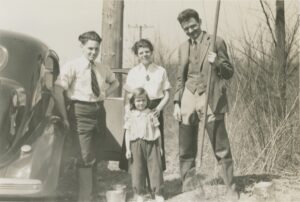
Black and white photo of a Doris Sloan as a child standing in front of three adults, including her father who is who wearing wading boots.
Doris Sloan, age 6 (front center), on a salamander egg collecting trip with father, Viktor Hamburger (right), and two of his graduate students in St. Louis County, Missouri, circa 1936.

Doris Sloan was born in October 1930, in Freiburg, Germany. At age four, she and her family fled Germany after the Nazis removed her father, preeminent embryologist Viktor Hamburger, from the faculty at the University of Freiburg because of his Jewish ancestry. Her family settled in Missouri after her father secured a faculty appointment at Washington University in St. Louis. As a young girl, Sloan accompanied her father and his embryology students on field research trips to collect salamander eggs. She also shared fond memories of youthful summers working in Woods Hole on Cape Cod at the Marine Biological Laboratory. Sloan attended Bryn Mawr College from 1948 to 1951, where she began attending Quaker meetings. Upon her mother’s deteriorating health, Sloan returned to St. Louis and graduated in 1952 from Washington University with a BA in Sociology. In that same year Sloan moved to San Francisco, California, with her then-husband, with whom she had four children. In 1957, she and her young family moved to Sonoma County, where she was neighbors with Peanuts cartoonist Charles Schulz. It was there in Sonoma County where, in the interests of protecting her children from nuclear radiation and preserving the beauty of the Sonoma Coast, that Sloan began her environmental activism that would, among other experiences, inspire her later career as a geologist and teacher.

Video clip from Doris Sloan’s oral history about her role in the “Battle of Bodega Head, Part 1:

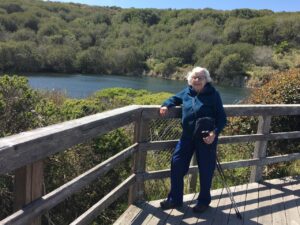
Color image of Doris Sloan standing beside a wooden railing in front of a pond and green plants.
Doris Sloan at the now water-filled “Hole in the Head” on Bodega Head on Mother’s Day in 2022. Photograph by her daughter Christy Sloan.

Sloan detailed her engagements in the multi-year “Battle of Bodega Head” that, in 1964, successfully stopped PG&E’s construction of a nuclear power plant on Bodega Head. After being told by an official from California’s Office of Atomic Energy Development and Radiation Protection to let go of concerns about the forthcoming nuclear plant and “leave it to the experts,” Sloan enlisted in the activist organization called the Northern California Association to Preserve Bodega Head and Harbor (NCAPBHH)—a name others created and she described as “dreamt up on a Friday night after too many beers.” The Association included an eclectic mix of anti-nuclear citizen activists that included communist chicken farmers, libertarian land owners, conservative cattle ranchers, Bodega fisherman, UC Berkeley professors, Sierra Club members, and jazz musicians and songwriters. In her role as Sonoma County Coordinator of NCAPBHH, Sloan also collaborated with an internationally recognized geophysicist and geologist named Pierre Saint-Amand. Fortuitously, on a rainy and wind-swept day, Sloan accompanied Saint-Amand on a clandestine and consequential visit to the “Hole in the Head,” the site on Bodega Head where PG&E had already drilled a deep pit into granite rock to place its nuclear reactor. It was on that visit, while looking into that hole, that Saint-Amand and Sloan discovered evidence of the San Andreas fault running directly through the reactor’s containment site, a discovery that eventually halted further nuclear construction there.

Video clip from Doris Sloan’s oral history about her role in the “Battle of Bodega Head, Part 2:

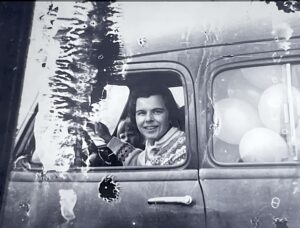
Black and white image of Doris Sloan driving a station wagon full of balloons.
Doris Sloan driving with her children and many helium-filled balloons to a NCAPBHH event at Bodega Head on Memorial Day, 1963. (Original film negative slightly damaged.)

As Sloan recalled about their activist victory in the early 1960s, “to have a group of citizens win out over a major institution was really pretty unique. … Bodega was a very important story at the very beginning of a huge cultural shift for not only environmental matters on nuclear energy, but in so many other ways, too. Basically, citizen involvement at every level, from students to housewives. And to be a part of that, I look back on that and think, wow, how could anybody have been so lucky in so many ways?” The story of this citizen-led anti-nuclear activism has been told elsewhere, including in Oral History Center interviews with David Pesonen and Joel Hedgpeth, as well as by nuclear historians J. Samuel Walker and UC Berkeley alumnus Thomas Wellock. Sloan’s storytelling on her personal role in the “Battle of Bodega Head”—like launching over a thousand helium-filled balloons from Bodega Head to the accompaniment of live jazz playing “Blues Over Bodega”—adds both flourish and important details to the eventual successes of NCAPBHH.

Sloan’s involvement at Bodega Head played a crucial role in launching the next phase of her life as a geologist and teacher. After moving with her children to Berkeley in 1963, Sloan worked for the Friends Committee on Legislation, a Quaker lobbying group. Yet, by the early 1970s, Sloan’s long-standing fascination of nature, a desire to experience more of it, and her memory of discovering fault seams on Bodega Head led her to take UC Extension courses on geology taught high up in the Sierra Nevada’s Emigrant Wilderness by a remarkable UC Berkeley professor named Clyde Wahrhaftig. Wahrhaftig eventually became a significant mentor and friend to Sloan on her academic journey, as were UC Berkeley geologists Garniss Curtis and William B.N. (Bill) Berry. In her oral history, Sloan shares many joys from her field research and academic experiences at Berkeley, including mapping rock formations in California’s Mazourka Canyon, communing with ancient bristlecone pines in the White Mountains, learning about limestone deposition in Florida, a fascinating question about an imaginary dinosaur civilization from Walter Alvarez during her PhD oral examination, and her own work deciphering the sedimentary mysteries of fossils from mud under the San Francisco Bay. Sloan also shared some of the challenges she faced in the late 1970s as one of the few women in Berkeley’s geology and paleontology departments that, by her account, then included more than a few male chauvinistic dinosaurs.

Video clip from Doris Sloan’s oral history about Clyde Wahrhaftig, a UC Berkeley geologist, mentor, and friend:

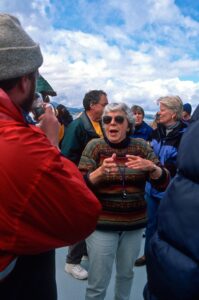
Color image of Doris Sloan talking to adults who surround her.
Doris Sloan lecturing during a University of California Museum of Paleontology (UCMP) field trip to the Marin Headlands in 2010. Photograph by John Karachewski.

Sloan’s oral history also explores her ensuing years as a teacher, travel guide, author, and environmental activist. Sloan discussed several senior research seminars in Environmental Studies that she taught at UC Berkeley, some records of which are preserved in UC Berkeley’s Library including East Bay Parklands: Planning and Management (1978), Seismic Safety in Berkeley (1979), San Pablo Bay: An Environmental Perspective (1980), and Hazardous Substances: A Community Perspective (1984). Sloan recorded stories and samples from lectures she delivered in her UC Extension geology courses and in her field classes for numerous organizations, including the Oakland Museum, Sierra Club, the Point Reyes National Seashore Association, and the Yosemite Association. And she shared some of her travel experiences as a guide for Cal Alumni groups on journeys all across the Earth, from the Himalayas to Central Asia, and from South America to Scandinavia. Sloan also spoke about her local environmental activism as a board member of Save The Bay, as a founding member of Citizens for East Shore Parks, and on her friendship with Save The Bay co-founder Sylvia McLaughlin, including efforts to secure what is now named as McLaughlin Eastshore State Park.

Doris Sloan’s enlightening oral history records marvelous stories from the first ninety-two years of her remarkable life—from fleeing Nazi Germany to summers in Woods Hole; from raising children in northern California to stopping construction of a nuclear power plant on the San Andreas fault; from graduate school in her forties at UC Berkeley to lecturing across California and much of the world. I am honored to have become one of Doris’s friends, and I’m lucky for the opportunity to become one of her students. Now, with the publication of Doris Sloan’s oral history, you also have the chance to learn from her deep wisdom and experience.

Doris Sloan, “Doris Sloan: Geologist, Educator, and Environmental Activist” conducted by Roger Eardley-Pryor in 2022, Oral History Center, The Bancroft Library, University of California, Berkeley, 2023.

Video clip from Doris Sloan’s oral history about the Bay Area’s complicated geology:

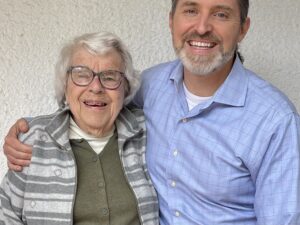
Color photograph of Doris Sloan and Roger Eardley-Pryor standing side-by-side
Doris Sloan with oral historian Roger Eardley-Pryor at her home in Berkeley, California, in May 2023.

ABOUT THE ORAL HISTORY CENTER

The Oral History Center of The Bancroft Library preserves voices of people from all walks of life, with varying political perspectives, national origins, and ethnic backgrounds. We are committed to open access and our oral histories and interpretive materials are available online at no cost to scholars and the public. You can find our oral histories from the search feature on our home page. Search by name, keyword, and several other criteria. Sign up for our monthly newsletter featuring think pieces, new releases, podcasts, Q&As, and everything oral history. Access the most recent articles from our home page or go straight to our blog home.