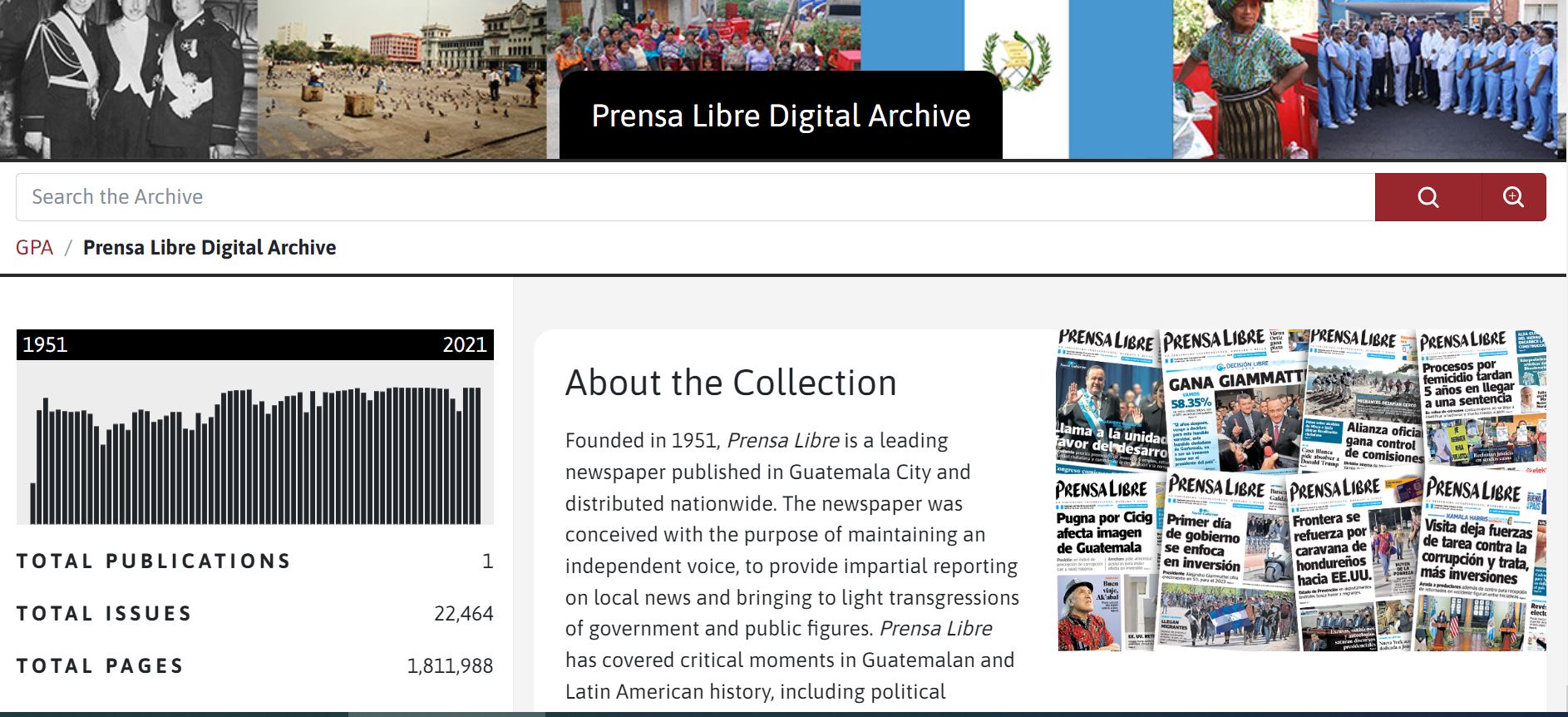
UC Berkeley Library has purchased ongoing access to Prensa Libre Digital Archive (1951-2024). Prensa Libre is a well-respected Spanish-language Guatemalan Newspaper. It began publishing in 1951, and since then has provided extensive coverage of politics, news, social conditions, history, governance issues, Garífuna, Mayan, and other indigenous communities (Pueblos Originarios en Guatemala), and civil war(s) in Guatemala and Central America.
We hope that this newspaper resource will be of great use to our faculty and students who study Anthropology, Politics Social Sciences, History of Central America, and Latin America.
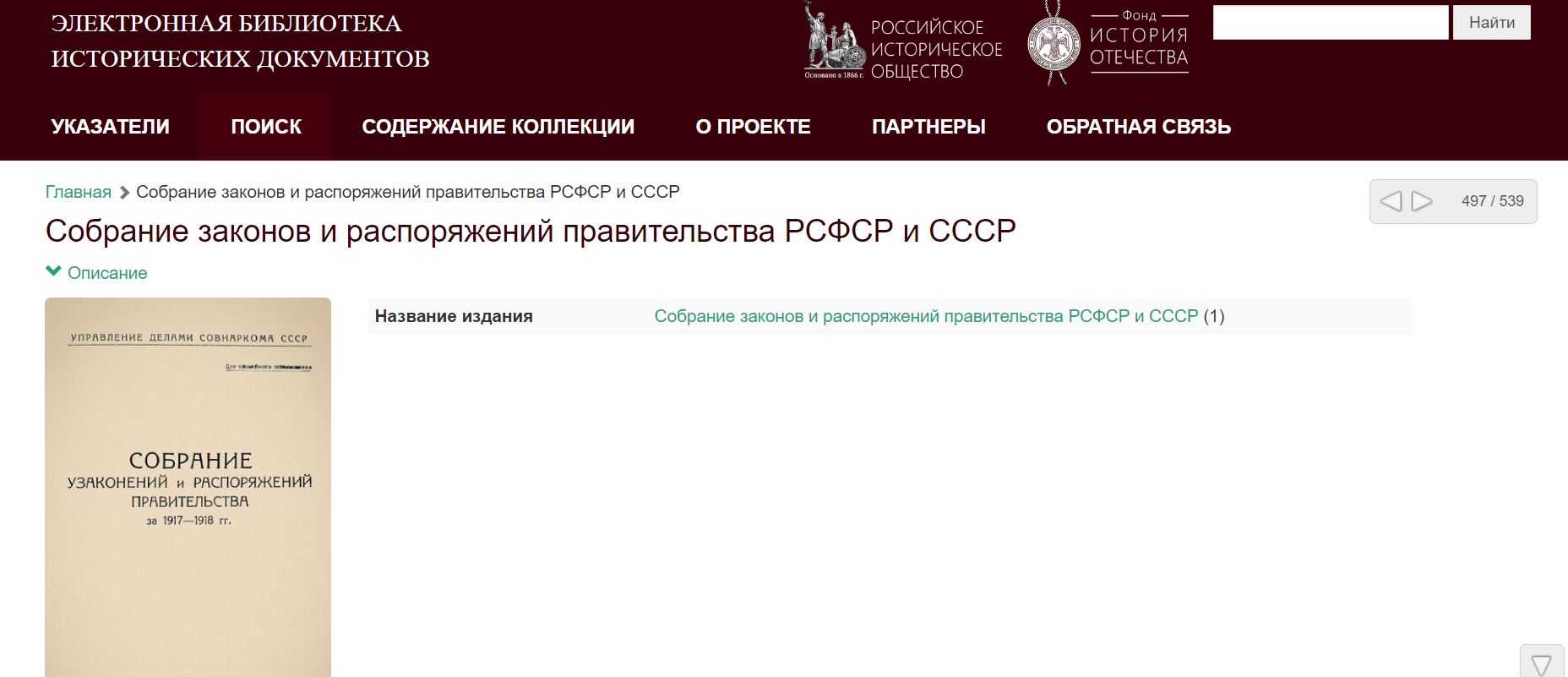
Recently in light of Russian invasion of Ukraine, with almost everything Russian being canceled in society at large, I wanted to bring to our readers’ attention a new digital resource on the Collection of laws and orders of the government of the RSFSR and the USSR. The resource is in Russian, and it was created by the Elektronnaia biblioteka istoricheskikh dokumentov (Электронная библиотека исторических документов).
The source provides access to digital copies of the laws and various orders of the Russian Soviet Socialist Republic and Soviet Union. I hope historians of the Soviet Union and the Russian Federation will find this resource of academic interest.
One can search within the text using specific keywords.
The UC-wide Love Data Week, brought to you by UC Libraries, will be a jam-packed week of data talks, presentations, and workshops Feb. 12-16, 2024. With over 30 presentations and workshops, there’s plenty to choose from, with topics such as:
Code-free data analysis
Open Research
How to deal with large datasets
Geospatial analysis
Drone data
Cleaning and coding data for qualitative analysis
3D data
Tableau
Navigating AI
All members of the UC community are invited to attend these events to gain hands-on experience, learn about resources, and engage in discussions about data needs throughout the research process. To register for workshops during this week and see what other sessions will be offered UC-wide, visit the UC Love Data Week 2024 website.
Trial access to the Africa Commons digital archival collections, produced by Coherent Digital, is available until January 31st. This resource provides access to books, magazines, newspapers, government documents, manuscripts, photographs, videos, and oral histories related to African history and culture. Africa Commons is a project which aims to enable Africa to easily control, digitize, and disseminate its cultural heritage–within Africa, and internationally.
Africa Commons comprises four distinct collections:
History and Culture, an index of open source materials related to African history and culture.
The Hilary Ng’wengo Archive documents the fifty-year career of the iconic Kenyan journalist, publisher, commentator, and public figure Hilary Ng’wengo through his magazines, newspapers, television programs, and documentaries.
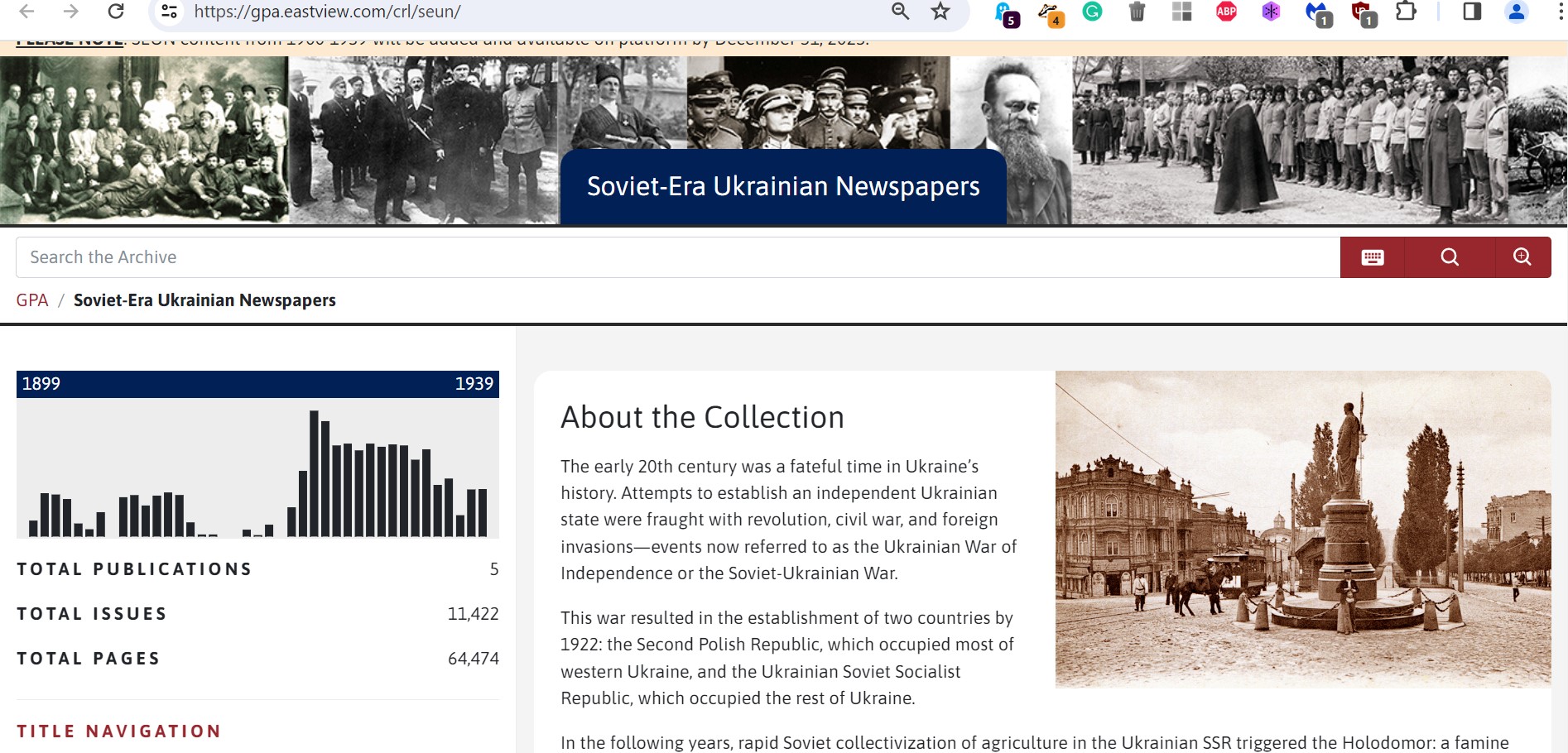
Center for Research Libraries in collaboration with the Global Press Archive of East View has released its latest digital collection of select Soviet-Era Ukrainian Newspaper. The collection can be accessed here: https://gpa.eastview.com/crl/seun/ or here
Soviet Era Ukrainian Newspaper project’s landing page. These are digital copies.
About the collection:
The early 20th century was a crucial time in Ukraine’s history, marked by attempts to establish an independent state, leading to the Ukrainian War of Independence. This conflict resulted in the creation of two countries by 1922: the Second Polish Republic in western Ukraine and the Ukrainian Soviet Socialist Republic in the rest of the country.
Following this, rapid Soviet collectivization in the Ukrainian SSR triggered the Holodomor, a famine that began in 1932 and claimed millions of lives.
The Soviet-Era Ukrainian Newspapers (SEUN) collection, with over 50,000 pages and five titles, documents Ukraine’s history during this turbulent period, including events leading up to WWII. It includes newspapers from Kyiv, Kharkiv, and Lviv, featuring content in both Ukrainian and Russian.
En una reciente visita a la Biblioteca Nacional de Francia pude consultar el manuscrito que contiene el Tratado de amor (BnF esp. 295) [BETA manid 2478], atribuido por una mano moderna a Juan de Mena (1411-1456).
Las notas allí tomadas y la celebración de la natividad de Jesús propician la redacción de este texto acerca del tópico del vulnus amoris en particular y acerca de la vulnerabilidad humana en general. Esta entrada de blog, por tanto, se articula entre las proyecciones de un texto tardomedieval y sus todavía posibles lecturas y lectores del siglo XXI; como si nos halláramos en medio de un juego de espejos que nos sitúa entre el vulnus amoris causado por las flechas de Cupido y nuestra propia vulnerabilidad, como entre los infinitos reflejos de nuestras figuras en los espejos de un ascensor. Seguiremos, pues, el sentido de las flechas de oro y de plomo de los goldres de Cupido, disparadas desde un códice cuatrocentista hasta nuestro espíritu navideño y hasta su reinterpretación desde las aportaciones de la neurobiología a la descripción de las relaciones humanas. Entre el siglo XV y el siglo XXI, se multiplicarán nuestros reflejos.
1. En las celebraciones navideñas, la vulnerabilidad del niño Jesús nos podría hacer recordar el niño que todos hemos sido. Todos hemos sido traspasados por flechas de oro que nos han llevado a perseguir el afecto y a captar la atención de aquellas personas de las que hemos dependido y de las que, en algunas ocasiones, para bien o para mal, todavía dependemos. Esa vulnerabilidad nos ha hecho ser humanos, animales sociales y políticos. Ese primer vulnus amoris de nuestra niñez lo causaría, desde la perspectiva adoptada para escribir este texto, otro dios con forma de niño: Cupido.
En el inicio del Tratado de amor se reproduce su imagen:
Todas las otras passiones li|ibidinosas て venereas llama el vulgo amor ⸿Delas quales los fabulosos fingimjentos dispusieron commo si pudieran disponer fue|se deesa venus て cupido dios ⸿ E pintauan a este cupido. mas verdadera mente llama|do ydolo que dios. con dos goldres llenos de frechas. て con vn arco dorado ⸿ E las frechas que traya enel vn goldre . eran dora|dos. las del otro plunbias es a dezir de plo|mo. E dezian que al que este dios feria con la frecha dorada.sienpre le cresçia el deseo de amar ⸿ E al que feria con la frecha de plo|mo. mas le cresçia aborresçer a qujen le amªse
Bibliothèque national de France, Ms. Espagnol 295, f. 71r
No sería Cupido, sin embargo, el dios de las tres maneras básicas de querer—“amistad, dilectión, que es amorío, e amor” (Valero 2001: 35)—, sino solo de una de ellas, a saber, de la pasión de amor. Por tanto, no sería el arquetipo de las relaciones escogidas e igualitarias de la amistad ni de las relaciones dilectas del amorío de los superiores para con sus inferiores, como el amorío del Creador para con sus criaturas, de la madre para con sus hijos o de “la yegua cuando pare el potrico” (Valero 2001: 47). ¿Qué tipo de pasión se establecería con el amor de Cupido? Una pasión “libidinosa e venérea” entre inferiores y vulnerables, que a su vez “se subdivide en dos partes: la una es en amor líçito e sano; la otra en no líçito e insano” (Valero 2001: 36). El amor lícito es el conyugal, al cual “non solamente la dotrina christiana alaba e bendize, mas aun la dotrina [de la] gentilidad” (Valero 2001: 36). La vieja solución pagana al desafío del desorden que puede producir el deseo libidinal, expresada por el mito clásico de Cupido y Psique, se cristianizaría con el amor conyugal del matrimonio lícito. Dicho de otro modo, el Tratado de amor subraya la coincidencia entre la solución gentil y la cristiana al alabar las bondades del matrimonio para solucionar los trastornos ocasionados por el vulnus amoris. Pero esa solución no cautiva la atención del autor del Tratado; son más interesantes, en cambio, los problemas que surgen del otro miembro de la bipartición, a saber, de la parte del amor no lícito. El Tratado además subraya que el amor, aparte de aumentar la vulnerabilidad de los amantes, provoca que estos no puedan escoger el tipo de pasión que les embarga, es decir, que no puedan elegir si persiguen o si son perseguidos, si son atraídos o atraen. De aquí que el modo de vulnerabilidad no sea elegido y de aquí que podamos entender la imagen del “amador çiego” como un trasunto de una voluntad débil que no elige o como—y aquí va la primera intersección de literatura y neurobiología—una motivación que nos impulsa a actuar desde determinadas áreas del sistema límbico y que escapa al control racional del córtex prefrontal, en el cual se concentran los circuitos cerebrales conectados con los procesos de la elección deliberada. Dicho de otro modo, la deliberación se puede entender como un proceso de la corteza cerebral que controla los impulsos procedentes de las zonas más internas del encéfalo, como se puede inferir a partir de la lectura de “Decision-Making and Consciousness” (Kandel et alii 2021: 1392-1419).
La pasión amorosa, en suma, se liga con el sistema límbico, la impulsividad irracional y la vulnerabilidad humana a través de la imagen literaria de los dos goldres de flechas de Cupido, unas de oro, otras de plomo: “E dezían que al que este dios fería con la frecha dorada, siempre le cresçía el deseo de amar. E al que fería con la frecha de plomo, más le cresçía aborresçer a quien le amase. E pintávanle la efigie o imagen del su rostro tierna e de poca hedad, como de niño, a dar a entender que como en el niño se varía la conplisión, así en el que ama la voluntad.” (Valero 2001: 35)
Por ello, el Tratado de amor equipara la herida de la pasión amorosa con la carencia infantil de juicio y con la debilidad de la voluntad o incontinencia, en consonancia con algunas doctrinas aristotélicas divulgadas en ambientes cortesanos ibéricos por el Compendio de la Ética nicomáquea (ca. 1463-64) [BETA texid 1294]. En efecto, su descripción de la incontinencia como debilidad de la voluntad proporciona un ejemplo coetáneo de la problemática latente en el arranque del Tratado de amor: “continente solamente es dicho el que finca e permanece en recta razón e elección. E incontinente es su contrario” (Cuenca 2017: 151). Sin embargo, el amor hace variar la razón de tal manera que impide la deliberación y sus efectos, a saber, las elecciones racionales, e imposibilita, por consiguiente, la práctica de los hábitos electivos que son las virtudes morales, tal como se explica en el capítulo 5 del libro segundo del Compendio: “Capítulo quinto pone tres notificaciones de virtud. La primera, que virtud es perfección de la cosa. Segunda, que es mediedad entre dos extremos. Tercera, que es hábito electivo.” (Cuenca 2017: 51)
De acuerdo con esta cita, podemos indicar que la inclusión de la virtud en la lista de las once causas de amor que, según el Tratado, “despiertan e atrahen los corazones a bien querer” es paradójica. Es decir, si en el arranque del Tratado se estipulaba que la pasión de amor es ciega e irresistible, después se argumenta lo contrario, a saber, que “como el camino del amante sea libertad para descoger lo que más le plaze, el hábito electivo de amor viene en ábito de elegir antes al virtuoso que a un otro” (Valero: 37-38). Aquí el Tratado no es estricto en el uso de la terminología filosófica y parece que copia irreflexivamente el sintagma “hábito electivo”, porque el término ético más adecuado para referirse al hábito virtuoso—y, por ello, electivo, en relación con la selección activa del mejor compañero—sería “amistad” y no “amor”, cuyo uso se restringiría a la pasión irresistible, o sea, no escogida, no selectiva, pasiva (Cuenca 2019). Es como si las flechas doradas de Cupido no cegaran al herido por ellas, como si el único “amante çiego” fuera aquel magullado por las flechas de plomo, o como si las flechas doradas activaran la selectividad y las plúmbeas fomentaran la pasividad de la pasión. ¿Cómo podemos entender la paradoja del vulnus amoris de las flechas doradas?
2. Gracias a las investigaciones de David J. Anderson (Californa Institute of Technology) sobre las conexiones neuronales que ponen en marcha nuestras interacciones como animales sociales, podemos reinterpretar el gozo de los heridos por las flechas doradas, o sea, el gozo provocado por la vulnerabilidad selectiva o por la vulnerabilidad que escoge. Anderson, especialista en las funciones del hipotálamo, nos permite entender la paradoja con la que hemos concluído el apartado anterior, a saber, la paradoja que resulta de combinar la herida y el gozo, la pasión del amor y la selección activa del amante virtuoso.
Todos los animales poseen un repertorio de conductas instintivas que pueden ponerse en práctica sin una enseñanza previa, es decir, que, desde la perspectiva en este texto adoptada, pueden manifestarse sin una elección racional y, por ende, asemejarse a las conductas descritas e identificadas con la etiqueta literaria de la pasión amorosa o vulnus amoris. Según Anderson, no se sabe aún si estas conductas están mediadas por circuitos neuronales diferenciados anatómicamente y/o genéticamente. Sus investigaciones, a partir de las imágenes de las conexiones neuronales del hipotálamo del ratón, concluyen que las conductas que impulsan a establecer vínculos con otros especímenes están modeladas por determinadas experiencias sociales—en humanos podríamos añadir “culturales”. De tal manera que las mismas neuronas (Esr1+: Oestrogen receptor 1-expressing neurons) de una área concreta del hipotálamo (VMHvl) controlan tanto el apareamiento como la dominación y agresión en los roedores machos (Anderson et alii 2017). Si damos el salto mortal de ratones a hombres y hacemos el ejercicio de aplicar estas investigaciones al tópico de las flechas de Cupido, podemos intuir que su disparo indiscriminado podría describir la conducta innata que a todos nos impulsa a establecer vínculos sociales, o sea, nadie elige las flechas que le hieren, las doradas o las plúmbeas, pero todos estamos expuestos a alguno de sus tipos de herida. Es decir, todos estamos cableados con los mismos circuitos neuronales que nos hacen someternos al influjo de Cupido. Ahora bien, ese influjo está moldeado por las experiencias sociales y los modelos culturales, de manera que las mismas neuronas pueden estar involucradas en las conductas de la seducción y persecución activa provocadas por las flechas doradas y en las conductas de aversión y evitación provocadas por las flechas plúmbeas. Resaltemos una curiosa coincidencia: la medicina medieval localizaba en un único ventrículo de la media pars cerebri la sede de la facultad estimativa, encargada de las conductas de persecución y de evitación, de manera semejante a la actual localización en el midbrain de los circuitos conectados con las conductas de fight or flight asociados al hipotálamo.
Tomás de Aquino, basándose en el Liber de anima de Avicena (I, 5 y II, 2), proporciona uno de los listados más conocidos de los sentidos interiores en Summa Theologiae, Iª, q. 78, a. 4: “Avicenna, in suo libro de anima, ponit quinque potentias sensitivas interiores, scilicet sensum communem, phantasiam, imaginativam, aestimativam et memorativam”. El dominico describe que la facultad estimativa es imprescindible para explicar las conductas animales de buscar/querer y de huir/evitar, como el huir de la oveja cuando ve al lobo: “necessarium est animali ut quaerat aliqua vel fugiat, non solum quia sunt convenientia vel non convenientia ad sentiendum, sed etiam propter aliquas alias commoditates et utilitates, sive nocumenta, sicut ovis videns lupum venientem fugit, non propter indecentiam coloris vel figurae, sed quasi inimicum naturae”. Subrayamos, también en este mismo artículo de la Summa, que el Aquinate explicita que la medicina medieval localizaba en la media pars capitis la facultad estimativa –cogitativa en los humanos– : “alia animalia percipiunt huiusmodi intentiones solum naturali quodam instinctu, homo autem etiam per quandam collationem. Et ideo quae in aliis animalibus dicitur aestimativa naturalis, in homine dicitur cogitativa, quae per collationem quandam huiusmodi intentiones adinvenit. Unde etiam dicitur ratio particularis, cui medici assignant determinatum organum, scilicet mediam partem capitis”. (Tomás de Aquino: 1889)
Volviendo a las investigaciones de Anderson, podríamos pensar que, aunque sean las mismas zonas del hipotálamo las involucradas en los procesos de persecución y aversión, en ellas se podrían activar circuitos neuronales distintos—como ha probado el profesor de CalTech en relación con los circuitos neuronales activos en las conductas sexuales de los roedores machos, que son distintos de aquellos activos en las conductas de dominación. Es decir, aunque la conducta masculina de montar y dominar sea muy parecida a ciertas conductas sexuales, se activan circuitos neuronales distintos en cada una de ellas, aun estando localizados en el hipotálamo todos esos circuitos. Podríamos pensar, volviendo al tópico del vulnus amoris, que la conducta de dominar y herir y la conducta de seducir y amar están muy cerca la una de la otra, aun siendo diferentes.
Ahora podemos responder a la pregunta formulada al final del segundo apartado: no elegimos nuestra anatomía, no escogemos tener circuitos neuronales que puedan encender un ánimo propenso a sentir el amor; lo único que podemos escoger en algunos casos es si orientamos esos circuitos del hipotálamo hacia personas virtuosas. Dicho de otro modo con la terminología del Tratado de amor, no elegimos ser heridos por las flechas de Cupido; lo único que podemos escoger, si nos ha perforado una flecha dorada, es orientar nuestra persecución hacia una persona virtuosa o que reúna alguna de las otras diez condiciones que motiven una constante persecución, ya que “muchas cosas se vençen por el seguimiento que en otra manera non se acabarían” (Valero 2001: 44). El que la seguía antes la conseguía, aunque en los últimos años ya no es así: primero con el paradigma del “no es no” y después del “solo sí es sí”. Podemos estar asistiendo, quizás, a una de esas experiencias sociales que modelan la conducta y cortocircuitan los impulsos procedentes del hipotálamo, gracias a la actividad deliberativa del córtex prefrontal.
3. Lo interesante del Tratado de amor es que muestra cómo la cultura bajomedieval ya diferenció el tipo de interacciones sociales del herido con las flechas doradas de aquellas del herido con las flechas plúmbeas. Las flechas doradas mueven a perseguir y las plúmbeas a evitar. La paradoja que hemos pretendido explicar con este breve texto es que las flechas de plomo no nos hieren, sino que nos hacen invulnerables y, por tanto, menos humanos. Sin embargo, esa invulnerabilidad es muy dolorosa, porque nos aísla y nos mueve a evitar las relaciones que nos hacen ser más humanos: las relaciones del amor. De aquí surge una última paradoja expresada por el tópico del vulnus amoris : todos somos propensos a un determinado tipo de herida, a un modo de vulnerabilidad, incluso aquellos que anhelan la invulnerabilidad. La dulce herida se abriría en la carne perforada por la flecha dorada y la herida amarga, en cambio, magullaría la dura piel contusionada por la flecha plúmbea. La invulnerabilidad, en conclusión, resultaría paradójicamente más dañina y dolorosa que la dulce vulnerabilidad infantil. Por eso adoramos a los niños, y no solo en Navidad.
Obras citadas:
Anderson et alii 2017: David J. Anderson, Ryan Remedios, Ann Kennedy, Moriel Zelikowsky, Benjamin F. Grewe, Mark J. Schnitzer: “Social behaviour shapes hypothalamic neural ensemble representations of conspecific sex”, Nature, 550: 388-92.
Cuenca 2017: Salvador Cuenca (ed.), Compendio de la Ética nicomáquea. Zaragoza: Prensas de la Universidad de Zaragoza.
Cuenca 2019: Salvador Cuenca, “Φιλία › amor, amicitia › ¿amor, amistança, amicicia o amistad? Las traducciones de φιλία en las traslaciones hispánicas de la Ética a Nicómaco en el siglo XV”. Cahiers d’études hispaniques medievales, 42:85-95.
Kandel et alii 2021: Eric R. Kandel, John D. Koester, Sarah H. Mack, Steven A. Siegelbaum (eds.), Principles of Neural Sciences, 6th edition: McGraw-Hill.
Valero 2001: Juan Miguel Valero (ed.), ¿Juan de Mena? Tratado de amor. En Tratados de amor en el entorno de la Celestina (Siglos XV-XVI), coord. Pedro M. Cátedra. Madrid: Sociedad Estatal España Nuevo Milenio: 31-49.
Tomás de Aquino 1889: Corpus Thomisticum. Sancti Thomae de Aquino Summa Theologiae
The Oral History Center has been as busy as ever this year, publishing hundreds of hours’ worth of interviews online. On top of making this wide range of voices available to the public, my colleagues have also used these collections of The Bancroft Library to interpret, frame and share new stories about our past. In November, the Japanese American Intergenerational Narratives project was launched, featuring interviews with the descendants of the incarceration camps during World War II. Not only are the transcripts online, but there is also a podcast and a deeply moving work of graphic illustrations that draw meaning from the interviews. In October, Todd Holmes and Roger Eardley-Pryor designed, wrote, and launched a new museum exhibit, Voices for the Environment: A Century of Bay Area Activism at the Bancroft Library Gallery, which runs through November 2024. There is an accompanying digital exhibit, which will feature podcasts, mini-documentaries, and a curriculum guide for students and teachers that will live on long after the gallery exhibit closes.
Center staff showed great leadership in the field of oral history. There is always lots to say about our oral history education programs, but what was new this year was OHC participation in a pilot historical methods course for undergraduate majors of UC Berkeley’s history program. Oral historian Shanna Farrell took a seat this year on the council of the Oral History Association, and Amanda Tewes and Roger Eardley-Pryor also led panels and gave papers at the OHA annual meeting. Todd Holmes, together with our Advanced Institute alum Emi Kuboyama, won the Autry Prize from the Western History Association for their documentary on the redress of the incarceration of Japanese Americans during World War II.
Communications and editorial lead Jill Schlessinger created, oversaw, and updated our editorial process. On the back end of our production, David Dunham led the team that transferred and preserved almost two thousand hours of audio-video that was trapped on defunct recording formats. Of course, we couldn’t have done this work without the help we get from student employees in production, preservation, and communications. Finally, following a competitive national search, I would like to celebrate the arrival of the new historian of science, technology, and medicine, Liz Semler.
I want to thank every member of the OHC staff for a great year! From all of us, we wish you all a peaceful and magical holiday and a wonderful 2024!
–OHC Director Paul Burnett
OHC Staff Reflections
I am grateful to have celebrated my 21st year with the Oral History Center. It is a privilege to support the efforts of our interviewers in producing the array of oral histories produced this year. I relish the opportunity to work with student workers, undergraduate research apprenticeship program [URAP] participants, and librarian interns. Students are integral to our production and preservation processes, ensuring that our transcripts, audio, and video are accessible and preserved. They also bring new perspectives and insights into our oral histories. It’s a cliche to say win-win, but our student workers and interns consistently share how participating with the OHC enriches their academic, intellectual, professional, and human interests. We could not do a fraction of the work we do without them. Special thanks this year to the following students and interns that contributed in countless ways to the OHC: Max Afifi; Sadie Baldwin; Peter Beshay; Hue Bui; Mina Choi; Georgia Cutter; Jason de Haaff; Nikki Do; Ava Escobedo; Leah Freeman; Samantha Goodson; Meiya Gujjalu; Anthony Lin; Lina Matine; Solomon Nichols; Guisselle Salazar; Mela Seyoum; Joe Sison; Manyi Tang; Kate Trout; Erin Vinson; and Cathy Zhang.
–David Dunham
My fifth year at OHC was the busiest yet! I’m especially grateful for exceptional and collaborative colleagues at OHC. This past year, we curated our first oral-history-focused gallery exhibit with videos and a podcast; we promoted our innovative Japanese American Intergenerational Narratives project, including graphic art and a superlative podcast; and we continued conducting and publishing outstanding oral history interviews. I’m also grateful that our new colleague, Liz, joined the OHC team. I hope you and yours celebrate all that’s good at the end of this year, and that next year is even better.
–Roger Eardley-Pryor
What a year 2023 has been! While I’ve had the privilege of working on several projects this past year, I’m very proud of working with Roger Eardley-Pryor and Amanda Tewes on the Japanese American Intergenerational Narratives project, which launched in November. We interviewed 23 survivors and descendants of WWII-era site of Japanese American incarceration, and produced a podcast and commissioned an artist to make graphic illustrations based on these oral histories. It’s been an extremely meaningful project to be a part of, and I’m grateful for the collaborative efforts of my colleagues to bring it to fruition.
–Shanna Farrell
Looking back on the year of 2023, I am struck by the power of collaboration. This year the Oral History Center curated the multimedia exhibit, Voices for the Environment: A Century of Bay Area Activism, at The Bancroft Gallery, a collaborative effort that was beyond rewarding. I am extremely grateful for the opportunity to do this work and collaborate with an amazing cast of colleagues.
–Todd Holmes
I look forward every year to this opportunity to acknowledge the talented team of student editors that make the pace of our work possible. They do the work of professional editors, create abstracts for oral histories with missing metadata, write articles about our narrators and projects, and provide invaluable suggestions in our department’s quest for continuous improvement of our workflow and processes. We said farewell to some long-term employees who recently graduated: Mollie Appel-Turner, William Cooke, Adam Hagen, Serena Ingalls, and Shannon White; I’d like to say thank you to our ongoing editor, Timothy Yue; and welcome two new staff, Nikhil Jagota and Lauren von Aspen. My favorite memory from 2023 was learning about how the experience of working with oral history has had a profound impact on how our student employees see things. I hope you will enjoy reading about their reflections as much as I did in this article, Connection, Insight, Inspiration, Truth: Berkeley undergraduates reflect on oral history.
–Jill Schlessinger
This past year has been a wild ride! I said goodbye to multi-year projects, moved across the country, and started a position at the Oral History Center in October. Although it’s only been a few months, I’ve already learned much in my new role, including technical details like how to use video recording equipment and more broadly about UC Berkeley and the surrounding area. As with any big change, sometimes I feel overwhelmed with the new-ness of it all. But change brings opportunity! I’m grateful for the chance to forge a new path as an interviewer and historian here at the Oral History Center and am excited to discover what the upcoming year holds.
–Liz Semler
In November 2023, I was honored to be a part of a great team (along with Roger Eardley-Pryor and Shanna Farrell) that launched the Japanese American Intergenerational Narratives Oral History Project, featuring 100 hours of oral history interviews with 23 Japanese American narrators who are survivors and descendants of two World War II-era sites of incarceration: Manzanar in California and Topaz in Utah. This public launch highlighted the release of most of the 23 oral history interviews, a four-part podcast series based on these original interviews, and graphic art inspired by the stories and themes from the interviews. It has truly been a meaningful experience to be a part of such important work about intergenerational memory and healing. Many thanks to the National Park Service’s Japanese American Confinement Sites Grant for funding this phase of the project!
The Berkeley Remix Season 8 Podcast Image for ‘From Generation to Generation’: The Legacy of Japanese American Incarceration.
Just a couple of months after the United States entered World War II, President Franklin D. Roosevelt signed Executive Order 9066 on February 19, 1942. This order authorized the government to forcibly remove more than 120,000 Japanese American civilians—even American-born citizens—from their homes on the West Coast, and put them into incarceration camps shrouded in barbed wire and patrolled by armed guards for the duration of the war. This imprisonment uprooted families, disrupted businesses, and dispersed communities—impacting generations of Japanese Americans.
In season 8 of The Berkeley Remix, a podcast of the Oral History Center at UC Berkeley, we are highlighting interviews from the Japanese American Intergenerational Narratives Oral History Project. The OHC team interviewed twenty-three survivors and descendants of two World War II-era sites of incarceration: Manzanar in California and Topaz in Utah. This four-part series includes clips from these interviews, which were recorded remotely via Zoom. Using healing as a throughline, these life history interviews explore identity, community, creative expression, and the stories family members passed down about how incarceration shaped their lives.
Produced by Rose Khor, Roger Eardley-Pryor, Shanna Farrell, and Amanda Tewes. Narration by Devin Katayama. Artwork by Emily Ehlen. A special thanks to the National Park Service’s Japanese American Confinement Sites Grant for funding this project.
The views and conclusions contained in this document are those of the authors and should not be interpreted as representing the opinions or policies of the U.S. Government. Mention of trade names or commercial products does not constitute their endorsement by the U.S. Government.
Episode 1: “‘It’s Happening Now’: Japanese American Activism.” In this episode, we explore activism and civic engagement within the Japanese American community. The World War II-era incarceration of Japanese Americans inspired survivors and descendants to build diverse coalitions and become engaged in social justice issues ranging from anti-Vietnam War activism to supporting Muslim Americans after 9/11 to protests against the separation of families at the US-Mexico border. Many Japanese Americans also participated in the redress movement, during which time many individuals broke their silence about incarceration, and empowered the community to speak out against other injustices.
This episode features interviews from the Oral History Center’s Japanese American Intergenerational Narratives Oral History Project, and includes clips from: Bruce Embrey, Hans Goto, Jean Hibino, Roy Hirabayashi, Susan Kitazawa, Kimi Maru, Margret Mukai, Ruth Sasaki, Nancy Ukai, and Rev. Michael Yoshii. Additional archival audio from Tsuru for Solidarity and the National Archives. The transcript from Sue Kunitomi Embrey’s testimony comes from the Los Angeles hearings from the Commission on Wartime Relocation and Internment of Civilians. To learn more about these interviews, visit the Oral History Center’s website.
Episode 2: “‘A Place Like This’: The Memory of Incarceration.” In this episode, we explore the history, legacy, and contested memory of Japanese American incarceration during World War II. Incarceration represented a loss of livelihoods, property, and freedom, as well as a disruption—cultural and geographic—in the Japanese American community that continued long after World War II. While some descendants heard family stories about incarceration, others encountered only silence about these past traumas. This silence was reinforced by a society and education system which denied that incarceration occurred or used euphemisms to describe what Japanese Americans experienced during World War II. Over the years, Japanese Americans have worked to reclaim the narrative of this past and engage with the nuances of terminology in order to tell their own stories about the personal and community impacts of incarceration.
This episode features interviews from the Oral History Center’s Japanese American Intergenerational Narratives Oral History Project, and includes clips from: Miko Charbonneau, Bruce Embrey, Hans Goto, Patrick Hayashi, Jean Hibino, Mitchell Higa, Carolyn Iyoya Irving, Susan Kitazawa, Ron Kuramoto, Kimi Maru, Lori Matsumura, Alan Miyatake, Jennifer Mariko Neuwalder, Ruth Sasaki, Masako Takahashi, Peggy Takahashi, Nancy Ukai, and Rev. Michael Yoshii. Additional archival audio from the US Office of War Information and the Internet Archive. To learn more about these interviews, visit the Oral History Center’s website.
Episode 3: “‘Between Worlds’: Japanese American Identity and Belonging.” In this episode, we explore identity and belonging in the Japanese American community. For many Japanese Americans, identity is not only personal, it’s a reclamation of a community that was damaged during World War II. The scars of the past have left many descendants of incarceration feeling like they don’t wholly belong in one world. Descendants have navigated identity and belonging by participating in Japanese American community events and supporting community spaces, traveling to Japan to connect with their heritage, as well as cooking and sharing Japanese food. However, embracing Japanese and Japanese American culture can highlight for descendants their mixed identities, leaving them feeling even more like they have a foot in multiple worlds.
This episode features interviews from the Oral History Center’s Japanese American Intergenerational Narratives Oral History Project, and includes clips from: Miko Charbonneau, Hans Goto, Jean Hibino, Roy Hirabayashi, Carolyn Iyoya Irving, Susan Kitazawa, Kimi Maru, Lori Matsumura, Alan Miyatake, Jennifer Mariko Neuwalder, Ruth Sasaki, Steven Shigeto Sindlinger, Masako Takahashi, Peggy Takahashi, Nancy Ukai, Hanako Wakatsuki-Chong, and Rev. Michael Yoshii. To learn more about these interviews, visit the Oral History Center’s website.
Episode 4: “‘Origami as Metaphor’: Creative Expression, Memorialization, and Healing.” In this episode, we explore creative expression, healing, and the memorialization of Japanese American incarceration. It is clear that stories about World War II incarceration matter. Some descendants embrace art and public memorialization about incarceration history as not only means of personal creative expression and honoring the experiences of their ancestors, but also as avenues to work through the intergenerational impact of this incarceration. Stories shared through art and public memorialization help people both inside and outside of the Japanese American community learn about the past so they have the tools to confront the present. Others seek healing from this collective trauma by going on pilgrimage to the sites of incarceration themselves, reclaiming the narrative of these places.
This episode features interviews from the Oral History Center’s Japanese American Intergenerational Narratives Oral History Project, and includes interviews from: Miko Charbonneau, Bruce Embrey, Hans Goto, Patrick Hayashi, Jean Hibino, Mitchell Higa, Roy Hirabayashi, Carolyn Iyoya Irving, Susan Kitazawa, Ron Kuramoto, Kimi Maru, Lori Matsumura, Jennifer Mariko Neuwalder, Ruth Sasaki, Masako Takahashi, Nancy Ukai, Hanako Wakatsuki-Chong, and Rev. Michael Yoshii. Additional audio of taiko drums from Roy Hirabayashi. To learn more about these interviews, visit the Oral History Center’s website.
ABOUT THE ORAL HISTORY CENTER
The Oral History Center of The Bancroft Library preserves voices of people from all walks of life, with varying political perspectives, national origins, and ethnic backgrounds. We are committed to open access and our oral histories and interpretive materials are available online at no cost to scholars and the public. You can find our oral histories from the search feature on our home page. Search by name, keyword, and several other criteria. Sign up for our monthly newsletter featuring think pieces, new releases, podcasts, Q&As, and everything oral history. Access the most recent articles from our home page or go straight to our blog home.
Please consider making a tax-deductible donation to the Oral History Center if you would like to see more work like this conducted and made freely available online. The Oral History Center is a predominantly self-funded research unit of The Bancroft Library. As such, we must raise the funds to cover the cost of all the work we do, including each oral history. You can give online, or contact us at ohc@berkeley.edu for more information about our funding needs for present and future projects.
Emily Ehlen graduated from Ringling College of Art and Design and lives in Florida.
For the first time, the Oral History Center, or OHC, partnered with an artist named Emily Ehlen, who created ten graphic narrative illustrations based upon stories and themes recorded in the OHC’s Japanese American Intergenerational Narratives Oral History Project, or JAIN project. The JAIN project documents and disseminates the ways in which intergenerational trauma and healing occurred after the United States government’s mass incarceration of Japanese Americans during World War II.
WAVE by Emily Ehlen
The OHC’s JAIN project documents and disseminates the ways in which intergenerational trauma and healing occurred after the United States government’s mass incarceration of Japanese Americans during World War II. The OHC team interviewed twenty-three Japanese American survivors and descendants of the World War II incarceration to investigate the impacts of healing and trauma, how this informs collective memory, and how these narratives change across generations. Initial interviews in the JAIN project focused on the Manzanar and Topaz prison camps in California and Utah, respectively. The JAIN project began at the OHC in 2021 with funding from the National Park Service’s Japanese American Confinement Sites Grant. The grant provided for 100 hours of new oral history interviews, as well as funding for a new season of The Berkeley Remix podcast and Emily Ehlen’s unique artwork, all based on the JAIN project oral histories.
Below is an interview with Emily Ehlen about her processes in creating such dynamic illustrations drawn from the memories and reflections of JAIN oral history narrators. You can see and save copies of larger images of Emily’s artwork for the JAIN project in a separate blog post.
Artist Bio:
Emily Ehlen is best known for her colorful and whimsical illustrations using mixed media. Watercolor, ink, spray paint, and gouache are the primary mediums she uses for her traditional works, and she also integrates them in her digital pieces. She loves being positive and expressing her interests while using her surroundings as inspiration. To invoke curiosity and imagination, her drawings reflect an open view of the subject and are framed with pieces of expression and reality. Change and adaptability are a constant as she goes through various experimentations and approaches to her art.
Q&A with artist Emily Ehlen:
Q: What was your process for creating the Japanese American Intergenerational Narratives artwork?
Draft version of SILENCES by Emily Ehlen
Emily Ehlen: My process started with selecting powerful imagery and phrases in relation to connecting themes found throughout the oral history transcripts. I composed thumbnails with the intent to represent the information clearly and use symbolism to convey the narrative. I wanted to use as much text from the source as I could, but I wanted to avoid it being too word heavy. It was a balancing act of editing the text and imagery to support each other in the composition and narrative. After developing and consolidating the initial drafts I moved on to tighter linework and color concepts. Once the colors were established, I inlaid patterns and handmade textures to add contrast between objects, panels, and the background. The handmade textures were made with ink washes and spray paint. The final step was applying shading and details to enhance the focus of each element while also keeping the flow throughout the entire composition.
Q: How was your work on this project similar or different to your prior art projects?
A section from Emily Ehlen’s comic “Weaver’s Weaver,” about Kay Sekimachi
Emily Ehlen: This Japanese American Intergenerational Narratives art project was similar to the comic series Drawn to Art: Tales of Inspiring Women Artists that I worked on in 2021 for the Smithsonian American Art Museum. For that Smithsonian project, I drew a three page comic called “Weaver’s Weaver,” featuring Kay Sekimachi, a Japanese American artist. My process for both projects were pretty identical. Although, I think I had a little more freedom with expanding the storytelling elements working on the JAIN project comics. Overall, they were mutually great experiences that I am so grateful to have been a part of.
Q: How did engaging with the Japanese American Intergenerational Narratives oral history transcripts shape the stories you chose to tell and some of the imagery you used in your graphic art?
FEAST by Emily Ehlen
Emily Ehlen: When drafting the concepts of the illustrations, I wanted to use imagery that would convey the message the stories presented. Reading the oral history transcripts, I found lots of interesting details to include, like with the different types of food to include in the FEAST composition. It was inspiring to hear everyone’s unique voice sharing aspects about their and their family’s lives.
Q: How did you choose the various scenes and stories that you eventually depicted? What stories in the transcripts most stood out to you? Why?
EUCALYPTUS by Emily Ehlen
Emily Ehlen: I illustrate with the goal to portray a story the audience can connect and respond to. I wanted to choose stories with lots of emotions that I could highlight in each drawing. The piece I got the most emotional while drawing was Nancy Ukai’s grandfather in EUCALYPTUS. I sympathized with the longing and sadness of missing Berkeley that her grandfather felt. I understood the rationality behind using the box for something else, but that emphasized just how important Berkeley was to him. It was heartbreaking to read, so I knew I had to draw it.
Q: What are some of the story themes that you worked to express throughout your art for this project?
TEACHER by Emily Ehlen
Emily Ehlen: The focus was how the Japanese American incarceration during World War II impacted themselves, their families, and how they responded to it. The themes were identity and belonging, intergenerational connections, and healing. I wanted the weight of the words to be carried through to the art accompanied with them.
Q: Can you describe some of the visual themes or repeated imagery that you incorporated throughout the various pieces you created? How and why did you develop these visual themes?
TREE by Emily Ehlen
Emily Ehlen: The color palette I used helped create the tone and atmosphere of each piece separately while also keeping the collection cohesive. The red was used with duality: the bright saturated hue represented youth, rebelliousness, and intensity; while the dark maroon represented authority and repressed quietness. The soft green color was used to depict change and positivity that connects to the healing theme. The navy blue signifies unity and freedom, but it is used with a sense of serenity and heaviness. For example, the blue in TEACHER extrudes an overbearing presence in contrast to when it’s used in TREE. The ochre yellow has different meanings for its surroundings, like in TEACHER it signifies uncertainty, and in STORIES it’s used to display hope.
STORIES by Emily Ehlen
The water pattern, waves, and watercolor texture are used with family elements, and it contrasts the dry gritty spray paint texture that references the environment of Topaz and Manzanar. Waves are symbols of growth, renewal, and transformation. They also represent the unpredictability of life, to which people learn to navigate its ups and downs. The plants and paper cranes also relate to family connections, development, and healing, going through many stages and flourishing together.
For darker imagery, I wanted the red barbed wire to be synonymous with the red stripes we see on the American flag. To show the lack of freedom and injustice that the Japanese Americans faced, those stripes became wire that entrapped and left scars on following generations. The guard towers were a beacon of looming authority and danger at the incarceration camps. They became a mental block for some that were confined in their silences.
Q: While creating the JAIN art, what did you learn that was new to you?
TOPAZ by Emily Ehlen
Emily Ehlen: I really enjoyed learning about everyone’s perspectives and experiences with being Japanese American. I am Chinese American, so I empathize with the stories about identity and the sense of belonging. This project lit up my desire to discover more about my culture. My motivation for drawing is to see how my art mirrors my development as a person. I think art is a record of growth and change. Like time, it never stops moving forward.
Q: Can you describe one or two of your favorite pieces that you created for this project? Why does this one stand out for you?
SPLASH by Emily Ehlen
Emily Ehlen: This is like asking the question, “Who’s your favorite child?” It’s super difficult because I love each piece for different reasons. I had the most fun drawing the piece SPLASH, about Jean Hibino and her mother. I think it has the most dynamic composition with how the imagery flows together with the text. I like the sequence of stillness to movement, and how a ripple can start a wave.
Q: What are your hopes for how people engage with your art for this project? Who do you hope sees it? What do you hope people take away from your art for this project?
MANZANAR by Emily Ehlen
Emily Ehlen: My hope for how people engage with the comic is to have open conversations about them or topics related to it. It would be nice to see what sticks out to people the most and what connections they make through their perspectives. I hope people are able to feel the sentiments in each piece and learn new aspects of its history. I can’t think of anyone specific I’d want to see it, but I strive to be someone who inspires others by taking creative approaches to new ideas. So, I hope other artists who are interested in drawing and story-telling see it
You can see and save copies of larger images of the graphic art that Emily Ehlen created for the Japanese American Intergenerational Narratives Oral History Project in a separate blog post. We encourage you to use and share Emily Ehlen’s artwork, along with the JAIN project oral history interviews, especially in classrooms when teaching the history and legacy of the World War II incarceration of Japanese Americans. When using these images, please credit Emily Ehlen as the artist (for example, Fig. 1, Ehlen, Emily, WAVE, digital art, 2023, Oral History Center, The Bancroft Library, University of California, Berkeley), and see the OHC website for more on permissions when using our oral histories.
Acknowledgments for the Japanese American Intergenerational Narratives Oral History Project
SILENCES by Emily Ehlen
This project was funded, in part, by a grant from the U.S. Department of the Interior, National Park Service, Japanese American Confinement Sites Grant Program. The views and conclusions contained in this document are those of the authors and should not be interpreted as representing the opinions or policies of the U.S. government. Mention of trade names or commercial products does not constitute their endorsement by the U.S. Government.
This material received federal financial assistance for the preservation and interpretation of U.S. confinement sites where Japanese Americans were detained during World War II. Under Title VI of the Civil Rights Act of 1964, Section 504 of the Rehabilitation Act of 1973, and the Age Discrimination Act of 1975, as amended, the U.S. Department of the Interior prohibits discrimination on the basis of race, color, national origin, disability or age in its federally funded assisted projects. If you believe you have been discriminated against in any program, activity, or facility as described above, or if you desire further information, please write to:
Office of Equal Opportunity
National Park Service
1201 Eye Street, NW (2740)
Washington, DC 20005
ABOUT THE ORAL HISTORY CENTER
The Oral History Center of The Bancroft Library preserves voices of people from all walks of life, with varying political perspectives, national origins, and ethnic backgrounds. We are committed to open access and our oral histories and interpretive materials are available online at no cost to scholars and the public. You can find our oral histories from the search feature on our home page. Search by name, keyword, and several other criteria. Sign up for our monthly newsletter featuring think pieces, new releases, podcasts, Q&As, and everything oral history. Access the most recent articles from our home page or go straight to our blog home.
Please consider making a tax-deductible donation to the Oral History Center if you’d like to see more work like this conducted and made freely available online. The Oral History Center is a predominantly self-funded research unit of The Bancroft Library. As such, we must raise the funds to cover the cost of all the work we do, including each oral history. You can give online, or contact us at ohc@berkeley.edu for more information about our funding needs for present and future projects.