Correspondence from German Concentration Camps and Prisons is a digitized version of a “collection of items originating from prisoners held in German concentration camps, internment and transit camps, Gestapo prisons, and POW camps, during and just prior to World War II. Most of the collection consists of letters written or received by prisoners, but also includes receipts for parcels, money orders and personal effects; paper currency; and realia, including Star of David badges that Jews were forced to wear.”1
Cover art for AOQU III, 2 (2022) by Antonio Possenti.
As serials costs continue to soar and academic library budgets continue to decline, Open Access (OA) remains a viable path for knowledge sharing in different disciplines. In the wake of the $850k serials cancellation project currently underway, here’s one online journal that will emerge unscathed. AOQU (Achilles Orlando Quixote Ulysses). Rivista di epica is published at the Università degli Studi di Milano (University of Milan) and is now in its fourth year.
This biannual peer-reviewed journal aims to be a forum for scholars from multiple disciplines to discuss epics beyond linguistic, cultural and chronological boundaries. Epic poetry will be seen as a cultural, moral and ideological model, defining self-perception in history and society, in relationship with other cultures, ideologies as well as the collective imagination.
Today Milan Kundera passed, and the whole literary world grieved; likewise, I grieved. I often ask myself why some deaths get marked albeit more while the others, such as those of migrants who drowned on their way to Europe or the Honduran female inmates who were killed in prison, were forgotten by many.
I believe life and death are part of being human or animate. When I heard the news of passing Professor Richard Hovannisian of Armenian History at UCLA yesterday, I grieved. In the Winter of 2002, when many of the UCLA classes were full and as a transfer student-immigrant, I had no idea what class in History I should enroll in as UCLA felt like an Indian jungle; Professor Hovanissian came out of new and suggested, I take his class on Armenian History. He also mentioned that although his class was full, he would gladly have an extra-Indian voice. I am forever grateful to him for admitting me to a course that opened the door to a new cultural, civilizational, and linguistic experience. His teaching style and compassion have remained with me to this day, for he was my first university professor. He was always supportive of my work as a professional librarian at UCLA. We have all his books
RIP Professor Hovannisian
Here is the obituary Professor Bedros de Matossian wrote on the Society of Armenian Studies email list.
“On July 10, the Society for Armenian Studies, the academic world, the field of Armenian Studies, and the Armenian nation lost one of the most prominent icons of the modern period: Prof. Richard G. Hovannisian (1932-2023). Hovannisian was a monumental figure in the field of Armenian Studies. Considered as the Dean of Modern Armenian History, he established the field of Modern Armenian History in the Western Hemisphere. He supported the establishment of some of the most important chairs in Armenian Studies in the United States. Hovannisian was the child of Genocide survivors. His father, Kaspar Gavroian, was born in in the village of Bazmashen near Kharpert in 1901. Unlike others, he survived the Genocide and arrived in the U.S. He changed his last name from Gavroian to Hovannisian after his father Hovannes. In 1928 Kaspar married Siroon Nalbandian, the child of Genocide survivors. They had four sons: John, Ralph, Richard, and Vernon. Richard was born in Tulare, California, on November 9, 1932. Being the son of Genocide survivors played an important role in his academic path. In 1957, he married Dr. Vartiter Kotcholosian in Fresno and had four children: Raffi, Armen, Ani, and Garo. Raffi would become the first Minister of Foreign Affairs (1991-1992) of the Modern Republic of Armenia.
Hovannisian began his academic life in 1954 by earning a B.A. in History, followed by an M.A. in History from the University of California, Berkley. In 1966, he earned his Ph.D. from the University of California, Los Angeles (UCLA). His dissertation was published in 1967 with the title Armenia on the Road to Independence which was the precursor to the four-volume magnum opus The Republic of Armenia. Hovannisian played an important role in establishing the teaching of Armenian history at UCLA. In 1987, he became the first holder of the Armenian Education Foundation Chair in Modern Armenian History at UCLA, which after his retirement was named in his honor as the Richard Hovannisian Endowed Chair in Modern Armenian History, with Prof. Sebouh Aslanian as its first incumbent.
Hovannisian was a Guggenheim Fellow and received numerous prestigious national and international awards for his service to the field and civic activities. He served on the Board of Directors of multiple national and international educational institutions and was a member of the Armenian National Academy of Sciences. After finishing his four-volume The Republic of Armenia, he dedicated his research and career to battling the denial of Armenian Genocide, resurrecting the history of Armenian towns and villages of the Armenian Provinces of the Ottoman Empire, and writing textbooks on modern Armenian history. Although not a scholar of Armenian Genocide, he has contributed more to the discipline than many others in the field. He edited multiple volumes on different facets of the Armenian Genocide, including historical, literary, and artistic perspectives. Hovannisian also spearheaded a monumental project to preserve the eyewitness accounts of the Armenian Genocide survivors.
In the 1970s, he launched the Armenian Genocide oral history project. He and his students interviewed more than 1,000 Armenian Genocide survivors in California. In 2018, Hovannisian donated the collection to the USC Shoah Foundation’s Visual History Archive to be available to scholars around the world. He single-handedly edited and published 15 volumes with Mazda Press as part of the UCLA Armenian History & Culture Series. The 15 volumes covered the history of Armenians in Van/Vaspourakan, Cilicia (with Simon Payaslian), Sivas/Sepastia, Trebizond/Trabzon, Baghesh/Bitlis, Taron/Mush, Smyrna/Izmir, Kesaria/Kayseri and Cappadocia among other places. The final book in the series, The Armenians of Persia/Iran, was published in 2022. Hovannisian’s also edited the two-volume The Armenian People from Ancient to Modern Times, which is considered a classic Armenian History textbook.
Hovannisian came from a generation that fought against the stifling of Armenian voices within the fields of Middle Eastern and Ottoman Studies, which had relegated Armenian Studies to second-class status. He fought for the relevance of Armenian Studies within these fields and tirelessly fought against the efforts to marginalize Armenian issues and to deny the Armenian Genocide.
Besides his contribution to the field, Hovannisian also mentored and educated multiple generations of scholars and thousands of students. He was a strict mentor who demanded that his students work to reach their full potential. He wanted to make sure that they would survive and thrive in the tough terrain of the academic job market.
In his lifetime, Hovannisian was especially influenced by two people: his wife Vartiter and Simon Vratsian (the last Prime Minister of the First Republic of Armenia). Vartiter was his life’s partner for more than half a century. Her dedication to Richard and the field of Armenian Studies played an important role in shaping who Richard became. Vartiter was an intellectual companion who read and reviewed every piece that he wrote. She was also a constant presence at every conference he planned or attended. In the early 1950s, Vratsian, the author of a major book on the First Republic, became Hovannisian’s mentor when he studied Armenian language at the Hamazkayin Nishan Palanjian Jemaran in Beirut, Lebanon. This influence led Hovannisian to write the first academic work on the First Republic of Armenia and created the first step for his academic career.
In 1974, Hovannisian along with Dickran Kouymjian, Nina Garsoïan, Avedis Sanjian, and Robert Thomson spearheaded the project to establish a Society for Armenian Studies (SAS). Considered as the pillars of Armenian Studies, the main objective of this group was the development of Armenian Studies as an academic discipline. With access to very limited resources, this group of scholars was able to establish the foundations of a Society that would play a dominant role in developing Armenian Studies in North America and beyond. From a handful of chairs and programs that supported the initiative at the time, today Armenian Studies as a discipline has flourished in the United States with more than thirteen chairs and programs providing their unconditional support to the Society. Hovannisian was the president of SAS for three terms (1977, 1991-1992, 2006-2009). During his tenure the Society flourished and achieved major accomplishments in the field.
In 2019, the Society for Armenian Studies awarded Hovannisian with the SAS Life Time Achievement Award in recognition and appreciation for his outstanding service and contribution to the field of Armenian Studies.
Hovannisian’s legacy will remain for generations to come.
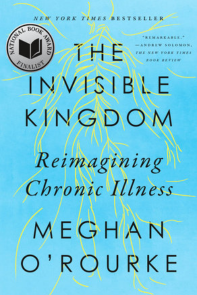
Celebrate this year’s Disability Pride Month with these great recommendations from the library. Spanning disability culture, activism, love, and finding yourself, our picks are a must-read for everyone!
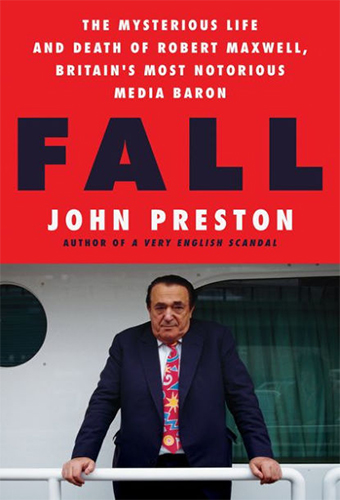
Fall: The Mysterious Life and Death of Robert Maxwell, Britain’s Most Notorious Media Baron John Preston
Ian Robert Maxwell (born Ján Ludvík Hyman Binyamin Hoch) was a Czechoslovak-born British media proprietor, member of Parliament (MP), suspected spy, and fraudster. He is a larger-than-life character whose triumphs, crimes, and human flaws are now notoriously documented.
Part of me appreciates this multifaceted and detailed analysis of Maxwell, but part of me is irritated at what sounds like tacitly absolving him of his worst crimes. All and all, this book by John Preston is breathtaking – you will gasp and choke on your emotions throughout it.
ELENA ZASLAVSKY Metadata Creation Professional, Metadata Creation Unit Collection Services Division — Metadata Services
Lady Justice: Women, the Law, and the Battle to Save America Dahlia Lithwick
Dahlia Lithwick profiles several women who used their legal expertise in various ways to challenge the excesses of the Trump administration. One thread that runs through the chapters (which cover topics like immigrant rights, reproductive rights, #MeToo in the federal judiciary, and protecting the vote) is the different perspectives on transformation from those who see themselves working inside versus outside the system.
KATHLEEN MCCARTHY Professor Ancient Greek and Roman Studies
The archivists of The Bancroft Library are pleased to announce that in the past quarter (April-June 2023) we have opened the following Bancroft archival collections to researchers.
Fuzz is a fun, pop-science book, like much of Roach’s work. The premise is: What happens when animals transgress on human society in different ways and how do different places handle that. Human rules meet the natural world with sometimes funny, sad, or concerning results.
CATHERINE CRONQUIST BROWNING Assistant Dean Academic Programs, Equity & Inclusion School of Information
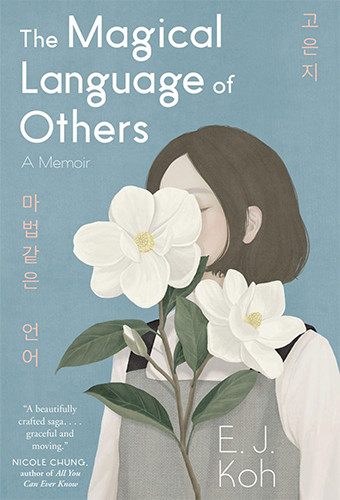
The Magical Language of Others: A Memoir E. J. Koh
As a young girl growing up in California, author E. J. Koh’s life is upended when her parents decide to return to their home country of South Korea, leaving her and her older brother behind to benefit from a life in America. Moving freely through time and space, Koh revisits this period of her life and beyond, building her memoir around the process of translating the (always unanswered) letters her mother would write to her. Through this literal process of “rewriting” her mother’s words, and the rules that hold a family together across generations, the book invites readers to embrace the imperfect but necessary role that language plays in enabling us to truly understand one another
Mario Cossío Olavide Universidad de Salamanca/IEMYRhd University of Minnesota/Center for Premodern Studies
Los Lucidarios
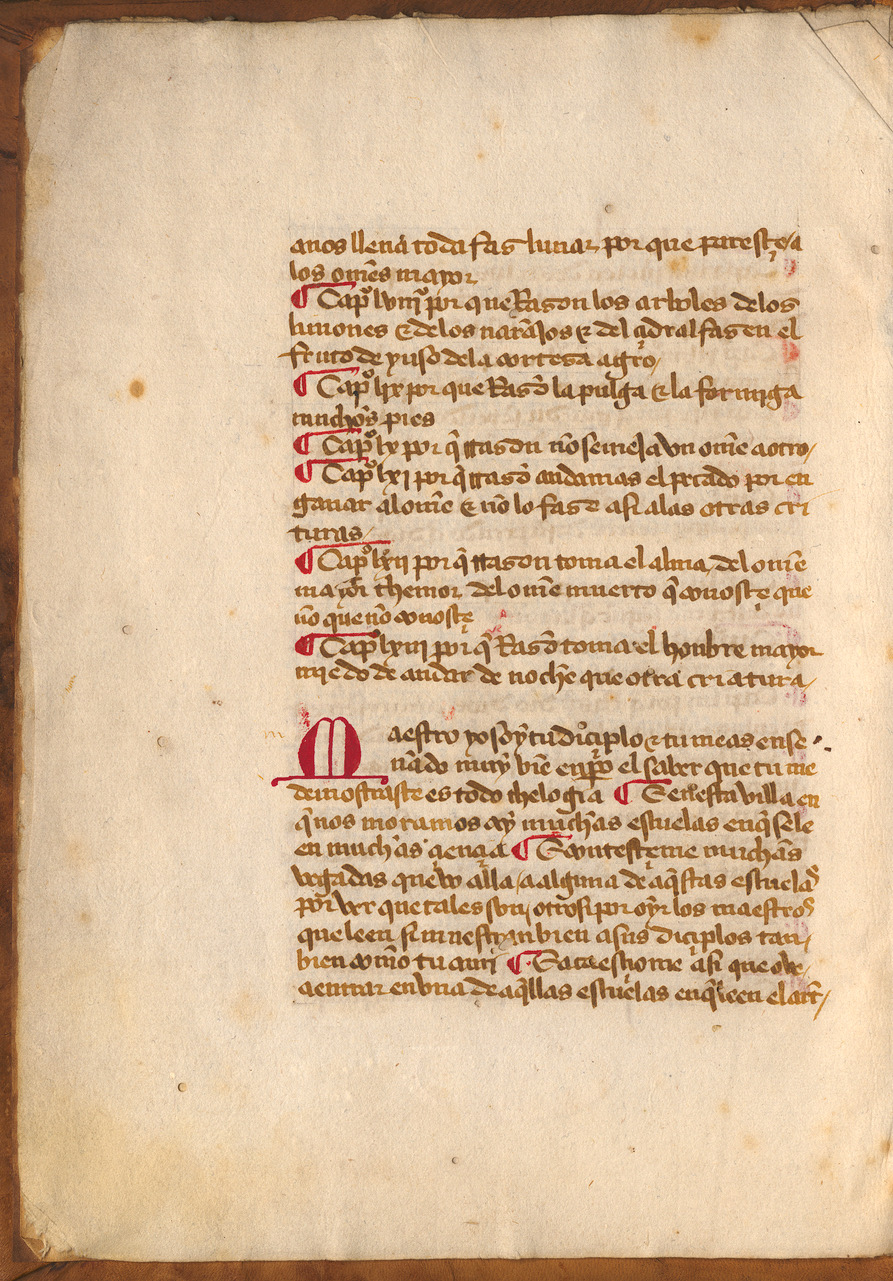
Cuando el célebre inspector de bibliotecas Henri Omont realizó el catálogo de los fondos de las bibliotecas públicas de Rouen, anotó que el manuscrito A283 de la Bibliothèque municipale –hoy Bibliothèque patrimoniale François Villon–, era un texto castellano del siglo XV al que le faltaba el título y que comenzaba en medio de la tabla de rúbricas. Tras la tabla, seguía el contenido de la obra, cuyas primeras líneas copió fielmente: “Maestro, yo soy tu discípulo e tú me as enseñado muy bien” (Cataloguegénérale, 184). El texto corresponde con el inicio del marco narrativo del Lucidario (BETA texid 1242).
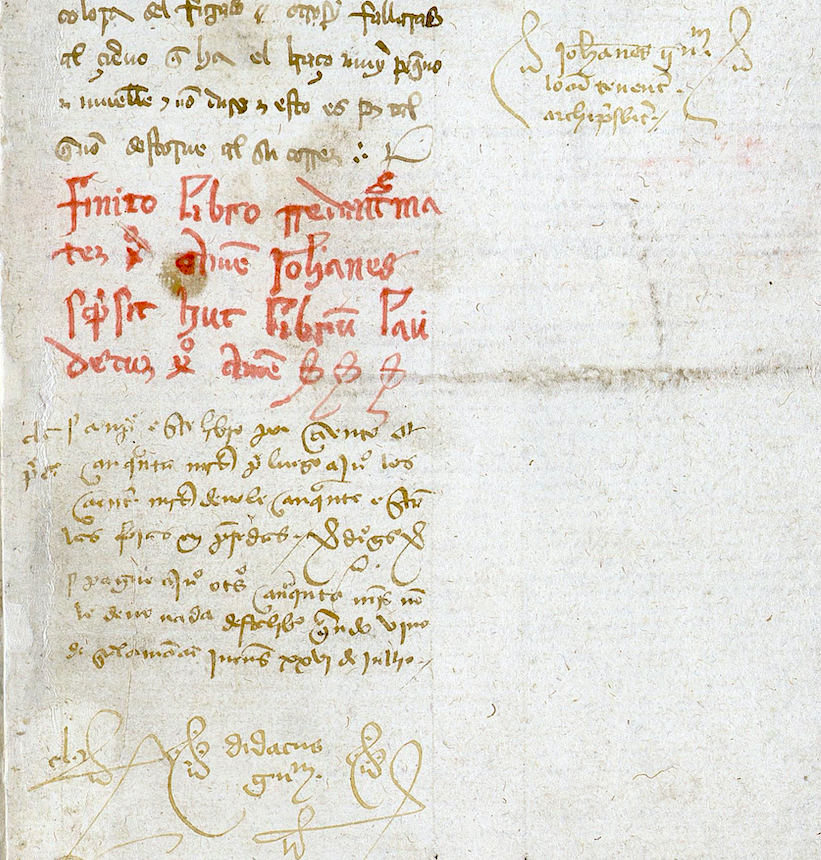
Imagen 1. Rouen: Bibliothèque municipale, Ms A283, f. 2v
El manuscrito transmite el octavo testimonio conocido de esta obra auspiciada por Sancho IV, al que le he dado la sigla H (BETA manid 6360). Se trata de una copia posiblemente realizada en los talleres napolitanos de los reyes de Aragón y que llegó a Rouen gracias a la compra de manuscritos de Federico I de Nápoles realizada por el cardenal Georges d’Amboise durante el exilio del monarca en Tours (para una descripción completa de su contenido, véase Cossío Olavide, “Un nuevo manuscrito”).
A H hay que sumarle un noveno testimonio, I (BETA manid 3067), que identifiqué hace unas semanas. La existencia de este texto también pasó desapercibida por mucho tiempo. Se encontraba en la Biblioteca Ducal de Medinaceli y de él había dado cuenta Antonio Paz y Meliá con una enigmática nota en su parcial catálogo del fondo, entre los “manuscritos curiosos”: “Libro del rey Sancho IV – Diálogo entre maestro y discípulo (Letra del siglo XV)” (Serie 2: 537). Entre todas las obras de Sancho IV, esta descripción solo puede ser aplicada al Lucidario. Después de la venta de la biblioteca en 1964, el manuscrito pasó a la colección de Bartolomé March en Madrid y, tras la muerte de este, fue trasladado, junto al resto de manuscritos, a la Biblioteca de la Fundación Bartolomé March de Palma (sobre este manuscrito, véase Cossío Olavide, “Un nuevo testimonio”).
Resulta interesante resaltar que se trata de un testimonio tardío del Lucidario, de mediados del siglo XVI por su letra y filigranas, mientras que el cuatrocientos acumula seis testimonios de la obra. Hay dos fechados, A (BNE MSS/3369 [BETA manid 1434]) de 1455 y C (Real Bibl. II/793 [BETA manid 1435]) de 1477. D, el códice Puñonrostro (RAE Ms. 15 [BETA manid 1424]), puede ser datado por sus filigranas entre 1450 y 1460 (Cossío Olavide, “D (RAE 15)”). G (RAH Cód. 101 [BETA manid 2285]) es de finales de siglo, mientras que H (Rouen BM A283 [BETA manid 6360]) es de mediados de la centuria.
El testimonio B (Salamanca BU Ms. 1958 [BETA manid 1433]) fue durante largo tiempo considerado de este siglo, pero sus filigranas y la letra empleada –muy similar a la cancilleresca– apuntan que fue producido entre 1380 y 1410. Esto es reconfirmado por una nota de compra-venta en los últimos folios, acompañada por las firmas de sus antiguos posesores, dos maestros salmantinos de las primeras décadas del siglo XV. Didacus Gundisalvi, Diego González, catedrático de derecho en la Universidad de Salamanca hacia 1433, y un Johanes Gundisalvi, locum tenentem archipresbiter, que bien podría ser Juan González de Segovia, catedrático de derecho canónico, teólogo y representante de Juan II en el Concilio de Basilea.
Imagen 2. Detalle del fol. 104r del ms. 1958 de la Biblioteca General Histórica de la Universidad de Salamanca
Manuscritos hispánicos en colecciones europeas
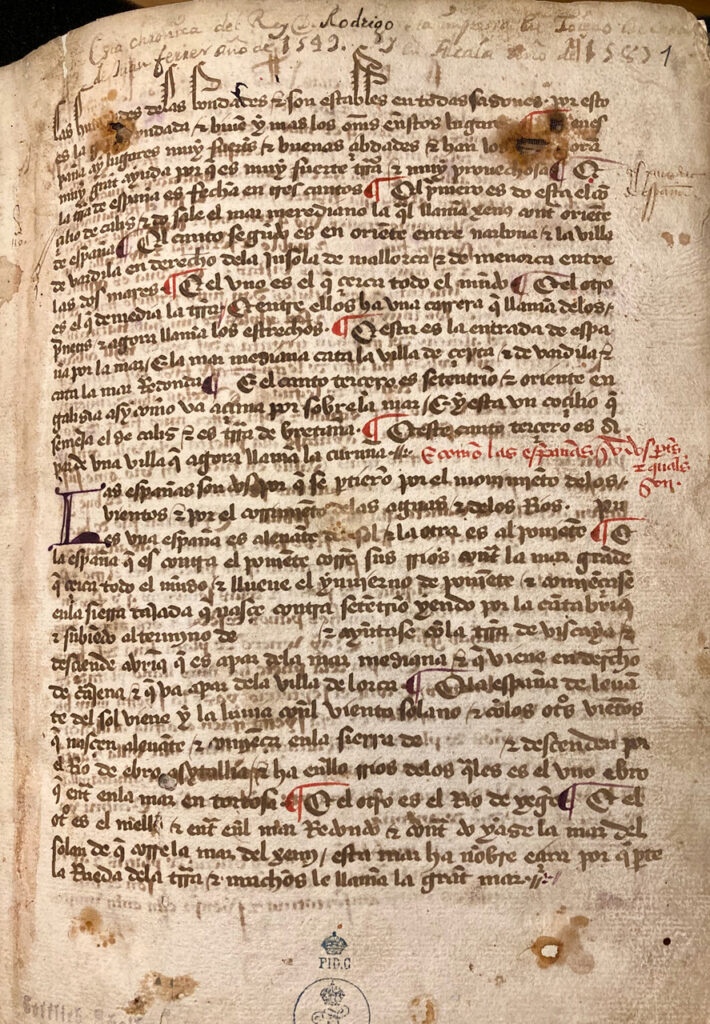
Un manuscrito recientemente redescubierto por Cossío Olavide y Romera Manzanares (“Nuevos testimonios”) es el Series Nova 12736 de la Biblioteca Nacional de Austria (BETA manid 6409), que transmite un testimonio parcial de la mal llamada Crónica del moro Rasis (BETA texid 1400) y de la Crónica sarracina (BETA texid 1462) de Pedro de Corral, datado entre 1460 y 1480.
Imagen 3. Fol. 1r del ms. Series Nova 12736 de la Österreichische Nationalbibliothek
Además de estos textos, el manuscrito vienés transmite dos romances tempranos en el fol. 36r y la guarda pegada a la contratapa final: Virgilios y ¡Ay de mi Alhama! (o Paséabase el rey moro), según se dará cuenta en Cossío Olavide y Pichel (“Dos romances”).
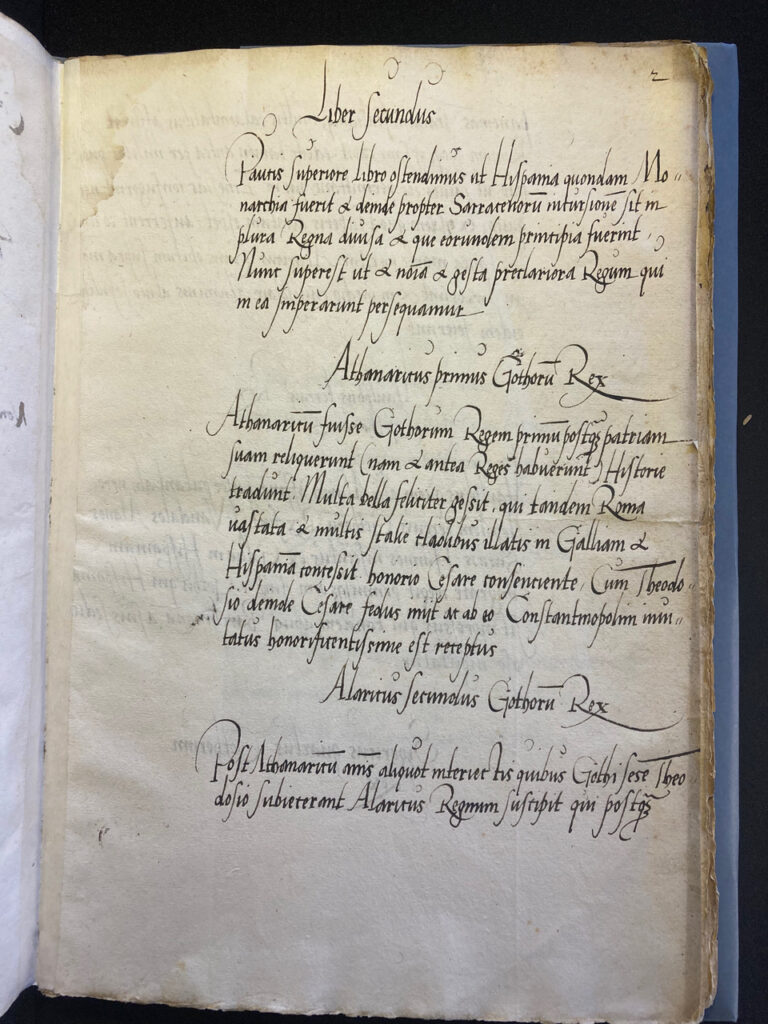
Otro texto de interés es el ms. 9221 de la misma biblioteca, un manuscrito facticio con doble numeración que transmite un repertorio de inscripciones sepulcrales alemanas (fols. 1r-73r) y un breve texto latino de formato analístico sobre los reyes visigodos (fols. 1rbis-10rbis). Aunque se trata de una copia del siglo XIX, parece estar vinculado con el Cronicón de Cardeña.
Imagen 4. Fol. 2r-bis del ms. 9221 de la Österreichische Nationalbibliothek
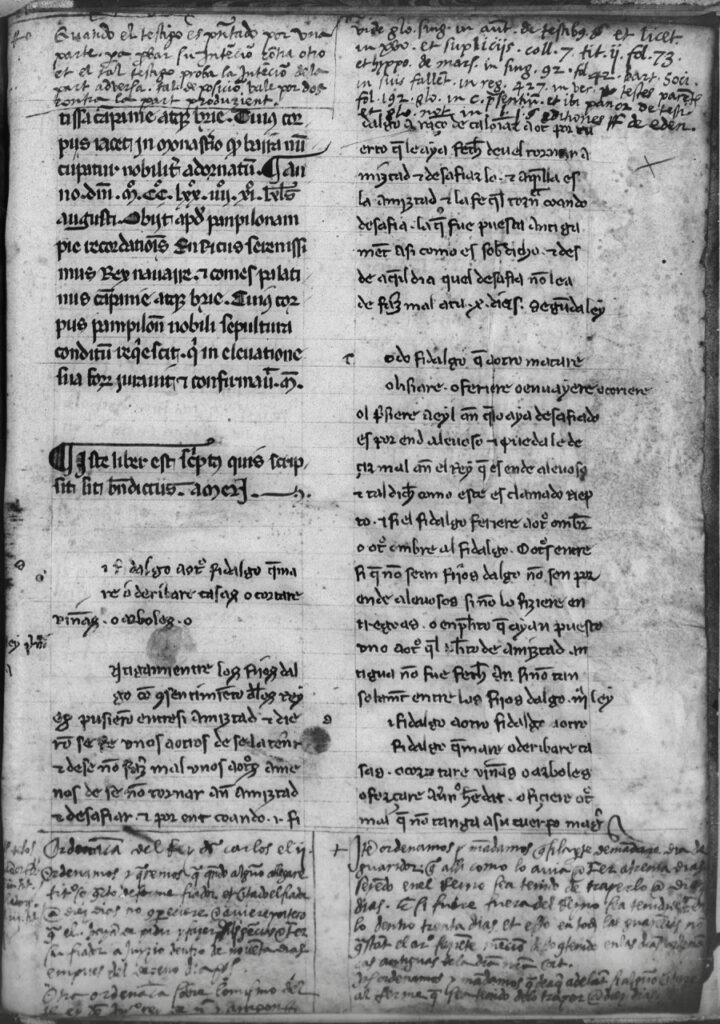
El manuscrito B702 de la Biblioteca Nacional de Suecia (BETA manid 4469) transmite la versión C del Fuero general de Navarra (BETA texid 1195), ampliado con disposiciones y textos legales añadidos, como el Amelloramiento de Philippe d’Evreux III (BETA texid 3192), estructura compartida por otros testimonios del fuero (BNE MSS/248 [BETA manid 1370] y MSS/ 6705 [BETA manid 3392], Biblioteca Regionale Universitaria di Catania ms. U009 [BETA manid 4600] y Real Biblioteca ms. II/1872 [BETA manid 3242]). Como estos, transmite en los fols. 114r-116v, una interpolación navarro-aragonesa del título de los retos del Fuero Real (libro 4, título 19), incorporada para cubrir un vacío legal en materia de justicia nobiliaria del Fuero general (véase Utrilla Utrilla, “Las interpolaciones” y Fradejas Rueda, “Una decepción”).
Imagen 5. Fol. 114r del ms. B702 de la Kungliga Biblioteket, Estocolmo
Referencias
Cossío Olavide, Mario y Ricardo Pichel. “Dos romances tempranos en un manuscrito historiográfico del siglo XV: ¡Ay de mi Alhama! y Virgilios (con una nota sobre la lectura del Amadís primitivo).” Actas del VIII Congreso Internacional de la Asociación Convivio, en prensa.
_____. “Un nuevo manuscrito (Rouen, Bibliothèque municipale Villon ms. A283) y una nueva edición del Lucidario de Sancho IV.” e-Spania, vol. 44, 2023. https://doi.org/10.4000/e-spania.46735
Fradejas Rueda, José Manuel. “Una decepción y un hallazgo. Una nueva copia del Fuero de Navarra.” Las Siete Partidas del Rey Sabio: una aproximación desde la filología digital y material, editado por José Manuel Fradejas Rueda, Enrique Jerez y Ricardo Pichel, Iberoamericana, 2021, pp. 138-43. https://doi.org/10.31819/9783968691503-011
Omont, Henri, editor. Catalogue général de manuscrits des bibliothèques publiques de France. Départaments, t. I. Rouen, Imprimerie nationale, 1886.
Paz y Meliá, Antonio. Series de los más importantes documentos del Archivo y Biblioteca del Excelentísimo Señor Duque de Medinaceli. 2 vols. Imprenta alemana e Imprenta de Blass, 1915-1922.
Romera Manzanares, Ana y Mario Cossío Olavide. “Vieron el escrito y mostráronlo. Nuevos testimonios de la Crónica del moro Rasis y de la Crónica sarracina.” Revista de literatura medieval, vol. 34, 2022, pp. 249-68. https://doi.org/10.37536/RLM.2022.34.1.87619
Utrilla Utrilla, Juan. “Las interporlaciones sobre reptorios en los manuscritos del Fuero general de Navarra.” Prínicpe de Viana. Anejo, no. 2-3, 1986, pp. 765-76.
Weapons of Math Destruction: How Big Data Increases Inequality and Threatens Democracy Cathy O’Neil
An examination of different algorithmic systems and how they structure our education, finances, career opportunities, and more, often amplifying biases or creating unintended consequences. O’Neil gives us insight into the semi-opaque rules that define our lives in an era where statistical principles are (mis)used to shape our world, and what we can/should do to understand, revise, or fight those rules. This book will keep you reading because you’ll get madder and madder, but you’ll appreciate the insight into things we don’t always know about.
CATHERINE CRONQUIST BROWNING Assistant Dean Academic Programs, Equity & Inclusion School of Information
Free: A Child and a Country at the End of History Lea Ypi
This memoir by an Albanian political scientist who now lives and works in Britain is a very interesting personal window into a little-studied country that had a very closed, Soviet-style socialist government until much later than its neighbors. Ypi discovers the rules that structured her life as she was growing up and has the opportunity to contrast them with different kinds of rules and social structures later in life. Ypi’s book is compelling and HIGHLY readable; I could not put it down. It’s also a book that doesn’t shy away from difficult things, but it’s not so heavy that it’s hard to get through.
CATHERINE CRONQUIST BROWNING Assistant Dean Academic Programs, Equity & Inclusion School of Information
Many of you may have already seen, or even read, the NSF Public Access Plan 2.0. This document, disseminated last week, is the National Science Foundation’s response to the OSTP Public Access Memo from August 2022, which requires all federal grant funding agencies to make research publications and their supporting data freely available and accessible, without embargo, no later than December 31, 2025. The public access plan is not the agency’s new policies, but rather the framework for how they will improve public access and address the new requirements. The agency states they will accomplish this prior to the December deadline, on January 31, 2025. I have highlighted just a few points from the report below.
The agency will leverage the existing NSF Public Access Repository (NSF-PAR) to make research papers, either the author’s accepted manuscript (AAM) or the publisher’s version of record (VOR), available immediately. All papers will be available in machine-readable XML, which will make additional research through text and data mining (TDM) possible.
The agency will continue to leverage relationships with long-standing disciplinary and generalist data repositories, like Dryad.
All data and publications will have permanent identifiers (PIDS). Data PIDS will be included with the article metadata.
The agency acknowledges the complexity in size, type, and quality of documentation with data. Publishing a dataset has far greater technical variability than publishing a manuscript. The agency will continue to explore how to best address data in the next two years.
The NSF has long required data management plans (DMPs). DMPs will be renamed to “data management and sharing plans,” or DMSPs, to better describe the required documentation and align with other agencies, like the NIH.
The above bullets are a mere 5 items in the lengthy report. Most importantly, over this next year, the Data Collaboration Team will develop an inreach plan to ensure all librarians and staff know how the OSTP memo and resulting policy will impact them and their researchers. Following awareness within the library, we will work on developing a coordinated outreach approach to support our researchers as they adapt to new requirements. This work will be in coordination with the Office of Scholarly Communication Services, the Research Data Management Program, and other longstanding LDSP partners.

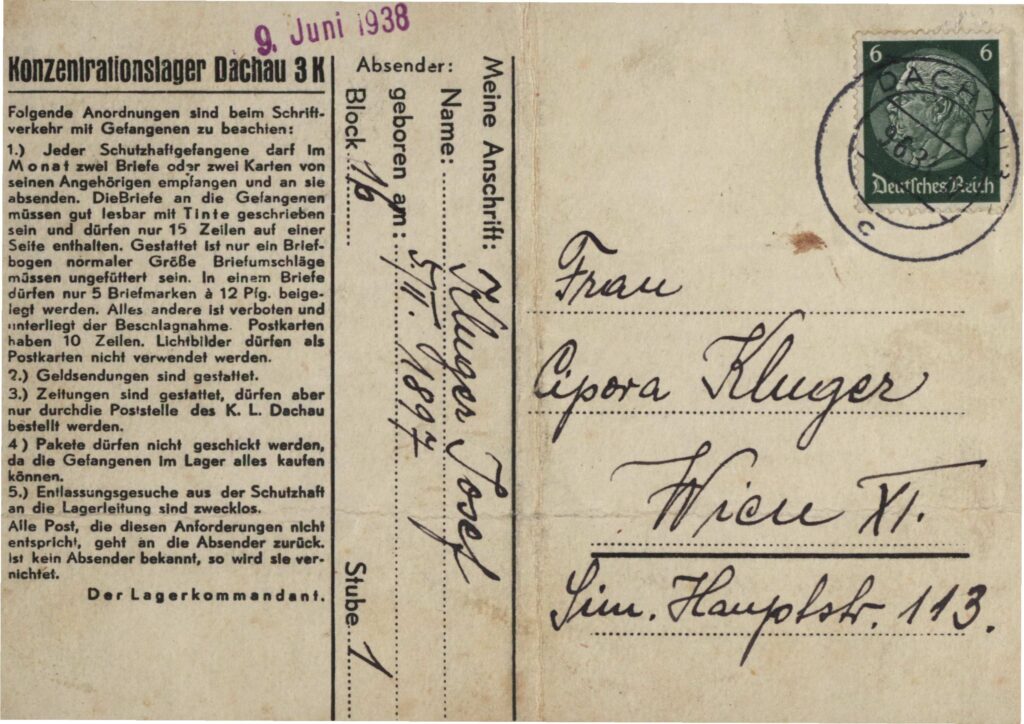 Correspondence from German Concentration Camps and Prisons is a digitized version of a “collection of items originating from prisoners held in German concentration camps, internment and transit camps, Gestapo prisons, and POW camps, during and just prior to World War II. Most of the collection consists of letters written or received by prisoners, but also includes receipts for parcels, money orders and personal effects; paper currency; and realia, including Star of David badges that Jews were forced to wear.”1