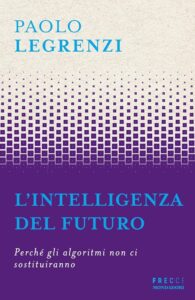
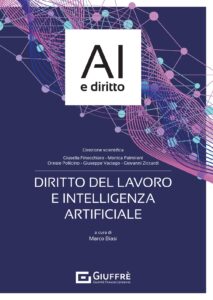
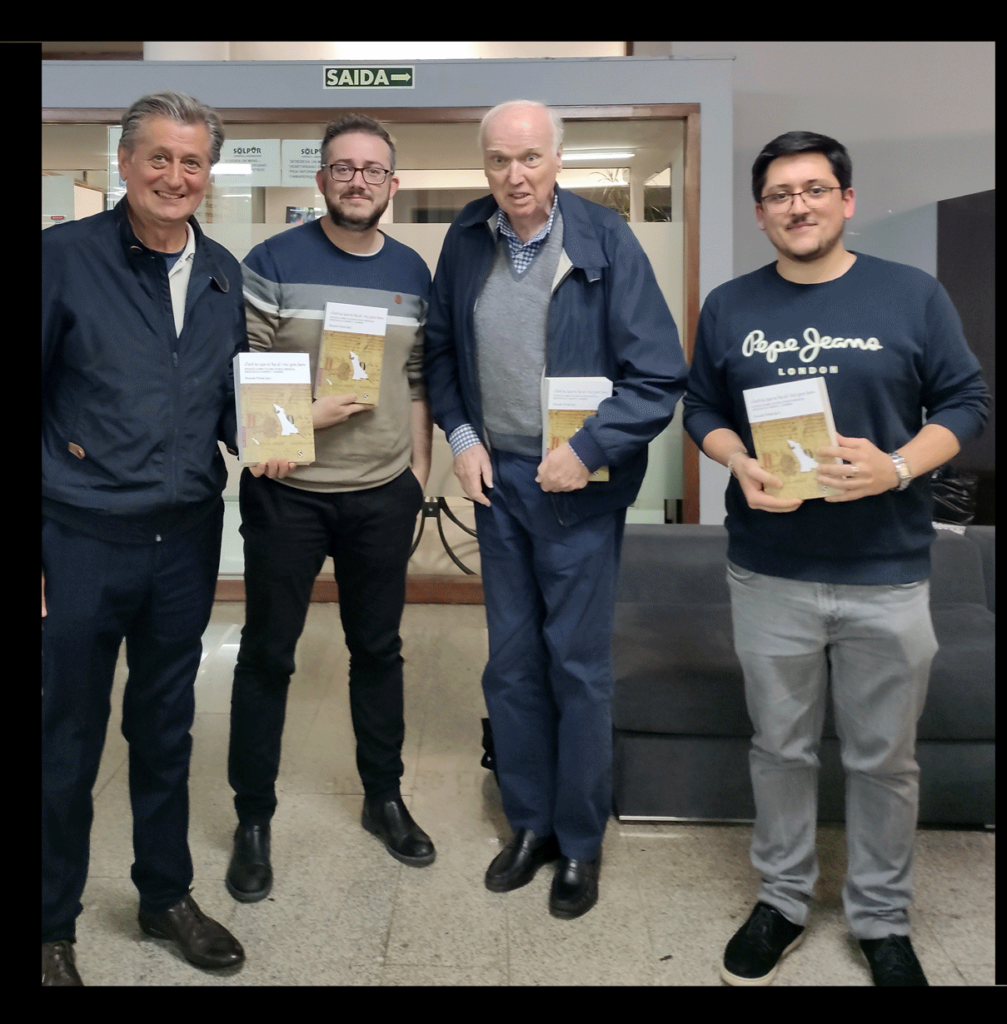
Judging by the explosion of new books on artificial intelligence, or AI, being published in Italy, you might think this Mediterranean country is the the editorial epicenter for one of the hottest interdisciplinary topics. Whether you are in the humanities, social sciences, human sciences, computer science, or STEM fields, “intelligenza artificiale” as it’s called in Italian will eventually find its way into your coursework or research. Here are just a few of the books on AI to recently reach bookstores in Italy and that have not automatically been sent to the UC Berkeley Library. However, if you are inclined just let your friendly Romance languages librarian know and he’ll be happy to push the first button to initiate this demand-driven order.*
*Demand-driven acquisition (DDA), is a model of library collection development in which a library only purchases materials when it is clear that a patron has demonstrated the need for a resource. If implemented correctly, DDA can make it possible to purchase only what is needed, allowing libraries to spend the same amount of money as they previously spent on monographs, but with a higher rate of use.
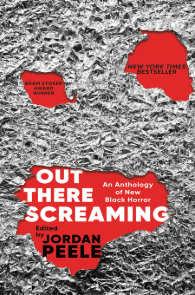
Get into the Halloween spirit with these chilling and spine-tingling reads! From ghostly tales and eerie mysteries to the darkest corners of the human mind, these books are perfect for embracing the spooky season this October. Check out more spooky finds at UCB Overdrive!
Library IT and the Library Data Services Program are thrilled to announce the launch of the UC Berkeley Library Dataverse, a new platform designed to streamline access to data licensed by the UC Berkeley Library. This initiative addresses the challenges users have faced in finding and managing data for research, teaching, and learning.
With Dataverse, we have simplified the data acquisition process and created a central hub where users can easily locate datasets and understand their terms of use. Dataverse is an open-source platform managed by Harvard’s Institute for Quantitative Social Science, and was selected for its robust features that enhance the user experience.
All licensed data, whether locally stored or vendor-managed, will now be available in Dataverse. While metadata is publicly accessible, users will need to log in to download datasets. This platform is the result of a collaborative effort to support both library staff and users. Anna Sackmann, our Data Services Librarian, will continue to assist with the acquisition process, while Library IT oversees the platform’s maintenance. We are also committed to helping researchers publish their data by guiding them toward the best repository options.
This October, the Literatures community in the UC Berkeley Library wants to acknowledge that Berkeley sits on the territory of xučyun (Huichin (Hoo-Choon), the ancestral and unceded land of the Chochenyo (Cho-chen-yo) speaking Ohlone people, the successors of the historic and sovereign Verona Band of Alameda County. For more information on UC Berkeley’s stance, take a look at Centers for Educational Justice & Community Engagement’s statement on Ohlone Land.
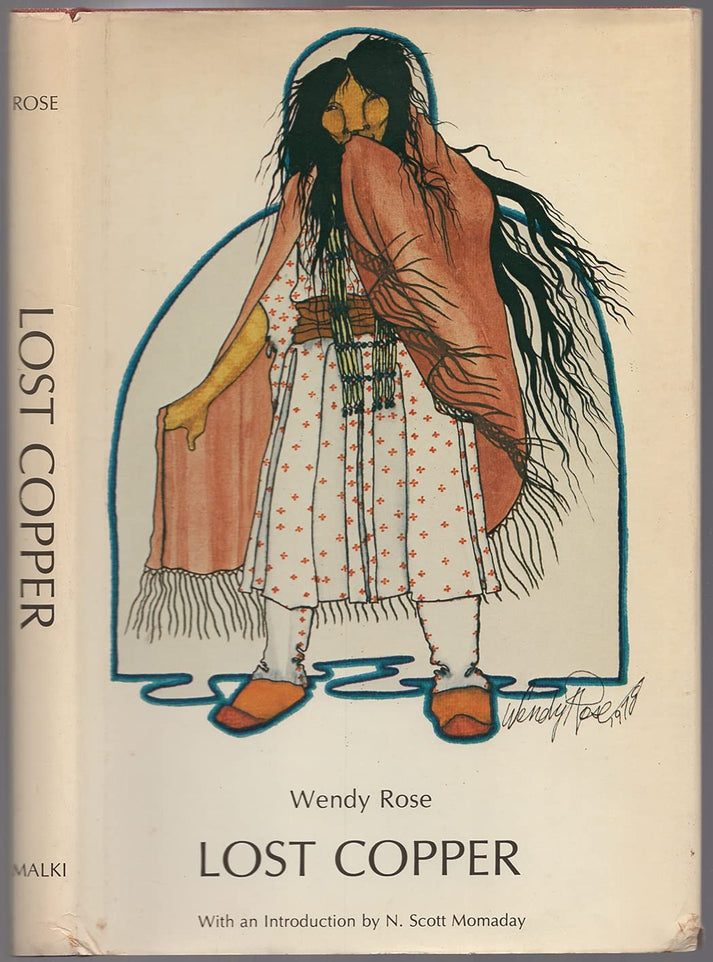
To celebrate that history, here are a few excerpts from different California Indigenous peoples including Ohlone as well as Chowchilla- or Coast Miwok poets that this Literatures group enjoys. We encourage you to read the full poems and check out the authors’ collections.
November 1980
November
and up near Eureka
the highway has tumbled
with what may be
the last earthquake
of the year; offshore
Jade green water
chops holes in the yellow
sandstone cliff.
[…]
You plan an uncomplicated path
through Colorado’s red dust,
around the caustic edge of Utah’s salt flats
a single night at a hotel
in the Idaho panhandle. Our plans change.
It’s spring, we are two Indian women along
together and the days open:
sunrise on a fine long road,
antelope against dry hills,
heron emerging from dim fields.
You tell me this is a journey
you’ve always wanted to take.
You ask me to tell you what I want.
[…]
Standing high on this hillside
the wind off the Pacific
forming the language of grasses
and escarpment eternally speaking
the sea birds far out
on their planes of air
gather and squander
what the short days encompass
[…]
– Stephen Meadows . For full poem check out the anthology The Sound of Rattles and Clappers (UC Library Catalog) or take a look at Meadows’ recent book Winter Work (UC Library Search).
Memory Weaver
Grandmother weave me a story
The memories she pulls out of me sting like poison. Her little fingers nimbly poke the top of my scalp, as if she was carefully choosing each memory to set on top of her loom.
The silence is deafening as Grandmother Dreamweaver works on my unusual request. She is the protector of dreams, not a keeper of memories. Yet, she understands what I have asked of her.
[…]
– Yulu Ewis. For full poem, see News from Native California, Berkeley. 32,.no. 3 (Spring 2019): 24 on Ethnic News Watch. For additional poetry, take a look at Dream Weaver and the Coyote-Man’s Tale (soon to be in the UC Berkeley Library).
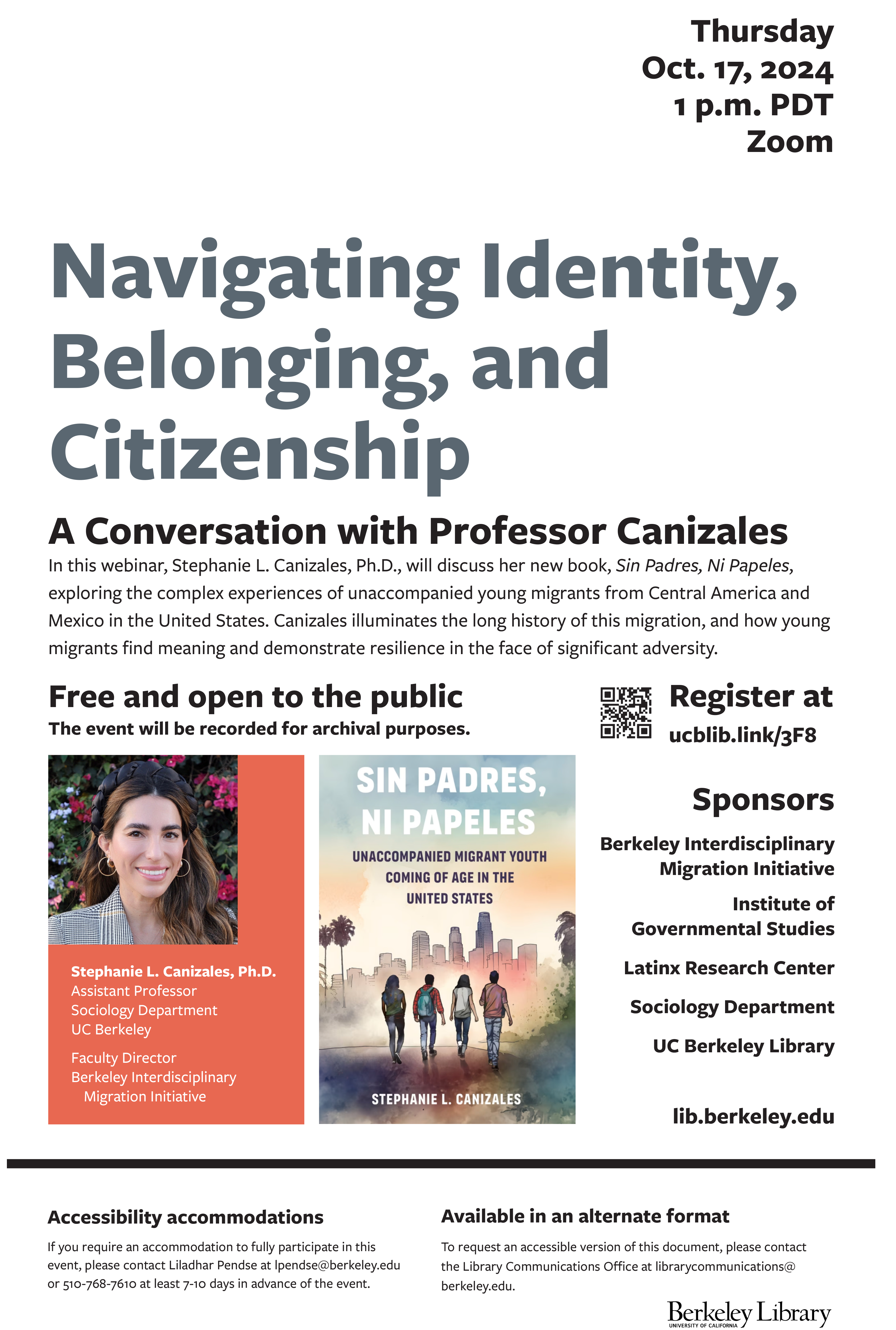
Navigating Identity, Belonging, and Citizenship: A Conversation with Professor Canizales
In this webinar, Stephanie L. Canizales, Ph.D., will discuss her new book, Sin Padres, Ni Papeles, which explores the complex experiences of unaccompanied young migrants from Central America and Mexico in the United States. Canizales illuminates the long history of this migration and how young migrants find meaning and demonstrate resilience in the face of significant adversity.
Assistant Professor
Sociology Department
UC Berkeley
Faculty Director
Berkeley Interdisciplinary Migration Initiative
Accessibility accommodations
If you require an accommodation to fully participate in this event, please contact Liladhar Pendse at lpendse at berkeley.edu or 510-768-7610 at least 7-10 days in advance of the event. Organizer: Dr. Liladhar R. Pendse
Available in an alternate format
To request an accessible version of this document, please contact the Library Communications Office at librarycommunications@berkeley.edu.
Navigating Identity, Belonging, and Citizenship: A Conversation with Professor Canizales
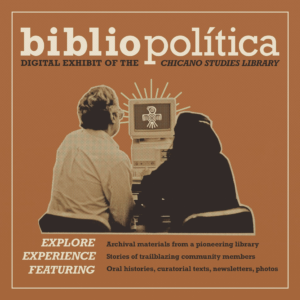
At the intersection of Chicana/o/x Studies, Digital Humanities and Library History, Bibliopolítica: A Digital History of the Chicano Studies Library chronicles the history of one of the first Chicana/o/x collections, the Chicano Studies Library at the University of California, Berkeley.
Bibliopolítica shares the stories of trailblazing library workers, students and community members who worked to preserve and make Chicana/o/x resources available. Featuring photographs, ephemera, archival documents, and oral histories, Bibliopolítica offers an original digital collection of primary sources and is the first audiovisual history of this special place that helped redefine what libraries could be.
Bibliopolítica takes its name from a book of the same title that Richard Chabrán and librarian colleague Francisco García-Ayvens published in 1984, BiblioPolítica: Chicano Perspectives on Library Service in the United States. In 2024, it remains one of the few titles dedicated to the discussion of Chicana/o/x librarianship. Bibliopolítica: a Digital History of the Chicano Studies Library adds to this important conversation, but it is only the beginning of a much needed longer and more detailed history of the Chicano Studies Library and the contributions of Chicana/o/x library workers.
Co-curated by Amanda Belantara – Assistant Curator at New York University Libraries, Lillian Castillo-Speed – former Chicano Studies Library Coordinator, now Head Librarian of the Ethnic Studies Library at UC Berkeley, and Richard Chabrán – former Chicano Studies Library Coordinator, Team Leader Latino Digital Archive Group.
Digitization of archival items by Chrissy Huhn and UC Berkeley Library IT and Oral history recordings at Berkeley by Pablo Gonzalez and Angelica Garcia. See additional credits.
It is with deep sadness that we share the news that Harvey Sharrer, our dear friend and colleague and co-director of the Bibliografia de Textos Antigos Galegos e Portugueses (BITAGAP) for more than thirty-five years, died unexpectedly last month.
Harvey, Professor Emeritus at the University of California Santa Barbara, passed away at his home in Santa Barbara on September 12, 2024. His life was dedicated to teaching, academic research, and world exploration.
Born in Oakland, California in 1940 to Ruth Morehouse and Harvey Sharrer, he spent his formative years in Oakland and Danville, California, graduating from San Ramon Valley High School in 1958. His passion for foreign languages was ignited by his high school Spanish teacher, who inspired him to pursue language studies in college. After graduating from high school, Harvey took a summer course at the Monterey Institute of Foreign Studies and spent Fall quarter at the University of San Francisco. He then took a gap year to work with his father’s remodeling business, saving money for a transformative month’s-long European trip with a high school friend—an experience that kindled his lifelong love for world travel.
Returning to the U.S., Harvey earned his bachelor’s and master’s degrees in Spanish from UC Berkeley in 1963 and 1965, respectively, followed by a doctorate in Hispanic and Luso-Brazilian Literature from UCLA in 1970, with a dissertation on “The Legendary History of Britain from its Founding by Brutus to the Death of King Arthur in Lope García de Salazar’s Libro de las bienandanzas e fortunas.” Even before finishing his dissertation he had published a Critical Bibliography of Hispanic Arthurian Material, I: Texts: The Prose Romance Cycles (London: Grant & Cutler, 1977) in Alan Deyermond’s fundamental series of Research Bibliographies & Checklists. He spent his entire academic career at UC Santa Barbara, starting in 1968 as an Acting Assistant Professor and progressing steadily through the canonical ranks to full professor in 1981. He served as chair of the UCSB Department of Spanish & Portuguese in 1978-1981 and then again 2002-2003.
Dr. Sharrer was universally admired for his scholarship and the impressive breadth of his knowledge of medieval literature and culture, encompassing Arthurian literature, the medieval Romance lyric, and, increasingly, the digital humanities—a field in which he was a pioneer. He made significant scholarly contributions to our knowledge of medieval and early modern Portuguese, Galician, Spanish, and Catalan literatures. His expertise in Catalan was honed by the two years (1984-1986) he spent as the director of the Barcelona Study Center (U. of California and U. of Illinois), where he enjoyed the friendship of Vicenç Beltran and Gemma Avenoza, who would become colleagues in PhiloBiblon as the directors of the Bibliografia de Textos Antics Catalans (BITECA).
He collaborated on BITAGAP with his friends Arthur Askins and Martha Schaffer from its beginning in 1989 as one of PhiloBiblon‘s three constituent bibliographies, all three dedicated to uncovering and documenting the primary sources of the medieval Romance literatures of the Iberian Peninsula:
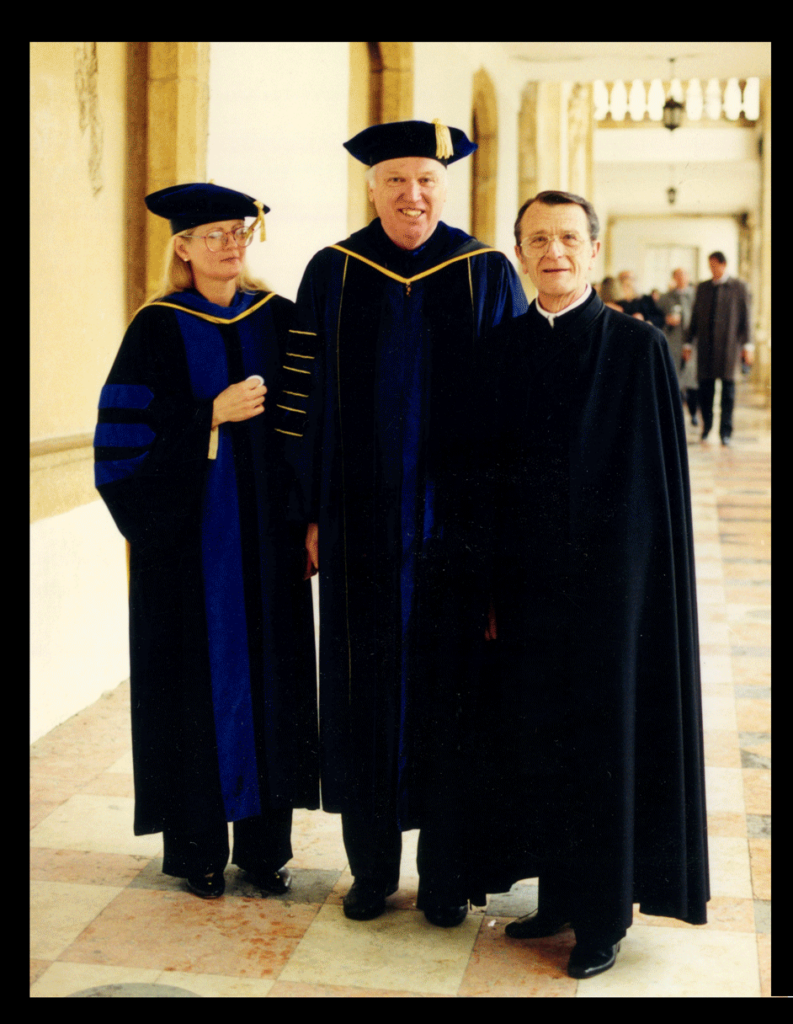
Martha Schaffer and Arthur Askins with Harvey Sharrer in Coimbra in 1999, on the occasion of the investiture of Askins as Doctor honoris causa of the Universidade de Coimbra.
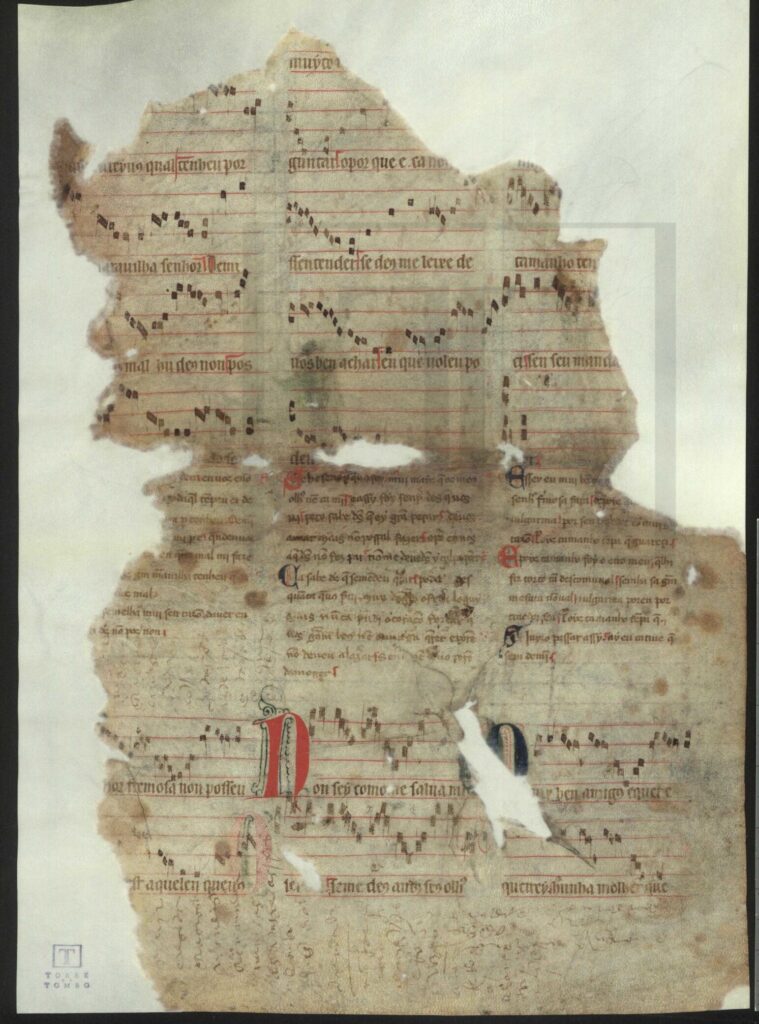
The three colleagues were indefatigable ratones de bibliotecas, systematically quartering Portugal, from Bragança in the north to Lagos in the south, in search of new manuscripts of medieval Portuguese and Galician texts. They found the richest collections, however, in Lisbon: the Biblioteca Nacional de Portugal, the Ajuda library, and Arquivo Nacional da Torre do Tombo. They and their Portuguese collaborators, especially Pedro Pinto and Filipe Alves Moreira, combed through those collections assiduously. Harvey’s most spectacular discovery, in 1990, was the eponymous Pergaminho Sharrer, a parchment fragment with seven lyric poems in Galician-Portuguese, with music, by King Dinis of Portugal (1278-1325) . It had been used as the cover of a bundle of 16th-c. documents in the Torre do Tombo, a not uncommon practice during the period.
Pergaminho Sharrer, with seven poems by King Dinis of Portugal, with music
Retirement came in 2011, but it did little to slow Harvey down. He continued to participate in conferences worldwide and, at UCSB, generously proofread articles for his former department. He remained a respected and admired scholar, mentor, and colleague throughout his life.
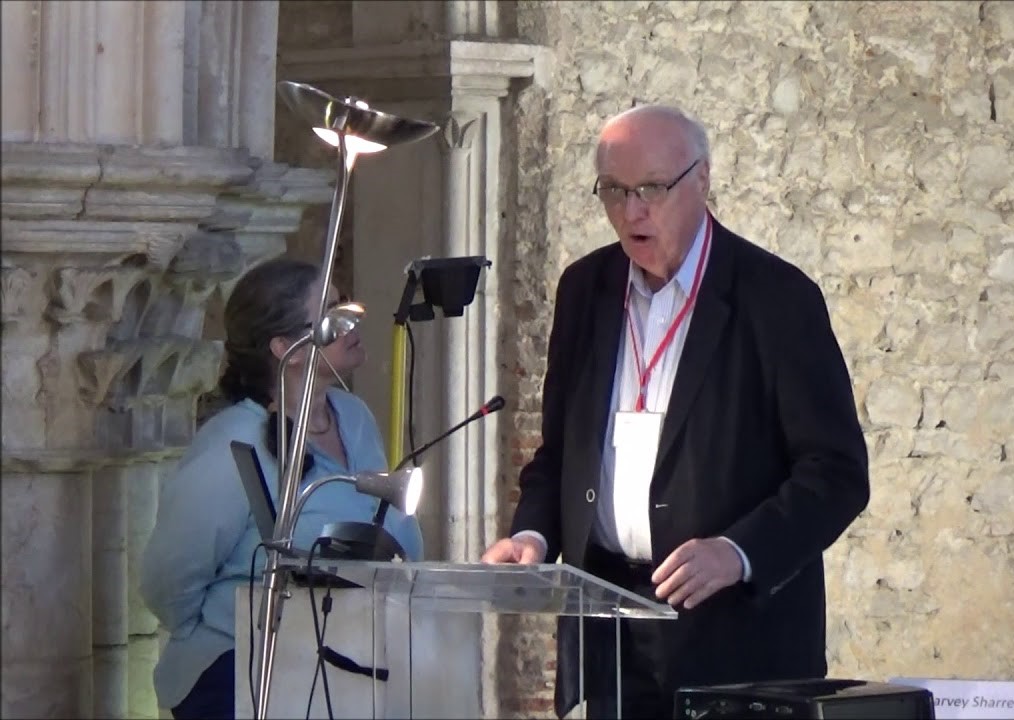
Harvey at the microphone
Harvey’s career was commemorated by a splendid volume of homage studies edited by Ricardo Pichel, “Tenh’eu que mi fez el i mui gran ben”. Estudos sobre cultura escrita medieval dedicados a Harvey L. Sharrer (Madrid: Silex, 2022):
Presentation of the homage volume in Santiago de Compostela: (from left): Xavier Varela Barreiro, Ricardo Pichel, Harvey Sharrer, Miguel García-Fernández
Harvey Sharrer will be deeply missed for his extraordinary scholarship, his remarkable mentorship of and generosity toward students and young scholars, and his courteous and congenial personality, um cavaleiro da escola antiga. His work will continue to influence future generations of students and scholars. In recognition of his scholarly career and lasting impact on the Santa Barbara campus, the campus flag was lowered to half-staff on Wednesday, October 2.
Harvey, who never married and considered his scholarly career to be his life’s work, is survived by a sister, Elizabeth Porter, in Upland, California, a brother, William Sharrer, in Louisville, Kentucky, and several cousins, nieces, and nephews who will miss him dearly.
Harvey did not wish to have a formal memorial service, but rather planned to create an endowment in his name at UC Santa Barbara, to be called the “Harvey L. Sharrer Dissertation Travel Grants.” Plans for this endowment are going forward actively, and we will announce them opportunely. It will support future scholars in their research endeavors, particularly in the field of Ibero-Romance languages, reflecting Harvey’s lifelong passion and areas of expertise.
William L. Sharrer Elide V. Oliver Charles B. Faulhaber
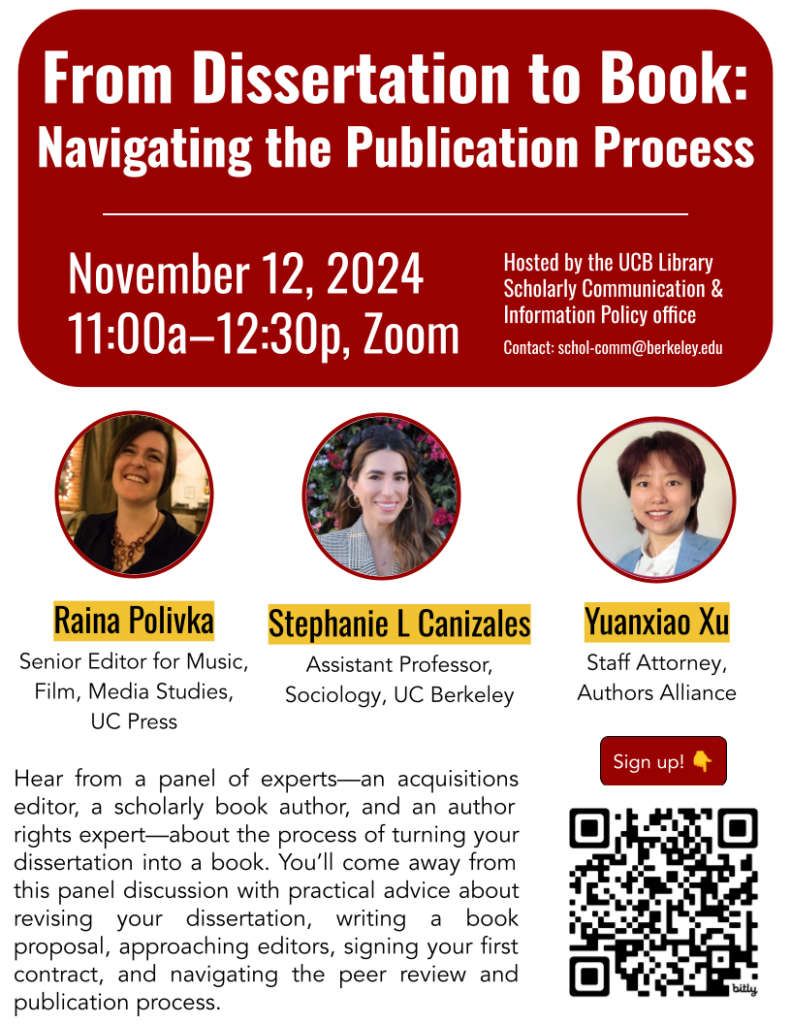
Date/Time: Tuesday, November 12, 2024, 11:00am–12:30pm Location: Zoom. RSVP.
Hear from a panel of experts—an acquisitions editor, a first-time book author, and an author rights expert—about the process of turning your dissertation into a book. You’ll come away from this panel discussion with practical advice about revising your dissertation, writing a book proposal, approaching editors, signing your first contract, and navigating the peer review and publication process.
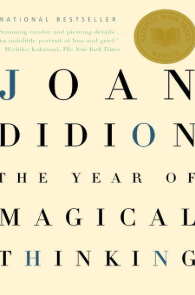
Celebrate Disability Awareness Month by exploring powerful stories and insights from disabled authors. Discover more diverse perspectives that inspire and educate on UCB Overdrive!
Last post, I promised to talk about using structured data with a dataset focused on 1950s Bay Area publishing. To get into that topic, I’m going to talk about 1) setting out with a research question as well as 2) data discovery, and 3) data organization, in order to do 4) initial mapping.
Background to my Research
When I moved to the Bay Area, I (your illustrious Literatures and Digital Humanities Librarian) started exploring UC Berkeley’s collections. I wandered through the Doe Library’s circulating collections and started talking to our Bancroft staff about the special library and archive’s foci. As expected, one of UC Berkeley’s collecting areas is California publishing, with a special emphasis on poetry.
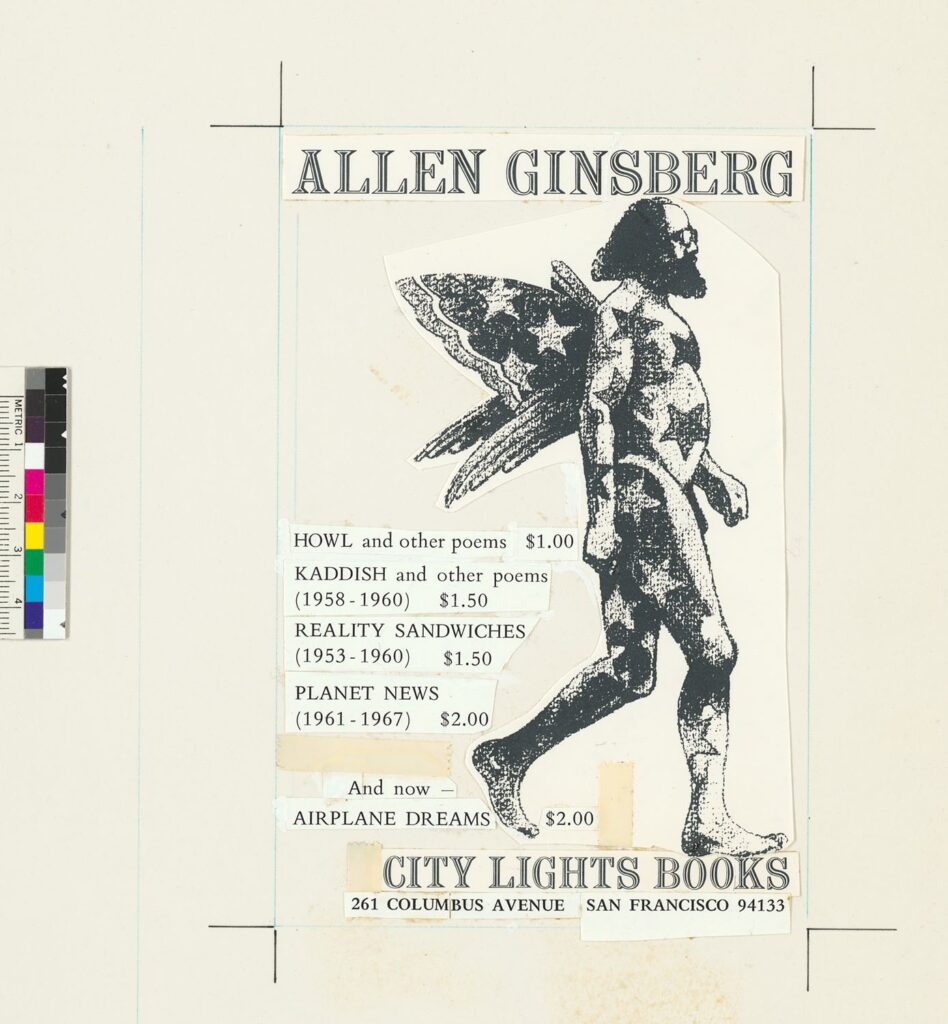
Mock-up of ad for books by Allen Ginsberg, City Lights Books Records, 1953-1970, Bancroft Library.
In fact, some of Bancroft’s oft-used materials are the City Light Books collections (link to finding aids in the Online Archive of California) that include some of Allen Ginsberg’s pre-publication drafts of “Howl” and original copies of Howl and Other Poems. You may already know about that poem because you like poetry, or because you watch everything with Daniel Radcliffe in it (IMDB on the 2013 Kill your Darlings). This is, after all, the very poem that led to the seminal trial that influenced U.S. free speech and obscenity laws (often called The Howl Obscenity Trial) . The Bancroft collections have quite a bit about that trial as well as some of Ginsberg’s correspondence with Lawrence Ferlinghetti (poet, bookstore owner, and publisher) during the harrowing legal case. (You can a 2001 discussion with Ferlinghetti on the subject here.)
Research Question
Interested in learning more about Bay Area publishing in general and the period in which Ginsberg’s book was written in particular, I decided to look into the Bay Area publishing environment during the 1950s and now (2020s), starting with the early period. I wanted a better sense of the environment in general as well as public access to books, pamphlets, and other printed material. In particular, I wanted to start with the number of publishers and where they were.
Data Discovery
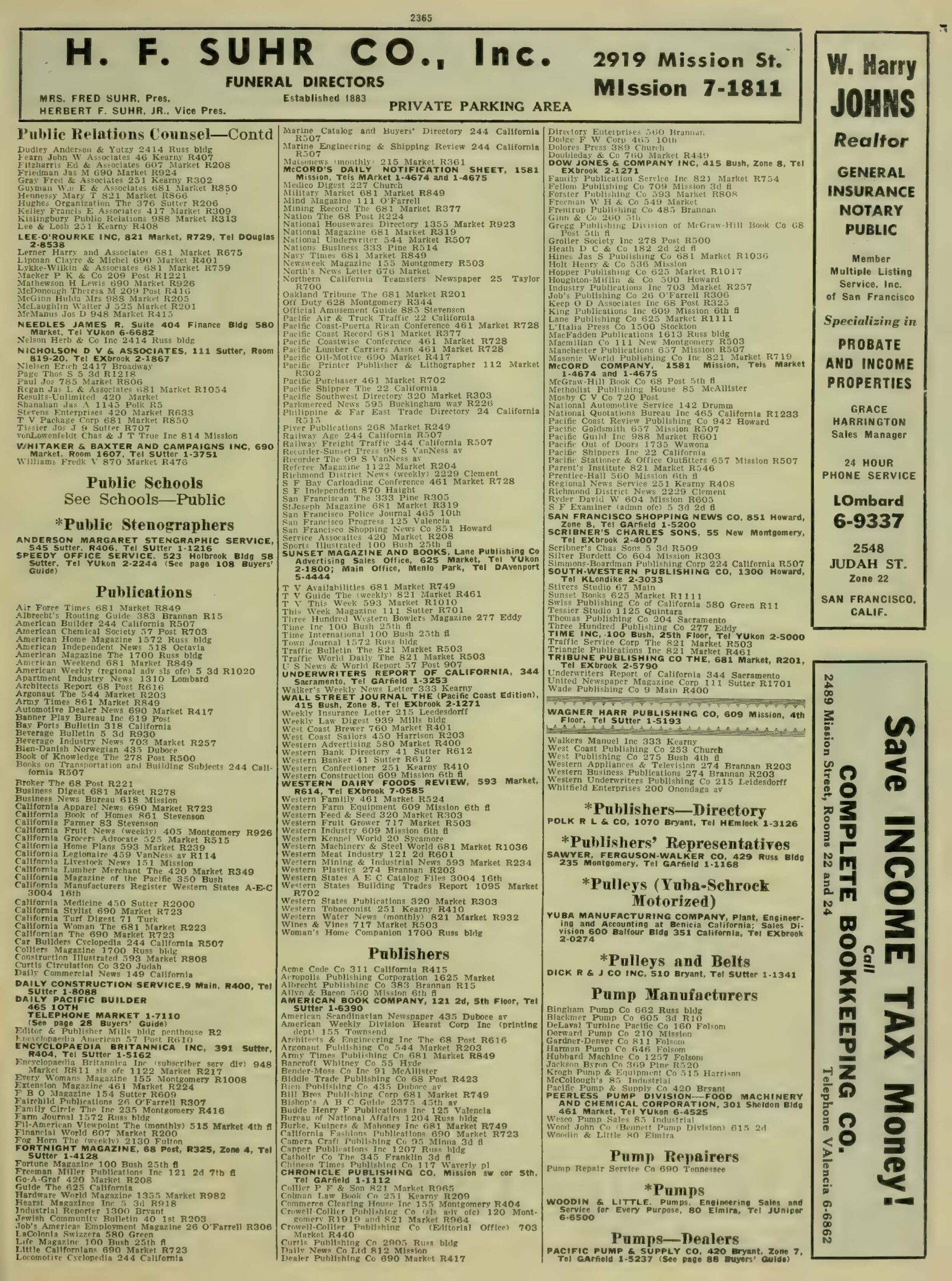
For a non-digital, late 19th and 20th century era, one of the easiest places to start getting a sense of mainstream businesses is to look in city directories. There was a sweet spot in an era of mass printing and industrialization in which city directories were one of the most reliable sources of this kind of information, as the directory companies were dedicated to finding as much information as possible about what was in different urban areas and where men and businesses were located. The directories, as a guide to finding business, people, and places, were organized in a clear, columned text, highly standardized and structured in order to promote usability.
Raised in an era during which city directories were still a normal thing to have at home, I already knew these fat books existed. Correspondingly, I set forth to find copies of the directories from the 1950s when “Howl” first appeared. If I hadn’t already known, I might have reached out to my librarian to get suggestions (for you, that might be me).
I knew that some of the best places to find material like city directories were usually either a city library or a historical society. I could have gone straight to the San Francisco Public Library’s website to see if they had the directories, but I decided to go to Google (i.e., a giant web index) and search for (historic san francisco city directories). That search took me straight to the SFPL’s San Francisco City Directories Online (link here).
On the site, I selected the volumes I was interested in, starting with Polk’s Directory for 1955-56. The SFPL pages shot me over to the Internet Archive and I downloaded the volumes I wanted from there.
Once the directory was on my computer, I opened it and took a look through the “yellow pages” (i.e., pages with information sorted by business type) for “publishers.”
Note the dense columns of text almost overlap. From R.L. Polk & Co, Polk’s San Francisco City Directory, vol. 1955–1956 (San Francisco, Calif. : R.L. Polk & Co., 1955), Internet Archive. | Public Domain.
Glancing through the listings, I noted that the records for “publishers” did not list City Light Books. Flipped back to “book sellers,” I found it. That meant that other booksellers could be publishers as well. And, regardless, those booksellers were spaces where an audience could acquire books (shocker!) and therefore relevant. Considering the issue, I also looked at the list for “printers,” in part to capture some of the self-publishing spaces.
I now had three structured lists from one directory with dozens of names. Yet, the distances within the book and inability to reorganize made them difficult to consider together. Furthermore, I couldn’t map them with the structure available in the directory. In order to do what I wanted with them (i.e., meet my research goals), I needed to transform them into a machine readable data set.
Creating a Data Set
Machine Readable
I started by doing a one-to-one copy. I took the three lists published in the directory and ran OCR across them in Adobe Acrobat Professional (UC Berkeley has a subscription; for OA access I recommend Transkribus or Tesseract), and then copied the relevant columns into a Word document.
Data Cleaning
The OCR copy of the list was a horrifying mess with misspellings, cut-off words, Ss understood as 8s, and more. Because this was a relatively small amount of data, I took the time to clean the text manually. Specifically, I corrected typos and then set up the text to work with in Excel (Google Sheets would have also worked) by:
creating line breaks between entries,
putting tabs between the name of each institution and corresponding address
Once I’d cleaned the data, I copied the text into Excel. The line breaks functioned to tell Excel where to break rows and the tabs where to understand columns. Meaning:
Each institution had its own row.
The names of the institutions and their addresses were in different columns.
Having that information in different spaces would allow me to sort the material either by address or back to its original organization by company name.
Adding Additional Information
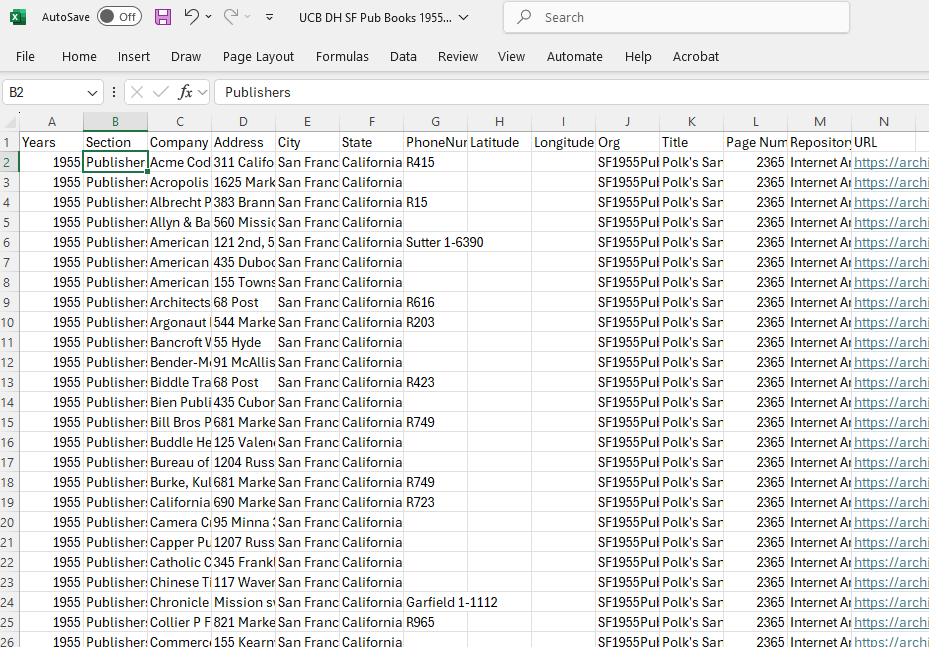
I had, however, three different types of institutions—Booksellers, Printers, and Publishers—that I wanted to be able to keep separate. With that in mind, I added a column for EntryType (written as one word because many programs have issues with understanding column headers with spaces) and put the original directory headings into the relevant rows.
Knowing that I also wanted to map the data, I also added a column for “City” and another for “State” as the GIS (i.e., mapping) programs I planned to use wouldn’t automatically know which urban areas I meant. For these, I wrote the name of the city (i.e., “San Francisco”) and then the state (i.e., “California”) in their respective columns and autofilled the information.
Next, for record keeping purposes, I added columns for where I got the information, the page I got it from, and the URL for where I downloaded it. That information simultaneously served for me as a reminder but also as a pointer for anyone else who might want to look at the data and see the source directly.
I put in a column for Org/ID for later, comparative use (I’ll talk more about this one in a further post,) and then added columns for Latitude and Longitude for eventual use.
The column headers here are: Years; Section; Company; Address; City; State; PhoneNumber; Latitude; Longitude; Org; Title; PageNumber; Repository; URL. Click on the chart to see the file.
Finally, I saved my data with a filename that I could easily use to find the data again. In this case, I named it “BayAreaPublishers1955.” I made sure to save the data as an Excel file (i.e., .xmlx) and Comma Separated Value file (i.e., .csv) for use and preservation respectively. I also uploaded the file into Google Drive as a Google Sheet so you could look at it.
Initial Mapping of the Data
With that clean dataset, I headed over to Google’s My Maps (mymaps.google.com) to see if my dataset looked good and didn’t show locations in Los Angeles or other spaces. I chose Google Maps for my test because it is one of the easiest GIS programs to use
because many people are already used to the Google interface
the program will look up latitude and longitude based on address
it’s one of the most restrictive, meaning users don’t get overwhelmed with options.
Heading to the My Maps program, I created a “new” map by clicking the “Create a new map” icon in the upper, left hand corner of the interface.
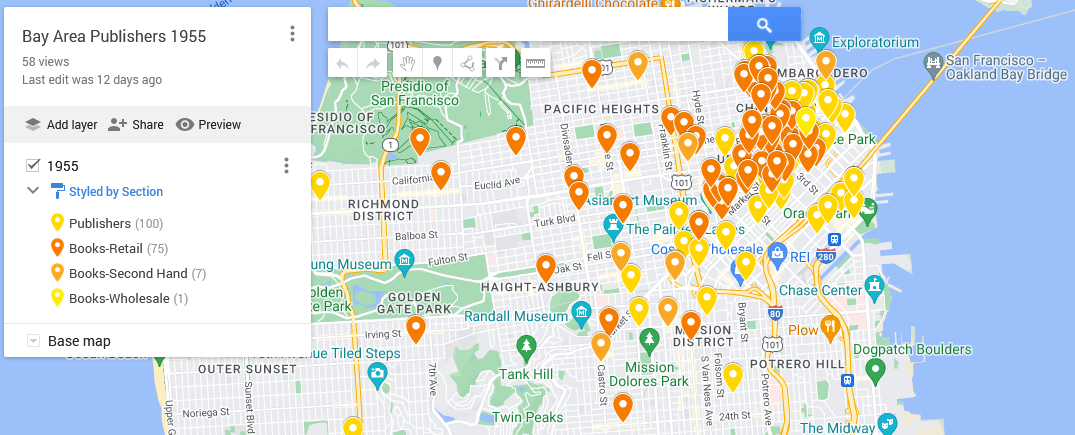
From there, I uploaded my CSV file as a layer. Take a look at the resulting map:
Click on the map for an interactive version. Note that I’ve set the pins to differ in column by “type.”
The visualization highlights the centrality of the 1955 San Francisco publishing world, with its concentration of publishing companies and bookstores around Mission Street. Buying books also necessitated going downtown, but once there, there was a world of information at one’s fingertips.
Add in information gleaned from scholarship and other sources about book imports, custom houses, and post offices, and one can start to think about international book trades and how San Francisco was hooked into it.
I’ll talk more about how to use Google’s My Maps in the next post in two weeks!