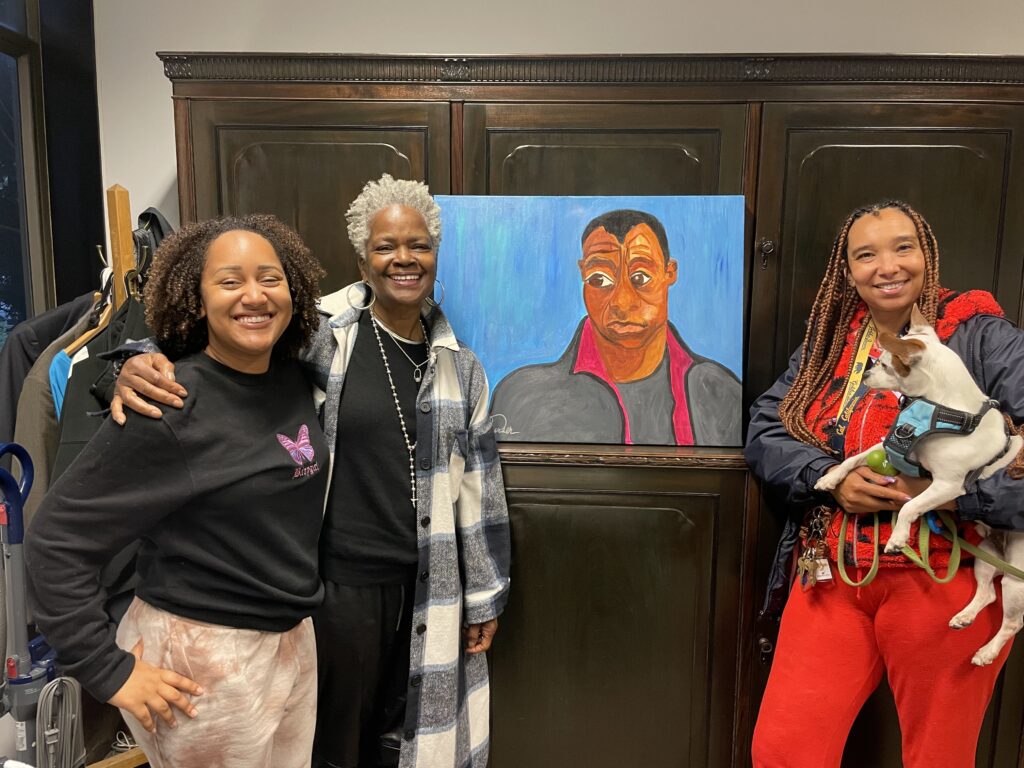
Artist Gaila Patrice Turner with her portrait of James Baldwin. With scholars Tatiana Butte and Amber Griffin-Royal.
The Social Sciences Division’s Undergraduate Research Advocates Program was initiated in spring 2022 by division head Susan Edwards and librarian David Eifler. This small pilot program worked with students from NavCal, the fellowship that assists incoming nontraditional students navigate the Berkeley campus. The pilot provided three NavCal fellows with small research stipends to explore new ways to provide library services to first generation and historically underrepresented students. It was designed to be a collaboration in which student research advocates educate librarians about ways to improve outreach; librarians, in turn, taught in-depth research methods to the students who then became trusted emissaries doing library outreach to communities to which they belong or identify.
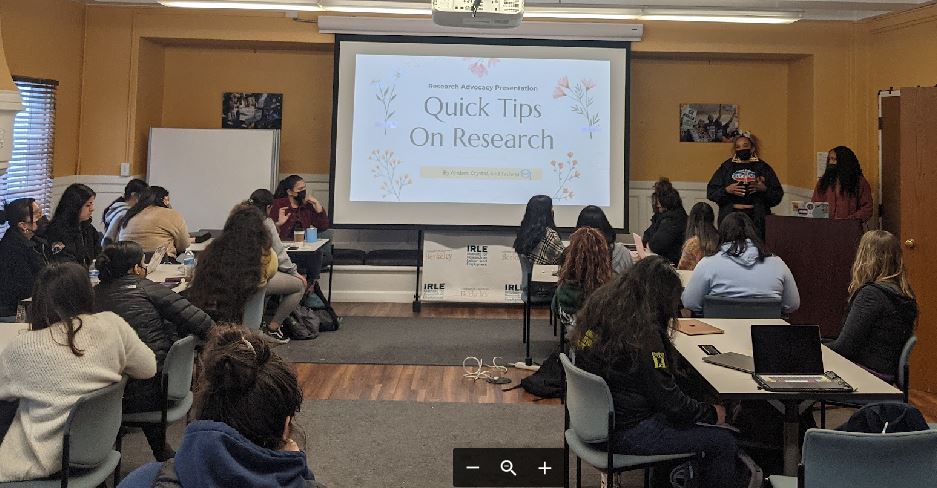
Our first cohort — Tatiana Butte, Crystal Swan and Amber Griffin-Royal — was selected from students expressing interest in the internship and with guidance from NavCal Director Dean Tanioka. The cohort met weekly with Environmental Design Librarian David Eifler to improve their research skills and develop ways the Environmental Design Library could be more welcoming to historically underserved communities. As with any pilot, there were failures and successes – hosting a film about Oakland gentrification on a busy night failed to attract anyone. However, acquiring more welcoming art for the Library and incorporating informative posters about women and underrepresented architects and landscape architects has been successful. Perhaps most exciting was Amber and Tatiana’s presentation to NavCal students highlighting key library resources and demonstrating Zotero citation software.
The student research advocates and the librarians learned a great deal in the process: opening new lines of communication, re-exploring the role of the library and the librarian in undergraduate education, making physical improvements to the Environmental Design Library, and establishing new friendships. Perhaps most important, bonds of trust, understanding, and empathy were created that extend to today.
Amber Griffin-Royal and Tatiana Butte provide library instruction to NavCal cohort.
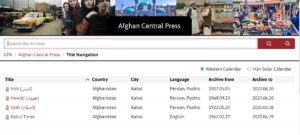
We have set up a thirty-day trial of Afghan Central Press at UC Berkeley Library beginning November 15, 2022.
The vendor description is as follows,
“The Afghan Central Press collection brings together four national, Kabul-based publications of Afghanistan whose long runs and prominence provide a concentrated vantage point for understanding developments in Afghanistan for much of the twentieth century. The English-language Kabul Times is presented alongside Pushto publications Anīs (انیس, Companion), Hewād (هیواد, Homeland), and Iṣlāḥ (اصلاح, Reform).”
The collection provides full-text access to over fifty thousand individual issues in Dari (Persian), Pushto, and English languages.
The Afghan Central Press collection is hosted on Eastview’s Global Press Archive platform.
African American Newspapers in the South, 1870-1926 is a new addition to Accessible Archives. It documents the African American press in the South from Reconstruction through the Jim Crow period. Written by African Americans for African Americans, the first-hand reporting, editorials, and features kept readers abreast of current domestic and international events, often focusing on racial issues. The editors didn’t shy away from exposing racial discrimination and violence, including the emotionally laden topic of lynching. Yet, the newspapers also covered lighter fare, reporting on civic and religious events, politics, foreign affairs, local gossip, and more.
It includes all complete runs of representative newspapers from the District of Columbia, Georgia, Louisiana, North Carolina, Oklahoma, Tennessee, and West Virginia:
The Advocate, 1907 – 1912
Athens Republique, 1921 – 1926
The Banner-Enterprise, 1883 – 1884
The Bee, 1882 – 1884
The Black Dispatch, 1917 – 1922
The Educator, 1874 – 1875
The Langston City Herald, 1892 – 1900
The Louisianian, 1870 – 1871
The Muskogee Cimeter, 1904 – 1920
The Nashville Globe, 1907 – 1918
The National Forum, 1910
Pioneer Press, 1911 – 1917
The Republican, 1873 – 1875
Semi-Weekly Louisianian, 1871 – 1872
The Tulsa Star, 1913 –1921
Western World, 1903 – 1904
By Ann Lage
Oral history interviewer (retired)
November 2022
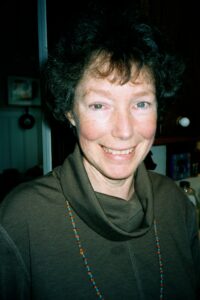
Julie Gordon Shearer, an esteemed former colleague from the days when the Oral History Center was known as the Regional Oral History Office, passed away in August 2022.
Julie Shearer (Photo courtesy of Russ Ellis)
Julie joined the ROHO staff in 1978, as the office was ramping up its second large-scale project documenting California’s political leadership. Having completed a comprehensive project on California governance during the years of Earl Warren’s gubernatorial administration, the office was now beginning to document the Goodwin Knight and Edmund “Pat” Brown administrations. Julie brought to the project an academic background in political science, relevant work experience as a journalist for the Mill Valley Record and as editor at UC’s Agricultural Extension, as well as personal experience as an environmental activist, most notably in the battle to prevent the building of a nuclear power plant at Bodega Head.
Julie’s interview subjects on the Knight-Brown project illustrate the breadth of the project’s scope, as well as Julie’s skill in connecting with diverse narrators. Her lengthy interview with Bernice Layne Brown focused on life in the governor’s mansion and the supporting role played by political spouses at the time, but Julie’s careful coaxing also elicited Mrs. Brown’s insights on the personal impacts of the governor’s difficult decisions, as in the Caryl Chessman capital punishment case. Others she interviewed included former Los Angeles Mayor Sam Yorty, who had opposed Pat Brown in the 1966 Democratic Party primary, and Helen Nelson, a pioneering consumer advocate and Brown’s appointee as California’s first Consumer Counsel.
In the early 1980s, ROHO’s political team launched its next major project, interviewing key figures in the Ronald Reagan gubernatorial administration, along with legislative leaders, political opponents, and community activists. Julie contributed numerous interviews to the Reagan project, delving into issues as broad as parent advocacy for children with intellectual disabilities, criminal justice issues, and tax reduction efforts of the Reagan governor’s office.
Following completion of the Reagan project, Julie was on the ROHO team for the California State Archives State Government Oral History program, interviewing several legislators and agency administrators.
In the summer of 1985, Julie had a leading role in an innovative oral history project. Berkeley Chancellor Michael Heyman asked ROHO to conduct interviews examining how the campus managed the recent student protests demanding the university’s divestment from the South African apartheid regime. Sixteen interviews were conducted with campus officials and police officers, intended not only for the historical record but also for current and future campus administrators tasked with managing freedom of speech and assembly issues. The interviews were for internal use until their publication in 2013 as Six Weeks in Spring: Managing Protest at a Public University.
Highlights of Julie’s contributions in the 1990s include two gems: an extensive, two-volume oral history with Sidney Roger, A Liberal Journalist on the Air and on the Waterfront: Labor and Political Issues, 1932–1990; and a deep dive into the lives of S.I. Hayakawa and his wife, Margedant, in From Semantics to the U.S. Senate, ETC., ETC. Hayakawa was a noted semanticist, a controversial president of San Francisco State College during a turbulent period of Vietnam War protests, and a one-term U.S. Senator from California.
After more than two decades with ROHO, Julie retired, turning her attention to her first love, music performance and composition. Julie Gordon Shearer will be remembered not only for her many contributions to the oral history archive, but also for her remarkable personal qualities, her openness and joy in life, her gift for friendship, and her warm relationships with her interviewees as well as ROHO colleagues.
You can find the interviews mentioned here and all of the Oral History Center’s interviews from the search feature on our home page.
Ann Lage conducted oral histories for the Oral History Center (previously called the Regional Oral History Office, or ROHO) from 1978–2013, on topics including natural resources and land use, the environmental movement, California political and social history, and the University of California. She was director of projects on the Sierra Club, the Disability Rights and Independent Living Movement, the Department of History at UC Berkeley, the University of California Office of the President, and Saving Point Reyes National Seashore. In the 1990s, she was deputy director of ROHO and then served as acting director following Willa Baum’s retirement. She holds a BA and MA in history from Berkeley.
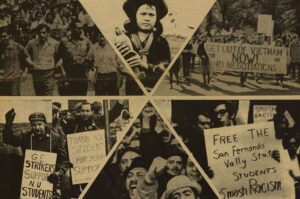
Reveal Digital’s Student Activism collection aims to provide access to unique, yet essential, primary sources documenting the deep and broad history of student organizing in the United States. It is intended to serve as a scholarly bridge from the extensive history of student protest in the United States to the study of today’s vibrant, continually unfolding actions.
The completed collection will contain approximately 75,000 pages drawn from special collection libraries and archives around the country. Materials intended for inclusion are wide-ranging in nature: Circulars, leaflets, fliers, pamphlets, newsletters, campaign materials, protest literature, clippings, periodicals, bulletins, letters, press releases, ephemera; and meeting, demonstration, conference, and event documentation. Currently approximately 58,000 pages are available.
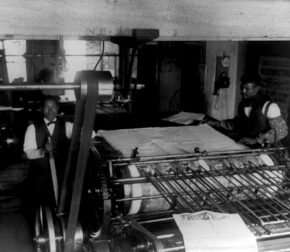
On March 24, 1800, Forlorn Hope became the first newspaper published within a prison by an incarcerated person. In the intervening 200 years, over 450 prison newspapers have been published from U.S. prisons. Some, like the Angolite and the San Quentin News, are still being published today. American Prison Newspapers will bring together hundreds of these periodicals from across the country into one collection that will represent penal institutions of all kinds, with special attention paid to women’s-only institutions.
Development of the American Prison Newspapers collection began in July 2020 and will continue through 2022, with new content added regularly. The source material for the collection is being provided by numerous libraries and individuals from across the country. Currently there are nearly 100,000 pages available (of a planned 250,000 pages), representing at least one prison in 30 states.
Presented by Adrienne Serra, Digital Project Archivist, The Bancroft Library, University of California, Berkeley, with an introduction by Principal Investigator Mary Elings, Interim Deputy Director, Associate Director, and Head of Technical Services, The Bancroft Library
In 2021, The Bancroft Library launched a large-scale digitization project to preserve and provide online access to more than 127,000 pages of California Land Case Files dating from ca. 1852 to 1892. These records tell an important story about the use and distribution of land, as well as social and legal justice in California following statehood in 1850, when all Spanish and Mexican land grants holders were required to prove their land claims in court. A lengthy process of litigation followed, which resulted in many early Californians losing their land. The Land Case Files are heavily used by current land owners, genealogists, historians, and environmentalists to understand the land, its uses, and ownership over time. The digitization project, Land, Wealth and Power: Private Land Claims in California, ca. 1852 to 1892 (Mary Elings, Principal Investigator), was awarded a 2019 Digitizing Hidden Special Collections and Archives: Amplifying Unheard Voices grant. Digital Project Archivist Adrienne Serra will discuss the collection and the project, including the challenges of preparing and imaging fragile materials under pandemic restrictions, and plans for future community engagement projects.
See you there! As always, this talk will also be recorded and added to our Youtube channel.
by Martin Meeker
Oral History Center Interviewer (retired)
“When we drink a glass of wine, we may enjoy its aromas, consider where it is from, and ideally, care about how it was made and who created it. We might think about the winemaker, along with the vineyard and winery team, and perhaps the brand owner. We most likely don’t consider the people beyond that circle who also play a role in a wine’s existence, ensuring its authenticity, making it more meaningful for consumers, and meanwhile, protecting some of the most sacred places to grow grapes and create wine. For those who are reading this, you are about to meet such a person, one of the most exceptional people in the wine world, and someone who has more passions and layers than the most complex glass of wine you have ever enjoyed,” Linda Reiff, President and CEO of Napa Valley Vintners.
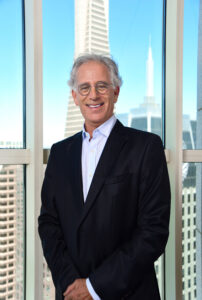
Richard Mendelson in San Francisco, 2021 (Photo courtesy of Richard Mendelson)
Richard Mendelson is in fact the person about whom Linda Reiff writes, and the Oral History Center is pleased to release this major life history interview with the man. Mendelson is an attorney who has played a pivotal role in creating the field of wine law through his legal practice, historical research and writing, and international leadership on the issue over the past four decades. Moreover, he is a Lecturer in Wine Law at UC Berkeley, School of Law, where he directs the Program on Wine Law and Policy. He also lectures on a variety of vineyard and wine law topics at UC Davis Graduate School of Management and has taught at the University of Aix-Marseille and the University of Bordeaux.
A graduate of Harvard University, Oxford University, and Stanford Law School, Mendelson has handled legal matters involving almost every aspect of the wine business, including liquor licensing, environmental challenges to vineyard development, grape purchase agreements, winery use permits, representation of winery clients before the California Department of Alcoholic Beverage Control and federal Alcohol & Tobacco Tax and Trade Bureau, state and federal label approvals, distributor appointments and terminations, and import-export contracts. Mendelson has a special expertise in geographical indications and has been responsible for obtaining recognition for some of the most well-known American Viticultural Areas. He assisted the California legislature with the drafting of legislation to protect the world-famous Napa Valley geographical indication. Subsequently, he successfully defended that law on behalf of the Napa Valley Vintners in the case of Bronco v. Jolly, which he argued before the California Supreme Court. Of his legal work, famed vintner Bill Harlan writes, “His legal mind, business judgment, negotiating skills, discipline, and commitment to his clients are first rate. With great integrity and knowledge and an abiding commitment to be fair and clear, he is able to gain the respect of all parties in practically any setting.”
This oral history is a globe-trotting one, with meaningful stops in England, France, India, and China, but the focus here, as with Mendelson’s work, is California’s Napa Valley. According to Harlan, Mendelson serves “as Napa Valley’s unofficial ambassador, he truly upholds our agricultural heritage and promotes our special place in the world of wine.” Linda Reiff, head of the Napa Valley Vintners, writes, “He helped make Napa Valley one of the most iconic wine regions in the world by mastering groundbreaking initiatives and complex legal challenges. He authors, refines and defends regulations to protect consumers and to ensure a more sustainable wine industry. He is a thinker and a problem solver, a deal maker, a broker.” This oral history goes a long way to explain how over the course of a few short decades “Napa Valley” came to signify and to exemplify environmental stewardship, preservation of agricultural resources, American ingenuity and achievement internationally, and, of course, quality wine.
In this interview, moreover, Mendelson discusses his family’s heritage and his own upbringing in Jacksonville, Florida; his early employment on Capitol Hill; and his attendance at Harvard University, Stanford University, and Oxford University, where he first became enamored with wine in Magdalen College’s wine cellar. Mendelson goes on to discuss his career in wine and wine law, beginning with Bouchard Aîné in Burgundy, France, and continuing in America with the establishment of American Viticultural Areas (AVAs). Other topics discussed in the interview include the research and writing of his books (From Demon to Darling, Law in America: Law and Policy, Spirit in Metal, and Appellation Napa Valley: Building and Protecting an American Treasure), California cannabis law, yoga, tai chi, Hinduism, artistic sculpture and metalwork, and wine law instruction.
Find this interview and all our oral histories from the search feature on our home page. You can search by name, keyword, and several other criteria.
About the Oral History Center
The Oral History Center of The Bancroft Library preserves voices of people from all walks of life, with varying political perspectives, national origins, and ethnic backgrounds. We are committed to open access and our oral histories and interpretive materials are available online at no cost to scholars and the public. You can find our oral histories from the search feature on our home page. Search by name, keyword, and several other criteria. Sign up for our monthly newsletter featuring think pieces, new releases, podcasts, Q&As, and everything oral history. Access the most recent articles from our home page or go straight to our blog home.
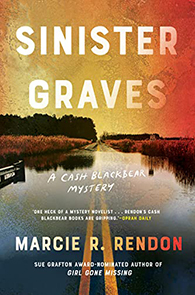
November is National Native American Heritage Month! We’ve compiled a list of fiction, memoirs, and poetry for you to check out. Visit the Native American Heritage Month website for more information and live events.


 Reveal Digital’s
 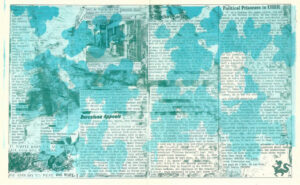 On March 24, 1800, Forlorn Hope became the first newspaper published within a prison by an incarcerated person. In the intervening 200 years, over 450 prison newspapers have been published from U.S. prisons. Some, like the Angolite and the San Quentin News, are still being published today.