The Etruscans Uncovered is an exhibit in Doe Library’s Bernice Layne Brown Gallery from March 9 until August 31, 2026. The Etruscans were the first builders of complex urban centers in ancient Italy, established elaborate religious practices, and crafted a wide range of artworks that decorated their homes, cities, and tombs. Although their writing (prose, poetry, and histories) has not survived, the Romans considered the Etruscans to be the “people of the book.” Their material culture allows us immediate entry into their public and private lives, whether through their tomb paintings, elaborate bronze and gold metalwork, or finely crafted clay objects. This exhibit presents a sampling of the large Etruscan collection housed at the Phoebe A. Hearst Museum of Anthropology at UC Berkeley, as well as complementary materials from The Bancroft Library.
This exhibit compliments two other Etruscan exhibitions in the Bay Area: Encountering the Etruscans at the Phoebe A. Hearst Museum (open Fridays, noon to 4:00 p.m., through May 2026) and The Etruscans: From the Heart of Ancient Italy at the Legion of Honor in San Francisco (May 2 through September 20, 2026).
Exhibit Curators: Lynn Cunningham, Audrey Feist, Zidheni Hernandez Callejas, Sofia Huff, Iman Khan, Sophia Lavrov, Juan Lopera, Alejandra Lopez, Marianna Maciel, Katherine McGuirt, Haley Morrill, Jackie Page, Lisa Pieraccini, Bradley Pultz, Maddie Qualls, Victoria Ramirez, Xiaonan Ren, Lily Yagubyan
Opening reception: March 11, 2026, 5-7, Morrison Library
– This post is a guest post by Annabel Barry, Ph.D. candidate at UC Berkeley and class.
Members of the spring 2025 class of English R1A: The Marriage Plot in Irish Literature, taught by Annabel Barry, worked together to curate a virtual exhibition of Irish rare books and manuscripts in the Bancroft Library’s Special Collections. The class explored how marriage in Irish literature from the nineteenth century to today represents not merely a private bond between individuals, but also a malleable metaphor that takes on public meanings, reflecting shared social aspirations and anxieties. While reading and discussing literary texts in which marriage straddles the boundary between private and public, students simultaneously explored the public humanities, or how humanistic research can be made accessible to audiences beyond the university.
Each student was assigned to research and draft an exhibition label for a unique object from the Bancroft Library related to an author from the course. Students were invited to use their interpretations of their objects to explore their individual interests—from economics to music. They then worked in small groups to revise and arrange their labels to create a coherent narrative arc. Along the way, they benefitted from the generous assistance of Bancroft Library Information and Instruction Specialist Lee Anne Titangos, who helped to select and present materials, and Literature and Digital Humanities Librarian Bee Lehman, who introduced students to using ArcGIS StoryMaps as a virtual exhibition platform.
Below are abridged versions of some of the exhibition labels featured in the virtual exhibition. The full exhibition is available to university affiliates with a CalNet ID at this link. To access the site, simply click “Your ArcGIS organization’s URL,” type “cal” in the text box, click continue, and input your CalNet ID and password.
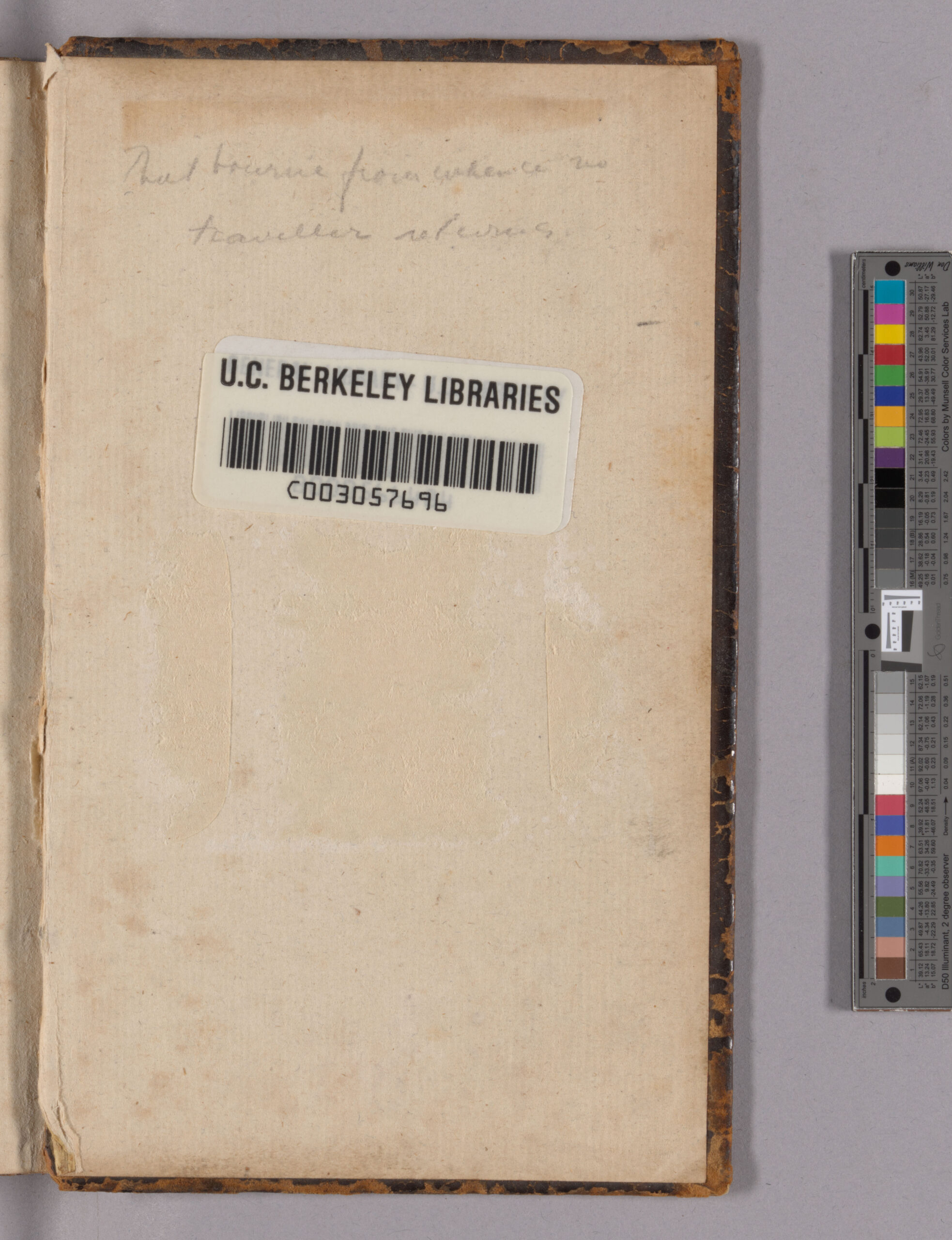
“That bourne from whence no traveller returns” by Naila Talib
Sydney Owenson, Lady Morgan (c.1781 – 1859) | The Wild Irish Girl first three-decker edition | 1806 | Published by Richard Phillips
When initially published in 1806 by Richard Phillips, Sydney Owenson’s The Wild Irish Girl was printed and distributed in a three-volume format, a strategy that was used to entice readers to buy multiple volumes to complete the story they started. The previous owner of this particular copy had to purchase the bindings with gold-laced engravings visible in the first and third volumes separately from the actual printed text itself. The intricate and high-quality design of the bindings indicates that they valued the text. The newer and simpler binding on the second volume is evidence of the Bancroft Library’s preservation efforts as the previous spine and binding may have been old and worn out, and so they replaced it with a newer, simpler binding. The yellowing and browning of the pages show that the volumes were viewed and handled by readers and researchers, causing the material to degrade overtime.
At the back of the book, an annotation written in pencil by a previous reader or owner reads “That bourne from whence no traveller returns.” This quote is uttered by Glorvina during a scene where the characters encounter a traditional Irish funeral; her remark is in reference to a famous Hamlet soliloquy where he says, “The undiscovered country from whose bourn / No traveler returns.” Through this phrase, Shakespeare both metaphorically and poetically communicates the idea that once someone has passed away, they can no longer come back into existence. In this context, the word “bourne” means “boundary” or “destination,” and thus Glorvina is recognizing the finality of death and a sentiment of uncertainty associated with what comes after death for the individual whose funeral they had just encountered.
“Samhain: Scarcity and Symbolism” by Sofia Aquino
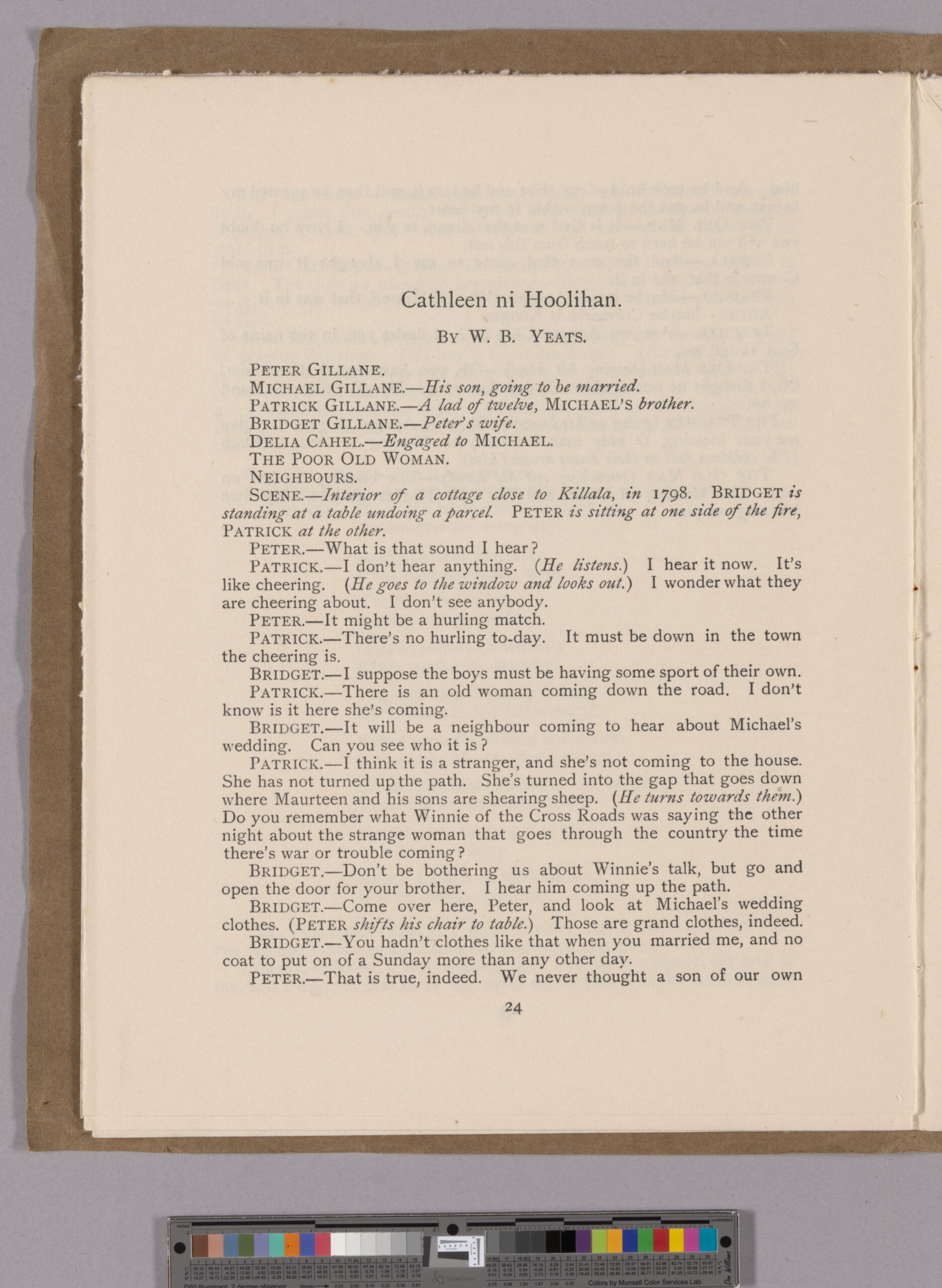
Isabella Augusta, Lady Gregory (1852-1932) and William Butler Yeats (1865-1939) | First publication of Cathleen ni Houlihan in Samhain: An Occasional Review, issue 2 of 7 | October 1902 | Published by Sealy, Bryers, & Walker and T. Fisher Unwin
Samhain, an irregularly published theater magazine (1901-1908), was founded and edited by poet-playwright W.B. Yeats as part of his collaboration with Lady Gregory to promote Irish culture and nationalism through founding the Abbey Theatre. In its first issue, Yeats explains the title’s significance: “I have called this little collection of writings Samhain, the old name for the beginning of winter, because our plays this year are in October, and because our Theater is coming to an end in its present shape.”
Samhain’s binding—soft, thin cardboard stitched with thread—reflected the financial struggles of the Irish Literary Revival. The Irish Literary Theater, a precursor to the Abbey Theatre, had disbanded in 1902 due to a lack of funding, underscoring the need for a government-subsidized national theater. This goal was accomplished in 1925 when the Abbey Theatre became the first state-subsidized theatre in the English-speaking world.
Most notably, this issue featured the first publication of Cathleen ni Houlihan, a nationalist play co-written by Yeats and Lady Gregory, though only Yeats was credited upon publication—a reflection of how Gregory’s contributions to Irish drama were often overlooked despite her significant influence. The play’s exploration of economic sacrifice mirrors the circumstances of its own creation. Just as Michael must choose between financial security or sacrificing all for Irish nationalism, Yeats and Gregory, who worked with limited resources and no government support, staged the play despite financial hardship, believing in its necessity for a country in need of inspiration.
“Bound by Myth and Melody” by Chloe Yuan
Isabella Augusta, Lady Gregory (1852-1932) and William Butler Yeats (1865-1939) | The Hour-Glass, Cathleen ni Houlihan, The Pot of Broth: Volume Two of Plays for an Irish Theatre | 1904 | Published by A.H. Bullen
Published by A.H. Bullen in London, this 1904 edition compiles three of Yeats’s plays: The Hour-Glass, Cathleen ni Houlihan, and The Pot of Broth. The spine, inscribed with Yeats’s name and the publisher A.H. Bullen of London, reflects the intersection of Irish literary nationalism and the British publishing industry.
The musical annotations remind us that these plays were composed as living works, meant to be heard and felt, a fusion of Ireland’s literary and musical heritage. Among the printed words of Cathleen ni Houlihan and The Pot of Broth, a striking detail emerges: musical notation embedded within the text. These passages indicate that music was not merely an ornament in the plays of Yeats and Gregory but a vital storytelling device. The presence of melody within the printed script underscores the oral tradition of Irish folklore, where song carried historical memory, rebellion, and lamentation. In Cathleen ni Houlihan, the mysterious old woman begins to sing a haunting tune, recalling those who have died for Ireland. The inclusion of sheet music in the book suggests that the play’s performance was intended to be a multisensory experience, reinforcing the theme of national sacrifice through the emotional resonance of the song.
“Inside the Mind of Seamus Heaney” by Anonymous
Seamus Heaney (1939-2013) | Notebook with manuscript drafts of poems, with revisions and annotations | 1970-1971 | Seamus Heaney Poems Collection
This 1970–71 notebook written by Seamus Heaney reveals the layered and often nonlinear process behind his poetry. Heaney wrote during a moment of deep political unrest; the conflict in Northern Ireland was just beginning, and a civil war loomed. From Berkeley, California, Heaney grappled with the growing tension back home.
Pages 86 and 87 of this notebook contain early drafts of Seamus Heaney’s poem “The Other Side,” published in 1972. The poem’s central theme is a Protestant neighbor living across a river, physically close, yet socially and ideologically distant. The river functions as both a literal border and a symbolic divide, reflecting Heaney’s concerns with religious identity, land, and division in a fractured Ireland.
Heaney’s shift in title, from “Fordings” to “Dreamer at the Ford” to “The Other Side,” marks a change in emphasis. “Fordings” is pastoral and descriptive, while “The Other Side” introduces political weight. The final title gestures toward separation and opposition, making the poem’s political dimensions more legible. This produces a tension: while the framing becomes more political, the language within the poem retracts from directness. That dual movement, toward both clarity and obscurity, reflects Heaney’s position as a poet caught between intimacy and distance, between naming a boundary and refusing to cross it.
“A Spark of Inspiration” by Ryan Luftman
Seamus Heaney (1939-2013) | Manuscript draft of “Gifts of Rain,” on back of working syllabus for English 161: Recent British & American Poetry, and later typescript draft | 1971 | Seamus Heaney Poems Collection
Heaney’s syllabus for his course on British and American Poetry serves as a perfect physical representation of his time at Berkeley. At Berkeley, Heaney continued his poetic pursuits both as an artist and a learner. We can see this explicitly through the syllabus as Heaney adds readings by James Dickery and Elizabeth Bishop to his list, showing active exploration of poets. More interestingly, flipping over the syllabus reveals a spectacular insight into Heaney’s mind.
On the back of the syllabus is a working draft of a brand-new poem, “A Gift of Rain” (later published as “Gifts of Rain”). Here we see the original iterations of what ends up being the first and third stanza of the final poem. Across the manuscript and typescript drafts, we can see how Heaney moves from a very personal poem to one with a more general address. Heaney makes changes like “my skin” to “his pelt,” “your” to “their.” Examining the contents of the poem, it seems Heaney begins writing about personal experiences of places from his youth after rainfall and changes them to a more general experience, allowing him to build up the more metaphorical tone of the poem. This is a common theme in Heaney’s work: he takes personal experiences and beliefs and alters them to have greater appeal to a wider audience.
Image reproduction was supported by a Daniel E. Koshland, Jr. Course Development Grant (for more information, click here).
Thumbnail associated with publisher map, displaying some of the publishers we collect from. Link goes to interactive map on ArcGIS.
Alongside the celebration of the many, phenomenal books we display, we’ve also made material available about what kinds of publishers UC Berkeley Library has been collecting from across the continent.
Let me (Bee, the Lit Librarian) know if you have questions or note that there is information missing. Our thanks for to the many artists, authors, and magazine editors who’ve made this possible.
Selections from the library’s collection of loanable artwork (the Graphic Arts Loan Collection) are now on display in the Art History/Classics Library (308 Doe).
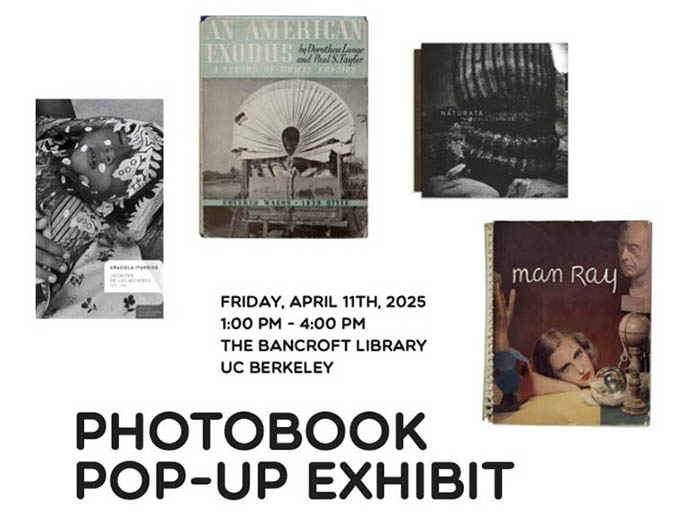
In association with the Reva and David Logan Photobook Symposium at the School of Journalism, the Bancroft Library is hosting a Photobook Pop-Up Exhibit, featuring selections from the Reva and David Logan Photobook Collection (The Bancroft), and photobook gifts from donor Richard Sun (Art History/Classics Library).
Artists featured:
Henri Cartier-Bresson, Claude Cahun, Robert Frank, Dorthea Lange, Miyako Ishiuchi, Graciela Iturbide, Dayanita Singh, Alfred Stieglitz, Francesca Woodman and many more.
Photobook Pop-Up Exhibit
Friday, April 11th 1:00 pm – 4:00 pm
The Bancroft Library
UC Berkeley
Free and open to all
Hosted by Christine Hult-Lewis, Pictorial Curator, and Lynn Cunningham, Art Librarian
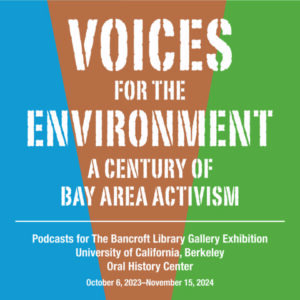
The Oral History Center is excited to announce the opening of Voices for the Environment: A Century of Bay Area Activism, a Bancroft Library Gallery exhibition that was curated by Todd Holmes, Roger Eardley-Pryor, and Paul Burnett. Voices for the Environment traces the evolution of environmentalism in the San Francisco Bay Area across the twentieth century. In three sections, it highlights how Bay Area activists have long been on the front lines of environmental change—from efforts to preserve natural spaces in the wake of the 1906 San Francisco earthquake and fire, to the midcentury fight for state regulations to protect San Francisco Bay shoreline, to more recent demands for environmental justice to address the disproportionate burden of pollution that sickened communities of color around the Bay.
We sat down with Eardley-Pryor and Holmes to ask them about their experience curating the exhibit, bringing the OHC’s interviews to life in The Bancroft Library’s gallery, and what they learned along the way.
OHC Historian/Interviewer Roger Eardley-PryorOHC Historian/Interviewer Todd Holmes
Q: When you were originally thinking about this exhibit, which spans a century of Bay Area environmental activism, what topics, themes, or events were important for you to include?
TH: As historians, both Roger and I approached the exhibit through the lens of change over time, essentially asking the question, “How did what we’ve come to recognize as environmentalism evolve and change in the Bay Area over the twentieth century?” Combining our knowledge of both the oral history collection – which was to stand at the heart of the exhibit – and the environmental history of California, we selected the three stories we wanted to highlight fairly quickly.
First, we wanted to tell the story of Hetch Hetchy, the valley in Yosemite National Park that was dammed for San Francisco’s water system. This is a seminal event used in history classes across the nation to highlight the battle between two schools of environmentalism, preservationists like the Sierra Club’s John Muir, and conservationists like Gifford Pinchot of the U.S. Forest Service in the first part of the twentieth century. For the exhibit, we sought to use the Hetch Hetchy story to introduce visitors to preservation as the first form of environmentalism that took root in the Bay Area.
Second, we wanted to tell the story of Save The Bay, the movement initiated by three women from Berkeley to halt bay fill. Ultimately, that movement led to the creation of the San Francisco Bay Conservation and Development Commission (BCDC), a state government agency to regulate development on the bay. Here we wanted to highlight how environmental concerns became embedded within the fold of government by the mid-century. BCDC stands as the first environmental agency in the United States, providing a precedent for other regulatory agencies on the state and federal level in the years that followed, such as the California Coastal Commission. Moreover, BCDC also operated within a framework that sought to balance environmental protection with economic development.
Third, we wanted to tell the story of environmental justice, a movement in the last part of the twentieth century that sought to put the health of people – particularly communities of color – within the environmental agenda. While environmental justice is fairly common today in discussions of environmental policy, the story of how it developed is not well known, and the Bay Area was one of the central places in the nation from which the movement took root.
REP: Todd and I worked to ensure that, in this exhibit, environmental activists could speak for themselves, and that visitors to the exhibit could actually hear the voices of activists recorded in their oral history interviews. The Audio Spotlight technology that allow people to hear interview clips in the gallery, the three videos Todd created with rare film footage and photographs, and the three podcast episodes we made with Sasha Khokha of KQED all make this exhibit something special that has never been done before in The Bancroft Library Gallery. For me, the people-power of communities of color demanding environmental justice, and the longtime leadership of women working for environmental protection were really important themes to include. Often, environmental history is told through the actions of men like John Muir, who does deserve credit for his early advocacy to protect nature through its preservation. The legacy of Muir and the ongoing work of the Sierra Club are important, and they remain so today. But Todd and I wanted to tell a deeper and broader history of Bay Area environmentalism, which shows how women and people of color have been central to the expansion and the evolution of environmental action over the course of the 20th century. I hope the stories shared in this exhibit help contextualize and make current environmental issues more meaningful—be it present-day preservation issues in 30 x ’30 campaigns, or conflicts over coastal regulations amid sea-level rise, or ongoing challenges to empower people of color in mainstream environmental movements.
Q: Did the themes you wanted to highlight change during the course of your research?
REP: We worked hard for over a year to bring this exhibit to life and to my memory, we agreed fairly early on about the three main narratives featured in the exhibit—the preservation of nature, reconciling environment and development, and environmental justice for communities of color. Over the course of our research, we changed the details of which particular oral history segment we might include here or there, or which image or document would best compliment the oral histories featured in each section of the exhibit. But as I recall, the exhibit’s main story arc remained steady from early in our curation process.
TH: Surprisingly, there was no change in the main topics / stories we wanted to highlight in the three sections of the exhibit. What our research did do was help expand on the themes within each to add more depth and nuance around community activism. For instance, in the first section we not only focused on the story of Hetch Hetchy, but connected it to activism around Save the Redwoods, which in turn highlighted the vital – yet often overlooked – role of women in the early preservation movement. Men like John Muir may have become the figureheads of environmentalism, and voted for such policies in government, but it was women who provided the grassroots momentum that put environmental concerns on the table. The same could be said for the third section on environmental justice. Our research uncovered a lot of different groups and experiences in the Bay Area grappling with environmental racism, from toxic sites in Richmond and what became known as the Silicon Valley, to debates with white environmental groups about even using the term “racism.” So in all, our research gave us a number of themes to spotlight and weave together throughout the exhibit
Q: The exhibit begins with the 1906 earthquake. Why did you decide to start there?
TH: This is another example of how research expanded the themes and stories of the three main topics we sought to feature in the exhibit. We wanted to highlight the story of Hetch Hetchy in the first section. Our research of the Hetch Hetchy battle forced us to upstream to the root cause – the 1906 earthquake and fire that destroyed 80 percent of San Francisco. At the time, San Francisco stood as the largest and richest city west of Chicago. In the wake of the disaster, the rebuilding effort posed a tremendous threat to the natural resources of the state. Ancient redwood forests throughout the Bay Area and along California’s north and central coast were targeted for timber, just as the Hetch Hetchy Valley was eyed for water and hydro-electric power. Thus, these rebuilding efforts proved the impetus of the early activism to preserve California’s environment.
REP: The drowning of Hetch Hetchy Valley—despite it being located within Yosemite National Park—is such a powerful and classic story in environmental history, and it occurred because the 1906 earthquake and fire destroyed San Francisco. Amazingly, Todd found several oral histories in our collection with survivors of the earthquake and fire who recall their experiences of it when they were children. In The Bancroft Library, Todd also found historic film footage, recently digitized, that shows San Francisco still aflame just after the earthquake. Putting those oral histories together with this footage make for a captivating start to the exhibit.
But what I didn’t realize until working on the exhibit was how the preservation of redwoods was also connected to how the earthquake and fire destroyed San Francisco. After the fire, lumber companies promoted California’s fire-resistant coastal redwoods as a means to rebuild the devastated city. In turn, environmentalists redoubled their efforts to preserve special groves of those ancient redwood trees. It suddenly made sense to me how Muir Woods National Monument was established in Marin County just a few years after the 1906 earthquake. Additionally, we wanted our exhibit on Bay Area environmentalism to highlight the Sierra Club, which was founded in San Francisco in 1892 and has since become one of the most influential environmental organizations in the nation. The Oral History Center has conducted oral histories with Sierra Club leaders since the early 1970s, and several activists, like William Colby, Ansel Adams, and David Brower, discussed in their oral histories how the fate of Hetch Hetchy continues to inform ongoing preservation efforts. So, in many ways, the 1906 San Francisco earthquake and fire helped ignite the spirit of preservation that still informs environmental activism, both in the Bay Area and across much of North America.
Q: What role does oral history play in the exhibit?
REP: Oral history is the beating heart that gives life to this exhibit! We scoured several scores of Oral History Center transcripts for captivating stories about Bay Area environmental activism. David Dunham helped us obtain digitized versions of those oral history recordings. We then used The Bancroft’s traditional paper, photograph, and film collections to complement the oral history narratives that we featured in the exhibit. Christine Hult-Lewis and Lorna Kirwan helped us explore several of those archival collections, and Theresa Salazar pointed us to the excellent Urban Habitat Program Records, 1970-2001, which are displayed in our exhibit. Ultimately, the exhibit offers a multi-sensory experience where visitors can engage audio recordings, film footage, oil paintings, photographs, pamphlets, posters, descriptive text, and they can even hold the hardbound oral history transcripts featured in the exhibit. But certainly, oral history is the centerpiece of the exhibit.
TH: In short, everything! This is the first exhibit curated by the Oral History Center, and the first in-depth effort to showcase both the oral history and other archival collections of The Bancroft Library. Each section features oral histories about the main topic in three ways. Edited oral history segments are played in each section through an Audio Spotlight speaker, and accompanied with a video that shows captions as well as related photographs and archival footage. The oral histories are also available through a three-episode podcast, narrated by Sasha Khokha from KQED San Francisco. The podcast episodes, available online and in the gallery by scanning a QR Code, offer a deeper dive into the stories of each section. Lastly, we used oral histories quotes in the labels of the exhibit material to add further detail and context.
Q: The 1960s and ’70s were two very productive decades in terms of environmental activism. Did the oral histories that you encountered from the OHC’s collection make you think differently about this period, or illuminate something new?
TH: In my view, the oral histories we used in the exhibit helped place the activism of the 1960s and 1970s in better context. For instance, we often think of the “environmental movement” as arising around the late 1960s / early 1970s. Yet, this view completely overlooks the activism of men and women around preservation in the first couple decades of the twentieth century. It also overlooks the vital work of Sierra Club executive director David Brower, whose activism throughout the 1950s and 1960s staved off numerous developments and led to the establishment of ten new national parks. In many respects, I think the oral histories featured in this exhibit pushed me to think about a “long environmental movement” that gained traction in the halls of government during the 1960s and 1970s. I think the exhibit also highlights how the Civil Rights Movement and environmental movement came to intertwine by the end of the decade to form environmental justice, which was an area I felt fortunate to learn more about through this project.
REP: Actually, rather than the 1960s and 1970s, the oral histories we included in the exhibit helped me realize the importance of the 1980s and 90s to the expansion and evolution of environmentalism. Without a doubt, activity surrounding Earth Day in 1970 was a key inflection point in environmental history, inspiring new environmental laws and a new generation of environmental activists. But the oral histories in our exhibit tell how Bay Area activists laid the early groundwork at least since the early 20th century for later environmental regulations, and how activists in the final decades of the 20th century worked to include all people in environmental protections, especially communities of color who suffered the most from industrial pollution.
Q: You put together additional material, like a podcast and class workbook, to accompany the exhibit. How do you hope people will use these materials?
TH: For the past couple years, the Oral History Center has been working on ways to get our collection into the K-12 education space. We developed additional materials, such as the class workbook and podcast, to serve as educational resources for K-12 classrooms, as well as undergraduate courses.
REP: The podcasts and educational workbook can be used anywhere—while visiting and experiencing the exhibit in person, or at home or in classrooms. We hope people use those additional materials long after the exhibit closes in November 2024!
Q: What do you hope that people take away from the exhibit?
REP: I hope exhibit visitors sense the importance, power, and potential of oral history. I hope they see how the Oral History Center’s work to record the lived experiences and reflections of people through oral history creates invaluable records that helps us better understand where we’ve come from and helps us make sense of our experiences today. I also hope visitors realize the importance of Bay Area activists in shaping the evolution of environmentalism over time. And I hope visitors hear how the actions of Bay Area people in the past, as told in their own words, helped define our experiences in the Bay Area today. Given today’s grave threats to our environment and to our democracy, I hope visitors appreciate how environmental activism remains an ongoing process that is shaped and renewed by average people like them who engage in civic activism. I also hope the oral histories featured in this exhibit—and the many, many more that are preserved in the Oral History Center collection—help inspire people to shape and renew environmentalism today and in the future.
TH: I hope visitors come away from the exhibit with a better understanding of how environmentalism evolved and changed over the century, and that it has a long history in the Bay Area. Moreover, I hope the oral histories featured in the exhibit highlight the change brought on by everyday people. It was the activism of men and women that led to protected redwood forests and the creation of state and national parks. It was the unwavering dedication of three women from Berkeley that stopped fill projects in San Francisco Bay and led to the nation’s first government-run environmental agency. And it was the collective action of communities of color that put justice within the environmental agenda, and on the dockets of policymakers. Ultimately, I hope visitors, young and old, walk away with the idea that change comes about through everyday people.
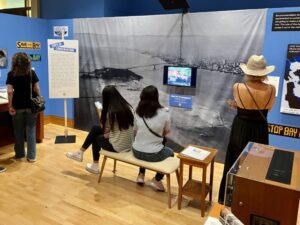
A group of people watch historic footage and listen to clips from oral history interviews in the Voices from the Environment exhibit in The Bancroft Library.
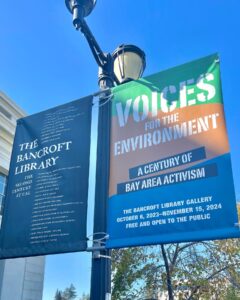
Banner for “Voices for the Environment” exhibit outside The Bancroft Library
We’re excited to announce the opening of Voices for the Environment: A Century of Bay Area Activism, a Bancroft Library Gallery exhibition that was curated by Todd Holmes, Roger Eardley-Pryor, and Paul Burnett of the Oral History Center. Voices for the Environment traces the evolution of environmentalism in the San Francisco Bay Area across the twentieth century. In three sections, it highlights how Bay Area activists have long been on the front lines of environmental change—from efforts to preserve natural spaces in the wake of the 1906 San Francisco earthquake and fire, to the midcentury fight for state regulations to protect San Francisco Bay shoreline, to more recent demands for environmental justice to address the disproportionate burden of pollution that sickened communities of color around the Bay.
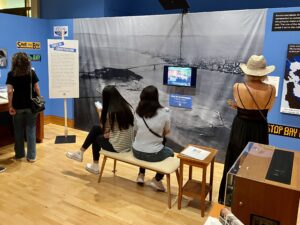
Visitors experience the “Voices for the Environment” exhibit, curated by the Oral History Center, in The Bancroft Library Gallery
Our Voices for the Environment exhibit is the first major effort in The Bancroft Library Gallery to showcase oral history alongside the traditional archival collections of The Bancroft Library, with the oral history collections leading the way. The exhibit still features historic photographs, pamphlets, post cards, and posters selected from several collections of The Bancroft’s physical archives. But for the first time in this gallery, our Voices for the Environment exhibit also includes three installations of special Audio Spotlight technology where you can listen to never-before-heard oral history recordings with Bay Area environmentalists, while simultaneously watching three videos edited by Todd Holmes that feature historic photographs and rare film footage from The Bancroft’s digital collections. Additionally, as a complement to the exhibit, curators Todd Holmes and Roger Eardley-Pryor created an educational workbook, so students of all ages can learn about the environmental movement by engaging with the themes and primary sources on display. Through these efforts, the Oral History Center hopes Voices for the Environment will have a life beyond its yearlong run.
Podcasts for “Voices for the Environment” were produced by Todd Holmes and Roger Eardley-Pryor of the Oral History Center, with help from Sasha Khokha of KQED. The podcast images, and the exhibit space, were designed by Gordon Chun.
For an even deeper dive, you can also scan a QR code in the gallery, or click the following link, to hear three Voices for the Environment podcast episodes produced in partnership with Sasha Khokha of KQED Public Radio and The California Report Magazine. The podcast episode for section 1 of the exhibit, titled “A Preservationist Spirit,” traces the environmental activism that arose amid the rebuilding efforts of San Francisco after the 1906 earthquake and fire, efforts that came to target the state’s ancient redwood forests and the beloved Hetch Hetchy Valley in Yosemite National Park. The episode features historic interviews from the Oral History Center archives including segments from the “Growing Up in the Cities” collection recorded in the late 1970s by Frederick M. Wirt, as well as oral history interviews with Carolyn Merchant recorded in 2022, with Ansel Adams recorded in the mid-1970s, and with David Brower recorded in the mid-1970s. The oral history of William E. Colby from 1953 was voiced by Anders Hauge, and the oral history of Francis Farquhar from 1958 was voiced by Ross Bradford. This first episode also features audio from the film Two Yosemites, directed and narrated by David Brower in 1955. The podcast episode for section 2 of the exhibit, titled “Tides of Conservation,” tells the story of the Save San Francisco Bay movement and the creation of the San Francisco Bay Conservation and Development Commission (BCDC), one the nation’s first environmental regulatory agencies. The episode features segments from oral history interviews with Save The Bay founders Esther Gulick, Catherine “Kay” Kerr, and Sylvia McLaughlin recorded in 1985; as well as interviews with BCDC executive director Joseph Bodovitz and chairman Melvin B. Lane, both recorded in 1984. And the podcast episode for section 3 of the exhibit, titled “Environmental Justice for All,” spotlights efforts by communities of color to place the health of people within the environmental agenda, including creation of new environmental organizations like the West County Toxics Coalition, the Urban Habitat Program, and APEN (Asian Pacific Environmental Network), all founded in the Bay Area. The episode features segments from oral history interviews with Carl Anthony, Pamela Tau Lee, Henry Clark, and Ahmadia Thomas, all recorded in 1999 and 2000.
The Voices for the Environment exhibition space was designed by Gordon Chun and is free and open to the public Monday through Friday between 10am to 4pm from Oct. 6, 2023 to Nov. 15, 2024, in The Bancroft Library Gallery, located just inside the east entrance of The Bancroft Library.
The Oral History Center of The Bancroft Library preserves voices of people from all walks of life, with varying political perspectives, national origins, and ethnic backgrounds. We are committed to open access and our oral histories and interpretive materials are available online at no cost to scholars and the public. You can find our oral histories from the search feature on our home page. Search by name, keyword, and several other criteria. Sign up for our monthly newsletter featuring think pieces, new releases, podcasts, Q&As, and everything oral history. Access the most recent articles from our home page or go straight to our blog home.
Please consider making a tax-deductible donation to the Oral History Center if you’d like to see more work like this conducted and made freely available online. While we receive modest institutional support, we are a predominantly self-funded research unit of The Bancroft Library. We must raise the funds to cover the cost of all the work we do, including each oral history. You can give online, or contact us at ohc@berkeley.edu for more information about our funding needs for present and future projects.
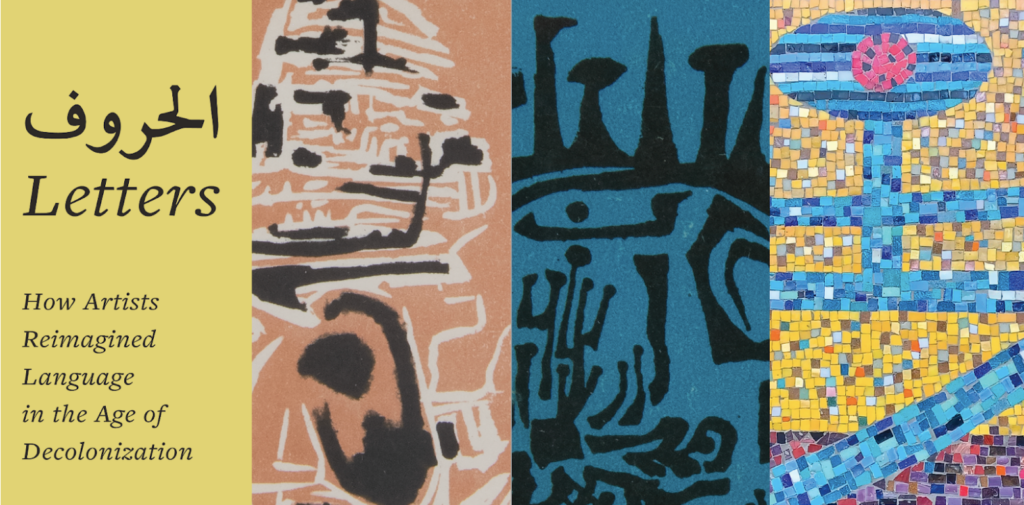
Letters | الحروف How Artists Reimagined Language in the Age of Decolonization
Left to right: art by Mohammed Khadda, Ibrahim El-Salahi, and Bedri Rahmi Eyüboğlu (details)
Letters | الحروف How Artists Reimagined Language in the Age of Decolonization is on exhibit in Doe Library’s Bernice Layne Brown Gallery from March 13 until Aug. 31, 2023. How have modern artists in North Africa, the Middle East, and South Asia made use of their inheritance of a visual cache of Arabic signs and letter-forms, and with what meanings? This exhibition, curated by students in the seminar History of Art 192Cu, “Exhibiting Calligraphic Modernism,” in collaboration with the Library, explores work by dozens of artists in multiple media, from poster design to painting, mosaic, poetry, and animation. A shared backdrop to the artwork on display are the decolonization processes and liberation struggles taking place across Asia, Africa, and Latin America in the 1950s, 1960s, and 1970s, which sparked desires to create cultural futures in resistance to dominant imperial values and official language policies.
Exhibit Curators: Drew Atkins, Riana Azevedo, Lynn Cunningham, Sharan Dulai, Eva Elfishawy, Mohamed Hamed, Teddi Haynes, Murtaza Hiraj, Viv Kammerer, Shanti Knutzen, Marissa Lee, Anneka Lenssen, Val Machado, Jasmine Nadal-Chung, Reyansh Sathishkumar, A. Wara, Alice Xie, Jinyu Xu, Suri Zheng, and Hayley Zupancic
Exhibit dates: March 13 to Aug. 31, 2023
Location: Bernice Layne Brown Gallery, Doe Library
Opening reception
Wednesday, March 15, 2023, 5-6:30 p.m.
Morrison Library
The reception will feature brief remarks by members of the curatorial team. Tours of the exhibition will be led by student-curators beginning at 5:45 p.m. Food and drinks will be served.
A pre-reception event will take place from 2:30-4:30 p.m. in 308A Doe Library, and will include a presentation and Arabic calligraphy workshop by the Bay Area-based calligrapher Zubair Simab. Participants will have an opportunity to try writing Arabic letters with a prepared pen and ink. There are 40 slots available for the workshop. Please register here: http://ucblib.link/calligraphyRSVP.
Both of these events are open to the public.
Details:
Wednesday, March 15, 2023
Pre-reception calligraphy workshop
2:30-4:30 p.m.
308A Doe Library
Register: http://ucblib.link/calligraphyRSVP
Exhibit reception and tours
5-6:30 p.m.
Morrison Library (101 Doe Library)
If you require an accommodation to fully participate in this event, please contact Amber Lawrence at libraryevents@berkeley.edu or 510-459-9108 at least 7-10 days in advance of the program.
Sponsors/contributors: Center for Middle East Studies, Department of History of Art, and UC Berkeley Library