A recent overhaul of the two literary research guides for French and Francophone Literatures and Italian Literature & Criticism first created quite a long time ago will improve navigation and discovery in these vast print collections. Over the course of the past year, we have critically reviewed the former guides, weeded outdated resources, and replaced them with more current content with links to digital resources when available.
These two literature research guides are now benefiting from the LibGuides platform, which makes it much easier to revise than the former PDFs. Each guide is structured by sections for article databases, general guides and literary histories, reference tools, poetry, theater & performance, and literary periods. They interface seamlessly with related guides published by the UC Berkeley Library. For example, on the home page of each LibGuide, there is a prominent link to the lists of recently acquired publications in both French and Italian, making it even easier to stay current on new books in any particular call number range.
Because the guides are much easier to update, they encourage user interaction and invite community suggestions for inclusion (or deletion).
If you have time over the winter break, please take a whirl and let us know what you think. We’ll be unveiling a similar guide for Iberian Literatures & Criticism this spring!
Como aguinaldo navideño, ofrecemos a lectores y lectoras de nuestro PhiloBlog una continuación de la primera entrada, publicada en marzo de 2021, en la que dimos a conocer algunas obras literarias encontradas en catálogos de subastas. En aquella ocasión describimos la existencia de una nueva Crónica de Enrique IV manuscrita (BETA manid 6089) y de tres impresos quinientistas: el Carro de las donas de Eiximenis traducido al castellano (BETA copid 9237) e impreso en 1542; la Crónica ocampiana (BETA texid 1141) de 1543; y las Siete Partidas alfonsíes (BETA copid 9240) impresas en 1576. En esta segunda entrega vamos a ofrecer otra vez un breve resumen de las últimas fichas incorporadas a nuestro proyecto procedentes de subastas y ventas de librerías de las que hemos tenido noticia.
La primera de ellas es una nueva fuente manuscrita de la obra que recibe el título de Sumario del despensero (BETA texid 2851), que se encuentra la venta en la Librería Anticuaria El Camino de Santiago (Catálogo 76, febrero de 2021, nº 85). A pesar de contar con una moderna edición (Jardin, 2013), el enorme laberinto ecdótico del Sumario todavía está por descifrar al completo, sobre todo lo que respecta a sus adiciones posteriores, así como a sus segundas y terceras redacciones, con la dificultad añadida del cotejo de supresiones o modificaciones del texto. La importancia de esta versión resumida del modelo narrativo cronístico emanado del escritorio alfonsí es su amplia presencia a lo largo de todo el Cuatrocientos, lo que a su vez conforma una magnífica prueba de la buena salud de la que gozaban estas recopilaciones abreviadas siglos más tarde de que fueran compuestas (Gómez Redondo, HPMC, III, 2098-2099).
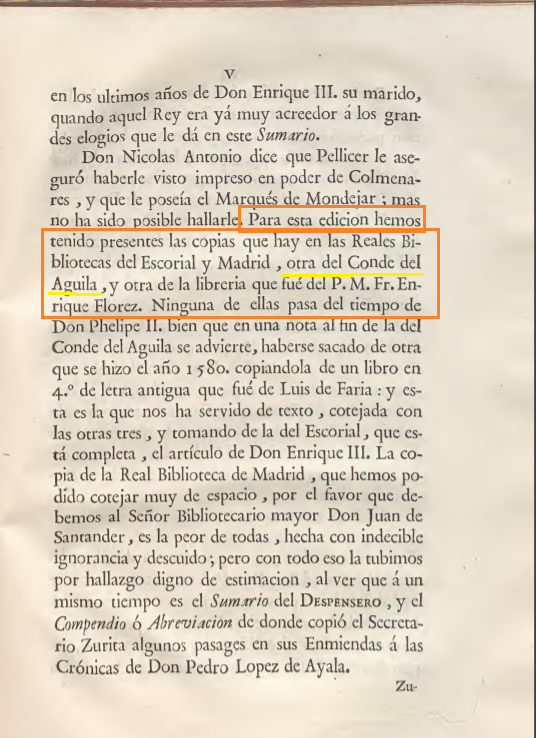
El códice del Sumario del despensero a la venta en la librería leonesa se presenta, como suele ser frecuente, con otra obra más: la Historia del Rey Don Pedro (BETA texid 1547), escrita por Pedro de Gracia Dei (BETA bioid 2995), un autor cuya obra y biografía conforman uno de los mayores laberintos de la literatura castellana de los siglos XV y XVI, a pesar de los recientes esfuerzos recorriendo sus vericuetos efectuados por González de Fauve, Las Heras y De Forteza (2006); por Mangas Navarro (2020a; 2020b); y por Perea Rodríguez (2024). En la descripción del catálogo del manuscrito—del cual no disponemos de imágenes—nos indica un detalle esencial para trazar su procedencia si lo relacionamos con la introducción de la primera edición moderna (1781) del Sumario del despensero, efectuada por Llaguno Amirola. En ella (p. V, reproducida más abajo), el erudito alavés dijo haber cotejado, entre otros, un códice perteneciente al conde de Águila, Juan Bautista de Espinosa Tello de Guzmán (BETA bioid 8671). El manuscrito a la venta en la Librería Anticuaria El Camino de Santiago indica que se copió en Sevilla en el año 1775 y tuvo como antígrafo a aquella misma copia utilizada por Llaguno Amirola procedente de la biblioteca del conde de Águila.
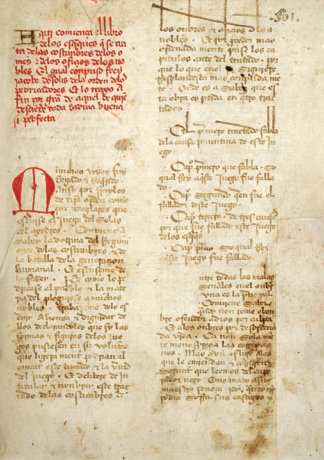
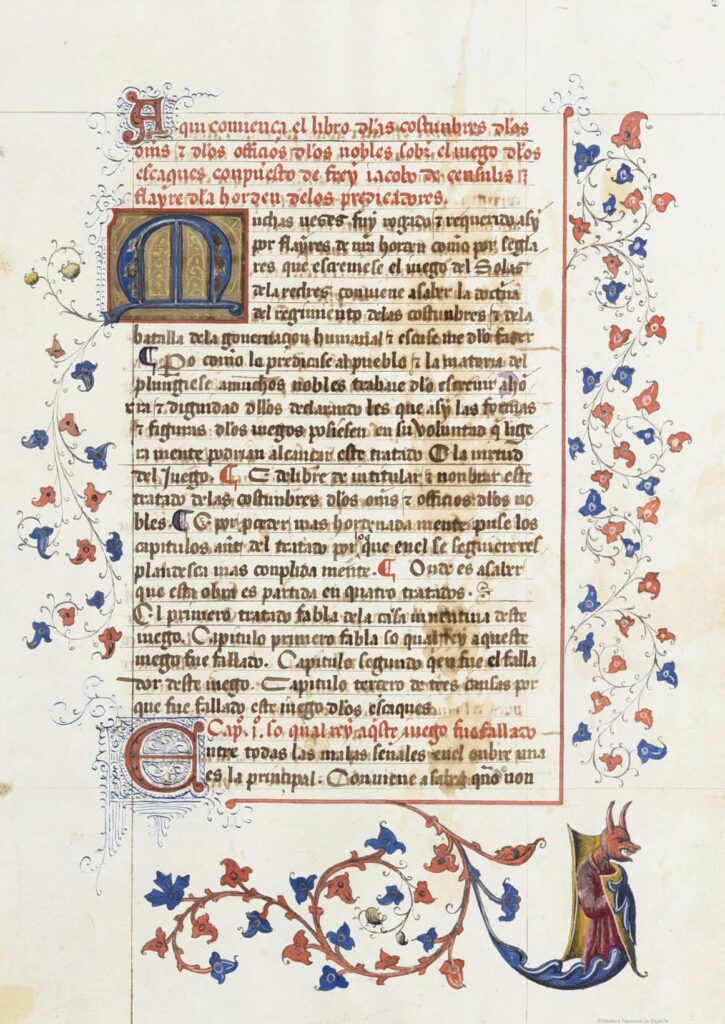
El siguiente manuscrito, del que sí disponemos de imágenes, pertenece a la madrileña sala de subastas El Remate, y fue anunciado en su catálogo de junio de 2023. Se trata de una nueva y hasta ahora desconocida copia del Libro de los esquaques (BETA CNUM 16143), que a veces aparece con un título más largo: Libro de las costunbres de los ommes e de los offiçios de los nobles sobre el juego de los escaques (BETA texid 11294). El códice subastado que aquí describimos (BETA manid 6461), de tamaño folio, se encuentra en muy buen estado de conservación, pues apenas contiene dos o tres folios con pequeñas manchas de humedad que en ningún modo impiden el disfrute de la lectura del contenido.
Libro de los esquaques, f. 1r (manuscrito subastado por El Remate, 2023)
Estamos ante una traducción al castellano del más importante tratado ajedrecístico de la Baja Edad Media en su vertiente románica occidental. Se atribuye su redacción al italiano Jacopo da Cessole, o Jacobus de Cessolis (BETA bioid 3290), que era la forma que llevaba su nombre en el tratado original, escrito en latín. Compuesta en el primer tercio del siglo XIV, la obra circuló con bastante profusión por toda Europa, como se deduce del amplio número de ejemplares de esta obra registrados por Patricia Cañizares Ferriz y Montserrat Jiménez San Cristóbal en la base de datos MANIPULUS. De hecho, la Biblioteca Nacional de España ha conservado varios de estos manuscritos del De ludo scachorum, entre ellos uno (MSS/8919) que tal vez sirviera como texto base para acometer algunas de las traducciones que hemos conservado. No obstante, téngase en cuenta que hay otros estudios, como los de Bataller Catalá (2000), que sugieren la atractiva hipótesis de que, en realidad, los romanceamientos castellanos de esta obra no fueron traducidos directamente del latín, sino que se basaron en una traducción previa ya existente del latín al catalán.
De ludo scachorum, BNE MSS/8919, f. 1r
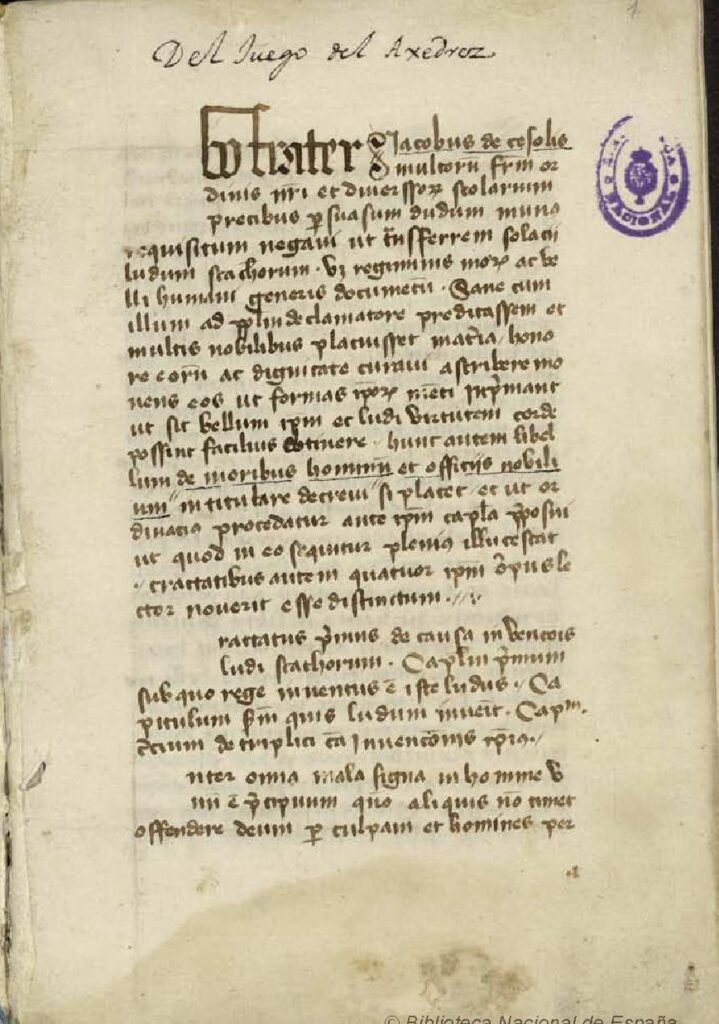
Gran parte del éxito del De ludo scachorum se debió a que, en realidad, al margen de describir las destrezas del juego del ajedrez, también era un manual de buenas costumbres de la aristocracia medieval, de ahí que muy pronto fuera traducido a otras lenguas. Por lo que respecta al castellano, se han conservado dos diferentes traducciones: la primera, la ya mencionada Libro de las costunbres de los ommes e de los offiçios de los nobles sobre el juego de los escaques (BETA texid 11294); y una segunda, de la que solo hemos conservado una traducción parcial del tercero de los tratados (BETA texid 3781). Esta última, la versión incompleta, se conserva junto a obras de Diego de Valera y Juan Rodríguez del Padrón en el manuscrito B2705 de la Hispanic Society neoyorquina (BETA manid 4024). De la versión completa conocemos dos manuscritos más: el primero es el códice 80 de la biblioteca de la Fundación Ducal de Alba (BETA manid 4880), mientras que el segundo es el RES/299 de la Biblioteca Nacional de España (BETA manid 6080).
Libro de las costumbres de los ommes. BNE, RES/299, f. 1r
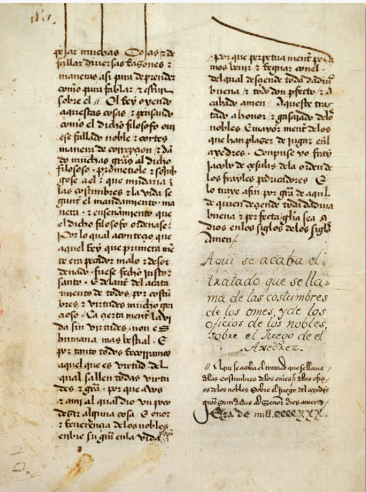
A falta de una más minuciosa exploración y cotejo de los textos contenidos en las fuentes, el manuscrito subastado por El Remate parece pertenecer a la misma tradición textual que los dos códices antes mencionados, el de la BNE y el de la Fundación Duque de Alba, si bien presenta un estado más tosco, sin tan profusa decoración como el de la BNE ni tan esmerados adornos gráficos y caligráficos como el de la Biblioteca ducal de Alba. Pese a este menor interés artístico, el manuscrito de El Remate aporta un dato fundamental para avanzar nuestro conocimiento de cuándo se realizó la traducción al castellano, puesto que está fechado en la “era de mill. cccc. xxx.”, tal como se observa al final de la columna de la derecha de la siguiente imagen.
Libro de los esquaques, f. 43r (manuscrito subastado por El Remate, 2023)
Como es sobradamente conocido, a la calendación en era hispánica hay que restarle 38 años para obtener la equivalencia en nuestro actual sistema de calendación, el de la era cristiana. Por lo tanto, el manuscrito estaría fechado en 1392, que es cuando la traducción ya se habría completado. Hasta ahora, se pensaba que había sido traducido mucho después, hacia mediados del siglo XV, conforme a la habitual tendencia de la crítica literaria medieval hispánica en hacer más tardías las fechas de traducciones de lo que en realidad son.
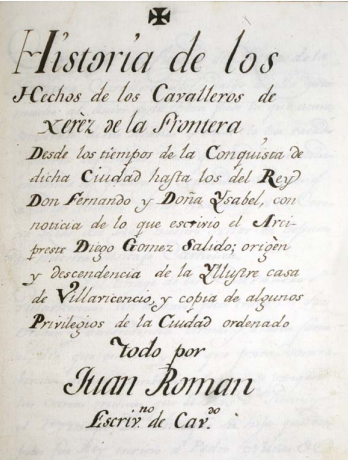
El último manuscrito al que nos referiremos en esta entrada también ha sido subastado por El Remate y lo más inmediato que hay que destacar de él es que, aparentemente, se trata de una obra que ha estado en paradero desconocido desde el siglo XVIII: la Historia de los hechos de los cavalleros de Xerez de la Frontera, que aparece con el nº 205 en el catálogo de subastas 239, correspondiente al mes de julio de 2023.
En su edición y estudio de El libro del alcázar, el profesor Abellán Pérez afirmó la existencia de un manuscrito del arcipreste local, Diego Gómez Salido, que en su momento fue muy utilizado por el medivalismo hispánico por su aparente contenido coetáneo a los tiempos medievales. Sin embargo, se perdió la pista de este libro entre 1705 y 1710. ¿Se trata del códice subastado por El Remate? Para asegurarse de que es, en efecto, el manuscrito de Gómez Salido, habría que contrastar su contenido con el del códice M/37 de la Biblioteca Municipal de Jerez de la Frontera. Parece bastante factible que puedan tener las mismas obras, sobre todo por las referencias que se hacen en ambos manuscritos a cierta genealogía sobre el linaje Villavicencio que se añadió con posterioridad a la primigenia redacción. El códice que reposa hoy en la librería pública jerezana ha sido recientemente restaurado, según informa Rafael de Leonor Molina en este artículo, y fue donado a la biblioteca por Pedro Gutiérrez de Quijano y López, que a su vez lo compró a Carmen de Cala, viuda de Juan Cortina de la Vega, conocido político y alcalde de Jerez de la Frontera en 1909. Es evidente que son de distinta procedencia, puesto que el subastado por El Remate, de 362 folios en total y con encuadernación holandesa del siglo XIX, presenta un exlibris de Feliciano Ramírez de Arellano (1826-1896), marqués de la Fuensanta del Valle, hermano de otros no menos destacados bibliófilos, los Ramírez de Arellano cordobeses. El marqués es conocido en el mundo de la erudicción hispánica decimonónica por haber sido durante muchos años, junto a José Sancho Rayón y a Francisco de Zabálburu, editor de la Colección de Documentos Inéditos para la Historia de España.
Por nuestra parte, solo esperamos a que los expertos se pongan de acuerdo sobre los contenidos de los últimos dos códices comentados para incorporar su contenido de creación medieval a nuestra base de datos y asignarlos los correspondientes identificadores. Pero eso será ya el año próximo, el mismo en el que deseamos a nuestros lectores y lectoras la mayor de las felicidades.
Óscar Perea Rodríguez
(PhiloBiblon BETA – University of San Francisco)
Gómez Redondo, Fernando. Historia de la prosa medieval castellana, III: Los orígenes del humanismo. El marco cultural de Enrique III y Juan II. Madrid: Cátedra, 2002.
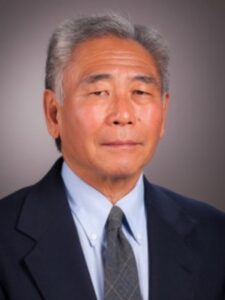
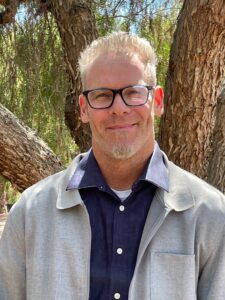
Patrick Hayashi, 2020. Photo taken by Greg Linhares
“My mom told me that an old deaf man, Mr. Wakasa, was walking his adopted stray dog around the perimeter of the camp,” recalled Patrick Hayashi. “His dog caught in the barbed wire fence and Mr. Wakasa went to save him and release him. The sentry ordered him to back away from the fence, but because he was deaf, he couldn’t do it, and so the sentry shot and killed him.”
This is the story of James Wakasa’s murder, which Patrick Hayashi’s mother told him when he was growing up. Wakasa was one of over 100,000 Japanese Americans incarcerated by the US government during World War II. In the incarceration camp of Topaz in the desert of central Utah, an armed US soldier shot and killed Wakasa. His death sparked outrage among Topaz’s incarcerees. Although individuals in the Japanese American community contest some of the details of Wakasa’s death, it remains a key, painful moment in the incarceration experience that Japanese Americans have passed down to their children.
The story of Wakasa’s death certainly remained an important memory for Hayashi, a Sansei—or third generation Japanese American—who was born in Topaz while his parents were unjustly imprisoned there. Hayashi discussed his life and career with the Oral History Center at UC Berkeley. His interview was conducted as part of the Japanese American Intergenerational Narratives Project, which explores trauma and healing across generations for Japanese Americans whose families were incarcerated during World War II.
As a young boy, after their release from the prison camp, Hayashi grew up with his parents in Hayward, California. His mother maintained ties to the Japanese American community, largely through church. However, when he was still young, Hayashi’s mother passed away of heart failure. This deeply saddened Hayashi’s father, who now carried the responsibility of raising a family as a single parent. Additionally, according to Hayashi, his father must have felt the guilt and shame from his incarceration experience in World War II. Nonetheless, Hayashi’s father exhibited resistance. He was a “no-no,” meaning he said “no” to two questions in an infamous loyalty questionnaire the US government forced upon the imprisoned Japanese Americans during WWII. The questions asked if one would be willing to serve in the US Army, and if one would swear loyalty to America and rescind loyalty to Japan. This sparked outrage among the Japanese American community, who were asked to serve a country that imprisoned them, and rescind a fealty to Japan that they didn’t have. Hayashi’s father’s “no, no” response was, as Hayashi believed, a “principled stand” against these unreasonable questions.
But his father never mentioned this resistance until Hayashi was an adult. Like many post war Japanese American families, Hayashi’s family did not often discuss their incarceration experiences.
Similar to his father, Hayashi also recalled feeling shame and guilt around incarceration and the war. In high school, he felt particularly ashamed of his identity when his class discussed WWII and the atomic bombs that destroyed Hiroshima and Nagasaki. At that time, Hayashi later recollected, “I was preferring not to be Japanese.” He also experienced a disconnect with the Japanese American community, largely due to his mother’s passing.Nevertheless, Hayashi shared many fond memories of his childhood, from reading Sherlock Holmes and science fiction books as an elementary schooler to becoming a star tennis athlete in high school.
If Hayashi felt shame due to his family incarceration, he channeled it into his work, starting in the 1960s. When reading his oral history, I noticed a theme of activism exhibited across his career in a near continuous fight for justice. After dropping out of college and working as a mail carrier, he found his calling in literature and became a UC Berkeley professor in the newfound Asian American Studies Department—one of the first such departments ever created. These developments for Hayashi came at the time of 1960s social movements in America. In one such movement, student protests in California universities led to the creation of an Ethnic Studies program at UC Berkeley.
Hayashi later became involved as a UC administrator, first working for Cal as the head of Student Conduct. After an investigation revealed that UC admissions were discriminating against Asian American applicants in the 1980s, Hayashi was appointed Associate Vice Chancellor of Admissions and Enrollment. In this position, and later as Associate President in the University of California, Hayashi worked on policy development and acted as an advocate for student applicants. He played a key role in fighting unfair admissions policies, such as the National Merit Scholarship Program (for discriminating against marginalized groups) and the Scholastic Aptitude Test or SAT (for not only explicitly favoring privileged students, but for also being, as Hayashi noted, a “bad test”).
One example of his advocacy came through at a meeting he attended soon after becoming Associate Vice Chancellor. In this meeting, Harold Doc Howe, Lyndon B. Johnson’s former Secretary of Education, communicated views with which Hayashi disagreed. Despite feeling nervous, Hayashi publicly challenged Howe in front of his colleagues. “My hands are actually trembling visibly in front of me and I said, ‘Howe begins with the assumption that a person’s writing ability reflects that person’s thinking ability. I don’t begin with that assumption. Instead I turn it into a question, and the question is to what extent does a person’s writing ability reflect that person’s ability to think?’ I said, ‘When you pose it as a question, the answer becomes obvious, it depends. If a person is new to the country or if the person is poor and has attended poor schools where the quality of education is low, then it’s incorrect and unfair to think that a person’s writing ability reflects that person’s thinking ability. Because oftentimes people just haven’t had the opportunity and the assistance to develop writing ability.’”
This, to me, demonstrates Hayashi’s sense of right and wrong – a fight against prejudiced assumptions in the admissions process.
Over time, too, Hayashi started to come to terms with the incarceration experience that his family hardly discussed and loomed over him like a cloud. One key moment for him occurred during his work as a UC professor. After reading James Baldwin’s Notes of a Native Son, in which Baldwin discusses his experiences with racism and understanding the good his overbearing father did, Hayashi felt a better understanding both of his own father and his emotions. According to Hayashi, “[Baldwin] helped me understand my rage. And how if you’ve been suppressed constantly by racism, that goes somewhere and then it explodes. That was my pattern, and then it made me realize that it must have been my father’s experience as well. He was a proud man, he was smart, but it was clear, the injustice was clear to him and so it must have gone somewhere.”
To me, Hayashi’s understanding of Baldwin speaks to the emotional scars of incarceration that burdened many Japanese Americans. After experiencing racist injustice during World War II, anger would seem like a reasonable response. Perhaps the silence of many Japanese Americans after the war was the product of the internal, bubbling anger that people of color have felt throughout American history.
As Hayashi continued to come to terms with his family’s incarceration experience, James Wakasa’s story reemerged as an important moment. In the late 1980s, Hayashi visited an art exhibition from the incarceration camps, filling him with emotion. He recalled, “I choked up more and more and then the fourth painting I saw was Chiura Obata’s sumi-E sketch of James Wakasa falling over after he was shot, and I started to sob. It was terribly embarrassing, but everyone around me was mainly Nisei, they were crying too. That’s when I started revisiting the camps in a systematic way.”
Hayashi held true to his word. Later in life, he became more and more involved in the memorialization of Topaz, the camp of his family’s imprisonment. After retirement from Cal, Hayashi played a role in the creation and work of the Topaz Museum, located near the site of the former incarceration camp. He taught workshops at the museum for teachers in Utah, served as the keynote speaker at a 2016 Day of Remembrance event, and interviewed the Topaz class of ‘45—high schoolers who graduated in 1945 as Topaz incarcerees. Hayashi also took up painting as a major passion and a creative expression of his identity.
Hayashi’s life story is a reminder that one does not need to be defined by internalized pain of the past, but can instead come to terms with that pain and tell its story. The interviews and life stories told throughout the Japanese American Intergenerational Narratives Oral History Project illuminate themes of memory, belonging, and healing. Hayashi’s life fully demonstrates each of these themes and serves as an inspiration for Japanese Americans pained by the past but who also want to make a difference.
To this day, he remains active in preserving the memory of incarceration. In 2016, Nancy Ukai, an activist who fought the auctioning of incarceration art, approached Hayashi with a request to create a painting for a Day of the Dead altar at a Japanese American cemetery. The request? To paint James Wakasa’s soul. His story, a source of intergenerational pain and important in Hayashi’s own life, now lay in the hands of Hayashi: a man who healed.
Zachary Matsumoto is a sophomore at UC Berkeley currently studying History and participating as an Oral History Center URAP apprentice. He was drawn to the Oral History Center after attending a Bancroft Roundtable presentation about the Japanese American Intergenerational Narratives Oral History Project. American history is a current academic interest of his, including the histories of communities relating to his background as a Chinese and Japanese American. In his free time, Zachary likes to go for runs, watch sports, and play taiko.
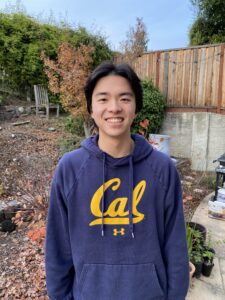
OHC URAP student and UC Berkeley sophmore Zachary Matsumoto
The Oral History Center has been as busy as ever this year, publishing hundreds of hours’ worth of interviews online. On top of making this wide range of voices available to the public, my colleagues have also used these collections of The Bancroft Library to interpret, frame and share new stories about our past. In November, the Japanese American Intergenerational Narratives project was launched, featuring interviews with the descendants of the incarceration camps during World War II. Not only are the transcripts online, but there is also a podcast and a deeply moving work of graphic illustrations that draw meaning from the interviews. In October, Todd Holmes and Roger Eardley-Pryor designed, wrote, and launched a new museum exhibit, Voices for the Environment: A Century of Bay Area Activism at the Bancroft Library Gallery, which runs through November 2024. There is an accompanying digital exhibit, which will feature podcasts, mini-documentaries, and a curriculum guide for students and teachers that will live on long after the gallery exhibit closes.
Center staff showed great leadership in the field of oral history. There is always lots to say about our oral history education programs, but what was new this year was OHC participation in a pilot historical methods course for undergraduate majors of UC Berkeley’s history program. Oral historian Shanna Farrell took a seat this year on the council of the Oral History Association, and Amanda Tewes and Roger Eardley-Pryor also led panels and gave papers at the OHA annual meeting. Todd Holmes, together with our Advanced Institute alum Emi Kuboyama, won the Autry Prize from the Western History Association for their documentary on the redress of the incarceration of Japanese Americans during World War II.
Communications and editorial lead Jill Schlessinger created, oversaw, and updated our editorial process. On the back end of our production, David Dunham led the team that transferred and preserved almost two thousand hours of audio-video that was trapped on defunct recording formats. Of course, we couldn’t have done this work without the help we get from student employees in production, preservation, and communications. Finally, following a competitive national search, I would like to celebrate the arrival of the new historian of science, technology, and medicine, Liz Semler.
I want to thank every member of the OHC staff for a great year! From all of us, we wish you all a peaceful and magical holiday and a wonderful 2024!
–OHC Director Paul Burnett
OHC Staff Reflections
I am grateful to have celebrated my 21st year with the Oral History Center. It is a privilege to support the efforts of our interviewers in producing the array of oral histories produced this year. I relish the opportunity to work with student workers, undergraduate research apprenticeship program [URAP] participants, and librarian interns. Students are integral to our production and preservation processes, ensuring that our transcripts, audio, and video are accessible and preserved. They also bring new perspectives and insights into our oral histories. It’s a cliche to say win-win, but our student workers and interns consistently share how participating with the OHC enriches their academic, intellectual, professional, and human interests. We could not do a fraction of the work we do without them. Special thanks this year to the following students and interns that contributed in countless ways to the OHC: Max Afifi; Sadie Baldwin; Peter Beshay; Hue Bui; Mina Choi; Georgia Cutter; Jason de Haaff; Nikki Do; Ava Escobedo; Leah Freeman; Samantha Goodson; Meiya Gujjalu; Anthony Lin; Lina Matine; Solomon Nichols; Guisselle Salazar; Mela Seyoum; Joe Sison; Manyi Tang; Kate Trout; Erin Vinson; and Cathy Zhang.
–David Dunham
My fifth year at OHC was the busiest yet! I’m especially grateful for exceptional and collaborative colleagues at OHC. This past year, we curated our first oral-history-focused gallery exhibit with videos and a podcast; we promoted our innovative Japanese American Intergenerational Narratives project, including graphic art and a superlative podcast; and we continued conducting and publishing outstanding oral history interviews. I’m also grateful that our new colleague, Liz, joined the OHC team. I hope you and yours celebrate all that’s good at the end of this year, and that next year is even better.
–Roger Eardley-Pryor
What a year 2023 has been! While I’ve had the privilege of working on several projects this past year, I’m very proud of working with Roger Eardley-Pryor and Amanda Tewes on the Japanese American Intergenerational Narratives project, which launched in November. We interviewed 23 survivors and descendants of WWII-era site of Japanese American incarceration, and produced a podcast and commissioned an artist to make graphic illustrations based on these oral histories. It’s been an extremely meaningful project to be a part of, and I’m grateful for the collaborative efforts of my colleagues to bring it to fruition.
–Shanna Farrell
Looking back on the year of 2023, I am struck by the power of collaboration. This year the Oral History Center curated the multimedia exhibit, Voices for the Environment: A Century of Bay Area Activism, at The Bancroft Gallery, a collaborative effort that was beyond rewarding. I am extremely grateful for the opportunity to do this work and collaborate with an amazing cast of colleagues.
–Todd Holmes
I look forward every year to this opportunity to acknowledge the talented team of student editors that make the pace of our work possible. They do the work of professional editors, create abstracts for oral histories with missing metadata, write articles about our narrators and projects, and provide invaluable suggestions in our department’s quest for continuous improvement of our workflow and processes. We said farewell to some long-term employees who recently graduated: Mollie Appel-Turner, William Cooke, Adam Hagen, Serena Ingalls, and Shannon White; I’d like to say thank you to our ongoing editor, Timothy Yue; and welcome two new staff, Nikhil Jagota and Lauren von Aspen. My favorite memory from 2023 was learning about how the experience of working with oral history has had a profound impact on how our student employees see things. I hope you will enjoy reading about their reflections as much as I did in this article, Connection, Insight, Inspiration, Truth: Berkeley undergraduates reflect on oral history.
–Jill Schlessinger
This past year has been a wild ride! I said goodbye to multi-year projects, moved across the country, and started a position at the Oral History Center in October. Although it’s only been a few months, I’ve already learned much in my new role, including technical details like how to use video recording equipment and more broadly about UC Berkeley and the surrounding area. As with any big change, sometimes I feel overwhelmed with the new-ness of it all. But change brings opportunity! I’m grateful for the chance to forge a new path as an interviewer and historian here at the Oral History Center and am excited to discover what the upcoming year holds.
–Liz Semler
In November 2023, I was honored to be a part of a great team (along with Roger Eardley-Pryor and Shanna Farrell) that launched the Japanese American Intergenerational Narratives Oral History Project, featuring 100 hours of oral history interviews with 23 Japanese American narrators who are survivors and descendants of two World War II-era sites of incarceration: Manzanar in California and Topaz in Utah. This public launch highlighted the release of most of the 23 oral history interviews, a four-part podcast series based on these original interviews, and graphic art inspired by the stories and themes from the interviews. It has truly been a meaningful experience to be a part of such important work about intergenerational memory and healing. Many thanks to the National Park Service’s Japanese American Confinement Sites Grant for funding this phase of the project!
The Oral History Center is pleased to welcome Liz Semler, our new historian of science, medicine, and technology!
Liz Semler, OHC Historian of Science, Medicine, and Technology
Liz comes to the UC Berkeley Library from the University of Minnesota’s Program in the History of Science, Technology, and Medicine. Elizabeth Semler is a medical and business historian and received her PhD from the University of Minnesota’s Program in the History of Science, Technology, and Medicine, where her academic work focused on the relationship between chronic diseases and diet in the United States and the Nordic countries. Her dissertation interrogated the intersections of epidemiological research, American business interests, and the development of public health prevention policies in the twentieth century. During her time at the University of Minnesota, Elizabeth taught undergraduate and community education courses on medical and technological history. She also participated in numerous public-facing history projects, including museum exhibits, educational websites, and film documentaries. Taken together, this work has fed Elizabeth’s passion for collecting, preserving, and making history accessible to broad audiences.
We sat down with Liz for a Q&A to get to know her better, which is below.
Q: When did you first encounter oral history?
A: I first encountered oral history in the first year of graduate school – I had the opportunity to participate in a project documenting the history of cardiovascular innovations at the University of Minnesota. This involved interviewing practicing clinicians, research scientists, and academicians about their contributions to cardiovascular care. It was a very different experience than studying archival documents and other static sources. Although I enjoy archival work, it was exciting to be able to ask questions and directly interact with narrators!
Q: What role did oral history play in your previous work?
A: I have worked on numerous public history projects over the past decade that have contained oral history components, with topics ranging from medical to the history of computing. Oral histories were also an important component of my dissertation project, which focused on the relationship between coronary heart disease and diet in the mid-to-late twentieth century.
Q: Which interviewers have been your biggest influences, oral historians or otherwise?
A: I really enjoy listening to Anna Sale’s interview podcast Death, Sex & Money. She does a great job of discussing challenging subjects with folks and I have learned a lot about how to tackle difficult, sensitive topics from listening to those conversations. I just learned the podcast may end in December, 2023. Who knows what will happen to archived episodes, so I recommend people give it a listen while they can!
Q: What projects are you most excited to work on at the OHC?
A: I’m still in the process of familiarizing myself with upcoming projects at OHC but I’m already very excited by the resources here at University of California, Berkeley as well as in the broader UC system. As a medical historian, the collections at UCSF have grabbed my attention – I’m looking forward to building connections across campuses and, hopefully, bringing together the resources of the Bay Area in collaborative projects.
Q: What is your dream oral history project?
A: Before COVID-19 shuttered things in 2020, I was in the process of interviewing folks who had worked at the midwest-based supercomputer company Cray Research. The company’s history is really interesting but extant archival materials are minimal and little has been written about Cray from an historical perspective. I’d like to finish capturing people’s experiences at Cray, if possible!
Zachary Matsumoto is a sophomore at UC Berkeley currently studying History and participating as an Oral History Center URAP apprentice. He was drawn to the Oral History Center after attending a Bancroft Roundtable presentation about the Japanese American Intergenerational Narratives Oral History Project. American history is a current academic interest of his, including the histories of communities relating to his background as a Chinese and Japanese American. In his free time, Zachary likes to go for runs, watch sports, and play taiko.
Reflections on Work with the Japanese American Intergenerational Narratives Project
by Zachary Matsumoto
OHC URAP student and UC Berkeley sophomore Zachary Matsumoto
This fall of 2023, I became a URAP student at the Oral History Center under the guidance of Shanna Farrell, Amanda Tewes, and Roger Eardley-Pryor. My work throughout this semester largely consisted of researching, analyzing, and writing about the oral histories of the Japanese American Intergenerational Narratives Project, as well as the Japanese American Confinement Sites Project. These oral histories highlighted a historical event that greatly affected my own family.
In 1942, the United States government, at the beginning of its involvement in World War II, issued Executive Order 9066. This order imprisoned Japanese Americans living on the West Coast and placed them in remote prison camps across the country. My paternal grandparents and their families were among them. Growing up, my parents told me of my grandparents’ histories as incarcerees, stressing the wrongdoing and unfairness done to them by the US government. As I grew up reading and watching material on Japanese American incarceration, I began to understand the details of the incarceration experience: how truly unfair it was; the crippling effects of losing a home for a remote prison camp; the silence of incarcerees afterward; and how themes of incarceration endure today.
Fast forward to 2023, when I joined the OHC as a URAP student and explored the oral histories of Japanese Americans. One component I learned from these oral histories was the traumatic intergenerational effects of incarceration: the pain and guilt that incarcerees passed down to their children, and at times even their grandchildren. This was a very eye-opening experience for me, as I personally felt as if the incarceration of Japanese Americans was an important, but almost distant historical event in my own life. Reading these oral histories, as well as listening to a podcast series “From Generation to Generation: The Legacy of Japanese American Incarceration,” based on the very same interviews, was at times an emotional experience. Hearing of descendants losing their sense of belonging, feeling disconnected with their culture, and living without the knowledge of their families’ incarceration experiences was heartbreaking to hear.
But what really struck me about these oral histories was not only the intergenerational pain and sorrow, but the agency exhibited by the project narrators after incarceration. This is something I knew but not really understood the scope of. This agency, as recounted in the oral histories, was both public and private. Patrick Hayashi, a man born in the incarceration camps and whose oral history I studied extensively, demonstrated activism as one of California’s first Asian American Studies professors and by fighting against prejudiced admissions practices. But more privately, he vowed to reexamine the trauma of his family’s past through creating artwork and educating Utah teachers on incarceration. Other individuals, in the 1970s and 1980s, participated in the redress movement, in which Japanese Americans questioned the wrongdoing of WWII incarceration and successfully drew attention to this experience. This eventually led to a formal apology and reparations paid by the US government.
Even in more recent years, the agency and activism of individuals in the oral history interviews shines brightly. Ruth Sasaki, an author, joined an organization named Tsuru for Solidarity: a group that fought against the forced incarceration of migrants crossing the US-Mexico border. After the Trump administration detained migrants at the US-Mexico border, including children, as part of the Zero Tolerance Policy, Sasaki and twenty-six other Tsuru for Solidarity members flew to Oklahoma to protest, along with a large number of Native American, Latino, and African American activists. Sasaki’s story, in particular, served as a reminder for me of the living memory of Japanese American incarceration and how that community in particular could serve as a key fighter: a guard against the unjust, unprovoked incarceration of marginalized groups today.
One moment of agency, in particular, was very personal for me and my interests. Roy Hirabayashi, a longtime San Jose resident and the descendant of Topaz survivors, recalled the founding of San Jose Taiko, a taiko (Japanese drumming) performance group. As San Jose Taiko began its performances and found its sound and style, Hirabayashi realized he did not know many traditional Japanese themes and rhythms for playing taiko; instead, he took rhythmic inspiration from music he was exposed to in the Bay Area, such as R&B and Latin soul. According to Hirabayashi, “We felt we were establishing pretty much early on that we, in Asian American sound, using what we called the Japanese drum, the taiko, our version.” For Hirabayashi, taiko was not just a performance instrument but an intentional expression of his developing Asian American identity. This, to me, shows his agency and sense of self. Reading Hirabayashi’s oral history also highlighted my personal connection to this interview. As a child, my mom drove me forty minutes to Santa Rosa so I could learn and practice taiko. Now, as a sophomore in college, I am a current member of Cal Raijin Taiko, UC Berkeley’s taiko organization and performance group. The fact that an instrument that occupies an important place in my own life is wrapped in the history and agency of Japanese Americans captivates me and brings me closer to the history of the Japanese American experience.
Over the course of my URAP experience in the Oral History Center, I felt my eyes further opened to the individual experiences of the descendants of incarcerees. What stands out was not just their guilt and attempts to cope with the scars of incarceration, but instead their strength through identity and activism. As a Japanese American myself, I feel proud to be part of this legacy of strength. In the future, I hope to continue exploring my identity, and what it means to be a descendant of the incarceration camps. As I explored the oral histories in the Japanese American Intergenerational Narratives Project, I encountered personal questions: why am I not feeling the same burden as the descendants of incarceration? Why do I feel as if incarceration was a memory without a strong effect on my own life? These questions remain in my mind, and I will continue to seek answers to them throughout my life.
We invite graduate students, undergraduates, and independent scholars to apply by Feb. 5, 2024
The Bancroft Library at UC Berkeley is pleased to announce we are now accepting applications for our 2024-25 fellowships and awards, available to graduate students, undergraduates, and independent scholars conducting research in our special collections. The Bancroft Library is committed to fostering a diverse and inclusive research environment, and seeks to support students and scholars using the collections both for traditional archival and bibliographic research, as well as those wishing to use the collections for creative projects.
Applications are due February 5, 2024, at 5 p.m., with decisions to be made by early April 2024.
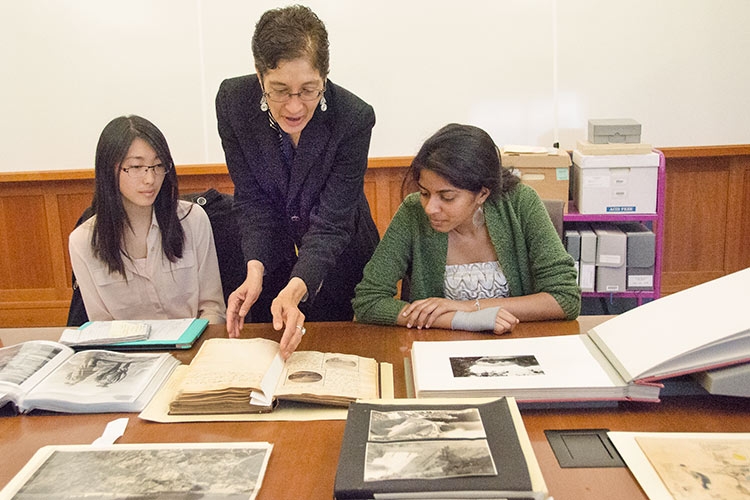
Bancroft Library curator Theresa Salazar assists undergraduate researchers. Photo by Cathy Cockrell (Courtesy of UC Regents).
Research areas
Several fellowships offer funding for research that would benefit from the use of any source materials in The Bancroft Library. Other fellowships are focused around specific subject areas. Our fellowships and awards range in amounts.
Our 2024-25 fellowships and awards are in the following research areas:
Research that would benefit from the use of any source materials in the Bancroft
History of California
Nineteenth century American West and related topics
Jewish experience in California from 1848 to 1915
Print culture in any part of the Western Hemisphere, or any investigation of the history of the book in the Americas
How to apply
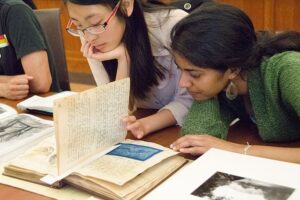
Bancroft archival materials in use by students.
Our Fellowships and Awards website has details about all the eligibility criteria for each fellowship or award, and the application process. Some opportunities are designated for Berkeley undergraduates, some for graduate students at any University of California campus, and some are open to students at any college or university or independent scholars —complete descriptions are on the website.
Please share this announcement with undergraduate and graduate students, and anyone else who may be interested in The Bancroft Library’s fellowship program.
About the Bancroft Library
The Bancroft Library is the primary special collections library at UC Berkeley, and one of the largest and most heavily used libraries of manuscripts, rare books, and unique materials in the United States. Bancroft supports major research and instructional activities and plays a leading role in the development of the university’s research collections.
Since Bancroft is a reference library, its collections are non-circulating, which means they are only available for your use in the Heller Reading Room. Fellowships and Awards facilitate this in-person research.
The Bancroft Library welcomes researchers from the UC Berkeley campus, nationally, and from around the world. Our holdings currently include: more than 600,000 volumes; 60 million manuscript items; 8 million photographs/pictorial materials; over 3 million digital files; 43,000 microforms; and 23,000 maps.
People worldwide can access Bancroft’s digital collections, which include digitized materials from the library’s extensive and ever-growing holdings, as well as born digital materials collected as part of our archival manuscript and pictorial collections.
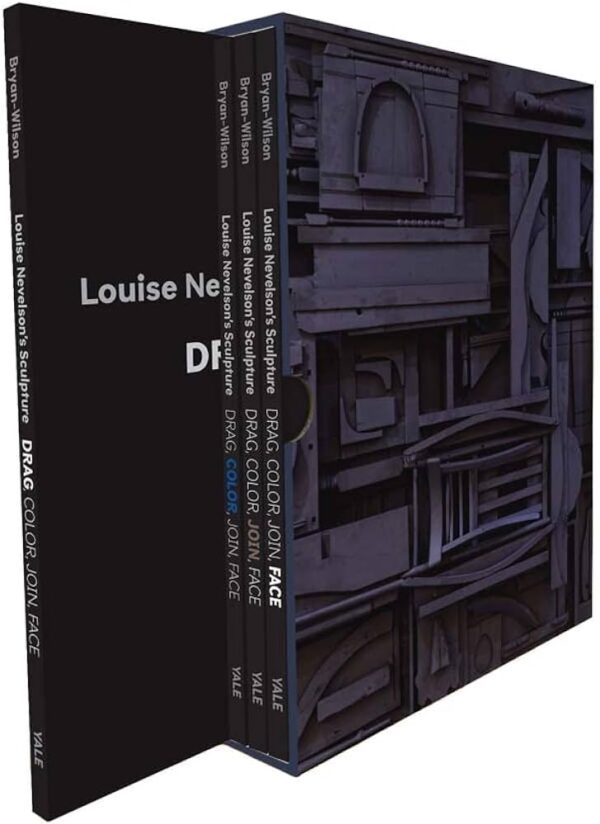
“A daring reassessment of Louise Nevelson, an icon of twentieth-century art whose innovative procedures relate to gendered, classed, and racialized forms of making
“Here is a book that is not only a transformative study of a single artist but also a record of the scholar’s own labor—and her devotion.”—Artforum
In this radical rethinking of the art of Louise Nevelson (1899–1988), Julia Bryan-Wilson provides a long-overdue critical account of a signature figure in postwar sculpture. A Ukraine-born Jewish immigrant, Nevelson persevered in the male-dominated New York art world. Nonetheless, her careful procedures of construction—in which she assembled found pieces of wood into elaborate structures, usually painted black—have been little studied.
Organized around a series of key operations in Nevelson’s own process (dragging, coloring, joining, and facing), the book comprises four slipcased, individually bound volumes that can be read in any order. Both form and content thus echo Nevelson’s own modular sculptures, the gridded boxes of which the artist herself rearranged. Exploring how Nevelson’s making relates to domesticity, racialized matter, gendered labor, and the environment, Bryan-Wilson offers a sustained examination of the social and political implications of Nevelson’s art. The author also approaches Nevelson’s sculptures from her own embodied subjectivity as a queer feminist scholar. She forges an expansive art history that places Nevelson’s assemblages in dialogue with a wide array of marginalized worldmaking and underlines the artist’s proclamation of allegiance to blackness.”
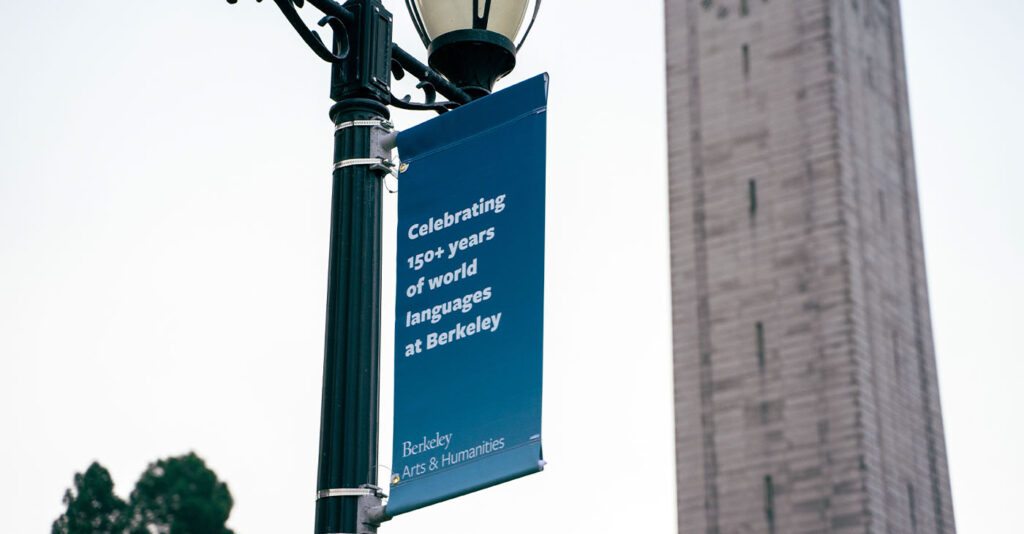
Collectively, undergraduates at Berkeley speak more than 220 different first languages. Offering instruction in at least 60 languages, Berkeley is one of the nation’s top institutions for the breadth and depth of its world languages program. The program also values revitalizing and preserving endangered languages. Photo: Neil Freese/UC Berkeley.
At least 60 languages — from Mongolian and Old Norse to Polish, Catalan, Ancient Egyptian, Arabic and Biblical Hebrew — are taught at UC Berkeley, one of the nation’s top institutions for the breadth and depth of its world languages program. A growing emphasis also is being placed at Berkeley on revitalizing and preserving endangered languages, most of them spoken by Indigenous peoples.
To help honor more than 150 years of global languages at Berkeley, 63 colorful banners will begin flying throughout campus today, and for the next 18 months, that feature facts about the campus’s language programs, as well as 21 bilingual and multilingual faculty members, students and alumni.
Among the messages on the banners:
Collectively, undergraduates at UC Berkeley speak more than 220 different first languages.
More than 500 language learning classes are taught at Berkeley annually.
More than 6,000 Berkeley students enroll in those classes each year.
In 1872, the first endowed chair in the UC system was created — for the study of East Asian languages at Berkeley.
Students at all UC campuses can take online African language classes at Berkeley, which is well-known for Amharic, Igbo and Swahili instruction.
The UC Berkeley Oral History Center (OHC) is thrilled to announce that OHC historian Todd Holmes and project partner Emi Kuboyama from Stanford University have won the 2023 Autry Public History Prize for their digital project, Redress: An Oral History. The award is given by the Western History Association for the best project in public history. Released to the public in 2022, the project documents the history of Japanese American Redress through oral histories and a documentary film, which are featured with related historical resources on a dedicated educational website.
Emi Kuboyama, Project Creator and Interviewer
Holmes and Kuboyama began the project in 2018 with the initial goal of documenting the history of the Office of Redress Administration (ORA), the little-known agency charged with administering redress by the Civil Liberties Act of 1988. Emi Kuboyama, the principal creator of the project, had a direct link to the agency and its work. As a native of Hawaii, she was no stranger to the history of Japanese American incarceration or the impact that dark period still held in Japanese American communities. She also began her legal career with the agency in 1994, an experience that had a profound impact on her personally and professionally.
In 2017, Kuboyama attended the OHC’s Advanced Oral History Institute to explore how oral history could help document the historic redress program and the work of the ORA. There she met OHC historian Todd Holmes and the two agreed to partner on the project. With the support of a Japanese American Confinement Sites grant from the National Parks Service, they conducted over a dozen interviews with former ORA staff, as well as community leaders affiliated with the program. The recordings and transcripts of those interviews are now housed at the Densho Digital Repository. Upon the completion of the oral history interviews, Holmes and Kuboyama recognized the need to put the history of the ORA into conversation with the experience of the Japanese American community in its forty-six-year journey from internment to redress. With the generous support of the Henri and Tomoye Takahashi Foundation, they enlisted the help of filmmaker Jon Ayon. The collaboration resulted in the film, Redress, which offers the first in-depth look at the history of Japanese American redress as told by the community members who took part in the program, and the government professionals who administered it.
Todd Holmes, Project Co-Creator and Videographer
The last part of this digital project was to create a website that would not only serve as a home for the oral histories and film, but also an educational space for students and the public to learn more about the history of redress. Created by Todd Holmes and Heidi Holmes, the website features two historical pages that supplement the film and oral histories, as well as a resources page that points visitors to related historical material such as books, films, and oral history collections. Since the project’s release in fall 2022, the website has received over 43,000 visitors.
The prize was awarded to Holmes and Kuboyama in October 2023 at the annual Western History Association Conference. In the awards program, the Autry Committee praised the Redress project as “an excellent model of professional public history practice that documents a moment in Western American History that has particular significance for today’s conversations about reparations within other marginalized groups.” The committee also applauded how the project “showcases the power of the medium of oral history.”
The Oral History Center congratulates Todd Holmes, Emi Kuboyama, and their partners on an outstanding project and contribution. For more on the history of Japanese American Redress, visit the project website. And to learn more about the Japanese American experience and the legacy of WWII, see the new oral histories of the OHC’s Japanese American Intergenerational Narratives project, which are featured in the newest season of The Berkeley Remix podcast.