We have access to a fully digitized daily newspaper from Estonia (1991-2009) aimed at Russian-speaking citizens of Estonia.
Following Estonia’s independence in 1991, the Tallinn-based Russian-language broadsheet Estoniia was launched. Built by the staff of the former Sovetskaia Estonia, it stood out as one of the country’s pioneering private media outlets. The paper took inspiration from Western journalism, focusing its reporting on global and local politics, financial trends, and the arts. Under the financial patronage of Vitaly Khaitov, the publication grew significantly and rebranded as Vesti dnia in 2004, though it eventually folded in 2009 due to economic challenges and a competitive market.
A collation of Estoniia Newspaper
Landing Page of Russian Language Newspaper, Estonia from Tallin.
Unfixed proof prints, each depicting Diego Rivera (left) and Timothy L. Pflueger, taken by Edward Weston at the outdoor studio of sculptor Ralph Stackpole in San Francisco on December 14, 1930. From Edward Weston Portraits from the Timothy L. Pflueger Papers (BANC PIC 2013.119).
On December 14, 1930 the photographer Edward Weston, then based in Carmel-by-the-Sea, drove to San Francisco to take portraits of a few clients, including the prominent architect Timothy L. Pflueger, who was then overseeing his firm’s remodel of the San Francisco Stock Exchange Building in the city’s financial district. The sitting with Pflueger took place at the North Beach studio of sculptor Ralph Stackpole, whose massive figurative pieces were commissioned by Pflueger to adorn the facade of the Exchange. Coincidentally residing with Stackpole at the time was Mexican artist Diego Rivera — also commissioned by Pflueger, to create a mural inside the Exchange. Accompanying Rivera was his young wife, the artist Frida Kahlo, who was early in her career and not yet known outside of Mexico. Weston was already acquainted with Rivera after having worked for a spell in Mexico City, where he befriended the artist and took his portrait in the mid-1920s. The crossing of paths of these creative luminaries at Stackpole’s studio is richly documented in Weston’s daybook entry for this date. (See The Daybooks of Edward Weston, vol. 2, pages 198-199; published by Aperture in 1973.)
The Pictorial unit of The Bancroft Library’s archival processing team is pleased to announce that some of the portraits taken by Weston at this sitting have been recently processed and are now available for access (described in the library catalog under the call number BANC PIC 2013.119). Separated and transferred from the Timothy L. Pflueger Papers of our Manuscripts unit (BANC MSS 2012/182), the collection of Weston materials includes a letter written by the photographer and a selection of small-format proof prints offered to the architect so that he could choose the images he preferred for final printing. Among the thirteen prints in the collection, eleven of them depict Pflueger in various shoulder-length poses, while two images depict the architect informally sitting on a bench with Rivera. Stackpole is not depicted, but evidence of his open-air studio is present in the natural light reflected on the subjects’ faces and some of the objects captured in the shots of the architect and muralist seated together. Although Weston took separate portraits of Rivera and Kahlo at this same encounter, these images are not present in the material sent to Pflueger.
Weston’s letter to Pflueger, written by hand on the photographer’s studio stationery, refers to the specific images from the sitting that he feels were best, yet also admits to his being unsatisfied with the overall results and offers the architect the option of a second sitting. The collection also includes Weston’s original envelope in which the letter and prints were sent, the wrapping materials in which Weston enclosed the prints, and Pflueger’s annotated file envelope in which the material had been saved.
Front page of letter from Edward Weston to Timothy L. Pflueger, written December 15, 1930; with the original postmarked envelope and Pflueger’s file envelope in which the letter and associated photographic prints were stored. From Edward Weston Portraits from the Timothy L. Pflueger Papers (BANC PIC 2013.119).
The proof prints that Weston sent to Pflueger were unfixed — i.e. after being exposed to the negative and placed in a bath of developer, the prints did not undergo a subsequent chemical bath which would have “fixed” the development of the images at a given point. The images therefore continued to gradually develop and are, in their current state, predictably faded and darkly discolored. The practice of not fixing such proof prints was common among 20th century portrait photographers whose work involved traditional gelatin silver “black & white” processes. In addition to serving as quickly produced reference images for both photographer and client, the inferior-quality prints also helped to ensure that the proofs sent to clients for final selection would have minimal resale value — an obvious concern for prominent photographers whose works were collected on the market.
Some of the prints in the collection display additional deterioration as a result of having been stored in direct contact with the chemically harmful foil and acidic paper in which they were wrapped for decades prior to their arrival in the library. On the backs of the prints are pencil-written annotations by Weston, including numbers that indicate the sequence of poses he photographed. On the back of one print Weston’s initials indicate an image which he considered to be among the most suitable for final printing.
Unfixed proof prints depicting San Francisco architect Timothy L. Pflueger, taken by Edward Weston at the North Beach studio of Ralph Stackpole on December 14, 1930. While both were stored in the same stack of prints likely for decades, the print on the left has undergone additional deterioration after prolonged immediate contact with acidic wrapping materials, and/or other detrimental environments. From Edward Weston Portraits from the Timothy L. Pflueger Papers (BANC PIC 2013.119).
To ensure safe access by researchers, the prints have been individually enclosed in polyester sleeves that prevent any unfixed chemical residue from migrating during their handling. As a safeguard against long-term damage caused by exposure to light, each print is additionally housed in a paper sleeve. Each of the components of the collection is housed in a separate folder, and all are stored together in a single box.
The Bancroft is excited to make this material accessible for a number of reasons, the most obvious being its evidentiary connection to a moment in time when Weston, Pflueger, Rivera, Kahlo and Stackpole came together for a professionally and socially satisfying gathering, one documented for posterity by the photographer in both word and image. Weston’s distinct large handwriting is impressive to behold in person, as are the pieces of stationery which conveyed the contents from photographer to architect. Perhaps the collection’s most enduring value lies in its glimpses of Weston’s working methods, his relations with his clients, and his openly frank assessment of the quality of his work.
To more broadly illustrate the context of the collection, we have supplemented the original material with printouts of high-quality scans of contact prints made from Weston’s original negatives taken at Stackpole’s studio on that day. Compared to the proofs in the Pflueger papers, these clear, sharp images depict the full range of portraits of Pflueger, and additional shots of Rivera, including one depicting him with Kahlo. We’ve also included a copy of the pages in Weston’s original daybook entry that describe the photographer’s various appointments and observations of that day, most of it expressing his affectionate reunion with Rivera, his first impressions of Kahlo, and the group’s dinner outing in North Beach that followed the sitting. These supplemental materials were kindly shared by the Center for Creative Photography of the University of Arizona, Tucson, where Edward Weston’s archive is held.
Contact print of an Edward Weston portrait of Diego Rivera (left) and Timothy L. Pflueger, taken at the San Francisco studio of Ralph Stackpole on December 14, 1930. (Courtesy of Center for Creative Photography, University of Arizona, Tucson.)
Contact print of an Edward Weston portrait of Frida Kahlo (left) and Diego Rivera, taken at the San Francisco studio of Ralph Stackpole on December 14, 1930. (Courtesy of Center for Creative Photography, University of Arizona, Tucson.)
Among the Pflueger papers are other photographs of Rivera and Kahlo – not taken by Weston – including two snapshots which may depict the couple during one of their stays in San Francisco. These can be found in BANC MSS 2012/182, carton 33.
Frida Kahlo, with Diego Rivera in image at left, on sunlit balcony, unidentified location. From the Timothy L. Pflueger Papers (BANC MSS 2012/182, carton 33).
Of related interest, Bancroft’s holdings of the San Francisco News-Call Bulletin Photograph Archive include original glass negatives of studio portraits of Rivera, Kahlo and Stackpole taken at a single sitting. The photographer, location and exact date of these portraits are unknown, but they were undoubtedly taken during the couple’s same stay in San Francisco, between late 1930 and mid-1931, when Weston visited them for the Pflueger sitting. These portraits are found in BANC PIC 1959.010–NEG pt. 1, box 3135 (items 37390 and 37391) and box 3136 (items 37404 and 37405).
Diego Rivera (left) and Ralph Stackpole, 1930 or 1931. Photographer unknown. From the San Francisco News-Call Bulletin Photograph Archive (BANC PIC 1959.010–NEG pt.1, box 3136, item 37405).Diego Rivera (left) and Frida Kahlo, 1930 or 1931. Photographer unknown. From the San Francisco News-Call Bulletin Photograph Archive (BANC PIC 1959.010–NEG pt.1, box 3135, item 37390).
Chris McDonald
Processing Archivist, Pictorial Unit
Technical Services
The Bancroft Library
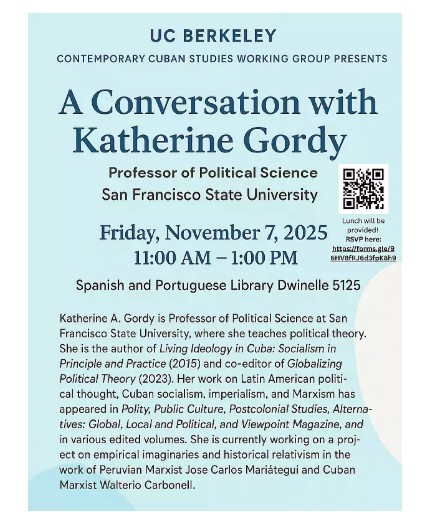
All are invited to attend the Cuban Studies Working Group’s conversation with Dr. Katherine Gordy, Professor of Political Science at San Francisco State University, which will take place tomorrow, November 7, 2025, at 11 am in Dwinelle 5125 (Level E)
Katherine Gordy is an accomplished author and editor in the field of political science. Her published works include the single-authored book Living Ideology in Cuba: Socialism in Principle and Practice (2015) and the co-edited volume Globalizing Political Theory (2023).
Gordy’s research spans Latin American political thought, Cuban socialism, imperialism, and Marxism, with articles published in notable journals such as Polity, Public Culture, Postcolonial Studies, Alternatives: Global, Local and Political, and Viewpoint Magazine, as well as various edited collections.
Currently, she is engaged in a research project exploring empirical imaginaries and historical relativism as present in the works of two prominent Latin American Marxist thinkers: the Peruvian José Carlos Mariátegui and the Cuban Walterio Carbonell.
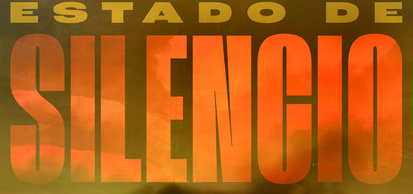
Film Screening & Discussion: “State of Silence”
Date & Time: Wednesday, November 5, 2025, 4:30 PM – 6:30 PM
The title of a film is “Estado de Silencio” (The State of Silence).
“State of Silence/Estado de Silencio” delves into the challenges facing press freedom in Mexico, chronicling the dangerous work of four journalists as they uncover the ties between organized crime and government corruption. Through their eyes, the documentary reveals the obstacles and risks they face in breaking the silence around systemic abuse and violence. A panel discussion and audience Q&A with will follow the screening:
Concrete art and poetry—a radical avant-garde movement where the visual and spatial arrangement of words on the page carries as much weight as their literal meaning—emerged in Brazil during the 1950s, a time of rapid and transformative modernization. Professor Nathaniel Wolfson (Spanish & Portuguese) challenges the notion that concretism was socially passive, as some scholars have claimed. Instead, he presents it as the defining literary genre of the early information age.
Concrete Encoded: Poetry, Design, and the Cybernetic Imaginary in Brazil (Texas, 2025) examines how Brazilian poets, artists, and designers engaged with the rise of digital capitalism, forging a distinct cybernetic vision. Wolfson’s study reinterprets concretism—not just as Brazil’s most internationally influential artistic movement, but as a network connecting both prominent and overlooked figures. By mapping these creative exchanges, the book reveals broader, transnational conversations about technology and its critical possibilities.
Día de los Muertos (Day of the Dead) is an essential Mexican holiday, primarily celebrated on November 1st and 2nd. It is a time for families and friends to gather, pray for, and remember loved ones who have died. The celebration is vibrant, focusing on life and remembrance, rather than mourning. Key traditions include creating ofrendas (altars) decorated with marigolds (cempasúchil), favorite foods and drinks of the departed, candles, and colorful sugar skulls (calaveras).
The Bancroft Library: Located within the Doe Annex, Bancroft is the university’s premier special collections library. Its Latin Americana Collection is a critical resource for primary materials related to Día de los Muertos and broader Mexican culture. This collection has been known to feature items such as:
Rare publications and historical documents on Mexican traditions.
Original materials related to the arts and political satire, including the iconic works of artist José Guadalupe Posada (known for his skeletal figures, or calaveras), whose prints have heavily influenced the holiday’s visual iconography.
Illustrating Mexico one page at a time-Print Art of José Guadalupe Posada
Several venues across the East Bay feature Día de los Muertos altars. The Oakland Public Library is among the organizations hosting a related activity. Below are photos of the altar created by the library’s César Chávez branch (formerly the Latin American Library) to commemorate this important cultural tradition.
Photos below: Credit: Liladhar P.
Our Social Sciences Library at UC Berkeley Library, my departmental colleagues have created also an altar whose pictures I am sharing. Two colleagues who took initiative in supporting this activity are Angelica V.M. and Cody H.
Photos below: Credit Angelica VM.
A dia de los muertos altar at Social Sciences Research Library
The following subject terms can be helpful to our students when trying to locate materials on Dia de los muertos in our library’s collections.
We invite you to attend “Art Against Artillery: Cultural Resilience in Times of War,” a panel discussion.
Date: December 4, 2025
Time: 10 am PST (8 pm Kyiv Time)
Registration: https://tinyurl.com/artagainstartillery
Organizer: Dr. Liladhar R. Pendse, Librarian for Slavic, East European, and Eurasian Studies
The event is free and open to all, provided prior registration is completed. Please sign in to your individual Zoom account and then register. All are welcome!
Please submit your feedback to your librarian for Latin American and Caribbean Studies: Liladhar
Latin America Commons Landing Page
Latin America Commons by Coherent Digital is a full-text, richly-indexed database that provides unified, cross-searchable access to millions of pages of Latin American and Latinx primary-source materials, including books, magazines, photographs, maps, letters, diaries, ephemera, videos, and audio files that were previously scattered across the internet and in archives. The project aims to preserve at-risk content, rare documents, and often overlooked resources spanning from the 16th to the 21st centuries, making it easier for scholars and students to discover vetted, high-quality material for research and study.
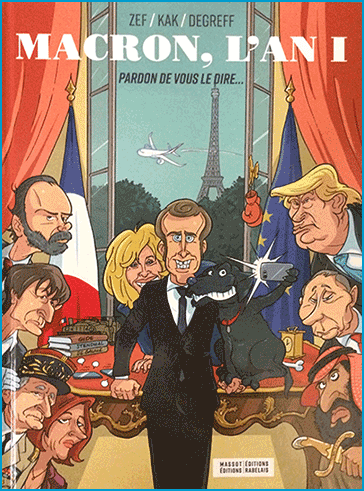
From Macron, L’an I: pardon de vous le dire par Zef, Kak, and Degreff (Paris: Florent Massot, 2018.)
Recent acts of censorship of late night television talk show hosts Stephen Colbert and Jimmy Kimmel have spurred interest in not only reposting this ever pertinent blog post originally published on November 27, 2018 but also updating it with some relevant books acquired since then. With or without humor, we find both presidents still (or again) in power and in the satirical spotlight. Enjoy! Amusez-vous!
—————————
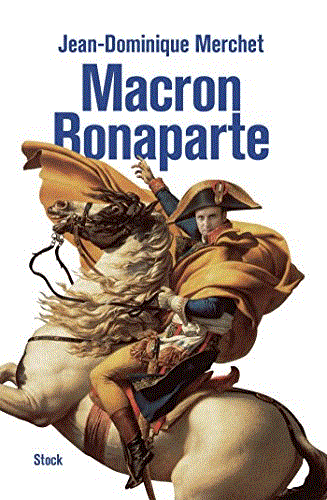
As two of the oldest modern democracies, France and the United States share a long tradition of freedom of speech and of the press (and at times governmental censorship). The two societies have found catharsis in the mockery of their highest elected officials through caricatures, cartoons, and critical writings. Here are a few recent library acquisitions, in English and in French, from both sides of the Atlantic in this category of political critique:
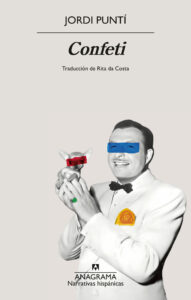
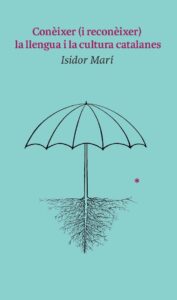
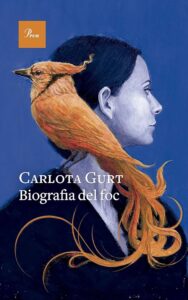
Please find this selection of books in Catalan recently received and cataloged for your reading pleasure. Catalan is a Western Romance language and is the official language of Andorra, and the official language of three autonomous communities in eastern Spain: Catalonia, the Balearic Islands and the Valencian Community, where it is called Valencian.
Catalan is considered a Less Commonly Taught Language (LCTL) in Europe and has received special support from the U.S. Department of Education under the auspices of Title VI of the Higher Education Act of 1965. Other languages of interest to research and teaching at Berkeley and historically supported by this program administered by the Institute of European Studies include Dutch, Portuguese, Modern Greek, Occitan, Yiddish, Galician, Danish, Finnish, Swedish, Norwegian, Icelandic, and more.





 As two of the oldest modern democracies, France and the United States share a long tradition of freedom of speech and of the press (and at times governmental censorship). The two societies have found catharsis in the mockery of their highest elected officials through caricatures, cartoons, and critical writings. Here are a few recent library acquisitions, in English and in French, from both sides of the Atlantic in this category of political critique:
 Collard, Susan P., ed.
  Drezner, Daniel W.
  Lee, Bandy X.
  Ngono, Emmanuel.