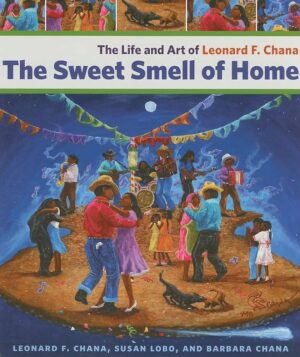
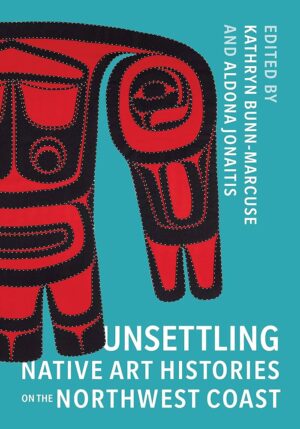
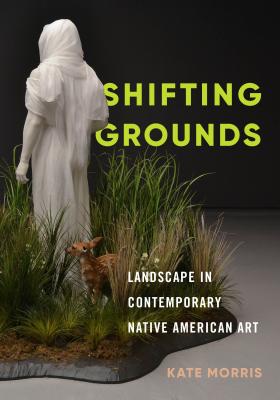
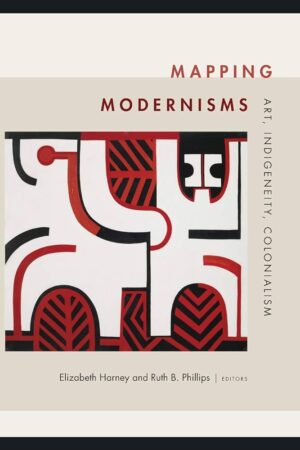
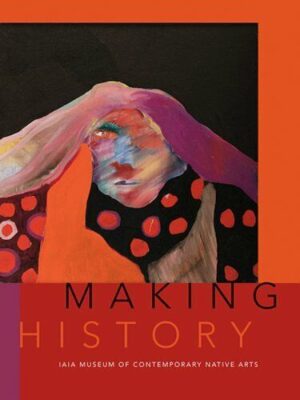
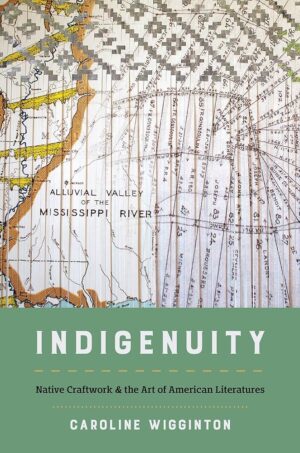
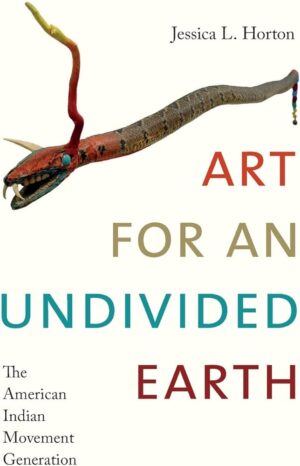
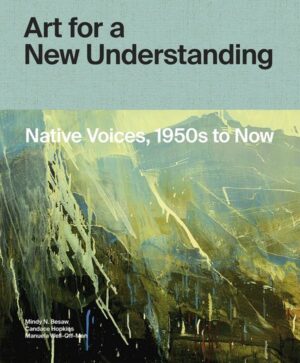
November is National Native American Heritage Month. Check out these online resources about Native American Art. Come see additional titles on display in the Art History/ Classics Library.
Food determines who we are. We are what we eat, but also how we eat, with whom we eat, where we eat and, in some cases, even why we eat. Food production and consumption in the ancient world can express multiple dimensions of identity and negotiate belonging to, or exclusion from, cultural groups. It can bind through religious praxis, express wealth, manifest cultural identity, reveal differentiation in age or gender, and define status. As a prism through which to investigate the past, its utility is manifold. The chapters gathered together in this ground-breaking book explore the intersections between food, consumption, and ritual within Etruscan society through a purposeful cross-disciplinary approach. It offers a unique and innovative selection of up-to-date analysis from a variety of Etruscan food-related topics. From banqueting, feasting, fish rites, and symbolic consumption to bio-archaeological data, this volume explores a new and exciting field in ancient Italian archaeology.
A requirement of the NEH Foundation grant for PhiloBiblon, “PhiloBiblon: From Siloed Databases to Linked Open Data via Wikibase: Proof of Concept” (PW-277550-21) was the preparation of a White Paper to summarize its results and provide advice and suggestions for other projects that have enthusiastic volunteers but little money:
White Paper NEH Grant PW-277550-21 October 10, 2023
The proposal for this grant, “PhiloBiblon: From Siloed Databases to Linked Open Data via Wikibase: Proof of Concept,” submitted to NEH under the Humanities Collections and Reference Resources Foundations grant program, set forth the following goals:
This project will explore the use of the FactGrid: database for Historians Wikibase platform to prototype a low-cost light-weight development model for PhiloBiblon:
(1) show how to map PhiloBiblon’s complex data model to Linked Open Data (LD) / Resource Description Framework (RDF) as instantiated in Wikibase; (2) evaluate the Wikibase data entry module and create prototype query modules based on the FactGrid Query Service; (3) study Wikibase’s LD access points to and from libraries and archives; (4) test the Wikibase data export module for JSON-LD, RDF, and XML on PhiloBiblon data, (5) train PhiloBiblon staff in the use of the platform; (6) place the resulting software and documentation on GitHub as the basis for a final “White Paper” and follow-on implementation project.
A Wikibase platform would position PhiloBiblon to take advantage of current and future semantic web developments and decrease long-term sustainability costs. Moreover, we hope to demonstrate that this project can serve as a model for low-cost light-weight database development for similar academic projects with limited resources.
PhiloBiblon is a free internet-based bio-bibliographical database of texts written in the various Romance vernaculars of the Iberian Peninsula during the Middle Ages and the early Renaissance. It does not contain the texts themselves; rather it attempts to catalog all their primary sources, both manuscript and printed, the texts they contain, the individuals involved with the production and transmission of those sources and texts, and the libraries holding them, along with relevant secondary references and authority files for persons, places, and institutions.
It is one of the oldest digital humanities projects in existence, and the oldest in the Hispanic world, starting out as an in-house database for the Dictionary of the Old Spanish Language project (DOSL) at the University of Wisconsin, Madison, in 1972, funded by NEH. Its initial purpose was to locate manuscripts and printed texts physically produced before 1501 to provide a corpus of authentic lexicographical material for DOSL. It soon became evident that the database would also be of interest to scholars elsewhere; and a photo-offset edition of computer printout was published in 1975 as the Bibliography of Old Spanish Texts (BOOST). It contained 977 records, each one listing a given text in a given manuscript or printed edition. A second edition followed in 1977 and a third in 1984.
PhiloBiblon was published in 1992 on CD-ROM, incorporating not only the materials in Spanish but also those in Portuguese and Catalan. By this time BOOST had been re-baptized as BETA (Bibliografía Española de Textos Antiguos), while the Portuguese corpus became BITAGAP (Bibliografia de Textos Antigos Galegos e Portugueses) and the Catalan corpus BITECA (Bibliografia de Textos Antics Catalans, Valencians i Balears).PhiloBiblon was ported to the web in 1997; and the web version was substantially re-designed in 2015. PhiloBiblon’s three databases currently hold over 240,000 records.
All of this data has been input manually by dozens of volunteer staff in the U.S., Spain, and Portugal, either by keyboarding or by cutting-and-pasting, thousands of hours of unpaid labor. That unpaid labor has been key to expanding the databases, but just as important, and much more difficult to achieve, has been the effort to keep up with the display and database technology. The initial database management system (DBMS) was FAMULUS running on the Univac 1110 at Madison, a flat-file DBMS originally developed at Berkeley in 1964. In 1985 the database was mapped to SPIRES (Stanford Public Information Retrieval System) and then, in 1987, to a proprietary relational DBMS, Revelation G, running on an IBM PC.
Today we continue to use Revelation Technology’s OpenInsight on Windows, the lineal descendent of Revelation G. We periodically export data from the Windows database in XML format and upload it to a server at Berkeley, where the XTF (eXtensible Text Framework) program suite parses it into individual records, indexes it, and serves it up on the fly in HTML format in response to queries from users around the world. The California Digital Library developed XTF as open source software ca. 2010, but it is now in the process of being phased out and is no longer supported by the UC Berkeley Library.
The need to find a substitute for XTF caused us to rethink our entire approach to the technologies that make PhiloBiblon possible. Major upgrades to the display and DBMS technology, either triggered by technological change or by a desire to enhance web access, have required significant grant support, primarily from NEH, eleven NEH grants from 1989 to 2021. We applied for the current grant in the hope that it would show us how to get off the technology merry-go-round. Instead of seeking major grant support every five to seven years for bespoke technology, this pilot project was designed to demonstrate that we could solve our technology problems for the foreseeable future by moving PhiloBiblon to Wikibase, the technology underlying Wikipedia and Wikidata. Maintained by Wikimedia Deutschland, the software development arm of the Wikimedia Foundation, Wikibase is made available for free. With Wikibase,we would no longer have to raise money to support our software infrastructure.
We have achieved all of the goals of the pilot project under this current grant and placed all of our software development work on GitHub (see below). We received a follow-on two-year implementation grant from NEH and on 1 July 2023 began work to map all of the PhiloBiblon data from the Windows DBMS to FactGrid.
❧ ❧ ❧
For the purposes of this White Paper, I shall focus on the PhiloBiblon pilot project as a model for institutions with limited resources for technology but dedicated volunteer staff. There are thousands of such institutions in the United States alone, in every part of the country, joined in national and regional associations, e.g., the American Association for State and Local History, Association of African American Museums, Popular Culture Association, Asian / Pacific / American Archives Survey Project, Southeastern Museums Conference. Many of their members are small institutions that depend on volunteer staff and could use the PhiloBiblon model to develop light-weight low-cost databases for their own projects. In the San Francisco Bay Area alone, for example there are dozens of such small cultural heritage institutions (e.g., The Beat Museum, GLBT Historical Society Archives, Holocaust Center Library and Archives, Berkeley Architectural History Association.
To begin at the beginning: What is Linked Open Data and why is it important? What is Wikibase, why use it, and how does it work?
Linked Open Data (LOD) is the defining principle of the semantic web: “globally accessible and linked data on the internet based on the standards of the World Wide Web Consortium (W3C), an open environment where data can be created, connected and consumed on internet scale.”
Why use it? Simply, data has more value if it can be connected to other data, if it does not exist in a silo.
Wikibase in turn is the “free software for open data projects. It connects the knowledge of people and organizations and enables them to open their linked data to the world.” It is one of the backbone technologies of the LOD world.
Why use it? The primary reason to use Wikibase is precisely to make local or specialized knowledge easily available to the rest of the world by taking advantage of LOD, the semantic web. Conversely, the semantic web makes it easier for local institutions to take advantage of LOD.
How does Wikibase work? The Wikibase data model is deceptively simple. Each record has a “fingerprint” consisting of a Label, a Description, and an optional Alias. This fingerprint uniquely identifies the record. It can be repeated in multiple languages, although in every case the Label and the Description in the other languages must also be unique. Following the fingerprint header comes a series of three-part statements (triples, triplestores) that link a (1) subject Q to an (2) object Q by means of a (3) property P. The new record itself is the subject, to which Wikibase assigns automatically a unique Q#. There is no limit, except that of practicality, to the number of statements that a record can contain. They can be input in any order, and new statements are simply appended at the end of the record. No formal ontology is necessary, although having one is certainly useful, as librarians have discovered over the past sixty years. Must records start with a statement of identity, e.g.: Jack Keraouc (Q160534) [is an] Instance of (P31)Human (Q5).[1] Each statement can be qualified with sub-statements and footnoted with references. Because Wikibase is part of the LOD world, each record can be linked to the existing rich world of LOD identifiers: Jack Keraouc (Q160534) in the Union List of Artist Names ID (P245) is ID 500290917.
Another important reason for using Wikibase is the flexibility that it allows in tailoring Q items and P properties to the needs of the individual institution. There is no need to develop an ontology or schema ahead of time; it can be developed on the fly, so to speak. There is no need to establish a hierarchy of subject headings, for example, like that of the Library of Congress as set forth in the Library of Congress Subject Headings (LCSH). LC subject headings can be extended as necessary or entirely ignored. Other kinds of data can also be added:
New P properties to establish categories: nicknames, associates (e.g., other members of a rock band), musical or artistic styles); New Q items related to the new P properties (e.g., the other members of the band).
There is no need to learn the Resource Description Access (RDA) rules necessary for highly structured data, such as MARC or its eventual replacement, BIBFRAME. This in turn means that data input does not need persons trained in librarianship.
How would adoption of Wikibase to catalog collections, whether of books, archival materials, or physical objects, work in practice? What decisions must be made? The first decision is simply whether (1) to join Wikidata or (2) set up a separate Wikibase instance (like FactGrid).[2] The former is far simpler. It requires no programming experience at all and very little knowledge of data science. Joining Wikidata simply means mapping the institution’s current database to Wikidata through a careful analysis of the database in comparison with Wikidata. For example, a local music history organization, like the SF Music Hall of Fame, might want to organize an archive of significant San Francisco musicians.
Once the institutional database properties have been matched to the corresponding Wikidata properties, the original database must be exported as a CSV (comma separated values) file. Its data must then be compared systematically to Wikidata through a process known as reconciliation, using the open source OpenRefine tool. This same reconciliation process can be used to compare the institutional database to a large number of other LOD services through Mix n Match, which lists hundreds of external databases in fields ranging alphabetically from Art to Video games. Thus the putative SF Music Hall of Fame database might be reconciled against the large Grammy Awards (5700 records) database of the Recording Academy.
Reconciliation is important because it establishes links between records in the institutional database and existing records in the LOD world. If there are no such records, the reconciliation process creates new records that automatically become part of the LOD world.
One issue to consider is that, like Wikipedia, anyone can edit Wikidata. This has both advantages and disadvantages. The advantage is that outside users can correct or expand records created by the institution. The disadvantage is that a malicious user or simply a well-intentioned but poorly informed one can also damage records by the addition of incorrect information.
In the implementation of the new NEH grant (2023-2025), we hope to have it both ways. Our new user interface will allow, let us say, a graduate student looking at a medieval Spanish manuscript in a library in Poland to add information about that manuscript through a template. However, before that information can be integrated into the master database, it would have to be vetted by a PhiloBiblon editorial committee.
The second option, to set up a separate Wikibase instance, is straightforward but not simple. The Wikibase documentation is a good place to start, but it assumes a fair amount of technical expertise. Matt Miller (currently at the Library of Congress) has provided a useful tutorial, Wikibase for Research Infrastructure , explaining how to set up a Wikibase instance and the steps required to go about it. Our programmer, Josep Formentí, has made this more conveniently available on a public GitHub repository, Wikibase Suite on Docker, which installs a standard collection of Wikibase services via Docker Compose V:
Wikibase Query Service QuickStatements OpenRefine Reconcile Service
The end result is a local Wikibase instance, like the one created by Formentí on a server at UC Berkeley as part of the new PhiloBiblon implementation grant: PhiloBiblon Wikibase instance. He used as his basis the suite of programs at Wikibase Release Pipeline. Formentí has also made available on GitHub his work on the PhiloBiblon user interface mentioned above. This would serve PhiloBiblon as an alternative to the standard Wikibase interface.
Once the local Wikibase instance has been created, it is essentially a tabula rasa. It has no Properties and no Items. The properties would then have to be created manually, based on the structure of the existing database or on Wikidata. By definition, the first property will be P1. Typically it will be “Instance of,” corresponding to Instance of (P31) in Wikidata.
The Digital Scriptorium project, a union catalog of medieval manuscripts in North American libraries now housed at the University of Pennsylvania, went through precisely this process when it mapped 67 data elements to Wikibase properties created specifically for that project. Thus property P1 states the Digital Scriptorium ID number; P2 states the current holding institution, etc.
Once the properties have been created, the next step is to import the data in a batch process, as described above, by reconciling it with existing databases. Miller explains alternative methods of batch uploads using python scripts.
Getting the initial upload of institutional data into Wikidata or a local Wikibase instance is the hard part, but once that initial upload has been accomplished, all data input from then on can be handled by non-technical staff. To facilitate the input of new records, properties can be listed in a spreadsheet in the canonical input order, with the P#, the Label, and a short Description. Most records will start with the P1 property “Institutional ID number” followed by the value of the identification number in the institutional database. The Cradle or Shape Expressions tools, with the list of properties in the right order, can generate a ready-made template for the creation of new records. Again, this is something that an IT specialist would implement during the initial setup of a local Wikibase instance.
New records can be created easily by inputting statements following the canonical order in the list of properties. New properties can also be created if it is found, over time, that relevant data is not being captured. For example, returning to the Jerry García example, it might be useful to specify “rock guitarist”(Q#) as a subclass of “guitarist.”
The institution would then need to decide whether the local Wikibase instance is to be open or closed. If it were entirely open, it would be like Wikidata, making crowd-sourcing possible. If it were closed, only authorized users could add or correct records. PhiloBiblon is exploring a third option for its user interface, crowdsourcing mediated by an editorial committee that would approve additions or changes before they could be added to the database.
One issue remains, searching:
Wikibase has two search modes, one of which is easy to use, and one of which is not.
The basic search interface is the ubiquitous Google box. As the user types in a request, the potential records show up below it until the user sees and clicks on the requested record. If no match is found, the user can then opt to “Search for pages containing [the search term],” which brings up all the pages in which the search term occurs, although there is no way to sort them. They show up neither in alphabetical order of the Label nor in numerical order of the Q#.
More precise and targeted searches must make use of the Wikibase Query Service, which opens a “SPARQL endpoint,” a window in which users can program queries using the SPARQL query language. SPARQL pronounced “sparkle,” is a recursive acronym for “SPARQL Protocol And RDF Query Language,” designed by and for the World Wide Web Consortium (WC3) as the standard language for LOD triplestores, just as SQL (Structured Query Language) is the standard language for relational database tables.
SPARQL is not for the casual user. It requires some knowledge of SPARQL or similar query languages as well as of the specifics of Wikibase items and properties. Many Wikibase installations offer “canned” SPARQL queries. In Wikidata, for example, one can use a canned query to find all of the pictures of the Dutch artist Jan Vermeer and plot their current locations on a map, with images of the pictures themselves. In fact, Wikidata offers over 400 examples of canned queries, each of which can then serve as a model for further queries.
How, then, to make more sophisticated searches available for those who do not wish to learn SPARQL?
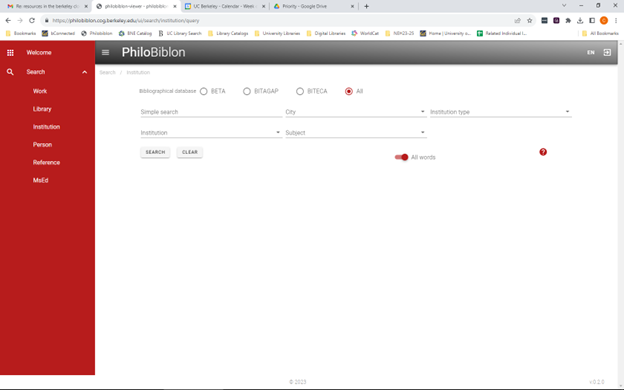
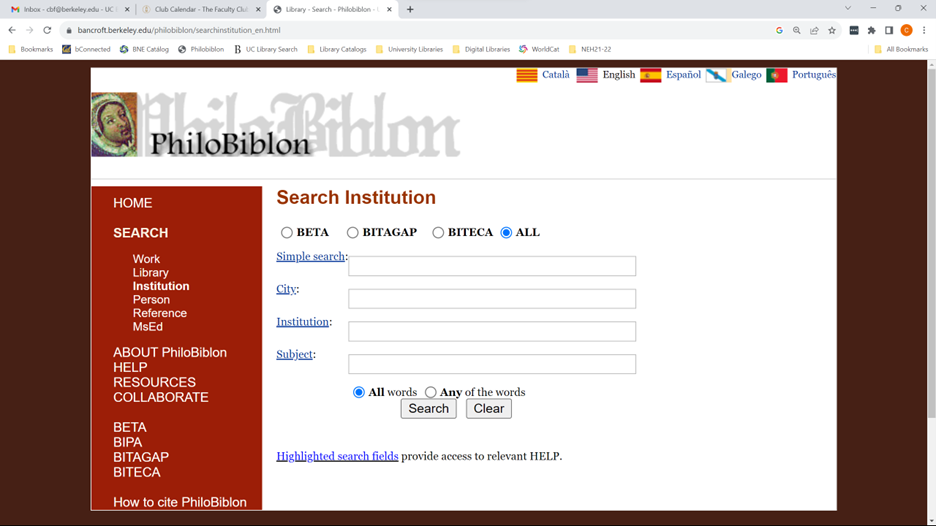
For PhiloBiblon we are developing masks or templates to facilitate searching for, e.g., persons, institutions, works. Thus, the institutions mask allows for searches for free text, the institution, its location, its type (e.g., university), and subject headings:
The use of templates does not, however, address the problem of searching across different types of objects or of providing different kinds of outputs. For example, one could not use such a template to plot the locations and dates of Franciscans active in Spain between 1450 and 1500. For this one needs a query language, i.e., SPARQL.
We have just begun to consider this problem under the new NEH implementation grant. It might be possible to use a Large Language Model query service such as ChatGPT or Bard as an interface to SPARQL. A user might send a prompt like this: “Write a SPARQL query for FactGrid to find all Franciscans active in Spain between 1450 and 1500 and plot their locations and dates on a map and a timeline.” This would automatically invoke the SPARQL query service and return the results to the user in the requested format.
Other questions and considerations will undoubtedly arise for any institution or project contemplating the use of Wikibase for its database needs. Nevertheless, we believe that we have demonstrated that this NEH-funded project can serve as a model for low-cost light-weight database development for small institutions or similar academic projects with limited resources.
Questions may be addressed to Charles Faulhaber (cbf@berkeley.edu).
[1] For the sake of convenience, I use the Wikidata Q# and P# numbers.
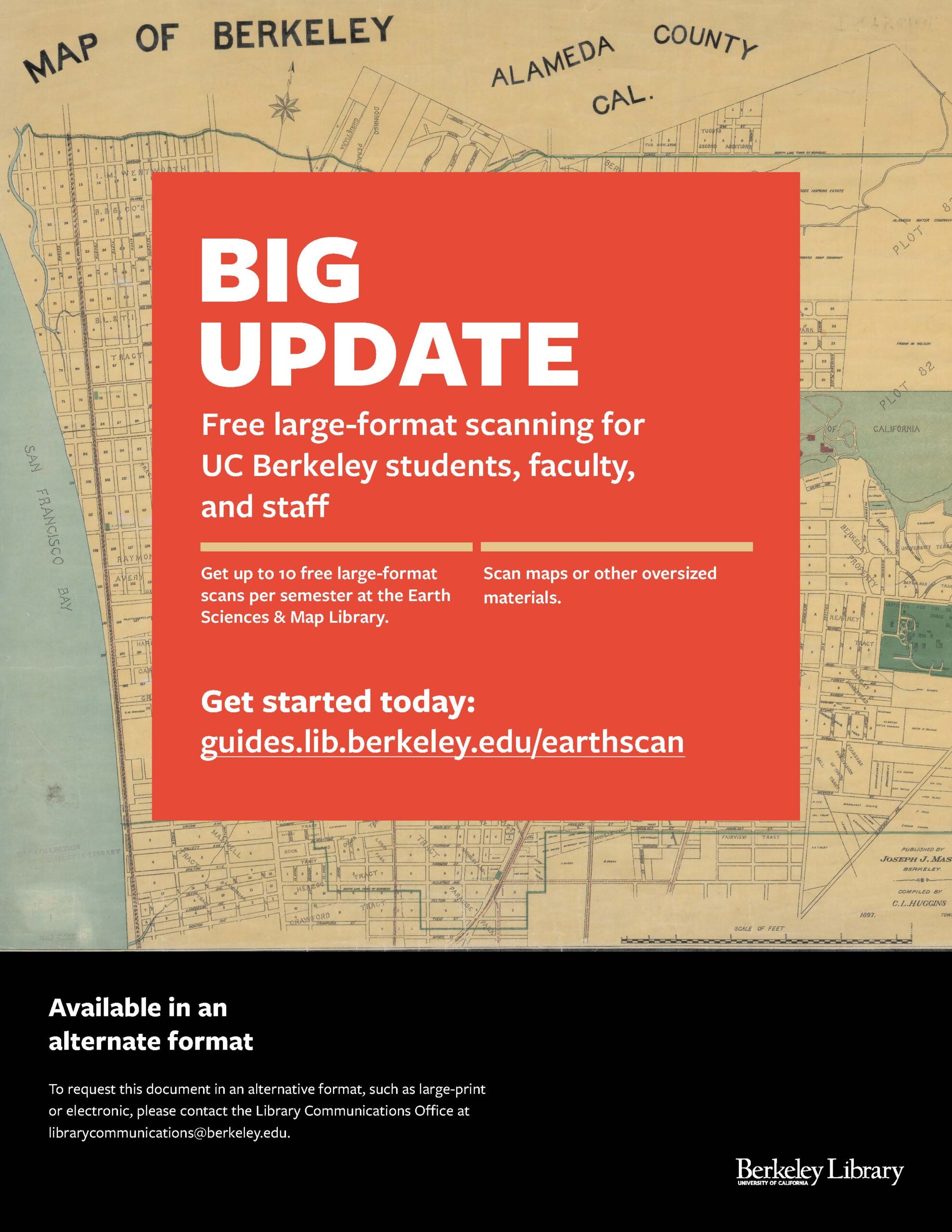
Members of the UC Berkeley community can now get up to 10 free large-format scans per semester at the Earth Sciences & Map Library! This can include maps or other large, flat materials. Scans over the free allotment are $10 each. For walk-in patrons not affiliated with the university, the cost is $25 per scan. Get more information about large-format scanning, or visit the library to start your scanning project.
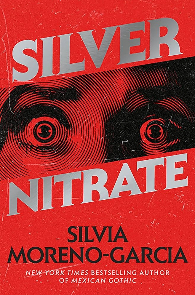
Celebrate this year’s Spooky Season with some of these terrifying and suspenseful titles below. From ghosts to haunted houses and even our own thoughts, check out these books if you’re feeling the Halloween festivities this October.
The most comprehensive book on the work of Liza Lou, whose popular and critically acclaimed installations made entirely of beads consider the important themes of women, community, and the valorization of labor.
Liza Lou first gained attention in 1996 when her room-sized sculpture Kitchen was shown at the New Museum in New York. Representing five years of individual labor, this groundbreaking work subverted standards of art by introducing glass beads as a fine art material. The project blurred the rigid boundary between fine art and craft, and established Lou’s long-standing exploration of materiality, process, and beauty. Working within a craft métier has led the artist to work in a variety of socially engaged settings, from community groups in Los Angeles, to a collective she founded in Durban, South Africa. Over the past fifteen years, Lou has focused on a poetic approach to abstraction as a way to highlight the process underlying her work.
In this comprehensive volume that considers the entirety of Lou’s singular vision, curators, art historians, and artists offer important perspectives on the breadth of the work.
Video clip from Robert Cox’s oral history on the Sierra Club’s environmental justice work with Jesus People Against Pollution (JPAP) in 1994
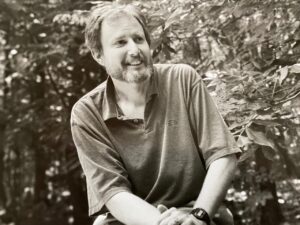
UNC Professor Robert Cox in 1994 upon his first time being elected as president of the national Sierra Club
Robert Cox is a scholar and a gentleman. He also has a fire burning in his belly for protecting nature, confronting injustice, and empowering people, which fueled his long-time leadership in environmental politics, strategy, and influential communication. Robbie Cox served three times as president of the national Sierra Club in 1994-96, 2000-01, and 2007-08. He is Professor Emeritus at the University of North Carolina at Chapel Hill (UNC-CH), and as a scholar of activist rhetoric, Cox helped found the academic field of environmental communication.
Robbie and I recorded nearly eleven hours of his life history over Zoom during five interview sessions in September 2020, during the early months of the COVID-19 pandemic. Robbie’s inspiring stories of environmental activism produced a 253-page transcript, which includes an appendix with several photographs. The stories that Robbie shared in his oral history also emphasized the incredibly high stakes for our present moment of environmental politics, rhetoric, and civic engagement.
Cox was born in September 1945, in Hinton, West Virginia, where his early influences included roaming Appalachian forests and rivers as well as his family’s history of union organizing and work toward social justice. He was recruited to the debate team at the University of Richmond where, from 1963 to 1967, he studied communication, philosophy, history, and religion while also participating in civil rights protests. In 1970, Cox earned his Ph.D. in classical rhetoric studies from the University of Pittsburgh with a dissertation on the rhetorical structures of the Vietnam antiwar movement in which he actively participated. From 1971 to 2010, Cox was a Professor in the Department of Communication at UNC-CH where he helped establish the field of environmental communication and focused his research and teaching on argumentation, rhetorical theory, and social movements. Cox married Professor Julia Wood in 1975 when she also joined the UNC-CH faculty in the Department of Communication.
Video clip from Robert Cox’s oral history on first joining the Sierra Club in 1979
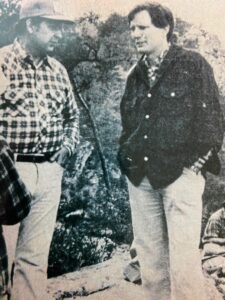
Robert Cox (right) with North Carolina Secretary of Natural Resources Joe Grimsley (left) discussing what would become the North Carolina Wilderness Act of 1984.
Upon Dr. Wood’s suggestion, Cox joined the Sierra Club in 1979 and, over time, he earned leadership positions at every level in the Club: as chair of the Research Triangle Group, as chair of the North Carolina Chapter, and as an elected member to the national board of directors for most years between 1993 and 2013, including three times as president of the national Sierra Club. Cox made significant contributions to passage in the US Congress of the North Carolina Wilderness Bill, to the Sierra Club’s early engagements in the environmental justice movement, to restructuring both the Club’s internal governance and its volunteer structure, as well as helping lead Sierra Club engagements in national politics, particularly during his times as Club president. In this oral history, Cox discusses all of the above, with a focus on leveraging influential communication and strategy, while also sharing his experiences hiking and trekking in the Himalayas, in the mountains of Europe, and in the Appalachian Mountains.
Robbie Cox’s oral history is significant for detailing the environmental activism and political strategies of one of the most influential volunteers in recent Sierra Club history. Some of the themes throughout Robbie’s oral history include the profoundly democratic nature of the Sierra Club, details on the Club’s geographically diverse grassroots activism, as well as numerous ways that volunteer environmentalists work together to shape state and national legislation. Robbie also reconstructed the ways he balanced his double life as UNC professor with his life as an environmental activist, especially through his work in Sierra Club media campaigns. He recounted his decades as a nationally elected volunteer leader in the Sierra Club, as told through the perspective of an academic scholar of rhetoric and communications. And throughout, Robbie shared stories of direct action for environmental causes at all levels of Sierra Club engagement, from local to national.
Video clip from Robert Cox’s oral history on passing the North Carolina Wilderness Act in 1984
The in-depth, life-history approach used in this oral history reveals ways that Robbie’s personal influences and his engagements in the Sierra Club evolved over time. For instance, Robbie’s family history of labor activism instilled in him the power of people and the importance of social justice. Similarly, his participation on debate teams shaped substantially his education and academic work, while also playing a central role throughout his life as a political and environmental activist. Robbie’s interview also explored the Sierra Club’s and his own personal engagements with environmental justice, including his attendance at the First National People of Color Environmental Justice Leadership Summit in 1991, his leveraging of media in the national Sierra Club’s partnership with “Jesus People Against Pollution” in Mississippi, as well as his experiences on toxic tours of colonias in Matamoro, Mexico, along with other actions against the negative results of neoliberal free trade agreements.
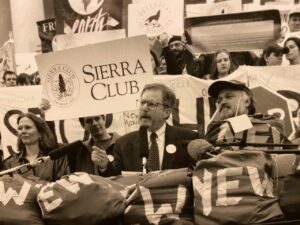
Robert Cox (center) speaking in November 1995 as Sierra Club president at the US Capitol Building while delivering to House Speaker Newt Gingrich several green bags containing copies of the Environmental Bill of Rights petition signed by more than a million Americans.
Robbie also shared insider details on several significant moments in the Sierra Club’s recent history. He recounted the Club’s severe financial crises in the 1990s that resulted in his work to reorganize the Club’s internal governance through Project Renewal as well as the Club’s volunteer structures via Project ACT. Robbie recounted his central role in the Sierra Club’s efforts to combat the de-regulatory and anti-environmental Congressional agenda in wake of Newt Gingrich’s Republican take-over of Congress in the 1990s, as well as Robbie’s personal role in securing the Sierra Club’s endorsement of Al Gore, for whom Robbie campaigned in 2000. Robbie also detailed the central role he played in the Groundswell Sierra campaign in the early 2000s to resist a take-over of the Sierra Club by anti-immigration and white supremacist forces. And as the world warms and the seas rise, Robbie discussed ways that the Sierra Club has confronted the compounding crises of climate change in the twenty-first century. Robbie’s decades of environmental activism provides a lens on ways the environmental movement has evolved over time from its early focus on wild lands, to concerns about human health, to engagement on issues of environmental justice, to the modern complexities of climate change. Robbie also reflects on the contemporary Sierra Club’s internal and external challenges in its ongoing work for equity, inclusion, and justice.
Video clip from Robert Cox’s oral history on delivering to Congress the Environmental Bill of Rights with 1.2 million signatures in 1995
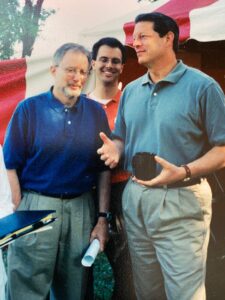
Robert Cox (left) and US Vice President Al Gore (right) in July 2000 in Grand Rapids, Michigan, delivering the Sierra Club’s public endorsement of Mr. Gore for US President during the 2000 election.
Back in the summer of 2020, when I spoke with Carl Pope, former Sierra Club executive director, to prepare for Robbie’s oral history, Pope recalled Robbie’s exceptional leadership and effectiveness. When “Professor Cox” first won election to the national Sierra Club board of directors in the 1990s, Pope described Robbie’s presence as “immediately noticeable.” Pope told me how Robbie used his expertise in rhetoric to unify people and advance proposals for environmental action. “You could see Robbie work at a board meeting,” Pope remembered. “When he wanted to get the board to agree, he would offer some initial proposal tentatively, then let folks respond to it and let the room talk. Then he’d come back in and make the same proposal, but he changed two words to see if that worked. He’d keep playing with the proposal and make changes rhetorically, until he got something that would work for everyone.” The Sierra Club’s board of directors come increasingly from a variety of backgrounds across the United States. All directors are volunteers, not employed staff, but like much of the Sierra Club staff, many Club directors consider themselves to be full-time environmental activists. As Carl Pope noted, however, most Sierra Club directors “are not professional communicators. People would talk past each other. Robbie’s skill on the board lubricated that process, which was phenomenally helpful. If anyone wanted to get something done, you asked Robbie.” Indeed, Robbie Cox got things done.
Pope also described Robbie as a kind of environmental philosopher. “He wasn’t ideological,” Pope explained, “but surely, he had his own vision of where the Club should go.” Now, with this publication of Robbie Cox’s oral history, you too can have him tell you in his own words about his visions for the Sierra Club and the ways he mobilized constituencies to make a reality of his visions for environmental protection, political power, and justice.
ABOUT THE ORAL HISTORY CENTER
The Oral History Center of The Bancroft Library preserves voices of people from all walks of life, with varying political perspectives, national origins, and ethnic backgrounds. We are committed to open access and our oral histories and interpretive materials are available online at no cost to scholars and the public. You can find our oral histories from the search feature on our home page. Search by name, keyword, and several other criteria. Sign up for our monthly newsletter featuring think pieces, new releases, podcasts, Q&As, and everything oral history. Access the most recent articles from our home page or go straight to our blog home.
Please consider making a tax-deductible donation to the Oral History Center if you’d like to see more work like this conducted and made freely available online. While we receive modest institutional support, we are a predominantly self-funded research unit of The Bancroft Library. We must raise the funds to cover the cost of all the work we do, including each oral history. You can give online, or contact us at ohc@berkeley.edu for more information about our funding needs for present and future projects.
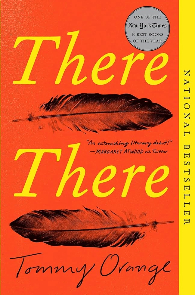
Celebrate Indigenous Peoples’ Day this Monday, October 9th with these wonderful selections by Native authors illustrating stories on Native history and fiction.
Listen to podcast episode 3, “Environmental Justice for All,” or read a written version of this podcast episode below.
Podcast Episode 3: “Environmental Justice for All” is part of the Voices for the Environment exhibition in The Bancroft Library Gallery
Voices for the Environment: A Century of Bay Area Activism is a gallery exhibition in The Bancroft Library that charts the evolution of environmentalism in the San Francisco Bay Area through the voices of activists who advanced their causes throughout the twentieth century—from wilderness preservation, to economic regulation, to environmental justice. The exhibition is free and open to the public Monday through Friday between 10am to 4pm from Oct. 6, 2023 to Nov. 15, 2024, in The Bancroft Library Gallery, located just inside the east entrance of The Bancroft Library. Curated by UC Berkeley’s Oral History Center, this interactive exhibit is the first in-depth effort to showcase oral history along with other archival collections of The Bancroft Library.
This exhibition includes three podcast episodes that offer deeper narratives to supplement the archival posters, pamphlets, postcards, photographs, oral history recordings, and film footage that are also presented in the gallery. Please use headphones when listening to podcasts in The Bancroft Library Gallery.
A written version of podcast episode 3 is included below.
Listen to episode 3: “Environmental Justice for All” on SoundCloud.
Episode 3: “Environmental Justice for All.” This podcast episode accompanies a section of the Voices for the Environment exhibition that explores how, in the 1980s and 90s, communities of color in the Bay Area fought against environmental racism by creating new organizations, such as the Urban Habitat Program, to demand environmental justice—the equal treatment and meaningful involvement of all people in environmental decision-making. In the city of Richmond, activists in the West County Toxics Coalition and the Asian Pacific Environmental Network, or APEN, organized against toxic threats from the area’s petrochemical and hazardous waste facilities. Environmental justice activists helped transform the American environmental movement from one focused mostly on landscapes to one that increasingly includes the health and wellbeing of historically disenfranchised people.
This podcast episode features historic interviews from the Oral History Center archives in The Bancroft Library at UC Berkeley, including segments from oral history interviews with Carl Anthony, Pamela Tau Lee, Henry Clark, and Ahmadia Thomas, all recorded in 1999 and 2000. This episode was narrated by Sasha Khokha, with thanks to KQED Public Radio and The California Report Magazine.
This podcast was produced by Todd Holmes and Roger Eardley-Pryor of the Oral History Center of The Bancroft Library at UC Berkeley, with help from Sasha Khokha of KQED. The album and episode images were designed by Gordon Chun.
WRITTEN VERSION OF PODCAST EPISODE 3: “Environmental Justice for All”
Pamela Tau Lee: We cannot be afraid to talk about environmental racism. We cannot be afraid to discuss that, talk about what it means: the discrimination of communities in environmental policy and being left out of the process.
Sasha Khokha: What does justice look like? Whose lives matter? And how does that relate to the environment? In the 1980s and 90s, concerns about toxic industrial waste led communities of color in the Bay Area, and across the nation, to create new organizations and demand environmental justice—the equal treatment and meaningful involvement of all people in environmental decision-making.
Pamela Tau Lee: What we need to deal with is the racism that is the root cause of why industry was targeting communities of color: because communities of color would not have any power; that it’s much more acceptable to dump this stuff in communities of color. So if we shied away from talking about racism, we would then not be able to articulate the realities, and we felt it was racism.
[music]
Sasha Khokha: Welcome to Voices for the Environment: A Century of Bay Area Activism. This podcast accompanies an exhibition in The Bancroft Gallery at UC Berkeley that’s the first major effort to bring together both the oral history and archival collections of The Bancroft Library. The voices you’ll hear were recorded by UC Berkeley’s Oral History Center, founded in 1953 to record and preserve the history of California, the nation, and our interconnected world.
Voices for the Environment traces the evolution of environmentalism in the San Francisco Bay Area across the twentieth century, and highlights ways that Bay Area activists have been on the front lines of environmental change.
This is our third and final episode, called “Environmental Justice for All.” I’m your host, Sasha Khokha, from KQED.
[harmonica blues music]
Sasha Khokha: Communities of color have long confronted environmental racism—the disproportionate burden of toxic waste and industrial pollution in neighborhoods that are mostly low income and home to BIPOC folks. But up until the 1980s, the big players in the environmental movement focused on other issues, like preserving redwood groves or protecting bay shoreline from new construction.
Pamela Tau Lee: I think many of the mainstream organizations, you know, they don’t focus on people. They focus on the ecology and other natural resources.
Sasha Khokha: That’s Pamela Tau Lee, a environmental and labor activist from San Francisco whose oral history you’re hearing.
Pamela Tau Lee: These predominantly white organizations did not want to really acknowledge that there was a different experience felt by communities of color.
Sasha Khokha: Take the city of Richmond, where more than 75% of residents identified as people of color in the 2022 census. Located along the bay above Berkeley and Oakland, Richmond has been home to the Chevron oil refinery since 1902. A host of other polluting industries were established there, too. As a result, people in Richmond experience higher levels of pollution and toxins, and have less access to healthy environments to live and play. In the mid-1980s, Richmond residents formed the West County Toxics Coalition. It’s a multi-racial organization aimed at empowering the community to have a greater voice in the environmental issues impacting their neighborhoods.
Henry Clark: You know, like anyone born and raised in North Richmond, we know that there was environmental problems there, you know, over your whole lifetime. So it was quite only logical when the West County Toxics Coalition was formed and they began to organize in North Richmond.
Sasha Khokha: That’s Henry Clark, who grew up in North Richmond. In 1986, after earning his Ph.D. in religious studies, Clark became executive director of the West County Toxics Coalition, and he led it for more than three decades. As a kid in North Richmond, Henry Clark’s home was directly next door to the Chevron oil refinery.
Henry Clark: I can remember clearly waking up many mornings and finding the leaves on the tree burnt crisp overnight from chemical exposure, or you know, going outside and the air would be so foul that you would literally have to grab your nose and try to not breathe the air and go back in the house and wait until it was cleared up. Those type of situations, you know, were a common experience.
Sasha Khokha: Ahmadia Thomas also knows about the foul air in Richmond. She moved there in the mid-1970s and was active in community organizing.
Ahmadia Thomas: Well, then I first came here, I didn’t know, but I used to smell these terrible odors. And I’d say, “What’s that?” And my husband said, “We all smelled it all the time, and we ain’t never made no kick about it.” But they didn’t know what they were smelling. And they were terrible odors: you know ones that smell like sulfur once in a while. Terrible odors out here, after I got out here. When I first came, I didn’t remember smelling all this stuff, but boy, after I was out here a while, I really got environmentally conscious.
Sasha Khokha: Thomas joined the West County Toxics Coalition, too, in part because she was concerned about how Richmond’s industrial pollution was affecting her health—and her neighbors’ health.
Ahmadia Thomas: Like a lot of people had long-term illnesses. Like, these illnesses we don’t know whether they’re short-term or long-term. But if you’ve been affected, say, five years ago and you’re still affected, well now that’s a long term. But, see, a lot of them has been affected. Children, too.
Sasha Khokha: Regular chemical exposures contributed to those illnesses, and so did the periodic accidents, fires, and explosions at the Chevron refinery.
Ahmadia Thomas: And then when they started having the accidents—whoo! There was always a fire or accident. It would be on the TV or in the paper: “There was an accident, but it wasn’t no harm to your health.” And that ain’t true! [laughs] Got to hearing that.
Sasha Khokha: Here’s Henry Clark again.
Henry Clark: You know, these chemical disasters, they do affect people’s lives and people do die from them. You usually don’t hear about the deaths that do occur. You now, they just end up being faceless people whose families may be aware of it, but most of the time you don’t hear about that. Nor do you really even get a good sense of the health impacts, because usually there’s no type of comprehensive health studies that are done or conducted after these disasters.
Sasha Khokha: But the health studies that have been conducted are clear.
Henry Clark: I do know that there’s a 33 percent higher than state average lung cancer rate throughout the Richmond area stretching actually throughout the county, stretching through the industrial corridor.
Sasha Khokha: Here’s Carl Anthony. He’s an architect, a city planner, and a former professor at UC Berkeley.
Carl Anthony: The communities get it. You don’t have to have a Ph.D. to figure out if you have asthma rates five or six times the regional average, it’s clearly symbolic of racism. It is an environmental racism.
Sasha Khokha: With so many other Bay Area groups focused on land, trees, and wildlife, Carl Anthony saw the need for a new organization to deal with the complex urban issues confronting communities of color.
[blues music]
In 1989, Anthony co-founded the Urban Habitat Program to focus on people who lived in cities. He envisioned it would be as multi-racial and multicultural as the Bay Area where he lived. And to better understand the connections between social injustice, economic inequality, and environmental racism, Anthony also helped create a groundbreaking journal, first published on Earth Day in 1990, called Race, Poverty, and the Environment.
Carl Anthony: When we began the Race, Poverty, and the Environment journal, we started looking at these. What is the energy cycle? We began to see that the whole system of extracting energy, distributing it, consuming it, and waste, at every step were huge social issues.
Sasha Khokha: Like the chemical pollution near oil refineries, or the health and safety issues for workers there, or the high cost of energy for low income people: all intertwined social and environmental issues. As executive director of the Urban Habitat Program, Carl Anthony built upon the Bay Area’s progressive and environmental traditions, with a focus on community-led decision making and public investment in historically disenfranchised neighborhoods. But, the more Anthony engaged with issues of environmental justice, the more problems he saw in the ways that mainstream, mostly white American environmental activists understood their own history.
Carl Anthony: There was a deep problem in the myth of the environmental movement, the story of the environmental movement, as having grown out of a certain understanding about the settlement of North America. Put really briefly, the settlement began in New England when the Puritans arrived, and then they found an empty wilderness, and they cleared the forests and built the dams and the towns, and came all the way across the country, and then they looked back and saw how much devastation they had made.
Sasha Khokha: By the start of the 20th century, that environmental devastation inspired the early conservation movement, led by preservationists like John Muir. But for Carl Anthony, this narrative focused too much on wilderness and the conservation of public lands, and not enough on the history of race and American expansion.
Carl Anthony: You know, if you look back a little bit, you say, “Wait a minute, hold it, what’s wrong with this model?” First of all, the North American continent wasn’t empty. There were ten million people here. So where do they fit in this story? And then, millions of people were brought from Africa who worked the land—now it has been eighteen generations—where do they fit in this story? And in particular, from the point of view of the racial issues, the things that were missing in the John Muir model was that this was the end of manifest destiny. It was the end of the frontier wars with the Indians. These were the years when there was rampant racism against Chinese people and against Japanese people in California; the years when Jim Crow was established, and the national parks were set up that were white only.
Sasha Khokha: If the old land-focused narrative of American environmentalism ignored social and racial issues, it also overlooked the urban issues that Carl Anthony was so passionate about.
Carl Anthony: So, the point I’m making about cities is that the environmental movement took off in many ways by saying, “We’re not connected with that whole thing, that mess around the cities. We’re not going to deal with that.” So there was this big hole. But in many ways, the issues that people are complaining about—whether it’s global warming, or whether it’s the squandering of, you know, chopping down the trees, whatever it is—are rooted in the way that we’re living in cities. So I felt that by setting up the Urban Habitat Program, we would then be in the position to be able to say, “This is how we need to think and act in relationship to restoring our cities. Here’s how we’re going to address the environmental issues; here’s how we’re going to address the social justice issues; here’s how we are going to address the economic issues. And because you care so much about biodiversity and energy efficiency and all these things, we would like to invite you to participate with us in doing that.”
[music]
Sasha Khokha: Bay Area activists soon discovered they weren’t alone in the fight for environmental justice. Shortly after starting the Urban Habitat Program, Anthony learned about the Toxic Wastes and Race report published in New York by the United Church of Christ’s Commission on Racial Justice. That analysis showed how government agencies across the nation consistently located toxic waste facilities in communities of color. And when the Church and other groups began to organize a national summit on environmental justice, the Bay Area sent a huge contingent.
Pamela Tau Lee: . . . 1991, in Washington DC, was so powerful to see people of color in this room talking about their struggles for justice in this country. I had not heard anything as dynamic and comprehensive since the Civil Rights [Movement] when I was young.
Sasha Khokha: Pamela Tau Lee, then a labor activist in San Francisco, attended that First National People of Color Environmental Leadership Summit.
Pamela Tau Lee: When you came into that room, you saw native people from Alaska, the deserts of Nevada, the Shoshone tribe. You saw African Americans who lived in small towns in the middle of Alabama, from the South, New Orleans, with African Americans from Harlem, and Detroit, and South Central Los Angeles. You saw brown people from Puerto Rico, from the border, together with Chicanos from New Mexico and California and farmworkers.
Sasha Khokha: At the summit, leaders of color shared examples of environmental racism from across the country, and they discussed what to do about it.
Pamela Tau Lee: People were there to articulate, what is it that we are experiencing? And what is it that we want? And what it is that we stand for? One is we cannot be afraid to talk about environmental racism. In many of the discussions when we start to talk with the traditional environmentalists, who are mainly white, or the government, they were very afraid of that term. And we said we cannot be afraid to discuss that, talk about what it means: the discrimination of communities in environmental policy and being left out of the process. The mainstream environmentalists, they didn’t want us to say anything about racism. They wanted us to use the word “equity.” And what we need to deal with is the racism that is the root cause of why industry was targeting communities of color: because communities of color would not have any power, that it’s much more acceptable to dump this stuff in communities of color. So if we shied away from talking about racism, we would then not be able to articulate the realities, and we felt it was racism.
Sasha Khokha: As Pamela Tau Lee recalled, activists at the summit also discussed a way forward: demanding justice and taking action.
Pamela Tau Lee: What we wanted industry and the government to use as the criteria for action was the facts: that there is a Superfund site there, that the soil is contaminated, that children are sick, that people have cancer, that the air quality here is bad. And therefore, do something! And what we were coming up against was, you know, “Prove it. Prove that the people are sick. Prove it.” And these communities don’t have the resources to do that. The government and industry knows these people are sick, knows the air quality is bad, knows the soil is contaminated, and should take action. So that was another key component, illustrated very wonderfully in the Principles of Environmental Justice.
Sasha Khokha: The First National People of Color Environmental Leadership Summit, and the Principles of Environmental Justice created there, reshaped the trajectory of American environmentalism. It inspired a new generation of activists who put people—not just landscapes—within the environmental agenda. For Pamela Tau Lee, attending that 1991 summit motivated her and others to form a new Asian American organization for environmental justice that would work with people here, in the Bay Area.
Pamela Tau Lee: We came back, Asians came back, we talked together, networked together, and after three years, I think, we formed the Asian Pacific Environmental Network [APEN], which has done very powerful work . . . [with] the ability to begin to articulate what environmental justice looks like for the Asian communities in this country.
Sasha Khokha: The Asian Pacific Environmental Network, or APEN, formed in 1993, and its initial work began in Richmond. APEN helped the Laotian immigrant community from Southeast Asia gain a voice in the larger efforts to address the toxic pollution caused by the Chevron refinery and other industrial sites in the city. Today, APEN continues organizing communities for environmental justice throughout the Bay Area.
[music]
By the mid-1990s, the demands of the environmental justice movement reached the White House. On February 11, 1994, President Bill Clinton signed an Executive Order directing federal agencies to “identify and address the disproportionately high and adverse human health or environmental effects of their actions on minority and low-income populations.” Here’s Carl Anthony reflecting on that moment.
Carl Anthony: Well, I think it was, first of all, an incredible achievement. And I can tell you, the ones that did it in the environmental justice movement were virtually uncompromising that the grassroots people have to be at the table. I mean, [they said], “To hell with all these experts and all these consultants and all these people.” They brought the people in who were suffering from the asthma, and respiratory conditions, and from the cancer.
Sasha Khokha: While the executive order didn’t mandate specific actions by law, Pamela Tau Lee thought it was an important benchmark.
Pamela Tau Lee: I think that President Clinton’s order had a very big impact. Many people want to have more, but there is no way that it was going to become law. But that executive order, I think, gave the movement opportunity to advocate the formation of a national environmental justice advisory committee within the EPA. That enabled the White House to call an interagency body to regularly discuss this. And I think that, you know, it’s not like spectacular changes, but I think that it has made a difference.
[music]
Sasha Khokha: By the late 1990s, when most of the oral histories you’ve heard here were recorded, several environmental justice groups had formed in the Bay Area. Like PODER, a Latinx-led group in San Francisco whose name stood for People Organizing to Demand Environmental and Economic Rights. And PUEBLO, which stood for People United for a Better Life in Oakland. And the Silicon Valley Toxics Coalition in the south bay. These activists often supported each other’s efforts. Here’s Henry Clark.
Henry Clark: Here in the Bay Area, there’s different groups in Oakland or San Francisco that do similar type of work. And so when they have public hearings, or protests, demonstrations, or activities, we go and support their works, send people there to support their work. And when we would have activities here in the Richmond area, they send people over to support our work, so building relationships to mutual support.
Sasha Khokha: Working to integrate environmental, social, and economic change for justice is difficult. So activists celebrate their victories, large and small. Like in the year 2000, when APEN’s Asian Youth Advocates and its Laotian Organizing Project in Richmond were able to create community warning systems in multiple languages for when industrial accidents occur. Or in 1997, when the West County Toxics Coalition shut down the Chevron Ortho Chemical Company’s toxic waste incinerator, which had been belching out pollution for decades.
Henry Clark: That campaign was linked to the Chevron Ortho Chemical Company incinerator that had been operating since 19—I believe—67, on a temporary permit. And Chevron was in the process of getting a permit to expand the hazardous waste that was being burned in that incinerator. The West County Toxics Coalition felt that the company should not get a permit to expand their waste burning. In fact, they should actually decrease the waste that was being incinerated. So we organized a campaign to do public education. We received word that Chevron was withdrawing their permit application to expand the incinerator, and that the incinerator was going to be closing down. And so the incinerator has been closed and dismantled as of June of 1997.
[music]
Sasha Khokha: But creating change doesn’t happen quickly. Most of the big, mainstream and mostly white environmental organizations have been slow to expand their activism, their funding, their membership, and their leadership to include BIPOC folks. Even so, since the 1980s and 90s, activists for environmental justice have unequivocally transformed the U.S. Environmental movement from one focused on trees, and landscapes, and sensitive habitats, to one that increasingly includes the health and wellbeing of historically disenfranchised people.
Carl Anthony: What I consider the most important work that I’m involved in is reframing the environmental story.
Sasha Khokha: Here’s Carl Anthony again.
Carl Anthony: There will have to be a much more systematic acknowledgement that environmental and social issues are connected; they are not separate. In my view, that means the environmental justice movement in some fundamental way must become the mainstream of the environmental movement. And I think the environmental movement has had the enormous luxury of being a white movement. But if we’re really serious about changing the dynamics at a global scale, there’s no way that it can keep going as a white movement.
Sasha Khokha: Bay Area environmental justice organizations, like the Urban Habitat Program, have shown a way for activists to build upon their past while still moving forward, together.
Carl Anthony: We kind of represented that model. That yes, you could in fact be advocates of social justice, you could in fact be militant about social justice, and still be an advocate of environmental preservation.
Sasha Khokha: And Bay Area leaders like Henry Clark and Pamela Tau Lee were on the cutting edge of helping the public understand that environmental justice means justice for all.
Henry Clark: When you’re looking at it from an environmental justice perspective, or justice period, the bottom line is that you work out a situation where it will be just for everyone involved, and that’s really what you have to keep the major focus on, especially when you’re trying to deal with situations that have been historically unjust.
Pamela Tau Lee: Many wealthy whites were content for this to be in the back yards of poor communities of color. Well, we were not going to say, “No, we don’t want it. We’re going to put it in rich, white people’s backyards.” That’s not something that we were going to stand for. We were going to always fight for the protection of all, public health of all, the ecology for all.
Sasha Khokha: After all, as our shared world becomes more interconnected, these are issues that affect all of us. Here’s Carl Anthony again.
Carl Anthony: But ultimately, as we get into the twenty-first century, this is the story of how the whole human race is going to address the shadow side of the industrial revolution. It’s not just a Black story. The fact of the matter is that all of us who benefited from the way the industrial revolution had functioned, the gifts that it has given us, are participants in this problem of the shadow side of consumption and waste and all this. Black people just happen to have, you know, kind of an angle or an insight on a piece of this.
[music]
Sasha Khokha: Our relationships with the world around us define who we are. So do the relationships we have with each other. Over the last century, Bay Area activists helped advance our understanding of both of these kinds of relationships—from preserving California’s ancient forests, to regulating economic development, to pushing for the health of communities of color as an environmental issue. Today, the social and environmental challenges we face appear even more daunting than the ones earlier generations had to face. Only by working together and building on lessons from the past can we work toward the solutions we need to thrive in the twenty-first century and become the newest Voices for the Environment.
[music]
You’ve been listening to “Environmental Justice for All,” the third and final episode in the podcast accompanying Voices for the Environment: A Century of Bay Area Activism. It’s an exhibition in The Bancroft Gallery at UC Berkeley that runs from October 2023 through November 2024. This episode featured historic interviews from the Oral History Center archives in The Bancroft Library at UC Berkeley. It included segments from oral history interviews with: Carl Anthony, Pamela Tau Lee, Henry Clark, and Ahmadia Thomas. To learn more about these interviews and the Oral History Center, visit the website listed in the show notes. This podcast was produced by Todd Holmes and Roger Eardley-Pryor, with help from me, Sasha Khokha. Thanks to KQED Public Radio and The California Report Magazine. I’m your host, Sasha Khokha. Thanks so much for listening!
End of Podcast Episode 3: “Environmental Justice for All”
ABOUT THE ORAL HISTORY CENTER
The Oral History Center of The Bancroft Library preserves voices of people from all walks of life, with varying political perspectives, national origins, and ethnic backgrounds. We are committed to open access and our oral histories and interpretive materials are available online at no cost to scholars and the public. You can find our oral histories from the search feature on our home page. Search by name, keyword, and several other criteria. Sign up for our monthly newsletter featuring think pieces, new releases, podcasts, Q&As, and everything oral history. Access the most recent articles from our home page or go straight to our blog home.
Please consider making a tax-deductible donation to the Oral History Center if you’d like to see more work like this conducted and made freely available online. While we receive modest institutional support, we are a predominantly self-funded research unit of The Bancroft Library. We must raise the funds to cover the cost of all the work we do, including each oral history. You can give online, or contact us at ohc@berkeley.edu for more information about our funding needs for present and future projects.
Listen to podcast episode 2, “Tides of Conservation,” or read a written version of this podcast episode below.
Podcast Episode 2: “Tides of Conservation” is part of the Voices for the Environment exhibition in The Bancroft Library Gallery
Voices for the Environment: A Century of Bay Area Activism is a gallery exhibition in The Bancroft Library that charts the evolution of environmentalism in the San Francisco Bay Area through the voices of activists who advanced their causes throughout the twentieth century—from wilderness preservation, to economic regulation, to environmental justice. The exhibition is free and open to the public Monday through Friday between 10am to 4pm from Oct. 6, 2023 to Nov. 15, 2024, in The Bancroft Library Gallery, located just inside the east entrance of The Bancroft Library. Curated by UC Berkeley’s Oral History Center, this interactive exhibit is the first in-depth effort to showcase oral history along with other archival collections of The Bancroft Library.
This exhibition includes three podcast episodes that offer deeper narratives to supplement the archival posters, pamphlets, postcards, photographs, oral history recordings, and film footage that are also presented in the gallery. Please use headphones when listening to podcasts in The Bancroft Library Gallery.
A written version of podcast episode 2 is included below.
Listen to episode 2: “Tides of Conservation” on SoundCloud.
Episode 2: “Tides of Conservation.” This podcast episode accompanies a section of the Voices for the Environment exhibition that explores how three women in Berkeley formed the Save San Francisco Bay Association in the early 1960s to resist numerous land-fill projects that would have turned the waters of the San Francisco Bay into land. By 1965, advocacy from this association, later called Save The Bay, led to the creation of the San Francisco Bay Conservation and Development Commission, or BCDC, a new California state agency tasked with balancing the conflicting interests between economic development and environmental conservation. BCDC’s work helped bolster a rising tide of conservation that led eventually to similar state regulatory agencies, including the equally historic California Coastal Commission.
This podcast was produced by Todd Holmes and Roger Eardley-Pryor of the Oral History Center of The Bancroft Library at UC Berkeley, with help from Sasha Khokha of KQED. The album and episode images were designed by Gordon Chun.
WRITTEN VERSION OF PODCAST EPISODE 2: “Tides of Conservation”
Sylvia McLaughlin: And I was totally appalled, reading the [Berkeley] Gazette, of the city manager’s dream to fill over 2,000 acres in front of Berkeley. And this was one of the things that galvanized us into action.
Sasha Khokha: The San Francisco Bay Area is no stranger to development booms. From the Gold Rush to the rise of Silicon Valley, the region ‘s history has been marked by a steady stream of growth and development. In the decades after World War II, new industries and a roaring postwar economy brought millions of people to the Golden State. By 1962, California ranked as the most populated state in the union. State agencies built dams, universities, and a network of freeways matched only in its intricacy by a statewide aqueduct system stretching over 700 miles, north to south. In the Bay Area, this combined boom in both population and development meant space was at a premium, pushing developers to target building on the 1,600 square miles of the bay itself. By the late 1950s, city councils throughout the region considered a host of fill projects that would turn bay waters into habitable land. And that sparked environmentalists to push back.
Melvin B. Lane: Environmentalists should be extremists. They represent an extreme, and the people who are going to make a buck represent the other one. And the decision-maker should sweat it out in the middle.
[music]
Sasha Khokha: Welcome to Voices for the Environment: A Century of Bay Area Activism. This podcast accompanies an exhibition in The Bancroft Library at UC Berkeley that’s the first major effort to bring together both the oral history and archival collections of The Bancroft Library. The voices you’re going to hear were recorded by UC Berkeley’s Oral History Center, founded in 1953 to record and preserve the history of California, the nation, and our interconnected world.
Voices for the Environment traces the evolution of environmentalism in the San Francisco Bay Area across the twentieth century. It highlights how Bay Area activists have long been on the front lines of environmental change—from efforts to preserve natural spaces in the wake of the 1906 San Francisco earthquake and fire, to the midcentury fight for state environmental protections, to demands to address the disproportionate burden of pollution that sickened communities of color around the bay.
You’re listening to the second episode of Voices for the Environment. We’re calling it “Tides of Conservation.” I’m your host, Sasha Khokha, from KQED.
[mid-century jazz music]
In 1961, OaklandTribune reporter Ed Salzman published an article detailing the number of proposed projects to fill in parts of the San Francisco Bay. What sparked Salzman’s interest was not any one project in particular. But it was a 1959 Army Corp of Engineers map he had stumbled upon while working on another story in Sausalito. On the surface, the government map was a projection of the San Francisco Bay in the year 2000. To Salzman, it was a horrifying glimpse of the reality that awaited Bay Area residents if developers were allowed to keep filling in the Bay. What he saw took his breath away. On the map, the open bay had been reduced to a river. The article, published along with a graphic of the government map, sent shockwaves around the Bay Area, alarming three Berkeley residents: Catherine “Kay” Kerr, Esther Gulick, Sylvia McLaughlin, who talked about seeing that map in an oral history that all three women recorded together in 1985.
Catherine Kerr: There was no denying the fact that the visible destruction of the Bay had been, maybe, of unconscious concern, so that when the Army Corps map appeared in the OaklandTribune showing that the Bay would end up being a river by 2020 because of all the fill, it was clear to me that this was certainly a possible train of events, and it needed to be stopped.
Sylvia McLaughlin: And I was totally appalled, reading in the [Berkeley] Gazette, of the city manager’s dream to fill over 2,000 acres in front of Berkeley. And this was one of the things that galvanized us into action.
Catherine Kerr: What happened was that the map that came out in the Tribune was brought to my attention. I went to a tea at the Town and Gown Club, and I said to Sylvia, “Did you see that terrible future of the Bay? And Sylvia said, “I certainly did. I think we should do something about it.” About two weeks later, Esther came over. We were sitting in the living room, and it was a beautiful day, and the Bay was very blue. I said to Esther, “I don’t know what’s going to happen to the bay. Did you see the map in the Tribune?” She said, “Yes. Wasn’t it awful?” I said, “Well, do you think you would have time to do something about it?” Esther said, “Well, yes, I think I would.” So I said, “All right, good. There’s three.” I called Sylvia, and we got together, set a date for coffee, and decided how we would start. We decided to start with Berkeley.
Sasha Khokha: The three Berkeley women who started meeting in the spring of 1961 fit squarely within a well-established Bay Area tradition of women environmental activists. They were white, highly educated, and well-connected in local and state political circles. Kay Kerr, the initial organizer of the group, was a Stanford graduate who was regularly active on the Berkeley campus and in city affairs. Her husband, Clark Kerr, was a Berkeley professor and president of the UC system, a position that put Kay in regular contact with the UC Board of Regents, which included the Governor, Lieutenant Governor, and Speaker of the Assembly. Esther Gulick was a Berkeley graduate and wife of Berkeley economics professor, Charles Gulick. She, too, was active in campus and city affairs. Sylvia McLaughlin had graduated from Vassar College and later married Donald McLaughlin, president of a California gold mining company.
These three Berkeley residents bonded over a desire to save the Bay. They read city council plans, consulted with a host of academics on the Berkeley campus, and then called a meeting of the leading environmental organizations in the Bay Area. They were hoping that after they presented their information, the professional conservationists would take charge and spearhead the effort to save the Bay.
Esther Gulick: We had most of the leaders who were very influential in their own organizations.
Catherine Kerr: All of the conservationists that we could think of. The three of us had decided that we were not conservationists and this was a really terrible problem. We were going to tell them about the problem, and then we expected they would carry the ball.
Esther Gulick: We weren’t going to form an organization at all.
Catherine Kerr: We didn’t have any of the expertise. We explained about the Army Corps map. And everything that we could find out was that there were maybe eighty square miles of fill already proposed by various cities around the Bay. And so we said, “This is the problem.” And so, I remember Dave Brower saying. “Well, it’s just exceedingly important, but the Sierra Club is interested in wilderness and in trails.” Then the next guy, Newton Drury, said, “Well, this is very important, but we’re saving the redwoods, and we can’t save the Bay.” And then it went around the room to the point where there was dead silence. So we said, “Well, the Bay is going to go down the drain.” Dave Brower said, “Now there’s only one thing to do: start a new organization, and we’ll give you all our mailing lists.” And they all wished us a great deal of luck when they went out the door. Yes.
Sylvia McLaughlin: They said, “Someone should really do something about this.”
Esther Gulick: It turned out that we were the somebodies.
Sasha Khokha: When the meeting ended, the mission of saving San Francisco Bay stayed in the hands of these three Berkeley women. The new organization they formed that evening in the Berkeley Hills would be known as the Save San Francisco Bay Association. And the environmental groups who felt they couldn’t take on the Bay campaign? They did follow through on the promise to share their mailing lists with Kerr, Gulick, and McLaughlin. Out of the first 700 mailers the three women sent out, they received some 600 pledges of support. Within a month, Save San Francisco Bay had secured a solid membership base. And those members were starting to get vocal in their opposition to Berkeley’s plan to to fill in more than 2,000 acres of Bay shoreline. The expansion would have doubled the size of the university town.
Sylvia McLaughlin: Berkeley had gotten—their plan was at the stage of the planning commission. They were holding hearings, almost the last stage before it got to the city council itself.
Esther Gulick: I think that’s what made the people of Berkeley, when we once got organized and sent letters to about a thousand people in Berkeley to ask them if they were interested in joining Save The Bay and told them some of the things that were going to happen if this went through—like Berkeley being almost twice the size as it now is, with the other half out in the Bay, and there were things like maybe an airport going to be out there, there were going to be storage buildings and that kind of thing—they just couldn’t believe it. You know? They, like us, thought the Bay belonged to us, the Bay belonged to everybody.
Sasha Khokha: Thanks to the new Save San Francisco Bay Association, Berkeley city council meetings were soon inundated with objections to the plan. So were the mailboxes of elected officials.
Sylvia McLaughlin: We felt that numbers were very important. As an example, at the city council meetings we noticed that the people who stood up to represent themselves had no audience. The city council in those days was very polite. But if someone stood up and said they represented an organization of thus-and-so-many members, the city council was more inclined to lean forward and sit on the edge of their chairs and be a bit more responsive. So from those observations, we felt that it was important to get as many members as possible.
Catherine Kerr: I would say that was one of our very first lessons, that if you were going to save the Bay, you had to have the support, and you had to educate the politicians. And the second thing was that you couldn’t educate them or get their support without facts. So we spent a great deal of time on collecting facts and then educating everybody that would listen.
Esther Gulick: Also, the fact that we were getting members was very important. Because they listened to how many members we had and how many letters they got.
Sylvia McLaughlin: Our members were very responsive. We would suggest that they attend critical city council meetings and they would. Sometimes the following city council meeting would be wall to wall with chamber of commerce people. It went back and forth like that.
[music]
Sasha Khokha: Ultimately, the will of Bay Area residents trumped the aspirations of developers. In 1963, the Berkeley city council rescinded the plan to fill in the Bay from the city’s waterfront master plan. It was a big victory for city residents. And it would change Berkeley and the larger Bay forever. But with dozens of fill plans still pending on the dockets of other cities, the three Berkeley activists knew something had to be done in Sacramento to really save the Bay across the region. That opportunity came the following year when Kay Kerr was able to secure a meeting with state Senator Eugene McAteer.
[music]
A San Francisco native, McAteer was a powerhouse in Bay Area politics. He had served on the San Francisco board of supervisors throughout most of the 1950s before heading to the state senate in 1958. He quickly established himself in the legislature. He was close friends with fellow San Franciscan, Governor Edmund “Pat” Brown, and fostered good working relationships with the leadership of both houses. Like most California politicians of that era, McAteer was a builder and supported a range of development and state infrastructure projects, from freeways and universities to dams and other water projects. He also had a calculating eye when it came to climbing the political ladder. And he could tell that the Bay issue was a significant one for the state. He’d seen the legislature stall over the issue before. So, following his meeting with Kay Kerr, he proposed a different tact: a study commission on regulating bay development.
Joseph Bodovitz became one of the planners to lead that study. After an early career as a reporter for the San Francisco Examiner, Bodovitz worked for many years with the San Francisco Bay Area Planning and Urban Research Association, also called SPUR. In his oral history, he explained how Eugene McAteer’s involvement in the issue of bay regulation was both novel and key to why the plan succeeded
Joseph Bodovitz: I think what people tend to forget now is how unusual it was to have anybody of McAteer’s stature interested in an environmental issue in the sixties. It would be common now, but part of what was intriguing about it at the time was, here was a person who had not been identified with environmental causes at all, part of the establishment in the state senate, suddenly taking up a brand-new and obviously glamorous, important kind of issue. But, here was a big issue brought by conservationists for a couple of years, and here was the legislature not wanting to legislate. There was no consensus that would have let a bill pass. Yet, here was somebody with the power of McAteer able to say, “Well let’s have a study commission.” And McAteer obviously had enough clout with the governor and with both houses to get a relatively simple thing like that through. But as I say, the kind of political novelty of a McAteer being involved in a “do-gooder”, “posy-plucker” issue just made it a different kind of issue. I don’t know what would be a good example, like Ronald Reagan really being serious about protecting redwoods or something.
Sasha Khokha: The study bill that the legislature passed in 1964 gave McAteer’s team four years to develop a plan and show it could work. Their plan focused on three areas. First, a permit process for all proposed development and land use changes on the Bay. Second, a set of standards and criteria to judge the permit applications. Third, the development of an appointment commission that would hold monthly public hearings and decide on the applications. In the end, McAteer’s study group created what became known as the San Francisco Bay Conservation and Development Commission, or BCDC.
These were uncharted waters. There was no precedent for this kind of environmental regulation back in 1965. In fact, BCDC was the first regulatory agency of its kind in the nation. For Joe Bodovitz, the chief architect of the Bay commission plan, this meant that the pressure was on and the clock was ticking.
Joseph Bodovitz: And here was the hand we were dealt in 1965: a temporary commission. Which means if you don’t score a touchdown, then the ballgame is over. Right? You don’t go on forever, so you don’t have the luxury of permanence. The goal was, “Let’s do something that will be the basis for successful legislation in 1969, that will both protect the Bay and encourage the kind of shoreline development you want to have. If you’ve shown, over the four years, that people were fairly treated; and that rational, necessary development was encouraged, not discouraged; and that the valuable bay-fill-in parts of the Bay were protected or whatever, you make a case for continuing. And finally, because the people that oppose you are going to be very strong, very well-financed and all, you have to maintain the public support that got the whole thing started. If you lose that, you’ve got nothing. You’ve got a plan and nobody who cares.
[music]
Sasha Khokha: While Bodovitz crafted the Bay plan and served as executive director of the commission’s staff, the operation of BCDC rested in the hands of founding chairman, Melvin B. Lane. Lane was the publisher of Sunset magazine. He fit the balanced approach McAteer and others envisioned for the new regulatory agency. He was a Republican and a successful businessman who could speak with authority to developers and real estate interests. At the same time, he was an environmentalist whose magazine had long celebrated the beauty of California and the West, and the importance of preserving natural lands. As Lane recalls in his oral history, he approached regulating bay development with a handful of basic policy concepts.
Melvin B. Lane: One of them was that, you don’t put something in the Bay that can just as well go on land. The next one was, you don’t put something next to the Bay that can just as well go inland. And that covered an awful lot of things. A house doesn’t have to be in the Bay, a yacht harbor does. [laughs] You know? So, if there’s a choice, okay, the things that are water-related get a priority over these others. Things that the general public can enjoy will get preference over things that just a limited group can enjoy. The things that a limited group of people can enjoy will get a preference over the something that only is for a single person, or a single owner. There are a lot of industries that need to be in the Bay, but if you fill it up with houses and warehouses, you don’t leave room for those things that really have to be there.
Sasha Khokha: Lane talked about how BCDC took a perspective very different from the view of a city council or a developer.
Melvin B. Lane: I think looking at the resource, and what we thought it should be one hundred years from now, took priority over what somebody could do to make a short-term profit. One of the big theories I came out of it with is called “salami logic.” It’s very true, in my opinion, that if you look at a slice, you see something very different than if you look at the whole loaf. If somebody owns a piece of shoreline and some mud flats, and they go to the city council and they say, “Now I just want to fill in a little bit out here to help my building, but I’m going to put a little path around here, and there’s a picnic table. And I’ve got this architect that’s going to put ivy on my building, and I’m going to create fifty jobs, and I’m going to pay you twenty thousand a year in taxes, and on and on. And, I’ve only taken .0007 per cent of the bay.” A city council can’t turn that down. But if you looked at all of the privately-owned shallow parts of San Francisco Bay and said, “Now if this happens to even a large part of it, was that a good idea?” We’d say, “No.” If you looked at that one slice, you’d say, “Yes.” So as planners, we should be looking at the total, but a developer looks at only his thing.
Sasha Khokha: Operating a commission that actually rejected permits for multi-million-dollar developments wasn’t easy. Almost immediately, BCDC found itself squaring off against all kinds of Bay Area business interests.
Melvin B. Lane: At the time BCDC was created there were some firms who were fighting it extremely hard, and they’d fought McAteer all the way through on the legislation. One of those certainly was Leslie Salt.
Sasha Khokha: Leslie Salt Company was the largest landowner on the San Francisco Bay, operating 26,000 acres of salt ponds at the southern tip of the Bay. By the time BCDC was created, however, this company was looking to develop large portions of their property as commercial and residential real estate. BCDC rejected the proposal. And that was a decision that impacted Mel Lane both personally and professionally, since he knew the family that owned Leslie Salt.
Melvin B. Lane: Aug Schilling, the president, was a friend of my family and my wife’s family. And they were a customer of my company. No, how do I say that? They bought things from us [laughs]. Or at least we were trying to sell them both advertising in our magazine, and one of the companies they owned was Spice Islands, and we published a book for Spice Islands. They were our biggest single customer in book publishing for a period of years right in the middle of all this fighting. So anyway, I knew them. They had decided a couple of years before BCDC came into being, that they were going to start making money on their real estate, because they were never going to do it in the salt business. So, they were off on these grandiose plans for filling in all the salt ponds, and therefore were scared to death of BCDC, as they should have been. And so, we did fight and scratch with them, and anything we ever had in Sacramento they were right there.
Sasha Khokha: We don’t know if Aug Schilling thought his company’s permit would get preferential treatment because he knew Mel Lane. But he didn’t hide his disdain for the new agency regulating development in the Bay. After the decision, he referred to BCDC as “a bunch of Fabian socialists.”
BCDC also battled corporate giants, including US Steel and Castle & Cooke, better known by its two subsidiaries, C&H Sugar and Dole. The two companies proposed large fill projects on either side of the historic Ferry Building in downtown San Francisco. US Steel wanted to build an office complex in the harbor that would have included a 550-foot skyscraper, a structure more than twice the size of the Ferry Building’s clock tower. Castle & Cooke’s project was even more ambitious. They had an idea for something called Ferry Port Plaza, a 42-acre fill that would house a hotel and an assortment of restaurants and shops. The footprint of the proposed plaza would have been 30% larger than Alcatraz Island. BCDC rejected both projects. And that sparked a bitter fight not just with the companies, but also their allies in City Hall, including Mayor Joseph Alioto.
Melvin B. Lane: Well, they wanted to put some big office buildings out in the Bay. And we did fight them on that, and everybody else took credit for it. But that U.S. Steel and Castle & Cook big building, we were the ones that stopped those. And they would have had those, because they had the city politics of San Francisco under control, and Alioto was right in the middle of it. We had awful fights with Joe Alioto over them.
Sasha Khokha: One of the more audacious proposals BCDC faced in its early years, was called the West Bay Project. It was backed by a real estate consortium that included David Rockefeller, Crocker Land company, and Ideal Cement. They wanted to fill in part of the Eastside of the Peninsula running from San Bruno to the San Mateo Bridge. Mel Lane recalls how the plan sought to remove 250 million cubic yards of dirt from San Bruno Mountain to fill in 27 square miles of the Bay.
Melvin B. Lane: They would cut down the mountain, push it in the Bay, and go right over Bayshore [Freeway] onto barges and take it down and fill in down there. And then, Rockefeller would put up the money and all the professional skills of planning the land and marketing it. Well, it’s like Candlestick Park, pushing land into the Bay. Developers just love that, God, they think that is so wonderful. Anyway, we finally wore them down, but they were tough and very able.
[music]
Sasha Khokha: In 1969, the California Legislature made BCDC, or San Francisco Bay Conservation and Development Commission, permanent. Sadly, Senator Eugene McAteer did not live to see the final vote. He suffered a fatal heart attack two years earlier. His vision, however—and the bold activism of people like Kay Kerr, Esther Gulick, and Sylvia McLaughlin—became enshrined in a regulatory agency that was the first of its kind in the country.
BCDC becoming an official state agency marked two milestones in the evolution of Bay Area environmentalism. First, it gave environmental considerations a permanent place in state government. Second, the agency aimed to strike a balance between economic development and environmental conservation. Here’s Joe Bodovitz:
Joseph Bodovitz: But see, it worked both ways, because the more development-minded people had to take a look at marshlands, but similarly, the dyed—absolute, if that’s the right term, conservationists, had to understand there was an economy in the Bay Area, and that shipping, after all, did depend on ports, and ports did depend on dredging and deep water access. People sort of had to confront the legitimate interests of both conservation and development. The idea, again, that Mel felt very strongly about is that reasonable, fair-minded people, confronted with facts in a reasonably unemotional way, are going to come out largely agreeing to the same kinds of things. They may disagree on a particular permit or a particular issue, but no fair-minded person can say marshlands aren’t important. Similarly, no fair-minded person can say ports aren’t important to the Bay Area economy.
Sasha Khokha: In fact, in his oral history, Mel Lane talked about exactly this: how what made BCDC historic was its role as government mediator. It created and enforced rules across the Bay; and it occupied a middle ground between activists and developers. Mel Lane said that was core to its mission.
Melvin B. Lane: I have a theory I inherited from Dave Brower actually. And that is, that environmentalists should be extremists. They represent an extreme, and the people who are going to make a buck represent the other one, and the decision-maker should sweat it out in the middle. These battles are ones that you don’t solve them ever, with the coast or bay or air or water or whatever it is, because tomorrow there is another group of citizens and voters and government leaders, so those battles just go on forever.
[music]
Sasha Khokha: What began with the activism of three women in Berkeley, and a brave proposal from a state senator, flourished into an environmental agency whose impact would be felt for decades to come. The work of BCDC certainly saved San Francisco Bay. It also helped bolster a rising tide of conservation that, in time, led to the creation of similar state regulatory agencies, like the Tahoe Regional Planning Agency, the Delta Stewardship Council, and the equally historic California Coastal Commission, which both Joe Bodovitz and Mel Lane would also help steer in its formative years.
Yet, as the 20th century continued, the Bay Area once again found itself at a crossroads. Yes, environmental concerns now had a permanent place in government, but not everyone received equal treatment. Our next episode of Voices for the Environment explores how the disproportionate impact of pollution on communities of color led to calls for environmental justice.
You’ve been listening to “Tides of Conservation,” the second episode in the podcast for Voices for the Environment: A Century of Bay Area Activism. It’s an exhibition in The Bancroft Gallery at UC Berkeley that runs from October 2023 through November 2024. This segment featured historic interviews from the Oral History Center archives in The Bancroft Library at UC Berkeley. Interviews include Esther Gulick, Catherine “Kay’ Kerr, Sylvia McLaughlin, Joseph Bodovitz and Melvin B. Lane. To learn more about these interviews and the Oral History Center, visit the website listed in the show notes. This podcast was produced by Todd Holmes and Roger Eardley-Pryor, with help from me, Sasha Khokha. Thanks to KQED Public Radio and The California Report Magazine. I’m your host, Sasha Khokha. Thanks for listening!
End of Podcast Episode 2: “Tides of Conservation.”
ABOUT THE ORAL HISTORY CENTER
The Oral History Center of The Bancroft Library preserves voices of people from all walks of life, with varying political perspectives, national origins, and ethnic backgrounds. We are committed to open access and our oral histories and interpretive materials are available online at no cost to scholars and the public. You can find our oral histories from the search feature on our home page. Search by name, keyword, and several other criteria. Sign up for our monthly newsletter featuring think pieces, new releases, podcasts, Q&As, and everything oral history. Access the most recent articles from our home page or go straight to our blog home.
Please consider making a tax-deductible donation to the Oral History Center if you’d like to see more work like this conducted and made freely available online. While we receive modest institutional support, we are a predominantly self-funded research unit of The Bancroft Library. We must raise the funds to cover the cost of all the work we do, including for each oral history. You can give online, or contact us at ohc@berkeley.edu for more information about our funding needs for present and future projects.