Presented by Alexander Chaparro-Silva, Ph.D. candidate in history, The University of Texas at Austin, and 2022 recipient of The Bancroft Library Summer Study Award
During the 19th century, many intellectuals and diplomats from Latin America came to California, published continental newspapers and books, sponsored intellectual circles and political clubs, and established transnational correspondence networks to engage with the political problems common to the American hemisphere. These transnational crossings contributed to debates over slavery, citizenship, and immigration in Latin America and reinforced an Anglo/Latin distinction within the hemisphere as the boundary between two competing civilizations. Drawing upon 19th-century printed materials, travelogues, diaries, official documents, and diplomatic correspondence — many from The Bancroft Library — Alexander Chaparro-Silva will explore the role of these hemispheric mobilities in the making of the geopolitical category of “Latin America,” and reflect on the possibilities and challenges of assembling a hemispheric archive dispersed across a vast geography.
This book addresses the unique and profound indeterminacy of “Creole,” a label applied to white, black, and mixed-race persons born in French colonies during the nineteenth century.
“Creole” implies that the geography of one’s birth determines identity in ways that supersede race, language, nation, and social status. Paradoxically, the very capaciousness of the term engendered a perpetual search for visual signs of racial difference as well as a pretense to blindness about the intermingling of races in Creole society. Darcy Grimaldo Grigsby reconstructs the search for visual signs of racial difference among people whose genealogies were often repressed. She explores French representations of Creole subjects and representations by Creole artists in France, the Caribbean, and the Americas. To do justice to the complexity of Creole identity, Grigsby interrogates the myriad ways in which people defined themselves in relation to others. With close attention to the differences between Afro-Creole and Euro-Creole cultures and persons, Grigsby examines figures such as Théodore Chassériau, Guillaume Guillon-Lethière, Alexandre Dumas père, Édouard Manet, Edgar Degas, the models Joseph and Laure, Josephine Bonaparte, Jeanne Duval, and Adah Isaacs Menken.
Based on extensive archival research, Creoleis an original and important examination of colonial identity. This essential study will be welcomed by specialists in nineteenth-century art history, French cultural history, the history of race, and transatlantic history more generally.
Darcy Grimaldo Grigsby is Richard and Rhoda Goldman Distinguished Professorin the Arts and Humanities at the University of California, Berkeley. She is the author of Enduring Truths: Sojourner’s Shadows and Substance; Colossal: Engineering the Suez Canal, Statue of Liberty, Eiffel Tower, and Panama Canal; and Extremities: Painting Empire in Post-Revolutionary France.
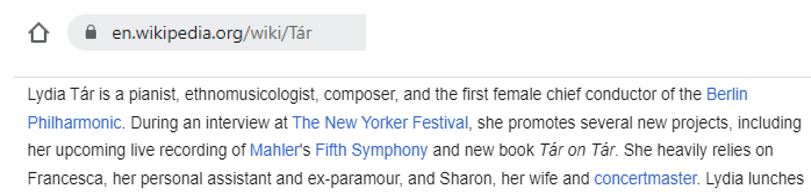
Screenshot of Wikipedia Entry for the Movie Tár 1-20-23
Wikipedia has become so central to our lives that we count on it to represent reality, and solid fact. When we encounter a new phenomenon, we check out our trusty online friend for more information. So, it was fascinating to me recently to see the lines blur between fiction and reality, when Wikipedia was used as a visual and social cue in the movie Tár, starring Cate Blanchett, about a famed female conductor. In the movie, one of the clues to the coming turbulence in Lydia Tár’s life is a screen capture of a mystery editor changing items on the conductor’s Wikipedia entry. It looked and felt so real, the filming and Blanchett’s performance so rivetingly vivid, that many people believed the film was a biopic of a real person. As Brooke LaMantia wrote in her article, No, Lydia Tar is Not Real,
“When I left the theater after watching Tár for two hours and 38 minutes, I immediately fumbled for my phone. I couldn’t wait to see actual footage of the story I had just seen and was so ready for my Wikipedia deep dive to sate me during my ride home. But when I frantically typed “Lydia Tar?” into Google as I waited for my train, I was greeted with a confusing and upsetting realization: Lydia Tár is not real…the film’s description on Letterboxd — “set in the international world of classical music, centers on Lydia Tár, widely considered one of the greatest living composer/conductors and first-ever female chief conductor of a major German orchestra” — is enough to make you believe Tár is based on a true story. The description was later added to a Wikipedia page dedicated to “Lydia Tár,” but ahead of the film’s October 28 wide release, that page has now been placed under a broader page for the movie as a whole. Was this some sort of marketing sleight of hand or just a mistake I stumbled upon? Am I the only one who noticed this? I couldn’t be, right? I thought other people had to be stuck in that same cycle of questioning: Wait, this has to be real. Or is it? She’s not a real person?
Wikipedia is central to LaMantia’s questioning! While it’s easy to understand people’s confusion in general, the Tár Wikipedia page, created by editors like you and like me, is very clear that this is a film, at least as of today’s access date, January 20, 2023… On the other hand, did you know you can click on the “View History” link on the page, and see every edit that has been made to it, since it was created, and who made that edit? If you look at the page resulting from one of the edits from October 27, 2022, you can see that it does look like Tár is a real person, and in fact, a person who later went on to edit this entry to make it clearer wrote, “Reading as it was, it is not clear if Lydia actually exists.” Maybe I should write to LaMantia and let her know.
I tell this story to show that clearly, Wikipedia is a phenomenon, and a globally central one, which makes it all the more amazing that it is created continuously, edit by edit, editor by editor. There are many ways in which our own and your own edits can create change, lead to social justice, correct misinformation and more. While it’s easy to get lost in the weeds of minute changes to esoteric entries, it’s also possible to improve pages on important figures in real-life history and bring them into our modern narrative and consciousness. And it’s easy to do!
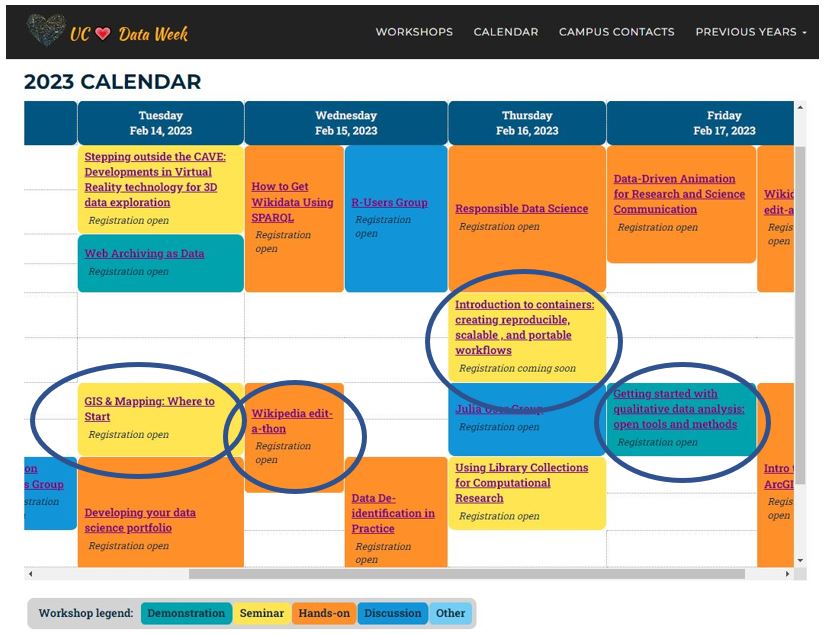
If you are interested in learning more, and being part of this central resource, we warmly welcome you and invite you to join us on Wednesday, February 15, from 1-2:30 for our 2023 Wikipedia Editathon, part of the University of Calif0rnia-wide 2023 Love Data Week. No experience is required—we will teach you all you need to know about editing! (but, if you want to edit with us in real time, please create a Wikipedia account before the workshop). The link to register is here, and you can contact any of the workshop leaders (listed on the registration page) with questions. We look forward to editing with you!
UC Berkeley has been loving its data for a long time, and has been part of the international movement which is Love Data Week (LDW) since at least 2016, even during the pandemic! This year is no exception—the UC Berkeley Libraries and our campus partners are offering some fantastic workshops (four of which are led by our very own librarians) as part of the University of California-wide observance.
Love Data Week 2023 is happening next month, February 13-17 (it’s always during the week of Valentine’s Day)!
UC Berkeley Love Data Week offerings for 2023 include:
All members of the UC community are welcome—we hope you will join us! Registration links for our offerings are above, and the full UC-wide calendar is here. If you are interested in learning more about what the library is doing with data, check out our new Data + Digital Scholarship Services page. And, feel free to email us at librarydataservices@berkeley.edu. Looking forward to data bonding next month!
Widely acknowledged as a major turning point in the history of visual depictions of war, Francisco de Goya’s renowned print series The Disasters of War remains a touchstone for serious engagement with the violence of war and the questions raised by its artistic representation.
The Art of Witnessing: Francisco de Goya’s Disasters of War provides a new account of Goya’s print series by taking readers through the forty-seven prints he dedicated to the violence of war. Drawing on facets of Goya’s artistry rarely considered together before, the book challenges the notion that documentary realism and historical testimony were his primary aims. Michael Iarocci argues that while the depiction of war’s atrocities was central to Goya’s project, the lasting power of the print series stems from the artist’s complex moral and aesthetic meditations on the subject.
Making novel contributions to longstanding debates about historical memory, testimony, and the representation of violence, The Art of Witnessing tells a new story, print by print, to highlight the ways in which Goya’s masterpiece extends far beyond conventional understandings of visual testimony.
Michael Iarocci is professor of Modern Spanish Literature and Culture (18th-21st centuries) in the Department of Spanish & Portuguese and the Associate Dean of Arts and Humanities at UC Berkeley. He received his Ph.D. from the University of Pennsylvania. Comparative and Transatlantic Hispanic Studies. Literature and geopolitics. Aesthetics and ideology. Visual culture. His previous books include Enrique Gil y la genalogía de la lírica moderna (Juan de la Cuesta, 1999), and Properties of Modernity: Romantic Spain, Modern Europe and the Legacies of Empire (Vanderbilt University Press, 2006).
The University of California continues to support a variety of ways UC authors can participate in open access publishing. At its heart, open access refers to the free, immediate, online availability of scholarship. Open access materials can be read and used by anyone, without any financial, legal, or technical barriers other than gaining access to the Internet.
But you might be wondering, why is the University of California concerned about trying to make research more openly available and accessible? Well, one fundamental reason is that the research and teaching mission of the UC includes the aim of “transmitting advanced knowledge,” and as part of doing that, our faculty, researchers, and students create and share their scholarship.
This system of scholarly publishing includes traditional or formal publications, such as peer-reviewed academic articles, scholarly chapters or books, and conference proceedings. It also includes emerging publications such as digital projects, data sets and visualizations, and working papers.
Support for Open Access Articles
UC offers a wide range of support to help authors publish scholarly articles. The UC’s Open Access Policies ensure that university-affiliated authors can deposit their final, peer-reviewed research articles into eScholarship, our institutional repository, immediately upon publication in a journal. Once they’re in eScholarship, the articles may be read by anyone for free.
The University of California has entered into 20+ transformative open access agreements or discount arrangements with scholarly publishers. These agreements permit UC corresponding authors to publish open access in covered journals, with the publishing fees being covered in part (or in full) by the UC. Last year there were 420 articles published open access by UC Berkeley authors under transformative open access agreements.
Locally, the Library continues to offer the Berkeley Research Impact Initiative (BRII). This program helps UC Berkeley authors defray article processing charges (APCs) that are sometimes required to publish in fully open access journals (note that BRII doesn’t reimburse authors for publishing in “hybrid” journals—that is, subscription journals that simply offer a separate option to pay to make an individual article open access). This past year BRII provided funding for the publication of 75 open access journal articles.
Support for Open Access Books
We know that not all University of California authors are publishing journal articles, and many disciplines—such as arts, humanities, and social sciences—focus on the scholarly monograph as the preferred mode of publishing. Some open access book publishers charge authors (or an author’s institution) a fee in exchange for publishing the book, similar to the practice of open access journal publishers charging an “author processing charge” to make a scholarly article open access.
UC Berkeley is supporting authors who wish to publish their books open access. The library provides funding assistance and access to publishing platforms and tools for UCB authors to make their books open access.
Berkeley Research Impact Initiative
Above we mentioned how the Berkeley Research Impact Initiative helps UC Berkeley authors publish articles in fully open access journals. BRII funding can also be used to help authors pay book processing charges (up to $10,000/book) so that their monographs can be published open access. In the last year, several UCB-authored books have been published open access in part due to BRII funding support.
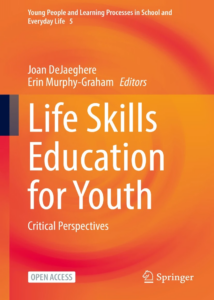
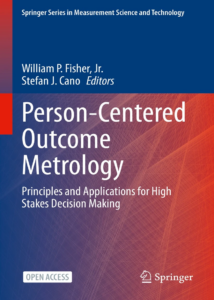
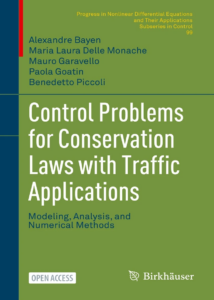
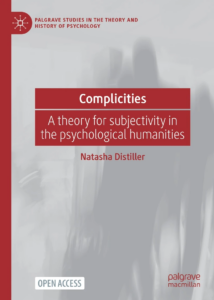
In March 2021, UC Berkeley Library entered into an institutional open access book agreement with Springer Nature. The partnership provides open access funding to UC Berkeley affiliated authors who have books accepted for publication in Springer, Palgrave, and Apress imprints. This means that these authors can publish their books open access at no direct cost to them. The agreement covers all disciplines published by Springer. All the books are published under a Creative Commons Attribution license for free access and downloading. In the last year, several UCB-authored books have been published open access as a result of the UCB-Springer agreement.
UC Berkeley Library continues to support open access book publishing via Luminos, the open access arm of the University of California Press. The Library membership with Luminos means that UC Berkeley authors who have books accepted for publication through the UC Press can publish their book open access with a heavily discounted book processing charge. When combined with additional funding support through BRII, a UC Berkeley book author could potentially publish their book open access with the costs being covered fully by the Library. Luminos books are published under Creative Commons licenses with free downloads.
Pressbooks platform
The UC Berkeley Library hosts an instance of Pressbooks, an online platform through which the UC Berkeley community can create open access books, open educational resources (OER), and other types of digital scholarship. In the last year, Christopher Jelen from the Department of Ancient Greek & Roman Studies published A Few Stories in Attic Greek: Adapted to Accompany Hansen & Quinn (11-20). The book is available under a Creative Commons Attribution-NonCommercial license.
Educational Workshops on open access book publishing
The Office of Scholarly Communication Services OSCS continues to offer a bi-annual Pressbooks workshop and demo where participants can learn how to navigate the platform and create and publish their own eBooks and open educational resources. (Note: the next Pressbooks workshop is coming up on February 8, 2023. Sign up now if you’re interested!)
Every year during the fall semester OSCS hosts an author panel to unpack the process of turning a dissertation into a book. One of the topics discussed during the panel are options for open access publishing. Here’s a recording of last year’s panel discussion.
We also talked with an author about their experiences in publishing a book open access with Springer.
UC supporting broader ecosystem of open access book publishing
In this post, we highlighted several ways that the University of California—and specifically UC Berkeley—is supporting scholarly authors to create and share open access books. In addition to providing financial assistance, platforms, and publishing guidance, the Library is committed to promoting the broader OA book publishing ecosystem. We’ll continue to explore a variety of approaches to support the UC Berkeley community (and beyond) who wish to publish books on open access terms.
If you’re interested to learn more about how you can create and publish an open access book, visit our website or send an email to schol-comm@berkeley.edu.
If you are working on a computational text analysis project and have wondered how to legally acquire, use, and publish text and data, this workshop is for you! We will teach you 5 legal literacies (copyright, contracts, privacy, ethics, and special use cases) that will empower you to make well-informed decisions about compiling, using, and sharing your corpus. By the end of this workshop, and with a useful checklist in hand, you will be able to confidently design lawful text analysis projects or be well positioned to help others design such projects. Consider taking alongside Copyright and Fair Use for Digital Projects.
If you’re looking to self-publish work of any length and want an easy-to-use tool that offers a high degree of customization, allows flexibility with publishing formats (EPUB, PDF), and provides web-hosting options, Pressbooks may be great for you. Pressbooks is often the tool of choice for academics creating digital books, open textbooks, and open educational resources, since you can license your materials for reuse however you desire. Learn why and how to use Pressbooks for publishing your original books or course materials. You’ll leave the workshop with a project already under way! Signup at the link above and the Zoom login details will be emailed to you.
Please sign up today and join us online on February 8.
In this book, Henrike Lange takes the reader on a tour through one of the most beloved and celebrated monuments in the world – Giotto’s Arena Chapel. Paying close attention to previously overlooked details, Lange offers an entirely new reading of the stunning frescoes in their spatial configuration. The author also asks fundamental questions that define the chapel’s place in Western art history. Why did Giotto choose an ancient Roman architectural frame for his vision of Salvation? What is the role of painted reliefs in the representation of personal integrity, passion, and the human struggle between pride and humility familiar from Dante’s Divine Comedy? How can a new interpretation regarding the influence of ancient reliefs and architecture inform the famous “Assisi controversy” and cast new light on the debate around Giotto’s authorship of the Saint Francis cycle?
Illustrated with almost 200 color plates, including individual images of each scene in the narrative cycle, this volume invites scholars and students to rediscover a key monument of art and architecture history and to see it with fresh eyes.
“Henrike Lange’s book on Giotto’s Arena Chapel changes our view of this key work of painting in Italy around 1300.” – Ulrich Pfisterer, Director of the Zentralinstitut für Kunstgeschichte; LMU, Munich
“Dr. Lange’s discovery is so all-encompassing and so to the point… It is now possible to bridge the Anglo-Saxon and Italian views of Giotto where once they were thought to be irreconcilable: a great step forward for the field.” – Laurence B. Kanter, Chief Curator, Yale University Art Gallery
“Lange shows how the theme of triumph is at once central and inexhaustible in the Arena Chapel – its structure, imagery, physical presence, context. The book is itself a vivid triumphal procession of ways of seeing, scholarship, discovery, and critical thinking.” – Randolph Starn, UC Berkeley History
“Lange’s discovery is completely new and original: an entirely convincing case built on the foundations of history, literature, philosophy, political iconography, and theology.” – Andrew Stewart, UC Berkeley History of Art and Classics
“Lange has the rare ability to build bridges for the reader with her command of European languages that allow her to translate and integrate the vast libraries of research on Giotto written in different linguistic and scholarly traditions. The very elegance and clarity of her writing suggest that Lange’s will be a contribution of real significance and will have quite an impact on medieval and Renaissance studies.” – Giuseppe Mazzotta, Sterling Professor of Italian, Yale University
“At its heart Lange’s impressive book relays an intensely visual argument. It is a scholarly triumph in itself to explicate the intimate relation – architectural, political, theological – between the Arena Chapel and a famous Roman prototype, the Arch of Titus. All scholars and students of the period will need to engage this powerful historical proposition and its implications for Italian Trecento visual culture. But Lange also finds the full measure of Giotto’s triumph as a painter.” – Whitney Davis, UC Berkeley History of Art
Henrike Christiane Lange is Associate Professor in History of Art and Italian Studies at the University of California, Berkeley. Lange completed her Magister Artium at Universität Hamburg, Germany, before earning her PhD at Yale University. The present book is the culmination of two decades of research at sites, archives, and collections across Europe.
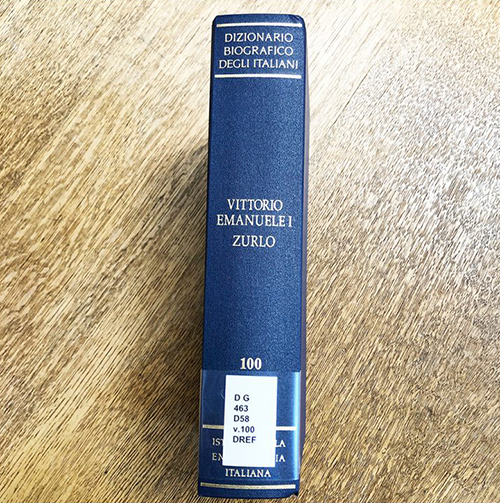
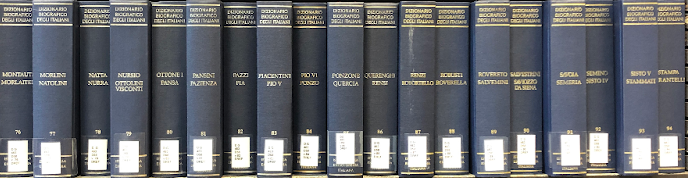
The publication of the hundredth (and final) volume of the Dizionario Biografico degli Italiani(Dbi, Biographical Dictionary of the Italians) last year by Istituto della Enciclopedia Italiana (Istituto Treccani) is a momentous occasion that may have been overshadowed by the global pandemic when libraries were shuttered and cataloging backlogs amassed. In the spirit of other European projects such as the Dictionary of National Biography (UK), the Diccionario biografIíco español (Spain), and the Allgemeine Deutsche Biographie (Germany), this ambitious biographical dictionary was conceived in 1925 with national-patriotic criteria in mind during the first phase of the National Fascist Party’s consolidation of power in Italy. Because of setbacks during and following World War II, the first volume did not appear in print until 1961 yet nearly every year thereafter, at least one or two volumes were added to the evolving reference set.
The enterprise endeavored to include the most illustrious figures in the history of Italy from the fall of the Western Roman Empire to the present day. Responding to the needs of the digital age, these 40,000 scholarly entries with sources and bibliographies have been made freely available online (but not free of ads) and integrated with other reference works they publish. While new entries are added to the online portal which also comprises Enciclopedia dell’Italiano, Dizionario di Filosofia, Enciclopedia Machiavelliana, Enciclopedia del Cinema, etc., entries in the print tomes are subject to the era in which they were authored. One of the conditions for inclusion in the Dbi is that of being deceased. According to its current director Raffaele Romanelli, the work is doomed to bear witness only to the past if worthy cultural figures are overlooked. He explains, “I have here a ready list of Italians who passed away this year: Alberto Arbasino, Franca Valeri, Rossana Rossanda. Will they all be destined for exclusion?”
The neo-Hegelian idealist philosopher, educator, and fascist politician Giovanni Gentile, who was also director of the Enciclopedia Italiana, referred to the work as “the golden book of the Italian stock.” In recent years, the notion of relevance has expanded to the world of business, technology, even of media and fashion, and includes previously unthinkable icons such as gay activist playwright Mario Mieli, notorious pornstar Moana Pozzi, and soccer heroes Enzo Bearzot and Dino Viola. According to Romanelli, there really never was a predefined canon. “To give an idea of the criterion, I would have liked to have included Pinocchio and Don Abbondio, non-existent but fundamental,” he quipped. Naturalized citizens such as the Swiss botanist Daniel Bovet and the mezzo-soprano Cathy Berberian of Armenian-American descent are included but entries for women remain overall at an appalling four percent. There are entries for fiction writers Natalia Ginzburg and Elsa Morante but it could be a long time before we see one for famous living writers such as Elena Ferrante. In 2015, the influential feminist art critic Carla Lonzi was added to the online version. Fans of the late philosopher, writer, and linguist Umberto Eco who died in 2016 still awaits an entry in the Dbi.
UC Berkeley is one of three dozen libraries across the country with the complete print set of 100 volumes. Most research libraries canceled their standing orders somewhere along the way. But what does this mean now when updates are not possible in a standard reference work such as this? Does the whole work become a cultural relic forever frozen in the epoch in which it was created? The lack of a critical lens and blatant exclusion of worthy cultural, political, scientific, and historical figures is reason enough to keep updating the work, illuminating the overlooked both from Italy’s past and recent years. While promises of forthcoming appendices and the technological capability of Trecanni to insert new entries and revise old ones in the online edition, the fate of this national reference work and others like it remains unknown. Students continue to rely, as many of us do for quick look-ups, on Wikipedia as the golden age of cumbersome print reference works sunsets. The burning question we should be asking ourselves is not what we would do without Wikipedia but what would we do without these print reference treasures, or knowledge bases, that constitute its foundation?
Sources consulted
Dizionario Biografico degli Italiani. Istituto della Enciclopedia Italiana fondata da Giovanni Treccani, https://www.treccani.it/biografico. Accessed 31 March 2022.
“Dizionario biografico degli italiani – Immagini.” YouTube, 14 December 2010. https://youtu.be/pul4bOZ7lAs. Accessed 31 March 2022.
Neveu, Bruno. “Biographie et historiographie: Le Dizionario biografico degli italiani.” Journal des Savants, vol. 1, no. 1, 1971, pp. 32–67, https://doi.org/10.3406/jds.1971.1240. Accessed 31 March 2022.

![Creole: Portraits of France’s Foreign Relations During the Long Nineteenth Century [book cover]](https://update.lib.berkeley.edu/wp-content/uploads/2023/01/CREOLE.jpg)
![The Art of Witnessing: Francisco de Goya's Disasters of War [cover]](https://update.lib.berkeley.edu/wp-content/uploads/2023/01/art-witnessing.png)


![Giotto's Arena Chapel and the Triumph of Humility [book cover]](https://update.lib.berkeley.edu/wp-content/uploads/2023/01/giotto.jpg)