Workshop: Creating Web Maps with ArcGIS Online

Digital Publishing Workshop Series

Creating Web Maps with ArcGIS Online
Thursday, October 13th, 11:10am – 12:30pm
Online: Register to receive the Zoom link
Susan Powell

Want to make a web map, but not sure where to start? This short workshop will introduce key mapping terms and concepts and give an overview of popular platforms used to create web maps. We’ll explore one of these platforms (ArcGIS Online) in more detail. You’ll get some hands-on practice adding data, changing the basemap, and creating interactive map visualizations. At the end of the workshop you’ll have the basic knowledge needed to create your own simple web maps. Register here

Upcoming Workshops in this Series – Fall 2022:

  • The Long Haul: Best Practices for Making Your Digital Project Last
  • Copyright and Fair Use for Digital Projects


Please see bit.ly/dp-berk for details.


University of California Research Data Policy: a few things to know

University of California Research Data Policy: a few things to know

The University of California Office of the President recently announced an updated Research Data Policy, effective July 15, 2022. The new policy complements the original policy from 1958. It re-confirms that research data are owned by the University but outlines how University Researchers may use the data generated or collected in the course of their research. While most researchers likely will find that the updated policy doesn’t require a complete overhaul of their data stewardship practices, it’s important to understand key  terms, conditions, and permissions enabled by the new policy. The policy, however, will help them make decisions around management, retention, data publication, and data transfer. Implementation of this policy at a campus level is currently under development. Additional details are forthcoming.

A few key points: 

  • The Regents of the University of California own Research Data generated or collected in the course of University Research. 
    • Research Data include “recorded information embodying facts resulting from a scientific inquiry.” Research Data do not include scholarly & aesthetic works, informal notes, paper drafts, administrative or medical records, and other materials (see policy text for complete list).
    • University Research means “research conducted by a Principal Investigator or University Researcher that is within the course and scope of their assigned duties, uses University resources, and/or is funded by or through the University.”
  • University Researchers may use the Research Data they generate or collect in order to conduct other research, share with collaborators, publish outcomes, and create scholarly works. The University “supports the free and unfettered dissemination of information, knowledge, and discoveries generated by University Researchers.” As such:
    • Principal Investigators (PIs) are the stewards of Research Data, and maintain autonomy about which data should be preserved or dispositioned;
    • Researchers may share data as dictated by scholarly/disciplinary standards or data management plans, or legal, funder, or contractual requirements; 
    • When a University Researcher leaves the UC, they may take copies of the data they generated or collected, as long as it is approved by the PI;
    • Neither the University nor University Researchers may assert ownership of Research Data owned by third parties.


Resources and Assistance: 


Written by Tim Vollmer, Erin Foster, and Anna Sackmann


Workshop: Web Platforms for Digital Projects

Digital Publishing Workshop Series

Web Platforms for Digital Projects

Monday, October 3rd, 11:00am – 12:30pm
In-Person: Doe 223
Stacy Reardon

How do you go about publishing a digital book, a multimedia project, a digital exhibit, or another kind of digital project? In this workshop, we’ll take a look at use cases for common open-source web platforms WordPress, Drupal, Omeka, and Scalar, and we’ll talk about hosting, storage, and asset management. There will be time for hands-on work in the platform most suited to your needs. No coding experience is necessary. Register here

Upcoming Workshops in this Series – Fall 2022:

  • Creating Web Maps with ArcGIS Online
  • The Long Haul: Best Practices for Making Your Digital Project Last
  • Copyright and Fair Use for Digital Projects


Please see bit.ly/dp-berk for details.


NIH DMSP Frequently Asked Questions

The Library Data Services Program recently posted about the National Institutes of Health (NIH) Data Management and Sharing Policy and how it will affect UC Berkeley researchers. Please read more about the new policy on this post.

Here are a list of FAQs about the new policy. Please contact the UC Berkeley Library Data Services Program (librarydataservices@berkeley.edu) with questions.

How is UC Berkeley  responding to this policy?

The Library Data Services Program is collaborating with the Research Data Management Program to provide guidance and documentation to ensure compliance with the NIH policy.

What is considered “scientific data” for the purposes of this plan?

The final NIH Policy defines Scientific Data as: “The recorded factual material commonly accepted in the scientific community as of sufficient quality to validate and replicate research findings, regardless of whether the data are used to support scholarly publications. Scientific data do not include laboratory notebooks, preliminary analyses, completed case report forms, drafts of scientific papers, plans for future research, peer reviews, communications with colleagues, or physical objects, such as laboratory specimens.” The NIH states that “the final DMS Policy is designed to increase the sharing of scientific data, regardless of whether a publication is produced…Data that do not form the basis of a publication produced during the award period should be shared by the end of the award period.”

What is included in a Data Management and Sharing Plan?

In these max two-page documents, researchers will describe their:

  • Data type(s)
  • Related tools, software, and/or code
  • Standards
  • Data preservation, access, and associated timelines
  • Access, distribution, or reuse considerations
  • Oversight of data management and sharing

Read more about Data Management Plans and see sample language

Can I make my data available upon request?

NIH strongly prefers that scientific data be shared and preserved through repositories or, for datasets up to 2GB, through PubMed Central-deposited supplemental data files, rather than kept by a researcher and provided upon request.

How will the plans be assessed?

NIH program staff will assess the DMS plans but peer reviewers may comment on the proposed budget for data management and sharing.

What data repository should I use?

NIH encourages the use of established repositories. To select the best repository for your data consider the following:

  • Is there a specific NIH repository named in the funding announcement?
  • Is there a data repository specific to your discipline?
  • If not, is there a general data repository you can use?

To learn more, read the NIH guidance on selecting a data repository.

What is a standard? What standards are relevant to my research?

A standard specifies how exactly data and related materials should be stored, organized, and described. In the context of research data, the term typically refers to the use of specific and well-defined formats, schemas, vocabularies, and ontologies in the description and organization of data. However, for researchers within a community where more formal standards have not been well established, it can also be interpreted more broadly to refer to the adoption of the same (or similar) data management-related activities, conventions, or strategies by different researchers and across different projects.

When do I need to make my data available?

NIH encourages scientific data to be shared as soon as possible, and no later than time of an associated publication or end of the performance period, whichever comes first.

What data management and sharing costs can I include in my grant?

Allowable costs can include:

  • data curation and developing documentation (formatting data, de-identifying data, preparing metadata, curating data for a data repository)
  • data management considerations (unique and specialized information infrastructure necessary to provide local management and preservation before depositing in a repository)
  • preserving data in data repositories (data deposit fees)

Read more about allowable costs.

Guidance for data management and sharing costs on NIH budget requests

What happens if I do not comply with the NIH policy or make my data available as described in the DMS policy?

NIH Program Staff will be monitoring compliance with the policy during the funding period. “Noncompliance with Plans may result in the NIH ICO adding special Terms and Conditions of Award or terminating the award. If award recipients are not compliant with Plans at the end of the award, noncompliance may be factored into future funding decisions.”

I work with sensitive topics/populations – how do I protect my participants’ privacy?

NIH strongly encourages researchers who work with sensitive topics and/or populations to address data sharing in the Informed Consent process. See the UC Berkeley Human Research Protection Program’s Informed Consent page, which includes guidelines and appropriate form templates.

Researchers should pay special attention to their de-identification process to ensure that all identifying information has been fully removed. Researchers should consider depositing their data in restricted access repositories that require data use agreements and research plans in order to access the data. Contact librarydataservices@berkeley.edu if you would like guidance on selecting restricted access repositories.

Please view the UCSF’s resources on data de-identification and sharing de-identified data for additional guidance. 

Do specific NIH Institutes and Centers (ICs) have additional policies or recommendations? 

Yes, NIH ICs may have additional requirements or recommendations. Please identify the institute or center using this table to learn more about requirements.

Supplemental information from the NIH:

Responsible Management and Sharing of American Indian/Alaska Native Participant Data

Protecting Privacy When Sharing Human Research Participant Data


Many thanks to Ariel Deardorff at the UCSF Library for allowing us to adapt their list of Frequently Asked Questions and thank you to UC Berkeley’s Elliott Smith, Michael Sholinbeck, and Erin Foster for all of their expertise and contributions. 



Fall 2022 copyright and publishing workshops with the Office of Scholarly Communication Services

Graphic of Office of Scholarly Communication Services logo with a textual list of Fall 2022 workshops

With the school year kicking off this week in Berkeley, the Office of Scholarly Communication Services is here to help UC Berkeley faculty, students, and staff understand copyright and scholarly publishing with online resources, Zoom workshops, and consultations.

Here’s what’s coming up this semester.

Workshops

Publish Digital Books & Open Educational Resources with Pressbooks

Date/Time: Tuesday, September 20, 2022, 11:00am–12:30pm
RSVP for Zoom link
If you’re looking to self-publish work of any length and want an easy-to-use tool that offers a high degree of customization, allows flexibility with publishing formats (EPUB, PDF), and provides web-hosting options, Pressbooks may be great for you. Pressbooks is often the tool of choice for academics creating digital books, open textbooks, and open educational resources, since you can license your materials for reuse however you desire. Learn why and how to use Pressbooks for publishing your original books or course materials. You’ll leave the workshop with a project already under way.

Copyright and Your Dissertation

Date/Time: Tuesday, September 27, 2022, 11:00am–12:30pm
RSVP for Zoom link 
This workshop will provide you with practical guidance for navigating copyright questions and other legal considerations for your dissertation or thesis. Whether you’re just starting to write or you’re getting ready to file, you can use our tips and workflow to figure out what you can use, what rights you have as an author, and what it means to share your dissertation online.

Managing and Maximizing Your Scholarly Impact

Date/Time: Tuesday, October 11, 2022, 11:00am–12:30pm
RSVP for Zoom link
This workshop will provide you with practical strategies and tips for promoting your scholarship, increasing your citations, and monitoring your success. You’ll also learn how to understand metrics, use scholarly networking tools, evaluate journals and publishing options, and take advantage of funding opportunities for Open Access scholarship.

From Dissertation to Book: Navigating the Publication Process

Date/Time: Tuesday, October 18, 2022, 11:00am–12:30pm 
RSVP for Zoom link
Hear from a panel of experts—an acquisitions editor, a first-time book author, and an author rights expert—about the process of turning your dissertation into a book. You’ll come away from this panel discussion with practical advice about revising your dissertation, writing a book proposal, approaching editors, signing your first contract, and navigating the peer review and publication process.

How to Publish Open Access at UC Berkeley

Date/Time: Tuesday, October 25, 2022, 11:00am–12:30pm
RSVP for Zoom link 
Are you wondering what processes, platforms, and funding are available at UC Berkeley to publish your research open access (OA)? This workshop will provide practical guidance and walk you through all of the OA publishing options and funding sources you have on campus. We’ll explain: the difference between (and mechanisms for) self-depositing your research in the UC’s institutional repository vs. choosing publisher-provided OA; what funding is available to put toward your article or book charges if you choose a publisher-provided option; and the difference between funding coverage under the UC’s “transformative agreements” vs. the Library’s funding program (Berkeley Research Impact Initiative). We’ll also give you practical tips and tricks to maximize your retention of rights and readership in the publishing process.

Copyright and Fair Use for Digital Projects

Date/Time: Tuesday, November 8, 2022, 11:00am–12:30pm
RSVP for Zoom link 
This training will help you navigate the copyright, fair use, and usage rights of including third-party content in your digital project. Whether you seek to embed video from other sources for analysis, post material you scanned from a visit to the archives, add images, upload documents, or more, understanding the basics of copyright and discovering a workflow for answering copyright-related digital scholarship questions will make you more confident in your project. We will also provide an overview of your intellectual property rights as a creator and ways to license your own work.

Other ways we can help

In addition to the workshops, we’re here to help answer a variety of questions you might have on intellectual property, digital publishing, and information policy. 

Want help or more information? Send us an email. We can provide individualized support and personal consultations, online class instruction, presentations and workshops for small or large groups & classes, and customized support and training for departments and disciplines.


Workshop: Publish Digital Books & Open Educational Resources with Pressbooks

Digital Publishing Workshop Series

Publish Digital Books & Open Educational Resources with Pressbooks
Tuesday, September 20th, 11:00am-12:30pm
Online: Register to receive the Zoom link
Tim Vollmer

If you’re looking to self-publish work of any length and want an easy-to-use tool that offers a high degree of customization, allows flexibility with publishing formats (EPUB, PDF), and provides web-hosting options, Pressbooks may be great for you. Pressbooks is often the tool of choice for academics creating digital books, open textbooks, and open educational resources, since you can license your materials for reuse however you desire. Learn why and how to use Pressbooks for publishing your original books or course materials. You’ll leave the workshop with a project already under way! Register here

Upcoming Workshops in this Series – Fall 2022:

  • Web Platforms for Digital Projects
  • Creating Web Maps with ArcGIS Online
  • The Long Haul: Best Practices for Making Your Digital Project Last
  • Copyright and Fair Use for Digital Projects


Please see bit.ly/dp-berk for details.


Forthcoming NIH Data Management and Sharing Policy

On January 25, 2023, the National Institutes of Health (NIH) will implement a new Data Management and Sharing Policy. The Library Data Services Program and Research Data Management Program have several resources to help you adapt to the new policy, including extensive guidance and suggested language for writing a plan. Additionally, the DMPTool, which is free for UC Berkeley users and supported by the Library Data Services Program, walks grant applicants through the plan requirements. We will be offering four drop-in workshops designed for researchers this fall. Please register using for the workshops using the links below:


The NIH is a leader in implementing data management plans and was the first federal granting agency to do so with their 2003 NIH Sharing Policy. In the years since, the agency developed two genomic data sharing policies (2008 and 2014), and addressed data sharing in clinical trials in 2016. The new data sharing policy builds on their existing data management requirements and is broadly sweeping with the goal to maximize the “…sharing of scientific data generated from NIH-funded or conducted research, with justified limitations or exceptions.” 


The new policy will apply to all research funded (in whole or in part) by the NIH that produces scientific data. It will apply to grant applications submitted on or after January 25, 2023. The NIH defines scientific data as: “the recorded factual material commonly accepted in the scientific community as of sufficient quality to validate and replicate research findings, regardless of whether the data are used to support scholarly publications…” Please note that the NIH definition of scientific data does NOT include the following: laboratory notebooks, preliminary analyses, completed case report forms, drafts of scientific papers, plans for future research, peer reviews, communications with colleagues, or physical objects, such as laboratory specimens.


There are a few aspects that set the new NIH DMSP apart from current policy:

  • Plans will outline how data and metadata will be managed over the course of the project and which of these data will be shared.
  • Grant applicants will need to include details about software or other tools that were used to analyze the data.
  • If generating data derived from human participants, plans will need to outline how confidentiality, privacy, and rights of those individuals will be preserved.
  • Plans must include a selected repository or repositories where the data will be preserved along with a timeline for sharing the data (either as soon as possible, no later than the time of an associated publication, or at the end of performance period if there is no associated publication). 
  • Updates to plans over the course of the project will be reviewed by the NIH ICO (institute, center, or office) during regular reporting intervals.
  • Data management costs may be added to the grant budget including data curation and developing documentation (e.g., formatting data, de-identifying data); data management considerations (e.g., unique and specialized information infrastructure necessary to provide local management and preservation before depositing in a repository); preserving data in data repositories (e.g., data deposit fees).
  • Compliance with plans will be measured during the funding period at regular reporting intervals.


Please see our list of frequently asked questions. For additional information about the policy, please see the NIH page on Data Management and Sharing Policy

Many thanks to Elliott Smith, Michael Sholinbeck, and Erin Foster for all of their expertise and contributions!

If you have any questions or need additional support, please email librarydataservices@berkeley.edu. 


Introducing the New Research Data Management (RDM) Program Website

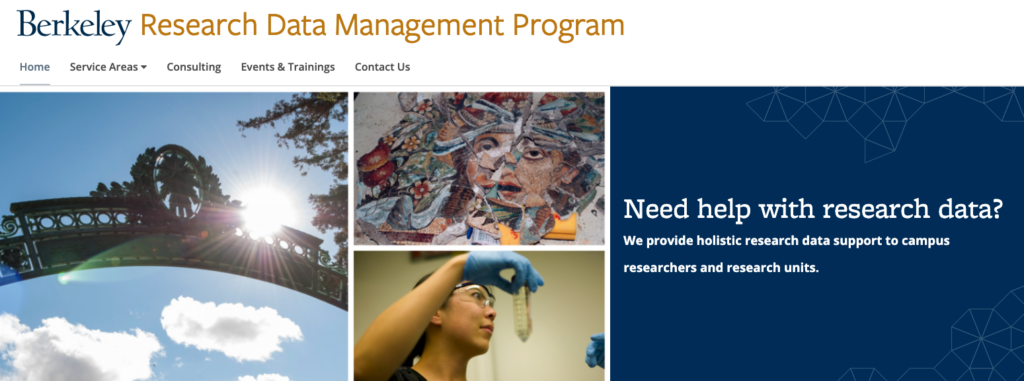
Screenshot of homepage As Service Lead of the Research Data Management (RDM) Program, I am very excited to announce the launch of the new RDM Program website! Since its launch in 2015, the RDM Program supports and advocates for campus researchers and their research data needs. In partnership with other campus research support units, we consult with researchers and research groups to understand their needs and connect them to systems and tools that facilitate their research goals.
A key aspect of building this site was to highlight the areas in which the RDM Program offers support for research data. From the Service Areas page, you can learn more about the six areas in which the RDM Program offers consulting, delivers training, and develops documentation for the UC Berkeley research community. These areas are: data classification & security, data collection, data management, data sharing, data storage & backup, and data transfer.

Additionally, the RDM Program sponsors and contributes to several events throughout the year, most notably Love Data Week and Women in Data Science (WiDS) at Berkeley. See content from previous years on the Events and Training page as well as the YouTube playlist of our recorded trainings!

By moving to the Open Berkeley platform, the RDM Program site now aligns with other campus websites and comes with enhanced security and accessibility features as well as Berkeley branding. Content from the previous RDM Program website has been moved – either to the new site or to the Research IT documentation site – or archived using the WayBack Machine.

Special thanks to: Tiffany Vo for her design and user experience expertise, Amy Neeser for helping develop and archive content, and the rest of the RDM Program team for their support. I hope you find our updated site useful in navigating the Berkeley research landscape and connecting with help! Let me know at researchdata@berkeley.edu if there is anything you want to see featured or if you have questions.

Cheers!

Erin D Foster


Nexis Data Lab Computing Environment


The UC Berkeley Library is pleased to announce access to a new text and data mining platform, Nexis Data Lab from LexisNexis. The cloud-based platform enables users to run computational analysis in a Jupyter notebook on content licensed for use at UC Berkeley. Please take a look at this brief, two minute video to see how the environment works. Researchers should be familiar with Python or R. Each account may have up to 6 projects (workspaces), with a limit of 100,000 documents per project. The number of seats are limited, so we ask that you have a TDM project in progress. 


Please view the list of content and titles available to UC Berkeley users. LexisNexis will continue to make additional content available as the platform grows. (Note that the following publications are NOT available: The New York Times (NDL does include NYT International), The New York Times Blogs, Wall Street Journal Abstracts, Information Base Abstracts, and Jane’s Defence Weekly.)


If you would like to get started using the platform, request a seat by filling out this form. The Library is holding a training session for the platform (hosted by LexisNexis) on August 15, 2022 at 9:00 AM. Please register here for the event. For more information on text and data mining platforms and resources available at UC Berkeley, please check out our guide to Text Mining and Computational Text Analysis. Contact the Library Data Services Program at librarydataservices@berkeley.edu with questions. 


Library Data Services Program logo


Create Change With Us: By Editing Wikipedia!

Edit For Change Editathon Logo

EVENT: Wikipedia Edit for Change: Workshop + group editing

Wednesday, February 16, 1:00pm-2:30pm

Register

We look forward every year to offering the annual Library Wikipedia Editathon, but this year we’re mixing it up in some exciting new ways!

First, what is an editathon?  It’s familiar to many of us to think about Wikipedia as a crowd-sourced online encyclopedia, which means that it’s only as good as its individual entries.  Library communities in particular are deeply committed to the quality of information in this much-used resource.  So, supporting Berkeley in learning to edit through a group editing event, with workshops for beginners, that is, an editathon, is a natural fit for us at the Library.

Second, what are we doing to mix it up?  Our focus is Edit For Change—we will support you in editing Wikipedia towards any change you’d like to see!   There is always room for improvement in Wikipedia’s topics and content.  We’ll offer an introductory level Wikipedia workshop to support you in editing Wikipedia even if you’ve never edited before, and following the workshop, we’ll make edits together so you can pursue your editing interests more fully.

As an added bonus, we’re also excited to pair with the new initiatives of the recently-launched Library Data Services Program. This year we’re part of the University of California’s Love Data Week event calendar, which is an invigorating connection.  How does Wikipedia connect to data? You may have heard of Wikidata, but there are also other connections between Wikipedia and data science: for example, Wikipedia’s content is a treasure trove for researchers who analyze textual content using data science methods.  Here are some examples of the kind of research that is happening now, and here and here are some suggestions for approaching these methods if you are interested!

Intrigued?  We’d love to have you come participate in the event!  Registration is at ucblib.link/edit4change . Questions?  Feel free to email us at editathon@lists.berkeley.edu, and we hope to “see” you on February 16!