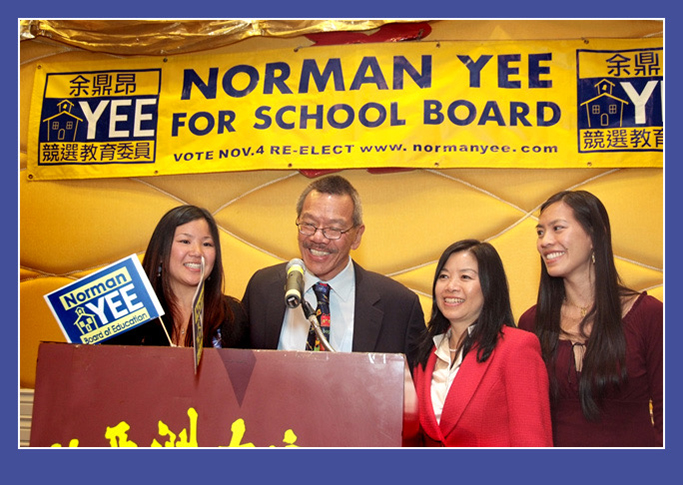
Yee and family at San Francisco Board of Education rally, 2008
“I am proud to be a Chinatown kid who grew up to be of consequence at City Hall for my own community, and for the City I love. I hope one day my story will be one that creates a history that affords others new futures.” — Norman Yee
The UC Berkeley Oral History Center is proud to announce the release of Norman Yee: Serving the People of San Francisco, From Chinatown to the Board of Supervisors. For most residents of San Francisco, Yee needs no introduction. He is a former member of the Board of Education and Board of Supervisors, elected positions in which he served for sixteen years. Before politics, we worked for over two decades as an innovative facilitator and advocate of multicultural education in San Francisco.
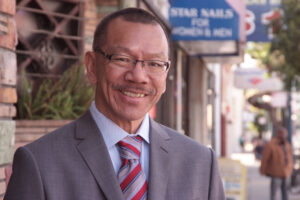
Norman Yee, District 7 Representative, San Francisco Board of Supervisors
Born and raised in San Francisco’s Chinatown, Yee grew up within a large extended family and spent much of his childhood and teenage years working at his parents’ grocery store. He attended Galileo Academy of Science and Technology, and upon graduation continued his education at City College of San Francisco and UC Berkeley, where he earned a bachelor’s degree in civil engineering. Yet, his career as an engineer barely lasted six months. Although he had a mind for mathematics, his heart drew him to education and the overlooked needs of the children in Chinatown. Leaving his position at Cal OSHA, he volunteered at the Chinatown YWCA, where he worked with the neighborhood’s youth and became involved in several projects aimed at expanding the resources and programs available to children and families in the neighborhood. By 1978, he decided that early childhood education was his calling, and entered the Teacher Corps, a two year program that asks candidates to work in urban school district, in this case East Palo Alto. In exchange he would receive his Master of Arts degree in elementary education.
Yee began his career in early care and education at Wu Yee Children’s Services in Chinatown. There he helped develop one of the first curriculums in bilingual multicultural education. He also taught mixed language classes in the San Francisco School district, as well as ESL (English as a Second Language) courses at City College of San Francisco, where he played a critical role in creating unit-bearing ESL classes. Yee continued to expand the educational opportunities for immigrant and first-generation children. He was a founding member of the Alice Fong Yu Alternative School, the country’s first Chinese immersion public school. He also expanded both the resources and services offered by Wu Yee Children Services, and proved pivotal in the creation of San Francisco’s Public Education Enrichment Fund, a third of which is designated for early childhood programs and education.
Norman Yee, President of the San Francisco Board of Supervisors
Yee entered public office in 2004, marking a start to a political career that would see him serve two terms on the San Francisco Board of Education and two terms on the San Francisco Board of Supervisors. In both positions, he continued to be an unwavering advocate for early childhood education and public services for underrepresented populations in the city. He co-authored Proposition C in 2018, which created universal childcare in San Francisco, as well as Proposition W, which made City College free for San Francisco residents. After being severely struck by a car in 2005, he sponsored the Vision Zero initiative to increase pedestrian safety. He also successfully sponsored initiatives for police reform and one of the city’s most progressive senior housing developments. In 2010, he was elected president of the Board of Supervisors, and played a critical role in helping guide San Francisco through the COVID-19 pandemic.
Throughout his multiple careers, Yee confronted each challenge with hope, determination, and an unwavering commitment to the city and community he sought to serve. The Oral History Center is thrilled to bring his inspiring and untold story to the public.
Find this interview and all our oral histories from the search feature on our home page. You can search by name, keyword, and several other criteria.
About the Oral History Center
The Oral History Center of The Bancroft Library preserves voices of people from all walks of life, with varying political perspectives, national origins, and ethnic backgrounds. We are committed to open access and our oral histories and interpretive materials are available online at no cost to scholars and the public. You can find our oral histories from the search feature on our home page. Search by name, keyword, and several other criteria. Sign up for our monthly newsletter featuring think pieces, new releases, podcasts, Q&As, and everything oral history. Access the most recent articles from our home page or go straight to our blog home.
For over 150 years, residents and visitors alike have not run short of reasons to support the claim, “There’s no place like California.” And since the 1960s, that claim has been echoed—albeit in whispers—among cannabis circles around the globe. Bestowed with rich soils and a unique Mediterranean climate, counterculture-turned-farming communities in California pioneered cultivation and breeding practices that would revolutionize cannabis, and in the process, give the Golden State near mythic status. Strains such as Haze, Kush, Blueberry, Purps, Skunk, and SAGE became legendary, as did the California regions that produced them: Big Sur, Santa Cruz, and the famed Emerald Triangle of Mendocino, Trinity, and Humboldt Counties. For a plant whose history spans millennia, such developments were more than just a feat; they proved to be a game changer. By the dawn of the twenty-first century, the innovations of California cultivators had created the very seedbed upon which the modern world of cannabis would flourish.
The UC Berkeley Oral History Center (OHC) is proud to announce the launch of the California Cannabis Oral History Series, and the release of the series’ inaugural interview, Oliver Bates: Reflections on Over Three Decades in the Cannabis Industry. Created by OHC Historian Todd Holmes, the new oral history series seeks to capture the untold history of the state’s cultivating communities and finally situate cannabis within the historical record. The Center is also thrilled to announce that Holmes will add nearly a hundred hours of interviews to this important series over the next two years as part of a multi-institutional research team studying legacy genetics among California cannabis communities. Supported by a $2.7 million grant from the California Department of Cannabis Control, the project will be conducted within a community-based participatory research framework that combines oral histories, ethnographic field studies, community outreach, genetic sequencing, and the creation of community herbariums.
An Untold Legacy
The significance of documenting the history of California cannabis is hard to overstate, as it has long been relegated to the shadows. Designated an illegal substance in 1937 with the passage of the Marijuana Tax Act, cannabis cultivation was forced to take root in the dark soils of prohibition—a landscape that legally branded farmers as outlaws, and their crop as contraband. Thus, unlike other agricultural sectors, cannabis had no state organizations to provide support to growers, no venues to share the latest methods and innovations. In fact, most cultivators lived and operated in near seclusion, which proved an important survival tactic amid America’s escalating War on Drugs. The craft of cultivation, therefore, came to resemble a highly guarded secret among cannabis communities, one that was passed down over the decades from one generation to the next. In a touch of irony, cannabis also arose during this same time to become—in terms of estimated sale revenue—the state’s number one cash crop. California voters finally began to pull back the veil of prohibition in 1996 with the passage of Proposition 215, which legalized cannabis for medical use. Twenty years later, voters fully legalized cannabis in the state with Proposition 64. For the first time in modern history, California cannabis farmers were able to fully step out of the shadows; and with them, came the untold history of their craft.
Oliver Bates, President of the Big Sur Farmer’s Assoc.
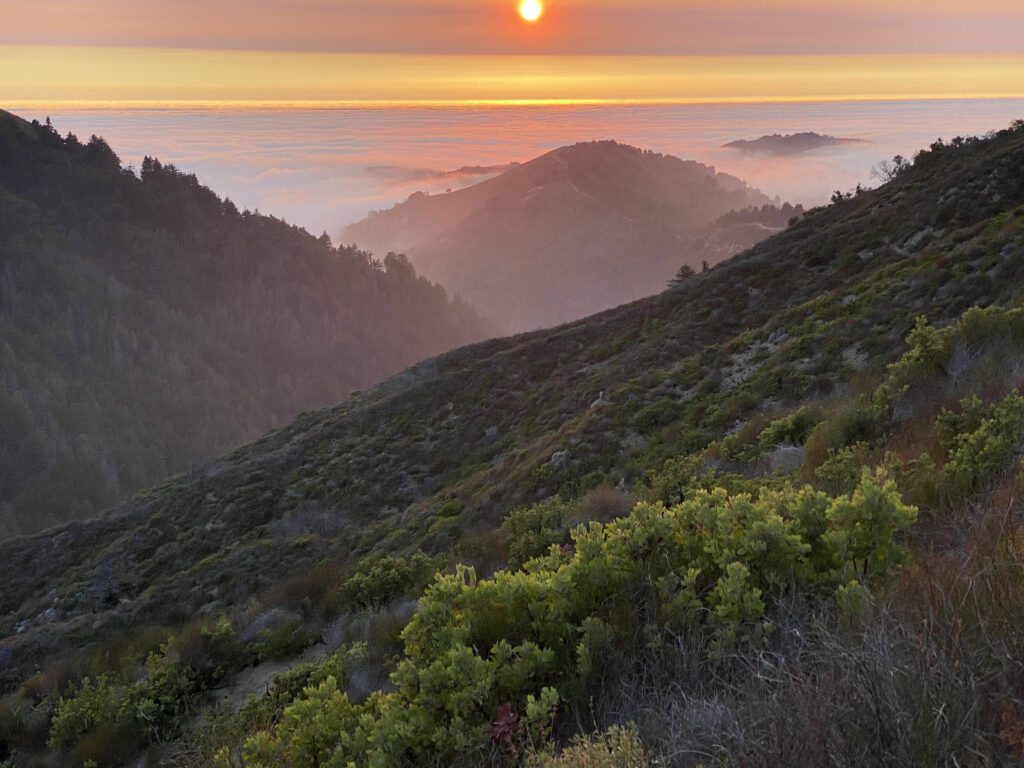
The oral history of Oliver Bates represents the OHC’s initial step toward documenting this overlooked history. President of the Big Sur Farmers Association and a thirty-year veteran of the cannabis industry, Bates began growing on California’s Central Coast in his teens, applying the methods he learned from working with elder farmers in the Big Sur community. Upon the passage of Proposition 215, he moved his small operation from the secluded mountains of Big Sur to a sizeable open farm in Monterey County, where he was among the region’s earliest cultivators of medical cannabis. The medical boom soon led him north to the border area of Mendocino and Humboldt Counties—the epicenter of the famed Emerald Triangle. There he worked in the historic Spyrock community with some of the top growers in the industry, helping to develop the new techniques and strains needed to meet the ever-changing demands of the evolving cannabis market.
“It was so dangerous and so tight knit…if you were lucky enough to know a grower, and then worked very hard for that grower, maybe you were lucky enough to get a few tricks so you didn’t have to spend the next ten to twenty years falling on your face to get it right. Because it’s a very finicky plant if you don’t know what you’re doing. It’s very sensitive. It’s hard. People think and say, ‘It grows like a weed.’ Not true.”
His experience at Spyrock expanded and refined his skillset as a cultivator. It also introduced him to the next chapter of his career: indoor hydroponics. For a grower who strove for perfection with every plant, Bates found the potential of indoor hydroponics hard to resist. Outdoor cultivation requires a farmer to work with the natural environment to produce the best possible product—a factor that explains California’s preeminence in cannabis cultivation. Indoor cultivation allows growers to create the optimal environment, and with it a greater chance for a more optimal product. Bates quickly took to the new venture, opening large indoor operations in Oregon and Colorado before returning to California to run one of the largest hydro operations in Santa Cruz County. And in each location, he increased both scale and variety to keep apace the shifting currents of the medical cannabis market. For a farmer who began growing in the secluded Santa Lucia Mountains of Big Sur, the developments he had both witnessed and helped advance in the cannabis world were staggering. The medical market now came to include hundreds of cannabis strains, powerful concentrates, and an ever-growing assortment of THC products.
In 2012, Bates returned to Big Sur with the intention of getting back to a simpler practice. Bothered by the environmental excesses of indoor growing and the commercialism of the cannabis market, he yearned to return to his roots by growing legacy cultivars in the community he called home. He also wished to be of service to his fellow farmers. Upon the passage of Proposition 64 in 2016, Bates helped found the Big Sur Farmers Association, a mutual benefit nonprofit that works to support, protect, and advance the rights of cannabis cultivators in the region.
Partnering on Ground-Breaking Study
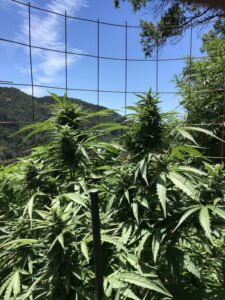
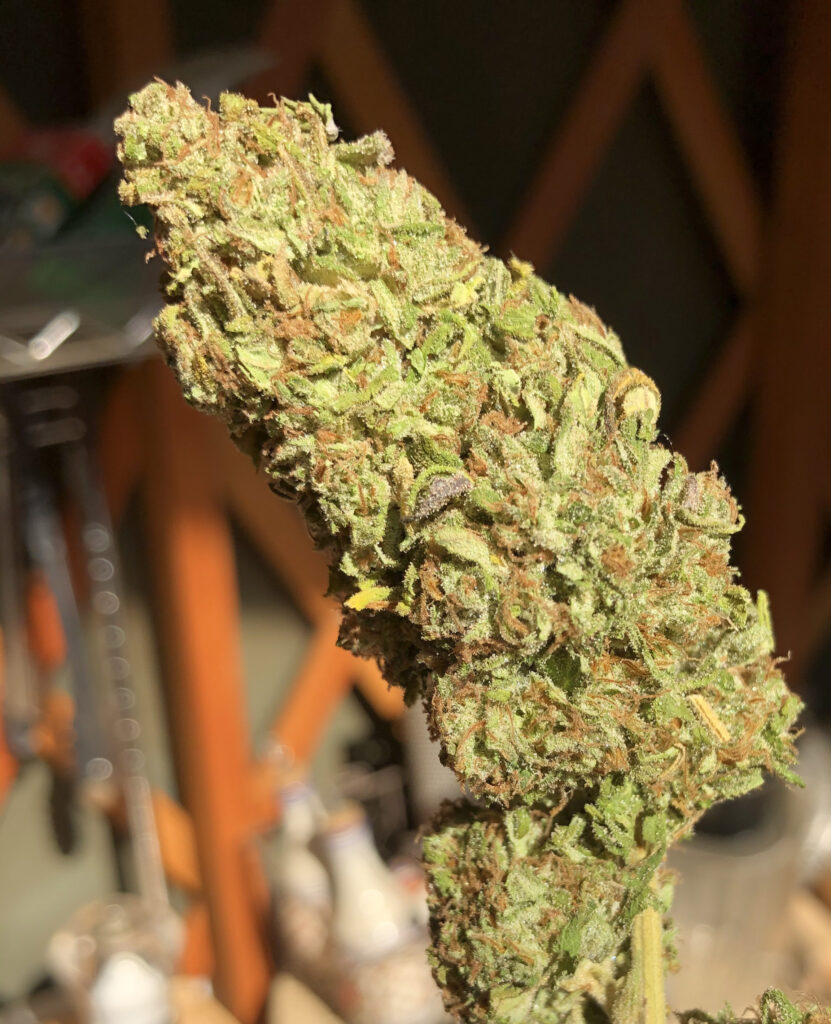
California Cannabis Flower
The oral history of Oliver Bates stands as a unique and valuable piece within the large mosaic of California cannabis—a picture that the OHC and its institutional partners hope to bring into better focus through their research project on legacy cannabis genetics. Supported by a $2.7 million grant from the California Department of Cannabis Control, the multi-institution research team will identify, document, and help preserve the history and diversity of the state’s legacy cannabis genetics and the communities that steward them. In many respects, the project stands as the first of its kind. First, the study will be conducted within a community-based participatory research framework, an approach where community members, organizational representatives, and academic researchers operate in partnership on all aspects of the research process. The community organizations partnered on this study are the Origins Council (OC), a California nonprofit public policy and research institute serving California’s historic rural cannabis farming regions and the Cannabis Equity Policy Council (CEPC), a statewide equity advocacy organization representing the interests of Black, Indigenous, and people of color (BIPOC) in urban communities.
Second, the study is being collaboratively led by a multidisciplinary team of researchers from across the state. The research team includes: Principal Investigator Dr. Dominic Corva, assistant professor of Sociology and program leader of Cannabis Studies at California State Polytechnic University, Humboldt; Co-Principal Investigator Genine Coleman, executive director of Origins Council; Co-Principal Investigator Dr. Rachel Giraudo, associate professor of Anthropology at California State University, Northridge; Co-Principal Investigator Dr. Todd Holmes, historian and associate academic specialist with the Oral History Center of The Bancroft Library, University of California, Berkeley; Co-Principal Investigator Dr. Eleanor Kuntz, co-founder of Canndor, the world’s first cannabis herbarium, and co-founder and CEO of LeafWorks, a genomics and plant science company.
For the Oral History Center, this project will add nearly 100 hours of oral history interviews to the California Cannabis series, making this collection the largest of its kind on cannabis history in the United States. These firsthand accounts will document the history of cultivation communities in the legacy regions of California’s Central and North Coasts as well as urban cultivators in cities such as Los Angeles, San Jose, and Oakland. Moreover, when paired with the other work of the research team—like the genetic sequencing and community herbariums produced by Dr. Kuntz at LeafWorks, and ethnographic fieldwork Dr. Corva at Cal Poly Humboldt—the oral histories will play a critical role in the official documentation of California’s world renown cannabis genetics. We are excited about the future of this project and the impact it will have for the scholars and policymakers of today, and those of tomorrow.
Watch The Short Film
The oral history interviews of Oliver Bates served as the basis for the short film, The Legacy of Big Sur Cannabis. Created and produced by OHC historian Todd Holmes and his partner Heidi Holmes, the film was recently featured in the Cannabis Exhibition at the 2023 California State Fair.
About The Oral History Center
The Oral History Center of The Bancroft Library preserves voices of people from all walks of life, with varying political perspectives, national origins, and ethnic backgrounds. We are committed to open access and our oral histories and interpretive materials are available online at no cost to scholars and the public. You can find our oral histories from the search feature on our home page. Search by name, keyword, and several other criteria. Sign up for our monthly newsletter featuring think pieces, new releases, podcasts, Q&As, and everything oral history. Access the most recent articles from our home page or go straight to our blog home.
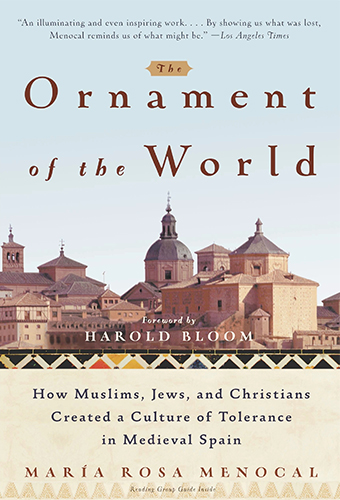
In her history of the vibrant Islamic state that governed Spain during the Dark Ages and its far-reaching cultural influence, Menocal shows us a very different set of rules for worship, war, and art than we typically associate with medieval Europe. The emergence of a society so steeped in learning and religious and linguistic diversity, and the mutual rewriting of rules brought about as it rubbed shoulders with its neighbors, make an eye-opening story.
SAM PIMENTEL Assistant Professor Department of Statistics
Caste: The Origins of Our Discontents Isabel Wilkerson
Caste: The Origins of our Discontent, by Isabel Wilkerson, really opened a new perspective into how I view race, particularly in the United States. It goes beyond the understanding of class and addresses a deeper issue of “caste” that underlies much of how we see race and class in this country.
COLETTE JACKSON Information Systems Analyst Berkeley IT
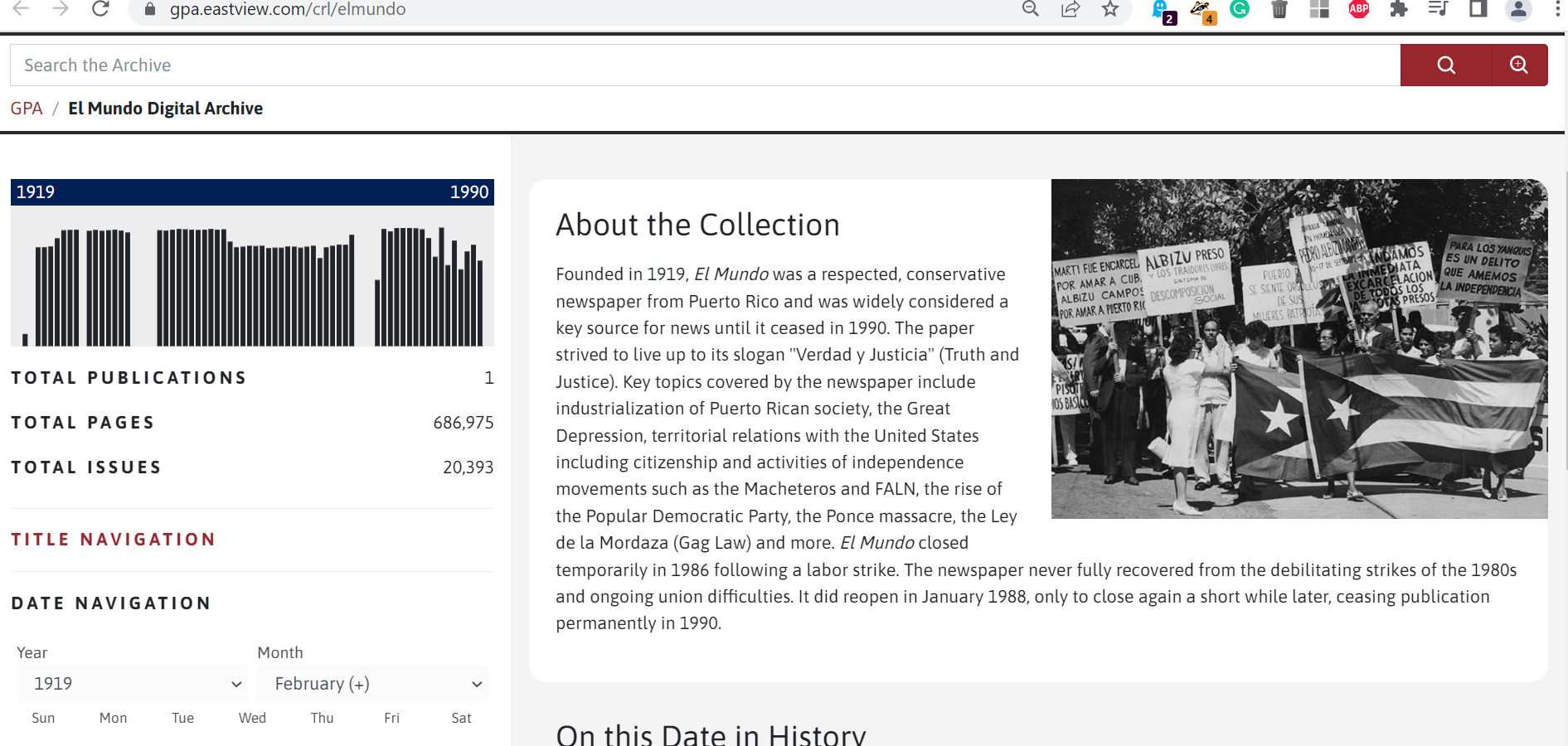
I am glad to report that the Center for Research Libraries, in collaboration with Eastview’s Global Press Archive platform, has released the full text of El Mundo newspaper published in Puerto Rico from 1919-1990.
Established in 1919, El Mundo was a well-respected and conservative newspaper hailing from Puerto Rico, widely acknowledged as a prominent news source until its cessation in 1990. The publication diligently aspired to uphold its motto of “Verdad y Justicia” (Truth and Justice). El Mundo extensively covered a range of significant topics, including the industrialization of Puerto Rican society, the impact of the Great Depression, territorial relations with the United States encompassing citizenship, activities of independence movements such as the Macheteros and FALN, the emergence of the Popular Democratic Party, the Ponce massacre, the enactment of the Ley de la Mordaza (Gag Law), and more. In 1986 El Mundo temporarily closed due to a labor strike, which inflicted lasting damage on the newspaper. Despite reopening in January 1988, the publication faced ongoing union difficulties and ceased operations permanently in 1990.
Spring is a time of year when things begin anew. Flowers bud new petals, days have new length, and college graduates embark on new careers. It’s also a time when we at the Oral History Center celebrate an exciting phase of our narrators’ lives: a new life in our archive, where their story will live on in perpetuity. Not only can a narrator’s loved ones, friends, and colleagues access their interviews for years to come, students, researchers, and scholars can learn something about a time and a place, illuminating an aspect of history they might not have previously considered.
One way the UC Berkeley Oral History Center (OHC) likes to usher in this new phase of a narrator’s life is to have a “graduation” ceremony to honor their participation in the oral history process. Traditionally, we did this in person at the Morrison Library here on UC Berkeley’s campus, but like many things, we’ve had to adjust in the wake of the COVID-19 pandemic. Now, we like to list their names and the projects for which they were interviewed online and in our newsletter so that all those in the OHC’s community can celebrate their contributions with us from near and far.
Please join us in expressing our appreciation for our latest cohort of narrators, spanning from fall 2021 to spring 2023. We are grateful to have their voices in our collection and their stories a new part of the historical record.
We also want to thank the OHC team—Paul Burnett, David Dunham, Roger Eardley-Pryor, Shanna Farrell, Todd Holmes, Jill Schlessinger, and Amanda Tewes—for their work in making these interviews come to fruition, along with the support from our student employees, who are a valuable part of our process: Max Afifi, Mollie Appel-Turner, Hue Bui, Mina Choi, William Cooke, Georgia Cutter, Nikki Do, Adam Hagen, Jordan Harris, Vivien Huerta-Guimont, Ashley Sangyou Kim, Ricky Noel, Deborah Qu, Mela Seyoum, Lauren Sheehan-Clark, Joe Sison, Erin Vinson, Shannon White, Serena Williams, and Timothy Yue.
Bravo, Oral History Center Class of 2023!
Anchor Brewing Co.
Mark Carpenter
Gordon MacDermott
Fritz Maytag
Linda Rowe
Bay Area Women in Politics
Louise Renne
Ruth Rosen
J.J. Wilson
California Business
Fred Martin
California Cannabis
Oliver Bates
California State Archives State Government Oral History Program
Wesley Chesbro
Fran Pavley
Lois Wolk
Bill Lockyer
Chicana/o Studies
Adele de la Torre
Ignacio García
East Bay Regional Park District
Ira Bletz
Ginny Fereira
Neil Havlik
Carol Johnson
Doug McConnell
Ruth Orta
Bethia Stone
Jeff Wilson
Mark Taylor
Mae Torlakson
Tom Torlakson
Will Travis
Nancy Wenninger
Environment/Natural Resources
Mary D. Nichols
Getty Research Institute’s African American Art History Initiative
Video clip from Doris Sloan’s oral history on living in the Bay Area, on deep time, and on thinking like a geologist:
Doris Sloan is a geologist and paleontologist who earned her PhD at UC Berkeley and who taught, wrote, and engaged in environmental activism and education throughout the Bay Area, across California, and beyond. Sloan and I recorded nine hours of her then 92-year life history at her home in Berkeley, California, in May 2022. Our four recording sessions resulted in a 162-page oral history volume that includes an appendix of photographs with family as well as documents from her efforts in the early 1960s to stop PG&E’s construction of a nuclear power plant atop Bodega Head, under which runs the seismic San Andreas fault. Today, the coastal outcrop of Bodega Head is preserved as part of California’s scenic 17-mile-long Sonoma Coast State Park.
Doris Sloan in 1963 as the Sonoma County Coordinator of the Northern California Association to Preserve Bodega Head and Harbor (NCAPBHH).
Sloan’s involvement in the “Battle for Bodega Head” helped inspire her later career as a geologist and teacher—a career she began by returning to graduate school as a mother in her early forties with children still at home. Sloan overcame numerous challenges, including gender discrimination in what were then male dominated departments and academic fields, to earn her MS in Geology in 1975 and her PhD in Paleontology in 1981. Her dissertation was an ecostratigraphic thesis on the sedimentary fossils of tiny creatures that once lived the San Francisco Bay. For many years, Sloan taught research-driven senior seminars in Environmental Science at UC Berkeley as well as geology courses for UC Extension. She lectured on travel excursions and field trips around California and across much of the Earth. Sloan became a board member with Save the Bay and a founding member of Citizens for East Shore Parks. In 2006, she published with UC Press the popular California natural history guide, Geology of the San Francisco Region. In her rich oral history, Sloan discussed all of the above, with details on her formative childhood experiences, her environmental and anti-nuclear activism, her experiences as a female geology graduate student at UC Berkeley, as well as her diverse teaching career.
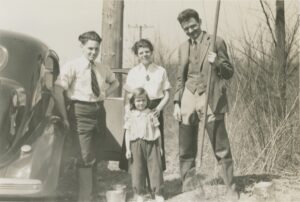
Doris Sloan, age 6 (front center), on a salamander egg collecting trip with father, Viktor Hamburger (right), and two of his graduate students in St. Louis County, Missouri, circa 1936.
Doris Sloan was born in October 1930, in Freiburg, Germany. At age four, she and her family fled Germany after the Nazis removed her father, preeminent embryologist Viktor Hamburger, from the faculty at the University of Freiburg because of his Jewish ancestry. Her family settled in Missouri after her father secured a faculty appointment at Washington University in St. Louis. As a young girl, Sloan accompanied her father and his embryology students on field research trips to collect salamander eggs. She also shared fond memories of youthful summers working in Woods Hole on Cape Cod at the Marine Biological Laboratory. Sloan attended Bryn Mawr College from 1948 to 1951, where she began attending Quaker meetings. Upon her mother’s deteriorating health, Sloan returned to St. Louis and graduated in 1952 from Washington University with a BA in Sociology. In that same year Sloan moved to San Francisco, California, with her then-husband, with whom she had four children. In 1957, she and her young family moved to Sonoma County, where she was neighbors with Peanuts cartoonist Charles Schulz. It was there in Sonoma County where, in the interests of protecting her children from nuclear radiation and preserving the beauty of the Sonoma Coast, that Sloan began her environmental activism that would, among other experiences, inspire her later career as a geologist and teacher.
Video clip from Doris Sloan’s oral history about her role in the “Battle of Bodega Head, Part 1:
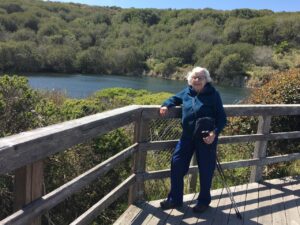
Doris Sloan at the now water-filled “Hole in the Head” on Bodega Head on Mother’s Day in 2022. Photograph by her daughter Christy Sloan.
Sloan detailed her engagements in the multi-year “Battle of Bodega Head” that, in 1964, successfully stopped PG&E’s construction of a nuclear power plant on Bodega Head. After being told by an official from California’s Office of Atomic Energy Development and Radiation Protection to let go of concerns about the forthcoming nuclear plant and “leave it to the experts,” Sloan enlisted in the activist organization called the Northern California Association to Preserve Bodega Head and Harbor (NCAPBHH)—a name others created and she described as “dreamt up on a Friday night after too many beers.” The Association included an eclectic mix of anti-nuclear citizen activists that included communist chicken farmers, libertarian land owners, conservative cattle ranchers, Bodega fisherman, UC Berkeley professors, Sierra Club members, and jazz musicians and songwriters. In her role as Sonoma County Coordinator of NCAPBHH, Sloan also collaborated with an internationally recognized geophysicist and geologist named Pierre Saint-Amand. Fortuitously, on a rainy and wind-swept day, Sloan accompanied Saint-Amand on a clandestine and consequential visit to the “Hole in the Head,” the site on Bodega Head where PG&E had already drilled a deep pit into granite rock to place its nuclear reactor. It was on that visit, while looking into that hole, that Saint-Amand and Sloan discovered evidence of the San Andreas fault running directly through the reactor’s containment site, a discovery that eventually halted further nuclear construction there.
Video clip from Doris Sloan’s oral history about her role in the “Battle of Bodega Head, Part 2:
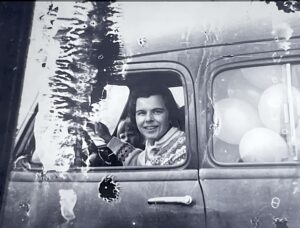
Doris Sloan driving with her children and many helium-filled balloons to a NCAPBHH event at Bodega Head on Memorial Day, 1963. (Original film negative slightly damaged.)
As Sloan recalled about their activist victory in the early 1960s, “to have a group of citizens win out over a major institution was really pretty unique. … Bodega was a very important story at the very beginning of a huge cultural shift for not only environmental matters on nuclear energy, but in so many other ways, too. Basically, citizen involvement at every level, from students to housewives. And to be a part of that, I look back on that and think, wow, how could anybody have been so lucky in so many ways?” The story of this citizen-led anti-nuclear activism has been told elsewhere, including in Oral History Center interviews with David Pesonen and Joel Hedgpeth, as well as by nuclear historians J. Samuel Walker and UC Berkeley alumnus Thomas Wellock. Sloan’s storytelling on her personal role in the “Battle of Bodega Head”—like launching over a thousand helium-filled balloons from Bodega Head to the accompaniment of live jazz playing “Blues Over Bodega”—adds both flourish and important details to the eventual successes of NCAPBHH.
Sloan’s involvement at Bodega Head played a crucial role in launching the next phase of her life as a geologist and teacher. After moving with her children to Berkeley in 1963, Sloan worked for the Friends Committee on Legislation, a Quaker lobbying group. Yet, by the early 1970s, Sloan’s long-standing fascination of nature, a desire to experience more of it, and her memory of discovering fault seams on Bodega Head led her to take UC Extension courses on geology taught high up in the Sierra Nevada’s Emigrant Wilderness by a remarkable UC Berkeley professor named Clyde Wahrhaftig. Wahrhaftig eventually became a significant mentor and friend to Sloan on her academic journey, as were UC Berkeley geologists Garniss Curtis and William B.N. (Bill) Berry. In her oral history, Sloan shares many joys from her field research and academic experiences at Berkeley, including mapping rock formations in California’s Mazourka Canyon, communing with ancient bristlecone pines in the White Mountains, learning about limestone deposition in Florida, a fascinating question about an imaginary dinosaur civilization from Walter Alvarez during her PhD oral examination, and her own work deciphering the sedimentary mysteries of fossils from mud under the San Francisco Bay. Sloan also shared some of the challenges she faced in the late 1970s as one of the few women in Berkeley’s geology and paleontology departments that, by her account, then included more than a few male chauvinistic dinosaurs.
Video clip from Doris Sloan’s oral history about Clyde Wahrhaftig, a UC Berkeley geologist, mentor, and friend:
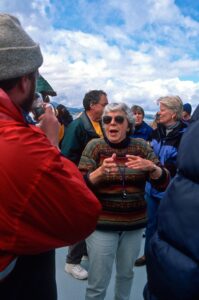
Doris Sloan lecturing during a University of California Museum of Paleontology (UCMP) field trip to the Marin Headlands in 2010. Photograph by John Karachewski.
Sloan’s oral history also explores her ensuing years as a teacher, travel guide, author, and environmental activist. Sloan discussed several senior research seminars in Environmental Studies that she taught at UC Berkeley, some records of which are preserved in UC Berkeley’s Library including East Bay Parklands: Planning and Management (1978), Seismic Safety in Berkeley (1979), San Pablo Bay: An Environmental Perspective (1980), and Hazardous Substances: A Community Perspective (1984). Sloan recorded stories and samples from lectures she delivered in her UC Extension geology courses and in her field classes for numerous organizations, including the Oakland Museum, Sierra Club, the Point Reyes National Seashore Association, and the Yosemite Association. And she shared some of her travel experiences as a guide for Cal Alumni groups on journeys all across the Earth, from the Himalayas to Central Asia, and from South America to Scandinavia. Sloan also spoke about her local environmental activism as a board member of Save The Bay, as a founding member of Citizens for East Shore Parks, and on her friendship with Save The Bay co-founder Sylvia McLaughlin, including efforts to secure what is now named as McLaughlin Eastshore State Park.
Doris Sloan’s enlightening oral history records marvelous stories from the first ninety-two years of her remarkable life—from fleeing Nazi Germany to summers in Woods Hole; from raising children in northern California to stopping construction of a nuclear power plant on the San Andreas fault; from graduate school in her forties at UC Berkeley to lecturing across California and much of the world. I am honored to have become one of Doris’s friends, and I’m lucky for the opportunity to become one of her students. Now, with the publication of Doris Sloan’s oral history, you also have the chance to learn from her deep wisdom and experience.
Video clip from Doris Sloan’s oral history about the Bay Area’s complicated geology:
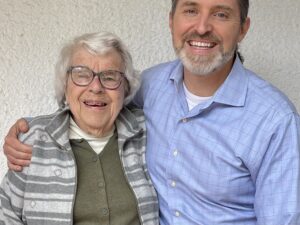
Doris Sloan with oral historian Roger Eardley-Pryor at her home in Berkeley, California, in May 2023.
ABOUT THE ORAL HISTORY CENTER
The Oral History Center of The Bancroft Library preserves voices of people from all walks of life, with varying political perspectives, national origins, and ethnic backgrounds. We are committed to open access and our oral histories and interpretive materials are available online at no cost to scholars and the public. You can find our oral histories from the search feature on our home page. Search by name, keyword, and several other criteria. Sign up for our monthly newsletter featuring think pieces, new releases, podcasts, Q&As, and everything oral history. Access the most recent articles from our home page or go straight to our blog home.
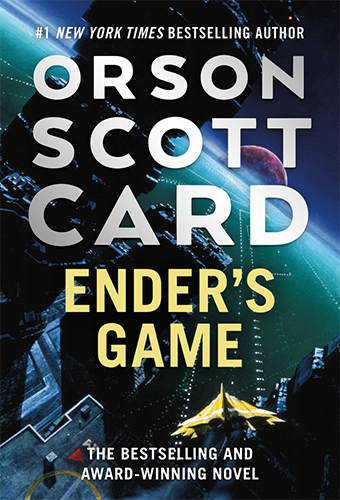
An alien threat leads world leaders to recruit and train child geniuses as military commanders using a series of increasingly complex and morally ambiguous war games. Ender Wiggin’s gradual mastery of each of these games leads him to see beyond the structures imposed by their rules, and confronts readers with challenging questions about the rules of childhood, warfare, and survival.
SAM PIMENTEL Assistant Professor Department of Statistics
A Children’s Bible Lydia Millet
In a not-too-distant future America plagued by climate change and government dysfunction, a divide grows between children and parents living together in a rural commune. The children recognize and adapt to a changing world that their myopic parents cannot fully understand, reshaping familial rules and roles.
SAM PIMENTEL Assistant Professor Department of Statistics
Americanah is a novel that follows the story of Ifemelu, a Nigerian woman who moves to the United States to pursue higher education. Her experiences in America allow her to gain firsthand insight into the complexities of racism and discrimination, prompting her to document her ideas on race and identity in a widely-read blog. However, after spending many years in the U.S., she begins to feel a sense of disconnection and a lack of belonging. This leads her to move back to Nigeria, where she seeks to rediscover her roots and reconnect with her cultural identity.
This novel is an excellent example of (Re)Writing the Rules, as it encourages readers to critically evaluate their views on race, identity, and the biases and prejudices they may have.
IMAAN NADIR Intended Molecular and Cell Biology major Class of 2025
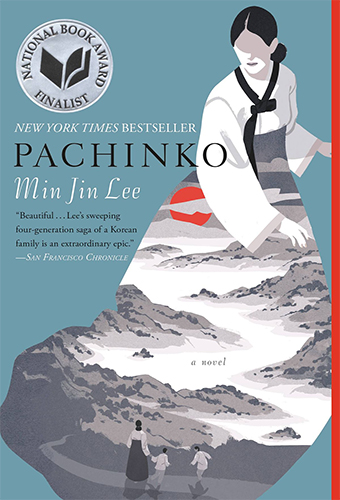
Pachinko Min Jin Lee
Pachinko is a compelling work of fiction that tells the story of a Korean family in Japan from the early 1900s to the 1980s. The novel explores the challenges faced by the family navigating life as Koreans in Japan during a time of political and social unrest. The family’s experiences are shaped by discrimination, poverty, war, and colonialism. Despite these struggles, they draw strength from their community and traditions. This novel fits the theme of (Re)Writing the Rules by exploring narratives of the human experience and challenging stereotypes about minority communities. It is a powerful story that highlights the importance of culture and identity and prompts readers to reflect on their biases and gives them an empathetic and nuanced way of understanding and relating to others.
IMAAN NADIR Intended Molecular and Cell Biology major Class of 2025
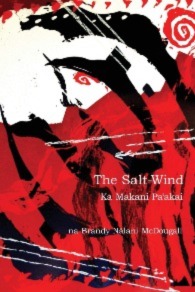
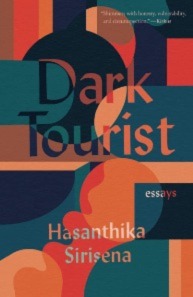
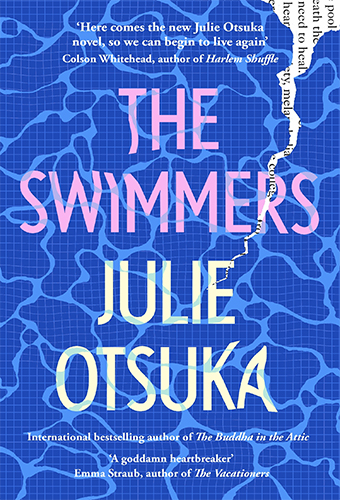
This May, celebrate Asian American and Pacific Islander Heritage Month with our wonderful and diverse collection of works by Asian American and Pacific Islander American authors. Encompassing books penned by Americans with roots from Sri Lanka to India to Hawai’i, with stories of college life, immigrant families, and much more, there are plenty of great novels to pick from. Check out more titles through Overdrive.
The Swimmers by Julie Otsuka rewrites the rules of novel-writing – if such rules exist. Hilarious at times, as the narrator assumes the first-person plural “we” from the POV of a diverse group of lap swimmers at a community pool, and poignantly heartbreaking later, as the voice shifts to the second-person “you” in the form of one of the swimmers’ daughters, a Japanese American novelist. Masterfully crafted, this novel delivers – in a slim 176 pages.
JOHN LEVINE Lecturer College Writing Programs
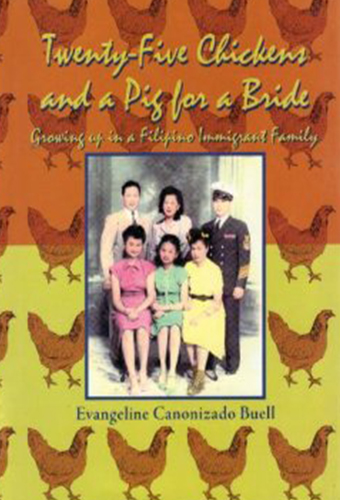
Twenty-Five Chickens and a Pig for a Bride Evangeline Canonizado Buell
In Twenty-Five Chickens and a Pig for a Bride: Growing Up in a Filipino Immigrant Family, Buell recounts her experiences as one of the few Filipino families growing up in West Oakland during the 1930s and ’40s, detailing her and her family’s triumphant struggles over racial and gender discrimination in the Bay Area. This wonderfully written and engaging memoir gives us a firsthand window into Buell’s family life, starting in the early 1920s when her parents immigrated to the United States, into her adult life, two marriages, and numerous achievements, which include helping to co-found the East Bay Chapter of the Filipino American National Historical Society. In addition to the engaging narrative, Buell welcomes us into her story through a series of family photographs.
Buell was recently interviewed on East Bay Yesterday, a great accompaniment to the book, and the Bancroft Library has an oral history with her, which is part of the Rosie the Riveter World War II American Homefront Oral History Project.