David Starkey founded Gunpowder Press in 2013 in Santa Barbara with a focus on California poetry. With the first two volumes, Starkey reached out to Chryss Yost to assist with the books’ layout and cover design. Today, with almost 50 volumes, the Starkey and Yost continue to helm the press. Their beautifully designed output showcases individually authored and compilation anthologies.
For their 30th-year anniversary, the Santa Barbara Independent recognized the press among Santa Barbara’s local heroes [1]. The same year, Starkey and Yost started the Anacapa Review. The review seeks to place established and new poets side-by-side, demonstrating the established and continued vibrancy of Santa Barbara’s literary scene.
Readers can find out more about the press’ titles and readings through their website or Instagram page.
At UC Berkeley
Mary Ann McFadden, Rosa Mundi, California Poets (2026).
[Note: We’ve updated the information below to reflect that as of September 4, 2026, the fund is now available to all UC authors publishing in eligible arts and humanities journals. Previously, the fund was limited to early career authors.]
Are you a researcher in the arts or humanities looking to publish your work open access? UC Libraries Arts & Humanities Open Access Fund can help cover the costs.
What Is the Fund?
The UC Libraries Arts & Humanities Open Access Fund is a program that covers the costs of open access publishing for all UC authors publishing in eligible arts and humanities journals. Funding is provided via the California Digital Library, not campus budgets, and covers the full cost of open access fees for qualifying articles.
Why Does This Matter?
Existing UC-wide open access publishing agreements already cover about 55% of UC publishing activity, but these agreements tend to benefit authors in STEM fields. Arts and humanities scholars may be less likely to have grant funding to pay open access publishing fees out of pocket. This fund is designed to close that gap.
Who Is Eligible?
The fund covers the full costs of the open access publication fees for all UC authors, regardless of career status, who are publishing arts and humanities articles that meet the eligibility requirements. Authors must be the corresponding author on the article and affiliated with one of the participating campuses: Berkeley, Davis, Los Angeles, Irvine, Merced, Riverside, San Diego, Santa Cruz, or San Francisco. Each author may receive funding for one article per calendar year.
Which Journals Qualify?
The fund covers articles published in arts and humanities journals on a pre-approved list of more than 3,600 titles. These are non-profit or society publisher journals not already covered by an existing UC open access agreement. If your target journal is not on the list, there may still be options, and you can contact UCLIB-ARTS-HUMANITIES-OAFUND-L@listserv.ucop.edu to ask.
How Do You Apply?
Simply fill out the online application form. You will receive confirmation that your application was received, and a decision will be made within five business days. You can apply before your article is accepted, but you will need to submit proof of acceptance before receiving reimbursement. Articles must be accepted for publication after November 21, 2025 to be eligible. Articles published prior to this date are not eligible. The pilot program runs until June 30, 2027.
Africa Commons is a collection of archives, streaming media, newspapers, journal articles, and other types of documents and records that is uniquely expansive in both its size and geographical breadth. The UC Berkeley Library has purchased access to the 4-part collection from Coherent Digital, which provides coverage of news and events as well as research publications from the east, west, and south of the African continent. The multidisciplinary nature of this database’s content makes it useful to a wide variety of researchers working on all things African.
Complementing Berkeley’s strong African print holdings, here are three French language journals included in the most recently purchased module – West African Journals:
L’Afrique Littéraire et Artistique (also called L’Afrique Littéraire in some issues) was a French-language literary and cultural magazine published by the Société Africaine d’Édition in Paris. Most issues focused on a specific aspect of African literature, cinema, and art, and include in-depth analysis and commentary on books and films created in or about Africa. This collection includes fifteen issues of the magazine, including a special film edition. Dates range between 1972 and 1989.
La Vie Africaine was a cultural and political magazine published between in France between 1959 and 1965. The publication covered many important events in 1960s Africa, at a time when many countries were gaining independence and working to define themselves anew. It also explored cinema, literature, and music by or about Africans. This collection includes 44 issues of La Vie Africaine, ranging from 1959 to 1965.
L’Afrique Actuelle was a bilingual French/English monthly magazine, and succeeded La Vie Africaine. It covered political, economic, and cultural issues, including independence movements and the relationship of newly formed African governments with European and American states. This collection includes 19 issues of L’Afrique Actuelle, covering the years 1967-1969.
Coherent Digital brings the values of academic publishing to real-world information—organizing, curating, and digitizing—so that information is preserved, trackable, stronger, and more impactful. In collaboration with libraries, archives, NGOs, and subject experts, they ensure that preservation is ethical, representative, and aligned with community needs.
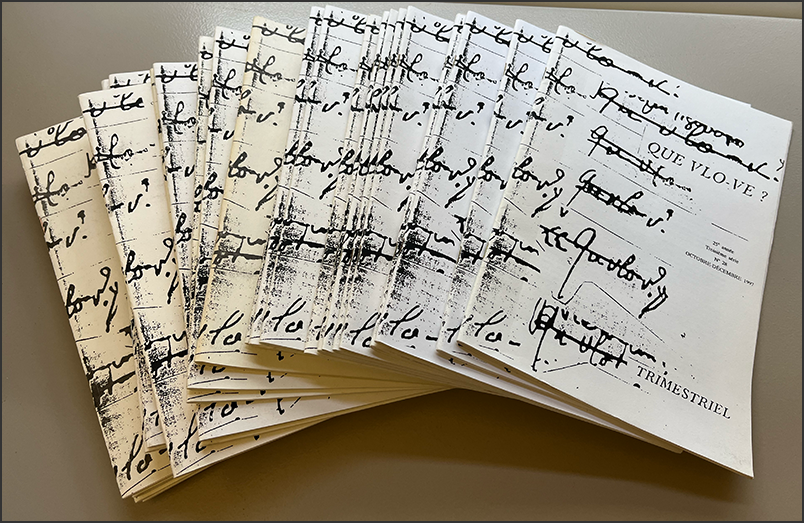
Various issues of the third series of Que vlo-ve ?
In these austere times where both financial resources and shelving space are limited, it has become a rare occasion when we are able to pursue full-runs of older periodicals. However, the recent acquisition of these two—one from France and the other from Belgium—in more or less the same time period has sparked the idea of hosting a hands-on journal presentation for those interested in interacting with the journals before the issues are processed, cataloged, bound, and stored in their distinct library locations.
Que vlo-ve?: bulletin de l’Association internationale des amis de Guillaume Apollinaire was published from January 1973 to 2004. Centered on the work of the celebrated 20th century French poet, playwright, short story writer, novelist and art critic of Polish descent, its intention was not to duplicate articles published in the annual Guillaume Apollinaire series by Lettres Modernes. Instead, it was meant to welcome articles that could not easily find a place, news of the association and of the museum as well as news that members of the scholarly society wished to disseminate internationally.
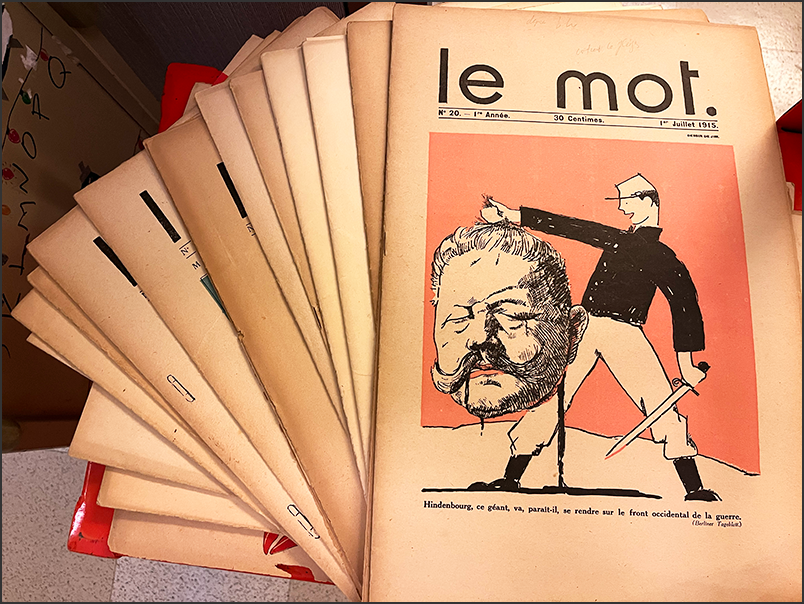
Sardonic and visually rich, this wartime French literary and artistic journal published by Jean Cocteau and Paul Iribe, was characterized by a restrained modernism and a fiercely nationalistic, anti-German perspective. Le Mot (The Word) was a wartime sequel to François Bernouard’s Schéhérazade: Album Mensuel d’Oeuvres Inédites d’Art et de Littérature (1909-11). Its primary purpose was to establish an entirely French artistic style and taste—anti-bourgeois and uninfluenced by German modernism.
Reports of the brutal treatment of noncombatants (such as mass executions that included women, small children, and the elderly) and damage to towns and cultural centers shocked the public, leading to a characterization, particularly within France, of the German soldiers as destructive and uncivilized “huns” particularly within wartime propaganda. The bi-monthly periodical included cover designs by not only Iribe and Cocteau but also Sem, Raoul Dufy, Léon Bakst, André Lhote, Albert Gleizes, and Pierre-Emile Legrain. Cocteau signed his drawings as Jim, the name of his dog. In August 1914, when war was declared with Germany, he was twenty-five years old. Like many patriotic young Frenchmen, Cocteau tried to enlist but was turned down because of his health. Looking for other ways to serve his country and the war effort, he collaborated with Iribe to launch Le Mot. As a teenager, Iribe drew illustrations for the popular caricature journal L’Assiette au Beurre (The Butter Plate), which ran from 1902 to 1912. He also freelanced for Le Témoin, Rire, Sourire and other periodicals and was enthusiastic about starting a satirical journal of his own.
Please join us for an interactive show and tell with special guest Willard Bohn, alumnus of the Department of French and Professor Emeritus of French and Comparative Literature at Illinois State University.
Thursday, February 6 4-5:30 pm 223 Doe Library (accessible through south end of the Heyns Reading Room)
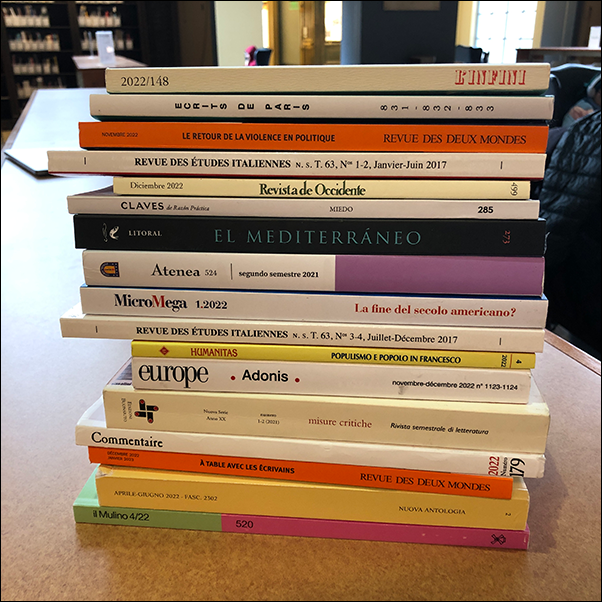
Journals in the Romance languages in Doe Library’s Heyns Reading Room.
You need not fret about L’Infiniti, Écrits de Paris, Revue des deux mondes, Revue des études Italiennes, Revista de occidente, Claves de razón práctica, El Mediterráneo, Atena, MicroMega, Humanitas, Europe, Misure critiche, Commentaire, Nuova antologia, Il Mulino, and many more journals in the Southern European collection. These have evaded cancellation for now in the second year of a two-year planned reduction of UC Berkeley Library’s acquisitions and licensing budget.
This week, the Library has shared with the campus via CALmessages a complete list of proposed serials cancellations for public comment until May 12. For 2023/24, the budget for recurring annual costs such as subscription databases, journal subscriptions, ebook and journal packages will be reduced by $850K. The Arts and Humanities portion of the serials reduction came to about $165,000. Much of this was met through a renegotiation of the price share for a statewide Taylor & Francis journal package that met about $65,000 of our target. The remaining $100,000 came from the subject funds. (For Latin American and Caribbean Studies, please scroll down to the Social Sciences grouping.)
The proposed list of cancellations was developed to minimize the impact on the community by focusing on duplicative subscriptions; journals and databases that are available open access or in other ways; and the most seldomly accessed journals and databases. Together, subject librarians have reviewed all subscriptions and prioritized retaining titles based on strength of need and available alternatives for access. Across disciplines, the total number of titles came to 1,204 which includes large packages. These ranged from very cheap (Annali di statistica @ $9.67/year) to exorbitant (Greenwire for $17,544/year).
These exercises are never easy but have become a regular part of the scholarly resources life cycle as academic libraries continue to endure rapidly declining budgets for an expanding terrain of expensive intellectual materials in both print and digital formats. The last serials reduction was in 2018 in the amount of $1.5M. At the beginning of this year, the Library reduced its discretionary budget (mostly for books) by $850K and two years earlier by $1M.
Including our recent reductions in 2018 and 2020, this year’s serials reduction will bring the total annual reduction in acquisitions and licensing to $4.425 million – an approximately 35% reduction of campus, state, and unrestricted funding for collections since 2016. Without an influx of funding from the campus and the state, the UC Berkeley Library can expect to see another round of budget cuts in the near future.
For the month of April, I will be posting on Instagram nearly every day the cover of a different journal in the Romance languages that we are retaining access to for now in either print or digital form.


 Readers can find out more about the press’ titles and readings through their website or Instagram page.