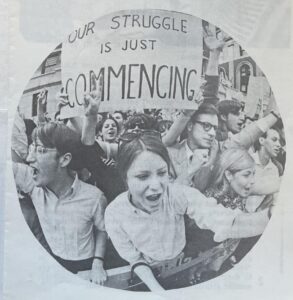
From file, “Student Political Parties” (carton 80)
The Associated Students of the University of California, Berkeley records are now open to researchers at The Bancroft Library. The Associated Students of the University of California, Berkeley (ASUC) is the officially recognized students’ association of the University of California, Berkeley. The ASUC is a 501(c)(3) non-profit, and is the largest and most autonomous students’ association in the nation. Founded in 1887, the ASUC continues to operate separate from University governance. The ASUC controls funding for all ASUC-sponsored clubs and organizations, provides resources and student programming, oversees commercial activities and student services including the Cal Student Store and Lower Sproul Plaza in partnership with the ASUC Student Union, and advocates for students on a University, local, state, and national level.
The collection includes ASUC constitutions, executive office files, Student Advocate’s Office files, senate bills, agendas, and resolutions, committee files, financial and budget materials, planning and renovation files, ASUC program files, and other material documenting student services, groups, and activities from 1893 to 2012.
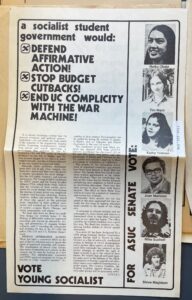
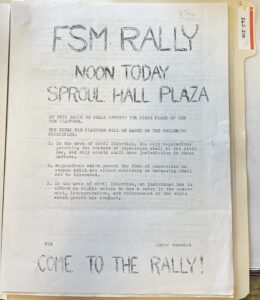
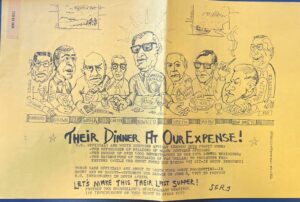
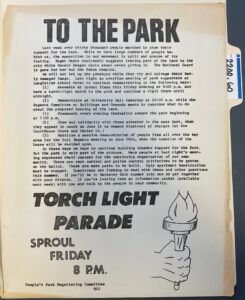
The collection also contains materials documenting student activism on campus, including the Free Speech Movement, People’s Park advocacy, affirmative action, the Third World Liberation Front, divestment in South Africa, and LGBTQ rights.
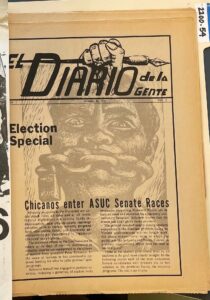
El Diablo de la Gente newspaper, October 20, 1972 (carton 82)Flyer for the Young Socialist candidates running for ASUC Senate (carton 74)
Free Speech Movement rally flyer (carton 39)
Protest flyer against UC investments in South Africa, 1978 (carton 51)People’s Park Negotiating Committee flyer (carton 82)
For more information about the collection, access the finding aid and/or catalog record for the Guide to the Associated Students of the University of California, Berkeley, records (CU-282). Interested in transferring your student records to University Archives? Find out more here.
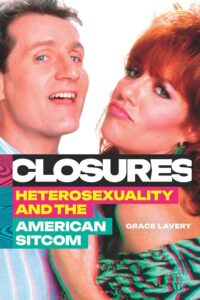
To my delight, I get to announce that Prof. Grace Lavery has a new book titled Closures: Heterosexuality and the American Sitcom (cover figured here).
At UC Berkeley, Lavery teaches courses (course catalog) on topics such as “Literature and Popular Culture” as well as special topics courses and research seminars examining representations of sex, sexuality, and gender.
Lavery’s new book is a phenomenal study looking at the idea of heterosexuality in the U.S. American sitcom. More specifically, the book “reconsiders the seven-decade history of the American sitcom to show how its reliance on crisis and resolution in each episode creates doubts and ambivalence that depicts heterosexuality as constantly on the verge of collapse and reconstitution.”
You can access and download the book online through the UC Library Search.
Researchers can now access the records of the California chapter of the National Organization for the Reform of Marijuana Laws at The Bancroft Library. California NORML is a non-profit “dedicated to protecting and expanding cannabis consumers’ rights.” According to their website, they were founded in 1972 as Amorphia (the Cannabis Cooperative), which organized the effort to repeal laws against adult use, possession, and cultivation of marijuana. In 1974, Amorphia merged with the state chapter of NORML. These days, California NORML lobbies lawmakers, sponsors events, offers consumer, educational and legal advice, and supports scientific research. (For more information, see https://www.canorml.org)
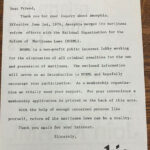
The California NORML records capture the history of marijuana reform nationwide. The bulk of the collection consists of people, organization, subject, and legal files, but there are also administrative records, ephemera, and publications about marijuana. The collection includes mass mailings that document the history of the organization, like this letter from Amorphia:
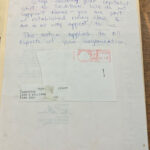
Amorphia merges with California NORML, 1974 (Carton 33)
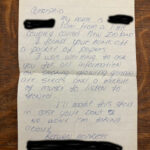
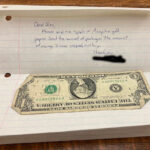
Some letters (circa 1974-1980) show how people worldwide used California NORML as a resource. A writer from New Zealand requests (among other things) “a mixture of music to listen to stoned”; another correspondent asks them to send as many packs of rolling papers as they can get for $1.
Letter from New Zealand (Carton 33)
Letter to CA NORML (Carton 33)
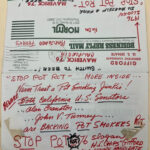
Some of the organization’s mass mailings were returned, with the recipients’ clear criticism of California NORML. One is from Howard L. “Chips” Gifford, a “Maverick” Democrat who challenged – and lost to – incumbent California Senator John V. Tunney in the 1976 primary. Gifford wanted to “Stop Pot Rot.” (Tunney was, in turn, narrowly defeated by Republican S.I. Hayakawa in the general election). Another was returned by the folks at Sedition, a radical free newspaper in San José that “sought to revolutionize the nation.” They critiqued California NORML from the left, as a tool of “the established ruling class.” (https://scholarworks.sjsu.edu/sedition/)
Returned Mail, from U.S. Senate Candidate, c. 1976 (“Unfriendly Mail,” Carton 19)
Returned Mail, from Sedition (“Unfriendly Mail,” arton 19)
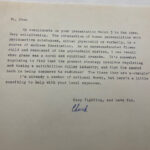
A letter from Chuck, “an unreconstructed flower child and reaminent [sic] of the psychedelic sixties,” circa 1978-1979, on the other hand, was complimentary, but also anticipates the changes legalization of marijuana will bring, and the development of the Marijuana Industrial Complex. Chuck writes, “I can recall when grass was a moral and spiritual crusade. It’s somewhat surprising to find that the present strategy involves regulating and taxing a multibillion [sic] dollar industry.”
Letter from Chuck (Carton 20)
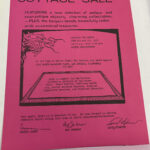
The subject files in the California NORML records track legislation in all of California’s counties and in all 50 states. They also document issues that were central to the organization in the 1970s and 1980s, from medical and therapeutic uses of cannabis, to correcting misinformation about marijuana, to the war on drugs, to the dangers of herbicides, such as paraquat. These files also help put the fight for marijuana reform in the context of other struggles for change. They also suggest an interest in coalition building with – or at least support of – other political activists, from the White Panthers, an anti-racist political collective, to COYOTE (Call Off Your Tired Old Ethics), a sex workers’ rights organization. The folder titled “Gay Coalition,” for example, contains a flyer for a sale in Los Angeles “to support the Gay/Lesbian liberation projects of our household.” The members of “our household” included Morris Kight, who co-founded the LA chapter of the Gay Liberation Front and who helped lead a campaign against Dow Chemical and the use of napalm in Vietnam. (https://oac.cdlib.org/findaid/ark:/13030/kt6w1040bj/)
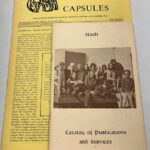
The California NORML records also include materials from other organizations and ephemera from their own events. These include publications from the Student Association for the Study of Hallucinogens (STASH), and a poster from the “First Right-to-Harvest Festival, “A Day on the Grass,” [1978]. The festival featured Margo St. James from COYOTE and medical marijuana activist Dennis Peron. (STASH formed to provide unbiased information on drugs and drug use by students at Beloit College in Wisconsin in 1968. They moved to Madison in 1974 and disbanded in 1980: https://search.library.wisc.edu/catalog/9911124865502121)
Cottage Sale to Support Gay/Lesbian Liberation (“Gay Coalition,” Carton 18)
STASH (Student Association for the Study of Hallucinogens), c. 1971-1973 (Carton 22)
“A Day on the Grass” (Oversize Folder 1)
For more information about the collection, access the finding aid and catalog record for the California NORML records (BANC MSS 2009/122) here:
It’s an election year. If you haven’t registered to vote yet, there’s still time! In California, you need to be registered at least 15 days before Election Day (this year that’s Tuesday, November 5). You can click on the link to the right to register.
As a quick reminder, there are two criteria to register. First (legal status), you must be a United States citizen and a resident of California. Second (age), you must be 18 years old or older on Election Day. You do not need a California state identification to register.
Once you register, you will be able to either vote by mailor at the polls on election day. Click on the link to the right to find out more information or to watch a video about how the process works.
If you aren’t from this state, be aware that California residents vote on multiple propositions alongside United States president. You can request an Official Voter Information Guide from the State which will contain a short blurb with pros/cons on each item for consideration. You can also choose to take a look at what will (probably) be on the ballot on Ballotpedia. Those propositions will include things like Mental Health Services; the right to marry; involuntary servitude; and more.
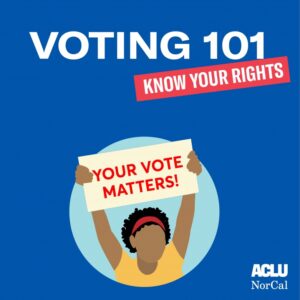
If you’re wanting to learn more about voting as a right, consider looking at this ACLU Voting 101 Toolkit:
Find the Voting 101 Toolkit on the ACLU’s website (click on image).
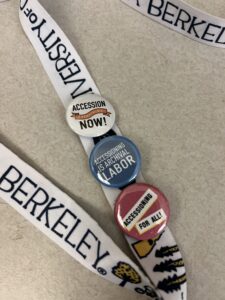
Lanyard with buttons created at the Accessioning Best Practices Symposium at the SAA Annual Meeting, 2024
The Society of American Archivists Annual General Meeting took place in Chicago between August 14th and August 17th. For many of the archivists at The Bancroft Library, this was the first in-person SAA meeting we have attended in years and we had lots to do, talk about, and even celebrate.
Most notably, Bancroft Accessioning Archivist Jaime Henderson helped put on a day-long symposium introducing a new archival standard: the Archival Accessioning Best Practices. The product of a few years of hard remote and in-person work by the Archival Accessioning Best Practices Working Group (of which Jaime is a member), these best practices are the first of their kind. The efforts of the Working Group were made possible by generous funding from the Institute of Museum and Library Services. Archivists all over the country are excited to see dedicated best practices that center archival accessioning as a key component in ethical archival practice and management.
The Archival Accessioning Best Practices were recently submitted to the Society of American Archivists’ Standards Committee (currently chaired by yours truly) for approval as an official SAA standard and will be published as a GitBook document soon.
The Archival Accessioning Best Practices Working Group was also honored with an SAA Council Exemplary Service Award at the annual business meeting this past Saturday. We all congratulate Jaime and her colleagues for this well-deserved honor.
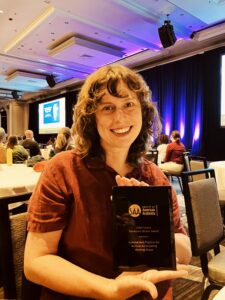
Bancroft Library Accessioning Archivist Jaime Henderson with SAA Council Exemplary Service Award, August 17, 2024.
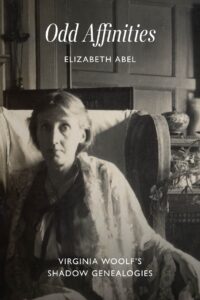
Mrs. Dalloway’s Literary and Garden Arts (website) got there first, nonetheless I’m thrilled to share the news that Prof. Elizabeth Abel released Odd Affinities : Virginia Woolf’s Shadow Genealogies with the University of Chicago Press this year.
Abel’s Odd Affinities (2024).
Prof. Abel (faculty page) teaches with the UC Berkeley English Department. They teach courses on Woolf and the Bloomsbury Group as well as broader overviews of 19th and 20th century English literatures. This fall, they are leading courses “Memoir and Memory” as well as on graduate readings and special study.
In Odd Affinities, Prof. Abel discusses Woolf’s influence beyond a female tradition, looking at echoes of Woolf work in four major writers from diverse cultural contexts: Nella Larsen, James Baldwin, Roland Barthes, and W. G. Sebald. Looking at those “odd affinities,” Abel looks at how “Woolf’s career and the transnational modernist genealogy was constituted by her elusive and shifting presence.”
You can access Abel’s book through the UC Library Search, where you can access it online and download the fulltext.
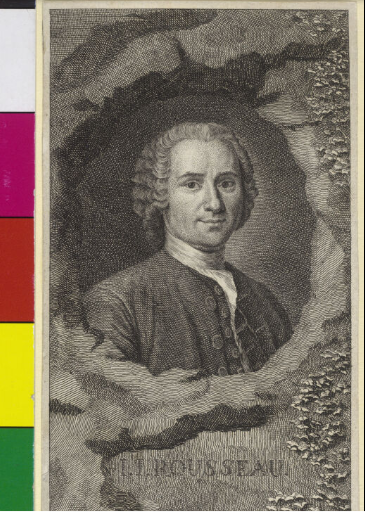
Image: Jean-Jacques Rousseau, 1712-1778. Austrian National Library
In partnership with the Voltaire Foundation, the Correspondance complète de Rousseau ONLINE makes Ralph Leigh’s critical edition in 52 volumes in the original French-language available as an ebook collection for the first time. The digital corpus gathers together all 8,000 letters written to and by one of the most important figures of eighteenth-century intellectual history, as well as the correspondence between third parties relating to the writer and his time. Drafts and copies have been collated against the original manuscripts and all variants reproduced. The extensive annotations identify individuals, events and places, explain the linguistic usages of the eighteenth century, give bibliographical information and clarify obscure allusions.
In the ever-evolving landscape of digital access to scholarly research, libraries face new challenges as they navigate the intersection of copyright law and contractual agreements. Academic institutions increasingly rely on digital content, and understanding how copyright exceptions and contract law interact is crucial for protecting the rights of libraries and our users.
Tim Vollmer (Scholarly Communication & Copyright Librarian, UC Berkeley), Sara Benson (Copyright Librarian and Associate Professor, University of Illinois-Urbana Champaign), Jonathan Band (copyright attorney and counsel to the Library Copyright Alliance), and Jim Neal (University Librarian Emeritus, Columbia University) presented on these issues at the 2024 American Library Association Annual Conference in San Diego. Our panel was titled When Copyright and Contracts Collide: Advocacy for Library and User Rights.
The Role of Copyright Exceptions
Sara set the stage for our discussion by describing the importance of limitations and exceptions to copyright that empower libraries, research, and teaching. For example, Section 108 of the U.S. Copyright Act allows libraries and archives to make limited copies of copyrighted materials for preservation, replacement, fulfilling interlibrary loan requests, and more. Fair use—Section 107 of the Act—permits limited use of copyrighted works without having to seek the copyright holder’s permission when the use is for purposes such as teaching, research, scholarship, reporting, criticism, or parody. Faculty, students, and academic authors leverage fair use when they incorporate copyrighted materials for teaching, research, and publishing. And the fair use exception has played an increasingly important role in facilitating new types of scholarly research, including text and data mining.
The Threat of Contractual Override
Despite these protections, contractual agreements can sometimes override copyright exceptions. Vendor licensing terms may include clauses that restrict activities such as text and data mining. And even though fair use is a statutory right (meaning it’s in the law) in the U.S., and even though there have been court cases that confirm that activities such as text data mining falls under fair use, there is no protection against the practice where private parties such as academic publishers “contract around” fair use for actions that already are lawful.
As a result, academic libraries are forced to negotiate and often pay significant sums each year to try to preserve fair use rights for campus scholars through the database and electronic content license agreements that they sign.
Jonathan discussed alternative international approaches to the problem of contractual override. The European Union, for example, has implemented directives that nullify contract terms which override specific copyright exceptions. Countries like Australia, New Zealand, and Norway have also adopted similar measures. However, the United States and Canada lack comprehensive contract override prevention laws, making it challenging to protect copyright exceptions at the national level.
Advocating for Fair Contracts in Library Licensing
Tim discussed how academic libraries are demanding license agreements that preserve fair use rights. But at the same time, libraries are already starting to see contract amendments put forth by scholarly publishers that attempt to impose outright bans on any use of artificial intelligence (AI) tools for the content we’re licensing from them. The challenge is that we know that researchers are using library-licensed materials for many AI uses in the context of nonprofit scholarship and research, and these uses should be a fair use, just as it’s fair use for researchers to conduct text data mining on licensed resources.
Library workers can smartly negotiate to protect the rights of instructors, students, and other academic community members to use library-licensed resources in the ways they need to conduct their teaching and research while simultaneously taking into consideration the concerns of publishers.
Moving Forward: A Coordinated Approach
To address the issue of contractual override, Jim suggested several approaches, including educating library stakeholders such as administrators and faculty, building constructive relationships with publishers, monitoring international developments, and pursuing legislative change to protect copyright exceptions.
The University of California Libraries are already collaborating on this and related issues with our colleagues. After outreach to several library and faculty committees, the UC’s Academic Senate sent a letter to UC President Michael Drake to advocate that the UC Libraries need to be able to negotiate to preserve fair use rights when licensing electronic resources—including the rights to conduct computational research and utilize AI tools in academic studies and scholarship. President Drake and UC System Provost and Executive Vice President for Academic Affairs Katherine S. Newman affirmed this commitment.
Please reach out to schol-comm@berkeley.edu with any questions. For more information, please see the links below.
The archivists of the Bancroft Library are pleased to announce that in the last quarter (April-June 2024) we opened the following Bancroft archival collections to researchers:

 To my delight, I get to announce that Prof. Grace Lavery has a new book titled Closures: Heterosexuality and the American Sitcom (cover figured here).

![Poster for "A Day on the Grass" listing bands, speakers. Trees and [marijuana buds] are in the background](https://update.lib.berkeley.edu/wp-content/uploads/2024/07/Poster_Large-150x150.jpg)