For over 150 years, residents and visitors alike have not run short of reasons to support the claim, “There’s no place like California.” And since the 1960s, that claim has been echoed—albeit in whispers—among cannabis circles around the globe. This summer, Oral History Center historian Todd Holmes has been traveling up and down the state to document the overlooked history of California cannabis communities as part of the multidisciplinary project, Legacy Cannabis Genetics: People and their Plants, A Community-Driven Study. Funded in 2023 by a $2.7 million grant from the California Department of Cannabis Control, the project is now in its final year charting the history and genetic heritage of the state’s famed cannabis communities.
LCG Research Team at community engagement meeting in Mendocino County. (Left to Right): Hannah Nelson (Origins Council); Genine Coleman (Origin Council); Todd Holmes (UC Berkeley Oral History Center); Dominic Corva (Cal Poly Humboldt); Kerin Law (LeafWorks and Canndor Herbarium); Caleb Chen (Research Assistant, Cal Poly Humboldt); Yaw Reinier (Research Assistant, Cal Poly Humboldt)
In many respects, the study can be seen as one of the first of its kind. The research team is composed of academic and community researchers from across the state: sociologist Dominic Corva from Cal Poly Humboldt; historian Todd Holmes from UC Berkeley’s Oral History Center; Genine Coleman from Origins Council, a nonprofit public policy and research institute serving the state’s historic rural cannabis farming regions; Khalil Ferguson of United CORE, a statewide equity advocacy organization representing the interests of Black, Indigenous, and people of color (BIPOC) in urban communities; and Eleanor Kuntz, co-founder of Canndor the world’s first cannabis herbarium, and co-founder and CEO of LeafWorks, a genomics and plant science company. Moreover, the project operates through Community-Based Participatory Research (CBPR), a methodology premised on a partnership approach to research that equitably involves community members, organizational representatives, and academic researchers in all aspects of the research process. “CBPR is an approach that not only affords community members an equal seat at the table,” Holmes explained, “but more importantly recognizes them as the real experts in this field.” Typically used in public health research, the CBPR approach of the project represents the first time the methodology has been used in cannabis research.
Cannabis Farm in Nevada County, California, getting ready for harvest.
For the oral history component of the project, Holmes is conducting around 100 hours of oral history interviews with cannabis farmers and breeders throughout the state. When complete, the oral histories will comprise the California Cannabis Oral History Collection at the Bancroft Library, another first-of-its-kind component of the project. “For most of the communities in this project, this is the first time they have told their stories,” Holmes explained. “It’s a powerful reminder of the importance of oral history and a real honor to help place California cannabis within the historical record.”
Be on the lookout for the release of the California Cannabis Oral History Collection in the fall of 2026. For more on the project, visit the Legacy Cannabis Genetics website.
Dr. Harold Palmer Smith, Jr., was a scientist, consultant, and defense policy expert who earned tenure at UC Berkeley’s Department of Nuclear Engineering in 1966, chaired the UC Davis Department of Applied Science at Lawrence Livermore National Laboratory in the early 1970s at the request of Edward Teller, and served the United States government and military in various roles throughout his life, including in the 1990s as Assistant Secretary of Defense for Nuclear, Chemical, and Biological Defense Programs. In that role for the US Department of Defense, Dr. Smith oversaw the security, safety, reliability, and treaty adherence of weapons of mass destruction for the United States and NATO arsenals. And, at the end of the Cold War, Dr. Smith implemented the historic Nunn-Lugar Cooperative Threat Reduction (CTR) program to dismantle the nuclear, chemical, and biological arsenals of the former Soviet Union in accordance with the strategic arms limitation treaties then in effect.
From left to right: Vladimir Putin, then mayor of St. Petersburg; Mikhail Kasyanov, then deputy Minister of Finance; Harold Palmer Smith, Jr.; and Russian-English interpreter Irene Nehonov in St. Petersburg, Russia, in 1994.
From June to August of 2023, Dr. Smith and I recorded fourteen-hours of his full-life oral history over seven interview sessions at The Bancroft Library, which resulted in his 304-page transcript, including a small appendix of photographs from his life and career.
I’m sad to report that Dr. Smith passed away in early August 2025, a few months shy of his ninetieth birthday. You can read Dr. Smith’s obituary, as shared by UC Berkeley’s Institute of Governmental Studies. Upon Dr. Smith’s retirement from his remarkable career of teaching, research, public service, and private consulting, he became a Distinguished Scholar in Residence at Berkeley’s Institute of Governmental Studies, where he created the Harold Smith Seminar Series on Defense Policy for public lectures on subjects related to national security.
Below is a brief summary of what Dr. Smith and I explored in his oral history, followed by several video clips from his recorded interview sessions. For greater detail on the diversity of topics discussed during each hour of Dr. Smith’s 14-hour-long oral history, please consult the discursive Table of Contents in the frontmatter to his published transcript.
Left to right: Russian General Evgenii Petrovich Maslin, Russian-English interpreter Irene Nehonov, Justice Stephen Breyer, and Harold Palmer Smith, Jr., in the US Supreme Court chambers in 1996. Dr. Smith discusses this meeting the video below.
Harold Palmer Smith, Jr., was born in November 1935 in Greensburg, Pennsylvania. He earned a B.S. degree in 1957 from the Massachusetts Institute of Technology (MIT), where he met his wife, Marian Bamford. They married in 1958 and have three children born between 1959 and 1963. Smith completed his Ph.D. thesis on nuclear powered rocketry at MIT in 1960, the same year he joined the faculty in Nuclear Engineering at UC Berkeley. After service in 1961 as an active-duty ROTC officer in the Ballistics Research Laboratory at the Aberdeen Proving Grounds, Smith returned to UC Berkeley where he conducted research on fissioning gas, Xenon poisoning, and nuclear sputtering to earn tenure in 1966. After a White House Fellowship under the direction of the Secretary of Defense Robert McNamara from 1966 to 1967, Smith regularly advised the US government on defense-related science and policy. From 1969 to 1975, Smith served as Chairman of UC Davis’s Department of Applied Science located adjacent to the Lawrence Livermore National Laboratory.
Harold Palmer Smith, Jr., with his longtime friend, hiking buddy, and former US Secretary of Defense William Perry in the Great Hall of the Ahwahnee Hotel at Yosemite National Park in 2007.
Upon retiring from the University of California in 1976, Smith worked through his Palmer Smith Corporation as a private defense industry consultant and government advisor. From 1993 to 1998, Smith accepted an appointment with the Clinton administration as Assistant Secretary of Defense for Nuclear, Chemical and Biological Defense Programs with responsibilities for the reliability, security, safety, and treaty adherence of weapons of mass destruction for the United States and NATO arsenals. He was responsible for implementation of the Cooperative Threat Reduction (Nunn Lugar) program and worked with former-Soviet officials to dismantle their weapons of mass destruction and convert related industries to commercial production. Smith then returned to UC Berkeley as a Distinguished Scholar in Residence with the Institute for Governmental Studies and organized the Harold Smith Seminar Series on Defense and National Security. He is a Fellow of the American Physical Society, a Commander in the Legion of Honor of France, and thrice received the Distinguished Public Service Award, the highest honor granted by the Department of Defense for civilian service. In this oral history, Smith discusses all of the above with details on his careers in academia, private consulting, and especially his government service in the Department of Defense.
Harold Palmer Smith, Jr. on teaching nuclear engineering at UC Berkeley, early 1960s
Harold Palmer Smith, Jr. shares his Edward Teller memories, 1970s
Harold Palmer Smith, Jr. on reducing weapons of mass destruction in the Nunn-Lugar Cooperative Threat Program, 1990s
Harold Palmer Smith, Jr. on NATO’s “slow pig” or Senior-Level Weapon Protection Group (SLWPG), 1990s
Harold Palmer Smith, Jr. on Russian General Evgeny Petrovich Maslin and the Nunn-Lugar Cooperative Threat Program, 1990s
The Oral History Center of The Bancroft Library preserves voices of people from all walks of life, with varying political perspectives, national origins, and ethnic backgrounds. We are committed to open access and our oral histories and interpretive materials are available online at no cost to scholars and the public. You can find our oral histories from the search feature on our home page. Sign up for our newsletter featuring think pieces, new releases, podcasts, Q&As, and everything oral history. Access the most recent articles from our home page or go straight to our blog home.
Please consider making a tax-deductible donation to the Oral History Center if you’d like to see more work like this conducted and made freely available online. As a soft-money research unit of The Bancroft Library, the Oral History Center must raise outside funding to cover its operational costs for conducting, processing, and preserving its oral history work, including the salaries of its interviewers and staff, which are not covered by the university. You can give online, or contact us at ohc@berkeley.edu for more information about our funding needs for present and future projects.
Three new and substantial Sierra Club Oral History Project interviews became available to the public earlier this year: Lawrence D. Downing (recorded in 2019), Debbie Sease (recorded in 2020), and Vivien Li (recorded in 2021). See further below for details about their unique oral history interviews.
Now over fifty-years old, the Sierra Club Oral History Project is a partnership between the Sierra Club—one of the oldest and most influential environmental organizations in the United States—and the Oral History Center of The Bancroft Library at UC Berkeley—one of the nation’s oldest organizations professionally recording and preserving oral history interviews. The Sierra Club Oral History Project documents the leadership, programs, strategies, and ideals of the national Sierra Club as well as the Club’s grassroots at regional and chapter levels from the early twentieth century through the present. These oral history interviews highlight the breadth, depth, and significance of the Sierra Club’s eclectic environmental efforts—from wilderness preservation to promoting environmental justice; from outdoor adventures to climate change activism; from environmental education to chemical regulation; from litigation to lobbying; from California to the Carolinas, and from Alaska to international realms. The Sierra Club Oral History Project arose around 1970 and has moved through cycles of intensity and lull due to the availability of funding for recording and publishing new interviews. Throughout, the Sierra Club Oral History Project has produced an unprecedented testimony of engagement in and on behalf of the environment as experienced by individual members and leaders of the Sierra Club. Together with the sizable archive of Sierra Club papers and photographs in The Bancroft Library, the Sierra Club Oral History Project offers an extraordinary lens on the evolution of environmental issues and activism over the past century, as well as the motivations, conflicts, and triumphs of individuals who helped direct that evolution—as told in their own words.
Lawrence D. Downing, Sierra Club President, 1986 to 1988.
Lawrence D. Downing is a Minnesota lawyer who, from 1983 to 1996, served nine years on the Sierra Club board of directors, including as Club president from 1986 to 1988. From 1986 to 1995, he was a Sierra Club Foundation Trustee, including as president from 1990 to 1992. Downing was born in August 1936, in McPherson, Kansas. In 1958, he earned his Bachelor of Science in Chemistry from Iowa State University, and then worked for the Proctor & Gamble Company in Cincinnati, Ohio, where he helped invent the liquid cleaner “Mr. Clean.” He earned his Juris Doctor in 1962 from the University of Minnesota Law School, where he edited the Minnesota Law Review. From 1962 until his retirement in 2010, Downing practiced matrimonial law in Rochester, Minnesota. After joining the Sierra Club by mail in 1969, Downing held leadership positions at every level: as founder and chair of his local Wasioja Group in the North Star Chapter; as chair of the North Star Chapter; as an executive in the National Sierra Club Council; as chair of numerous national committees; as a Sierra Club Foundation Trustee, including a term as president; and as an elected member to the national Sierra Club board of directors for nine years between 1983 and 1996, including his terms as Club president from 1986 to 1988. As a national leader, Downing earned the nickname “Mr. Grassroots” for advocating training and support for Sierra Club volunteers. Downing also forged international connections with the John Muir Trust and the Royal Scottish Geographical Society to help return to Scotland the preservationist legacy of Sierra Club founder John Muir, who was born in Scotland. Downing received the Centennial Campaign Award for his work in the late 1980s and early 1990s as Chair of the Planning Committee for the Sierra Club’s $110 million Centennial Capital Campaign. He also received the Sierra Club’s award for continued service by a past director of the Club. In 2003 and 2004, Downing played a fundamental role in the “Groundswell Sierrans” movement to prevent an elected take-over of the Sierra Club board of directors by a coalition of immigration opponents, white supremacists, and animal rights organizations who disguised their campaign in rhetoric against overpopulation. Downing also served on the board of the Minnesota Center for Environmental Advocacy, the largest non-profit environmental law firm in Minnesota. In this interview, Downing details all of the above and comments on the evolution of both volunteer and staff leadership of the Sierra Club, including several conflicts within and between volunteer and staff leadership.
Debbie Sease at the Sierra Club’s office in Washington, DC, early 1980s.
Debbie Sease worked from 1981 to 2020 as a Sierra Club lobbyist in its Washington, DC, office, where she became Legislative Director as well as National Campaign Director. Sease was born in November 1948 in Oklahoma, where she contracted polio at age three. Each year throughout her childhood, Sease spent several months in a Texas hospital receiving surgeries to repair damaged leg tissue. At age 10, Sease’s family moved to Las Cruces, New Mexico, where her mother died six years later from cancer. Upon graduating high school in 1967, Sease took architecture and photography courses at the University of New Mexico in Albuquerque. Sease soon became active in the New Mexico Wilderness Committee, where she met her first husband Dave Foreman. Conservationist Celia Hunter offered Sease and Foreman jobs as lobbyists for the Wilderness Society in Washington, DC, where they moved in 1978. Upon arriving, Sease dedicated her career to preserving public lands, initially on Bureau of Land Management wilderness reviews, and to advocating for environmental policies. In 1981, Sease began working for the Sierra Club, from which she retired in 2020. Her career in Washington, DC, spanned from the end of the environmental decade in the 1970s, through seven US Presidential administrations and numerous shifts in Congress, up through the end of the Trump administration in 2020. Upon her retirement, Sease and her husband Russ Shay split their time between their home on Capitol Hill and their cabin on twelve acres in the Shenandoah Valley. In this oral history, Sease recounts all the above with a focus on her nearly four decades as a Sierra Club lobbyist in Washington, DC, including details on particular campaigns and specific wilderness lands she helped protect, as well as her reflections and hard-earned wisdom on successful legislative campaigning. Throughout, Sease discusses ways the Sierra Club has evolved throughout her career, as well as the ways environmental politics have changed over time, especially in the nation’s capital.
Vivien Li became the first person of color elected to the Sierra Club Board of Directors from 1986 to 1992, chaired the Club’s newly established Ethnic and Cultural Diversity Task Force from 1990 to 1994, and lead The Boston Harbor Association from 1991 to 2015 as an advocate for a clean, alive, accessible, and climate resilient waterfront. Li was born in New York City in February 1954 as the first of five children to parents who emigrated from China. Li’s family moved to suburbs near Ridgewood, New Jersey, where, as a rising high school senior, she began her environmental activism shortly after the first Earth Day in 1970. While attending college from 1971 to 1975, Li worked part time as an environmental planner in the administration of Newark Mayor Kenneth A. Gibson. After receiving a bachelor’s degree in environmental management from Barnard College at Columbia University and working for the City of Newark, New Jersey, Li became a community fellow in MIT’s Department of Urban Studies and Planning from 1976 to 1977. Li was conference coordinator for City Care, a national conference on the urban environment held in 1979 in Detroit, Michigan, which brought together 700 environmental and civil rights activists associated with conference sponsors the Sierra Club, National Urban League, and the Urban Environmental Conference and Foundation. Li served as the Sierra Club’s New Jersey Chapter Chair and Regional Conservation Committee Chair prior to her election to the Club’s Board of Directors. In 1983, she earned a Master’s of Public Administration and Urban and Regional Planning from Princeton University, a year before marrying Bob Holland, with whom she has two children. In the 1980s, Li worked for the Massachusetts Public Health Commissioner and as senior staff to Massachusetts Governor Michael Dukakis. Li received the Sierra Club’s Walter Starr Award in 2015 and has continued her Sierra Club involvement on the Club’s Finance and Risk Management Committee and its Investment Advisory Committee. Li’s oral history discusses all the above, with emphasis on her environmental and Sierra Club activism from the early 1970s through the early twenty-first century, particularly on issues of environmental justice and on renewal of urban waterfronts, including in Boston, Massachusetts, and Pittsburgh, Pennsylvania.
ABOUT THE ORAL HISTORY CENTER
The Oral History Center of The Bancroft Library preserves voices of people from all walks of life, with varying political perspectives, national origins, and ethnic backgrounds. We are committed to open access and our oral histories and interpretive materials are available online at no cost to scholars and the public. You can find our oral histories from the search feature on our home page. Search by name, keyword, and several other criteria. Sign up for our monthly newsletter featuring think pieces, new releases, podcasts, Q&As, and everything oral history. Access the most recent articles from our home page or go straight to our blog home.
Please consider making a tax-deductible donation to the Oral History Center if you’d like to see more work like this conducted and made freely available online. As a soft-money research unit of The Bancroft Library, the Oral History Center must raise outside funding to cover its operational costs for conducting, processing, and preserving its oral history work, including the salaries of its interviewers and staff, which are not covered by the university. You can give online, or contact us at ohc@berkeley.edu for more information about our funding needs for present and future projects.
In 1870, the Regents of the University of California system voted to admit women on the same basis as men. Since then, female members of the faculty, staff, and student body have been inextricable from the University of California’s achievements and legacy. This Women’s History Month, the Oral History Center of The Bancroft Library would like to highlight interviews from female faculty members who achieved historic “firsts” at the University of California, Berkeley. The four Professors featured in this blog post were interviewed as a part of the Oral History Center’s Education and University of California, African American Faculty and Senior Administrators at Berkeley, and Women Political Leaders projects.
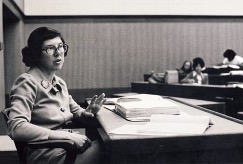
Herma Hill Kay teaching at Berkeley Law, c. 1970s. Image courtesy of Berkeley Law.
Herma Hill Kay was the second woman ever hired to UC Berkeley’s Law faculty in 1960, following the impending retirement of their first female professor, Barbara Armstrong. Kay taught at Berkeley Law for an astonishing fifty-seven years, during which the number of female faculty and students greatly increased as a direct result of her efforts. Germaine LaBerge, the interviewer for Kay’s oral history, recalls “Only fourteen women anywhere in the United States had become law professors before Professor Kay joined the faculty at Boalt Hall [now Berkeley Law].” In addition to her historic tenure, when Kay was “selected as Boalt’s first woman dean in 1992, she was adding to a long list of ‘firsts’ that, taken together, make an exceptional story” (pg. i).
Herma Hill Kay, image date not provided..
Kay devoted her career to furthering the rights of women, specifically pursuing cases concerning sex-based discrimination and California marital property laws. As a result, Kay contributed to the conception of the first no-fault divorce law in the United States. In her oral history, she attributed her passion for women’s rights to a firm belief in legal equality for all: “I’ve always felt very strongly—and this came from my father—that women ought to be free and conscious actors. They ought to determine their own role in this world. So I was very opposed to anything that would stand in the way of their self-realization. I feel the same way about racial equality. There shouldn’t be any barriers placed in front of anybody to do what that person wants to do and is able to do.” (Kay 2005, pg. 76) In addition to her academic achievements, Kay played a pivotal role in forming both the Berkeley Faculty Women’s Club in 1969 and the Boalt Hall’s Women’s Association. She passed away at the age of eighty-two in 2017, but her legacy and impact on the law community at UC Berkeley remains evident to this day.
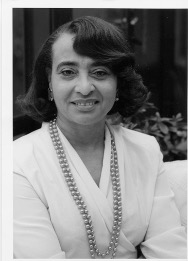
Jewelle Taylor Gibbs, c. 1996. Photograph by Julian C.R. Okwu.
Jewelle Taylor Gibbs began teaching at the UC Berkeley School of Social Welfare in 1979 and earned tenure as a full professor in 1986. Shortly after, in 1993, Gibbs earned an endowed appointment as the Zellerbach Family Fund Professor of Social Policy, Community Change and Practice—a position she held until her retirement in 2000. She became the first African American professor appointed to the position of endowed chair across the UC system. The Oral History Center interviewed Gibbs in 2003 and 2004 as a part of their African American Faculty and Senior Staff Oral History Project. Over the course of her career at the University, she contributed to several key dialogues in African American Studies. These included articles and books she wrote on “minority mental health, young Black men in America, and the O.J. Simpson and Rodney King cases” (pg. v). Gibbs also testified before the U.S. Congress concerning her research on young Black males.
Gibbs devoted her scholarly and personal pursuits to furthering justice and equality for several minority groups, which she detailed during her oral history: “So, this whole idea of all of the early influences which were around social justice from my family, my father and growing up in the church, have kind of really been a very, very deep influence on me in my work, coming back to that and looking at it in the last book that I did and even now things that I’m doing, the kinds of things I’m going to volunteer doing, it’s really coming back to civil rights, human rights, and women’s rights and how we can make our communities work better for minorities, poor people, the disadvantaged people and women. And that’s what I have done” (Gibbs 2010, pg. 424). Upon her retirement in late 2000, Gibbs earned the Berkeley Citation, the University’s highest honor awarded to individuals “whose contributions to UC Berkeley go beyond the call of duty and whose achievements exceed the standards of excellence in their fields.”
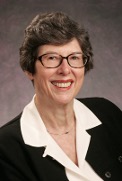
As the first woman tenured by the UC Berkeley Anthropology department, Laura Nader had an extensive impact on the University’s history and culture. She joined the faculty in 1960, the same year Herma Hill Kay started at Berkeley Law. Nader published ten books and around 290 other publications over the course of her career. As an influential and popular professor at UC Berkeley, she taught thousands of undergraduate students and supervised more than one-hundred PhD students. She recounted one of these popular classes in her oral history interview: “I puzzled because I never really understood why do students love the course Controlling Processes so much? Why do they remember it? Like the woman who said, ‘I took a course from you ten years ago.’ And I said, ‘You remember it?’ And she said, ‘Yes, it was Controlling Processes.’ Why do they remember it? They don’t remember any courses from one semester to another; who taught it and whatever it is. Their memories are worse than seventy-five year olds. So it opens their eyes to something. But why are our eyes closed? We’re not looking at reality in this country and many people are saying this now.” (Nader 2014, pg. 88)
Nader also taught at several other prestigious universities across the country, such as Yale Law, Harvard Law, and Stanford. Her research explored the interactions of law, anthropology, and energy science, specifically in indigenous Mexican cultures and the Middle East. Nader served as an ambassador for both the UC Berkeley community and the field of anthropology more broadly. As a result of her contributions to law and anthropology, she received the Law and Society Association’s 1995 Kalven prize for distinguished research. Experts across disciplines have commended her theoretical and ethical approaches to her research questions.
Gloria Bowles (bottom left) at the first UC Berkeley Department of Women’s Studies graduation, 1980.
In the fall of 1976, Gloria Bowles taught the first cohort of students in the Women’s Studies department at UC Berkeley and served as its founding coordinator. She taught throughout the University of California system at UC Berkeley, UC Santa Cruz, and UC Davis for much of her career as a professor in Comparative Literature and Women’s Studies. She recalled, “In a sense, the women’s movement came to me through my students, because in one of those proposal meetings, they accepted my proposal for Comp Lit 40A, the undergraduate course. I had a wonderful group of women. Of course, these women were so excited to be reading women writers.” (Bowles 2021, page 16)
Gloria Bowles, c. 1987.
Bowles, like the other professors highlighted in this blog post, considered the Women’s Liberation Movement in conjunction with other Civil Rights movements taking place during the 20th century. “Feminist was not a word we used when we were undergraduates in Ann Arbor. I think we were more obsessed with civil rights. The women’s movement followed civil rights, and the Women’s Studies Program followed Ethnic Studies, and one movement came and another. I think probably thinking about civil rights causes you to think about your rights, or lack thereof—and of course, totally different, depending on your class and color. I think that I always thought about things like that, although I didn’t give them labels.” (Bowles 2021, page 17)
After her retirement from academia. Bowles established the Berkeley Women’s Studies Movement Archive at UC Berkeley’s Bancroft Library. Bowles influenced the Bay Area’s feminist culture and paved the way for generations of female scholars to come.
Conclusion
Herma Hill Kay, Jewelle Taylor Gibbs, Laura Nader, and Gloria Bowles all achieved historic milestones and paved the way for future generations of female students and faculty at UC Berkeley. Without their contributions, UC Berkeley would be drastically different from the community we know today. They are just four of the dozens of influential women faculty members that the Oral History Center of The Bancroft Library has interviewed. To find more fascinating oral histories like these, explore the Education and University of California and African American Faculty and Senior Administrators at Berkeley oral history projects. For additional information, explore the 150 Years of Women at Berkeley history project, which includes Oral Histories of Berkeley Women.
Read the full oral histories of these women:
Herma Hill Kay, “Herma Hill Kay: Professor, 1960-Present, and Dean, 1992-2000, Boalt Hall School of Law, UC Berkeley,” interview by Germaine LaBerge in 2003, Oral History Center, The Bancroft Library, University of California, Berkeley, 2005.
Jewelle Taylor Gibbs, “Jewelle Taylor Gibbs,” interview by Leah McGarrigle in 2002, 2003 and 2004, Oral History Center, The Bancroft Library, University of California, Berkeley, 2010.
Laura Nader, “Laura Nader: A Life of Teaching, Investigation, Scholarship and Scope,” interview by Samuel Redman and Lisa Rubens in 2013, Oral History Center, The Bancroft Library, University of California, Berkeley, 2014.
Gloria Bowles, “Gloria Bowles: The Founding of Women’s Studies,” conducted by Amanda Tewes in 2021, Oral History Center, The Bancroft Library, University of California, Berkeley, 2021.
“Iconic Professor and Former Berkeley Law Dean Herma Hill Kay Dies at 82.” 2022. UC Berkeley Law. March 24, 2022. https://www.law.berkeley.edu/article/iconic-professor-former-berkeley-law-dean-herma-hill-kay-dies-82/.
“‘Something Has to Change’: Collection Explores Movement behind UC Berkeley’s Women’s Studies Program.” 2021. UC Berkeley Library. 2021. https://www.lib.berkeley.edu/about/news/womens-studies.
ABOUT THE ORAL HISTORY CENTER
The Oral History Center of The Bancroft Library preserves voices of people from all walks of life, with varying political perspectives, national origins, and ethnic backgrounds. We are committed to open access and our oral histories and interpretive materials are available online at no cost to scholars and the public. You can find our oral histories from the search feature on our home page. Search by name, keyword, and several other criteria. Sign up for our monthly newsletter featuring think pieces, new releases, podcasts, Q&As, and everything oral history. Access the most recent articles from our home page or go straight to our blog home.
Please consider making a tax-deductible donation to the Oral History Center if you’d like to see more work like this conducted and made freely available online. As a soft-money research unit of The Bancroft Library, the Oral History Center must raise outside funding to cover its operational costs for conducting, processing, and preserving its oral history work, including the salaries of its interviewers and staff, which are not covered by the university. You can give online, or contact us at ohc@berkeley.edu for more information about our funding needs for present and future projects.
Brianna Iswono is a third-year undergraduate student at UC Berkeley majoring in chemical engineering. Throughout the Fall 2024 semester, Brianna worked with Roger Eardley-Pryor of the Oral History Center to earn academic credits through Berkeley’s Undergraduate Research Apprentice Program (URAP). URAP provides opportunities for undergraduates to work closely with Berkeley scholars on cutting edge research projects for which Berkeley is world-renowned. In this post, Brianna reflects on her research about nuclear power as it appeared in the Oral History Center archives.
As a chemical engineering student at UC Berkeley, my coursework only briefly touches on topics of nuclear power and energy. I wanted to learn more and my curiosity deepened as I saw more and more headlines about nuclear energy in news articles and social media. To dive deeper, in the fall of 2024 I joined Berkeley’s URAP (Undergraduate Research Apprenticeship Program) under the mentorship of historian Roger Eardley-Pryor at the Oral History Center, where I analyzed various oral histories and technical reports about nuclear energy. Through this experience, what I discovered was not only a stronger interest in nuclear power, but a field marked by polarizing perspectives and profound complexity—one where simple answers do not exist.
William E. Siri, environmentalist and biophysicist, 1964
Nuclear power stands as one of the most reliable carbon-free energy sources available today. Unlike fossil fuels, it produces no carbon dioxide during electricity generation, which makes nuclear power a critical tool in the fight against climate change and reducing greenhouse gas emissions. Given the growing urgency for energy facilities to reduce their overall emissions, nuclear power offers a viable option for large-scale, reliable energy production. As former Sierra Club president, mountaineer, biophysicist, and Berkeley Lab energy analyst William E. Siri noted in his oral history in the late 1970s, “Coal is a very dirty fuel… That leaves nuclear as one clean energy source until solar and other energy sources are fully developed.” Today, solar and wind are more developed, but the energy they generate drops when the sun sets or when winds cease. By providing steady, continuous power, nuclear energy complements intermittent renewable sources like wind and solar, ensuring grid stability. This reliability reduces the need for fossil fuel-based backup systems and thus helps mitigate climate change.
David Brower, environmental activist and first executive director of the Sierra Club (undated).
However, nuclear power is not without its environmental challenges. The construction and operation of plants can disrupt local ecosystems, particularly since they are often built in rural areas rich in biodiversity and ecological value. Habitat disruption, deforestation, and the high demand for water used in reactor cooling all remain significant concerns. The presence of nuclear plants places an increased strain on local water resources, particularly in underserved regions already facing water scarcity. In the first of his two archived oral history interviews, David Brower, the former executive director of the Sierra Club, the nation’s largest environmental organization, explained about the Club’s consideration of nuclear power, “You certainly haven’t helped the poor by degrading the environment, the working place, by not getting into the battles to protect them from the chemicals that they’re exposed to.”
Laurence I. Moss, nuclear engineer and former Sierra Club president, 1973.
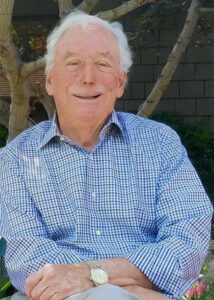
Also, the visual impact of large nuclear facilities can dramatically alter the character of scenic areas. At least in California, public opposition was fueled historically by concern that industrial structures for nuclear power detracts from the natural beauty and environment of rural areas, making them appear stark and out of place. Laurence I. Moss, former Sierra Club president and nuclear engineer, worked directly on construction of nuclear reactors. Moss shared in his oral history, “In my mind it was always a location issue. That was not the right place to put a nuclear power plant, or any industrial facility. I would not want to put a residential development there, anything that would alter the natural environment for the worse.” Moss’s perspective highlights the tension between technological advancement and environmental preservation, underscoring the importance of careful site selection to balance progress with respect for natural landscapes.
Professor Thomas H. Pigford, founding chair of UC Berkeley’s Department of Nuclear Engineering, 2001.
Another major challenge, and perhaps the most pressing, is the management of nuclear waste. Nuclear reactors generate long-lived radioactive waste that requires secure, long-term storage, and even the most advanced waste repositories carry the risk of leakage or contamination over the thousands of years that spent nuclear fuel remains toxic. Efforts to manage nuclear waste have included ambitious ideas such as deep-sea disposal or even launching the waste into the sun. However, these approaches fail to fully eliminate the risk of leakage, especially given the exceptionally long timescales over which the waste must remain secure, and they often introduce additional challenges. As Thomas H. Pigford, the founding chair of UC Berkeley’s Department of Nuclear Engineering, explained in his oral history from the late 1990s,“Another more attractive approach is to shoot the radioactive waste into the sun, which would require concentrating it to reduce the weight. And that’s where it belongs, because the sun is so radioactive. But there, the technical challenge or problem is the abort rate of missiles, of space vessels, and so when consulting the people in NASA, we concluded that that was just untenable.” Such unresolved issues remain a central concern for environmental advocates, highlighting the ongoing tension between the potential of nuclear power as a clean energy source and the ecological risks it poses.
Economically, nuclear power presents both opportunities and challenges. Once operational, nuclear reactors have relatively low fuel and operating costs compared to many other energy sources. Uranium, the main fuel used, is highly energy-dense, requiring only small amounts to generate large quantities of energy. This efficiency makes nuclear power a cost-effective solution to meet large-scale energy demands, providing a reliable supply of energy at a lower long-term cost while still delivering the high output needed to sustain industrial and societal needs. After working directly with the economic analysis of nuclear plant construction in the 1960s, Moss shared, “we were able to show that other alternatives, specifically a nuclear power alternative, built in those years could provide power at lower cost than the dams.” Nuclear power also has an extensive reach that goes far beyond reactors, influencing a wide range of industries and technologies. The advancements and expertise gained through working with radiation and the advanced technologies required for waste facilities have helped with the development of new medical technologies used to measure radiation. Professor Pigford was directly involved in establishing the nuclear engineering curriculum at Berkeley and saw its expansion into related medical technologies. In his oral history, Pigford shared “Yes, well, there are plenty of jobs in waste disposal. And they are emphasizing more and more the interaction with the bioengineering program, which, as you probably know, is a new push on the campus. There’s a new department, and they’ve even gone into the field of tomography, which is doing scans on the brain and on the rest of the body. These involve nuclear reactions and so the development of instrumentation for that, techniques of sensing the nuclear radiations and interpreting them, is occupying more and more time.” Pigford’s insight highlights how nuclear engineering graduates have the opportunity to apply their expertise to innovations in health-related technologies, such as medical imaging.
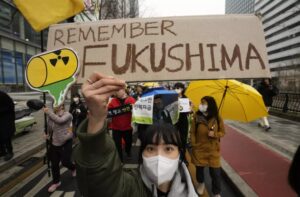
Environmental activist in Seoul, Korea, at a rally marking the 12th anniversary in 2023 of Japan’s Fukushima nuclear disaster (photograph by Ahn Young-joon of Associated Press).
Yet, a major economic challenge of nuclear power is the huge initial investment needed to build a plant. Designing, constructing, and meeting regulatory standards for a single nuclear plant can cost billions of dollars. While the long-term operating costs are lower, the upfront costs to begin production are much higher than those of other energy sources.This creates a significant barrier, particularly for developing countries that may also lack the technical expertise or regulatory infrastructure needed to operate plants safely. In his oral history, Siri captured the economic trade-off and complexity of nuclear power. Siri noted, “The more countries that have nuclear power plants, particularly the less advanced countries, the more likelihood there will be of meltdowns, simply because many such countries don’t have the technical base on which to maintain such an industry.” For these countries, nuclear power offers a chance to advance economically, but it also comes with the greater risk of catastrophic failure.
Roy Woodall, Australian geologist (undated).
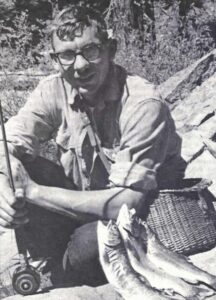
On the global stage, nuclear technology carries a sense of prestige. Non-nuclear nations often see other nations with advanced nuclear developments as leaders in innovation, which enhances their national pride and elevates their international status. The high demand for uranium to fuel nuclear reactors has led various countries to form alliances or joint ventures, employing any means necessary to secure a share of the advancements in nuclear technology. Roy Woodall, an Australian geologist known for his contributions to the mining and exploration industries, directly engaged with the mining sector to meet the growing global demand for uranium. In his oral history from the early 2000s, Woodall shared, “There was quite a lot of interest from other overseas companies in looking for uranium in Australia, so we formed a joint venture to look for conglomerate-type uranium deposits in Northern Western Australia.” His experience highlights the global scramble for uranium resources, reflecting how the race for nuclear technology has spurred both national and international collaboration.
Michael R. Peevey, an energy entrepreneur and regulator (undated).
However, the social risks associated with nuclear power are significant. Public fear of radiation exposure, which can lead to various health risks, has been intensified by past large-scale nuclear accidents like Fukushima and Three Mile Island, along with the media frenzy surrounding them. When reflecting on nuclear concerns during his oral history in 2019, Michael R. Peevey, a UC Berkeley alumnus, former electric utility executive, and previous president of the California Public Utilities Commission, recalled “But we had Chernobyl in Russia, which was a disaster; it’s a lingering disaster today.” Such concern has resulted in widespread resistance to the construction of new nuclear reactors and calls to shutdown existing ones. Grassroots movements and anti-nuclear campaigns have further fueled this opposition, creating a broad social aversion to nuclear power.
David Pesonen, attorney and environmentalist, 1963.
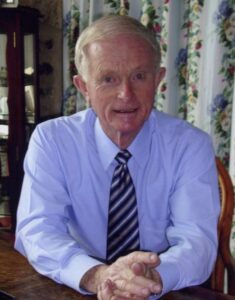
David E. Pesonen is a UC Berkeley alumnus, attorney, and environmental activist best known for his leadership role in the battle to defeat a PG&E nuclear power plant at Bodega Bay in the early 1960s. In his oral history recorded in the late 1990s, Pesonen explained his motivation for spreading the anti-nuclear power agenda. “Mainly because of the waste disposal problem. I don’t know the answer to that. I don’t know that anybody does. And also because I think the design of the generation of plants that we are involved with is inherently unsafe.” Despite the advanced safety features of modern plants, the widespread fear and skepticism continue to challenge the nuclear industry, highlighting the complex intersection of technological progress, environmental concerns, and public perception.
After conducting this oral history research and diving into the different aspects of nuclear power, I have come to realize that this field is inherently complex. I am still unsure where I stand in these debates, but one thing is clear: nuclear energy shouldn’t be dismissed outright. A recent LA Times article notes that, as energy-demanding technologies like AI continue developing rapidly, the demand for energy will only increase and all carbon-free options must be considered, especially in light of climate change. At the same time, we cannot ignore the risks that nuclear power poses. I think that the best approach is to carefully consider all non-fossil energy sources, such as nuclear or renewable, to make informed choices. Nuclear power is neither entirely good nor entirely bad; it is a complex and multifaceted technology with the potential for significant benefits and serious risks. Attitudes will likely continue to shift back and forth, but embracing the complexities of nuclear power is important to making wise decisions about its future role in meeting global energy needs. Reflecting on my semester of oral history research, I am grateful to have taken this URAP opportunity, as it gave me valuable insight and a new understanding of nuclear power that I always hoped to explore. Nuclear power is a complicated yet astonishing field, and I hope others can be informed on it to formulate their own stance on how to create a greener future.
The Oral History Center of The Bancroft Library preserves voices of people from all walks of life, with varying political perspectives, national origins, and ethnic backgrounds. We are committed to open access and our oral histories and interpretive materials are available online at no cost to scholars and the public. You can find our oral histories from the search feature on our home page. Search by name, keyword, and several other criteria. Sign up for our monthly newsletter featuring think pieces, new releases, podcasts, Q&As, and everything oral history. Access the most recent articles from our home page or go straight to our blog home.
Please consider making a tax-deductible donation to the Oral History Center if you’d like to see more work like this conducted and made freely available online. As a soft-money research unit of The Bancroft Library, the Oral History Center must raise outside funding to cover its operational costs for conducting, processing, and preserving its oral history work, including the salaries of its interviewers and staff, which are not covered by the university. You can give online, or contact us at ohc@berkeley.edu for more information about our funding needs for present and future projects.
Brianna Iswono is a third-year undergraduate student at UC Berkeley majoring in chemical engineering. In the Fall 2024 semester, Brianna is working with Roger Eardley-Pryor of the Oral History Center to earn academic credits through Berkeley’s Undergraduate Research Apprentice Program (URAP). URAP provides opportunities for undergraduates to work closely with Berkeley scholars on cutting edge research projects for which Berkeley is world-renowned. This “From the Archives” article emerged from Brianna’s research in the Oral History Center’s long standing Sierra Club Oral History Project.
Laurence I. Moss, who recorded his oral history in 1992, integrated engineering innovation with environmental protection in ways that inspire me as a chemical engineering student who wants to contribute towards sustainability. Today, efforts to reduce carbon emissions and combat climate change are increasingly prominent in academia and technological industries. The surge of various electric cars, solar power installations, and increased sustainability awareness begs the question: how has this shift towards a more green future been feasible? This shift has required, and continues to require, technical developments with environmental goals. Laurence I. Moss was a nuclear engineer who, in the 1960s and 1970s, became a national leader in the Sierra Club. Moss used his technical expertise for advancements in engineering as well as developing processes to prioritize environmental protections.
Laurence I. Moss, a nuclear engineer and Sierra Club President from 1973-1974, recorded his oral history in 1992.
Laurence I. Moss’s early life and education laid the groundwork for his expertise in engineering, equipping him with the technical knowledge to contribute meaningfully to the nuclear industry. Moss was born in 1935 during the Great Depression. He was raised in Queens and Brooklyn in New York City by parents who, as he said, believed deeply in the “American Dream.” He attended the prestigious Massachusetts Institute of Technology (MIT) where he studied chemical engineering as an undergraduate. Driven by his passions in math and science, he described wanting a career where “people would be judged on their merits and on their ability to contribute.” Continuing to spark his interests and explore new fields, Moss completed a graduate program at MIT in nuclear engineering, a field he was previously unfamiliar with.
Moss’s work on nuclear reactors, particularly at Rockwell International, highlighted his ability to understand and improve cutting-edge technologies, a key skill that later influenced his advocacy for sustainable energy solutions. Prior to Rockwell International, Moss worked for nearly ten years at the Santa Susana nuclear field laboratory in Simi Hills where he designed and constructed various nuclear power reactors. He focused on developing safer nuclear technologies as the key engineer for testing so-called “critical experiments”—that is, low-power nuclear physics experiments conducted with nuclear reactors that avoid producing large amounts of fission products. This work laid a foundation for broader environmental impacts that he pursued in his later career at Rockwell International. Reflecting on his time at Rockwell, Moss shared, ”It was very rewarding too when you spend several months doing a highly theoretical calculation which makes certain assumptions about physical and nuclear properties, and predicts on the basis of these assumptions that a certain result will happen under these unusual circumstances. And then you go out and test it, and indeed that’s exactly what happens.” After acquiring first-hand experience managing nuclear-scale trials and operations, Moss joined the Sierra Club, and his work efforts soon transitioned towards processes that targeted innovative and renewable energy alternatives.
The personal connection Moss had to nature and his growing awareness of environmental issues, such as pollution and habitat destruction, inspired his shift towards engineering solutions that balanced technical progress with environmental preservation. His admiration of the natural environment grew from his youth in a rural setting where he spent most of his time outdoors. Later in life, seeing the effects of pollution in Los Angeles strengthened his belief that engineering should play a role in protecting the environment. Recalling these aspects, especially from his daily commute, Moss shared, “Another influence was the smog in the L.A. Basin. I remember my feelings at the end of the day, usually driving down from the Santa Susana Mountains to the San Fernando Valley and seeing a blanket of smog over the valley. Thinking about living in that polluted environment and how that had to change.” Seeing the impact of pollution firsthand inspired Moss to turn his personal convictions into action by using his engineering knowledge to advocate for environmental protections.
Moss became a prominent figure in the Sierra Club where he leveraged his engineering expertise for environmental advocacy, including influencing key decisions on energy production and infrastructure through a quantitative approach. He encapsulated his values by asserting, “I wanted to know how many pounds, how many tons, how much toxicity, how many people are at risk, what is the probability of distribution for the hazards, the number of people who can be affected by a single incident, and the consequences of that incident.” Moss joined the Sierra Club in 1959, remained active for over fifteen years, and served as the first non-Californian president of the Club from 1973 to 1974. His leadership was characterized by providing data and analytical information to illuminate the economic and environmental trade-offs of energy production and conservation. During his tenure, Moss opposed construction of the Diablo Canyon nuclear power plant in central California, not in opposition to nuclear power, per se, but by emphasizing its potential dangers in an earthquake-prone area as well as concerns about the plant’s long-term sustainability. In Congressional hearings, he also contributed economic analyses to oppose dams in the Grand Canyon, and instead he advocated for nuclear power as a cleaner, more environmentally sustainable, and cost-effective alternative to burning coal or oil. Moss approached this argument by claiming the dams in the Grand Canyon were not necessary for the economic success of the Central Arizona Project (CAP). He shared, “Those dams were not the key factors in subsidizing the Central Arizona Project. One, we did the calculation that the Bureau of Reclamation did and took out both the costs of and the revenue from the two Grand Canyon dams. At the end of the fifty-year period, you ended up with about the same amount of money with the Central Arizona Project subsidized as with the dams in the calculation.” By merging his analytical mind and engineering expertise, Moss played a key role in broadening the Sierra Club’s mission, helping shift its focus strictly from wildlife conservation to address the broader environmental challenges of his time.
The oral history of Laurence I. Moss offers testimony to the crucial role that engineering and technical expertise can play in creating a safer, more environmentally friendly future. His integration of engineering and environmental protection inspires future generations of engineers like me, who hope to contribute to the sustainable engineering industry. Moss’s life, work, and advocacy emphasized deep interconnections between economics, engineering, and environmental action. He serves as a lasting source of inspiration for students and professionals who share his values in the ongoing pursuit for a healthier planet.
The Oral History Center of The Bancroft Library preserves voices of people from all walks of life, with varying political perspectives, national origins, and ethnic backgrounds. We are committed to open access and our oral histories and interpretive materials are available online at no cost to scholars and the public. You can find our oral histories from the search feature on our home page. Search by name, keyword, and several other criteria. Sign up for our monthly newsletter featuring think pieces, new releases, podcasts, Q&As, and everything oral history. Access the most recent articles from our home page or go straight to our blog home.
Please consider making a tax-deductible donation to the Oral History Center if you’d like to see more work like this conducted and made freely available online. As a soft-money research unit of The Bancroft Library, the Oral History Center must raise outside funding to cover its operational costs for conducting, processing, and preserving its oral history work, including the salaries of its interviewers and staff, which are not covered by the university. You can give online, or contact us at ohc@berkeley.edu for more information about our funding needs for present and future projects.
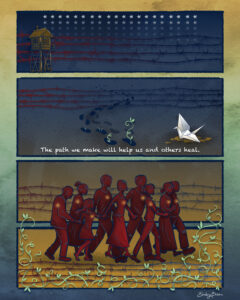
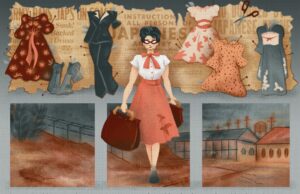
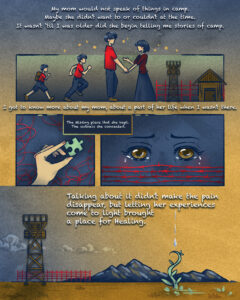
“TOPAZ” by Emily Ehlen, a graphic illustration based on oral histories recorded in the Oral History Center’s Japanese American Intergenerational Narratives project
In April 2024, Oral History Center (OHC) interviewers Amanda Tewes, Shanna Farrell, and Roger Eardley-Pryor traveled to Salt Lake City, Utah, where we presented our work on the Japanese American Intergenerational Narratives Project at the annual meeting of the National Council on Public History (NCPH). We also joined a pilgrimage to the central desert of Utah along with other public historians and several members of the Wakasa Memorial Committee, including survivors and descendants of the Topaz prison camp in Utah, one of the ten US government mass incarceration sites where Japanese Americans were unjustly imprisoned during World War II. Our experiences in Utah at NCPH and at Topaz reiterated how history remains a powerful and living force, and how oral history can help promote that power. Difficult questions about “belonging” appear throughout many of the oral histories in OHC’s Japanese American Intergenerational Narratives project, and those same questions punctuated much of our time in Utah this past April.
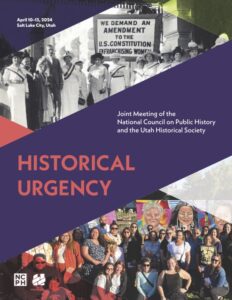
Program cover for the annual meeting of the National Council on Public History held in Salt Lake City, Utah, from April 10-13, 2024.
“Historical Urgency” was the conference theme for this year’s meeting of the National Council on Public History (NCPH) in Salt Lake City, where some 740 attendees presented, networked, and learned together. Presentation topics included community engagement, particularly with communities whose histories face urgent existential threats; communicating the critical importance of history and historical thinking; discourse and dialogue in a time of extreme social polarization; exploration of oral history, especially the collection of oral histories from older generations; and repatriation of human remains and cultural objects. As noted by NCPH president Kristine Navarro-McElhaney, conference discussions highlighted how historians’ work for public audiences remains essential to the fabric of our society, especially during this time of political and cultural polarization—and yet historical perspectives, tools, and history workers themselves have increasingly come under threat. While urgency may seem in opposition to the often slow and deliberate work that oral historians and other public historians do to build trust and lasting relationships with the communities we serve, many of us cannot help but feel a strong sense of urgency and importance in our efforts to collaboratively excavate the past and elevate community stories in ways that help make meaning in the present.
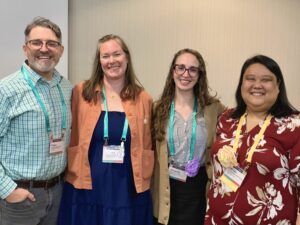
Left to right: OHC interviewers Roger Eardley-Pryor, Shanna Farrell, and Amanda Tewes, and Executive Director of the Japanese American Museum of Oregon Hanako Wakatsuki-Chong at the 2024 NCPH conference in Utah
We felt especially honored to share at this NCPH our work on the Japanese American Intergenerational Narratives Project. Our roundtable presentation recounted the project’s origins, the trauma-informed interviewing approach we used with these oral histories, and some of emergent themes from the project’s interviews, like “belonging,” “art and expression,” “healing,” and “memorialization.” The roundtable’s discussion was moderated by Hanako Wakatsuki-Chong, the Executive Director of the Japanese American Museum of Oregon and a former National Park Service Ranger who recorded her own oral history as part of the project. Nancy Ukai and Masako Takahashi, both of whom also recorded oral histories as part of the project, attended and also presented at the NCPH conference in Utah, where they heard portions their own oral history interviews during our presentation. Our presentation included audio clips from season 8 of The Berkeley Remix podcast, “From Generation to Generation”: The Legacy of Japanese American Incarceration,” as well as graphic narrative artwork by Emily Ehlen, all based on oral histories recorded for the Japanese American Intergenerational Narratives Project.
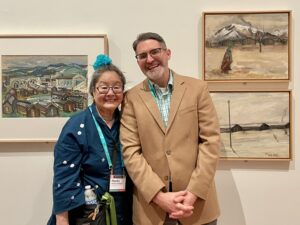
Masako Takahashi and Roger Eardley-Pryor at the Pictures of Belonging exhibit at the Utah Museum of Fine Arts
Relatedly, during the NCPH conference, I (Roger Eardley-Pryor) joined other public historians for a tour of the Utah Museum of Fine Arts on the University of Utah campus to see a new exhibit titled Pictures of Belonging: Miki Hayakawa, Hisako Hibi, and Miné Okubo. The exhibition was curated by Professor ShiPu Wang of UC Merced and features over 100 paintings and works on paper by these three Japanese American women artists, all critically acclaimed with long and productive careers. Yet during World War II, both Hibi and Okubo were unjustly incarcerated in Utah at Topaz, along with Hayakawa’s parents. Pictures of Belonging follows the three artists’ prewar, wartime, and postwar art practices, sharing an expanded view of the American experience by women who used artmaking to take up space, make their presence and existence visible, and assert their own belonging. Many of the exhibit’s artworks are on view to the public for the first time. The exhibit’s titular theme of “belonging” resonated nicely with the Oral History Center’s Japanese American Intergenerational Narratives Project at UC Berkeley, and Okubo even earned her Master in Fine Arts degree in 1938 from UC Berkeley. Our tour of the art exhibit was co-led by Sarah Palmer, Head Exhibition Designer at the Utah Museum of Fine Arts, and by Dr. Kristen Hayashi, Director of Collections Management & Access and Curator at the Japanese American National Museum in Los Angeles. I am especially grateful I could tour Pictures of Belonging with Masako Takashashi, who herself is an outstanding multi-media artist, was born behind barbed wire at the Topaz prison camp in Utah, and who I worked with to record her forthcoming oral history interview for the Japanese American Intergenerational Narratives Project.
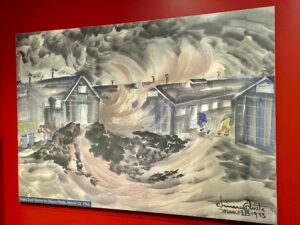
“Dust Storm, Topaz” by Chiura Obata, reprint of 1943 watercolor as displayed at the Topaz Museum in Delta, Utah
Our visit to the Utah Museum of Fine Arts also included another new exhibit titled Chiura Obata: Layer by Layer, which presents an in-depth look at the creation and conservation of Obata’s beautiful “Horses” silk screen painting from 1932. Chiura Obata was an esteemed artist and professor at UC Berkeley who was also incarcerated during World War II at Topaz in Utah, where he and Miné Okubo taught art classes for their fellow Japanese American incarcerees. Kimi Kodani Hill, the granddaughter of Chiura Obata, recently presented at the Utah Museum of Fine Arts on her grandfather’s life and work, and I’m grateful that during our recent meeting in Berkeley, prior to my own Utah trip, she shared stories with me about Obata’s silk screen exhibit. During the screen’s 2022 conservation treatment, conservators at Nishio Conservation Studio discovered that the four-paneled screen contained hidden full-scale preparatory charcoal drawings of the horses. In addition, they found that the screen’s internal layers were made of practice drawings by Professor Obata and his summer 1932 students. The recently conserved screen, the full-scale under-drawings, and a selection of the practice drawings were all on display at the Utah Museum of Fine Arts, along with a short film on the conservation process, which itself is an artform. After we returned to the Bay Area, Kimi Kodani Hill provided a guided tour of another exhibition with forty of Chiura Obata’s watercolors, woodblock prints, and ink paintings from several decades of his life that are currently displayed through mid-July at the San Francisco Museum of Modern Art.
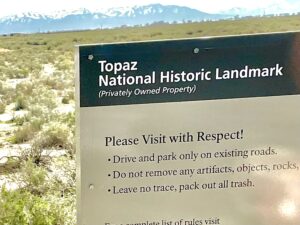
National Historic Landmark sign at Topaz notes that the site is privately owed by the Topaz Museum Board and asks visitors not to remove any objects, including rocks
On April 11, 2024, in Salt Lake City at the NCPH conference, Masako Takahashi and Nancy Ukai joined other members of the Wakasa Memorial Committee to present their own panel titled “Who Writes Our History?” This panel explored the life and tragic death of James Hatsuaki Wakasa, who was shot and killed while confined in Topaz eighty-one years earlier on April 11, 1943. Their panel also addressed urgent and ongoing challenges over descendant and survivor community consent and collaboration with the Topaz Museum following the recent discovery and excavation of the Wakasa Memorial Stone from the Topaz incarceration site in 2021. That massive, 1,000-pound stone memorial was erected in 1943 by Japanese American incarcerees at Topaz just after James Wakasa’s murder there. But US government authorities quickly demanded the memorial’s destruction in their effort to bury acknowledgement of Wakasa’s death from a bullet fired by a white, nineteen-year-old US soldier who was quickly acquitted of any crime. The Wakasa Memorial Committee’s NCPH presentation, which was standing-room only, featured short films and personal reflections on the life, death, memory, and now-contested stone memorial of James Wakasa.
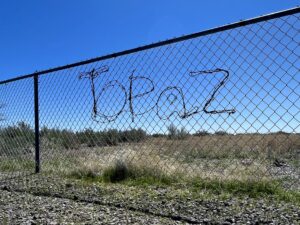
A perimeter fence at Topaz bears the name of the WWII-era mass incarceration in barbed wire
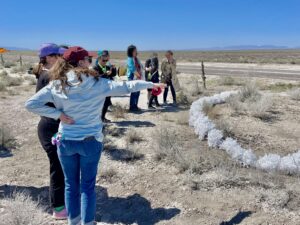
Two days later, still in Utah, Oral History Center interviewers and several other public historians joined Ukai, Takahashi, and other members of the Wakasa Memorial Committee on a pilgrimage to the dust-strewn ruins of the Topaz site on the edge of the Great Basin in Utah’s central desert. The bus ride out to the remote site included watching historical films and sharing personal backgrounds and reflections amongst this group that had assembled from eight different states. Hours later, we arrived at a sparse, sun-bleached landscape encircled by distant snow-capped mountains. Much of the original barbed wire fence around Topaz remains today where some 8,000 Americans were unjustly imprisoned for years during World War II. Crumbled concrete foundations mark sites of now-gone guard towers where US soldiers aimed their guns down at the Japanese American prisoners, and from where they occasionally fired shots, like the one that pierced James Wakasa’s heart in 1943. At the Topaz site, we joined members of the Topaz Museum Board, including board president Patricia Wakida; Scott Bassett, board secretary and education director at the Topaz Museum; and Topaz descendant and board member Dianne Fukami. Together, we all participated in a ceremony organized by the Wakasa Memorial Committee to commemorate Wakasa’s death, as well as the 140 people who died behind barbed wire at Topaz, and the sixteen Japanese American soldiers drafted from Topaz who died during their World War II military service.
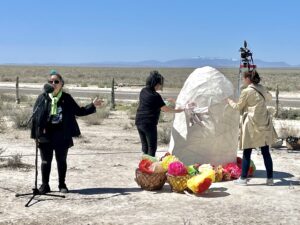
Wakasa Memorial Committee members Masako Takahashi (left), Nancy Ukai (center) and Lauren Araki at Topaz near where James Wakasa was shot 81 years earlier. Ukai and Araki drape ancestral name tags around an artist’s rendition of the Wakasa Memorial Stone.
The Wakasa 81st Memorial Ceremony at Topaz began at block 36-7-D, where James Wakasa’s tar-paper barracks once stood. From there, we re-traced Wakasa’s steps across the dusty and now-hauntingly empty landscape to the western perimeter site of his murder, near where the Wakasa Memorial Stone once stood before incarcerated Japanese Americans, under government orders to destroy the memorial, buried it in 1943. An artist’s large recreation of the stone, this one blazing white and made of paper mache and wood, stood near the former burial site of the stone memorial before its removal in 2021. After a land blessing and words of remembrance from survivors born at Topaz, we encircled the artist’s stand-in memorial with name tags bearing the names of our own ancestors. Joshua Shimizu then sang in both Japanese and English the hymn “Rock of Ages,” which was also sung at Wakasa’s funeral in April 1943, and which offered deeper meaning for the missing original Wakasa Memorial Stone.
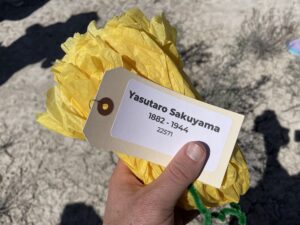
A folded paper flower used during the ceremony that bears the name of Yasutaro Sakuyama, who died in 1944 while imprisoned at Topaz.
During the “Rock of Ages” hymn, ceremonial participants attached to the base of the art installation many colorful paper flowers that carried tags naming other Japanese Americans who died in Topaz. The paper flowers we carried to the ceremony were made by Topaz survivors and descendants in honor of the paper floral blossoms folded by imprisoned Japanese Americans at Topaz in lieu of actual flowers for James Wakasa’s 1943 funeral. Miné Okubo, the artist whose work we saw earlier at the Utah Museum of Fine Arts, drew several illustrations of Wakasa’s funeral while she was incarcerated at Topaz, including drawings of imprisoned women folding paper flowers to adorn wreaths and crosses. On the desert floor in April 2024, white paper flowers also surrounded the excavation site where the Topaz Museum Board excavated Wakasa’s Memorial Stone in 2021. The Wakasa 81st Memorial Ceremony at Topaz simultaneously evoked absence and living memory. It was especially meaningful to me (Roger) to join Nancy Ukai and Masako Takahashi at the ceremony after having worked together to record their oral histories, in which they shared intergenerational memories about James Wakasa and more recent memories about the Wakasa Memorial Stone’s recent rediscovery and removal from that site.
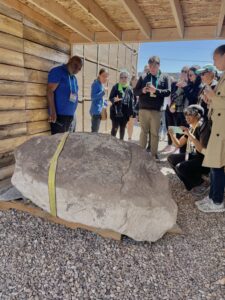
Public historians and Wakasa Memorial Committee members view the excavated Wakasa Memorial Stone at the Topaz Museum in Delta, Utah
After the ceremony at Topaz, the pilgrimage group boarded the bus and traveled sixteen miles to the handsome Topaz Museum, which opened in 2017 after decades of fundraising and planning in the small town of Delta, Utah. Once there, the pilgrimage group found their way to the back of the museum where we gathered to witness the actual Wakasa Memorial Stone, a one-thousand-pound rock now confined in a small enclosure. After paying our respects to the stone, we toured the Topaz Museum’s exhibits and collections, which include hundreds of artifacts, photographs, and oral histories, as well as 150 pieces of original artwork. The Topaz Museum’s core exhibit explores the complex story of the World War II Japanese American incarceration experience, especially as it transpired at Topaz. The exhibit begins with the racist laws that marginalized early Japanese immigrants, which lead eventually to the mass incarceration of Japanese Americans during World War II. The exhibit extends into the traumatic impacts of their exile, with an obvious focus on the Topaz experience, and it concludes with an examination of the Constitutional violations that the incarcerees were forced to endure. I found the Topaz Museum exhibits to be impressive, interactive, and informative. The pilgrimage group then gathered a final time out back by the Wakasa Memorial Stone before boarding the bus and returning to Salt Lake City.
OHC interviewers Amanda Tewes (in maroon cap) and Shanna Farrell (in purple hat) observe the excavation site of the Wakasa Memorial Stone near where James Wakasa was shot 81 years earlier in April 1943
The emotional experiences throughout our time in Utah reminded me of William Faulkner’s line in Requiem for a Nun: “The past is never dead. It’s not even past.” The public history presentations on “historical urgency” at NCPH, the outstanding exhibits on Japanese American artists, the powerful pilgrimage to Topaz and the commemorative ceremony at the site of James Wakasa’s murder, which we shared with survivors and descendants of the prison camp eighty-one years from the date of Wakasa’s death, as well as our trip to the Topaz Museum to see its exhibits and the excavated Wakasa Memorial Stone all reminded us that history is still very much alive and shapes our present experiences. At both the Topaz incarceration site and at the Topaz Museum in Delta, we witnessed some of the still-simmering tensions between Topaz Museum Board members and members of the Wakasa Memorial Committee over what has happened and what will happen to the now-unearthed Wakasa Memorial Stone. Throughout all of those experiences in Utah, I kept thinking on the recurrent theme of “belonging,” including in the oral histories we continue to conduct in the Oral History Center’s Japanese American Intergenerational Narratives Project. “Belonging” carries multiple meanings and invites complex questions. Within what communities, or within which factions of communities, do we find and feel belonging? Throughout history, and up through the present, where have Japanese Americans found belonging? What about the physical artifacts of Japanese American history, like artwork created during World War II-era incarceration, or like the recently re-discovered Wakasa Memorial Stone? To whom do those objects belong? And importantly, who has the right to tell the history of artifacts, artwork, memorials, or lived experiences? To whom does this history belong?
Answers to questions of belonging are elusive because they’re always evolving. I do know, however, how grateful I feel to continue working with individuals and communities to record oral histories that empower narrators to share their own living memories and reflections on the past, and how the personal histories these interviews record will continue to shape our shared present moments. These experiences in Utah helped further inspire our ongoing work on the Japanese American Intergenerational Narratives Project. We hope that you, too, can find inspiration and meaning in these stories, and that they might inform your own sense of belonging.
— Roger Eardley-Pryor, Oral History Center historian and interviewer
ABOUT THE ORAL HISTORY CENTER
The Oral History Center of The Bancroft Library preserves voices of people from all walks of life, with varying political perspectives, national origins, and ethnic backgrounds. We are committed to open access and our oral histories and interpretive materials are available online at no cost to scholars and the public. You can find our oral histories from the search feature on our home page. Search by name, keyword, and several other criteria. Sign up for our monthly newsletter featuring think pieces, new releases, podcasts, Q&As, and everything oral history. Access the most recent articles from our home page or go straight to our blog home.
Please consider making a tax-deductible donation to the Oral History Center if you’d like to see more work like this conducted and made freely available online. While we receive modest institutional support, we are a predominantly self-funded research unit of The Bancroft Library. We must raise the funds to cover the cost of all the work we do, including each oral history. You can give online, or contact us at ohc@berkeley.edu for more information about our funding needs for present and future projects.
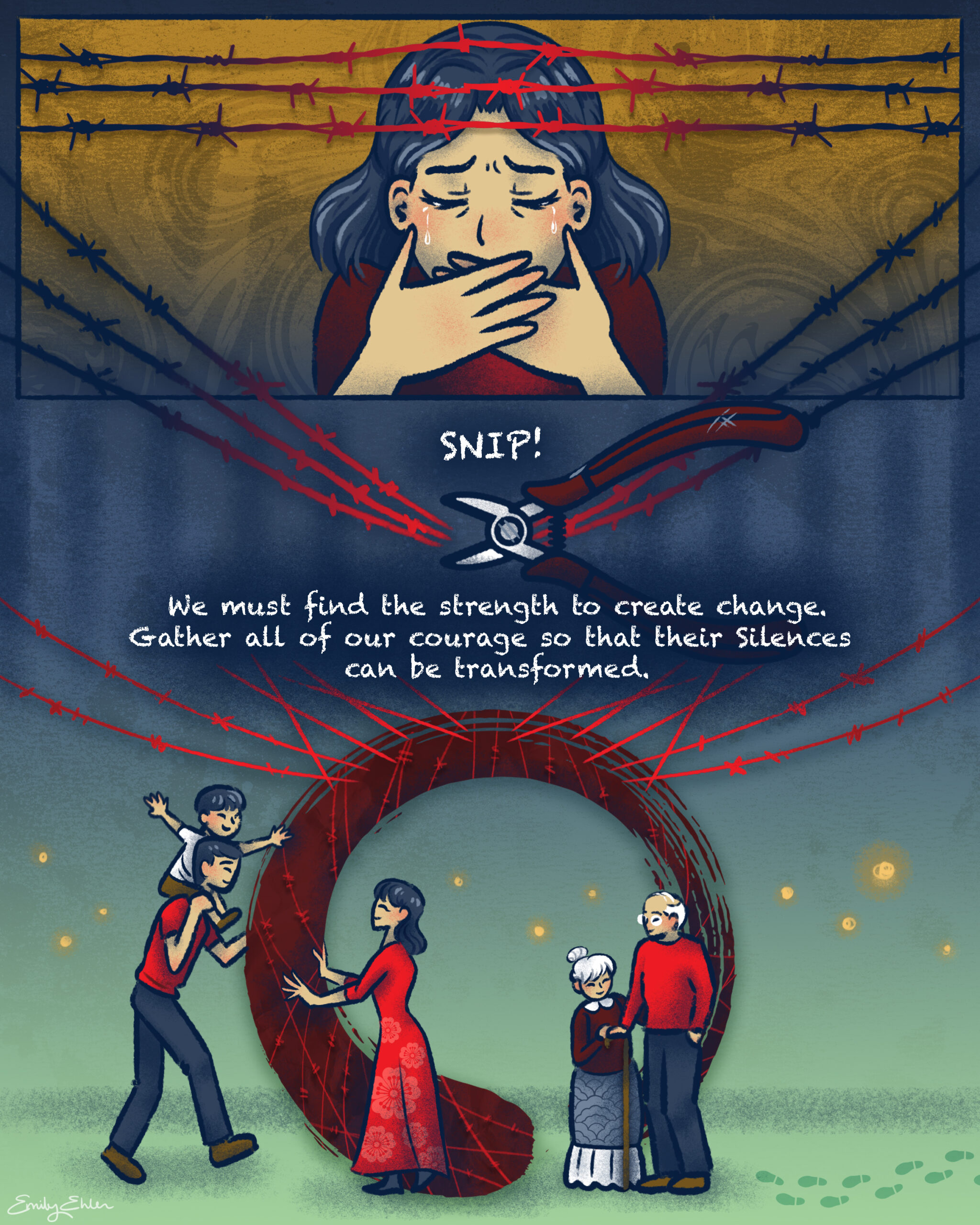
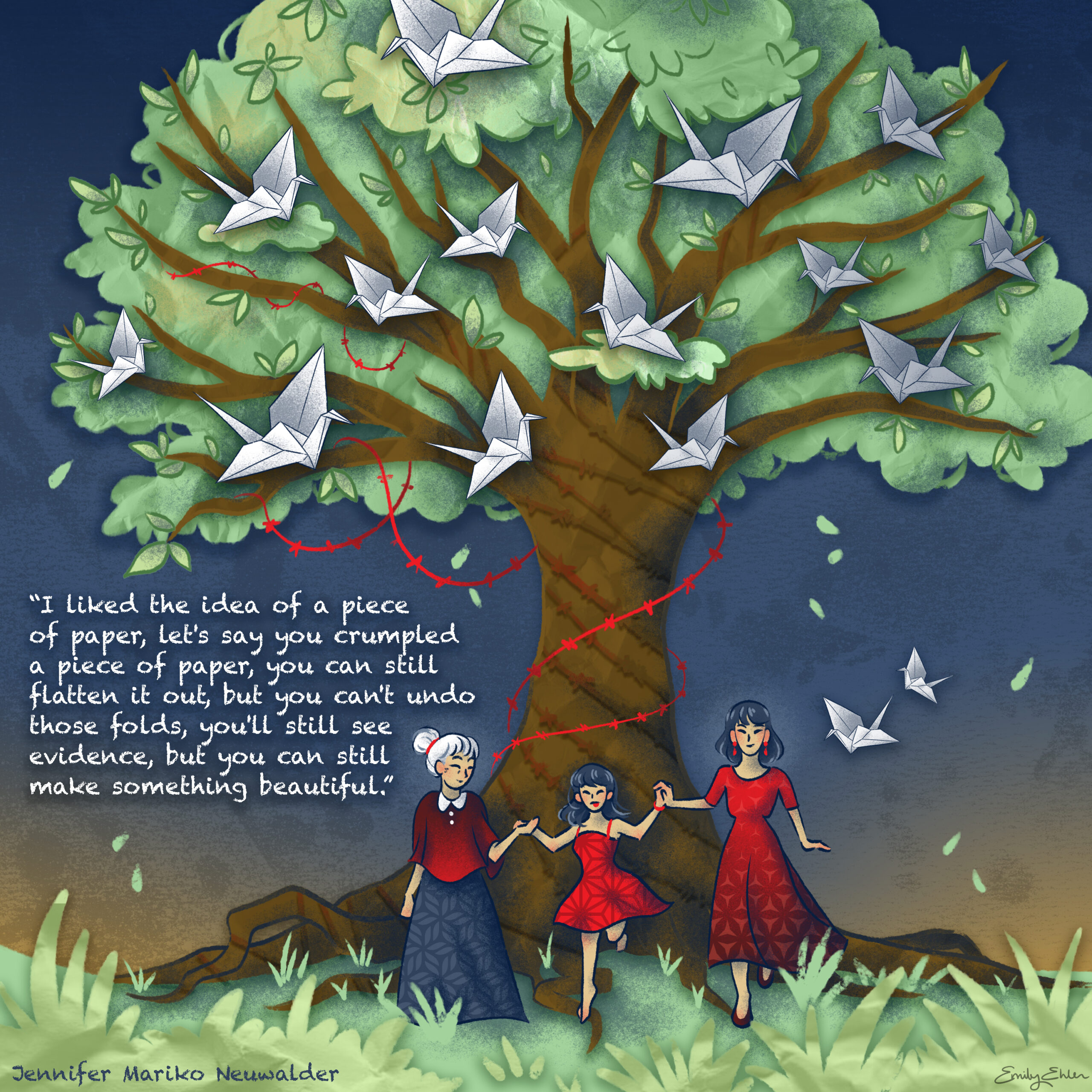
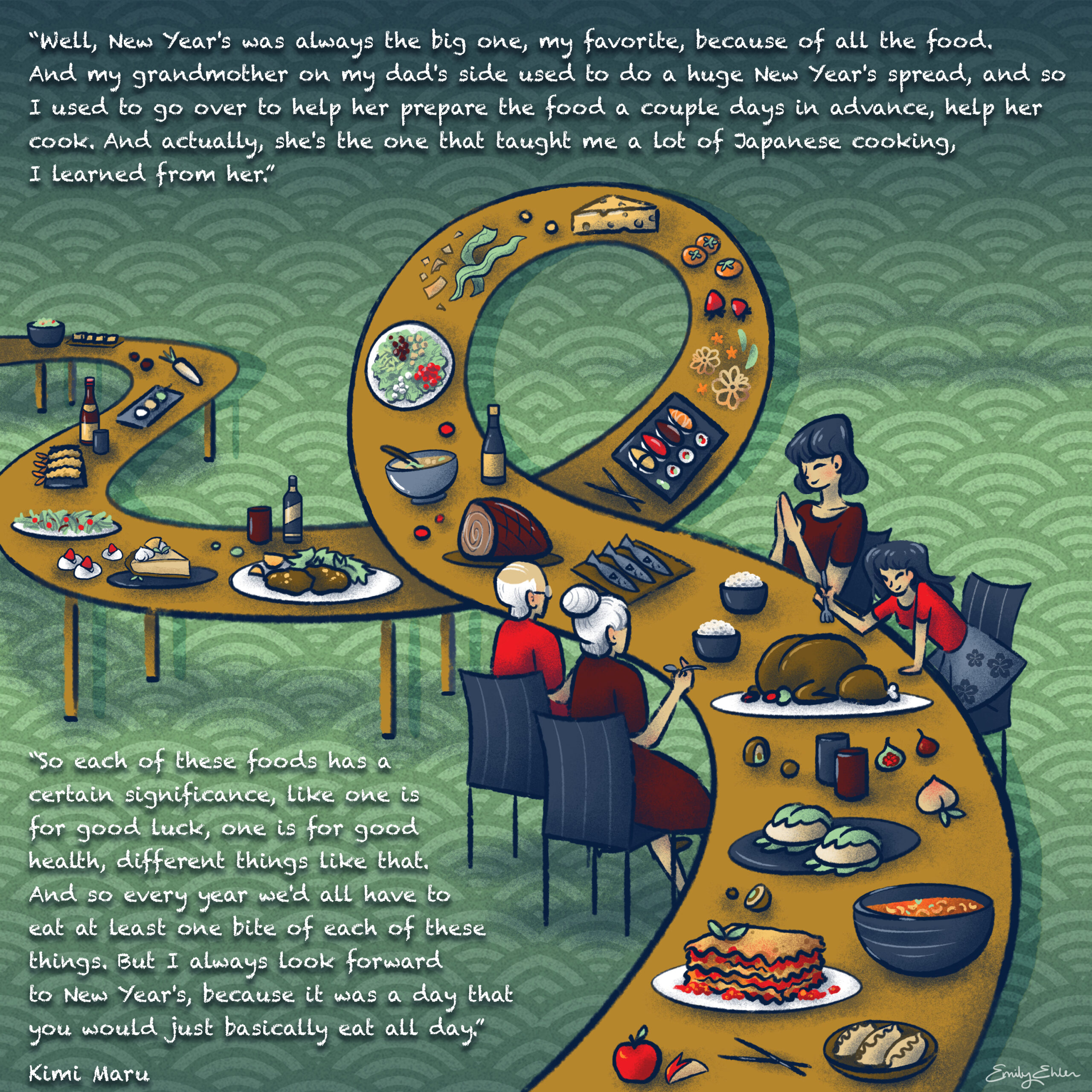
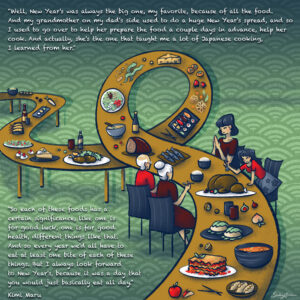
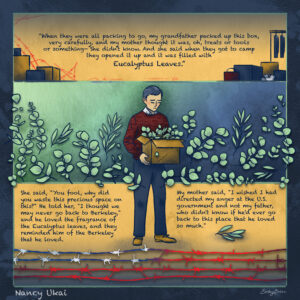
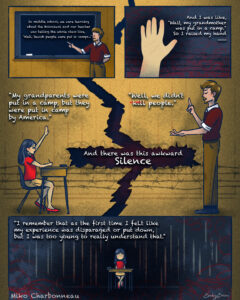
The OHC’s JAIN project documents and disseminates the ways in which intergenerational trauma and healing occurred after the United States government’s mass incarceration of Japanese Americans during World War II. The OHC team interviewed twenty-three Japanese American survivors and descendants of the World War II incarceration to investigate the impacts of healing and trauma, how this informs collective memory, and how these narratives change across generations. Initial interviews in the JAIN project focused on the Manzanar and Topaz prison camps in California and Utah, respectively. The JAIN project began at the OHC in 2021 with funding from the National Park Service’s Japanese American Confinement Sites Grant. The grant provided for 100 hours of new oral history interviews, as well as funding for a new season of The Berkeley Remix podcast and for Emily Ehlen’s unique artwork below, all based on the JAIN project oral histories.
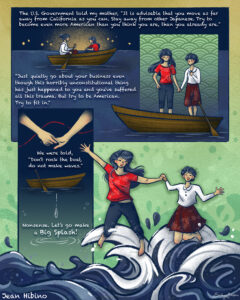
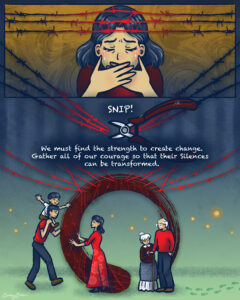
We encourage you to use and share Emily Ehlen’s artwork, along with the JAIN project oral history interviews, especially in classrooms when teaching the history and legacy of the World War II incarceration of Japanese Americans. When using these images, please credit Emily Ehlen as the artist (for example, Fig. 1, Ehlen, Emily, WAVE, digital art, 2023, Oral History Center, The Bancroft Library, University of California, Berkeley), and see the OHC website for more on permissions when using our oral histories. To save a digital copy of any illustration below for fair use, right click on the image and select “Save Image As…” The text description that accompanies each illustration below aims to provide accessibility for the visually impaired in lieu of Alt-Text limitations, which does not easily accommodate graphic narrative images. In a separate blog post, you can learn more about the artist Emily Ehlen and her processes while creating these dynamic illustrations drawn from the memories and reflections of JAIN oral history narrators.
Artist’s statement
Emily Ehlen’s illustrations for the Japanese American Intergenerational Narratives Oral History Project convey compelling narratives and imagery, with impactful shapes and color, by crafting traditionally and translating images into digital pieces. She uses text and imagery to balance the composition and support storytelling elements. Her work encompasses themes of identity and belonging, intergenerational connections, and healing. The collection navigates the impact and experiences of Japanese American incarceration during World War II and its effects on future generations.
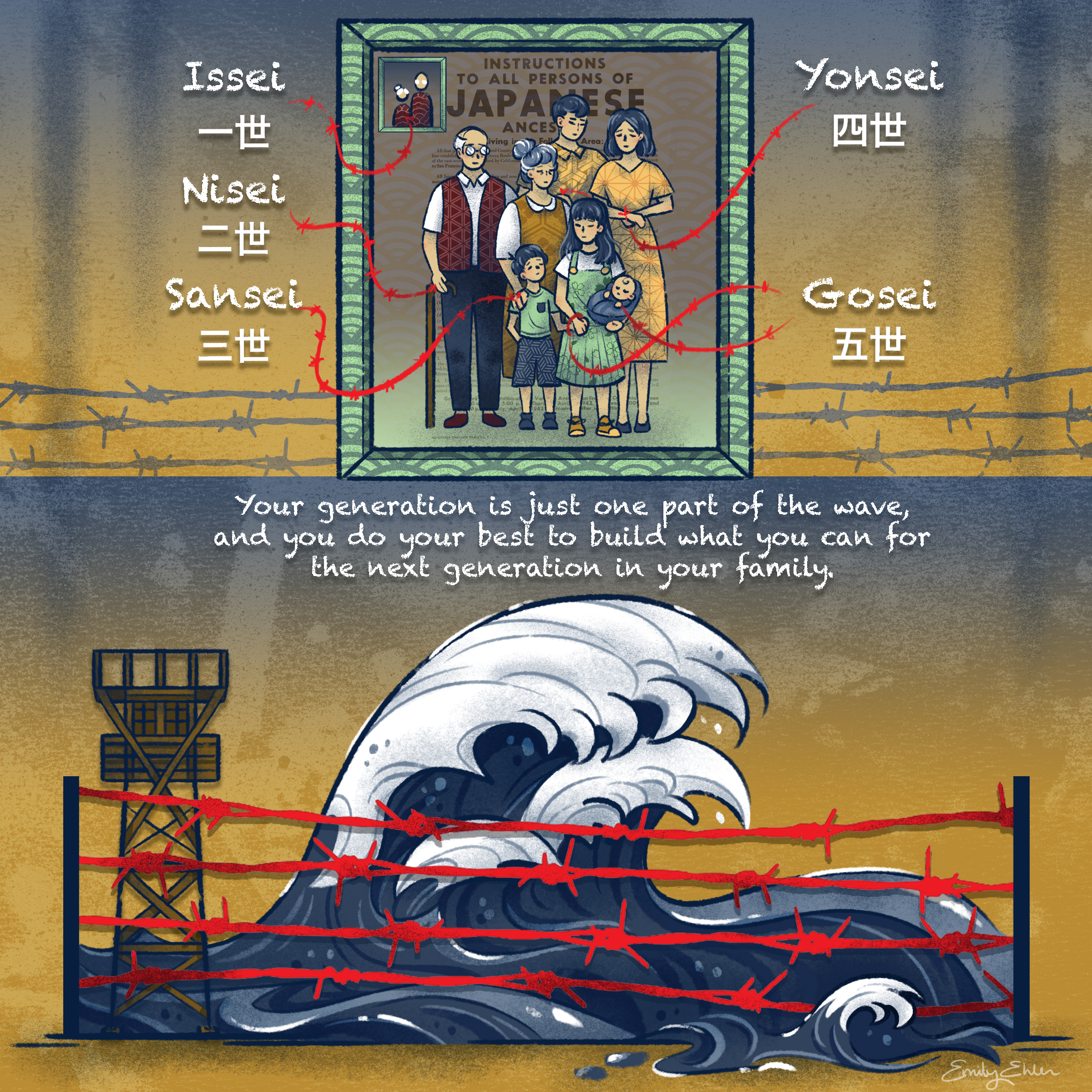
WAVE by Emily Ehlen
This image titled WAVE consists of two panels. The top panel depicts text that relates to the number of generations of Japanese descents surrounding a family portrait using barbed wires as arrows. The text is in romanized Japanese and kanji. It reads: “Issei,” meaning first generation; “Nisei,” meaning second generation; “Sansei,” meaning third generation; “Yonsei,” meaning fourth generation; and “Gosei,” meaning fifth generation. The bottom panel depicts a large wave and guard tower behind barbed wire with text above that reads, “Your generation is just one part of the wave, and you do your best to build what you can for the next generation in your family.”
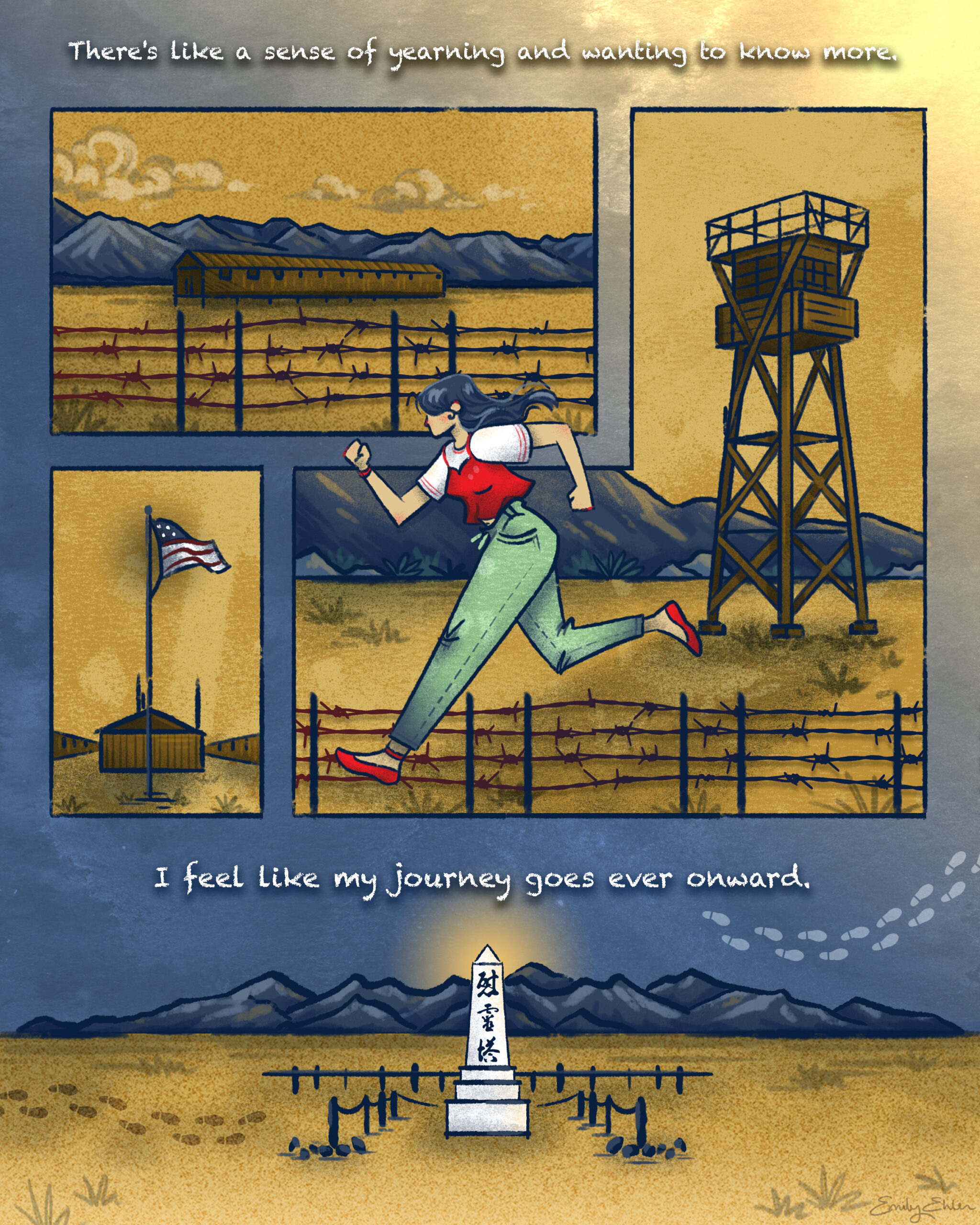
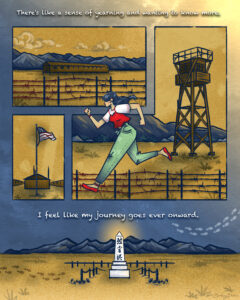
MANZANAR by Emily Ehlen
This image titled MANZANAR consists of four different panels. Each panel depicts a part of an incarceration camp and features barbed wire, the American flag, and the buildings in the camp. Above the top panel there is text that reads, “There’s like a sense of yearning and wanting to know more.” In the middle right panel, a woman in a red top layered over a white T-shirt and green pants runs towards the left of the image. The bottom panel depicts the cemetery monument at Manzanar National Historic Site, with Japanese kanji written on top, which reads, “I REI TO,” or “soul consoling tower.” Below the bottom panel there is text that reads, “I feel like my journey goes ever onward.”
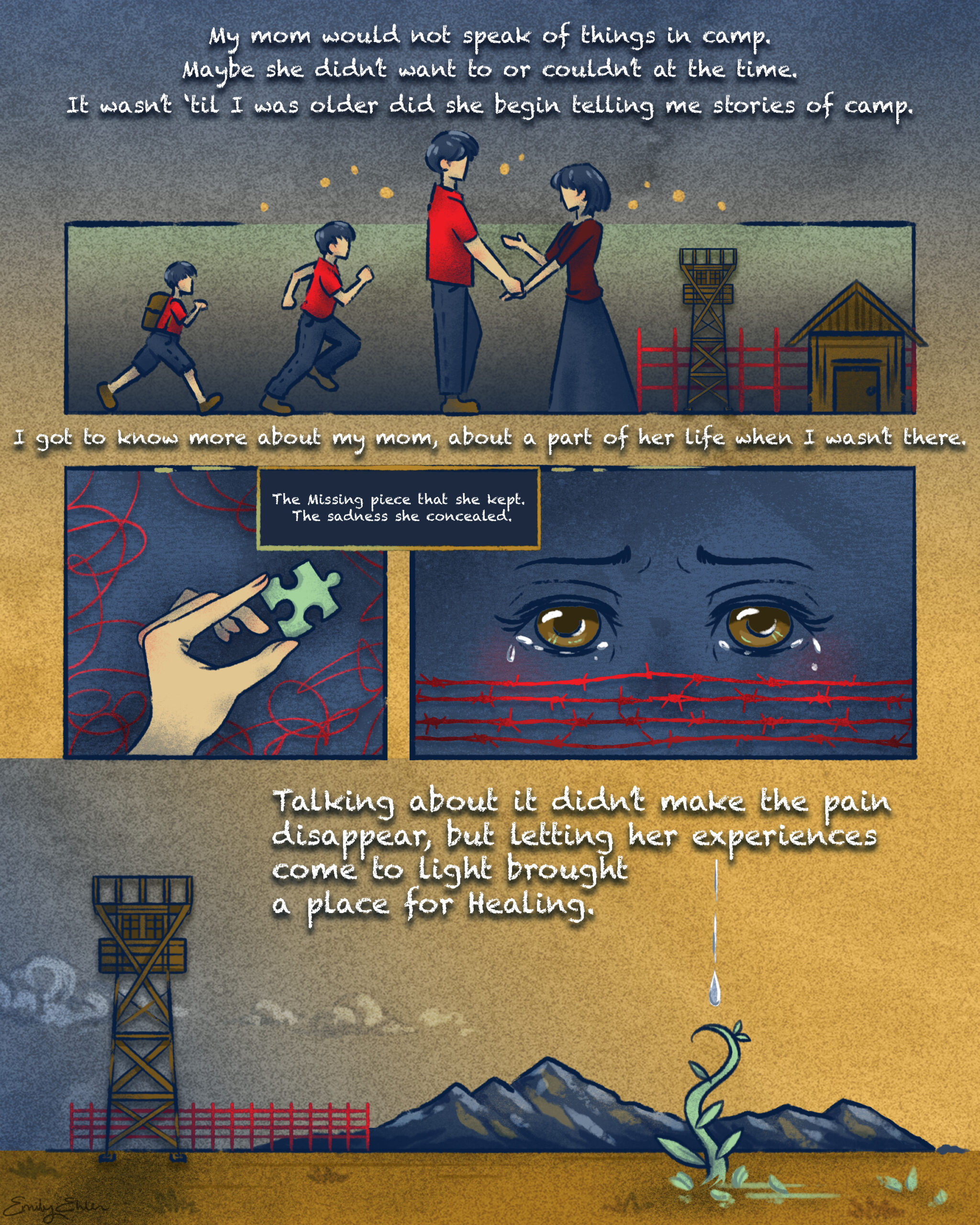
STORIES by Emily Ehlen
This image titled STORIES consists of four panels. The top panel depicts a growing boy talking to his mother. An incarceration camp appears behind the mother. Above this top panel, the text reads, “My mom would not speak of things in camp. Maybe she didn’t want to or couldn’t at the time. It wasn’t ’til I was older did she begin telling me stories of camp.” Under this top panel, the text reads, “I got to know more about my mom, about a part of her life when I wasn’t there.” Two middle panels follow, depicting a green puzzle piece and crying eyes behind barbed wire. The text between these panels reads, “The missing piece she kept. The sadness she concealed.” In the bottom panel, tears from the eyes above fall into a plant on the ground that is growing. The text on this panel reads, “Talking about it didn’t make the pain disappear, but letting her experiences come to light brought a place for healing.”
TEACHER by Emily Ehlen
This image titled TEACHER consists of four panels. The top left panel shows a male teacher next to a chalkboard. The text on the chalkboard reads, “In middle school, we were learning about the Holocaust, and our teacher was telling the whole class like, ‘Well, Jewish people were put in camps…'” The top right panel depicts a raised hand with text that reads, “And I was like, ‘Wait, my grandmother was put in a camp.’ So I raised my hand.” The middle panel depicts a girl sitting at a desk, a male teacher standing, and a large crack between them. On the left of the panel, the girl says, “My grandparents were put in a camp, but they were put in a camp by America.” The text in the large crack reads, “And there was this awkward silence.” The teacher responds, “Well, we didn’t kill people.” The word “kill” has a red strikethrough on it. The bottom panel depicts the girl at the desk alone in the dark. The text reads, “I remember that as the first time I felt like my experience was disparaged or put down, but I was too young to really understand that.” Text on the bottom left indicates these quotations are from Miko Charbonneau’s oral history for the Japanese American Intergenerational Narratives Oral History Project.
EUCALYPTUS by Emily Ehlen
This image titled EUCALYPTUS consists of three panels. The top panel depicts suitcases and boxes of various sizes, and includes text which reads, “When they were all packing to go, my grandfather packed up this box, very carefully, and my mother thought it was, oh, treats or tools, or something—she didn’t know. And she said when they got to camp and opened it up and it was filled with Eucalyptus Leaves.” The words “eucalyptus leaves” are larger than the other words. In the center, the grandfather stands in front of all of the panels with a box of eucalyptus leaves. He is looking down with a sad expression. The bottom panel depicts some eucalyptus leaves as well as barbed wire that mimics the red, white, and blue of an American flag. This panel includes text which reads, “She said, ‘You fool, why did you waste this precious space on this?’ He told her, ‘I thought we may never go back to Berkeley,’ and he loved the fragrance of the Eucalyptus leaves, and they reminded him of the Berkeley he loved. My mother said, ‘I wished I had directed my anger at the U.S. government and not my father, who didn’t know if he’d ever go back to this place that he loved so much.'” Text on the bottom left indicates these quotations are from Nancy Ukai’s oral history for the Japanese American Intergenerational Narratives Oral History Project.
SPLASH by Emily Ehlen
This image titled SPLASH consists of two panels on the top and two on the bottom. The top left panel depicts a younger woman and an older woman in a boat. Text above the top two panels reads, “The U.S. Government told my mother, ‘It is advisable that you move as far away from California as you can. Stay away from other Japanese. Try to become even more American than you think you are, than you already are.'” The top right panel depicts the two women holding hands and standing in the boat. The text below these panels reads,”‘Just quietly go about your business even though this horribly unconstitutional thing has just happened to you and you’ve suffered all this trauma. But try to be American. Try to fit in.'” The bottom left panel depicts a close-up of the women holding hands above the boat and a ripple in the water. Beneath the hands, the text reads, “We were told, ‘Don’t rock the boat, do not make waves.” Beneath the boat, the text reads, “Nonsense. Let’s go make a Big Splash!” The bottom right panel depicts the two women holding hands and jumping into a sea of waves. Text on the bottom left indicates these quotations are from Jean Hibino’s oral history for the Japanese American Intergenerational Narratives Oral History Project.
TOPAZ by Emily Ehlen
This image titled TOPAZ consists of four panels. The top panel depicts white stars behind barbed wire in red and blue that mimics the American flag, as well as a guard tower. The next panel depicts footsteps with plants sprouting from the final four steps. To the right of the footsteps, a white paper crane rests on soil. Red and blue barbed wire appears in the background. Text at the bottom of this panel reads, “The path we make will help us and others heal.” The bottom two panels depict barbed wire at the top and bottom, which frame a group of people all holding hands walking to the right. The group of people, which includes a range of ages, spans both panels. The individuals have glowing lights over their hearts. Plants sprout from the bottom of this panel.
SILENCES by Emily Ehlen
This image titled SILENCES consists of two panels. In the top panel, a woman cries while framed by red barbed wire. The bottom panel depicts wire cutters snipping the red barbed wire. Text reads, “SNIP!” Beneath the barbed wire is text that reads, “We must find the strength to create change. Gather all of our courage so that their silences can be transformed.” Beneath this text is a scene depicting a man with a child on his shoulders moving toward a woman with open arms. To the right of them are an elderly woman and man. Behind the group of people, there is a large, red circular ensō formed from the barbed wire. Glowing lights also appear in the background.
TREE by Emily Ehlen
This image titled TREE consists of one panel, depicting three women of different generations holding hands in front of a large tree wrapped in red barbed wire and filled with white paper cranes. This image includes text which reads, “‘I liked the idea of a piece of paper, let’s say you crumpled a piece of paper, you can still flatten it out, but you can’t undo those folds, you’ll still see evidence, but you can still make something beautiful.” Text on the bottom left indicates these quotations are from Jennifer Mariko Neuwalder’s oral history for the Japanese American Intergenerational Narratives Oral History Project.
FEAST by Emily Ehlen
This image titled FEAST consists of one panel that depicts a long table that stretches from the left side to the bottom right which loops before reaching four people of different generations eating. The food on the table includes a variety of foods like sushi, lasagna, salad, turkey, and dumplings. Text at the top of the image reads, “‘Well, New Year’s was always the big one, my favorite, because of all the food. And my grandmother on my dad’s side used to do a huge New Year’s spread, and so I used to go over to help her prepare the food a couple days in advance, help her cook. And actually, she’s the one that taught me a lot of Japanese cooking, I learned from her.'” Text on the bottom left of the image reads,, “‘So each of these foods has a certain significance, like one is for good luck, one is for good health, different things like that. And so every year we’d all have to eat at least one bite of each of these things. But I always look forward to New Year’s, because it was a day that you would just basically eat all day.'” Text on the bottom left indicates these quotations are from Kimi Maru’s oral history for the Japanese American Intergenerational Narratives Oral History Project.
Acknowledgments for the Japanese American Intergenerational Narratives Oral History Project
This project was funded, in part, by a grant from the U.S. Department of the Interior, National Park Service, Japanese American Confinement Sites Grant Program. The views and conclusions contained in this document are those of the authors and should not be interpreted as representing the opinions or policies of the U.S. government. Mention of trade names or commercial products does not constitute their endorsement by the U.S. Government.
This material received federal financial assistance for the preservation and interpretation of U.S. confinement sites where Japanese Americans were detained during World War II. Under Title VI of the Civil Rights Act of 1964, Section 504 of the Rehabilitation Act of 1973, and the Age Discrimination Act of 1975, as amended, the U.S. Department of the Interior prohibits discrimination on the basis of race, color, national origin, disability or age in its federally funded assisted projects. If you believe you have been discriminated against in any program, activity, or facility as described above, or if you desire further information, please write to:
Office of Equal Opportunity
National Park Service
1201 Eye Street, NW (2740)
Washington, DC 20005
ABOUT THE ORAL HISTORY CENTER
The Oral History Center of The Bancroft Library preserves voices of people from all walks of life, with varying political perspectives, national origins, and ethnic backgrounds. We are committed to open access and our oral histories and interpretive materials are available online at no cost to scholars and the public. You can find our oral histories from the search feature on our home page. Search by name, keyword, and several other criteria. Sign up for our monthly newsletter featuring think pieces, new releases, podcasts, Q&As, and everything oral history. Access the most recent articles from our home page or go straight to our blog home.
Please consider making a tax-deductible donation to the Oral History Center if you’d like to see more work like this conducted and made freely available online. The Oral History Center is a predominantly self-funded research unit of The Bancroft Library. As such, we must raise the funds to cover the cost of all the work we do, including each oral history. You can give online, or contact us at ohc@berkeley.edu for more information about our funding needs for present and future projects.
Emily Ehlen graduated from Ringling College of Art and Design and lives in Florida.
For the first time, the Oral History Center, or OHC, partnered with an artist named Emily Ehlen, who created ten graphic narrative illustrations based upon stories and themes recorded in the OHC’s Japanese American Intergenerational Narratives Oral History Project, or JAIN project. The JAIN project documents and disseminates the ways in which intergenerational trauma and healing occurred after the United States government’s mass incarceration of Japanese Americans during World War II.
WAVE by Emily Ehlen
The OHC’s JAIN project documents and disseminates the ways in which intergenerational trauma and healing occurred after the United States government’s mass incarceration of Japanese Americans during World War II. The OHC team interviewed twenty-three Japanese American survivors and descendants of the World War II incarceration to investigate the impacts of healing and trauma, how this informs collective memory, and how these narratives change across generations. Initial interviews in the JAIN project focused on the Manzanar and Topaz prison camps in California and Utah, respectively. The JAIN project began at the OHC in 2021 with funding from the National Park Service’s Japanese American Confinement Sites Grant. The grant provided for 100 hours of new oral history interviews, as well as funding for a new season of The Berkeley Remix podcast and Emily Ehlen’s unique artwork, all based on the JAIN project oral histories.
Below is an interview with Emily Ehlen about her processes in creating such dynamic illustrations drawn from the memories and reflections of JAIN oral history narrators. You can see and save copies of larger images of Emily’s artwork for the JAIN project in a separate blog post.
Artist Bio:
Emily Ehlen is best known for her colorful and whimsical illustrations using mixed media. Watercolor, ink, spray paint, and gouache are the primary mediums she uses for her traditional works, and she also integrates them in her digital pieces. She loves being positive and expressing her interests while using her surroundings as inspiration. To invoke curiosity and imagination, her drawings reflect an open view of the subject and are framed with pieces of expression and reality. Change and adaptability are a constant as she goes through various experimentations and approaches to her art.
Q&A with artist Emily Ehlen:
Q: What was your process for creating the Japanese American Intergenerational Narratives artwork?
Draft version of SILENCES by Emily Ehlen
Emily Ehlen: My process started with selecting powerful imagery and phrases in relation to connecting themes found throughout the oral history transcripts. I composed thumbnails with the intent to represent the information clearly and use symbolism to convey the narrative. I wanted to use as much text from the source as I could, but I wanted to avoid it being too word heavy. It was a balancing act of editing the text and imagery to support each other in the composition and narrative. After developing and consolidating the initial drafts I moved on to tighter linework and color concepts. Once the colors were established, I inlaid patterns and handmade textures to add contrast between objects, panels, and the background. The handmade textures were made with ink washes and spray paint. The final step was applying shading and details to enhance the focus of each element while also keeping the flow throughout the entire composition.
Q: How was your work on this project similar or different to your prior art projects?
A section from Emily Ehlen’s comic “Weaver’s Weaver,” about Kay Sekimachi
Emily Ehlen: This Japanese American Intergenerational Narratives art project was similar to the comic series Drawn to Art: Tales of Inspiring Women Artists that I worked on in 2021 for the Smithsonian American Art Museum. For that Smithsonian project, I drew a three page comic called “Weaver’s Weaver,” featuring Kay Sekimachi, a Japanese American artist. My process for both projects were pretty identical. Although, I think I had a little more freedom with expanding the storytelling elements working on the JAIN project comics. Overall, they were mutually great experiences that I am so grateful to have been a part of.
Q: How did engaging with the Japanese American Intergenerational Narratives oral history transcripts shape the stories you chose to tell and some of the imagery you used in your graphic art?
FEAST by Emily Ehlen
Emily Ehlen: When drafting the concepts of the illustrations, I wanted to use imagery that would convey the message the stories presented. Reading the oral history transcripts, I found lots of interesting details to include, like with the different types of food to include in the FEAST composition. It was inspiring to hear everyone’s unique voice sharing aspects about their and their family’s lives.
Q: How did you choose the various scenes and stories that you eventually depicted? What stories in the transcripts most stood out to you? Why?
EUCALYPTUS by Emily Ehlen
Emily Ehlen: I illustrate with the goal to portray a story the audience can connect and respond to. I wanted to choose stories with lots of emotions that I could highlight in each drawing. The piece I got the most emotional while drawing was Nancy Ukai’s grandfather in EUCALYPTUS. I sympathized with the longing and sadness of missing Berkeley that her grandfather felt. I understood the rationality behind using the box for something else, but that emphasized just how important Berkeley was to him. It was heartbreaking to read, so I knew I had to draw it.
Q: What are some of the story themes that you worked to express throughout your art for this project?
TEACHER by Emily Ehlen
Emily Ehlen: The focus was how the Japanese American incarceration during World War II impacted themselves, their families, and how they responded to it. The themes were identity and belonging, intergenerational connections, and healing. I wanted the weight of the words to be carried through to the art accompanied with them.
Q: Can you describe some of the visual themes or repeated imagery that you incorporated throughout the various pieces you created? How and why did you develop these visual themes?
TREE by Emily Ehlen
Emily Ehlen: The color palette I used helped create the tone and atmosphere of each piece separately while also keeping the collection cohesive. The red was used with duality: the bright saturated hue represented youth, rebelliousness, and intensity; while the dark maroon represented authority and repressed quietness. The soft green color was used to depict change and positivity that connects to the healing theme. The navy blue signifies unity and freedom, but it is used with a sense of serenity and heaviness. For example, the blue in TEACHER extrudes an overbearing presence in contrast to when it’s used in TREE. The ochre yellow has different meanings for its surroundings, like in TEACHER it signifies uncertainty, and in STORIES it’s used to display hope.
STORIES by Emily Ehlen
The water pattern, waves, and watercolor texture are used with family elements, and it contrasts the dry gritty spray paint texture that references the environment of Topaz and Manzanar. Waves are symbols of growth, renewal, and transformation. They also represent the unpredictability of life, to which people learn to navigate its ups and downs. The plants and paper cranes also relate to family connections, development, and healing, going through many stages and flourishing together.
For darker imagery, I wanted the red barbed wire to be synonymous with the red stripes we see on the American flag. To show the lack of freedom and injustice that the Japanese Americans faced, those stripes became wire that entrapped and left scars on following generations. The guard towers were a beacon of looming authority and danger at the incarceration camps. They became a mental block for some that were confined in their silences.
Q: While creating the JAIN art, what did you learn that was new to you?
TOPAZ by Emily Ehlen
Emily Ehlen: I really enjoyed learning about everyone’s perspectives and experiences with being Japanese American. I am Chinese American, so I empathize with the stories about identity and the sense of belonging. This project lit up my desire to discover more about my culture. My motivation for drawing is to see how my art mirrors my development as a person. I think art is a record of growth and change. Like time, it never stops moving forward.
Q: Can you describe one or two of your favorite pieces that you created for this project? Why does this one stand out for you?
SPLASH by Emily Ehlen
Emily Ehlen: This is like asking the question, “Who’s your favorite child?” It’s super difficult because I love each piece for different reasons. I had the most fun drawing the piece SPLASH, about Jean Hibino and her mother. I think it has the most dynamic composition with how the imagery flows together with the text. I like the sequence of stillness to movement, and how a ripple can start a wave.
Q: What are your hopes for how people engage with your art for this project? Who do you hope sees it? What do you hope people take away from your art for this project?
MANZANAR by Emily Ehlen
Emily Ehlen: My hope for how people engage with the comic is to have open conversations about them or topics related to it. It would be nice to see what sticks out to people the most and what connections they make through their perspectives. I hope people are able to feel the sentiments in each piece and learn new aspects of its history. I can’t think of anyone specific I’d want to see it, but I strive to be someone who inspires others by taking creative approaches to new ideas. So, I hope other artists who are interested in drawing and story-telling see it
You can see and save copies of larger images of the graphic art that Emily Ehlen created for the Japanese American Intergenerational Narratives Oral History Project in a separate blog post. We encourage you to use and share Emily Ehlen’s artwork, along with the JAIN project oral history interviews, especially in classrooms when teaching the history and legacy of the World War II incarceration of Japanese Americans. When using these images, please credit Emily Ehlen as the artist (for example, Fig. 1, Ehlen, Emily, WAVE, digital art, 2023, Oral History Center, The Bancroft Library, University of California, Berkeley), and see the OHC website for more on permissions when using our oral histories.
Acknowledgments for the Japanese American Intergenerational Narratives Oral History Project
SILENCES by Emily Ehlen
This project was funded, in part, by a grant from the U.S. Department of the Interior, National Park Service, Japanese American Confinement Sites Grant Program. The views and conclusions contained in this document are those of the authors and should not be interpreted as representing the opinions or policies of the U.S. government. Mention of trade names or commercial products does not constitute their endorsement by the U.S. Government.
This material received federal financial assistance for the preservation and interpretation of U.S. confinement sites where Japanese Americans were detained during World War II. Under Title VI of the Civil Rights Act of 1964, Section 504 of the Rehabilitation Act of 1973, and the Age Discrimination Act of 1975, as amended, the U.S. Department of the Interior prohibits discrimination on the basis of race, color, national origin, disability or age in its federally funded assisted projects. If you believe you have been discriminated against in any program, activity, or facility as described above, or if you desire further information, please write to:
Office of Equal Opportunity
National Park Service
1201 Eye Street, NW (2740)
Washington, DC 20005
ABOUT THE ORAL HISTORY CENTER
The Oral History Center of The Bancroft Library preserves voices of people from all walks of life, with varying political perspectives, national origins, and ethnic backgrounds. We are committed to open access and our oral histories and interpretive materials are available online at no cost to scholars and the public. You can find our oral histories from the search feature on our home page. Search by name, keyword, and several other criteria. Sign up for our monthly newsletter featuring think pieces, new releases, podcasts, Q&As, and everything oral history. Access the most recent articles from our home page or go straight to our blog home.
Please consider making a tax-deductible donation to the Oral History Center if you’d like to see more work like this conducted and made freely available online. The Oral History Center is a predominantly self-funded research unit of The Bancroft Library. As such, we must raise the funds to cover the cost of all the work we do, including each oral history. You can give online, or contact us at ohc@berkeley.edu for more information about our funding needs for present and future projects.
Banner for “Voices for the Environment” exhibit outside The Bancroft Library
We’re excited to announce the opening of Voices for the Environment: A Century of Bay Area Activism, a Bancroft Library Gallery exhibition that was curated by Todd Holmes, Roger Eardley-Pryor, and Paul Burnett of the Oral History Center. Voices for the Environment traces the evolution of environmentalism in the San Francisco Bay Area across the twentieth century. In three sections, it highlights how Bay Area activists have long been on the front lines of environmental change—from efforts to preserve natural spaces in the wake of the 1906 San Francisco earthquake and fire, to the midcentury fight for state regulations to protect San Francisco Bay shoreline, to more recent demands for environmental justice to address the disproportionate burden of pollution that sickened communities of color around the Bay.
Visitors experience the “Voices for the Environment” exhibit, curated by the Oral History Center, in The Bancroft Library Gallery
Our Voices for the Environment exhibit is the first major effort in The Bancroft Library Gallery to showcase oral history alongside the traditional archival collections of The Bancroft Library, with the oral history collections leading the way. The exhibit still features historic photographs, pamphlets, post cards, and posters selected from several collections of The Bancroft’s physical archives. But for the first time in this gallery, our Voices for the Environment exhibit also includes three installations of special Audio Spotlight technology where you can listen to never-before-heard oral history recordings with Bay Area environmentalists, while simultaneously watching three videos edited by Todd Holmes that feature historic photographs and rare film footage from The Bancroft’s digital collections. Additionally, as a complement to the exhibit, curators Todd Holmes and Roger Eardley-Pryor created an educational workbook, so students of all ages can learn about the environmental movement by engaging with the themes and primary sources on display. Through these efforts, the Oral History Center hopes Voices for the Environment will have a life beyond its yearlong run.
Podcasts for “Voices for the Environment” were produced by Todd Holmes and Roger Eardley-Pryor of the Oral History Center, with help from Sasha Khokha of KQED. The podcast images, and the exhibit space, were designed by Gordon Chun.
For an even deeper dive, you can also scan a QR code in the gallery, or click the following link, to hear three Voices for the Environment podcast episodes produced in partnership with Sasha Khokha of KQED Public Radio and The California Report Magazine. The podcast episode for section 1 of the exhibit, titled “A Preservationist Spirit,” traces the environmental activism that arose amid the rebuilding efforts of San Francisco after the 1906 earthquake and fire, efforts that came to target the state’s ancient redwood forests and the beloved Hetch Hetchy Valley in Yosemite National Park. The episode features historic interviews from the Oral History Center archives including segments from the “Growing Up in the Cities” collection recorded in the late 1970s by Frederick M. Wirt, as well as oral history interviews with Carolyn Merchant recorded in 2022, with Ansel Adams recorded in the mid-1970s, and with David Brower recorded in the mid-1970s. The oral history of William E. Colby from 1953 was voiced by Anders Hauge, and the oral history of Francis Farquhar from 1958 was voiced by Ross Bradford. This first episode also features audio from the film Two Yosemites, directed and narrated by David Brower in 1955. The podcast episode for section 2 of the exhibit, titled “Tides of Conservation,” tells the story of the Save San Francisco Bay movement and the creation of the San Francisco Bay Conservation and Development Commission (BCDC), one the nation’s first environmental regulatory agencies. The episode features segments from oral history interviews with Save The Bay founders Esther Gulick, Catherine “Kay” Kerr, and Sylvia McLaughlin recorded in 1985; as well as interviews with BCDC executive director Joseph Bodovitz and chairman Melvin B. Lane, both recorded in 1984. And the podcast episode for section 3 of the exhibit, titled “Environmental Justice for All,” spotlights efforts by communities of color to place the health of people within the environmental agenda, including creation of new environmental organizations like the West County Toxics Coalition, the Urban Habitat Program, and APEN (Asian Pacific Environmental Network), all founded in the Bay Area. The episode features segments from oral history interviews with Carl Anthony, Pamela Tau Lee, Henry Clark, and Ahmadia Thomas, all recorded in 1999 and 2000.
The Voices for the Environment exhibition space was designed by Gordon Chun and is free and open to the public Monday through Friday between 10am to 4pm from Oct. 6, 2023 to Nov. 15, 2024, in The Bancroft Library Gallery, located just inside the east entrance of The Bancroft Library.
The Oral History Center of The Bancroft Library preserves voices of people from all walks of life, with varying political perspectives, national origins, and ethnic backgrounds. We are committed to open access and our oral histories and interpretive materials are available online at no cost to scholars and the public. You can find our oral histories from the search feature on our home page. Search by name, keyword, and several other criteria. Sign up for our monthly newsletter featuring think pieces, new releases, podcasts, Q&As, and everything oral history. Access the most recent articles from our home page or go straight to our blog home.
Please consider making a tax-deductible donation to the Oral History Center if you’d like to see more work like this conducted and made freely available online. While we receive modest institutional support, we are a predominantly self-funded research unit of The Bancroft Library. We must raise the funds to cover the cost of all the work we do, including each oral history. You can give online, or contact us at ohc@berkeley.edu for more information about our funding needs for present and future projects.