International Collaboration (VŠE Prague, UT Austin, UC Berkeley) Builds Agentic AI System for CIA FOIA Archives

International Collaboration (VŠE Prague, UT Austin, UC Berkeley) Builds Agentic AI System for CIA FOIA Archives

Prague / Austin / Berkeley — A new international research collaboration has developed and tested a multi-stage “agentic AI” system capable of extracting structured historical knowledge from large, unstructured digital archives. Using declassified CIA documents as a case study, the research demonstrates how artificial intelligence can help transform thousands of pages of scanned archival material into a coherent, time-resolved narrative, making Cold War-era intelligence reporting significantly more accessible for the wider public.

The study, published in The Electronic Library, focuses on one of the most dramatic turning points in modern European history: the Prague Spring reforms and the subsequent Soviet-led invasion of Czechoslovakia in 1968. By applying AI-driven processing to the CIA’s FOIA Electronic Reading Room, the team shows how today’s large language models (LLMs) can support the systematic reconstruction of historical reporting, while also highlighting the continued need for expert human oversight to preserve nuance, accuracy, and interpretive integrity.

This makes the research immediately useful not only for historians, but also for institutions deciding how to deploy AI responsibly at scale: libraries, archives, universities, and even public sector organizations managing large document collections.

A Collaboration Across Three Institutions and Disciplines

The project brings together expertise from three leading academic environments:

Prague University of Economics and Business contributed primarily to the design of the agentic workflow, the methodological framing of the solution, and the evaluation of the models, including the comparison of metrics, the analysis of the CIA FOIA Reading Room entity data structure, and the resulting information-ethical questions.

The University of Texas at Austin provided expert context in geopolitical and historical studies, which enabled grounding the case study and interpreting the results within the history of the Cold War.

UC Berkeley contributed a perspective from information science and librarianship, including work with digital collections and archival processing practice, which strengthened the applicability of the workflow for digital archives, libraries, and research organizations focused on history.

This cross-disciplinary cooperation reflects a growing reality: solving “big archive” challenges requires not only technical innovation, but also domain expertise and information science know-how.

From 2,122 Pages to Usable Knowledge: What the System Achieved

The research introduces an eight-agent workflow designed to mirror the real tasks historians and intelligence researchers face when working with archival material. The system was applied to 201 President’s Daily Brief documents, spanning January 1968 to January 1969, totaling 2,122 pages from the CIA’s FOIA Electronic Reading Room.

The AI pipeline produced three key outputs:

  1. A month-by-month narrative summary of intelligence reporting on Czechoslovakia
  2. A structured list of key named entities (people, organizations, events) organized chronologically
  3. A thematic quantification of reporting, measuring how much attention was given to political, societal, economic, and tactical military topics

To reduce noise and improve relevance, the system used OCR (optical character recognition) and automated filtering. Out of more than 1.37 million characters extracted via OCR, the pipeline isolated 265,550 characters of relevant intelligence content, achieving an extraction rate of 19.3%—meaning over 80% of raw text was correctly removed as irrelevant metadata or unrelated content.

Why This Matters for Society

This research tackles a quiet but serious societal problem: massive collections of historically valuable documents exist but remain effectively “locked away” because they are not machine-readable or searchable in meaningful ways.

Many declassified archives—especially scanned collections—are technically accessible but practically unusable without months (or years) of manual work. By introducing a replicable agentic workflow, the study shows how AI can:

  • expand access to historical primary sources
  • reduce routine work (searching, cleaning, extracting, organizing)
  • support transparency and democratic access to government records
  • enable deeper analysis of geopolitical crises through time-resolved narratives

The research is grounded in the democratic logic behind the US Freedom of Information Act (FOIA): that an informed public is essential for a functioning democracy. In this context, AI becomes more than a productivity tool—it becomes a method for scaling public understanding of complex historical events.

A Key Message: AI Helps, But Experts Still Matter

A central conclusion is clear and responsible: fully automated historical analysis is not yet feasible without risk. OCR errors, model instability, and interpretive ambiguity remain real challenges.

The authors emphasize the need for human-in-the-loop workflows, where AI accelerates extraction and structuring, while experts validate, interpret, and preserve historical nuance.

In other words: AI can carry the heavy boxes—but humans still need to read the labels.

Main Takeaways

This research offers a practical and forward-looking message for archives, universities, and society:

  • Agentic AI can turn unstructured archives into structured knowledge
  • Large language models can support digital humanities at scale
  • Model selection must be based on measurable trade-offs (quality, cost, speed, stability)
  • Human oversight remains essential for credibility
  • The approach is replicable beyond Cold War history, and can be extended to other FOIA collections and geopolitical contexts

About the Publication

The study was published in The Electronic Library under the title:
“A multi-stage agentic AI system for extracting information from large digital archives: case study on the Czechoslovak year 1968 in CIA’s FOIA collection.”

Reference: Černý J, Avramov K, Pendse LR (2026;), “A multi-stage agentic AI system for extracting information from large digital archives: case study on the Czechoslovak year 1968 in CIA’s FOIA collection”. The Electronic Library, Vol. ahead-of-print No. ahead-of-print. https://doi.org/10.1108/EL-06-2025-0272


Publisher Highlight: Unnamed Press

banner for unnamed press

In 2015, Publishers Weekly declared that Unnamed Books was “Creating Home For Contemporary Authors.”[1] At that point, the small, LA-based publisher was still only getting off the ground. In the early 2010s, Chris Heiser and Olivia Taylor Smith decided to go into independent publishing. In 2013, the two started with the name Ricochet Books, but USC had already claimed the name “Ricochet” in 2012. In 2014, they chose to rebrand as Unnamed Press, with the intention of providing a space for international literature. Their early titles included works like Deji Olukotun’s Nigerians in Space and Rocío Cerón’s Diorama.[2]

Since then, the press has expanded to become “general interest.”[2] In 2024, that included the creation of their Smith & Taylor Classics imprint with titles such as Vernon Lee’s Hauntings: And Other Stories. To continue pushing literature and providing spaces for experimental literature, in 2025 the press started a poetry line. That line often includes audio components on vinyl (https://www.unnamedpress.com/vinyl) with titles such as Emma Ruth Rundle’s The Bella Vista: Poems.[3]

Readers can find out more about their titles on the website (https://www.unnamedpress.com/) or on their Instagram page (https://www.instagram.com/unnamedpress/).

Recent Titles

For additional titles at UC Berkeley

Readers can find more material through a publisher focus in our UC Library Search. Select titles are available for circulation in Doe’s Main Stacks while others are in our special collections in Bancroft (UC Library search limited to special collections). See individual catalog entries for location.

Notes

[1] Anisse Gross, “Unnamed Press Creating Home For Contemporary Authors,” PublishersWeekly.Com, February 27, 2015, https://www.publishersweekly.com/pw/by-topic/industry-news/publisher-news/article/65736-unnamed-press-creating-home-for-contemporary-authors.html.

[2] Edward Nawotka, “LA’s Unnamed Press: Relatable Foreign Fiction, Unlikely Protagonists,” Publishing Perspectives, July 18, 2014, https://publishingperspectives.com/2014/07/las-unnamed-press-relatable-foreign-fiction-unlikely-protagonists/.

[3] “About,” Unnamed Press, accessed January 12, 2026, https://www.unnamedpress.com/about-1.

[4] Nathalie op de Beeck, “Unnamed Press Develops Cross-Media Poetry Line,” PublishersWeekly.Com, accessed January 12, 2026, https://www.publishersweekly.com/pw/by-topic/industry-news/publisher-news/article/97014-unnamed-press-develops-cross-media-poetry-line.html.


La Hora (Uruguay) on Sitios de Memoria Uruguay

La Hora is an essential primary source for scholars of Latin American political and economic history. This period marked a decline in Uruguay’s historic democratic stability — marked by high inflation, government, crackdowns on leftist political movements. La Hora offers a unique lens on the political conditions that led to significant social changes in Uruguay. “Sitios de Memoria Uruguay” has digitized forty-two issues of La Hora from 1984 to 1989.

This website is an independent initiative by the Sitios de Memoria Uruguay collective, supported by organizations central to the struggle for memory, truth, justice, and reparation.

The site description is as follows,” La Hora (diario cooperativo) fue un diario vinculado al Partido Comunista del Uruguayo, pero a la que se integraban periodistas de otros sectores del Frente Amplio. Sus números se publicaron entre 1984 (aún en dictadura) y 1989, año en que se fusionó con El Popular. De esa fusión surgió el diario “La Hora Popular”, publicado entre 1989 y 1991. El antecedente inmediato a la aparición de “La Hora” fue la publicación “Cinco días”, editada durante solo 4 semanas entre marzo y abril de 1984 hasta su clausura.

La Hora tuvo suplementos temáticos, como “La Hora sindical”, “Liberación” y “La Hora Internacional”. En los casos en que la publicación completa pudo obtenerse, estos suplementos se presentan integrados dentro de un mismo archivo. Cuando solo pudo conseguirse los suplementos, se presentan separados.”

Below is the landing page of the newspaper archive.

La Hora serves as a critical primary source for scholars analyzing Latin American political and economic history. During this era, Uruguay’s longstanding democratic stability eroded, characterized by soaring inflation, state suppression of leftist movements, and the emergence of the Tupamaros.


REECAS Northwest, the annual ASEEES northwest regional conference , April 16-18, 2026

REECAS Northwest 2026

The 32nd Annual Conference for Russian, East European and Central Asian Studies

April 16-18, 2026

University of Washington

Seattle, WA USA

Deadline: January 9

REECAS Northwest, the annual ASEEES Northwest Regional Conference for Russian, East European and Central Asian Studies, welcomes students, faculty, independent scholars, and language educators from the United States and abroad.

REECAS Northwest, the annual ASEEES northwest regional conference for Russian, East European, and Central Asian Studies (REECAS) will take place April 16-18 at the University of Washington in Seattle, WA.

The REECAS Northwest Conference welcomes students, faculty, independent scholars, and language educators from the United States and abroad. Proposals on all subjects connected to the Slavic, East European, and Eurasian regions are encouraged. The conference hosts panels on a variety of topics and disciplines including political science, history, literature, linguistics, anthropology, culture, migration studies, gender studies, LGBTQ studies, film studies and more.

Established in 1994, REECAS Northwest is an important annual event for scholars and students in the Western U.S., Canada, and beyond. This interdisciplinary conference is organized by the University of Washington’s Ellison Center for Russian, East European, and Central Asian Studies.

The REECAS Northwest Conference welcomes both individual paper proposals and also panel/roundtable proposals. Individual proposal submissions will be grouped into panels with a common theme.  To submit your proposal, please submit a 250-word abstract and abbreviated C.V. using the form on the REECAS Northwest Conference webpage: Call for Proposals Form: REECAS NW 2026 – Fill out formDeadline January 9th, 2026. 

Questions? Please email cereas@uw.edu with any questions not answered on the conference webpage.


New Open Access Resource in Eastern European and Slavic Studies: Estonia Digital Archive (1991-2009)

We have access to a fully digitized daily newspaper from Estonia (1991-2009) aimed at Russian-speaking citizens of Estonia.

Following Estonia’s independence in 1991, the Tallinn-based Russian-language broadsheet Estoniia was launched. Built by the staff of the former Sovetskaia Estonia, it stood out as one of the country’s pioneering private media outlets. The paper took inspiration from Western journalism, focusing its reporting on global and local politics, financial trends, and the arts. Under the financial patronage of Vitaly Khaitov, the publication grew significantly and rebranded as Vesti dnia in 2004, though it eventually folded in 2009 due to economic challenges and a competitive market.


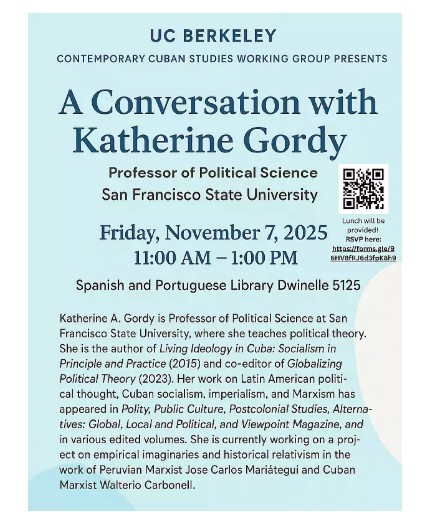
UC Berkeley’s Cuban Studies Working Group: Conversation with Dr. Katherine Gordy, Professor of Political Science at San Francisco State University

All are invited to attend the Cuban Studies Working Group’s conversation with Dr. Katherine Gordy, Professor of Political Science at San Francisco State University, which will take place tomorrow, November 7, 2025, at 11 am in Dwinelle 5125 (Level E)

RSVP Here: Lunch will be provided!

Katherine Gordy is an accomplished author and editor in the field of political science. Her published works include the single-authored book Living Ideology in Cuba: Socialism in Principle and Practice (2015) and the co-edited volume Globalizing Political Theory (2023).
Gordy’s research spans Latin American political thought, Cuban socialism, imperialism, and Marxism, with articles published in notable journals such as PolityPublic CulturePostcolonial StudiesAlternatives: Global, Local and Political, and Viewpoint Magazine, as well as various edited collections.
Currently, she is engaged in a research project exploring empirical imaginaries and historical relativism as present in the works of two prominent Latin American Marxist thinkers: the Peruvian José Carlos Mariátegui and the Cuban Walterio Carbonell.
Please join the Cuban Studies Working Group on Friday, November 7th at 11am in the Spanish and Portuguese Library (Dwinelle 5125) for a lecture and lunch gathering with Dr. Katherine Gordy, Professor of Political Science at San Francisco State University. 

Katherine is the author of Living Ideology in Cuba: Socialism in Principle and Practice (2015) and co-editor of Globalizing Political Theory (2023). Her work on Latin American political thought, Cuban socialism, imperialism, and Marxism has appeared in Polity, Public Culture, Postcolonial Studies, Alternatives: Global, Local and Political, and Viewpoint Magazine, and in various edited volumes. She is currently working on a project on empirical imaginaries and historical relativism in the work of Peruvian Marxist Jose Carlos Mariátegui and Cuban Marxist Walterio Carbonell.

Speaker: Katherine Gordy, Professor of Political Science, San Francisco State University
A Conversation with Katherine Gordy

Sponsor: Townsend Center


Today at the Law School: Estado de Silencio / State of Silence: Film Screening and Panel

Film Screening & Discussion: “State of Silence
Date & Time: Wednesday, November 5, 2025, 4:30 PM – 6:30 PM

Estado de Silencio Film Title
The title of a film is “Estado de Silencio” (The State of Silence).

State of Silence/Estado de Silencio” delves into the challenges facing press freedom in Mexico, chronicling the dangerous work of four journalists as they uncover the ties between organized crime and government corruption. Through their eyes, the documentary reveals the obstacles and risks they face in breaking the silence around systemic abuse and violence. A panel discussion and audience Q&A with will follow the screening:

RSVP here


Dia de los muertos in the East Bay

Día de los Muertos and UC Berkeley Library Collections

Día de los Muertos (Day of the Dead) is an essential Mexican holiday, primarily celebrated on November 1st and 2nd. It is a time for families and friends to gather, pray for, and remember loved ones who have died. The celebration is vibrant, focusing on life and remembrance, rather than mourning. Key traditions include creating ofrendas (altars) decorated with marigolds (cempasúchil), favorite foods and drinks of the departed, candles, and colorful sugar skulls (calaveras).

In the pantheon of the late nineteenth- and early twentieth-century artists who represent Mexico and Mexican art, the artwork of José Guadalupe Posada stands out as a bright constellation that continues to shine a light on important stories through woodcuts, imprints, and engravings. This virtual exhibition is a counterpart of the physical exhibition on Posada that was created by Liladhar P., the Librarian for Latin American Collections. The title of this exhibition is "Illustrating México one page at a time-Print Art of José Guadalupe Posada."The exhibition also highlights two important contemporary Mexican artists: Artemio Rodriguez and Sergio Sánchez Santamaría who continue to cherish and carry the legacy of José Guadalupe Posada. However, I note that these artists have their own stories and own unique style that illustrates the beauty of Mexico's printmaking heritage. This exhibition highlights selected print-items by José Guadalupe Posada. The curator owes a debt of gratitude to Aisha Hamilton and Virgie Hoban.

Illustrating Mexico one page at a time-Print Art of José Guadalupe Posada

Several venues across the East Bay feature Día de los Muertos altars. The Oakland Public Library is among the organizations hosting a related activity. Below are photos of the altar created by the library’s César Chávez branch (formerly the Latin American Library) to commemorate this important cultural tradition.

Photos below: Credit: Liladhar P.

Dia de los muertos altar at Cesar Chavez Branch Library of Oakland Public Library
Our Social Sciences Library at UC Berkeley Library, my departmental colleagues have created also an altar whose pictures I am sharing. Two colleagues who took initiative in supporting this activity are Angelica V.M. and Cody H.

Photos below: Credit Angelica VM.

A dia de los muertos altar at Social Sciences Research Library

The following subject terms can be helpful to our students when trying to locate materials on Dia de los muertos in our library’s collections.

Subject

Library Trial: Latin America Commons by Coherent Digital

We currently have trials set up for several modules from Coherent Digital. We have selected modules from Policy Commons, Africa Commons, and Latin America Commons available until Nov 15, 2025.

Please submit your feedback to your librarian for Latin American and Caribbean Studies: Liladhar

Latin America Commons by Coherent Digital is a full-text, richly-indexed database that provides unified, cross-searchable access to millions of pages of Latin American and Latinx primary-source materials, including books, magazines, photographs, maps, letters, diaries, ephemera, videos, and audio files that were previously scattered across the internet and in archives. The project aims to preserve at-risk content, rare documents, and often overlooked resources spanning from the 16th to the 21st centuries, making it easier for scholars and students to discover vetted, high-quality material for research and study.
Latin America Commons Landing Page

Latin America Commons by Coherent Digital is a full-text, richly-indexed database that provides unified, cross-searchable access to millions of pages of Latin American and Latinx primary-source materials, including books, magazines, photographs, maps, letters, diaries, ephemera, videos, and audio files that were previously scattered across the internet and in archives. The project aims to preserve at-risk content, rare documents, and often overlooked resources spanning from the 16th to the 21st centuries, making it easier for scholars and students to discover vetted, high-quality material for research and study.


Publisher Highlight: Insert Press

Insert Press logo from 2025

Insert Press was found in 2005 by Mathew Timmons to focus on interdisciplinary and/or hybrid works.[1] Initially, Insert Press focused on poetry in chapbook form, but over the following decade turned to increasingly toward “translation, poetics, artist books.”[2]

Readers can find information about their publications and local, LA events on their Instagram page (https://www.instagram.com/insert.press/).

Recent Titles

Take a look at at some of their recent titles.

For More at UC Berkeley

For more at UC Berkeley, take a look at this publisher search for “Insert Press” through the UC Library Search.

EndNotes

[1] “About Insert Press,” Insert Press, accessed July 10, 2025, https://insert.press/.

[2] Matthew Timmons, Publisher Questionnaire: Insert Press, interview by Asterism, Blog, May 15, 2025, https://asterismbooks.com/.