Black smoke rises from a military airport in Chuguyev near Kharkiv on February 24, 2022. Photo by ARIS MESSINIS / AFP
February 24th, 2022 was a date I was looking forward to, from a bureaucratic perspective. It would mark the transition to a new role here at the Oral History Center as the Interim Director. Of course, it was impossible to ignore the anxiety building about Ukraine. Even though predictions were made by many sources well in advance, the arrival of the world’s most recent invasion was no less shocking.
The invasion of Ukraine on that day was shocking. Its scale and horror were surprising to many of us. But it was not an unfamiliar story. The experience of invasion is a story often told, and it is stories, first-hand accounts, that are galvanizing tremendous worldwide support for Ukraine in this war. The power of these stories is also evidenced by their absence from the official state organs of Russia’s media, by the slippage of individual moments of protest past the censors, scrawled posters behind the measured tones of the polished presenter, by emails and texts to individual Russians from around the world, fragments of stories, coming one at a time.
Oral history in its modern form coalesced in the 1960s as a movement and an association to document the lives, experiences, and views of ordinary people, with a democratic ethos at its heart. The basic idea was that if you collected, archived, and published multiple stories from individuals and representatives of communities, they could stand in contrast to the single narrative of any social system — an institution, a government, those authorized to speak on behalf of others — which represents a tempered, aggregate, vetted version of the truth, one that may obscure or distort more than it reveals. The truth of one person’s experience is always partial to that exact extent. The collection, archiving, and sharing of multiple perspectives, it is hoped, is an incomplete antidote to conventional wisdom, dogma, propaganda, euphemism, and erasure. To the extent that these stories can be preserved, they promise to outlast the dominant truth of any particular group or era.
The theme of this year’s annual meeting of the Oral History Association is “Walking Through the Fire: Human Perseverance in Times of Turmoil.” I wish I could say the theme was prescient, but these days it is just a good title for where we are at this moment in history.
This theme and this war spark memories of interviews I’ve done over the years. Materials scientist Ted Massalski recounted his narrow escape as a boy in Poland in World War II, sandwiched between the occupying Nazis and the advancing Soviet Army. In another oral history, engineering scientist George Leitmann told me what it was like to see the Nazis roll in to Vienna in 1938. There are many other stories of the survival of invasions and evacuations in our collection, including from Russian emigres who fled the Soviet Union, from former UC Berkeley Chancellor Chang-Lin Tien or restaurateur Ceclia Chiang, who escaped war-torn China, or economist John Harsanyi, who escaped from Soviet-occupied Hungary after World War II.
Before the pandemic, I completed a project on physicists who lived through the communist period in Czechoslovakia. Speaking from the land of Franz Kafka, they described the risks of running afoul of the state while running an “underground university,” which hosted secret political discussions of smuggled forbidden texts in the 1970s and 80s, and which paved the way for the turn toward democracy in the early 1990s.
Some of these Czech narrators believe that the threat of totalitarian control never really went away in that region, and for that reason remained vigilant. I was heartened and humbled by their swift action in the face of the invasion, their efforts to influence the Russian government to reverse course, and to help incoming refugees from Ukraine. Their stories will hopefully inspire the current generation of Czechs to defend their hard-won freedom.
What makes suffering so unbearable is when it is by design. In the strategy of total war, only most recently manifested in Ukraine, the burden of injury, death, destruction, division, and separation of loved ones is planned to produce a desired outcome: the conquest of territory in the most brutal terms, but also the achievement of enforced conformity, complicity, resignation, and humiliation of the recipients of this terror, in short, dehumanization.
What can make suffering more bearable, at least from my experience interviewing people who have passed through terrible events, is when the subjects of such terror bear witness to what they endured, name it, and pass the stories of loss and survival to others as a testament to their resilience and humanity. Storytelling, in the face of dehumanization, can promise a rehumanization, of those who survived to tell the story, those who did not, those who hear the story, those who keep it, and those who pass it along.
Of course, this most acute crisis, this war, requires direct and immediate action. Part of this action is a commitment to the expression and dissemination of narratives of multiple, diverse experiences, in Ukraine, in Russia, and everywhere a single voice threatens to silence all others. As gutted as I am by the horror of this war, I do find hope in the assistance provided to many millions of those who are suffering. The stories circulating about the plight of Ukrainians are aimed most urgently at stopping the war; but they are also, I think, about spreading the load of grief and loss to any and all who will listen. They indicate what is most powerful about oral history. Stalin is reported to have said, apropos of the deliberate starvation of millions of Ukrainians at the beginning of the 1930s: “If only one man dies of hunger, that is a tragedy. If millions die, that is only a statistic.” Apocryphal or not, the statement expressed well the numbing effect of brutality at scale. But a story is not a list of numbers; it is the meaning of an experience to an individual. Oral testimony counters the enormity of Stalinist terror with an individual experience and perspective, amplified by the number of listeners, readers, and repeaters, each connected to one person’s visceral truth.
Loyalty oaths have long been in use in the United States as a means of promoting social unity in the face of war, perceived security threats, or fears about waning political support. Even now, loyalty oaths are common as a condition of employment for many state workers. In fact, all employees of the state of California, including the faculty and staff members of the University of California, currently sign an oath of loyalty upon hire, stating that they will defend the constitution against all enemies foreign and domestic, and that they take this obligation freely.
In particular, the idea of a governmental loyalty oath rose to prominence in the 1940s, when tensions between the US and the Soviet Union and growing fears about a communist infiltration of the government prompted President Harry S. Truman to establish a loyalty program for federal employees. In March 1947, Truman signed Executive Order 9835, which ensured that employees of the US government could be subject to investigation for potential involvement in “subversive” organizations.
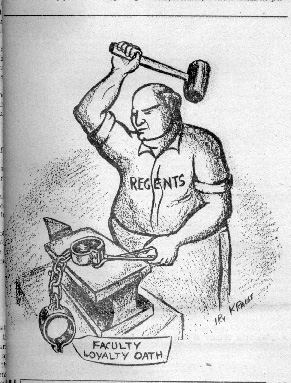
In the wake of President Truman’s Executive Order, the California state legislature began to introduce its own policies in opposition to potential communist activity in the government. These proposals would have given the state authority over the University of California in matters of loyalty, prompting the University of California administration to act in response to prevent infringement on the institution’s autonomy. Furthermore, the university was at this time also facing financial difficulties, with the state threatening to withhold funding for the university budget due to worries about subversive activity within its community. As a result of these mounting pressures, University President Robert G. Sproul proposed his own loyalty oath for university faculty and employees on March 25, 1949. The text of the oath approved by the Regents on June 24 was as follows:
I do solemnly swear (or affirm) that I will support the Constitution of the United States and the Constitution of the State of California, and that I will faithfully discharge the duties of my office according to the best of my ability; that I do not believe in, and I am not a member of, nor do I support any party or organization that believes in, advocates, or teaches the overthrow of the United States Government, by force or by any illegal or unconstitutional means, that I am not a member of the Communist Party or under any oath or a party to any agreement or under any commitment that is in conflict with my obligations under this oath.
Almost immediately, the introduction of the loyalty oath garnered controversy. Many faculty members and staff refused to sign the oath, resulting in a rash of firings and resignations and a tense stand-off between the Board of Regents and university faculty, staff, and students. The oath was later declared unconstitutional in 1951 in Tolman v. Underhill, and many of the thirty-one dismissed faculty returned to Berkeley.
University of California Regents’ Meeting about Loyalty Oath Non-signers, 1950 August 25, BANC PIC 1959.010. San Francisco News-Call Bulletin Newspaper Photograph Archive, The Bancroft Library, UC Berkeley.
The UC Berkeley Oral History Center has several interviews related to the loyalty oath controversy, many from UC faculty members who witnessed or were themselves involved in the response to the oath’s introduction.
Among these is a collection of interviews specifically concerning the loyalty oath, which features oral histories from Howard Bern, a UC Berkeley faculty member who signed the oath last-minute; Ralph Giesey, a graduate student of non-signer Ernst Kantorowicz; and Deborah Tolman Whitney and Mary Tolman Kent, the children of Berkeley professor Edward Tolman, a key leader of the faculty opposition to the oath.
These interviews reveal the fraught relationship between university faculty and administration after the instatement of the loyalty oath, with rampant fears about academic freedom and discrimination against potentially “subversive” faculty members. Here, Howard Bern shares his distaste of the oath and his moral grounds for originally refusing to sign:
I felt that it was discriminatory, that it was singling out university professors as if they were especially potentially evil. So on a civil libertarian ground I objected to this. And the second ground was my own feeling. I had been in the army for almost four years. What more manifestation of loyalty did they really want?
In the oral history of Charles Muscatine, who returned to UC Berkeley in 1953 after being fired for his refusal to sign the oath as an assistant professor, Muscatine recalls the most poignant moment for him of the entire controversy:
At a certain moment, [Malcolm Davisson, a faculty policy chair] contacted me. He said, “We have lost the moral right to decide.”
Other interviews offer more insight into the experience of witnessing the loyalty oath controversy firsthand. For instance, Ralph Giesey discusses the hearings he and his fellow non-signing teaching assistants had to undergo as a condition of their opposition to the oath. Howard Schachman, an assistant professor at UC Berkeley at the time of the oath, describes the moral compromise he underwent when he signed something he considered philosophically “abhorrent.”
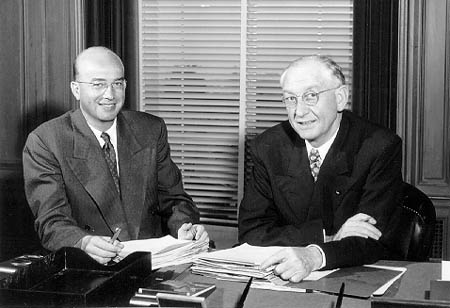
Chancellor Clark Kerr (left) and Robert Gordon Sproul, November 16, 1953
The loyalty oath controversy at UC Berkeley is often viewed through the perspective of academic freedom amid anticommunist fervor, but an oral history of Clark Kerr, UC Berkeley faculty member at the time — and later campus chancellor and university president — provides another perspective. Kerr observed that the controversy must be viewed in light of the internal divisions in the Board of Regents that escalated in the 1940s over debates about centralization versus campus autonomy. According to Kerr, Regent John Francis Neylan and the southern regents tended to favor campus autonomy, while University President Robert G. Sproul and most of the northern regents called for a centralized system. This issue resolved itself with the creation of the post of chancellor for each UC campus, and Kerr himself was later appointed to the position at UC Berkeley in 1952.
According to Kerr:
As I understand it, Neylan really just seized on the oath controversy as a way of whipping Sproul around because he was unhappy with him on other grounds. . . . [Sproul] looked to me like a man who was just immobilized by the controversy. It was out of this, according to what I observed, that [Earl] Warren then came to take a position of leadership, which he had not taken in the regents before. Normally governors don’t. But the controversy was tearing the university apart. The president was immobilized. Warren stepped in, then, essentially against the oath, or at least against the firing of the non-signers, and took leadership of the more liberal elements of the board.
Howard Bern also recognizes Robert Sproul’s role in mishandling the loyalty oath controversy, stating, “Just as, although he would not admit it, the Free Speech Movement really broke Clark Kerr, I think the loyalty oath situation just destroyed Robert Gordon Sproul and his influence. I don’t think he was a bad man, a bad leader, but I think he made a very fatal error.”
All in all, these oral histories concerning the UC loyalty oath controversy are a great resource for understanding the climate at the University of California in the 1940s and ’50s. They offer a wealth of insight concerning the faculty experience at UC Berkeley, and since many of the interviewees went on to become involved with the Free Speech Movement and other political causes, there is a particular focus in these oral histories on the growth of social movements at the university. For more information about the loyalty oath controversy, check out the Oral History Center’s collection of interviews concerning the oath and other related resources from The Bancroft Library.
Shannon White is currently a third-year student at UC Berkeley studying Ancient Greek and Latin. They are an undergraduate research apprentice in the Nemea Center under Professor Kim Shelton and a member of the editing staff for the Berkeley Undergraduate Journal of Classics. Shannon works as a student editor for the Oral History Center.
Adam Hagen is currently a third-year history student with a concentration in modern European history. Adam works as a student editor for the Oral History Center. He is also a member of the editing staff of Clio’s Scroll, the Berkeley Undergraduate History Journal.
Related Resources from the OHC and The Bancroft Library
Oral Histories Cited
Clark Kerr, University of California Crises: Loyalty Oath and the Free Speech Movement.
The Loyalty Oath at the University of California, 1949–1952. Interviews with Howard Bern, Ralph Giesey, Mary Tolman Kent, Deborah Tolman Whitney.
Howard Schachman: UC Berkeley Professor of Molecular Biology: On the Loyalty Oath Controversy, The Free Speech Movement, and Freedom in Scientific Research.
Charles Muscatine: The Loyalty Oath, The Free Speech Movement, and Education Reforms at the University of California, Berkeley.
Related Oral History Projects
The SLATE Oral History Project documents the UC Berkeley campus political organization SLATE — so named because the group backed a slate of candidates who ran on a common platform for ASUC (Associated Students of the University of California) elections from 1958 to 1966. SLATE ignited a passion for politics in the face of looming McCarthyism and what many perceived as the University of California’s encroachment on student rights to free speech. See also, “They Got Woken Up”: SLATE and Women’s Activism at UC Berkeley
The Free Speech Movement Oral History Project documents the movement at UC Berkeley that began in the fall of 1964 from the perspective of the ordinary people who made it possible — and those who opposed it — including students, lawyers, faculty, and staff.
Related Resources from The Bancroft Library
Gardner, David Pierpont. The California oath controversy. F870.E3C4122.G3.
Kantorowicz, Ernst H. The fundamental issue : documents and marginal notes on the University of California loyalty oath. Bancroft F870.E3 K18.
Papers pertaining to California loyalty oaths, 1954. Bancroft BANC MSS C-Z 92.
University of California, Berkeley Accounting Office loyalty oath records, 1949–1964. UC Archives CU-3.11.
About the Oral History Center
The Oral History Center of The Bancroft Library has interviews on just about every topic imaginable. You can find the interviews mentioned here and all our oral histories from the search feature on our home page. Search by name, keyword, and several other criteria. We preserve voices of people from all walks of life, with varying political perspectives, national origins, and ethnic backgrounds. We are committed to open access and our oral histories and interpretive materials are available online at no cost to scholars and the public.
The On the Waterfront oral history project is a collection of interviews from residents of Richmond, California conducted by the UC Berkeley Oral History Center in the 1980s. These oral histories span decades, offering an interesting glimpse into the history of the Bay Area in the early- to mid-twentieth century. This collection features interviews from shipyard workers, cannery employees, fishermen, and early residents of Richmond, many of whom have resided in the area for decades and have witnessed firsthand the city’s evolution over the better part of a century.
These interviews devote a great deal of time to talking about the development of the city as a result of World War II. Common themes throughout the On the Waterfront project as a whole include labor practices, race relations and discrimination, and industrial growth and urban development in the Bay Area.
Title: Workers (general photos). Identifier 35. From the Henry J. Kaiser Pictorial Collection, The Bancroft Library. Available on the Online Archive of California.
During the 1940s, Richmond experienced a massive influx of workers, many of whom arrived from the southern United States as part of the Great Migration, seeking wartime employment at local businesses or the Kaiser Shipyards. “I thought it was in the neighborhood of eighteen to twenty thousand. By the time Kaiser came in and all the shipyards moved in there, we were over a hundred thousand,” Joseph Perrelli, whose family founded the Filice and Perrelli Canning Company, says of the rapid population and industrial growth in Richmond as a result of wartime industry.
F & P Brand Solid Pack Tomatoes label, 1929. Courtesy of the History San Jose Research Library, via Calisphere. Identifier: F144A3D6-2ADB-4D06-9E10-193468533590 1985-95-34.
In his interview, Perrelli describes the history of the Filice and Perrelli Canning Company, which began in 1913 as a small family business and grew exponentially during the war.
They would ask us to bid on their needs to feed the army as far as tomatoes and fruit was concerned. We were competitive. We had to bid against each other. We bid against our fellow canners. But the percentage that the military allowed us was much greater than we could get in competition with our fellow canners. Naturally we made some money on the sales that we made to the government, to the military.
The increased need for labor during the war meant that job opportunities opened up en masse for women and people of color, many of whose testimonies were put on record by the Oral History Center. Here, Lucille Preston describes her experience working as a welder in Richmond during World War II:
We would have to punch the time clock at eleven-thirty. I would leave home around eleven-fifteen. . . .Then we would have to go and get our own welding lines. I’m sure you don’t know what that is, but it looks just like a water hose, these welding lines. I would have to have two, one on one shoulder and one on the other, and I would have to climb up a ladder or go down in a hold on a ladder and carry those on my shoulders.
Preston looks back on the hands-on work she performed as a positive experience, recalling, “We would have to go out in the water on the ship. The ship was floating while we were on there welding. So it was really fun. I really enjoyed it.”
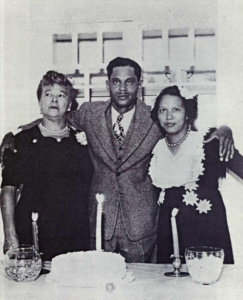
Mollie Bowie, son Marvin Foster, Selena Foster, Richmond, 1947, following Mrs. Bowie’s move to Richmond
At the same time though, Selena Foster, the owner of the Oakland-based restaurant Selena’s Kitchen and an employee of Lou’s Defense Diner during World War II, discusses hiring discrimination for black women looking for shipyard work, saying:
There were blacks out there but mostly the white girls were the ones who got all the training. They all had to wear the same welding suits because this was a training outfit. So they would just try them for so many minutes, and then they would try the other. We tried the whole day to get fitted. Other girls kept coming, white girls. Alma was kind of chubby but she wasn’t fat and at that time I only weighed about a hundred and ten, and it seems that we were too big. This was just prejudice.
Marguerite Williams, a long-time Bay Area resident, also recalls an almost instantaneous increase in racialized violence and discrimination in conjunction with the growing black population in the Bay Area:
It seemed like overnight people on the street would be fighting with knives and everything. . . . When we first came to Richmond in 1946, [Harry Williams] and I and the kids, there was still a lot of that bad feeling, because you would go into the store downtown and the people wouldn’t want to wait on you.
Harry Williams, whose mother worked for the Filice and Perrelli Canning Company in the 1930s, discusses the lack of cannery employment for people of color in the decades following: “I don’t think they hired any blacks that I know of. If they did, they had menial work. They weren’t working on the line.”
Wartime industry in Richmond brought both economic success and population growth to the city, but at the same time brought with it a myriad of issues with racial discrimination and exploitative labor practices. For example, Joseph Perrelli discusses early anti-union sentiment in the canning industry, which led to protests and strikes among the Filice and Perrelli labor force, something Perrelli recalls as “labor activity that was inamicable to our interests at that time.”
Aside from these wartime industries, many other enterprises saw wild success in Richmond over the years, including several fishing and whaling operations.
Pratt Peterson, a lifetime fisherman and former employee of the Richmond Whaling Station, talks about the Bay Area whaling industry over the decades. Here, Peterson discusses the early days of San Francisco’s Fisherman’s Wharf:
That was a long time ago. You talk about San Francisco being a different town. When I was fishing shark, I lived on a boat at Fisherman’s Wharf. Fisherman’s Wharf wasn’t what it is now. There were a lot of vacant lots.
When discussing the current state of the Richmond Whaling Station, which closed in the early 1970s, Peterson recalls, “The slip is still there where they pulled them up, and some of the winches are still there. A lot of the equipment to cut the whale up is still there. Of course, it’s all rusted out now, but they haven’t moved it out.”
Dominic Ghio, a lifetime commercial fisherman, describes his family’s experience fishing and shrimping in the Bay Area for almost a century. Regarding his and his siblings’ work, Ghio says:
It was in San Francisco Bay and San Pablo Bay. We used to commute. We would park our boats in Richmond. That was in the 1930s. And we slept on the boat five days a week. Then, from Richmond we used to go commute home and get changed, take a bath and do what we had to do. Then on Sunday evening in the afternoon we’ll go back and do it all over again. Three hundred and sixty-five days of the year all around.
The stories in these oral histories span the better part of a century of Richmond’s history and include the interviewees’ perspectives on issues that are still very much relevant to the Bay Area of the twenty-first century.
Stanley Nystrom, a longtime resident of the city, discusses the widespread “drug panic” of the 1980s, noting that though these issues affected Richmond, they were not exclusive to the Bay Area:
Now it’s nationwide and worldwide. It has affected the economy, it has affected the crime, it’s affected people in such drastic ways. So you can’t really relate that to Richmond alone. It’s all over everywhere.
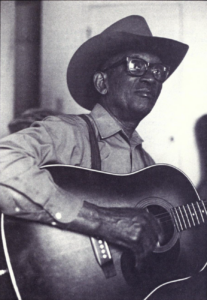
Lewis Van Hook, 1991. Photograph by Judith K. Dunning.
Lewis Van Hook, a member of the Singing Shipbuilders gospel quartet during World War II, gives his thoughts on life in Richmond over the years, mentioning the city’s experience with police brutality at the time of the interview in the early 1980s and the 1983 NAACP lawsuit against the City of Richmond in response to police behavior:
I think it’s still a good place to live, but I would say, in some ways, there’s lots of room for improvement. This problem that they’ve been having now with the police has been kind of disgusting. I think there needs to be some improvements both ways. . . .These lawsuits that they’ve been having—I don’t know, I think of it and think of both sides of it. I know you have some brutality on the police’s side. We’ve had some all right.
The interviews of this oral history project are vibrant and interesting, providing a wealth of information about life in the Bay Area during a time of massive population growth, industrial evolution, and urban development. The narrators for this project have unique perspectives on the changes that Richmond has experienced over the years, and many also share their hopes for the city’s future as well.
Shannon White
You can find the interviews mentioned here and all our oral histories from the search feature on our home page. Search by name, keyword, and several other criteria.
Shannon White is currently a third-year student at UC Berkeley studying Ancient Greek and Latin. They are an undergraduate research apprentice in the Nemea Center under Professor Kim Shelton and a member of the editing staff for the Berkeley Undergraduate Journal of Classics. Shannon works as a student editor for the Oral History Center.
Related Resources from the OHC and The Bancroft Library
Henry J. Kaiser pictorial collection: Approximately 150,000 items (photographic prints, negatives, and albums). Bancroft BANC PIC 1983.001-.075–PIC and other locations. See especially Richmond Shipyard workers.
About the Oral History Center
The Oral History Center of The Bancroft Library has interviews on just about every topic imaginable. You can find the interviews mentioned here and all our oral histories from the search feature on our home page. Search by name, keyword, and several other criteria. We preserve voices of people from all walks of life, with varying political perspectives, national origins, and ethnic backgrounds. We are committed to open access and our oral histories and interpretive materials are available online at no cost to scholars and the public.
We are pleased to announce that historian Paul Burnett has been named the interim director of the Oral History Center upon the retirement of Martin Meeker last month. Paul joined the OHC staff in 2013 and has been a versatile historian with a focus on science, engineering, and UC Berkeley history. He has published a number of academic articles, and has developed and directed several large-scale oral history projects: on economics, paleontology, Czech physics, the San Francisco Opera, and engineering, among other subjects. Paul has also worked to reach a wider public with a series of blog posts, a curriculum for high schools on epidemics in history, and podcasts on the early years of the HIV/AIDS epidemic, and the contribution of UC Berkeley to the rise of Silicon Valley.
Prior to joining the Oral History Center, Paul was an assistant professor with the Science and Technology Studies Programme at St. Thomas University in New Brunswick, Canada. Before that, Paul researched and produced museum exhibits for the American Philosophical Society in Philadelphia. He completed his PhD at the Department of History and Sociology of Science at the University of Pennsylvania in 2008, where he developed his research on the politics of expertise — how scientists and experts of all kinds establish their credibility, and how people choose between different kinds of expertise to try to solve complex social, political, scientific, and technical problems.
Please join us in welcoming Paul Burnett to his new role.
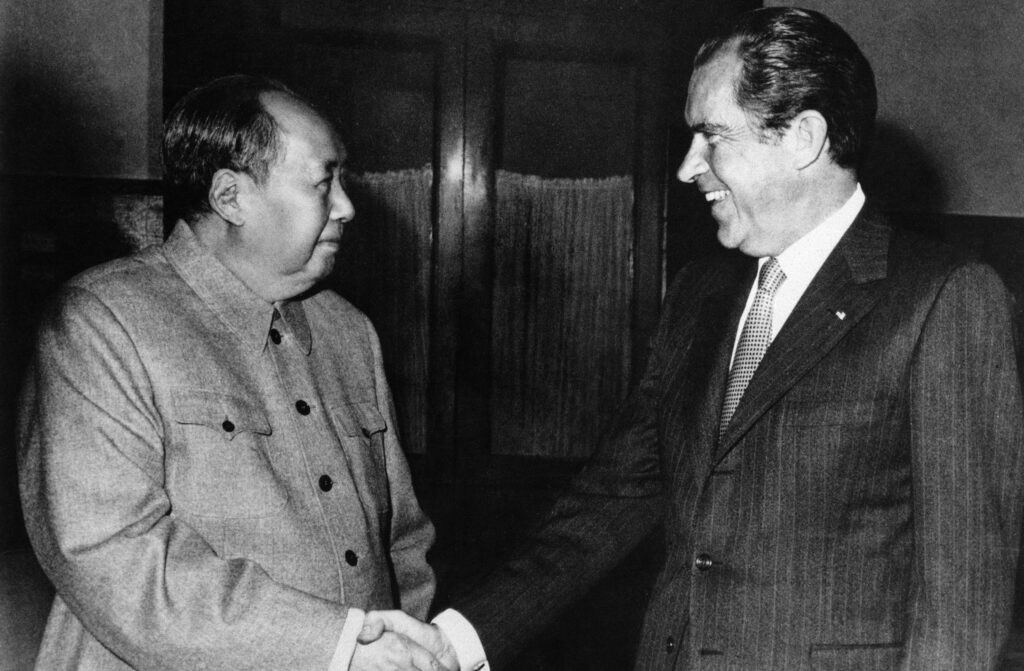
February 2022 — This month marks the 50th anniversary of President Richard Nixon’s weeklong visit to China, a trip that resulted in the establishment of a formal diplomatic relationship between the governments of the United States and the People’s Republic of China.
The UC Berkeley Oral History Center’s collection contains several interviews discussing the event, as well as the political and public atmosphere that surrounded Nixon’s 1971 announcement of the impending trip. Included in these are the accounts of both Caroline and John Service, the latter a diplomat and member of the United States Foreign Service. The Services were among the few Americans welcomed back to the country in the early 1970s by Zhou Enlai, then the premier of the PRC.
President Nixon Shaking Hands with Chairman Mao, February 21, 1972 (Photo: National Archives. National Archives Identifier 194759.)
In Caroline Service’s oral history, she discusses the era of “ping pong diplomacy” in the early 1970s that occurred prior to the president’s visit to China. “We were all electrified one day. . . by seeing on television, reading in the paper, seeing pictures that the American ping pong team was going to Peking,” Service recalls of this turning point in the relations between the two countries.
In this interview, Service also discusses the public perception of Richard Nixon at the time of the trip, echoing the popular opinion that only Nixon, as a staunch anti-communist with the support of his fellow political conservatives, could make such a move without widespread criticism. As Service says:
Now I have hardly a good word to say for Nixon. I have disliked him intensely forever, it seems to me, since ever he appeared on the political scene. Yet, I suppose that only a Republican conservative, reactionary almost, president could have done this. I do not think a Democrat could have done this. I think it had to be done.
In his oral history, Dr. Otto C. C. Lin, whose career is in Chinese technological innovation and entrepreneurship, offers his perspective on Henry Kissinger and Nixon traveling to China. When asked about the effects of the visit on Taiwan, Lin said, “Republicans were always considered friends for KMT [Kuomintang]. Hence, Nixon was considered a turncoat and Kissinger an accomplice of Nixon in betraying his friend, the ROC [Republic of China].” Ultimately, though, Lin says, “I think history would say that Nixon and Kissinger did the right thing to help open up China.”
Cecilia Chiang, a chef and entrepreneur credited with popularizing northern Chinese cuisine in the United States, discusses in her oral history the buzz surrounding the state dinner attended by Nixon and Kissinger during their visit. “The menu was printed in all these newspapers in the United States and also the Chinese Newspaper,” recalls Chiang, “People called in. Called in from New York, from Hawaii, called me. ‘Can you duplicate that dinner? That dinner for us. We would like to just fly in just for that dinner.’”
Chiang remembers her surprise at the simplicity of the meal, stating that when she saw the menu, “I started to laugh. They said, ‘Why do you laugh?’ They put bean sprouts on the menu, because China is so poor at the time. No food, no nothing.”
These interviews contain a wealth of insightful information concerning not just the presidential visit to China, but also the general political climate of US foreign relations in the 1970s. Caroline Service offers the perspective of a family who had by this point been involved in US foreign diplomacy for decades. Otto Lin leverages the Nixon visit in relation to the modern political, cultural, and economic landscape of China. Cecilia Chiang’s oral history provides a glimpse into the culinary landscape of China, a country still struggling with rationing and food shortages in the midst of the Cultural Revolution.
Shannon White
You can find the interviews mentioned here and all our oral histories from the search feature on our home page. Search by name, keyword, and several other criteria.
Shannon White is currently a third-year student at UC Berkeley studying Ancient Greek and Latin. They are an undergraduate research apprentice in the Nemea Center under Professor Kim Shelton and a member of the editing staff for the Berkeley Undergraduate Journal of Classics. Shannon works as a student editor for the Oral History Center.
About the Oral History Center
The Oral History Center of The Bancroft Library has interviews on just about every topic imaginable. We preserve voices of people from all walks of life, with varying political perspectives, national origins, and ethnic backgrounds. We are committed to open access and our oral histories and interpretive materials are available online at no cost to scholars and the public.
Oral Histories Used Here
Caroline Service: State Dept. Duty in China, The McCarthy Era, and After 1933–1977
Otto C.C. Lin: Promoting Education, Innovation, and Chinese Culture in the Era of Globalization Volume I: Oral History
Cecilia Chiang: An Oral History
Related Resources from The Bancroft Library
Cecilia Chiang is included in the Chez Panisse, Inc. pictorial collection. BANC PIC 2001.192.
Caroline Service letters to Lisa Green : TLS and ALS, 1950 Sept.–1995 April. Bancroft BANC MSS 99/81 cz.
Caroline Schulz Service papers, 1919–1997. Bancroft BANC MSS 99/237 cz.
John S. Service papers, 1925–1999. BANC MSS 87/21 cz.
We would like to congratulate Martin Meeker on his retirement as the director of the Oral History Center of The Bancroft Library. As Martin put it, when you spend so much of your time listening to the stories of other people’s triumphs and challenges, at some point you want to focus on creating your own story.
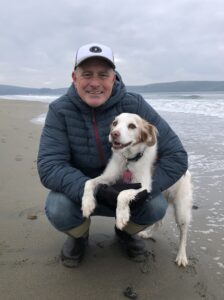
Martin with Daisy at Dillon Beach
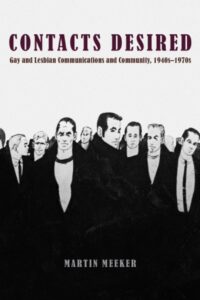
Martin has achieved much during his time at Bancroft. He started his career here as an interviewer/historian in 2004, after graduating with a PhD in history from the University of Southern California. Martin published Contacts Desired: Gay and Lesbian Communications and Community, 1940s-1970s in 2006 with University of Chicago Press; The Oakland Army Base: An Oral History, an anthology of fifty interviews; along with a number of articles over the years. He served as acting associate director of the Center from 2012 to 2016 and became its director in 2016.
From the early 2010s, Martin built up the program, hiring four full-time interviewer historians and a communications director, managing and initiating large endeavors such the Freedom to Marry Project, and facilitating longstanding partnerships with the Getty Trust, the East Bay Regional Park District, and the National Park Service, to name just a few. Under Martin’s leadership, the OHC has continued and expanded its education outreach and public profile. An expert interviewer, Martin conducted interviews with former San Francisco Mayor Willie Brown, Governor Jerry Brown, along with many artists, financial experts, and vintners, to hint at the range of his interviewing.
Lisa Rubens, retired oral historian and longtime OHC interviewer, reflected on Martin’s appointment: “I worked closely with Martin after he joined our staff in 2003. He was a breath of fresh air — his scholarship, collegiality, and interviewing skills were immediately obvious. Once becoming director he created an environment which supported our staff in interviewing people in all walks of life, sustaining OHC’s deserved reputation as the nation’s leading academic oral history program.”
We thank Martin for his contributions to the growth and health of the Oral History Center, and we wish him the best in writing this next chapter of his own story.
An announcement about the interim director and director search will be made in our next newsletter.
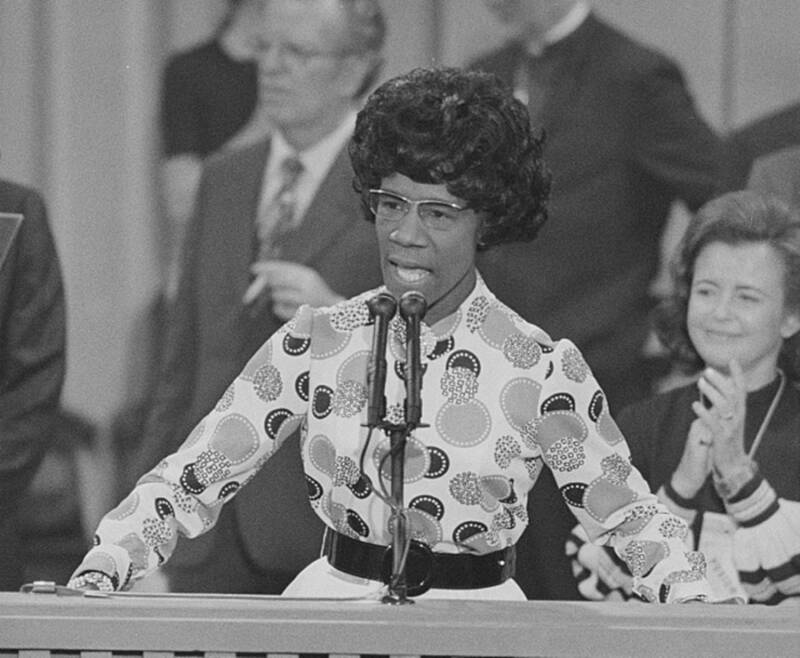
On Jan 25, 1972, Congresswomen Shirley Chisholm, representative for New York State’s Twelfth District and the first African American woman elected to the U.S. House of Representatives, announced her candidacy for president. With this announcement, Chisholm became both the first African American to run for a major party’s presidential nomination and also the first woman ever to run for the Democratic Party’s presidential nomination. The UC Berkeley Oral History Center has several interviews that address Chisholm’s trailblazing candidacy. In addition, the Center has numerous interviews with other ground-breaking female politicians.
Shirley Chisholm thanking delegates, Democratic National Convention, Miami Beach, Fla., 3rd session (Photo: Library of Congress)
“Anything that black women do like that, they’re pioneering; they’re the first, or one of the first. Because it takes a lot of guts and militancy and sacrifice to do those things when it isn’t popular.” — Frances Mary Albrier
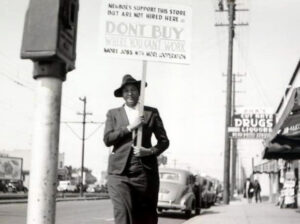
Frances Mary Albrier was a woman of numerous accomplishments. A graduate of UC Berkeley, she was an indefatigable opponent of racism, a civil rights activist from the 1920s onward, the first woman elected to Alameda County’s Democratic Central Committee, as well as the first black woman hired by Kaiser Shipyards during World War II. She founded the East Bay Women’s Welfare Club, and her efforts led to the hiring of black women teachers in the Berkeley public schools. Albrier discussed Chisholm’s then-recent candidacy when she was interviewed in 1977 and 1978 as part of a series on women political leaders.
Frances Albrier leading picket at corner of Sacramento and Ashby, 1939. (Photo: Berkeley Plaques)
Mrs. Chisholm pioneered when she ran for Congress in New York as a black woman. Anything that black women do like that, they’re pioneering; they’re the first, or one of the first. Because it takes a lot of guts and militancy and sacrifice to do those things when it isn’t popular, and it wasn’t popular for a black woman in the East or anywhere. Now, when Mrs. Chisholm ran for president, she did it again. She’s pioneered the way for [others]. Eventually, we’ll have a woman president of the United States. Those doors have been opened. People had looked at her and they’ve talked about a woman running for president. They heard what she had to say. It will be much easier for the next woman who has the ambition to run for president to do so.
Janet West was also interviewed for the women political leaders series, focusing on her work as a Santa Barbara Board of Education member. In the multi-interview volume Women in Politics Volume II, West spoke about how her experiences as a parent influenced her desire to run for office, and both motivated and informed her decisions as a board member. In her 1972 oral history, West discussed the significance of Chisholm’s then-contemporary candidacy:
I think if you’re talking about a large political office, people have the idea that you know, a woman couldn’t stand up under the pressures and maybe couldn’t take all that guff or whatever it is. I think we really have to overcome that type of thing and I’m not sure how many votes Shirley Chisholm will get just because she’s a woman, certainly not because she’s black but because she’s a woman and I don’t think people really feel that a woman can do all that hard work. It’s a lot of hard work.
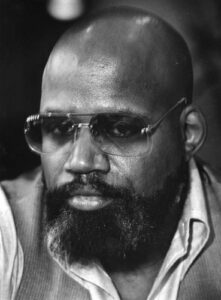
Professor Harry Edwards joined UC Berkeley’s department of sociology in 1971. He conducted scholarship in the area of sociology of race and sport and is also renowned for his involvement in the famous Black Power salute on the victory podium at the 1968 Olympic Games in Mexico City. In “Harry Edwards: An Oral History,” he discussed his early life and upbringing in addition to his role as a scholar-activist, his time at Berkeley, and his work as a consultant to national football and basketball teams. When he was interviewed as part of the UC Berkeley African American Faculty and Senior Staff oral history project in 2005, Edwards spoke of Chisholm with both the knowledge of a contemporary and the perspective of a sociologist. Edwards discussed Chisholm’s extraordinary independence:
Harry Edwards, 1984 (Photo: Toru Kawana, Los Angeles Herald Examiner Photo Collection, Los Angeles Public Library via Calisphere)
Shirley Chisholm, first of all, she had one phenomenal liability, and what I call it is the Stevenson syndrome. She was extraordinarily bright. She was extremely intelligent. That’s a phenomenal liability in the convention of the American political scene. She also had an independence to her that put her outside of the authoritative black leadership influence and control circle. The authoritative black leadership influence and control circle tried to get her not to run. They did not feel that it was “time” for a black woman to step out and run for President. She ran without the endorsement of the NAACP, without the endorsement of the Congress of Racial Equality, without the endorsement of SCLC, without the endorsement of Operation PUSH and Jesse Jackson. She ran on her own.
Shirley Chisholm is one of many women politicians discussed in the Oral History Center’s collections. The Oral History Center contains a wide variety of interviews on women in local, state, and national politics. For more on ground-breaking female politicians, the Oral History Center’s Women Political Leaders collection contains interviews that cover almost the entirety of the 20th century, from the suffragists onward. Interviewees include March Fong Eu, the first Asian American woman in the United States to be elected to a state constitutional office; Helen Gahagan Douglas, the first Democratic woman elected to the U.S. House of Representatives; and Hope Mendoza Schechter, a member of the Democratic State Central Committee and an activist for both the labor movement and the Mexican American community. The Oral History Center continues to preserve the histories of women leaders in the political sphere and is currently conducting new interviews with female political leaders in the Bay Area Women in Politics and California State Archives projects. For those who wish to learn more, a good place to start is the Oral History Center’s Women in Politics podcast, which has episodes on a variety of important female political leaders of the twentieth century — at the local, state, and national levels — including Francis Albrier.
Mollie Appel-Turner
Mollie Appel-Turner joined the Oral History Center as a student editor in fall 2021. She is currently a fourth-year history student with a concentration in medieval history.
About the Oral History Center
The Oral History Center of The Bancroft Library has interviews on just about every topic imaginable. You can find the interviews mentioned here and all our oral histories from the search feature on our home page. Search by name, keyword, and several other criteria. We preserve voices of people from all walks of life, with varying political perspectives, national origins, and ethnic backgrounds. We are committed to open access and our oral histories and interpretive materials are available online at no cost to scholars and the public.
From years of listening, I’ve learned that we all want to tell our stories and that we want, we need, to be heard.
After close to nineteen years with the Oral History Center — ten of those years serving in a leadership role — I have decided to hang up my microphone and leave my job at Cal. As with any major life transition, reflections naturally pour forth at times like these. I’ve been keeping track of these thoughts in hopes that they might prove interesting to others who have spent so many hours interviewing people about their lives or those who are interested in oral history writ large.
For me, learning and practicing oral history interviewing has been a gift. It has made my life richer, allowed me to access insights about human nature that otherwise might have been hidden from me, and offered me the opportunity to see people as the individuals that they are, freed from the stifling confines of presumed identities and expected opinions.
At OHC, interviewers typically work on a wide variety of projects. We often interview about topics in which we do not already have expertise and thus must develop some fluency with something new to us. Because we contribute to an archive that is to serve the needs of an unforeseeable set of current and future researchers, we naturally interview people who have made their mark in very different fields. This means that we interview people, sometimes at tremendous length, who are not like us and whose life stories and ways of thinking might be very different from our own. There is a well-documented tendency among oral historians to interview our heroes, people whose political ideals jibe with our own, people who can serve protagonists in our histories, people whose voices we want to amplify. At the Oral History Center, this bias is not paramount — rather, we strive to interview people across a broad spectrum of every imaginable category. And while we almost always end up very much liking our interviewees, they need not be our personal heroes and are not required to share our opinions; they only need to be an expert in one thing: their own lives and experiences.
Martin with Daisy McFurpants at Dillon Beach, beginning his first “gap year”.
This way in which we do our work has sent me wide and far and exposed me to a profound diversity of ways of looking at the world. And this multiplicity of perspectives has informed, challenged, engaged, astounded, and, frankly, remade me again and again over the past two decades. It is this essential facet of my work that I consider a gift to my own life.
After having conducted approximately 200 oral histories, ranging in length from ninety minutes to over sixty hours each, I find it a tad difficult at this point to highlight some interviews and not others. Whenever I get asked (as I often do): what was your favorite interview? I used to wrack my brain, endlessly scrolling through all of those experiences, but now I usually just say, “my most recent oral history.” I offer that up because the latest one typically remains most fresh in my own (not always so robust) memory — it is the interview that still retains much of the nuance, content, and feeling for me and that’s why it is “the best.” Still, I want to offer up a few examples from some of my oral histories to show how interviewing has influenced the way I live in the world.
Moving beyond my comfort zone
I arrived at OHC in July 2003, first spending a year on a fellowship in which I was given the opportunity to finish my book manuscript, Contacts Desired (2006), and then in July 2004 I started as a staff interviewer. My areas of expertise were social history, the history of sexuality and gender, and the history of communications. My first major oral history assignment? A multiyear project on the history of the major integrated healthcare system, Kaiser Permanente. Not only was this topic well outside my area of expertise, it also was not intrinsically interesting to me. But this was a new job and a big opportunity, so with an imposing hill in front of me, I decided to climb it. The project went on for five years and during that time I conducted most of the four dozen interviews. The topics ranged from public policy and government regulation to epidemiological research and new approaches to care delivery. I was sensitive to my inexperience with the subject matter so I hit the books and consulted earlier oral histories. I worked hard to get up to speed.
Just a few interviews into the project I had what might be considered an epiphany. After years of studying historical topics that were familiar to me, even deeply personal, I was pleased to discover something new about myself: I loved the study of history and the process of learning something new. Period. With this newly understood drive, I pushed myself deeper into the project and, I hope, was able to be the kind of interviewer that allowed my interviewees to tell the stories that most needed to be told. As it happens, along the way, I learned a great deal about a topic — the US healthcare system — that is exceedingly important, extraordinarily complex, yet necessary to understand. When the push for healthcare reform burst through in 2009 and 2010, I felt informed enough to follow the story and to understand the possibilities and pitfalls endemic to such an effort. In short, if one is open to the challenge, oral history can significantly broaden one’s horizons, educating one in critical areas of knowledge (from the mouths of experts!), and it might even make one into a more informed citizen.
Questioning what I thought I already knew
The Freedom to Marry oral history project was in many ways the opposite of the Kaiser Permanente project. First off, I could rightfully consider myself an expert in the history of the fight to win the right to marry for same-sex couples and the broader issues surrounding it. After all, I had written a book on gay and lesbian history and had personal experience with the movement when I married my partner in February 2004. Moreover, in graduate school and in preparation for writing my book, I had closely studied the history of activism and social movements. I had gone into this project, then, thinking I had a pretty good idea of what the story would be and what the narrators might say on the topic: this would be another chapter in the decades-long fight for civil rights in which activists engaged in protest and direction action, spoke truth to power, and forced the recalcitrant and prejudiced to change their minds.
From fall 2015 through spring 2016, I conducted twenty-three interviews with movement leaders and big-name attorneys, but also with young organizers and social media pros; I interviewed people in San Francisco and New York, but also in Maine, Oklahoma, Minnesota, and Oregon. What I learned in these interviews not only made me greatly expand my understanding of the campaign for marriage equality, these interviews also forced me to revise my beliefs about social movements and how meaningful and lasting social change can happen (I write about this more here). As a result of this project, I came to believe that some forms of protest, especially violent direct action, are almost always counterproductive to the purported aims; that castigating people with different ideas and perceived values is wrong and likely to produce a long-term backlash; and that in spite of our differences of opinion on contemporary hot button social issues, the majority of people cherish similar core values — values that bind rather than separate. The interviews demonstrated that by focusing on the shared values, rather than hurling epithets like “homophobe!” or “racist!” at your opponents, the ground is better readied for future understanding to grow. The history I documented surely is more complex than this, but these observations are true to what I found and are a necessary part of the reason this particular movement succeeded as well as it did. Through the Freedom to Marry oral history project, I learned to question the accepted public narrative and even what historians think that they knew on a topic. I recognized that openness to new ideas is a prerequisite of good scholarship. I recognized that most of all I needed to listen to what the oral history interviewees said and to compare that to what I thought I already knew. As a result, I learned to not let what I thought I already knew determine what I could still learn.
Telling a good story
The oral history interview is a peculiar thing. As ubiquitous as interviewing seems today, from StoryCorps on NPR to countless podcasts featuring interviews around the world to articles in the biggest magazines, the classic oral history method as we practice it at OHC is still quite rare. For our interviews, both interviewer and interviewee put in a great deal of effort in terms of background research, drafting interview outlines, on-the-record interviewing (often in excess of 20 hours with one person), and review and editing of the interview transcript. As a result, our interviews are almost always excellent source material for historians, journalists, and researchers and students of all stripes. But what moves an oral history from “good documentation” to something more is often the quality of the storytelling. Certainly some people, as a result of special experiences, have more fascinating stories to tell than others, but everyone I’ve ever interviewed has many worthwhile stories to tell: from formative family dynamics while young to the universal process of aging.
The difference between a competently told story and an engrossing one isn’t necessarily the elements of the story but the skill and verve of the storyteller. To hear Richard Mooradian, for example, speak about his life as a tow truck driver on the Bay Bridge and tell what it’s like to tow a big rig on the bridge amidst a driving rain storm is, yes, to learn something new but, more, it is to gain insight into a personality and the passion that drives that person to do what he does. I eventually learned (maybe I’m still learning) that when someone begins a story — and I know now the difference between a question being answered and a story being told — it is time for me to shut up, actively listen, and be open to the interviewee to reveal something meaningful about themselves. After years of helping, I hope, others give the best telling of their own stories, I started to think about my own stories, both the stories themselves but also how they have been told. I’ve come to think that these stories are nothing less than life itself: they are the emotional diaries that we keep with us always and, if we’re good, are prepared to present them to friends and strangers alike. From years of listening, I’ve learned that most of us want to tell our stories and that we want, we need, to be heard. This is a deeply humane impulse and I like to think that nurturing this impulse is at the core of what I’ve learned to be of true value over the past two decades.
These three lessons — openness to moving beyond your comfort zone, questioning what you think you already know, and telling a good story — are not necessarily profound or new. For me, however, they are real and as I return to them regularly in my work and personal life, they have been transformative. They have been a gift. The world of knowledge is massive. Learning something new is a key part of this gift. I’ve long recognized that we live in a world of Weberian “iron cages,” siloed into separate tribes. Listening to my interviewees challenge accepted wisdom inspired me to buck trends, forget the metanarratives, and break free from those cages confining our intellect and spirit. Stories are the most precious things we can possess. Create many of your own and share them widely – and wildly. After close to nineteen years at the Oral History Center, I am departing to do just that: to focus on living new stories and ever striving to tell them better.
Martin Meeker
Oral History Center
Director (2016-2021)
Acting Associate Director (2012-2016)
Interviewer/Historian (2004-2012)
Postdoc (2003-2004)
It’s been a topsy-turvy couple of years. But it’s not the only time in recent memory that the world’s turned upside down. As the Omicron variant has once again derailed our path to normalcy, I decided to search the Oral History Center’s collection to see what our interviewees have described as topsy-turvy. Referencing the trivial to some of the most challenging times in recent history, those who used the adjective included household names like Chief Justice Earl Warren and California Supreme Court Justice Cruz Reynoso, as well as artists, urban planners, venture capitalists, and Rosie the Riveters. Topics raised include the rise of Hitler, atomic weapons, the Great Depression, educational equity, campaign finance, messy houses, and downtown San Francisco. Here are the results.
See below for a detailed description of how to search our collection by a keyword like topsy-turvy.
Mannequin after the Operation Cue atomic blast, 1955 (Photo: National Archives)
The rise of Hitler
Betty Hardison: Rosie the Riveter World War II American Home Front Oral History Project
“The world was beginning to be topsy-turvy. That was around 1939, when Hitler was not being very friendly.”
During World War II, Betty Hardison worked at the Mare Island Naval Shipyards for the department responsible for repairing ships damaged during Pearl Harbor. Here she reflects on why she gave up her dream of university and journalism and took her first job.
Betty Hardison
When it was time to go off to school, I sold my clarinet and I went to Armstrong Business College in Berkeley. . . . It no longer exists, but it was a very prominent business school at the time. I took secretarial and all phases of business. But at that time, then, the world was beginning to be topsy-turvy. That was around 1939, when Hitler was not being very friendly. . . . Journalism was a strong goal. I had been editor of the yearbook and things like that, so I thought that I wanted to go to the university and take journalism. But then with the world being turned upside-down, I went for my first job.
Related discussion within the interview: educational expectations for women, life in Calistoga, California during the Great Depression
Downtown San Francisco
Robert Riley: 1988–2000 Curator of Media Arts, SFMOMA 75th Anniversary
“He found San Francisco to be completely topsy-turvy, vertiginous, and absolutely mad.”
Steve McQueen’s “Drumroll” on display (Photo: Los Angeles Museum of Contemporary Art)
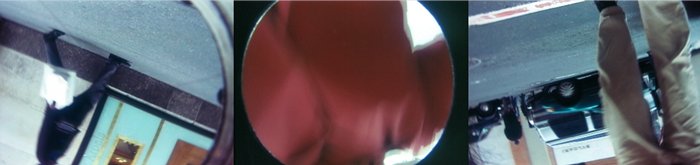
Robert Riley, the curator of media arts for the San Francisco Museum of Modern Art, recalled the inspiration for artist Steve McQueen’s work, Drumroll. McQueen had visited San Francisco during the exhibit of his work, Bear, in the early 1990s.
When he was in San Francisco, he experienced the hurly-burly, topsy-turvy development of the downtown—there was a lot of construction when he was here. There was traffic mayhem. . . . He found San Francisco to be completely topsy-turvy, vertiginous, and absolutely mad. He work-shopped an idea here of putting a camera lens into the drain hole of a striped orange construction barrel, which he borrowed. He’s a large man. He decided to start pushing the barrel down the street and just telling people to look out.
Related discussion within the interview: acquisition of Steve McQueen’s work, Bear; the development of Drumroll
Atomic bomb testing
Jean Fuller: Organizing Women: Careers in Volunteer Politics, Law, and Policy Administration
“Was that the mannequin whose head was cut off? Do you remember?”
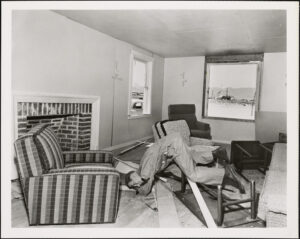
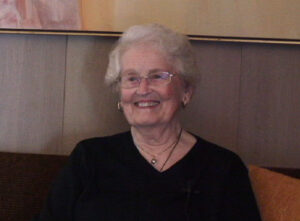
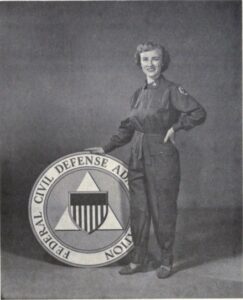
Jean Fuller, director of women’s activities of the Federal Civil Defense Administration, 1954–58, was present at an atomic bomb test explosion in May 1955, dubbed Operation Cue. Conducted by the Atomic Energy Commission outside of Las Vegas, the test was designed to determine how the blast would affect people (represented by mannequins), food, and various structures. Looking at before and after photos of a test home, Fuller discusses the results with her interviewer, Miriam Stein.
Jean Wood Fuller, 1958 (Photo: Federal Civil Defense Administration/Internet Archive)
Fuller: Now, here’s the before scene of that living room where we saw the man all topsy-turvy. As you see there were draperies and there were Venetian blinds. Now, had they had the draperies pulled completely across, the blinds probably would not have done quite as much damage but they were only as people normally leave them.
Stein: Was that the mannequin whose head was cut off? Do you remember?
Fuller: No, he was upside down here someplace.
Stein: That’s right. He was hanging over a chair.
Fuller: Yes, but he undoubtedly would have been dead.
Related discussion within the interview: detailed account of the atomic test
Campaign finance
Earl Warren Sr.: Conversations with Earl Warren on California Government
“Some poor son of a gun with no money but with a great issue will come along, and he’ll just turn them topsy-turvy.”
Earl Warren, who attended UC Berkeley as an undergraduate and also received his law degree from Berkeley Law, was governor of California and chief justice of the United States Supreme Court. Here he discusses campaign finance with his interviewer, Amelia Fry, and an editor from Doubleday and Company, Luther Nichols, who was assisting Warren with his autobiography.
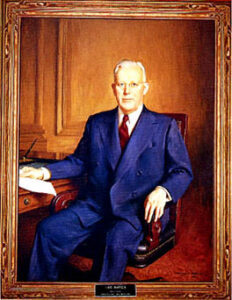
Official paining of Earl Warren as governor of California
Nichols: I think Alioto spent half a million dollars—
Warren: More than that.
Nichols: It came out to something like six dollars a voter — six dollars a vote—
Warren: Well, I’ll tell you. Of course, it’ll go along that way and then some poor son of a gun with no money but with a great issue will come along, and he’ll just turn them topsy-turvy. Now, you take that fellow who was elected—was it governor or senator—in Florida this year [1971]. He was a little country lawyer, Chiles, his name is— He’s a little country lawyer, he had no money of any kind to spend, but he told them he was going to start in the north of Florida and was going to walk clear through the state making his campaign. And, by George, he did. He’d arrange every way that— To start in the morning where there was a television station, and they’d pick him up there, say something about him, and he’d always stop at a television station at night. [Laughter] He got publicity that way and never spent a nickel on it, and he went all through the state, and he beat the whole outfit. [Laughter]
Fry: And he got all that free TV time!
Warren: Oh yes, he got all that free TV time.
Fry: He must have had a million dollars of TV time!
Warren: [Laughter] And never paid a dime for it!
Related discussion within the interview: decision to run for governor, campaign finance
Education
Justice Cruz Reynoso: California Supreme Court Justice, Professor of Law, Vice-Chair United States Commission on Human Rights, and 2000 Presidential Medal of Freedom Recipient
“Somehow those parents, when they have come to a meeting, have felt uncomfortable, as my parents did when they went to a PTA meeting.”
Cruz Reynoso, who received his law degree from Berkeley Law, was the first Hispanic California State Supreme Court justice. Here he reflects on race relations and parental involvement in schools.
Cruz Reynoso (Photo: UC Davis School of Law)
I will tell you a story because it turns things topsy-turvy. I may have told you about this. I was invited to go speak on a Saturday to a parent-student group in a school in the Los Angeles area. When I got there, I noticed that practically everybody involved was Spanish-speaking, and a great majority of the kids there were there, but the leadership of the PTA and practically everybody in charge was Latino. So I asked, “Is this an entirely Latino school? Do you have some other folk?” And they said, “Oh yes, about 20 percent of our students are Anglo.” And I said, “Well, where are the Anglo parents?” And they said, “We don’t know. We keep inviting them; they just don’t come.” I was bemused because I have heard that story told a hundred times about Latino parents by Anglo parents, “You know we keep sending these notices. They don’t come. They must not be—” They don’t say this, but the implication is “they must not be interested in education or must not be interested in their kids.” Well, I just said, “Maybe you ought to do something more so they feel comfortable when they come to these meetings and so on.” Something is not quite right when 20 percent of the parents don’t come to a Saturday function that is supposed to be good for everybody. I don’t know what they have done right or wrong, I really don’t. I nonetheless have the absolute sense that they haven’t done enough. Somehow those parents, when they have come to a meeting, have felt uncomfortable, as my parents did when they went to a PTA meeting. And we as human beings are smart enough to be able to figure things out on how to make those folk feel more comfortable and so on.
Related discussion within the interview: affirmative action generally, and in particular at UC Berkeley
Venture capital partnerships
Paul Bancroft III: Early Bay Area Venture Capitalists: Shaping the Economic and Commerce, Industry, and Labor Landscape
“Others are saying the world has kind of gone topsy-turvy today—I don’t mean today, but up until recently.”
Paul “Pete” Bancroft was an early participant in the venture capital industry and president, CEO, and director of Bessemer Securities Corporation. Mr. Bancroft also devoted considerable time to The Bancroft Library, which was founded by his great grandfather, Hubert Howe Bancroft.
Paul “Pete” Bancroft
It finally evolved, unfortunately, to the point where the venture capital partnerships were investing so much money that with the fees they were getting, the 1 percent to 2.5 percent of the assets, that they were making more money that way than they were on the profits that were being made when the investments were sold. It meant that they were really starting to lose sight of really making money on the companies they were investing in. Which is why Arthur Rock and others are saying the world has kind of gone topsy-turvy today— I don’t mean today [2010], but up until recently.
Related discussion within the interview: venture capital partnerships, CEO salaries, Bessemer Venture Partners
The de Young Museum. . . and the Monterey Bay Aquarium
Jim Chappell: Directing the Resurgence of SPUR & Urban Planning in San Francisco
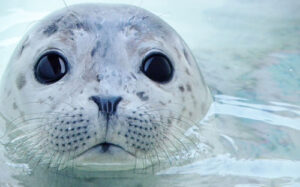
“Who can hate a baby seal?”
Jim Chappell is a retired urban planner whose forty-year career focused on intertwining environmental conservation into urban design. As the director of the nonprofit SPUR (San Francisco Bay Area Planning and Urban Research Association), he helped shape San Francisco into a modern city. Here he discusses design and structural problems with two California landmarks.
Jim Chappell
The de Young Museum harkens back to the Midwinter Exposition of 1894, and then opened as the de Young Museum in 1895. It grew topsy-turvy over the years and was badly damaged in the 1989 Loma Prieta earthquake. In fact, they built a steel exoskeleton around it to keep the walls from falling down. It had never been a great museum in terms of collection or building. And they are related. . . .
The [Monterey Bay] Academy was three or four years behind the de Young, so they got to learn from the mistakes, or at least knew what they were going to be up against when they started. Like the de Young, it was a building that had grown like topsy and was a mess of a building even before the earthquake. And then in the earthquake, pipes broke, which isn’t very good if you’re an aquarium. . . .
A baby seal
So in March 2000—this was three-and-a-half years after the first de Young bond vote—there was an $87 million bond on the ballot for the Academy. They needed 66 2/3 percent “yes.” They got sixty-seven. Phew. Just sneaked by. It was a different call than “old art.” It was “kids.” Their poster for the “yes” on the measure was a baby seal. Who can hate a baby seal?
Related discussion within the interview: California’s proposition system, the adaptability of Golden Gate Park, and the evolution of parks and recreation since the 1800s.
How to search for a keyword like topsy-turvy
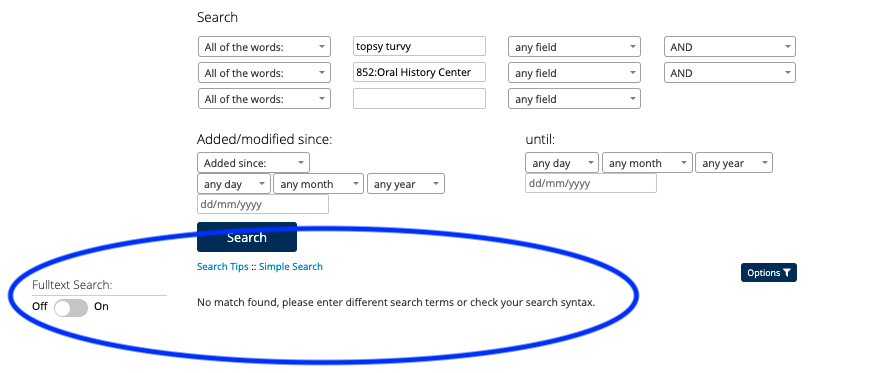
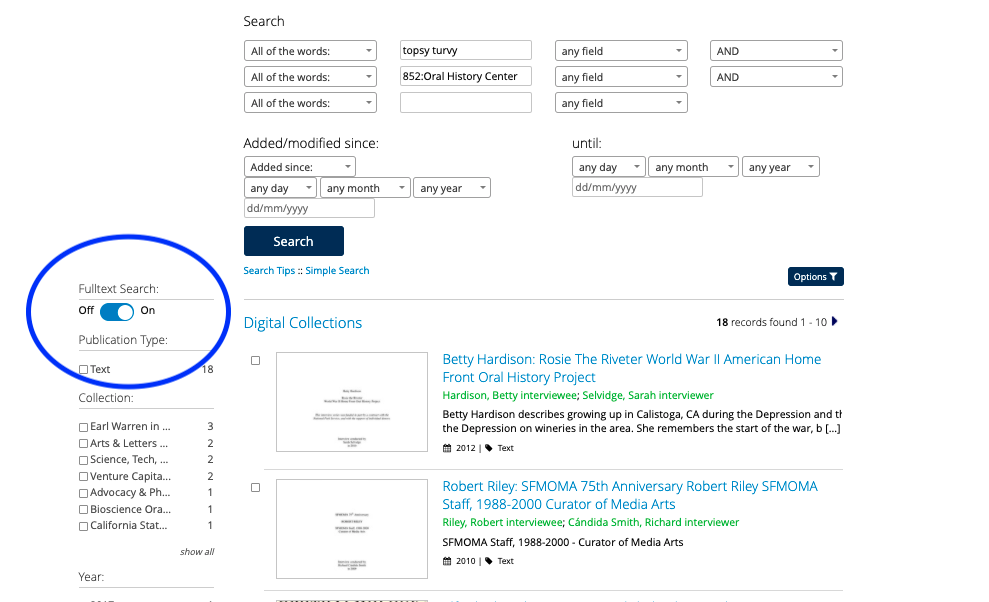
You can find the interviews mentioned here and all our oral histories from the search feature on our home page. Search by name, keyword, and several other criteria. From our home page, I entered topsy turvy in the search box and clicked search. (I did not get a different result with/without a hyphen.) There were 18 total results, including when the interviewer used the term or it appeared in an introduction.
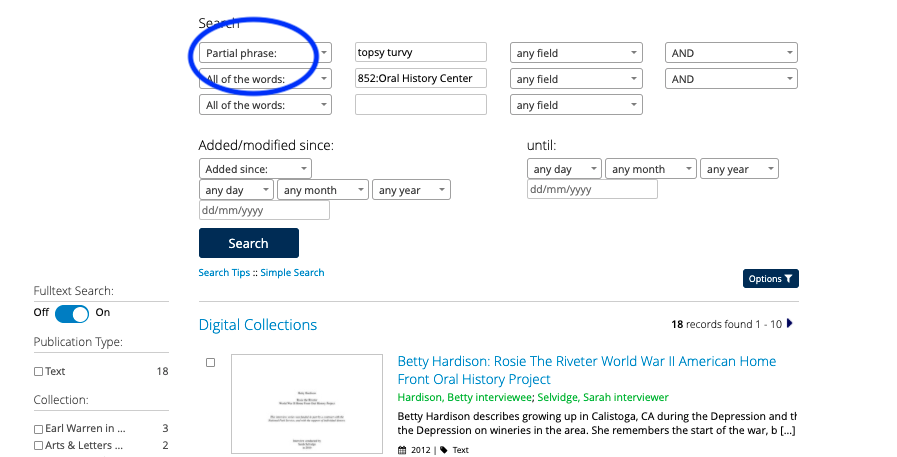
When you get to the results page, you might not initially see any oral histories. This is because the “full text” feature is off by default. On the results page, toggle on “Fulltext search.” A number of oral histories will populate on that page in a list. Please note that sometimes I get better results when I change the default “all the words” to “partial phrase.”
From the results list, click on any oral history. The next page will provide information about the oral history, such as interviewer, publication date, project, and so on. That page also enables you to read or download a PDF of the oral history. Without downloading, I entered the word “topsy” into the oral history search feature and selected “highlight all.” Then I just clicked on the arrow to be taken directly to the word. Repeat clicking on the arrow to see all examples of the search term within the oral history.
Jill Schlessinger is communications director and managing editor for the Oral History Center. She received her doctorate in history from UC Berkeley.
About the Oral History Center
The Oral History Center of The Bancroft Library has interviews on just about every topic imaginable. We preserve voices of people from all walks of life, with varying political perspectives, national origins, and ethnic backgrounds. We are committed to open access and our oral histories and interpretive materials, including our podcasts and articles, are available online at no cost to scholars and the public.
The OHC is offering interactive, online versions of our educational programs again this year due to the ongoing COVID-19 crisis.
CLOSED: Advanced Institute: August 8–12, via Zoom
NOTE: Applications to the Advanced Institute are now closed and the wait-list is full. We look forward to seeing you at our Introductory Workshop and Advanced Institute in 2023. Dates for these programs will be announced in the future.
The Oral History Center is offering an online version of our one-week advanced institute on the methodology, theory, and practice of oral history. This will take place from August 8–12, 2022. Due to the global COVID-19 pandemic, the Advanced Institute will be held online.
The cost of the Advanced Institute has been adjusted to reflect the online nature of this year’s program. Tuition is $600. See below for more details, including scholarship opportunities.
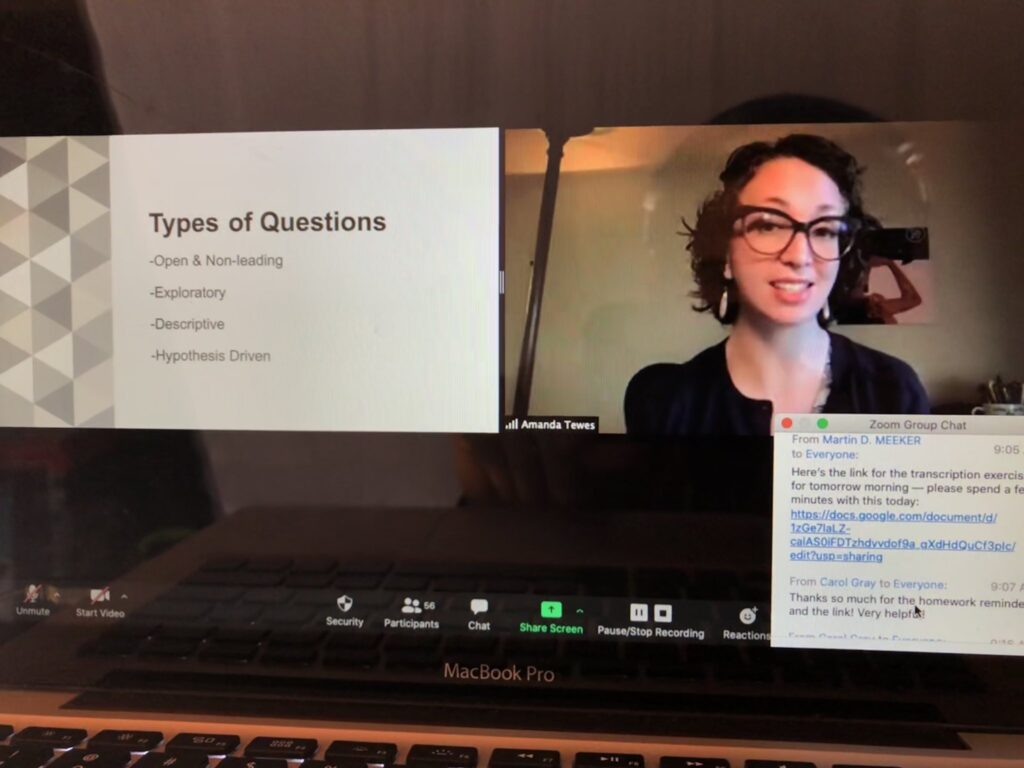
Amanda Tewes presents on interviewing during a remote workshop.
The institute is designed for graduate students, postdoctoral fellows, university faculty, independent scholars, and museum and community-based historians who are engaged in oral history work. The goal of the institute is to strengthen the ability of its participants to conduct research-focused interviews and to consider special characteristics of interviews as historical evidence in a rigorous academic environment.
We ask that applicants have a project in mind that they would like to workshop during the week. All participants are required to attend small daily breakout groups in which they will workshop projects. In the sessions, we will devote particular attention to how oral history interviews can broaden and deepen historical interpretation situated within contemporary discussions of history, subjectivity, memory, and memoir.
Overview of the Week
The institute is structured around the life cycle of an interview. Each day will focus on a component of the interview, including foundational aspects of oral history, project conceptualization, the interview itself, analytic and interpretive strategies, and research presentation and dissemination.
Instruction will take place online. Seminars will cover oral history theory, legal and ethical issues, project planning, oral history and the audience, anatomy of an interview, editing, fundraising, and analysis and presentation. During workshops, participants will work throughout the week in small groups, led by faculty, to develop and refine their projects.
Participants will be provided with a resource packet that includes a reader, contact information, and supplemental resources. These resources will be made available electronically prior to the Institute, along with the schedule.
Applications and Cost
The cost of the institute is $600. We are offering a limited number of participants a discounted tuition of $300 for students, independent scholars, or those experiencing financial hardship. If you would like to apply for discounted tuition, please indicate this on your application form and we will send you more information. [Update March 10, 2022: Discounted tuition slots are now full.]
Please note that the OHC is a soft money research office of the university, and as such receives precious little state funding. Therefore, it is necessary that this educational initiative be a self-funding program. Unfortunately, we are unable to provide financial assistance to participants other than our limited number of scholarships. We encourage you to check in with your home institutions about financial assistance; in the past we have found that many programs have budgets to help underwrite some of the costs associated with attendance. We will provide receipts and certificates of completion as required for reimbursement.
Applications are accepted on a rolling basis. We encourage you to apply early, as spots fill up quickly.
Questions?
Please contact Shanna Farrell at sfarrell@library.berkeley.edu with any questions.
The 2022 Introduction to Oral History Workshop will be held virtually via Zoom on Friday, February 4, from 8:30 a.m.– 2:30 p.m. Pacific Time, with breaks woven in. Applications are now being accepted on a rolling basis. Please apply early, as spots fill up quickly.
This workshop is designed for people who are interested in an introduction to the basic practice of oral history and learning best practices. The workshop serves as a companion to our more in-depth Advanced Oral History Summer Institute held in August.
This workshop focuses on the “nuts-and-bolts” of oral history, including methodology and ethics, practice, and recording. It will be taught by our seasoned oral historians and include hands-on practice exercises. Everyone is welcome to attend the workshop. Prior attendees have included community-based historians, teachers, genealogists, public historians, and students in college or graduate school.
Tuition is $150. Please note that the OHC is a soft money research office of the university, and as such receives precious little state funding. Therefore, it is necessary that this educational initiative be a self-funding program. We encourage you to check in with your home institutions about financial assistance; in the past we have found that many programs have budgets to help underwrite some of the costs associated with attendance. We will provide receipts and certificates of completion as required for reimbursement.
Applications are accepted on a rolling basis. We encourage you to apply early, as spots fill up quickly.


 In the wake of President Truman’s Executive Order, the California state legislature began to introduce its own policies in opposition to potential communist activity in the government. These proposals would have given the state authority over the University of California in matters of loyalty, prompting the University of California administration to act in response to prevent infringement on the institution’s autonomy. Furthermore, the university was at this time also facing financial difficulties, with the state threatening to withhold funding for the university budget due to worries about subversive activity within its community. As a result of these mounting pressures, University President Robert G. Sproul proposed his own loyalty oath for university faculty and employees on March 25, 1949. The text of the oath approved by the Regents on June 24 was as follows: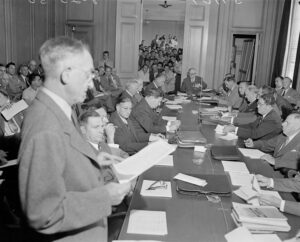


 Lisa Rubens, retired oral historian and longtime OHC interviewer, reflected on Martin’s appointment: “I worked closely with Martin after he joined our staff in 2003. He was a breath of fresh air — his scholarship, collegiality, and interviewing skills were immediately obvious. Once becoming director he created an environment which supported our staff in interviewing people in all walks of life, sustaining OHC’s deserved reputation as the nation’s leading academic oral history program.”