Central Asian Studies Society, University of Chicago6031 S Ellis Ave, Chicago, IL 60637, US cass.uofc@gmail.com
Call for Papers for the Central Asian Studies ConferenceWe are excited to announce the Central Asian Studies Conference at the University of Chicago, organized by the university’s Central Asian Studies Society and taking place on April 17–18, 2026.About the Conference. Throughout Central Asia, embodied culture is expressed through art and culture: oral traditions, written poetry and literature, textiles, music, and many other media. Creative acts and works have been intertwined with collective experiences ranging from celebrations to invasions to revolutions, working to represent and shape memory and identity. Our conference centers reflections on art, music, oral traditions, literature and other cultural practices as not only objects of study, but also as sources of inspiration, tangible connections to the past and means to understand the present. We are creating a space for young researchers interested in matters of culture and identity to meet, learn about, and learn from each other.Call for Papers. We are now accepting abstracts of papers, mainly from graduate students, but also from postdoctoral fellows, faculty members, and independent scholars. We invite historians, linguists, anthropologists, art historians, literary scholars, sociologists, musicologists, and scholars of religion whose work engages with Central Asia—conceived broadly: from the Mongolian Plateau in the east to the Urals in the west, from Afghanistan in the south to the Altai Mountains in the north—between late antiquity to the present.We particularly encourage submissions related to this inaugural conference’s theme: “Voices through Art and Culture: Identity Formation in Central Asia, from Music to Architecture.” What can art and culture tell us about the process of identity formation? What is the relationship between culture and politics? How were the responses to historical events that affected the whole of Central Asia, in political, ecological, economical realms differ and take shape in the forms of art and culture? How does art and culture reflect Central Asianness, whether as a unified identity and/or a condition of great diversity and difference?In the current political climate of instability globally and in the region, this Conference aims to delve into the historical practice of artistic and cultural responses and help us investigate the current time – how is identity being transformed and reflected in modern art and cultural traditions? We believe that, especially in at such a time, it is important to look back at the roots of the identity and reevaluate it. And there is no better tool for that than looking into Art and Culture.Keynote Speakers: The keynote speakers for the Conference are a distinguished scholar of ethnomusicology Professor Theodore C. Levin and a prominent artist from Kazakhstan Gulnur Mukazhanova.Dr. Theodore C. Levin, Arthur R. Virgin Professor of Music at Dartmouth University, author of the book The Music of Central Asia. Theodore Levin is a longtime student of music, expressive culture, and traditional spirituality in Central Asia and Siberia. Levin served as the first executive director of the Silk Road Project, founded by cellist Yo-Yo Ma. His research and advocacy activities focus on the role of arts and culture in international development, and on the preservation and revitalization of musical heritage.Gulnur Mukazhanova, a distinguished artist born in Kazakhstan and based in Berlin, who weaves together Central Asian heritage with contemporary artistic enquiry. Through textiles and symbolic materials, she evokes layers of cultural and historical memory. Her works unfold as dialogues between suppressed traditions and today’s shifting realities, reflecting on postcolonial experience, feminism and globalization. Her recent solo exhibitions include Bosağa – Transition. The Weave of Ancestral Memory at the Tselinny Center of Contemporary Culture, Almaty (2025); Öliara: The Dark Moon at Mimosa House, London (2022); and The Space of Silence at Aspan Gallery, Almaty (2021).Submissions. Please send submissions electronically to caconferenceuofc@gmail.com no later than Sunday, February 1, 2026. Please include your name, institutional affiliation, program of study or position, a 250-word abstract, and a tentative title. If you are unsure about the suitability of your topic, please feel free to email us at the above address. Applicants will hear back from us by late February 2026.Selected papers will be grouped into panels of three. Participants should be prepared to deliver a 20-minute presentation, followed by a led Q&A discussion. Written papers must be circulated to the discussant and fellow members of the panel at least two weeks before the conference.Limited funds for travel will be available to presenters without access to institutional funding. Please indicate if you are interested in being considered for this funding in your email.Please circulate this widely! For questions and accessibility concerns, please write to caconferenceuofc@gmail.com.A performance by the Tuvan music trio Alash, also organized by the Central Asian Studies Society and taking place in Rockefeller Chapel, will conclude the conference.
Tag: Central Asia
Library Trial: Muslim in Russia Online (Brill Database)
UC Berkeley Library has set up a trial of Brill’s Muslim in Russia Online Database. The database trial will continue until February 1, 2025. You can access the trial here.
This collection examines the varied Russian Muslim population during the period of 1861-1918. It includes works by and about Muslims, highlighting the significance of this heritage as the history and spirituality of Muslims in Russia are being reexamined. A word of caution: Most of the periodicals in this database have been digitized from microfilms; thus, digitization quality is problematic. The OCR seems unchecked and automated “dirty,” so one has to look at the images.
Please access the database here: https://shorturl.at/M4IyT
Please see the screenshot below:
![Title: V mīri͡e musulʹmanstva:ezhenedelʹnai͡a, literaturnai͡a, politicheskai͡a i obshchestvennai͡a gazeta.<br />Date: 1911<br />
Date in Source: [1911-1912]](https://update.lib.berkeley.edu/wp-content/uploads/2025/01/Screenshot-2025-01-08-105604.jpg)
Date: 1911
Date in Source: [1911-1912]
Here are the key points about this database are highlighted below:
- Role in Russian State: Muslims played a crucial role in the creation of the multinational Russian state, completed with the annexation of Central Asia in the 1860s. By 1897, Muslims made up almost 11% of Imperial Russia’s population (14 million).
- Russian State Policy: Russian policy towards Muslims varied. Initially, there was forced Russification and Christianization. From Ekaterina II onwards, the policy shifted towards legitimizing Muslims. Under Alexander III, discrimination against non-Christians, including Muslims, increased.
- Early 20th Century: The early 1900s saw a rise in Muslim nationalism, fueled by religious reformism and liberal ideas. The First Russian Revolution (1905-1907) led to significant political changes, including creating the State Duma and civil freedoms.
- Union of Muslims of Russia: Formed in 1905-1906, this organization became the most powerful political body for Muslims until 1917, with branches across various regions.
- Intellectual and National Identity: Early 20th century saw more Muslim intellectuals and interest in national identity, heritage, and traditions.
- 1917 Revolutions: Muslim nationalist movements grew during the February and October Revolutions of 1917. Post-1917, Bolshevik policies negatively impacted Muslims’ religious freedoms.
- Muslim Press: Until 1905-1907, Muslim issues were poorly reported. The 1905 revolution led to a surge in Muslim publications. These periodicals covered a range of ideological perspectives and helped address Muslim problems.
- Unique Publications: Publications from 1861-1918 provide insights into Muslim life in the Russian Empire and their leaders’ perspectives. These works are valuable for understanding Muslims’ historical and spiritual heritage in Russia.
Conference at UC Berkeley: Ruling Together Consultation and Collaboration in the Political Regimes of Premodern Eurasia
Ruling Together: Consultation and Collaboration in the Political Regimes of Premodern Eurasia
February 16, 2024
Maude Fife Room, 315 Wheeler Hall, UC Berkeley
Organized by Tang Center for Silk Road Studies
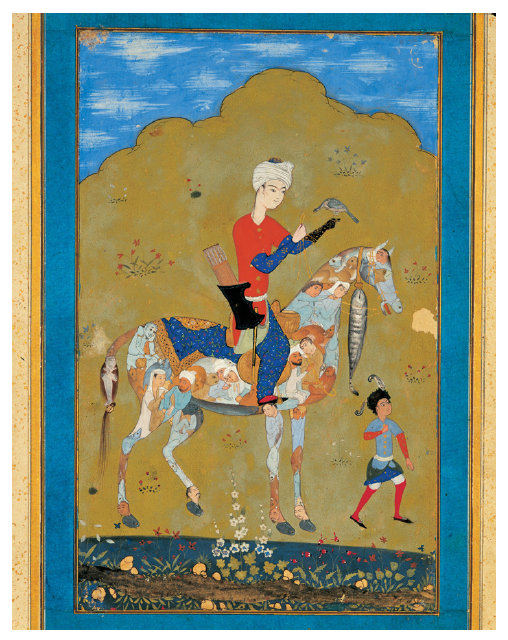
The conference focuses on the medieval and early modern periods (1000-1700 CE) as a crucial era for cross-cultural contact, challenging the lesser emphasis this period has received within “Silk Road” scholarship. It argues that viewing Eurasia merely as a space of intermittent object and idea exchange through trade or diplomacy depoliticizes cultural and goods spread, which is inadequate for understanding the political dynamics of these centuries dominated by the Mongol Empire and its successors. Emphasizing the role of political institutions in transregional history, the conference aims to integrate the study of cross-cultural contact with political history, highlighting Central Asia’s significance in the global political history of the medieval and early modern periods.
8:30 Tea and Coffee
9:00 Welcome Remarks
Panel 1
Who Should Rule? Institutions of Sovereignty and Succession
9:15 Christopher Atwood, University of Pennsylvania
The First Interregnum: Imperial Stake Holders in a (Temporarily) Khan-less World
9:45 Michael Bechtel, Nazarbaev University
Mongol Empire 1229-46: Frameworks of Rule and Redistribution (Related article is here)
10:15 Jonathan Brack, Northwestern University
Chinggisid Family Feuds, Islamization, and the Religious Sphere in Mongol-ruled Iran
10:45 Evrim Binbaş, University of Bonn
The Theater of Constitutional Ideas: The First Timurid Civil War and Shahrukh’s Ascension to Timur’s Throne
11:15 Discussion
11:45 Lunch break
Panel 2
How to Rule? Transcontinental Institutions
1:30 Carol Fan, University of Bonn
Revenue sharing networks within the Mongol Empire and transregional contacts
across Eurasia in the 13th and 15th centuries
2:00 Paehwan Seol, Chonnam National University
The Jarghu: Mobile Courts and Justice Networks of the Mongols throughout East-
West Asia during the 13th to 14th Centuries
2:30 Natalia Królikowska, University of Warsaw
Numerous Nogay peoples, the Circassians and innumerable Tatars’ influence on the decision-making process in the Crimean khanate.
3:00 Discussion
3:30 Tea and Coffee
Panel 3
What is Ruling? Conceptualizing State and Empire
3:45 David Sneath, University of Cambridge
The Lords’ Administration: Mongolian aristocratic governance and the state as social
relation
4:15 Munkh-Erdene Lhamsüren, National University of Mongolia
The Chinggisid Sovereignty: Myth, Archetype, and Transformation (see similar article here)
4:45 Kaveh Hemmat, Benedictine University
Rule of Law in Islamicate Civic Lore Concerning the Mongol Empire and China
5:15 Discussion
Primary Sources: British and US documents on Afghanistan, Central Asia, and Persia
Afghanistan and the U.S., 1945-1963: Records of the U.S. State Department Classified Files
Declassified U.S. State Department files documenting U.S. and Afghan relations during the height of the Cold War and U.S. policies toward Afghanistan. The resource includes 3 subcollections:
- Records of the Department of State relating to Internal Affairs: Afghanistan, 1945-1949
- Records of the Department of State relating to Internal Affairs: Afghanistan, 1960-1963
- Records of the Department of State relating to Political Relations: U.S. and Afghanistan, 1930-1959
Afghanistan in 1919: The Third Anglo-Afghan War
The Third Anglo-Afghan War began 6 May 1919 and ended with an armistice on 8 August 1919 resulted in Afghanistan gaining indpendence from British influence. This collection of British India Office documents includes confidential correspondence, memoranda, orders, reports and other materials that provide a broad spectrum of information on military policy and administration, including the organization, operations and equipment of the British army during the war.
Central Asia, Persia and Afghanistan, 1834-1922: From Silk Road to Soviet Rule
This collection of British Foreign Office files explores the history of Persia (Iran), Central Asia and Afghanistan from the decline of the Silk Road in the first half of the nineteenth century to the establishment of Soviet rule over parts of the region in the early 1920s. It encompasses the era of “The Great Game” – a political and diplomatic confrontation between the Russian and British Empires for influence, territory and trade across a vast region, from the Black Sea in the west to the Pamir Mountains in the east.
Comprised of correspondence, intelligence reports, agents’ diaries, minutes, maps, newspaper excerpts and other materials from the FO 65, FO 106, FO 371 and FO 539 series, this resource forms one of the greatest existing sets of historical documents relating to this region, offering insights not only into the impact of Great Power politics on the region, but also the region’s peoples, cultures and societies.
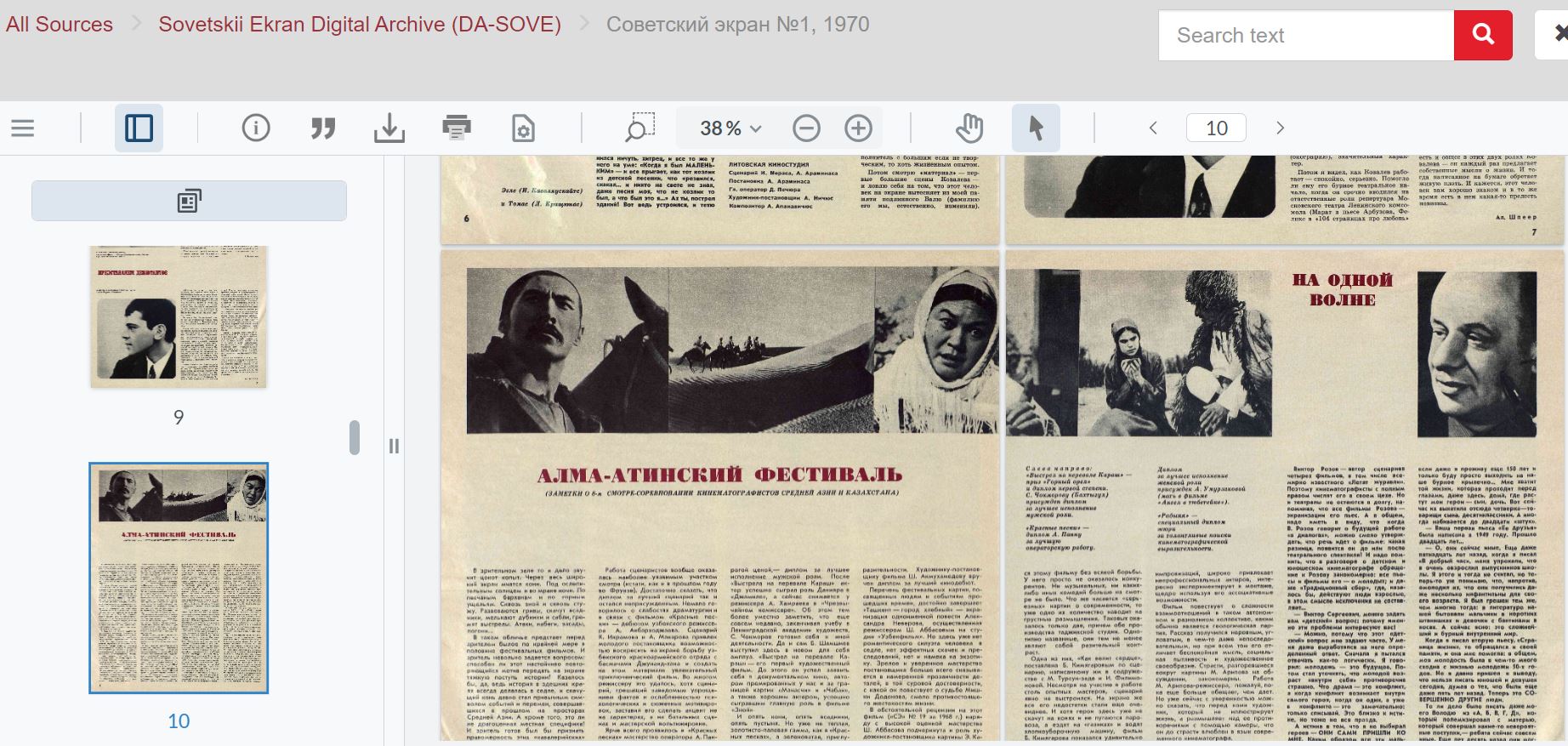
Sovetskii Ekran (Soviet Film) Digital Archive at UC Berkeley Library
The Library has purchased the Digital Archive of a Soviet film magazine: Sovetskii Ekran. The archive provides access to the full-text of journal issues that were published from 1925-1998.
Below is the screenshot of the landing page of the Sovietskii Ekran.

At the time of writing this blog, the digitization of issues was completed through 1970 and the additional digitization was in progress.
About the journal:
Soviet Screen was a magazine in the USSR that ran from 1925 to 1998 (with a break from 1941 to 1957). It talked about movies, both from the Soviet Union and other countries, cinema history, and had articles critiquing films. They also had reader polls each year to pick the best film, actor, actress, film for children, and music film.
The magazine had different names over the years, like Screen Film Gazeta in 1925, Cinema and Life in 1929–1930, Proletarian Cinema from 1931–1939, and Screen from 1991–1997. Before 1992, it was connected to the Union of Cinematographers of the USSR State Committee for Cinematography and the USSR.
In 1984, they printed 1.9 million copies. In 1991, the editor was Victor Dyomin, and the magazine was published under the title: Screen. It started coming out less often, monthly instead of more frequently. It kept going as Screen Magazine until 1997, then for a few months in 1997-1998, it went back to its old name-Soviet Screen. But it couldn’t survive the financial troubles in 1998 and had to stop publishing (Source: Wikip.).
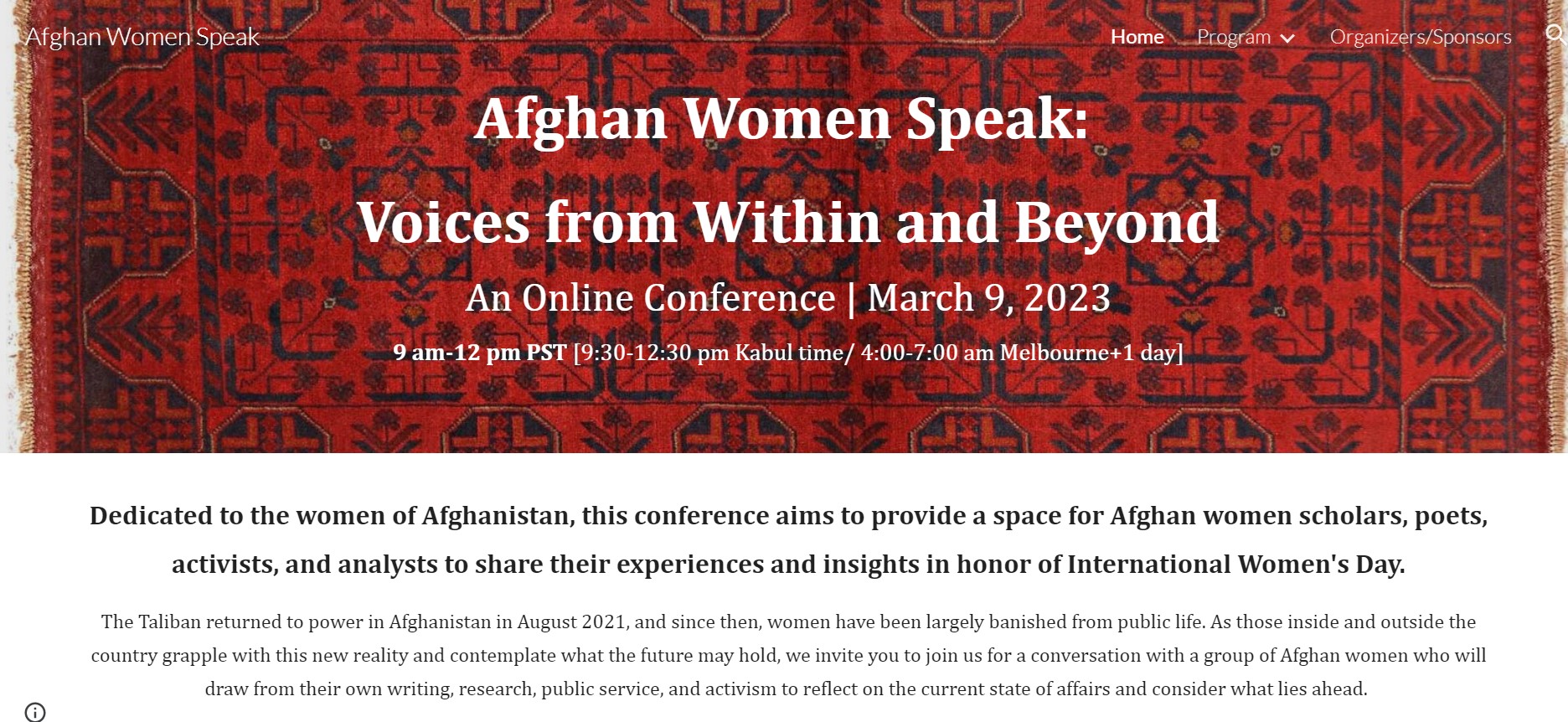
Happy International Women’s Day and Conference Dedicated to International Women’s Day!
In many of the world, we enthusiastically celebrate International Women’s Day. We were not aware then of Valentine’s Day and scamming of flower prices then. While the questions surrounding diverse values, gender identities, and contemporary politics are complicated, it is important to note that for many in the world, the basic human rights that we take for granted in the United States are beyond reach. I have been asked today to post a courtesy conference that is not affiliated with our library in which I will participate as a member of the organizing committee in my private capacity. The conference is dedicated to women of contemporary Afghanistan.
The conference will occur tomorrow, March 9th, from 9 am PST through 12 noon. The website for the conference is Afghan Women Speak: Voices from within and beyond. The conference is FREE and OPEN to all with prior registration.