By Lily Garcia, Undergraduate Library Fellow (2022-23)
The start of each semester brings a new weekly routine. Classes and extracurricular activities structure your days and influence where you spend your time on campus. Gradually, you become accustomed to your schedule, going to the same place, sitting in the same seat, and doing the same activity on repeat week after week. Novelty becomes easy to forget. During my time as a Research Fellow, I learned how to look at routine experiences and recollect that novelty to help others navigate academic spaces.
One project I was involved in over the spring semester was completing UC Berkeley Library (Hub) Profiles. As a former Main Stacks student library employee and frequent visitor to Heyns Reading Room, these two libraries had long been cloaked by familiarity for me. The project of visiting Main Stacks and Doe Library while imagining I was entering them for the first time again, thus proved to be an enlightening exercise. Using the “I Like, I Wish, I Wonder” and “One thing to know before…” frameworks, I navigated through these spaces I had visited consistently for the past two years and asked myself, what did I enjoy about that library when I first saw it? How did I figure out where to go initially? I became aware again of how confusing, yet exciting, everything is in the beginning. Once I had reflected, I recorded my ideas into our online profile templates, which is data that can be used to improve the wayfinding experience for future visitors to the UC Berkeley libraries.
As I prepare to graduate next week, I am practicing this skill of remembrance. I have been (re)visiting my Berkeley haunts for the last time and thinking about how I have grown throughout my journey. In particular, Doe Library has been a place I have thought a lot about. Not only was it the first place I went to on campus, but it acted as the home of my community at Cal. It is where I went weekly to meet with my ULF peers and mentors. Being a Research Fellow in the ULF program has been an invaluable experience that I will treasure well into the future and has helped me see the novelty again in the routine.
By Timothy Kim, Undergraduate Library Fellow (2022-23)
Looking back on the efforts of the Undergraduate Library Fellows, I’ve come to realize and appreciate how much the program has matured. A theme I noticed this semester had been on wayfinding, or the ways in which people navigate unexplored places and orient themselves.
We started off in January optimistic but a little unguided. The fellows and I knew what our main goal was–to help bridge the gap between library resources and students–but we didn’t have a clear path on how to do this. Great ideas were conceived, from developing our social media presence to creating library profiles and grouping them in hubs for easier access, but I felt there were too many avenues and not enough time to properly explore each one. Each fellow pursued projects they were most interested in and developed frameworks for how they could best accomplish their goals.
As the semester progressed and students began to navigate their research projects, however, I think the other fellows and I were reoriented to really focusing on the student experience. We had peer-to-peer consultations and were given the opportunity to lead a Research 101 Workshop, which encouraged us to develop frameworks on how to approach individual and group learning and forced us to look at the path to research from different perspectives. Some students had no experience with research but needed to complete their assignments while others were very experienced but had reached a dead end. We had to look at how students approached their projects and create a map that they could use to help them with their needs.
Leading the workshop in front of my fellow undergrads and guiding students through consultations was very rewarding, and with each experience I learned to rely less on a rigid framework and instead cater to where each student was at on their journeys. I believe this allowed me to be more useful as a fellow and grounded the other fellows and I to our main goal.
Our final project, the Bancroft User Experience, was a culmination of the skills and experiences we had throughout the semester. In this project all of the fellows concentrated on how users would navigate archival research from the Bancroft collection and any roadblocks they might encounter while doing so. Now that we had a framework and more importantly, experience and perspective, we could ask ourselves where students and researchers might encounter obstacles when using Bancroft library resources. We were able to identify and present our findings to the librarians of the Bancroft library.
As I reflect on the past semester and past year overall, I can see how much the other fellows and I have grown. I can see where we have gained perspective on what research is and the path it takes to help students benefit from the library’s vast wealth of knowledge. More importantly though, I’ve thoroughly enjoyed the experiences I’ve had and the interactions with so many wonderful people that taught me the ability to find this direction.
By Avery Klauke, Undergraduate Library Fellow (2022-23)
When I tell people I work in Doe Library, it is sometimes followed by, “Is that the big building people take grad photos in front of?” Although true, it has previously amazed me that some students don’t know more about Doe (or many other libraries). But as I was reflecting on this year, this didn’t come as much of a surprise…
When you enter Berkeley in your first year, there’s often a stigma around the libraries. They’re big, quiet, and intimidating. Their sole purpose is to be a place where students can cram for finals or get in a quick nap between classes. And most of the time, this stigma doesn’t go away in the years you’re here. That was the goal for the library fellows this year. To make strides in painting the libraries as a place of collaboration, creativity, and fun.
The first thing the research fellows got to do this semester was teach a Research 101 Workshop. This workshop was our way of merging our 1-1 research consultations with the ways Research 101 is traditionally taught. And between presenting all of the material well to trying to keep everyone engaged and collaborative, it was no easy feat. But we thought that if students could see their peers presenting, it would help our goal of making the library less menacing of a place. Personally, being able to field questions and work together with the rest of the research fellows made this experience my personal favorite.
Another project we did this semester was coined the “Bancroft User Experience Project”. Unlike the other projects this year, I didn’t have to put myself into the shoes of a new student because I too had almost no experience with the Bancroft Library. Our goal was to identify advantages and “pain points” when requesting a special collection item. One of my conclusions from this project was that despite the employees and librarians in Bancroft being so helpful and understanding, there’s still an intimidation factor that turns away most undergraduates before they even enter the front door. If you’re a new student reading this- don’t believe what people say about Bancroft being an exclusive library! If you can get over this hurdle, you’ll be exposed to some of the most extensive collections on campus!
Although the goal for this year was to give back to the Berkeley student body, I cannot say that I didn’t experience any personal gain. This year’s fellows and mentors provided me with the most enjoyable space to spend my afternoons. I hope to continue our goal of making the library more welcoming to students, and I can’t wait to see what we accomplish next year!
By Sofia Hernandez, Undergraduate Library Fellow (2022-23)
A highlight of my ULF experience this semester was being able to bring our peer-to-peer consultation experience outside of Doe 190 and into a different setting: Doe 223! Last semester, I learned a lot about hosting peer-to-peer consultations and meeting the needs of a wide variety of learners. Assuming the role of a “mentor” to my peers while simultaneously being an undergraduate student myself gave me unique insight into the research consultation experience: it is daunting to ask for help, but that fear slowly dissipates as you work alongside someone who looks just like you and is on the same educational journey as you are! I loved getting to know our consultees and the wide-ranged string of research ideas they brought us to untangle together, therefore, I was delighted to learn that this semester would bring in the opportunity for the Research fellows to host a “Research 101” workshop of our own in the library classroom (infamous and aforementioned Doe 223) on the second floor–talk about moving up in the world!
As a returning fellow, I’ve attended a couple of Research 101’s in my time; all of them uniquely wonderful and engaging. The rotating teams of librarians who host these workshops have a seemingly natural “synergy” to their presentations and teaching styles, a quality I greatly admire as an aspiring librarian myself, so the idea of hosting a workshop for students, by students, made me feel equal parts nervous and excited.
After some tentative scheduling and planning, a date was set: March 16. The lead up to that Thursday was short lived (as was the rest of the spring semester…where did the time go?!). Alongside two of the three other Research fellows, our consultation-free days were spent going over changes we’d like to see in the current workshop module. We played around with the order of information, reworded text-heavy slides with student-friendly language, and most importantly: bonded and got to know one another the more time we spent together tinkering with our Google slides.
The day of our presentation rapidly crept up on us, and though I was nervous beforehand (and admittedly during), our workshop ran quite smoothly. Hosting a research workshop was no different than hosting a consultation, plus, I had the support of two awesome Research fellows beside me who I could rely on to take the reins and fill in for spots or details I missed. Everything did not fall solely on one person–a feat unknown to many who have experienced college group projects. Hosting Research 101 allowed me to exercise the skills I have been learning in our consultations (for instance, how to be flexible and open to throwing “the rule book” out when things don’t go as planned) and apply them to a larger and more collaborative scale.
As I close out my junior year at Cal, I am excited and eagerly anticipating returning to the fellowship in the Fall and seeing what new opportunities and doors the fellows and I can open together.
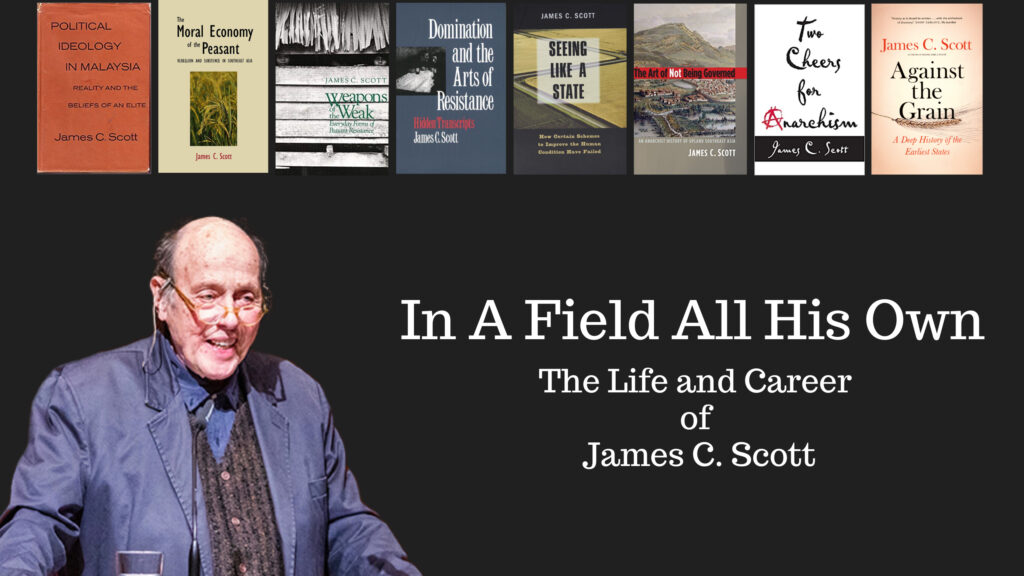
In A Field All His Own: The Life and Career of James C. Scott
“James C. Scott is regarded by many as one of the most influential thinkers of our time.”
The Oral History Center at UC Berkeley is proud to release, In A Field All His Own: The Life and Career of James C. Scott, a documentary that offers an unprecedented look at the famed Yale political scientist. Created and produced by UC Berkeley Oral History Center (OHC) historian Todd Holmes, the film draws from nearly thirty hours of oral history interviews with Scott and affiliated scholars at Yale and UC Berkeley to trace the intellectual journey of the award-winning social scientist from his childhood in New Jersey through each of the ground-breaking works he produced throughout his accomplished career. Overall, the film presents an intellectual biography of one of the world’s preeminent academics, a feature that will serve as a treasured resource for students and scholars around the globe.
While intellectual biographies may not be a typical genre, Scott is far from a typical academic. Over the last fifty years, few scholars have achieved such prominence within the American academy as James C. Scott. The Sterling Professor of Political Science at Yale University, with appointments in anthropology and the school of forestry and environmental studies, he is regarded by many as one of the most influential thinkers of our time. Throughout his career, his scholarship became a series of major interventions that impacted dozens of disciplines across the humanities and social sciences. From the strategic rhythms of peasant life to notions of resistance and the functioning of the modern state, his work continually shaped and reshaped research agendas and discourses in the academy. By his retirement in 2022, Scott stood as one the most widely read social scientists in the world – an influence and distinction that placed him, as the film title suggests, “in a field all his own.”
The idea for the documentary developed out of the Yale Agrarian Studies Oral History Project, which Holmes conducted between 2018 and 2020. The focus of that project was to document the career of James C. Scott, as well as the thirty-year history of the renowned Yale Agrarian Studies Program he founded. Those oral history interviews, which the OHC released in 2021, served as the basis for the film. Holmes had worked for both Scott and the Agrarian Studies Program during his graduate studies at Yale. His motivation for both the project and documentary was to capture Scott’s story—in his own words—for future generations. As Holmes recalls, “I had the privilege of meeting and working with Jim Scott before ever reading Jim Scott, a unique vantage point that allowed me to develop a deep appreciation for the brilliant scholar behind the books—his limitless curiosity, his wit and humor, and the welcoming nature of his intellect. I wanted to capture these qualities in telling his story. His books will be read for generations to come; it was my hope that this film could serve as a companion and allow students and scholars to get to know James C. Scott and the inspiration behind his work.”
The film was made possible through the generous support of Yale University’s Program in Agrarian Studies, InterAsia Initiative, and Council on Southeast Asia Studies. It was produced by Todd Holmes in association with the UC Berkeley Oral History Center and Teidi Productions, a digital creations label he operates with his partner Heidi Holmes. The film is available to the public via YouTube.
About the Oral History Center
The Oral History Center of The Bancroft Library preserves voices of people from all walks of life, with varying political perspectives, national origins, and ethnic backgrounds. We are committed to open access and our oral histories and interpretive materials are available online at no cost to scholars and the public. You can find our oral histories from the search feature on our home page. Search by name, keyword, and several other criteria. Sign up for our monthly newsletter featuring think pieces, new releases, podcasts, Q&As, and everything oral history. Access the most recent articles from our home page or go straight to our blog home.
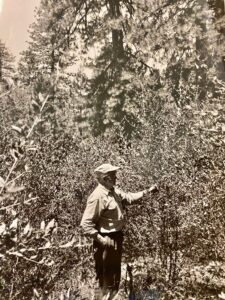
Harold Biswell in the field assessing forest conditions
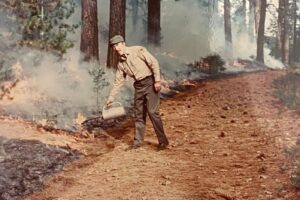
The Harold H. Biswell papers are now open to researchers at the Bancroft Library. Harold H. Biswell (1905-1992) served as a faculty member in the School of Forestry from 1947 to 1973. Biswell was a researcher, teacher, and advocate of the use of prescribed burning for fire management. Prescribed burns are intentionally-set fires for purposes of forest management, fire suppression, farming, prairie restoration or greenhouse gas abatement. The Biswell papers include photographs and slides of controlled burns and survey images of California forests, chaparral, and ranches. The collection also contains articles by Biswell and others, reports, booklets, survey and research material, School of Forestry theses, and other material related to controlled burning and forest ecology.
Photograph from a report on controlled burning in California ponderosa pine forests
Indigenous peoples were the first to use cultural burning for managing vegetation and wildlife habitats. “Cultural burning” refers to the Indigenous practice of intentionally setting fires in alignment with traditional belief and knowledge systems to revitalize habitats or provide a desired cultural service, such as promoting the health of vegetation and animals that provide food, clothing, ceremonial items and more. These practices were disrupted by European colonization and forced relocation of Indigenous communities from the lands they had been maintaining for centuries. In 1850, California passed the Act for the Government and Protection of Indians, which outlawed intentional burning. These bans, guided by a strategy of fire suppression, led the way for a rapid increase in destructive wildfires, as well as the inability for Indigenous people to practice traditional cultural burning practices.
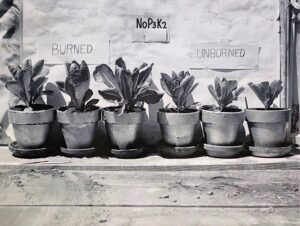
“August 4. 1952, lettuce plants grow in soils from heavily burned and very lightly burned (unburned) spots at Hoberg’s” negative HHB 2137
Despite opposition and direct criticism, Biswell continually advocated for developing new policies for prescribed burning. Biswell staked his academic reputation on demonstrating that prescribed burns improved ecosystem health and reduced wildfire threats. The Forest Service began to examine its fire exclusion policy in the early 1970’s, and in 1978 the national policy was changed to encompass total fire management including prevention, suppression, and use. Prescribed burns are now recognized as a critical tool to reduce the severity of wildfires.
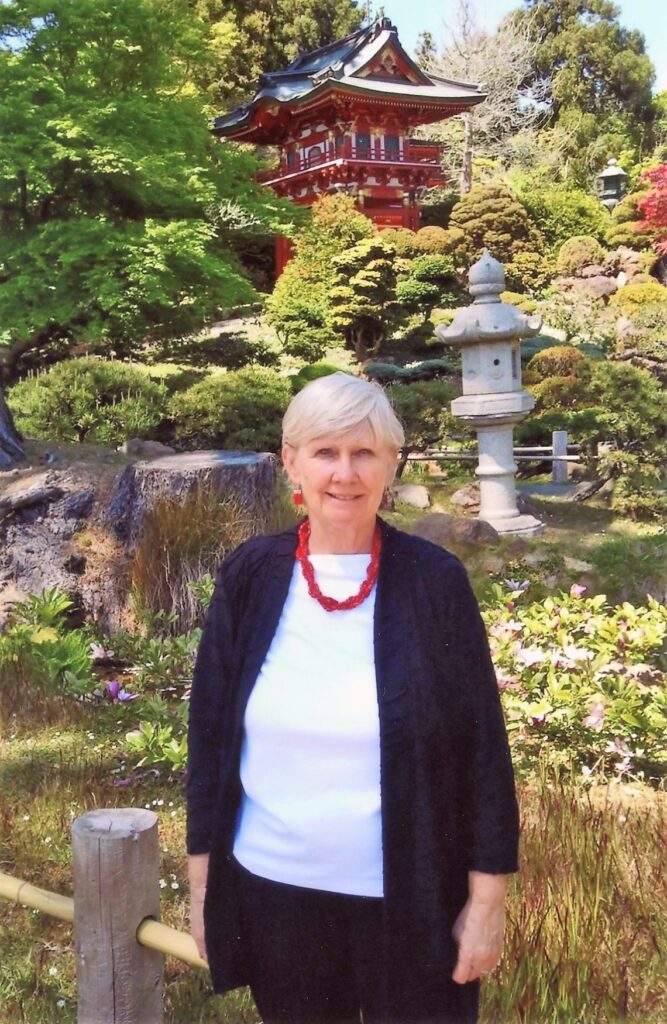
Cheryl Resh in San Francisco’s Japanese Tea Garden, 2013.
Cheryl Resh’s oral history paints an intimate portrait of family, of love, of world travel, and of her nearly four-decade career in university administration—from Resh’s first job in the early 1970s as a computer programmer at a community college in northern Illinois, to her eventually becoming Assistant Vice Chancellor and Director of the Financial Aid and Scholarships Office at UC Berkeley where she implemented new computerized financial-aid delivery systems and expanded student aid availability for low income and first-generation students. Resh also served on the Executive Council of the National Direct Student Loan Coalition from 2003 through 2011 to advocate in Washington DC for increased student aid and national expansion of the Direct Loan Program. The nation-wide transition to Direct Loans was enacted during the Obama administration in 2010, adding billions of dollars to the federal Pell Grant Program while also eliminating excessive fees for students and their families. Upon her retirement, Resh earned the Berkeley Citation, a high honor reserved for those whose contributions to UC Berkeley go beyond the call of duty and whose achievements exceed the standards of excellence in their fields.
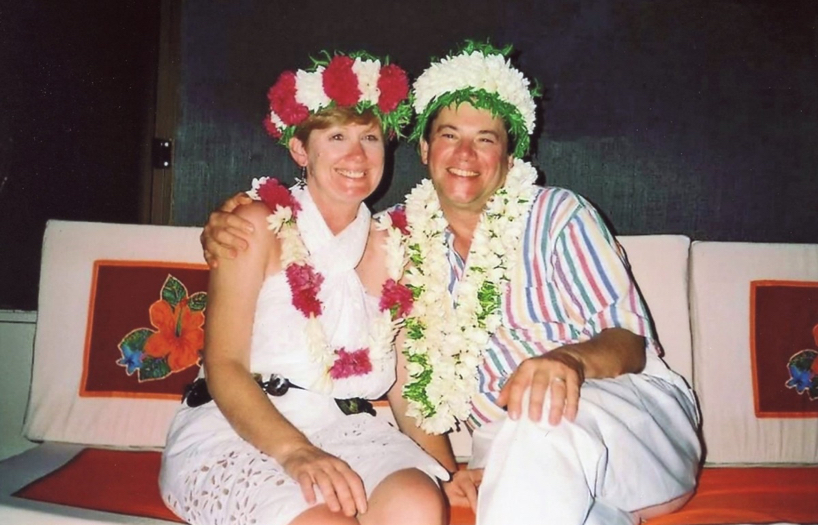
Cheryl and Vince Resh enjoy a special wedding reception at the Gump Field Station on Moorea in French Polynesia, 1994.
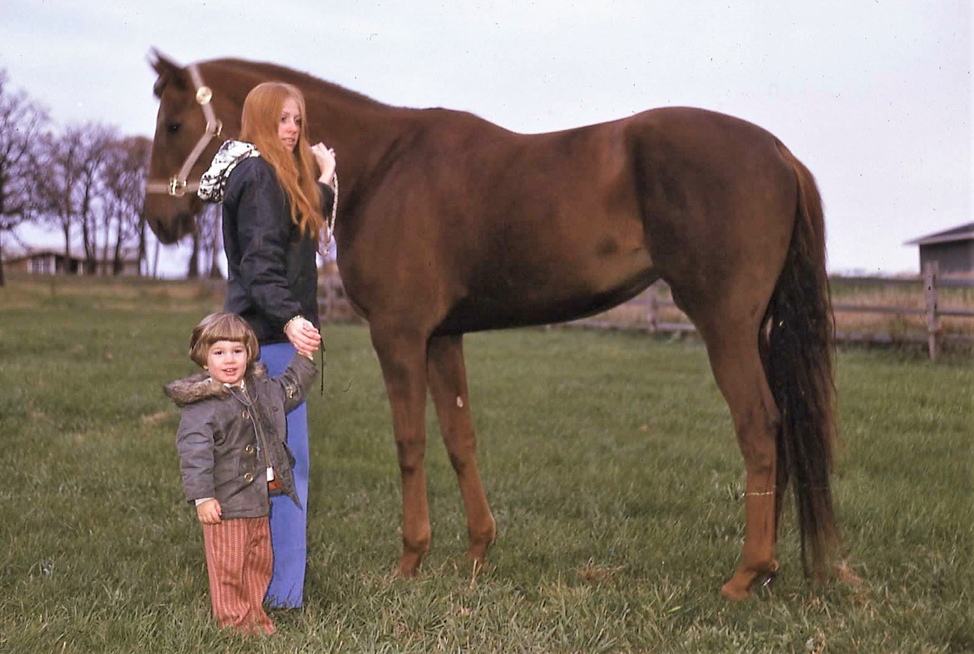
Cheryl Resh and I recorded her oral history over Zoom from January to late March 2021. Our eighteen hours of recordings produced Resh’s reflective transcript of nearly 470 pages, including an appendix of photographs with family and friends and some of her world-spanning travels. In addition to discussing details from her outstanding service to the UC Berkeley community, Resh shared tales of her parents’ lives, her own memories of childhood, her experiences of becoming a mother in 1970 and eventually a grandmother, as well as sharing the tragedy of her son’s sudden death in 2020 just a few months before recording her oral history. Resh also discussed her deep involvement in competitive horse jumping, her ownership of two horses, and her tangential connections to horse-trading activities she later learned were linked to Chicagoland organized crime. And of course, Resh shared her deep love and many adventures with her husband, Vincent H. Resh, a Professor of Aquatic Ecology and Entomology at UC Berkeley with whom she has visited every continent on Earth, including several decades of visiting the island of Moorea in French Polynesia as well as their travels on rivers and railroads across Eurasia and Africa.
Cheryl Resh’s oral history also offers unprecedented detail on the operations, computerization, and evolution from 1978 through 2011 of UC Berkeley’s student services. Her career spanned Berkeley’s transition from hand-written student records that were then transferred to key-punched cards and inserted into a mainframe Tandem computer in the late 1970s, to the development and implementation of bespoke computerized financial aid delivery systems and web-based student services systems that allowed real-time access and updating to individual student information. By the time she retired as Vice Chancellor and Director of the Financial Aid and Scholarships Office at UC Berkeley, Resh managed seventy staff members in eleven units that were responsible for the programming, processing, and delivery of $250,000,000 of student financial aid that came from 700 federal, state, institutional, and other scholarship funds that were delivered in aid packages uniquely individualized for over 25,000 undergraduate and graduate students.
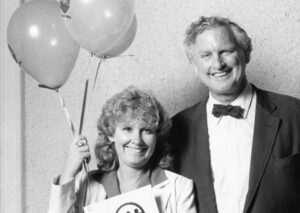
Cheryl Resh with UC Berkeley Chancellor Michael Heyman when she received the United Way Outstanding Volunteer Award, 1986.
Receiving the Berkeley Citation in 2011 surprised Resh, but not her friends and colleagues, many of whom wrote letters celebrating her contributions to UC Berkeley and to students across the nation. Harry Le Grande, a Vice Chancellor at UC Berkeley’s Division of Student Affairs, reported that “Dr. Cheryl Haigh Resh has dramatically improved student aid service in an environment of rapidly escalating costs and shrinking operational resources to provide services.” Kate Jeffery, the Director of Student Financial Support in the University of California Office of the President, praised Resh for her “rare combination of technical ‘systems’ expertise together with a keen grasp of the policy and student equity implications of each feature and choice.” Jeffery noted how “Cheryl has always been particularly compassionate on a personal level with students for whom the challenge of coming to UC Berkeley was possibly the hardest.” And Roberta Johnson, the Director of Financial Aid at Iowa State University and a fellow past chair of the National Direct Student Loan Coalition, shared how Resh’s leadership on their national executive committee guided “a movement that has changed financial aid for students for the better and hopefully forever!”
Cheryl Resh and her son Jeff Haigh with her horse Lulu Bay in Roscoe, Illinois, 1973.
Throughout her oral history, Cheryl Resh wove together stories about her family, her personal life, and her professional life. Resh was born in September 1947, in Dubuque, Iowa, as the eldest of six siblings to their father, a Lutheran minister who spent his entire life not knowing that he was actually adopted from an orphanage by his own birth mother. In the late 1960s, Resh attended Northern Illinois University, got married, and followed her recently drafted husband to the Panama Canal Zone, where she spent a transformative year amid Panama’s military coups. In 1970, Resh’s son Jeffrey Haigh was born, and that same year, she earned her B.S. in Mathematics from Northern Illinois University. In 1972, Resh began her career in university administration as a computer programmer and soon became Assistant Director of Admissions and Records at Rock Valley College in Rockford, Illinois. In 1978, upon earning her M.S. in Higher Education Administration from the School of Business Management at Northern Illinois University, Resh bravely moved with her son from the Midwest to California as a single mother to begin work as an administrative analyst in the Office of Admissions and Records at UC Berkeley. She soon became Associate Director of Records, helped convert Berkeley from quarters to semesters, and at one point was even burned in effigy on the steps of Sproul Hall during a staff union protest over her efforts to automate the Records Office. By 1985, she and her colleagues successfully ended the era of hand-written student records by automating all major processes in Berkeley’s Admissions and Records Office. In 1986, Resh began work in Berkeley’s Financial Aid and Scholarships Office where she worked for the next twenty-five years.
From her Financial Aid office in Sproul Hall, Resh had a front-row seat on historic UC Berkeley activities, from student demonstrations against South African apartheid in the mid-1980s, to the campus controversy in the 1990s over declining Asian American admissions that re-shuffled campus policies as well as the careers of several leaders in university administration. In 1991, Resh earned her Ph.D. in Educational Administration from UC Berkeley, with emphasis in Finance, Economics, and Operations Research. At the Financial Aid Office, she helped implement computer system upgrades to the SAMS (Student Aid Management System) software from Sigma Systems, and from 2007-2010, she managed the new ProSAM computer system implementation to greatly enhance Berkeley’s financial aid delivery system and its web-based student service systems.
Cheryl Resh (center, red jacket) traveling with National Direct Student Loan Coalition members to Stonehenge, England, 2017.
Resh remains rightfully proud of her many years working to implement Federal Direct Loans for students, first at UC Berkeley, and then for all students across the nation. She implemented the Direct Loan program at UC Berkeley in 1995, which greatly improved the delivery of over $100 million per year in financial aid along with long-term savings on the total cost of their loans, all while enabling enormous administrative savings for the campus. Resh also shared stories of serving from 2003 through 2011 on the Executive Council of the National Direct Student Loan Coalition. Through the National Direct Student Loan Coalition, Resh and her fellow Financial Aid Directors from universities across the nation successfully lobbied US Congressmembers to protect and expand the Direct Loan Program. The Health Care and Education Reconciliation Act of 2010 then mandated that all federal student loans be Direct Loans, which also increased student grant aid for needy American students by over $60 billion while saving significant taxpayer dollars over time.
Over Cheryl Resh’s thirty-three year career at UC Berkeley, she substantially enhanced student aid services while reducing costs, and she did this work while maintaining Berkeley’s commitment to supporting students from all economic backgrounds, especially students from the lowest income groups. Her dedication to equity of opportunity included her development of the Berkeley Cares program, which provided needed financial aid outreach and support to newly admitted low-income students, many of whom were first generation college students.
Cheryl Resh defied norms to achieve success both with and for others, all while carving a unique and adventurous path through life. I hope you enjoy reading Cheryl Resh’s oral history as much as I enjoyed working on it with her.
The Oral History Center of The Bancroft Library preserves voices of people from all walks of life, with varying political perspectives, national origins, and ethnic backgrounds. We are committed to open access and our oral histories and interpretive materials are available online at no cost to scholars and the public. You can find our oral histories from the search feature on our home page. Search by name, keyword, and several other criteria. Sign up for our monthly newsletter featuring think pieces, new releases, podcasts, Q&As, and everything oral history. Access the most recent articles from our home page or go straight to our blog home.
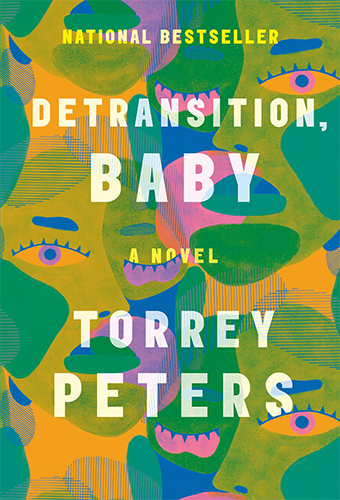
What are the rules of motherhood, fatherhood, gender, love, and family? The characters in Detransition, Baby toss out and revise so many of these rules, and I thoroughly enjoyed being a witness to that!
Reese and Amy, two trans women, are in a relationship with each other until Amy de-transitions due to the transphobia she faces: It was just too difficult for her to live as a woman. Now going by Ames, he finds himself in a relationship(ish) with his boss, Katrina, a biracial, Chinese American, Jewish, cis woman. There is an unexpected pregnancy and some creative finagling, and Reese’s strong desire to be a mother – coupled with Ames’ desire to be a father-not-father – leads our characters to have a lot of dialogue about what family is, and in turn an unconventional family is “born.” There are some plot twists that I don’t want to give away here, but know that Peters’ characters are just as dysfunctional, histrionic, and damaged as any of us. It is refreshing and delightful to read! Detransition, Baby is also among the first novels written by a trans woman to be issued by a major publishing house.
MAYA MAHAJAN Coordinator Language Exchange Program
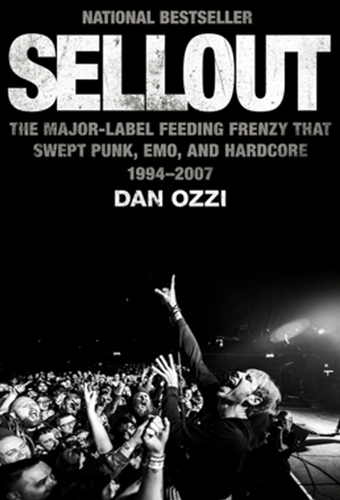
Sellout: The Major-Label Feeding Frenzy That Swept Punk, Emo, and Hardcore (1994-2007) Dan Ozzi
The word “sellout” might not have the same integrity-shattering connotation as it used to in this age of get-famous-at-all-costs social media influencers. But it wasn’t always this way. As punk and alternative broke (again) in the 1990s, the music industry started to take notice and artists from the underground were confronted with a Faustian bargain: to stay true to the DIY, anti-corporate ethos of the scene, or to sign to a major label and face the music (and be tagged with the dreaded S-word). Getting shunned by the die-hards and banned from 924 Gilman Street in Berkeley, the East Bay epicenter of punk rock in the ’90s, might sound quaint today, but it was enough to threaten the clout and credibility of bands of the time.
Brimming with thorough reporting and illuminating interviews, Dan Ozzi’s Sellout follows the road to the major label debuts of artists such as Green Day, Jawbreaker, Jimmy Eat World, Blink-182, At the Drive-In, The Donnas, The Distillers, and My Chemical Romance. Some transcended the “sellout” tag, while others buckled under the weight of remorse and expectation, or were swept back into obscurity by the changing tides of popular music. But each band had a hand in rewriting the script for a new era of punk- and alternative-influenced pop music, and ushering in an age where the word “sellout” is no longer a nail in the coffin of an artist’s reputation. Put simply, these bands walked so Olivia Rodrigo and Machine Gun Kelly (and so many others) could run.
TOR HAUGAN Multimedia Writer + Editor Library Communications
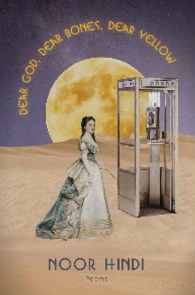
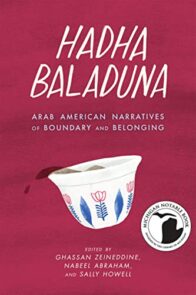
Arab-American Heritage Month pays tribute to the contributions of Arab Americans and Arabic-speaking Americans and their cultures. Celebrate this April’s Arab-American Heritage Month with these great reads.
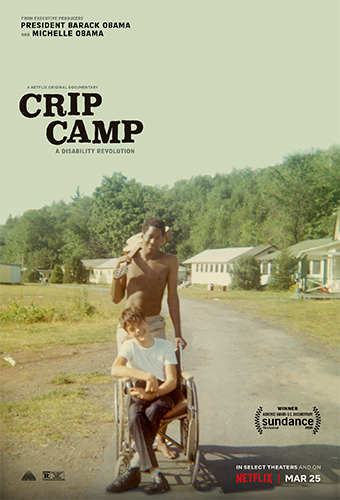
Crip Camp Nicole Newnham, Jim LeBrecht (directors)
Following a group of disabled teenagers from Camp Jened in New York to Berkeley, California, in the 1970s, this exuberant documentary chronicles a turning point in the disability rights movement and the fight for accessibility. Our student reviewers for the 2023 On the Same Page program described the documentary as “incredible,” “moving,” “full of fun, joy, and love,” and something that “everyone should see.” Another student reviewer appreciated the documentary’s portrayal of “disabled-centered happiness and accomplishments, one of the many ways it changed my perspective.” Crip Camp reminds us of the power of community and activism to rewrite the rules (literally!) and change the world.
AILEEN LIU Director of Curricular Engagement Initiatives College of Letters & Science
The Beadworkers: Stories Beth Piatote
The featured read for the 2022-2023 LEP Global Book Club, Beth Piatote’s debut collection is rich, inventive, and altogether stunning. The very first words are written in nimipuutímt – the language of her Nez Perce heritage – a decision that, rather than being alienating as some publishers feared, invites readers to trust that their discomfort will be rewarded. Throughout the collection, she draws on Nez Perce history, aesthetics, and culture to provide a complex picture of modern Native American life that is as rooted in injustice as it is joy, community, and resilience. The stories she tells are at once a radical departure from dominant narratives while also deeply reflective of the human condition, giving all readers the opportunity to experience new ways of being while drawing connections to their own. From poetry to prose, board game rules to a reimagination of an ancient Greek tragedy, her varied use of form and genre make for a delightful read and re-read.
MAYA MAHAJAN Coordinator Language Exchange Program




 Crip Camp
 The Beadworkers: Stories