New oral history: “Carolyn Merchant: My Life Exploring Science, Environment, and Ethics”
Video clip from Carolyn Merchant’s oral history on the 1970s social contexts for her book The Death of Nature
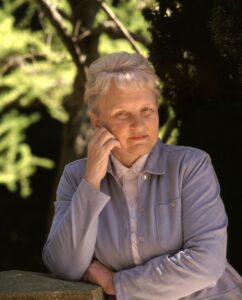
Carolyn Merchant is a Distinguished Professor Emerita of Environmental History, Philosophy, and Ethics at UC Berkeley. Her extensive research and teaching at Cal explored historical relationships between humanity, nature, and science with an ecofeminist focus on Western culture’s domination of nature and women. Throughout her academic career, Merchant published numerous peer-reviewed articles and wrote eleven books, as well as four edited volumes. Her genre-shaping publications—including The Death of Nature: Women, Ecology, and the Scientific Revolution (1980); Ecological Revolutions: Nature, Gender, and Science in New England (1989); Radical Ecology: The Search for a Livable World (1992), among others—influenced various academic fields from Women’s Studies to the History of Science, and from Ethics to Environmental History.
Merchant and I video-recorded seven hours of her oral history over four interview sessions in the spring of 2022. Those recordings resulted in a 132-page transcript that includes an appendix with photographs. Merchant’s full-life oral history not only explored her intellectual and academic career, but also recorded lesser known details from her female-centered childhood, her educational mentors, her personal relationships, and her social activism, all of which shaped her academic research and teaching at UC Berkeley.
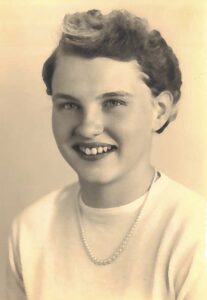
Merchant was born in 1936, in Rochester, New York, where she and her younger sister were raised by their mother, grandmother, and aunt. Merchant recalled how sharing a home with five strong women taught her that “women could do anything. …That gave me a role model unconsciously to know that I could do anything I wanted to.” As a high school senior in 1954, Merchant became a national top ten finalist in the Westinghouse Science Talent Search. She earned her AB in Chemistry from Vassar College in 1958, studied physics for a year at the University of Pennsylvania, and then, at the University of Wisconsin, Madison, she earned her MA in 1962 and her PhD in 1967 in the History of Science. Her graduate research explored the Vis Visa controversy in the seventeenth and eighteenth centuries over a “living force” in nature, from Gottfried Wilhelm Leibniz to Jean-Baptiste le Rond D’Alembert.
Video clip from Carolyn Merchant’s oral history on learning and teaching the history of science, 1960s and 1970s
During graduate school in Wisconsin, Merchant met and married botanist Hugh Iltis, with whom she had two sons, both of whom later graduated from UC Berkeley. Merchant also began her environmental activism during graduate school, which included lighting Wisconsin prairies on fire as a means to restore native plants and animal habitat. At that time, Merchant first read Betty Friedan’s The Feminine Mystique and Rachel Carson’s Silent Spring, which affected both her life and academic trajectories. In the late 1960s, upon completing her PhD thesis and her divorce from Iltis, Merchant and her sons moved from Wisconsin to Berkeley, California.

Merchant’s life on the west coast provided new opportunities and realizations. While teaching the History of Science as a Visiting Lecturer at Oregon State University, Merchant lived on a Corvallis farm where the runner-up Dairy Queen of the state of Oregon taught her how to milk goats and cows. Merchant’s back-to-the-land experiences would shape her later analysis on utopias and what she described as the “organic society,” from John Salisbury’s organic concept of the state in 1159, to Francis Bacon’s The New Atlantis in 1627. To support herself and her family back in Berkeley, Merchant worked as an adjunct instructor, which she eventually parlayed into a fulltime position. She taught as a Lecturer at the University of San Francisco, where by 1976 she became an Assistant Professor, and she also taught in the innovative, interdisciplinary, yet short-lived Strawberry Creek College program at UC Berkeley.
Throughout the 1970s in the Bay Area, Merchant engaged in feminist, environmental, anti-war, and anti-capitalist politics, which is how she first met UC Berkeley historian Charles Sellers, whom she later married. Over many decades together, Merchant and Sellers advocated for social justice and shared adventures traversing the United States in a camper van while searching for rare birds and visiting far flung archival collections. On the road, Merchant used some of the first laptop computers to draft her eventual publications. Back in the Bay Area, Merchant connected with intellectuals like Theodore Roszak and became a visiting scholar at Stanford’s Center for Advanced Study in Behavioral Sciences. Around that time, Merchant learned from a USF colleague that UC Berkeley planned to hire a professor to work in the then-nascent field of environmental history. “I can do that,” she said to herself, and walked up the hill from her house to campus to submit her application. As she recalled, “when I was interviewed, I was from Stanford, and I was not a local yokel four blocks away in Berkeley where my house actually was.”
Video clip from Carolyn Merchant’s oral history on her hiring at UC Berkeley’s College of Natural Resources, 1980

Women played a central role in Merchant’s research, as well as with her hiring at UC Berkeley in 1979. Merchant applied to the College of Natural Resources for a position in a new department then called Conservation and Resource Studies, which later became the Department of Environmental Science, Policy, and Management. On the hiring committee were five male faculty members and five female undergraduates. Many women took courses in the college, yet the faculty of the College of Natural Resources were still mostly men. After her on-campus interview, Merchant recalled “the students wanted a woman, and they lobbied. …They wanted to understand what role women had played in the environment, and how they used the environment, and how they developed as scientists and environmental scientists. And they liked me because I was interested in pursuing those topics and finding out by digging into the archives who the women were and what they had done.” The first three hires for the new department were all women. In 1980, one year after Merchant joined the faculty at UC Berkeley, she published The Death of Nature: Women, Ecology, and the Scientific Revolution, which remains in print today and has been translated into numerous languages. As Merchant recalled, when the book appeared, “there was a column in Newsweek, and then it was brought up at a congressional hearing. It [my book] was a criticism of what mechanistic science alone would do to the environment if it wasn’t associated with an ethic and some restraints and understanding of what the consequences were. So it was very gratifying to see that reception.”
The majority of Carolyn Merchant’s oral history explores her career as a Professor of Environmental History, Philosophy, and Ethics at UC Berkeley. The topics we discussed ranged from the evolution of Merchant’s research and teaching to her reflections on how the College of Natural Resources has changed over time. Generally, Merchant’s research and teaching examined the history and ethics of science and the environment through the lens of gender. As she noted during her oral history, “gender is so important and so central. Because most of human history, and most of even environmental history and the history of science, has been concerned with the roles that men play. And I want to make the roles that women play and the importance of gender as an equal thing, so that the roles of women are not obscured—and that women and men are equal partners not only in an existing political economy and a social economy, but they are equal partners in every aspect of trying to work together as partners to make the whole planet continue to live on.”
Video clip from Carolyn Merchant’s oral history on gendered reproduction
In her oral history, Merchant also addressed some of the specific, interrelated research themes that she developed throughout her career. One of those themes focused on science and domination, especially Merchant’s attention to impacts on nature as both a mental construct and a physical reality when institutions of science emerged within a patriarchal society. She also spoke about women and nature through the lens of ecofeminism. “Ecofeminism comes from a woman named Françoise d’Eaubonne in France,” Merchant explained. “Ecofeminism asserts the power of women and also their interrelationships with nature, and how women can save nature, and how women themselves can become important forces in the whole role of the conservation of resources.” Merchant discussed her partnership ethic, a contribution she made to environmental ethics in which humans of all genders, along with nonhuman nature, would be valued as equal partners inhabiting a flourishing earth. “Partnership makes nature and humans equal, and interactive, and sharing and giving,” Merchant declared, “and we have to conserve nature if we are going to go ahead and live in the future with an active nature and an active humanity.” In light of her own politics to protect and conserve nature, Merchant also reflected on about the importance of gendered reproduction, and how control of women’s bodies and the unpaid labor of those bodies are essential to the material, social, and cultural maintenance of a capitalist and patriarchal society. In contrast to the modern world’s focus on production, Merchant emphasized the need for reproduction: “allowing the reproduction of nature and its systems to continue is what is going to allow humanity to reproduce itself and to continue. …Because if we don’t allow the natural resources of the world to keep reproducing themselves, if we don’t set aside land or pass laws that prevent us from using everything up, we won’t be able to continue reproduction.”
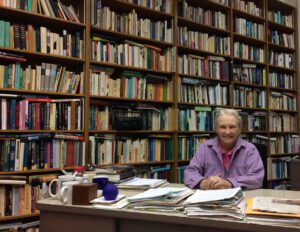 Carolyn Merchant’s oral history is now available to read online, even as the ever-worsening impacts of climate change create an interrelated set of crises for the Earth and all living organisms on it, including humanity. After her long career teaching and researching environmental topics at UC Berkeley, Merchant admitted, “of course, I’m distressed that we have all the environmental problems that we have now.” Yet, in the face of these crises, she also shared her optimism. “There’s also hope in the sense that there are laws being passed, there are people who are working continuously, and there are new societies and new organizations being formed. So we’re at a tipping point. And hopefully, we’ll go in the direction of conservation, and environmental justice, and environmental reform, and saving the Earth.”
Video clip from Carolyn Merchant’s oral history on her partnership ethic for humanity and nature
Video clip from Carolyn Merchant’s oral history on becoming a national finalist in the Westinghouse Science Talent Search, 1954
ABOUT THE ORAL HISTORY CENTER
The Oral History Center of The Bancroft Library preserves voices of people from all walks of life, with varying political perspectives, national origins, and ethnic backgrounds. We are committed to open access and our oral histories and interpretive materials are available online at no cost to scholars and the public. You can find our oral histories from the search feature on our home page. Search by name, keyword, and several other criteria. Sign up for our monthly newsletter featuring think pieces, new releases, podcasts, Q&As, and everything oral history. Access the most recent articles from our home page or go straight to our blog home.
If you’d like to see more interviews like this conducted and made freely available online, please consider making a tax-deductible donation to the Oral History Center. While we receive modest institutional support, we are a predominantly self-funded research unit of The Bancroft Library. We must raise the funds to cover the cost of each oral history. You can give online, or contact us at ohc@berkeley.edu for more information about our funding needs for present and future projects.