Since its inception in January 2021, Abalone Mountain Press (https://www.abalonemountainpress.com) has published several phenomenal compilations of poetry and zines. Amber McCrary, the founder, operates the press on operates on the traditional lands of the Akimel O’odham.[1]
To delight, this semester (Spring 2025), UC Berkeley’s Doe Library put in an order for five of Abalone Mountain Press’s recent publications. The chapbooks, anthology, and zines will be located in Doe Library’s main stacks.
Taté Walker and Ohíya Walker, The Trickster Riots (Abalone Mountain Press, 2022).
Kinsale and Alice Mao, Hummingbird Heart, Pink (Abalone Mountain Press, 2022).
Take a look at these or other Abalone Mountain Press books in our UC Berkeley Library.
Additional Material
Several of these authors contributed to The Diné Reader: An Anthology of Navajo Literature. You can find an interview with Amber McCrary about the Press in the September 2022 issue of Poetry.
From Macron, L’an I: pardon de vous le dire par Zef, Kak, and Degreff (Paris: Florent Massot, 2018.)
Recent acts of censorship of late night television talk show hosts Stephen Colbert and Jimmy Kimmel have spurred interest in not only reposting this ever pertinent blog post originally published on November 27, 2018 but also updating it with some relevant books acquired since then. With or without humor, we find both presidents still (or again) in power and in the satirical spotlight. Enjoy! Amusez-vous!
—————————
As two of the oldest modern democracies, France and the United States share a long tradition of freedom of speech and of the press (and at times governmental censorship). The two societies have found catharsis in the mockery of their highest elected officials through caricatures, cartoons, and critical writings. Here are a few recent library acquisitions, in English and in French, from both sides of the Atlantic in this category of political critique:
Three new and substantial Sierra Club Oral History Project interviews became available to the public earlier this year: Lawrence D. Downing (recorded in 2019), Debbie Sease (recorded in 2020), and Vivien Li (recorded in 2021). See further below for details about their unique oral history interviews.
Now over fifty-years old, the Sierra Club Oral History Project is a partnership between the Sierra Club—one of the oldest and most influential environmental organizations in the United States—and the Oral History Center of The Bancroft Library at UC Berkeley—one of the nation’s oldest organizations professionally recording and preserving oral history interviews. The Sierra Club Oral History Project documents the leadership, programs, strategies, and ideals of the national Sierra Club as well as the Club’s grassroots at regional and chapter levels from the early twentieth century through the present. These oral history interviews highlight the breadth, depth, and significance of the Sierra Club’s eclectic environmental efforts—from wilderness preservation to promoting environmental justice; from outdoor adventures to climate change activism; from environmental education to chemical regulation; from litigation to lobbying; from California to the Carolinas, and from Alaska to international realms. The Sierra Club Oral History Project arose around 1970 and has moved through cycles of intensity and lull due to the availability of funding for recording and publishing new interviews. Throughout, the Sierra Club Oral History Project has produced an unprecedented testimony of engagement in and on behalf of the environment as experienced by individual members and leaders of the Sierra Club. Together with the sizable archive of Sierra Club papers and photographs in The Bancroft Library, the Sierra Club Oral History Project offers an extraordinary lens on the evolution of environmental issues and activism over the past century, as well as the motivations, conflicts, and triumphs of individuals who helped direct that evolution—as told in their own words.
Lawrence D. Downing, Sierra Club President, 1986 to 1988.
Lawrence D. Downing is a Minnesota lawyer who, from 1983 to 1996, served nine years on the Sierra Club board of directors, including as Club president from 1986 to 1988. From 1986 to 1995, he was a Sierra Club Foundation Trustee, including as president from 1990 to 1992. Downing was born in August 1936, in McPherson, Kansas. In 1958, he earned his Bachelor of Science in Chemistry from Iowa State University, and then worked for the Proctor & Gamble Company in Cincinnati, Ohio, where he helped invent the liquid cleaner “Mr. Clean.” He earned his Juris Doctor in 1962 from the University of Minnesota Law School, where he edited the Minnesota Law Review. From 1962 until his retirement in 2010, Downing practiced matrimonial law in Rochester, Minnesota. After joining the Sierra Club by mail in 1969, Downing held leadership positions at every level: as founder and chair of his local Wasioja Group in the North Star Chapter; as chair of the North Star Chapter; as an executive in the National Sierra Club Council; as chair of numerous national committees; as a Sierra Club Foundation Trustee, including a term as president; and as an elected member to the national Sierra Club board of directors for nine years between 1983 and 1996, including his terms as Club president from 1986 to 1988. As a national leader, Downing earned the nickname “Mr. Grassroots” for advocating training and support for Sierra Club volunteers. Downing also forged international connections with the John Muir Trust and the Royal Scottish Geographical Society to help return to Scotland the preservationist legacy of Sierra Club founder John Muir, who was born in Scotland. Downing received the Centennial Campaign Award for his work in the late 1980s and early 1990s as Chair of the Planning Committee for the Sierra Club’s $110 million Centennial Capital Campaign. He also received the Sierra Club’s award for continued service by a past director of the Club. In 2003 and 2004, Downing played a fundamental role in the “Groundswell Sierrans” movement to prevent an elected take-over of the Sierra Club board of directors by a coalition of immigration opponents, white supremacists, and animal rights organizations who disguised their campaign in rhetoric against overpopulation. Downing also served on the board of the Minnesota Center for Environmental Advocacy, the largest non-profit environmental law firm in Minnesota. In this interview, Downing details all of the above and comments on the evolution of both volunteer and staff leadership of the Sierra Club, including several conflicts within and between volunteer and staff leadership.
Debbie Sease at the Sierra Club’s office in Washington, DC, early 1980s.
Debbie Sease worked from 1981 to 2020 as a Sierra Club lobbyist in its Washington, DC, office, where she became Legislative Director as well as National Campaign Director. Sease was born in November 1948 in Oklahoma, where she contracted polio at age three. Each year throughout her childhood, Sease spent several months in a Texas hospital receiving surgeries to repair damaged leg tissue. At age 10, Sease’s family moved to Las Cruces, New Mexico, where her mother died six years later from cancer. Upon graduating high school in 1967, Sease took architecture and photography courses at the University of New Mexico in Albuquerque. Sease soon became active in the New Mexico Wilderness Committee, where she met her first husband Dave Foreman. Conservationist Celia Hunter offered Sease and Foreman jobs as lobbyists for the Wilderness Society in Washington, DC, where they moved in 1978. Upon arriving, Sease dedicated her career to preserving public lands, initially on Bureau of Land Management wilderness reviews, and to advocating for environmental policies. In 1981, Sease began working for the Sierra Club, from which she retired in 2020. Her career in Washington, DC, spanned from the end of the environmental decade in the 1970s, through seven US Presidential administrations and numerous shifts in Congress, up through the end of the Trump administration in 2020. Upon her retirement, Sease and her husband Russ Shay split their time between their home on Capitol Hill and their cabin on twelve acres in the Shenandoah Valley. In this oral history, Sease recounts all the above with a focus on her nearly four decades as a Sierra Club lobbyist in Washington, DC, including details on particular campaigns and specific wilderness lands she helped protect, as well as her reflections and hard-earned wisdom on successful legislative campaigning. Throughout, Sease discusses ways the Sierra Club has evolved throughout her career, as well as the ways environmental politics have changed over time, especially in the nation’s capital.
Vivien Li became the first person of color elected to the Sierra Club Board of Directors from 1986 to 1992, chaired the Club’s newly established Ethnic and Cultural Diversity Task Force from 1990 to 1994, and lead The Boston Harbor Association from 1991 to 2015 as an advocate for a clean, alive, accessible, and climate resilient waterfront. Li was born in New York City in February 1954 as the first of five children to parents who emigrated from China. Li’s family moved to suburbs near Ridgewood, New Jersey, where, as a rising high school senior, she began her environmental activism shortly after the first Earth Day in 1970. While attending college from 1971 to 1975, Li worked part time as an environmental planner in the administration of Newark Mayor Kenneth A. Gibson. After receiving a bachelor’s degree in environmental management from Barnard College at Columbia University and working for the City of Newark, New Jersey, Li became a community fellow in MIT’s Department of Urban Studies and Planning from 1976 to 1977. Li was conference coordinator for City Care, a national conference on the urban environment held in 1979 in Detroit, Michigan, which brought together 700 environmental and civil rights activists associated with conference sponsors the Sierra Club, National Urban League, and the Urban Environmental Conference and Foundation. Li served as the Sierra Club’s New Jersey Chapter Chair and Regional Conservation Committee Chair prior to her election to the Club’s Board of Directors. In 1983, she earned a Master’s of Public Administration and Urban and Regional Planning from Princeton University, a year before marrying Bob Holland, with whom she has two children. In the 1980s, Li worked for the Massachusetts Public Health Commissioner and as senior staff to Massachusetts Governor Michael Dukakis. Li received the Sierra Club’s Walter Starr Award in 2015 and has continued her Sierra Club involvement on the Club’s Finance and Risk Management Committee and its Investment Advisory Committee. Li’s oral history discusses all the above, with emphasis on her environmental and Sierra Club activism from the early 1970s through the early twenty-first century, particularly on issues of environmental justice and on renewal of urban waterfronts, including in Boston, Massachusetts, and Pittsburgh, Pennsylvania.
ABOUT THE ORAL HISTORY CENTER
The Oral History Center of The Bancroft Library preserves voices of people from all walks of life, with varying political perspectives, national origins, and ethnic backgrounds. We are committed to open access and our oral histories and interpretive materials are available online at no cost to scholars and the public. You can find our oral histories from the search feature on our home page. Search by name, keyword, and several other criteria. Sign up for our monthly newsletter featuring think pieces, new releases, podcasts, Q&As, and everything oral history. Access the most recent articles from our home page or go straight to our blog home.
Please consider making a tax-deductible donation to the Oral History Center if you’d like to see more work like this conducted and made freely available online. As a soft-money research unit of The Bancroft Library, the Oral History Center must raise outside funding to cover its operational costs for conducting, processing, and preserving its oral history work, including the salaries of its interviewers and staff, which are not covered by the university. You can give online, or contact us at ohc@berkeley.edu for more information about our funding needs for present and future projects.
Founded by Malcolm Margolin in 1974, Heyday (https://www.heydaybooks.com/) is an established California independent publisher based out of Berkeley. They offer material focused on topics such as social justice and supporting Californian Indian cultural renewal.
While not focused exclusively on literature, they often Heyday has released beautiful books looking at California’s environment and people. Their output includes exciting memoirs as well as contemplations of writing.
Celebrate Filipino American History Month this October with our featured collection of novels and memoirs by Filipino American authors. Find these and more in our UCB Overdrive collection.
Please find this selection of books in Catalan recently received and cataloged for your reading pleasure. Catalan is a Western Romance language and is the official language of Andorra, and the official language of three autonomous communities in eastern Spain: Catalonia, the Balearic Islands and the Valencian Community, where it is called Valencian.
Catalan is considered a Less Commonly Taught Language (LCTL) in Europe and has received special support from the U.S. Department of Education under the auspices of Title VI of the Higher Education Act of 1965. Other languages of interest to research and teaching at Berkeley and historically supported by this program administered by the Institute of European Studies include Dutch, Portuguese, Modern Greek, Occitan, Yiddish, Galician, Danish, Finnish, Swedish, Norwegian, Icelandic, and more.
Kaya Press (https://kaya.com/) has been making space for voices in the Asian and Pacific Islander diasporic writers in the United States since 1994, when it was founded in New York City. Establishing itself as a “premier publisher of cutting-edge” literature, the Press moved to in USC Dornsife’s Department of American Studies and Ethnicity in Los Angeles in 2012 where it has continued releasing phenomenal material.[1]
The Press not only releases excellent novels and poetry, but also participates in book fairs, contributes to community activity, hosts author readings, and more.[2] Readers can find information about their events on their Instagram page.
You can find the majority of the Press’ catalog through the (UC Library Search) and access them in either in the UC Berkeley Main Stacks or the Ethnic Studies Library’s shelves.
Red points show Doe Library and the UC Berkeley Ethnic Studies Library building locations. Check out the UC Berkeley Library locations and Affiliate Libraries as a Google Map.
Two Line Press, a press line for the Center for the Art of Translations, concentrates on translations of phenomenal fiction from around the world. Oliver Sears initially founded the Two Lines journal (UC Catalog Search for journal) in 1993 to focus on the art of translation and acknowledge the hard, incredible work of the translators.[1] In 2000, Sears and a team of wonderful collaborators launched the Center for the Art of Translation (CAT) out of San Francisco both to run the journal and start the Calico Series for books.[2]
As of the writing of this post, the press is reaching toward 100 translations of books from Arabic, Czech, Finish, Macedonian, Swahili, Spanish, Thai, and more. Readers can take a look at their catalog at https://www.catranslation.org/books/.
You can find more about Two Lines Press’ events on their Instagram page. Note that as of the writing of this post, they have a series of events in both New York City and in San Francisco! The ones in San Francisco include book events such as Mary Jo Bang on Dante’s Paradiso with Tess Taylor (information) and participation in the Litquake Small Press Book (September 28).
Recent Titles
Readers are encouraged to check out these recent titles from UC Berkeley Library!
Layla Martínez, Woodworm, trans. Sophie Hughes and Annie McDermott (Two Lines Press, 2025).
Maria Judite de Carvalho, So Many People, Mariana, trans. Margaret Jull Costa (Two Lines Press, 2023).
Astrid Roemer, Off-white, trans.Lucy Scott and David McKay (Two Lines Press, 2025).
Selections from the library’s collection of loanable artwork (the Graphic Arts Loan Collection) are now on display in the Art History/Classics Library (308 Doe).
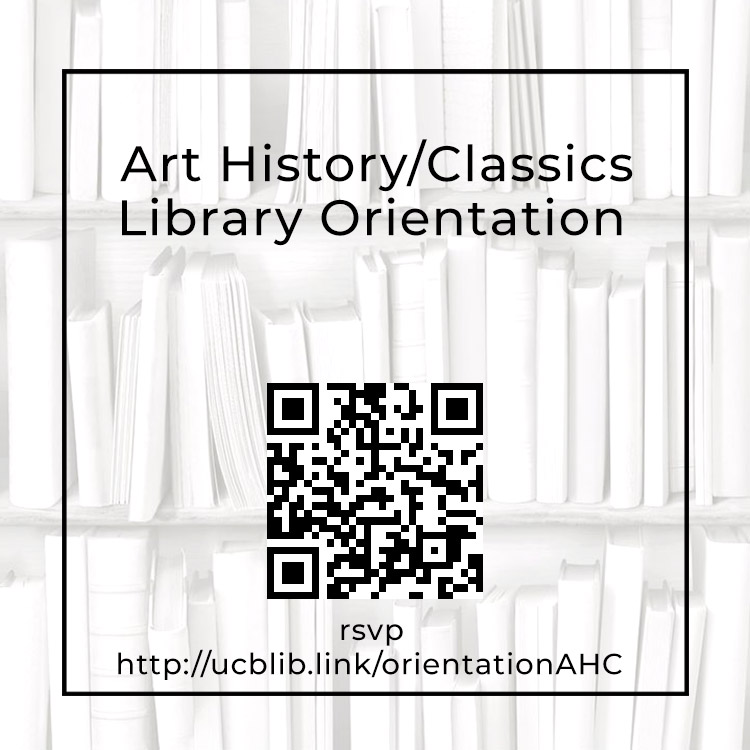
You are welcome to attend one of the upcoming library orientation sessions for the Art History/Classics Library (308 Doe). The sessions are capped at 20 students, so be sure to reserve your spot via the rsvp form. Sessions are offered on the following dates/times:
Thursday, September 11th, 12-1
Monday, September 15th, 4-5
Tuesday, September 16th, 5-6



 As two of the oldest modern democracies, France and the United States share a long tradition of freedom of speech and of the press (and at times governmental censorship). The two societies have found catharsis in the mockery of their highest elected officials through caricatures, cartoons, and critical writings. Here are a few recent library acquisitions, in English and in French, from both sides of the Atlantic in this category of political critique:
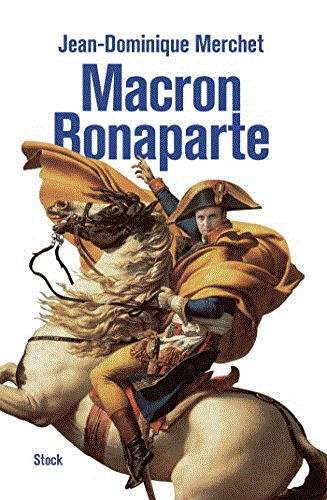 Collard, Susan P., ed.
  Drezner, Daniel W.
  Lee, Bandy X.
  Ngono, Emmanuel.