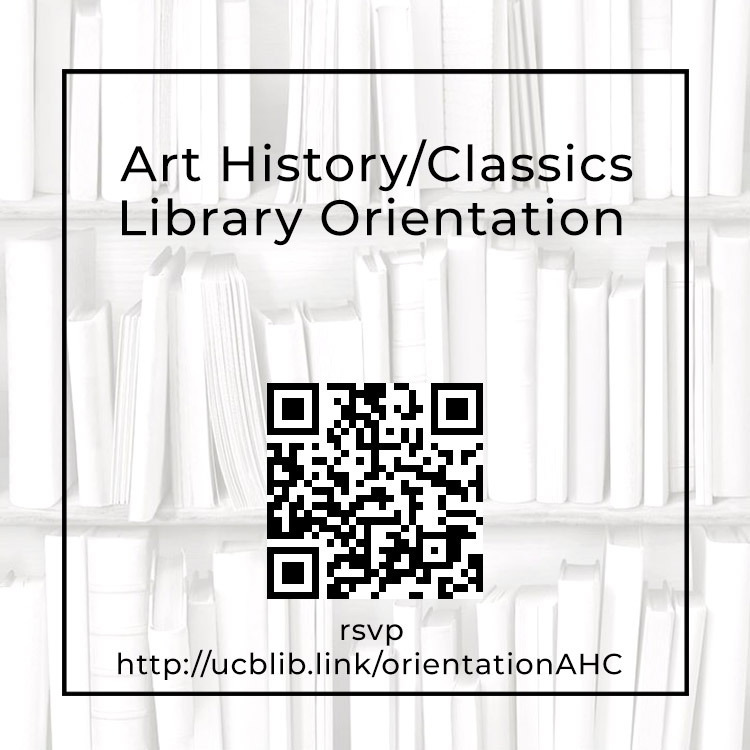
Welcome back students! If you are interested in learning more about the wonderful library arts resources, please join us at one of our upcoming library orientation sessions. Current sessions offered include:
Tuesday, September 5th 1-2
Tuesday, September 5th 4-5
Friday, September 8th 12-1
Friday, September 8th 3-4
Registration will be capped at 20 students per session. New dates/times will be added to the rsvp form if the current offerings reach capacity. We will meet in the Art History/Classics Library (room 308, 3rd floor Doe Library).
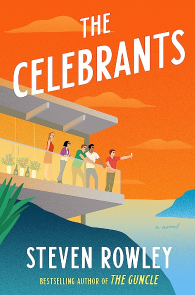
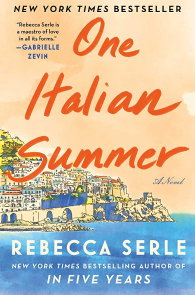
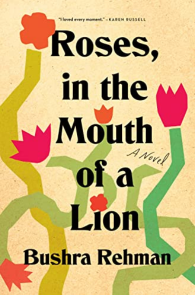
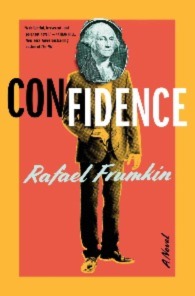
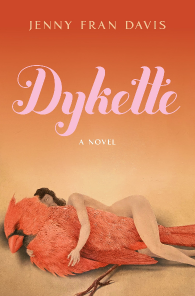
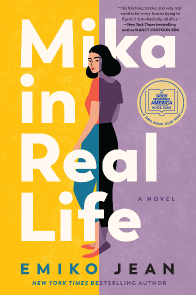
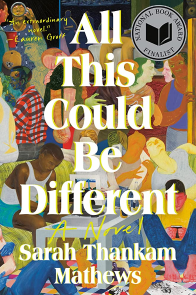
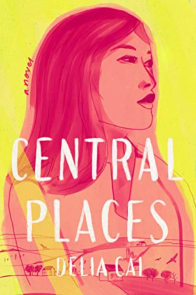
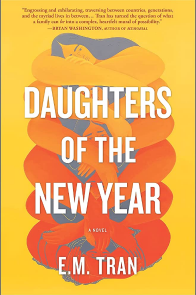
Kick off this summer with these fantastic beach reads! From summer scares to beachside romances, check out Overdrive and the selections below for an irresistible read.
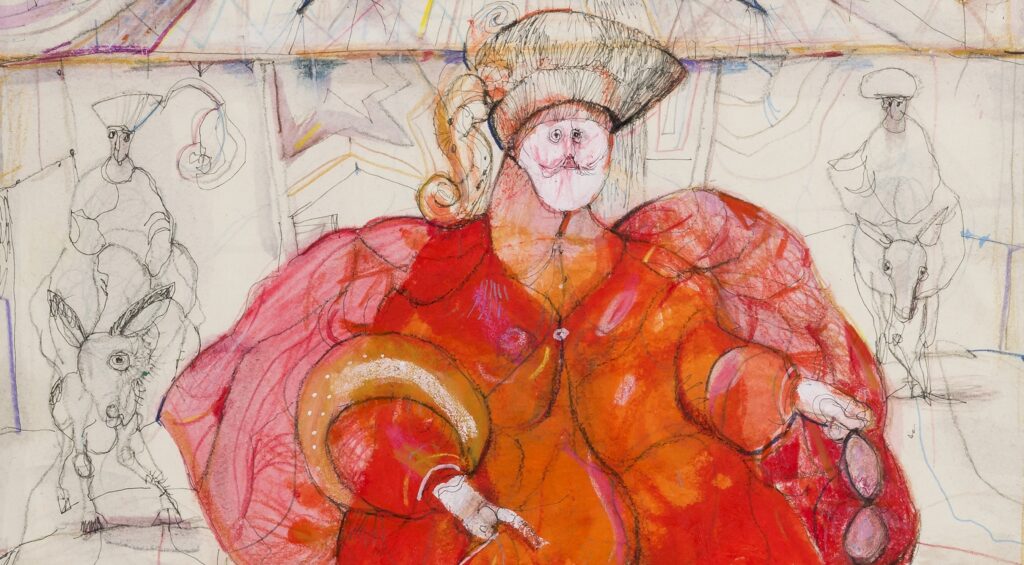
Cover art for AOQU III, 2 (2022) by Antonio Possenti.
As serials costs continue to soar and academic library budgets continue to decline, Open Access (OA) remains a viable path for knowledge sharing in different disciplines. In the wake of the $850k serials cancellation project currently underway, here’s one online journal that will emerge unscathed. AOQU (Achilles Orlando Quixote Ulysses). Rivista di epica is published at the Università degli Studi di Milano (University of Milan) and is now in its fourth year.
This biannual peer-reviewed journal aims to be a forum for scholars from multiple disciplines to discuss epics beyond linguistic, cultural and chronological boundaries. Epic poetry will be seen as a cultural, moral and ideological model, defining self-perception in history and society, in relationship with other cultures, ideologies as well as the collective imagination.
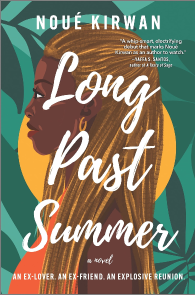
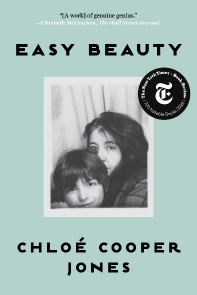
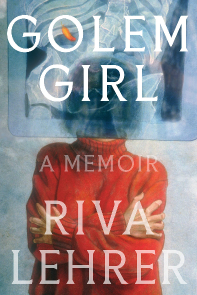
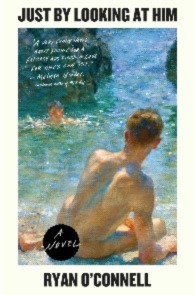
Celebrate this year’s Disability Pride Month with these great recommendations from the library. Spanning disability culture, activism, love, and finding yourself, our picks are a must-read for everyone!
Mario Cossío Olavide Universidad de Salamanca/IEMYRhd University of Minnesota/Center for Premodern Studies
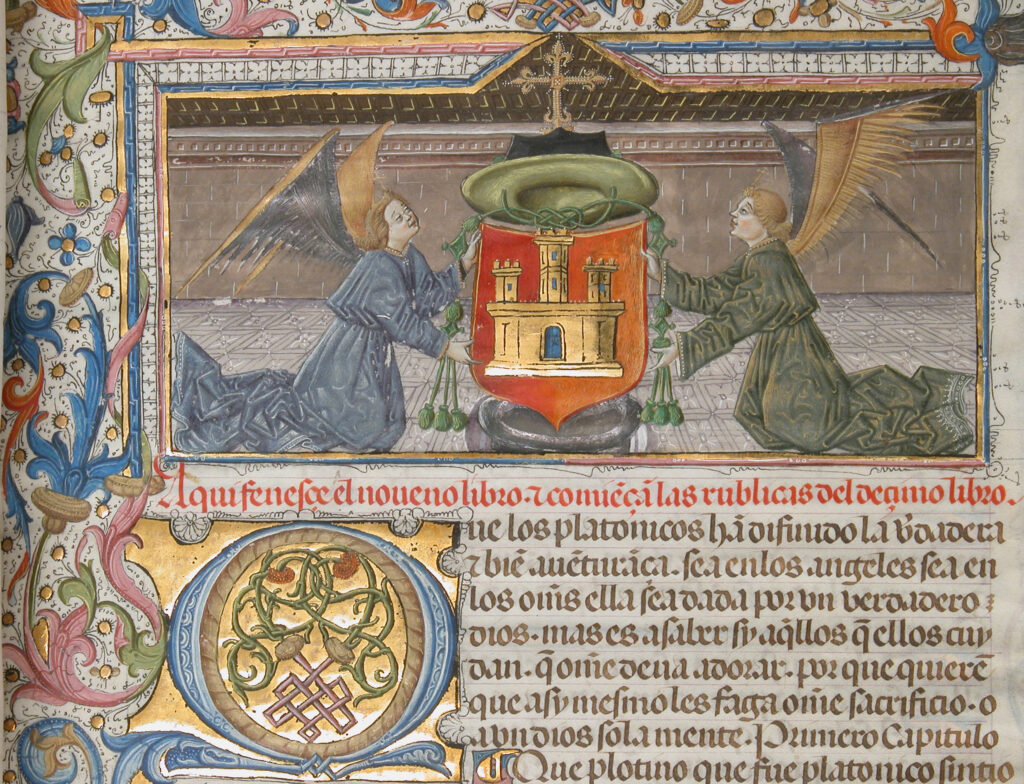
Los Lucidarios
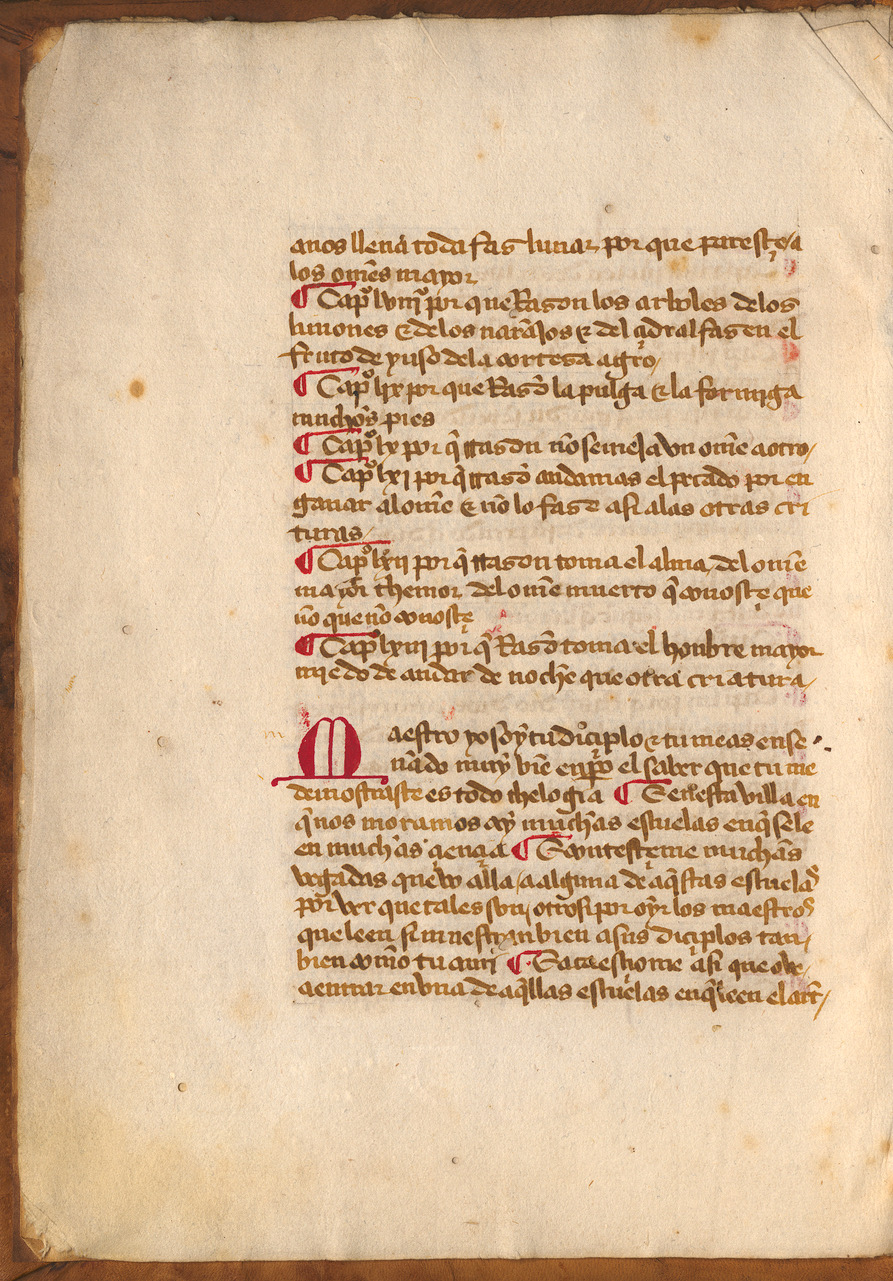
Cuando el célebre inspector de bibliotecas Henri Omont realizó el catálogo de los fondos de las bibliotecas públicas de Rouen, anotó que el manuscrito A283 de la Bibliothèque municipale –hoy Bibliothèque patrimoniale François Villon–, era un texto castellano del siglo XV al que le faltaba el título y que comenzaba en medio de la tabla de rúbricas. Tras la tabla, seguía el contenido de la obra, cuyas primeras líneas copió fielmente: “Maestro, yo soy tu discípulo e tú me as enseñado muy bien” (Cataloguegénérale, 184). El texto corresponde con el inicio del marco narrativo del Lucidario (BETA texid 1242).
Imagen 1. Rouen: Bibliothèque municipale, Ms A283, f. 2v
El manuscrito transmite el octavo testimonio conocido de esta obra auspiciada por Sancho IV, al que le he dado la sigla H (BETA manid 6360). Se trata de una copia posiblemente realizada en los talleres napolitanos de los reyes de Aragón y que llegó a Rouen gracias a la compra de manuscritos de Federico I de Nápoles realizada por el cardenal Georges d’Amboise durante el exilio del monarca en Tours (para una descripción completa de su contenido, véase Cossío Olavide, “Un nuevo manuscrito”).
A H hay que sumarle un noveno testimonio, I (BETA manid 3067), que identifiqué hace unas semanas. La existencia de este texto también pasó desapercibida por mucho tiempo. Se encontraba en la Biblioteca Ducal de Medinaceli y de él había dado cuenta Antonio Paz y Meliá con una enigmática nota en su parcial catálogo del fondo, entre los “manuscritos curiosos”: “Libro del rey Sancho IV – Diálogo entre maestro y discípulo (Letra del siglo XV)” (Serie 2: 537). Entre todas las obras de Sancho IV, esta descripción solo puede ser aplicada al Lucidario. Después de la venta de la biblioteca en 1964, el manuscrito pasó a la colección de Bartolomé March en Madrid y, tras la muerte de este, fue trasladado, junto al resto de manuscritos, a la Biblioteca de la Fundación Bartolomé March de Palma (sobre este manuscrito, véase Cossío Olavide, “Un nuevo testimonio”).
Resulta interesante resaltar que se trata de un testimonio tardío del Lucidario, de mediados del siglo XVI por su letra y filigranas, mientras que el cuatrocientos acumula seis testimonios de la obra. Hay dos fechados, A (BNE MSS/3369 [BETA manid 1434]) de 1455 y C (Real Bibl. II/793 [BETA manid 1435]) de 1477. D, el códice Puñonrostro (RAE Ms. 15 [BETA manid 1424]), puede ser datado por sus filigranas entre 1450 y 1460 (Cossío Olavide, “D (RAE 15)”). G (RAH Cód. 101 [BETA manid 2285]) es de finales de siglo, mientras que H (Rouen BM A283 [BETA manid 6360]) es de mediados de la centuria.
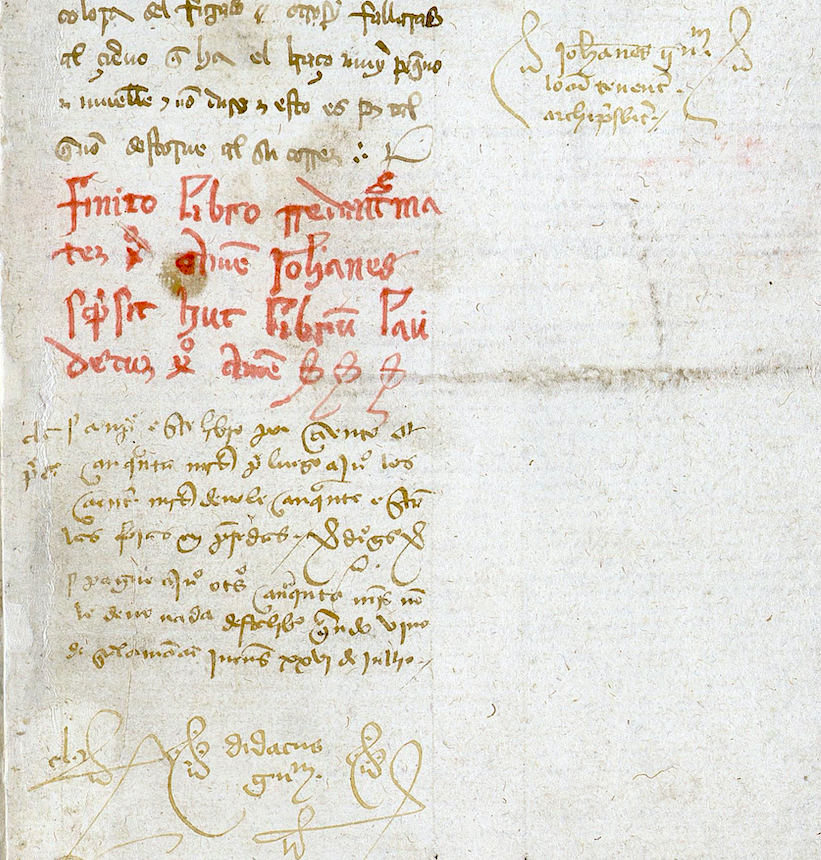
El testimonio B (Salamanca BU Ms. 1958 [BETA manid 1433]) fue durante largo tiempo considerado de este siglo, pero sus filigranas y la letra empleada –muy similar a la cancilleresca– apuntan que fue producido entre 1380 y 1410. Esto es reconfirmado por una nota de compra-venta en los últimos folios, acompañada por las firmas de sus antiguos posesores, dos maestros salmantinos de las primeras décadas del siglo XV. Didacus Gundisalvi, Diego González, catedrático de derecho en la Universidad de Salamanca hacia 1433, y un Johanes Gundisalvi, locum tenentem archipresbiter, que bien podría ser Juan González de Segovia, catedrático de derecho canónico, teólogo y representante de Juan II en el Concilio de Basilea.
Imagen 2. Detalle del fol. 104r del ms. 1958 de la Biblioteca General Histórica de la Universidad de Salamanca
Manuscritos hispánicos en colecciones europeas
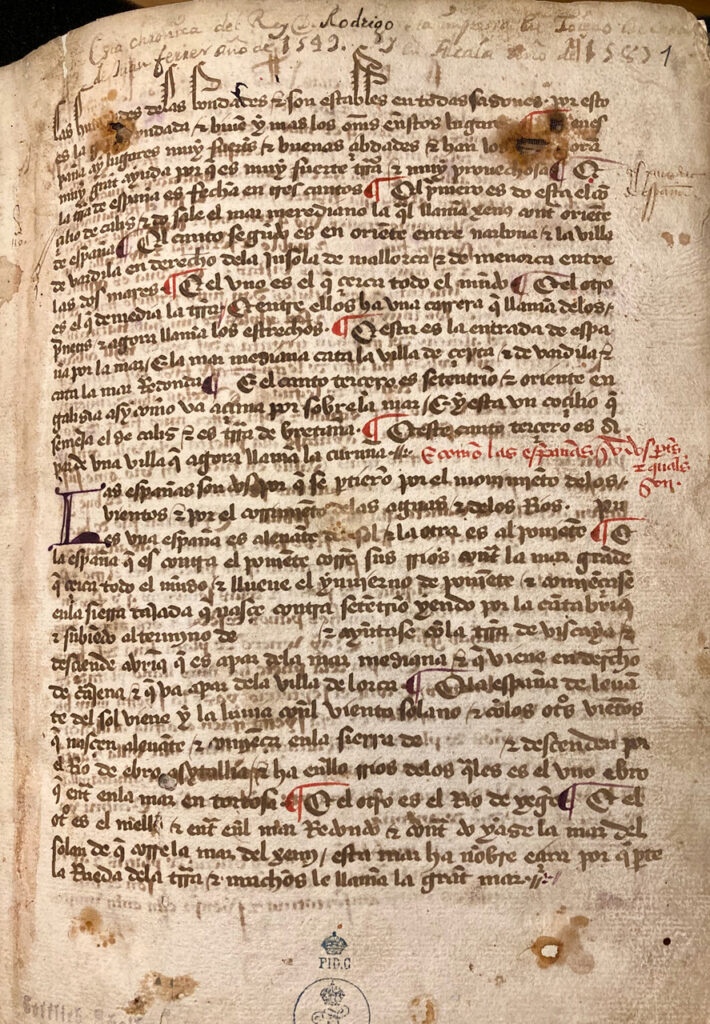
Un manuscrito recientemente redescubierto por Cossío Olavide y Romera Manzanares (“Nuevos testimonios”) es el Series Nova 12736 de la Biblioteca Nacional de Austria (BETA manid 6409), que transmite un testimonio parcial de la mal llamada Crónica del moro Rasis (BETA texid 1400) y de la Crónica sarracina (BETA texid 1462) de Pedro de Corral, datado entre 1460 y 1480.
Imagen 3. Fol. 1r del ms. Series Nova 12736 de la Österreichische Nationalbibliothek
Además de estos textos, el manuscrito vienés transmite dos romances tempranos en el fol. 36r y la guarda pegada a la contratapa final: Virgilios y ¡Ay de mi Alhama! (o Paséabase el rey moro), según se dará cuenta en Cossío Olavide y Pichel (“Dos romances”).
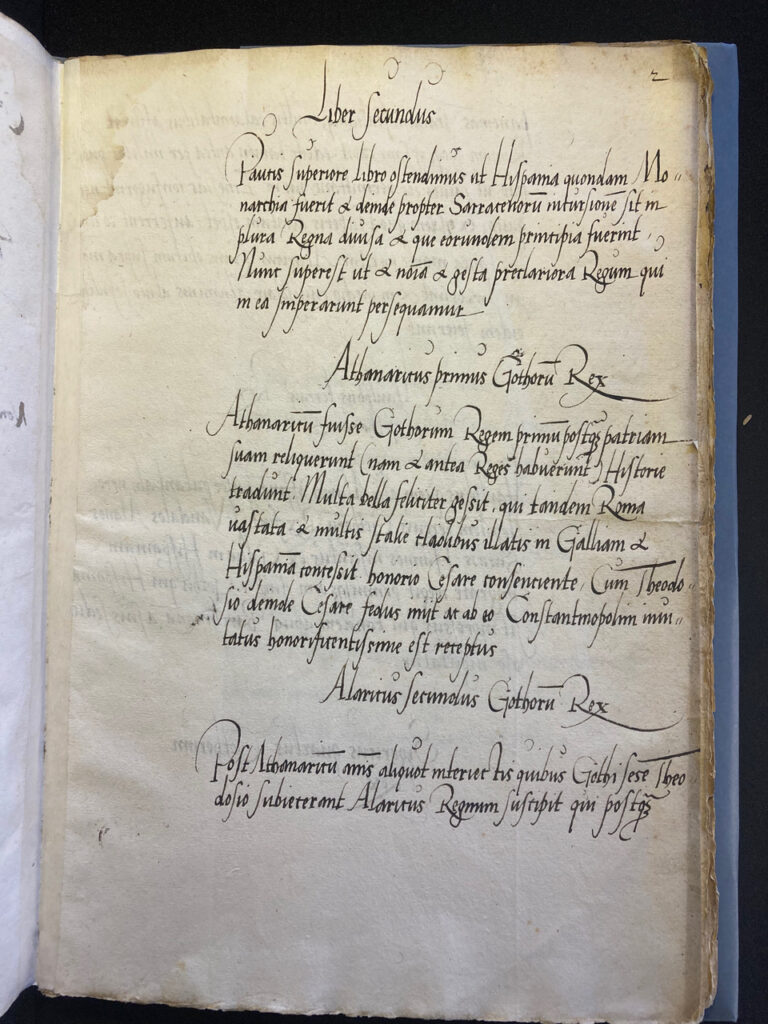
Otro texto de interés es el ms. 9221 de la misma biblioteca, un manuscrito facticio con doble numeración que transmite un repertorio de inscripciones sepulcrales alemanas (fols. 1r-73r) y un breve texto latino de formato analístico sobre los reyes visigodos (fols. 1rbis-10rbis). Aunque se trata de una copia del siglo XIX, parece estar vinculado con el Cronicón de Cardeña.
Imagen 4. Fol. 2r-bis del ms. 9221 de la Österreichische Nationalbibliothek
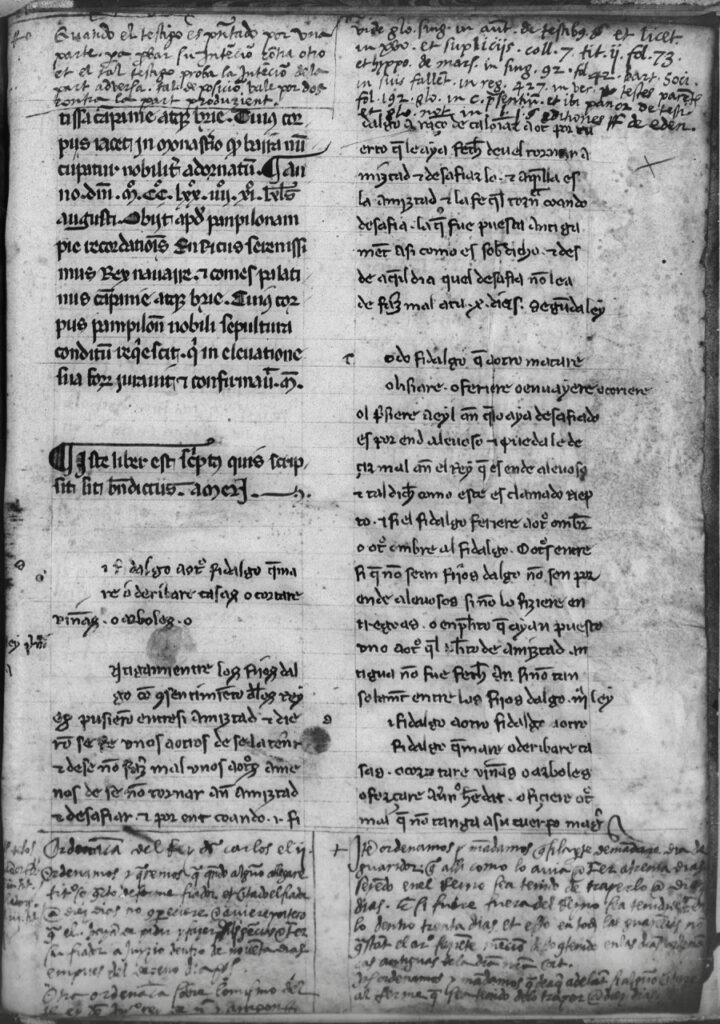
El manuscrito B702 de la Biblioteca Nacional de Suecia (BETA manid 4469) transmite la versión C del Fuero general de Navarra (BETA texid 1195), ampliado con disposiciones y textos legales añadidos, como el Amelloramiento de Philippe d’Evreux III (BETA texid 3192), estructura compartida por otros testimonios del fuero (BNE MSS/248 [BETA manid 1370] y MSS/ 6705 [BETA manid 3392], Biblioteca Regionale Universitaria di Catania ms. U009 [BETA manid 4600] y Real Biblioteca ms. II/1872 [BETA manid 3242]). Como estos, transmite en los fols. 114r-116v, una interpolación navarro-aragonesa del título de los retos del Fuero Real (libro 4, título 19), incorporada para cubrir un vacío legal en materia de justicia nobiliaria del Fuero general (véase Utrilla Utrilla, “Las interpolaciones” y Fradejas Rueda, “Una decepción”).
Imagen 5. Fol. 114r del ms. B702 de la Kungliga Biblioteket, Estocolmo
Referencias
Cossío Olavide, Mario y Ricardo Pichel. “Dos romances tempranos en un manuscrito historiográfico del siglo XV: ¡Ay de mi Alhama! y Virgilios (con una nota sobre la lectura del Amadís primitivo).” Actas del VIII Congreso Internacional de la Asociación Convivio, en prensa.
_____. “Un nuevo manuscrito (Rouen, Bibliothèque municipale Villon ms. A283) y una nueva edición del Lucidario de Sancho IV.” e-Spania, vol. 44, 2023. https://doi.org/10.4000/e-spania.46735
Fradejas Rueda, José Manuel. “Una decepción y un hallazgo. Una nueva copia del Fuero de Navarra.” Las Siete Partidas del Rey Sabio: una aproximación desde la filología digital y material, editado por José Manuel Fradejas Rueda, Enrique Jerez y Ricardo Pichel, Iberoamericana, 2021, pp. 138-43. https://doi.org/10.31819/9783968691503-011
Omont, Henri, editor. Catalogue général de manuscrits des bibliothèques publiques de France. Départaments, t. I. Rouen, Imprimerie nationale, 1886.
Paz y Meliá, Antonio. Series de los más importantes documentos del Archivo y Biblioteca del Excelentísimo Señor Duque de Medinaceli. 2 vols. Imprenta alemana e Imprenta de Blass, 1915-1922.
Romera Manzanares, Ana y Mario Cossío Olavide. “Vieron el escrito y mostráronlo. Nuevos testimonios de la Crónica del moro Rasis y de la Crónica sarracina.” Revista de literatura medieval, vol. 34, 2022, pp. 249-68. https://doi.org/10.37536/RLM.2022.34.1.87619
Utrilla Utrilla, Juan. “Las interporlaciones sobre reptorios en los manuscritos del Fuero general de Navarra.” Prínicpe de Viana. Anejo, no. 2-3, 1986, pp. 765-76.
I am delighted to announce that thanks to the efforts of Randy Brandt, Head Cataloguer of The Bancroft Library, it is now possible to find all of the volumes in Bancroft’s Fernán Núñez Collection.
You can now search by call number and retrieve the records for the volumes that have been individually cataloged. (If you don’t see the volume number you’re looking for, that means it is still only part of the larger set; no individual record yet).
2) Open the pop-up menu and scroll down to “Other call numbers.”
3) Type in “BANC MS UCB 143” and click the Search icon (or press Enter).
The first result is the record for the collection itself, followed by several hits for microfilm, many with the title “Host bibliographic record for boundwith item….” Near the bottom of the first screen you will see the record for v. 1-2, Epitome de la vida del Marques de la Mina, Conde de Pezuela …. To see the rest of the call numbers, use the scroll tab at the lower right of the screen.
Note that even with this project, there are still some volumes that have “Host bibliographic record…” as the title (see v. 17 for the first one). However, when you click on that record, you will have access to the individual titles bound within that volume.
This collection of 224 manuscripts comes from the library of the counts and then dukes of Fernán Núnez, a town near Córdoba, principally from that of the 6th count of Fernán Núñez, Carlos José Gutiérrez de los Ríos y Córdoba (1742-1795), although the nucleus of the collection probably goes back to Juan Fernández de Velasco (1550-1613), 5th duke of Frías and viceroy of Milan. According to the Diccionario Biográfico electrónico of the Real Academia de la Historia, Gutiérrez de los Ríos was a man of broad culture who wrote a biography of King Carlos III and was an honorary member of the Real Academia de Bellas Artes de San Fernando in Madrid and the Real Academia Sevillana de Buenas Letras.
Bancroft bought the collection in 1984 from the legendary New York bookseller H.P. Kraus, thanks in part to the happy instance that at the time I was in New York working on the catalog of medieval manuscripts of the Hispanic Society of America. Kraus recruited me to write an initial description of the collection prior to putting it on the market. I alerted my colleagues in Berkeley of its importance, and they in turn convinced James D. Hart, Bancroft’s director, to find the funds for its purchase.
Among the interesting volumes is the most important manuscript of the Crónica sarracina de Pedro del Corral (BETA manid 3602), from the library of Bernardo de Alderete, author of Del origen y principio de la lengua castellana o romance que hoy se usa en España (1606), and a late 16th-c or early 17th-c. copy of the Cancioneiro da Vaticana (BITAGAP manid 1666), one of the three major collections of medieval Galician-Portuguese lyric poetry.
We are fortunate to have descriptions of the collection from Ignacio Díez Fernández and Antonio Cortijo. Cortijo also studied the Crónica sarracina, while Arthur Askins identified the Cancioneiro da Bancroft Library. More recently Pablo Saracino has studied the Antigüedades de España of Lorenzo Padilla.
Charles B. Faulhaber University of California, Berkeley
References
Askins, Arthur L-F. “The Cancioneiro da Bancroft Library (previously, the Cancioneiro de um Grande d’Hespanha): a copy, ca. 1600, of the Cancioneiro da Vaticana.” Actas do IV Congresso da Associação Hispânica de Literatura Medieval. Lisboa: Edições Cosmos, 1991: I:43-47 (BITAGAP bibid 2595)
Cortijo Ocaña, Antonio. “La Crónica del Moro Rasis y la Crónica Sarracina: dos testimonios desconocidos (University of California at Berkeley, Bancroft Library, MS UCB 143, Vol. 124).” La Corónica 25.2 (1997): 5-30 (BETA bibid 3946)
—–. La Fernán Núñez Collection de la Bancroft Library, Berkeley: estudio y catálogo de los fondos castellanos (parte histórica). London: Dept. of Hispanic Studies, Queen Mary and Westfield College, 2000 (BETA bibid 7111)
—–. Viviendo yo esta desorden del mundo. Textos literarios españoles de los Siglos de Oro en la Colección Fernán Núnez. Burgos : Fundación Instituto Castellano y Leonés de la Lengua, 2003 (BITAGAP bibid 17216)
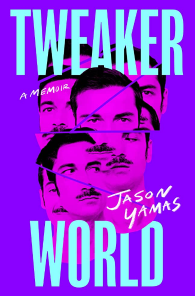
Celebrate Pride Month this June with novels, essays, romances, and humor by LGBTQIA writers. Browse through our Overdrive collection for even more great picks this month.
Video clip from Doris Sloan’s oral history on living in the Bay Area, on deep time, and on thinking like a geologist:
Doris Sloan is a geologist and paleontologist who earned her PhD at UC Berkeley and who taught, wrote, and engaged in environmental activism and education throughout the Bay Area, across California, and beyond. Sloan and I recorded nine hours of her then 92-year life history at her home in Berkeley, California, in May 2022. Our four recording sessions resulted in a 162-page oral history volume that includes an appendix of photographs with family as well as documents from her efforts in the early 1960s to stop PG&E’s construction of a nuclear power plant atop Bodega Head, under which runs the seismic San Andreas fault. Today, the coastal outcrop of Bodega Head is preserved as part of California’s scenic 17-mile-long Sonoma Coast State Park.
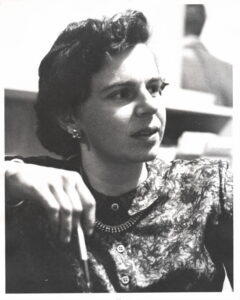
Doris Sloan in 1963 as the Sonoma County Coordinator of the Northern California Association to Preserve Bodega Head and Harbor (NCAPBHH).
Sloan’s involvement in the “Battle for Bodega Head” helped inspire her later career as a geologist and teacher—a career she began by returning to graduate school as a mother in her early forties with children still at home. Sloan overcame numerous challenges, including gender discrimination in what were then male dominated departments and academic fields, to earn her MS in Geology in 1975 and her PhD in Paleontology in 1981. Her dissertation was an ecostratigraphic thesis on the sedimentary fossils of tiny creatures that once lived the San Francisco Bay. For many years, Sloan taught research-driven senior seminars in Environmental Science at UC Berkeley as well as geology courses for UC Extension. She lectured on travel excursions and field trips around California and across much of the Earth. Sloan became a board member with Save the Bay and a founding member of Citizens for East Shore Parks. In 2006, she published with UC Press the popular California natural history guide, Geology of the San Francisco Region. In her rich oral history, Sloan discussed all of the above, with details on her formative childhood experiences, her environmental and anti-nuclear activism, her experiences as a female geology graduate student at UC Berkeley, as well as her diverse teaching career.
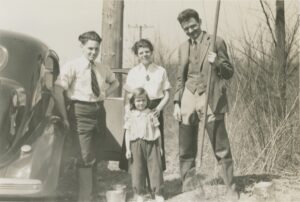
Doris Sloan, age 6 (front center), on a salamander egg collecting trip with father, Viktor Hamburger (right), and two of his graduate students in St. Louis County, Missouri, circa 1936.
Doris Sloan was born in October 1930, in Freiburg, Germany. At age four, she and her family fled Germany after the Nazis removed her father, preeminent embryologist Viktor Hamburger, from the faculty at the University of Freiburg because of his Jewish ancestry. Her family settled in Missouri after her father secured a faculty appointment at Washington University in St. Louis. As a young girl, Sloan accompanied her father and his embryology students on field research trips to collect salamander eggs. She also shared fond memories of youthful summers working in Woods Hole on Cape Cod at the Marine Biological Laboratory. Sloan attended Bryn Mawr College from 1948 to 1951, where she began attending Quaker meetings. Upon her mother’s deteriorating health, Sloan returned to St. Louis and graduated in 1952 from Washington University with a BA in Sociology. In that same year Sloan moved to San Francisco, California, with her then-husband, with whom she had four children. In 1957, she and her young family moved to Sonoma County, where she was neighbors with Peanuts cartoonist Charles Schulz. It was there in Sonoma County where, in the interests of protecting her children from nuclear radiation and preserving the beauty of the Sonoma Coast, that Sloan began her environmental activism that would, among other experiences, inspire her later career as a geologist and teacher.
Video clip from Doris Sloan’s oral history about her role in the “Battle of Bodega Head, Part 1:
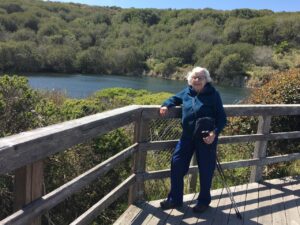
Doris Sloan at the now water-filled “Hole in the Head” on Bodega Head on Mother’s Day in 2022. Photograph by her daughter Christy Sloan.
Sloan detailed her engagements in the multi-year “Battle of Bodega Head” that, in 1964, successfully stopped PG&E’s construction of a nuclear power plant on Bodega Head. After being told by an official from California’s Office of Atomic Energy Development and Radiation Protection to let go of concerns about the forthcoming nuclear plant and “leave it to the experts,” Sloan enlisted in the activist organization called the Northern California Association to Preserve Bodega Head and Harbor (NCAPBHH)—a name others created and she described as “dreamt up on a Friday night after too many beers.” The Association included an eclectic mix of anti-nuclear citizen activists that included communist chicken farmers, libertarian land owners, conservative cattle ranchers, Bodega fisherman, UC Berkeley professors, Sierra Club members, and jazz musicians and songwriters. In her role as Sonoma County Coordinator of NCAPBHH, Sloan also collaborated with an internationally recognized geophysicist and geologist named Pierre Saint-Amand. Fortuitously, on a rainy and wind-swept day, Sloan accompanied Saint-Amand on a clandestine and consequential visit to the “Hole in the Head,” the site on Bodega Head where PG&E had already drilled a deep pit into granite rock to place its nuclear reactor. It was on that visit, while looking into that hole, that Saint-Amand and Sloan discovered evidence of the San Andreas fault running directly through the reactor’s containment site, a discovery that eventually halted further nuclear construction there.
Video clip from Doris Sloan’s oral history about her role in the “Battle of Bodega Head, Part 2:
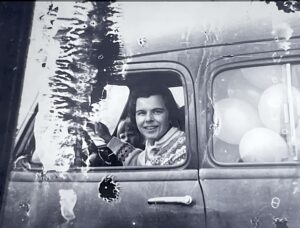
Doris Sloan driving with her children and many helium-filled balloons to a NCAPBHH event at Bodega Head on Memorial Day, 1963. (Original film negative slightly damaged.)
As Sloan recalled about their activist victory in the early 1960s, “to have a group of citizens win out over a major institution was really pretty unique. … Bodega was a very important story at the very beginning of a huge cultural shift for not only environmental matters on nuclear energy, but in so many other ways, too. Basically, citizen involvement at every level, from students to housewives. And to be a part of that, I look back on that and think, wow, how could anybody have been so lucky in so many ways?” The story of this citizen-led anti-nuclear activism has been told elsewhere, including in Oral History Center interviews with David Pesonen and Joel Hedgpeth, as well as by nuclear historians J. Samuel Walker and UC Berkeley alumnus Thomas Wellock. Sloan’s storytelling on her personal role in the “Battle of Bodega Head”—like launching over a thousand helium-filled balloons from Bodega Head to the accompaniment of live jazz playing “Blues Over Bodega”—adds both flourish and important details to the eventual successes of NCAPBHH.
Sloan’s involvement at Bodega Head played a crucial role in launching the next phase of her life as a geologist and teacher. After moving with her children to Berkeley in 1963, Sloan worked for the Friends Committee on Legislation, a Quaker lobbying group. Yet, by the early 1970s, Sloan’s long-standing fascination of nature, a desire to experience more of it, and her memory of discovering fault seams on Bodega Head led her to take UC Extension courses on geology taught high up in the Sierra Nevada’s Emigrant Wilderness by a remarkable UC Berkeley professor named Clyde Wahrhaftig. Wahrhaftig eventually became a significant mentor and friend to Sloan on her academic journey, as were UC Berkeley geologists Garniss Curtis and William B.N. (Bill) Berry. In her oral history, Sloan shares many joys from her field research and academic experiences at Berkeley, including mapping rock formations in California’s Mazourka Canyon, communing with ancient bristlecone pines in the White Mountains, learning about limestone deposition in Florida, a fascinating question about an imaginary dinosaur civilization from Walter Alvarez during her PhD oral examination, and her own work deciphering the sedimentary mysteries of fossils from mud under the San Francisco Bay. Sloan also shared some of the challenges she faced in the late 1970s as one of the few women in Berkeley’s geology and paleontology departments that, by her account, then included more than a few male chauvinistic dinosaurs.
Video clip from Doris Sloan’s oral history about Clyde Wahrhaftig, a UC Berkeley geologist, mentor, and friend:
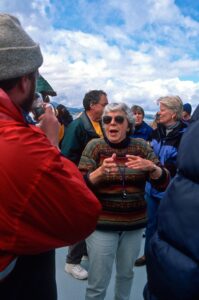
Doris Sloan lecturing during a University of California Museum of Paleontology (UCMP) field trip to the Marin Headlands in 2010. Photograph by John Karachewski.
Sloan’s oral history also explores her ensuing years as a teacher, travel guide, author, and environmental activist. Sloan discussed several senior research seminars in Environmental Studies that she taught at UC Berkeley, some records of which are preserved in UC Berkeley’s Library including East Bay Parklands: Planning and Management (1978), Seismic Safety in Berkeley (1979), San Pablo Bay: An Environmental Perspective (1980), and Hazardous Substances: A Community Perspective (1984). Sloan recorded stories and samples from lectures she delivered in her UC Extension geology courses and in her field classes for numerous organizations, including the Oakland Museum, Sierra Club, the Point Reyes National Seashore Association, and the Yosemite Association. And she shared some of her travel experiences as a guide for Cal Alumni groups on journeys all across the Earth, from the Himalayas to Central Asia, and from South America to Scandinavia. Sloan also spoke about her local environmental activism as a board member of Save The Bay, as a founding member of Citizens for East Shore Parks, and on her friendship with Save The Bay co-founder Sylvia McLaughlin, including efforts to secure what is now named as McLaughlin Eastshore State Park.
Doris Sloan’s enlightening oral history records marvelous stories from the first ninety-two years of her remarkable life—from fleeing Nazi Germany to summers in Woods Hole; from raising children in northern California to stopping construction of a nuclear power plant on the San Andreas fault; from graduate school in her forties at UC Berkeley to lecturing across California and much of the world. I am honored to have become one of Doris’s friends, and I’m lucky for the opportunity to become one of her students. Now, with the publication of Doris Sloan’s oral history, you also have the chance to learn from her deep wisdom and experience.
Video clip from Doris Sloan’s oral history about the Bay Area’s complicated geology:
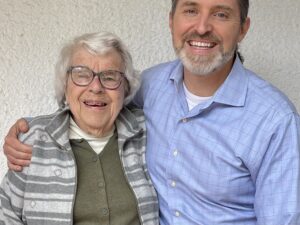
Doris Sloan with oral historian Roger Eardley-Pryor at her home in Berkeley, California, in May 2023.
ABOUT THE ORAL HISTORY CENTER
The Oral History Center of The Bancroft Library preserves voices of people from all walks of life, with varying political perspectives, national origins, and ethnic backgrounds. We are committed to open access and our oral histories and interpretive materials are available online at no cost to scholars and the public. You can find our oral histories from the search feature on our home page. Search by name, keyword, and several other criteria. Sign up for our monthly newsletter featuring think pieces, new releases, podcasts, Q&As, and everything oral history. Access the most recent articles from our home page or go straight to our blog home.
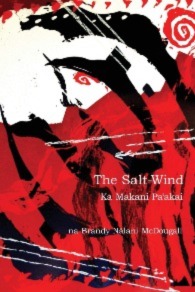
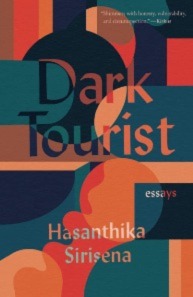
This May, celebrate Asian American and Pacific Islander Heritage Month with our wonderful and diverse collection of works by Asian American and Pacific Islander American authors. Encompassing books penned by Americans with roots from Sri Lanka to India to Hawai’i, with stories of college life, immigrant families, and much more, there are plenty of great novels to pick from. Check out more titles through Overdrive.
We are delighted to announce that PhiloBiblon has received a two-year implementation grant from the Humanities Collections and Reference Resources program of the National Endowment for the Humanities to complete the mapping of PhiloBiblon from its almost forty-year-old relational database technology to the Wikibase technology that underlies Wikipedia and Wikidata. The project will start on the first of July and, Dios mediante, will finish successfully by the end of June 2025.
The fundamental problem is to map the 422,000+ records of PhiloBiblon’s bibliographies with their complexly interrelated relational tables to the triplestore structure of Wikibase. A triplestore relates two Items by means of a Property. Thus a Work is linked to an Author by the Property “written by.”
We received an NEH Foundations grant for this project in 2021, as described in detail in PhiloBiblon 2021 (n. 3): PhiloBiblon y el mundo wiki: propuesta de una colaboración. Over the course of the last two years, the pilot project team, consisting of Charles Faulhaber (PI), Patricia García Sánchez-Migallón and Almudena Izquierdo Andreu (doctores por la UCM); Berkeley undergraduate Spanish and data science majors (Julieta Soto, Serena Bai, Tina Lin, Cassandra Calciano, Martín García Ángel); Max Ziff (data engineer); and Josep Formentí (user interface programmer), has analyzed the data structures of PhiloBiblon’s ten relational tables (using BETA for the test cases) and worked out the procedures needed to convert them into triplestore structures.
Almudena and Patricia manually mapped more than 125 BETA records to FactGrid: PhiloBiblon as models for the automated processing of the rest. See for example the records for Alfonso X, BNE MSS/10069 (Cantigas de Santa Maria), and the 1497 edition of the translation of Boccacio’s Fiammeta. These models have been key for establishing the semantic relations between PhiloBiblon’s data fields and the Properties and Items in FactGrid. In many cases appropriate properties did not exist and it was necessary to create them. For example, something as simple as the Watermark property was needed in order to identify the various watermark types set forth in PhiloBiblon’s controlled vocabulary.
Julieta Soto and Martín García Ángel attacked the problem of creating almost 900 FactGrid records for the controlled vocabulary terms in BETA. This meant in the first place a search in FactGrid to make sure that an equivalent term did not already exist, in order to avoid creating duplicate records. Then they had to situate the term in the FactGrid ontology by specifying it as a “basic object” (e.g., fruit) or identifying it as a subclass of an appropriate basic object, for example facsímil impreso as a subclass of facsímil. At the same time they had to link the record to the code in PhiloBiblon, BIBLIOGRAPHY*RELATED_BIBCLASS*FAP, identifying a record in the Bibliography table as a print facsimile, thereby making it possible to search for such items.
The default viewer used in FactGrid, the same as that used in Wikidata, is not user friendly. Therefore Josep has created a prototype user interface, using data from the BETA Institutions table. We encourage you to play with it and tell us what you like or—more usefully—don’t like.
This change to Wikibase technology is designed to allow PhiloBiblon not only to take advantage of the linked open data of the semantic web, but also, and most importantly, to decrease sustainability costs. Because Wikibase is open-source software maintained by WikiMedia Deutschland, the software development arm of the Wikimedia Foundation, software maintenance costs for PhiloBiblon will be minimal in the future. This means that it will no longer be necessary to seek major grant support every five to seven years merely to keep up with technology change.
While this work has been going on, we have not neglected the vital process of cleaning up PhiloBiblon data in order to facilitate the automated mapping nor the equally vital process of adding new information to PhiloBiblon. For example, Pedro Pinto, a member of the BITAGAP team, has recently discovered a “folha desmembrada” (BITAGAP manid 7862) from the Livro 4 of the chancery records of king Fernando I (1345-1383) (BITAGAP manid 3255), separated from the manuscript in the Arquivo Nacional da Torre do Tombo. The newly discovered dismembered leaf contains five previously unknown royal documents. It was being used as the cover of the “Livro de Acordãos, 1620-24,” in the archive of the Santa Casa de Misericórdia in Coruche, a small city in the Santarem district on the Tagus river northeast of Lisbon.
The recycling of parchment leaves from discarded medieval manuscripts, presumably for more socially beneficial purposes, such as the protection of administrative records, was common in both Spain and Portugal in the sixteenth and seventeenh centuries. Such leaves have been the source of many unknown or poorly documented medieval texts. Perhaps the most spectacular example was Harvey Sharrer’s discovery in 1990 of the eponymous Pergaminho Sharrer (BITAGAP manid 1817), with musical notation for seven poems of king Dinis of Portugal (1279-1325). This had been used as the binding of a collection of notarial documents (Lisboa: Arquivo Nacional da Torre do Tombo: Lisboa, Cartório Notarial de. N. 7-A, Caixa 1, Maça 1, livro 3).
Mariña Arbor Aldea
Arthur L-F. Askins
Vicenç Beltran Pepió
Álvaro Bustos Táuler
Antonio Cortijo Ocaña
Charles B. Faulhaber
Patricia García Sánchez-Migallón
Ángel Gómez Moreno
José Luis Gonzalo Sánchez-Molero
Almudena Izquierdo Andreu
Filipe Alves Moreira
María Morrás
Óscar Perea Rodríguez
Ricardo Pichel Gotérrez
Pedro Pinto
Maria de Lurdes Rosa
Nicasio Salvador Miguel
Martha E. Schaffer
Harvey L. Sharrer
Cristina Sobral
Lourdes Soriano Robles