Date/Time: Wednesday, September 27, 2023, 11:00am–12:30pm Location: Hybrid: Join in person at 223 Doe Library, or on Zoom. Register via LibCal.
This workshop will provide you with practical guidance for navigating copyright questions and other legal considerations for your dissertation or thesis. Whether you’re just starting to write or you’re getting ready to file, you can use our tips and workflow to figure out what you can use, what rights you have as an author, and what it means to share your dissertation online.
Some questions we’ll answer during the workshop include:
What’s mine after I’m done writing my dissertation?
Can I re-use previous scholarly articles I’ve written?
Date/Time: Wednesday, September 20, 2023, 11:00am–12:30pm Location: Zoom only. Register via LibCal and you’ll receive the Zoom link for the event.
If you’re looking to self-publish work of any length and want an easy-to-use tool that offers a high degree of customization, allows flexibility with publishing formats (EPUB, PDF), and provides web-hosting options, Pressbooks may be great for you. Pressbooks is often the tool of choice for academics creating digital books, open textbooks, and open educational resources, since you can license your materials for reuse however you desire. Learn why and how to use Pressbooks for publishing your original books or course materials. You’ll leave the workshop with a project already under way.
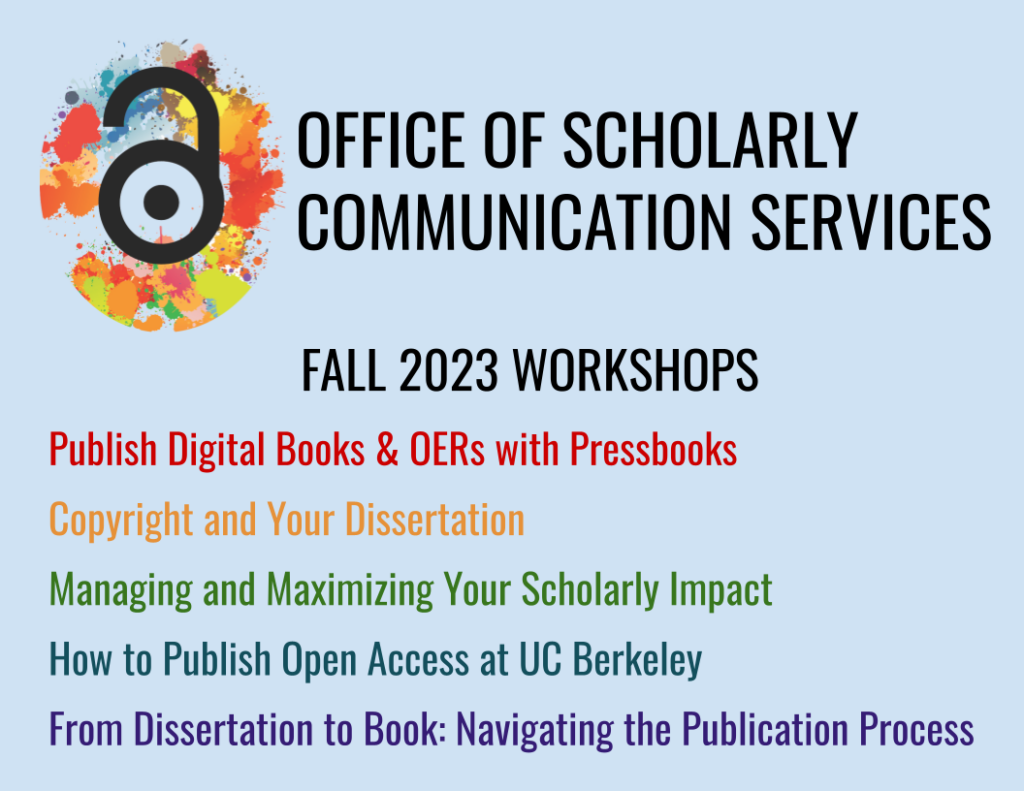
With the school year kicking off soon in Berkeley, the Library’s Office of Scholarly Communication Services is here to help UC Berkeley faculty, students, and staff understand copyright and scholarly publishing with online resources, Zoom and in-person workshops, and consultations. Here’s what’s coming up this semester.
Workshops
Publish Digital Books & Open Educational Resources with Pressbooks
Date/Time: Wednesday, September 20, 2023, 11:00am–12:30pm Location: Zoom only. Register via LibCal.
If you’re looking to self-publish work of any length and want an easy-to-use tool that offers a high degree of customization, allows flexibility with publishing formats (EPUB, PDF), and provides web-hosting options, Pressbooks may be great for you. Pressbooks is often the tool of choice for academics creating digital books, open textbooks, and open educational resources, since you can license your materials for reuse however you desire. Learn why and how to use Pressbooks for publishing your original books or course materials. You’ll leave the workshop with a project already under way.
Copyright and Your Dissertation
Date/Time: Wednesday, September 27, 2023, 11:00am–12:30pm Location: In-person in Doe Library Room 223, or Zoom. Register via LibCal.
This workshop will provide you with practical guidance for navigating copyright questions and other legal considerations for your dissertation or thesis. Whether you’re just starting to write or you’re getting ready to file, you can use our tips and workflow to figure out what you can use, what rights you have as an author, and what it means to share your dissertation online.
Managing and Maximizing Your Scholarly Impact
Date/Time: Tuesday, October 10, 2023, 11:00am–12:30pm Location: In-person in Doe Library Room 223, or Zoom. Register via LibCal.
This workshop will provide you with practical strategies and tips for promoting your scholarship, increasing your citations, and monitoring your success. You’ll also learn how to understand metrics, use scholarly networking tools, and evaluate journals and publishing options.
How to Publish Open Access at UC Berkeley
Date/Time: Tuesday, October 17, 2023, 11:00am–12:30pm Location: Zoom only. Register via LibCal.
Are you wondering what processes, platforms, and funding are available at UC Berkeley to publish your research open access (OA)? This workshop will provide practical guidance and walk you through all of the OA publishing options and funding sources you have on campus. We’ll explain: the difference between (and mechanisms for) self-depositing your research in the UC’s institutional repository vs. choosing publisher-provided OA; what funding is available to put toward your article or book charges if you choose a publisher-provided option; and the difference between funding coverage under the UC’s systemwide OA agreements vs. the Library’s funding program (Berkeley Research Impact Initiative). We’ll also give you practical tips and tricks to maximize your retention of rights and readership in the publishing process.
From Dissertation to Book: Navigating the Publication Process
Date/Time: Thursday, November 9, 2023, 11:00am–12:30pm Location: Zoom only. Register via LibCal.
Hear from a panel of experts—an acquisitions editor, a first-time book author, and an author rights expert—about the process of turning your dissertation into a book. You’ll come away from this panel discussion with practical advice about revising your dissertation, writing a book proposal, approaching editors, signing your first contract, and navigating the peer review and publication process.
Other ways we can help
In addition to the workshops, we’re here to help answer a variety of questions you might have on intellectual property, digital publishing, and information policy.
Interested in publishing your research Open Access? UCB Library can help defray the costs of an article processing charge (up to $2,500) or book processing charge (up to $10,000). See the Berkeley Research Impact Initiative (BRII) for more information. And explore the various UC-wide open access agreements and discounts that can help UC corresponding authors publish their scholarship open access.
Do you want to create an open digital textbook? Take a look at UC Berkeley’s Open Book Publishing platform (anyone with a @berkeley.edu email can sign up for a free account), and get in touch with us about our Open Educational Resources (OER) grant program.
Keep an eye on the Library’s events calendar for more workshops and trainings.
Want help or more information? Send us an email. We can provide individualized support and personal consultations, online class instruction, presentations and workshops for small or large groups & classes, and customized support and training for departments and disciplines.
This post provides information to UC Berkeley authors about programs that our Library and the UC system offer to help defray open access article processing charges. It also offers tips about how to plan or budget in advance for these fees when possible.
The University of California has been a long-time supporter of open access publishing—that is, making peer-reviewed scholarship available online without any financial, legal, or technical barriers. Just because the publishing outcome is open to be read at no cost, though, doesn’t mean the publishing enterprise as a whole is “free.” One of the most common ways for open access publishers to continue to finance their publishing and production of journals in the absence of selling subscriptions for access is to instead charge authors a fee to publish—moving from a publishing system based on paying to read to one based on paying to publish. Of course, not all methods of funding open access require authors to pay publication fees in this way. And in all cases (except those rare instances in which a publisher requests that you waive this right), the UC’s open access policy makes it possible for UC authors to share their author-accepted manuscript version of their articles on eScholarship, the UC’s research repository, immediately upon publication in a journal.
But when a publisher does charge a fee to publish, we want to help you understand what UC Berkeley resources are available—whether from your grant funds or the University of California Libraries—to help with those costs.
Typically publishers refer to author-facing fees as “article processing charges”, or “APCs”. APCs can range from a few hundred dollars all the way up to $10,000 or more for some select Nature journals.
UC authors may be able to cover or contribute to these fees by leveraging research accounts or grant funds (to the extent available). But there are also other University Library programs available to support payment when research accounts or grant funds are not available.
UC-wide open access publishing agreements will cover some (or all) APCs
UC corresponding authors can take advantage of funding opportunities to defray the cost of publishing their scholarship open access where their grant or other research funds come up short or are not available. The University of California libraries have entered into a growing number of systemwide transformative open access agreements with publishers. UC libraries’ transformative agreements aim to transform scholarly publishing by moving from a publication model based on subscription access to an open access model.
When a UC-affiliated corresponding author has an article accepted for publication in a journal with which the UC has an open access publishing agreement, the UC libraries will pay some or all of the associated publishing fee. So, when it comes time to pay the APC, the UC libraries will pay at least the first $1,000. If there’s any remaining balance due on the APC, the publisher’s payment system will ask if the UC author has grant funding available to cover the remainder. If the UC author cannot contribute the remaining balance, the UC libraries will pay the entire APC on their behalf. (Note: there are a few instances where the UC libraries will contribute a maximum of $1,000 toward the APC, such as Nature-branded titles.)
The UC maintains an updated list of Publisher OA Agreements and Discounts where you can explore which journals are available for partial or full APC coverage under the open access agreements.
The UC Berkeley Library-specific fund can reimburse open access fees for other fully open access journals
UC Berkeley’s Library also has a campus open access fund that UCB authors can use if they are publishing in a fully open access journal and are required to pay an APC. The Berkeley Research Impact Initiative (BRII) is open to any current UC Berkeley faculty, graduate student, postdoc, or academic staff who does not have other sources of funds to pay article processing charges. The BRII fund is available for journals other than those with which the UC has entered into a systemwide transformative open access agreement.
For BRII APC coverage to apply, the entire journal must be freely available to the public without subscription fees. BRII cannot cover fees for publishing in “hybrid” OA journals—which are subscription-based journals that only offer open access options if an author decides to pay an additional fee to make their individual article open access. BRII reimbursements are capped at $2,500 per article, and a UC Berkeley author can use BRII funds once per fiscal year.
How to plan in advance
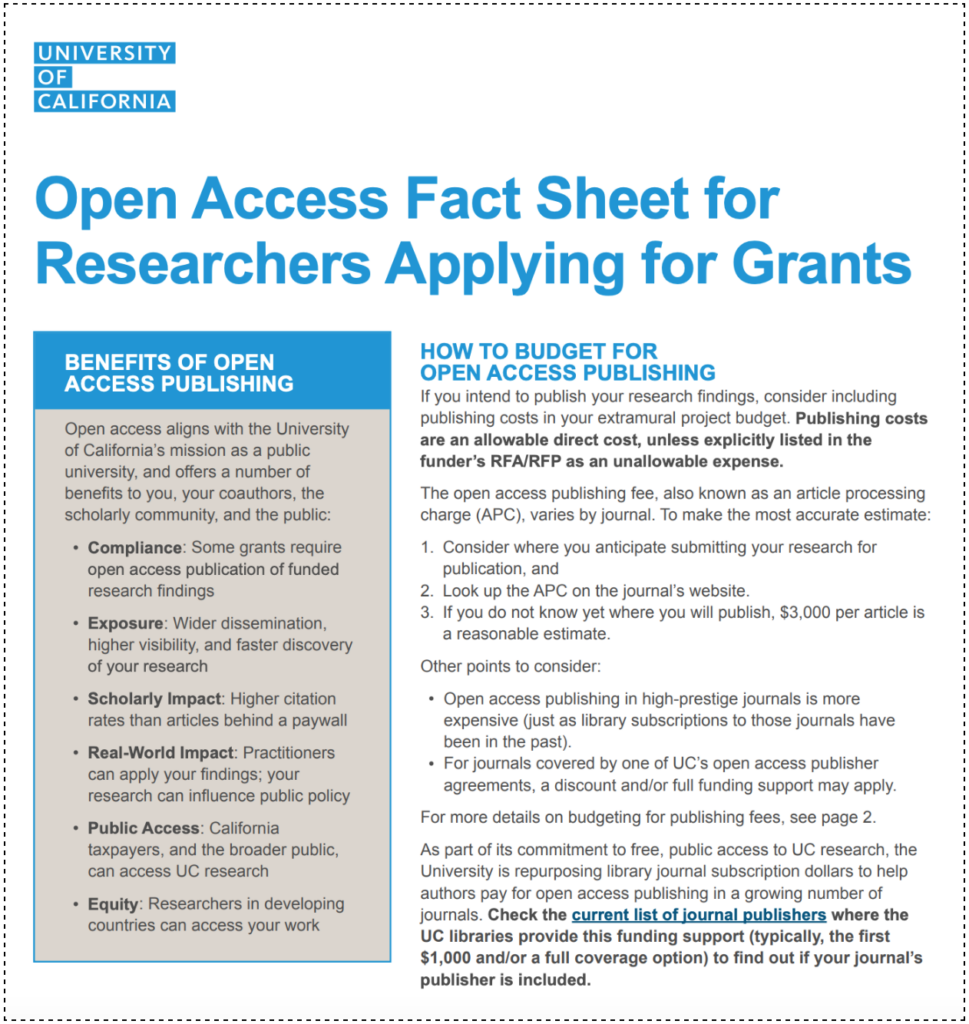
If your research is grant funded, it is important to think about publishing costs at the beginning of your research cycle and account for them in your grant applications and annual research budgeting. For grant recipients (such as researchers with funding from NIH, NSF, etc.), open access publishing costs generally are considered an allowable direct expense unless funders explicitly prohibit them. For more information on how and why to plan in advance, check out the Open Access Fact Sheet for Researchers Applying for Grants.
Click the image above to view the full guide “Open Access Fact Sheet for Researchers Applying for Grants”
Planning in advance allows you to be a partner in the publishing process. It allows the UC libraries to cover some of your article processing charge ($1,000) and, where possible, you to use grant or research funds to cover the rest. The more researchers are able to contribute, the farther the UC agreements can go in publishing more articles open access, and the better UC libraries are able to help provide financial support to researchers who do not have specific access to grant funds.
Most of the UC transformative open access agreements are set up to cover the full article processing charge should UC authors not have research or grant funds to contribute to making their journal articles open access. But there are a few journal titles and series within transformative agreements for which the libraries were unable to negotiate full coverage. For example, if a UC author has an article accepted in Nature Communications, the UC libraries cover only the first $1,000 of the article processing charge through the terms of the UC-Springer Nature transformative open access agreement. Since the current APC for Nature Communications is $6,290, then the UC author must pay the remainder of the fee ($5,290).
Another instance in which an author may need to pay a balance is when the author is publishing in a fully-open access journal not covered by a transformative agreement at all, and in turn when that journal’s article processing charge exceeds what can be covered through the BRII program. For instance, if a UC Berkeley author has an article accepted for publication in JAMA Network Open, the BRII program is capped at covering $2,500 of the article processing charge. Since the APC for JAMA Network Open is $3,000, then the UC Berkeley author must pay the remainder of the fee ($500).
Since both of the examples above are journals in which an APC is required in order to publish there, authors are responsible for securing the remainder of any publishing fees should the open access publication costs exceed the amount of UC libraries (or UC Berkeley Library’s) support.
If you’re looking to self-publish work of any length and want an easy-to-use tool that offers a high degree of customization, allows flexibility with publishing formats (EPUB, PDF), and provides web-hosting options, Pressbooks may be great for you. Pressbooks is often the tool of choice for academics creating digital books, open textbooks, and open educational resources, since you can license your materials for reuse however you desire. Learn why and how to use Pressbooks for publishing your original books or course materials. You’ll leave the workshop with a project already under way! Signup at the link above and the Zoom login details will be emailed to you.
Please sign up today and join us online on February 8.

Are you wondering what processes, platforms, and funding are available at UC Berkeley to publish your research open access (OA)? The Library’s Office of Scholarly Communication Services is hosting a workshop to provide practical guidance and walk you through all of the OA publishing options and funding sources you have on campus. We’ll explain: the difference between (and mechanisms for) self-depositing your research in the UC’s institutional repository vs. choosing publisher-provided open access; what funding is available to put toward your article or book charges if you choose a publisher-provided option; and the difference between funding coverage under the UC’s “transformative agreements” vs. the Library’s funding program (Berkeley Research Impact Initiative). We’ll also give you practical tips and tricks to maximize your retention of rights and readership in the publishing process.
Are you a faculty member or student thinking about publishing a book based on your dissertation or other scholarship? The Library’s Office of Scholarly Communication Services is hosting a panel discussion with speakers who have generously agreed to share experiences and information on the process of publishing a scholarly book.
Joining us will be:
Raina Polivka, Senior Acquisitions Editor for Music, Cinema, and Media Studies at the University of California Press. She joined the UC Press in 2015 and acquires scholarly and general interest books in Music, Film, and Media Studies.
Michael Rodríguez-Muñiz, Associate Professor of Sociology, UC Berkeley. Before coming to Berkeley this fall, he taught sociology and Latino Studies at Northwestern University. Michael is the author of the recent book Figures of the Future: Latino Civil Rights and the Politics of Demographic Change. It’s an in-depth look at how U.S. Latino advocacy groups are using ethno-racial demographic projections to bring about political change in the present. Figures of the Future was published by Princeton University Press in 2021.
Rachel Brooke, Senior Staff Attorney at Authors Alliance. Authors Alliance is nonprofit organization which representing the interests of authors who want to take advantage of the digital age to share their creations with readers, promote the ongoing progress of knowledge, and advance the public good. Rachel has also worked as a literary agent in a small New York City agency.
Our goal with the conversation is to demystify the monograph publishing process, and to give participants practical advice on what it’ll take to revise your dissertation, how to develop a book proposal, tips for interacting with editors, how to address legal considerations, and much more.
With the school year kicking off this week in Berkeley, the Office of Scholarly Communication Services is here to help UC Berkeley faculty, students, and staff understand copyright and scholarly publishing with online resources, Zoom workshops, and consultations.
Here’s what’s coming up this semester.
Workshops
Publish Digital Books & Open Educational Resources with Pressbooks
Date/Time: Tuesday, September 20, 2022, 11:00am–12:30pm RSVP for Zoom link
If you’re looking to self-publish work of any length and want an easy-to-use tool that offers a high degree of customization, allows flexibility with publishing formats (EPUB, PDF), and provides web-hosting options, Pressbooks may be great for you. Pressbooks is often the tool of choice for academics creating digital books, open textbooks, and open educational resources, since you can license your materials for reuse however you desire. Learn why and how to use Pressbooks for publishing your original books or course materials. You’ll leave the workshop with a project already under way.
Copyright and Your Dissertation
Date/Time: Tuesday, September 27, 2022, 11:00am–12:30pm RSVP for Zoom link
This workshop will provide you with practical guidance for navigating copyright questions and other legal considerations for your dissertation or thesis. Whether you’re just starting to write or you’re getting ready to file, you can use our tips and workflow to figure out what you can use, what rights you have as an author, and what it means to share your dissertation online.
Managing and Maximizing Your Scholarly Impact
Date/Time: Tuesday, October 11, 2022, 11:00am–12:30pm RSVP for Zoom link
This workshop will provide you with practical strategies and tips for promoting your scholarship, increasing your citations, and monitoring your success. You’ll also learn how to understand metrics, use scholarly networking tools, evaluate journals and publishing options, and take advantage of funding opportunities for Open Access scholarship.
From Dissertation to Book: Navigating the Publication Process
Date/Time: Tuesday, October 18, 2022, 11:00am–12:30pm RSVP for Zoom link
Hear from a panel of experts—an acquisitions editor, a first-time book author, and an author rights expert—about the process of turning your dissertation into a book. You’ll come away from this panel discussion with practical advice about revising your dissertation, writing a book proposal, approaching editors, signing your first contract, and navigating the peer review and publication process.
How to Publish Open Access at UC Berkeley
Date/Time: Tuesday, October 25, 2022, 11:00am–12:30pm RSVP for Zoom link
Are you wondering what processes, platforms, and funding are available at UC Berkeley to publish your research open access (OA)? This workshop will provide practical guidance and walk you through all of the OA publishing options and funding sources you have on campus. We’ll explain: the difference between (and mechanisms for) self-depositing your research in the UC’s institutional repository vs. choosing publisher-provided OA; what funding is available to put toward your article or book charges if you choose a publisher-provided option; and the difference between funding coverage under the UC’s “transformative agreements” vs. the Library’s funding program (Berkeley Research Impact Initiative). We’ll also give you practical tips and tricks to maximize your retention of rights and readership in the publishing process.
Copyright and Fair Use for Digital Projects
Date/Time: Tuesday, November 8, 2022, 11:00am–12:30pm RSVP for Zoom link
This training will help you navigate the copyright, fair use, and usage rights of including third-party content in your digital project. Whether you seek to embed video from other sources for analysis, post material you scanned from a visit to the archives, add images, upload documents, or more, understanding the basics of copyright and discovering a workflow for answering copyright-related digital scholarship questions will make you more confident in your project. We will also provide an overview of your intellectual property rights as a creator and ways to license your own work.
Other ways we can help
In addition to the workshops, we’re here to help answer a variety of questions you might have on intellectual property, digital publishing, and information policy.
Interested in publishing your research Open Access? UCB Library can help defray the costs of an article processing charge (up to $2,500) or book processing charge (up to $10,000). See the Berkeley Research Impact Initiative (BRII) for more information. And explore the various UC-wide transformative open access agreements and discounts that can help UC corresponding authors publish their scholarship open access.
Do you want to create an open digital textbook? Take a look at UC Berkeley’s Open Book Publishing platform (anyone with a @berkeley.edu email can sign up for a free account), and get in touch with us about our Open Educational Resources (OER) grant program.
Keep an eye on our events calendar for more workshops and trainings.
Want help or more information? Send us an email. We can provide individualized support and personal consultations, online class instruction, presentations and workshops for small or large groups & classes, and customized support and training for departments and disciplines.
Note from October 21, 2022: this post has been updated with new rollout dates. Please see below.
If you are a University of California academic author who is employed at the UC but not part of the Faculty Senate, you will soon have a new way to post copies of scholarly articles you’ve written into eScholarship.org, the UC’s open access repository.
This blog post answers questions and provides assistance to those authors affected by this change.
What is happening?
There will be a procedural change to how certain UC authors upload copies of their scholarly articles to the UC’s institutional repository to make these articles available “open access.”
Publishing scholarship “open access” means making it available to be read online by anyone at no cost to the reader. Within the UC, there are many ways to publish “open access”, including by “depositing” or uploading a copy of your “author accepted manuscript” into the UC’s institutional repository. Author accepted manuscripts (or AAMs) are the final textual version of your article without publisher formatting and final copy edits.
What’s happening now are changes to how some of you may be doing the uploading of AAMs to eScholarship. Some UC Berkeley scholars (i.e. faculty senate authors) already use a special software system for the uploading process, whereas other scholars (i.e. anyone else employed within the UC who creates academic scholarship) instead upload AAMs directly to escholarship.org through the eScholarship website. Soon, everyone (that is both faculty and all other employees who create scholarly works) will begin using the special software system for uploading.
The software system is called UC’s Publication Management System. In addition to streamlining how you undertake the uploading of your AAMs, the software also proactively searches published literature for articles that it thinks you authored and should deposit. If the system identifies an article that it thinks you’ve published, you will receive an e-mail notification (on a bi-monthly basis) requesting that you upload your AAMs through the Publication Management System platform.
So, nothing is changing for you if you’re a faculty author who already has access to and uses the Publication Management System. But for all other academic authors within the University of California, you’re soon going to get a new way to deposit your AAMs to eScholarship, and will receive periodic e-mails letting you know when to do it.
Why is this happening?
The University of California has two open access policies addressing the deposit of AAMs into the eScholarship repository. One such policy pertains to Academic Senate faculty and has been in place since 2013. The other, called the Presidential Open Access Policy (because it was issued by the UC President in 2015), covers non-faculty authors. Specifically, the Presidential Open Access Policy includes non-senate researchers, lecturers, post-doctoral scholars, administrative staff, librarians, and graduate student employees.
California Digital Library, which oversees and manages the eScholarship repository, had already added everyone covered by the Academic Senate open access policy to the UC Publication Management System, making it easier for Academic Senate faculty to get their articles into eScholarship..
To date, however, authors covered by the Presidential Open Access Policy have only been able to upload their articles directly via the eScholarship website, and have not yet had access to the facilitation software. California Digital Library is now adding these “Presidential” policy authors to the Publication Management System, too.
Who is affected?
Scholarly authors who are employed by the UC and who are not part of the Faculty Senate.
Faculty Senate authors already use the UC Publication Management System software to upload their articles to eScholarship. Soon, non-Faculty Senate authors will also begin using the software to make their uploads, rather than uploading their AAMs directly via the eScholarship.org website.
How does the software work?
UC’s Publication Management System software searches multiple publication databases (such as Scopus, Web of Science, and others) to automatically locate scholarly articles written by UC authors, and sends them a periodic e-mail alert (about twice a month) to review the publications identified under their name, and upload a policy-compliant version of the article. The UC’s Open Access Policies grants covered authors the right to share their author accepted manuscript (the final, peer-reviewed, but not yet publisher-formatted version) immediately upon publication in a journal.
In addition to using the Publication Management System to claim and upload open access versions of articles, authors can also integrate scholarly profiles (such as ORCID), generate individual publishing reports, and get up-to-date statistics on the work they’ve authored while at the UC.
When is this happening?
The California Digital Library is rolling out the change over the course of a few months. This means that after the date outlined below, affected authors will begin to claim and upload their articles using the Publication Management System, and they’ll be notified via e-mail when there is an action they need to take.
If you are a non-Faculty Senate author in one of the following departments or units, you can expect California Digital Library to add you to the Publication Management System according to the following schedule:
June 2022
UC Berkeley libraries
July 2022 [New date: November 30, 2022]
Letters & Sciences – Arts & Humanities
Letters & Sciences – Biological Sciences
Letters & Sciences – Math & Physical Sciences
Letters & Sciences – Social Sciences
August 2022 [New date: January 18, 2023]
College of Chemistry
College of Environmental Design
College of Natural Resources
College of Engineering
September 2022 [New date: February 1, 2023]
UC Berkeley School of Law
Goldman School of Public Policy
Haas School of Business
School of Education
School of Information
School of Journalism
School of Optometry
School of Public Health
School of Social Welfare
March 1, 2023: All other academic units not situated under a college, school, or department classification mentioned above.
Where can authors get assistance?
Authors covered under the Presidential Open Access Policy can explore the UC Publication Management System now by logging in at https://oapolicy.universityofcalifornia.edu/. However, the Publication Management System will not begin sending e-mail notifications until the approximate rollout date indicated above.