Coming Soon: Love Your Data, from Editathons to Containers!

UC Berkeley has been loving its data for a long time, and has been part of the international movement which is Love Data Week (LDW) since at least 2016, even during the pandemic!  This year is no exception—the UC Berkeley Libraries and our campus partners are offering some fantastic workshops (four of which are led by our very own librarians) as part of the University of California-wide observance.

Love Data Week 2023 is happening next month, February 13-17 (it’s always during the week of Valentine’s Day)!

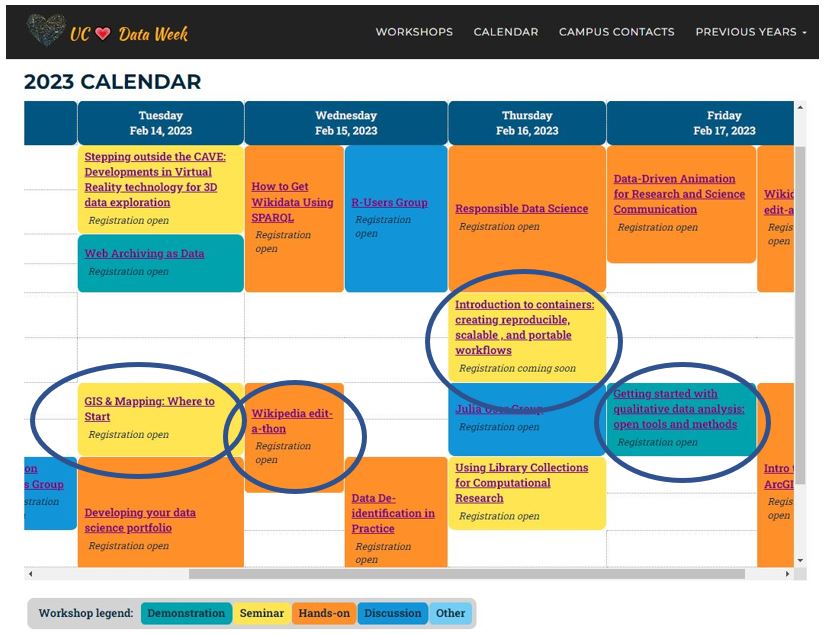
University of California 2023 Love Data Week calendar with UC Berkeley offerings

UC Berkeley Love Data Week offerings for 2023 include:

GIS & Mapping: Where to Start

Wikipedia Edit-a-thon (you can also dip into Wikidata at other LDW events)

Introduction to Containers

Textual Analysis with Archival Materials

Getting Started with Qualitative Data Analysis

All members of the UC community are welcome—we hope you will join us!  Registration links for our offerings are above, and the full UC-wide calendar is here.   If you are interested in learning more about what the library is doing with data, check out our new Data + Digital Scholarship Services page.  And, feel free to email us at librarydataservices@berkeley.edu.   Looking forward to data bonding next month!


Supporting open access book publishing at UC Berkeley: Winter 2023 update

The University of California continues to support a variety of ways UC authors can participate in open access publishing. At its heart, open access refers to the free, immediate, online availability of scholarship. Open access materials can be read and used by anyone, without any financial, legal, or technical barriers other than gaining access to the Internet. 

But you might be wondering, why is the University of California concerned about trying to make research more openly available and accessible? Well, one fundamental reason is that the research and teaching mission of the UC includes the aim of “transmitting advanced knowledge,” and as part of doing that, our faculty, researchers, and students create and share their scholarship. 

This system of scholarly publishing includes traditional or formal publications, such as peer-reviewed academic articles, scholarly chapters or books, and conference proceedings. It also includes emerging publications such as digital projects, data sets and visualizations, and working papers.

Support for Open Access Articles

UC offers a wide range of support to help authors publish scholarly articles. The UC’s Open Access Policies ensure that university-affiliated authors can deposit their final, peer-reviewed research articles into eScholarship, our institutional repository, immediately upon publication in a journal. Once they’re in eScholarship, the articles may be read by anyone for free.

The University of California has entered into 20+ transformative open access agreements or discount arrangements with scholarly publishers. These agreements permit UC corresponding authors to publish open access in covered journals, with the publishing fees being covered in part (or in full) by the UC. Last year there were 420 articles published open access by UC Berkeley authors under transformative open access agreements. 

Locally, the Library continues to offer the Berkeley Research Impact Initiative (BRII). This program helps UC Berkeley authors defray article processing charges (APCs) that are sometimes required to publish in fully open access journals (note that BRII doesn’t reimburse authors for publishing in “hybrid” journals—that is, subscription journals that simply offer a separate option to pay to make an individual article open access). This past year BRII provided funding for the publication of 75 open access journal articles. 

Support for Open Access Books

We know that not all University of California authors are publishing journal articles, and many disciplines—such as arts, humanities, and social sciences—focus on the scholarly monograph as the preferred mode of publishing. Some open access book publishers charge authors (or an author’s institution) a fee in exchange for publishing the book, similar to the practice of open access journal publishers charging an “author processing charge” to make a scholarly article open access. 

UC Berkeley is supporting authors who wish to publish their books open access. The library provides funding assistance and access to publishing platforms and tools for UCB authors to make their books open access. 

Berkeley Research Impact Initiative

Above we mentioned how the Berkeley Research Impact Initiative helps UC Berkeley authors publish articles in fully open access journals. BRII funding can also be used to help authors pay book processing charges (up to $10,000/book) so that their monographs can be published open access. In the last year, several UCB-authored books have been published open access in part due to BRII funding support. 

Springer 

In March 2021, UC Berkeley Library entered into an institutional open access book agreement with Springer Nature. The partnership provides open access funding to UC Berkeley affiliated authors who have books accepted for publication in Springer, Palgrave, and Apress imprints. This means that these authors can publish their books open access at no direct cost to them. The agreement covers all disciplines published by Springer. All the books are published under a Creative Commons Attribution license for free access and downloading. In the last year, several UCB-authored books have been published open access as a result of the UCB-Springer agreement. 

University of California Press

UC Berkeley Library continues to support open access book publishing via Luminos, the open access arm of the University of California Press. The Library membership with Luminos means that UC Berkeley authors who have books accepted for publication through the UC Press can publish their book open access with a heavily discounted book processing charge. When combined with additional funding support through BRII, a UC Berkeley book author could potentially publish their book open access with the costs being covered fully by the Library. Luminos books are published under Creative Commons licenses with free downloads.  

Pressbooks platform 

The UC Berkeley Library hosts an instance of Pressbooks, an online platform through which the UC Berkeley community can create open access books, open educational resources (OER), and other types of digital scholarship. In the last year, Christopher Jelen from the Department of Ancient Greek & Roman Studies published A Few Stories in Attic Greek: Adapted to Accompany Hansen & Quinn (11-20). The book is available under a Creative Commons Attribution-NonCommercial license.

Educational Workshops on open access book publishing

The Office of Scholarly Communication Services OSCS continues to offer a bi-annual Pressbooks workshop and demo where participants can learn how to navigate the platform and create and publish their own eBooks and open educational resources. (Note: the next Pressbooks workshop is coming up on February 8, 2023. Sign up now if you’re interested!)

Every year during the fall semester OSCS hosts an author panel to unpack the process of turning a dissertation into a book. One of the topics discussed during the panel are options for open access publishing. Here’s a recording of last year’s panel discussion. 

We also talked with an author about their experiences in publishing a book open access with Springer. 

UC supporting broader ecosystem of open access book publishing

At the systemwide level, the UC is supporting several open access book publishing ventures, including Opening the Future and the University of Michigan Press’ Fund to Mission. In general, these models secure investments from libraries or other stakeholders, and agree to publish some or all of their frontlist books open access, with limited or zero direct cost to the authors. The backlist books are made accessible to participating institutions. The UC has also supported projects such as the Open Library of Humanities, Knowledge Unlatched, the Directory of Open Access Books, Open Education Network, and other initiatives. 

Wrapping up

In this post, we highlighted several ways that the University of California—and specifically UC Berkeley—is supporting scholarly authors to create and share open access books. In addition to providing financial assistance, platforms, and publishing guidance, the Library is committed to promoting the broader OA book publishing ecosystem. We’ll continue to explore a variety of approaches to support the UC Berkeley community (and beyond) who wish to publish books on open access terms.

If you’re interested to learn more about how you can create and publish an open access book, visit our website or send an email to schol-comm@berkeley.edu.


Upcoming Workshop: Can I Mine That? Should I Mine That? A Clinic for Copyright, Ethics & More in TDM Research

computer keyboard and mouse with title of the Digital publishing Workshop Series

Workshop Date/Time: Wednesday, March 8, 2023, 11:00am–12:30pm

Register to receive Zoom link

If you are working on a computational text analysis project and have wondered how to legally acquire, use, and publish text and data, this workshop is for you! We will teach you 5 legal literacies (copyright, contracts, privacy, ethics, and special use cases) that will empower you to make well-informed decisions about compiling, using, and sharing your corpus. By the end of this workshop, and with a useful checklist in hand, you will be able to confidently design lawful text analysis projects or be well positioned to help others design such projects. Consider taking alongside Copyright and Fair Use for Digital Projects.

Please sign up today and join us online on March 8.


Upcoming Workshop: Publish Digital Books and Open Educational Resources with Pressbooks

computer keyboard and mouse with title of the Digital publishing Workshop Series

Workshop Date/Time: Wednesday, February 8, 2023, 11:00am–12:30pm

Register to receive Zoom link

If you’re looking to self-publish work of any length and want an easy-to-use tool that offers a high degree of customization, allows flexibility with publishing formats (EPUB, PDF), and provides web-hosting options, Pressbooks may be great for you. Pressbooks is often the tool of choice for academics creating digital books, open textbooks, and open educational resources, since you can license your materials for reuse however you desire. Learn why and how to use Pressbooks for publishing your original books or course materials. You’ll leave the workshop with a project already under way! Signup at the link above and the Zoom login details will be emailed to you.

Please sign up today and join us online on February 8.


Workshop Reminder—Copyright & Fair Use for Digital Projects

Presentation title slide with logo of the Office of Scholarly Communication Services and text as follows: "Copyright & Fair Use for Digital Projects"

Workshop Date/Time: Tuesday, November 8, 2022, 11:00am–12:30pm

RSVP for Zoom link

This training from the Library’s Office of Scholarly Communication Services will help you navigate the copyright, fair use, and usage rights of including third-party content in your digital project. Whether you seek to embed video from other sources for analysis, post material you scanned from a visit to the archives, add images, upload documents, or more, understanding the basics of copyright and discovering a workflow for answering copyright-related digital scholarship questions will make you more confident in your project. We will also provide an overview of your intellectual property rights as a creator and ways to license your own work.

Please sign up today and join us on November 8.


Workshop Reminder—How to Publish Open Access at UC Berkeley

Presentation title slide with Office of Scholarly Communication Services logo and following text: "How to Publish Open Access at UC Berkeley"

Workshop Date/Time: Tuesday, October 25, 2022, 11:00am–12:30pm

RSVP for Zoom link

Are you wondering what processes, platforms, and funding are available at UC Berkeley to publish your research open access (OA)? The Library’s Office of Scholarly Communication Services is hosting a workshop to provide practical guidance and walk you through all of the OA publishing options and funding sources you have on campus. We’ll explain: the difference between (and mechanisms for) self-depositing your research in the UC’s institutional repository vs. choosing publisher-provided open access; what funding is available to put toward your article or book charges if you choose a publisher-provided option; and the difference between funding coverage under the UC’s “transformative agreements” vs. the Library’s funding program (Berkeley Research Impact Initiative). We’ll also give you practical tips and tricks to maximize your retention of rights and readership in the publishing process.

Please sign up today and join us on October 25.


Event Reminder—From Dissertation to Book: Navigating the Publication Process

Slide with images, names, and titles of panel presenters, including Raina Polivka, Senior Editor for Music, Film, Media Studies, UC Press; Michael Rodríguez-Muñiz, Associate Professor, Sociology, UC Berkeley; Rachel Brooke, Senior Staff Attorney, Authors Alliance.

Panel Date/Time: Tuesday, October 18, 2022, 11:00am–12:30pm

RSVP for Zoom link

Are you a faculty member or student thinking about publishing a book based on your dissertation or other scholarship? The Library’s Office of Scholarly Communication Services is hosting a panel discussion with speakers who have generously agreed to share experiences and information on the process of publishing a scholarly book.

Joining us will be:

  • Raina Polivka, Senior Acquisitions Editor for Music, Cinema, and Media Studies at the University of California Press. She joined the UC Press in 2015 and acquires scholarly and general interest books in Music, Film, and Media Studies.
  • Michael Rodríguez-Muñiz, Associate Professor of Sociology, UC Berkeley. Before coming to Berkeley this fall, he taught sociology and Latino Studies at Northwestern University. Michael is the author of the recent book Figures of the Future: Latino Civil Rights and the Politics of Demographic Change. It’s an in-depth look at how U.S. Latino advocacy groups are using ethno-racial demographic projections to bring about political change in the present. Figures of the Future was published by Princeton University Press in 2021.
  • Rachel Brooke, Senior Staff Attorney at Authors Alliance. Authors Alliance is nonprofit organization which representing the interests of authors who want to take advantage of the digital age to share their creations with readers, promote the ongoing progress of knowledge, and advance the public good. Rachel has also worked as a literary agent in a small New York City agency.

Our goal with the conversation is to demystify the monograph publishing process, and to give participants practical advice on what it’ll take to revise your dissertation, how to develop a book proposal, tips for interacting with editors, how to address legal considerations, and much more.

Please sign up today and join us on October 18!


University of California Research Data Policy: a few things to know

University of California Research Data Policy: a few things to know

The University of California Office of the President recently announced an updated Research Data Policy, effective July 15, 2022. The new policy complements the original policy from 1958. It re-confirms that research data are owned by the University but outlines how University Researchers may use the data generated or collected in the course of their research. While most researchers likely will find that the updated policy doesn’t require a complete overhaul of their data stewardship practices, it’s important to understand key  terms, conditions, and permissions enabled by the new policy. The policy, however, will help them make decisions around management, retention, data publication, and data transfer. Implementation of this policy at a campus level is currently under development. Additional details are forthcoming.

A few key points: 

  • The Regents of the University of California own Research Data generated or collected in the course of University Research. 
    • Research Data include “recorded information embodying facts resulting from a scientific inquiry.” Research Data do not include scholarly & aesthetic works, informal notes, paper drafts, administrative or medical records, and other materials (see policy text for complete list).
    • University Research means “research conducted by a Principal Investigator or University Researcher that is within the course and scope of their assigned duties, uses University resources, and/or is funded by or through the University.”
  • University Researchers may use the Research Data they generate or collect in order to conduct other research, share with collaborators, publish outcomes, and create scholarly works. The University “supports the free and unfettered dissemination of information, knowledge, and discoveries generated by University Researchers.” As such:
    • Principal Investigators (PIs) are the stewards of Research Data, and maintain autonomy about which data should be preserved or dispositioned;
    • Researchers may share data as dictated by scholarly/disciplinary standards or data management plans, or legal, funder, or contractual requirements; 
    • When a University Researcher leaves the UC, they may take copies of the data they generated or collected, as long as it is approved by the PI;
    • Neither the University nor University Researchers may assert ownership of Research Data owned by third parties.


Resources and Assistance: 


Written by Tim Vollmer, Erin Foster, and Anna Sackmann


Fall 2022 copyright and publishing workshops with the Office of Scholarly Communication Services

Graphic of Office of Scholarly Communication Services logo with a textual list of Fall 2022 workshops

With the school year kicking off this week in Berkeley, the Office of Scholarly Communication Services is here to help UC Berkeley faculty, students, and staff understand copyright and scholarly publishing with online resources, Zoom workshops, and consultations.

Here’s what’s coming up this semester.

Workshops

Publish Digital Books & Open Educational Resources with Pressbooks

Date/Time: Tuesday, September 20, 2022, 11:00am–12:30pm
RSVP for Zoom link
If you’re looking to self-publish work of any length and want an easy-to-use tool that offers a high degree of customization, allows flexibility with publishing formats (EPUB, PDF), and provides web-hosting options, Pressbooks may be great for you. Pressbooks is often the tool of choice for academics creating digital books, open textbooks, and open educational resources, since you can license your materials for reuse however you desire. Learn why and how to use Pressbooks for publishing your original books or course materials. You’ll leave the workshop with a project already under way.

Copyright and Your Dissertation

Date/Time: Tuesday, September 27, 2022, 11:00am–12:30pm
RSVP for Zoom link 
This workshop will provide you with practical guidance for navigating copyright questions and other legal considerations for your dissertation or thesis. Whether you’re just starting to write or you’re getting ready to file, you can use our tips and workflow to figure out what you can use, what rights you have as an author, and what it means to share your dissertation online.

Managing and Maximizing Your Scholarly Impact

Date/Time: Tuesday, October 11, 2022, 11:00am–12:30pm
RSVP for Zoom link
This workshop will provide you with practical strategies and tips for promoting your scholarship, increasing your citations, and monitoring your success. You’ll also learn how to understand metrics, use scholarly networking tools, evaluate journals and publishing options, and take advantage of funding opportunities for Open Access scholarship.

From Dissertation to Book: Navigating the Publication Process

Date/Time: Tuesday, October 18, 2022, 11:00am–12:30pm 
RSVP for Zoom link
Hear from a panel of experts—an acquisitions editor, a first-time book author, and an author rights expert—about the process of turning your dissertation into a book. You’ll come away from this panel discussion with practical advice about revising your dissertation, writing a book proposal, approaching editors, signing your first contract, and navigating the peer review and publication process.

How to Publish Open Access at UC Berkeley

Date/Time: Tuesday, October 25, 2022, 11:00am–12:30pm
RSVP for Zoom link 
Are you wondering what processes, platforms, and funding are available at UC Berkeley to publish your research open access (OA)? This workshop will provide practical guidance and walk you through all of the OA publishing options and funding sources you have on campus. We’ll explain: the difference between (and mechanisms for) self-depositing your research in the UC’s institutional repository vs. choosing publisher-provided OA; what funding is available to put toward your article or book charges if you choose a publisher-provided option; and the difference between funding coverage under the UC’s “transformative agreements” vs. the Library’s funding program (Berkeley Research Impact Initiative). We’ll also give you practical tips and tricks to maximize your retention of rights and readership in the publishing process.

Copyright and Fair Use for Digital Projects

Date/Time: Tuesday, November 8, 2022, 11:00am–12:30pm
RSVP for Zoom link 
This training will help you navigate the copyright, fair use, and usage rights of including third-party content in your digital project. Whether you seek to embed video from other sources for analysis, post material you scanned from a visit to the archives, add images, upload documents, or more, understanding the basics of copyright and discovering a workflow for answering copyright-related digital scholarship questions will make you more confident in your project. We will also provide an overview of your intellectual property rights as a creator and ways to license your own work.

Other ways we can help

In addition to the workshops, we’re here to help answer a variety of questions you might have on intellectual property, digital publishing, and information policy. 

Want help or more information? Send us an email. We can provide individualized support and personal consultations, online class instruction, presentations and workshops for small or large groups & classes, and customized support and training for departments and disciplines.


UC Berkeley Library and Internet Archive co-directing project to help text data mining researchers navigate cross-border legal and ethical issues

We are excited to announce that the National Endowment for the Humanities (NEH) has awarded nearly $50,000 to UC Berkeley Library and Internet Archive to study legal and ethical issues in cross-border text data mining. The funding was made possible through NEH’s Digital Humanities Advancement Grant program

NEH funding for the project, entitled Legal Literacies for Text Data Mining – Cross Border (“LLTDM-X”), will support research and analysis to address law and policy issues faced by U.S. digital humanities practitioners whose text data mining research and practice intersects with foreign-held or -licensed content, or involves international research collaborations. 

LLTDM-X builds upon the highly successful Building Legal Literacies for Text Data Mining Institute (Building LLTDM), previously funded by the NEH in 2019. UC Berkeley Library directed Building LLTDM in June 2020, bringing together expert faculty from across the country to train 32 digital humanities researchers on how to navigate law, policy, ethics, and risk within text data mining projects. (All of the results and impacts are summarized in the white paper here.) 

In Building LLTDM’s instructional sessions and post-workshop evaluations, participants identified cross-border research collaborations as an ongoing and critical legal and policy problem, and they also noted that foreign law and ethics issues pervaded their research. UC Berkeley Library’s Office of Scholarly Communication Services partnered with Internet Archive to begin to address these essential needs, and LLTDM-X sprung to life.

Why is LLTDM-X needed?

Text data mining, or TDM, is an increasingly essential and widespread research approach. TDM relies on automated techniques and algorithms to extract revelatory information from large sets of unstructured or thinly-structured digital content. These methodologies allow scholars to identify and analyze critical social, scientific, and literary patterns, trends, and relationships across volumes of data that would otherwise be impossible to sift through.

While TDM methodologies offer great potential, they also present scholars with nettlesome law and policy challenges that can prevent them from understanding how to move forward with their research. Building LLTDM trained TDM researchers and professionals on essential principles of copyright, licensing, and privacy law, as well as ethics—thereby helping them move forward with impactful digital humanities research.

As Building LLTDM revealed, United States digital humanities scholars do not conduct text data mining research only in or about the U.S. Further, digital humanities research in particular is marked by collaboration across institutions and geographical boundaries. Yet, U.S. practitioners encounter expanding and increasingly complex cross-border problems. 

For example, U.S. contract law may supersede rights under copyright, such that a U.S. database license agreement may prohibit text data mining and other fair uses, whereas UK licenses cannot. Therefore U.S. TDM practitioners collaborating with UK-based colleagues face impactful choices about which agreements to apply, as this may determine whether text data mining is permitted. In the U.S., “breaking” technological protection measures to conduct text data mining is now authorized within certain parameters, yet other jurisdictions prohibit such work or apply different conditions. U.S. text data mining researchers must accordingly consider how they work with internationally-held or -licensed materials or collaborators. 

There are at least three such “cross-border” TDM scenarios that scholars must parse, including: (i) if the materials they want to mine are housed in a foreign jurisdiction, or are otherwise subject to foreign database licensing or laws; (ii) if the human subjects they are studying or who created the underlying content reside in another country; or, (iii) if the colleagues with whom they are collaborating reside abroad, yielding uncertainty about which country’s laws, agreements, and policies apply. These may collectively be considered the “cross-border” TDM scenarios.

U.S. researchers are uncertain about how to navigate each of these scenarios. As evidenced in an informal survey that we conducted with digital humanities scholars, 70% of respondents reported cross-border copyright questions, 72% reported uncertainty about cross-border licensing terms, 52% noted privacy issues, and 48% identified ethical concerns. This confusion greatly impacted their TDM research. Twenty-eight percent (28%) of respondents confirmed that these cross-border copyright, licensing, privacy, or ethical issues impeded or prevented their project entirely. Of equal concern is that 40% of responding practitioners reported hesitation to share their workflows, methodology, or sources because of possible cross-border LLTDM issues. Without transparency, findings are deemed unreliable and scholarship may be rejected for publication. These problems will only mount given the increasing collaborativeness of research and the substantial amount of cross-border research occurring.

How will LLTDM-X help the world? 

Our long-term goal is to design instructional materials and institutes to support digital humanities TDM scholars facing cross-border issues, but our first step with LLTDM-X is getting a better handle on the specific law and policy challenges they face.

Through a series of virtual roundtable discussions, and accompanying legal research and analysis, LLTDM-X will surface these cross-border issues and begin to distill preliminary guidance to help scholars in navigating them. 

The first roundtable will engage U.S. digital humanities text data mining practitioners in sharing their cross-border TDM experiences. U.S. and global law and ethics experts will help guide the roundtable discussion to elicit the contours of practitioner experiences. During two subsequent roundtables—one focusing on cross-border copyright and licensing, and another on cross-border privacy and ethics—the experts will discuss practitioners’ hurdles in depth, and begin to develop customized guidance. 

After the roundtables, we will work with the law and ethics experts to create instructive case studies that reflect the types of cross-border TDM issues practitioners encountered. These case studies will incorporate recommendations to help a broad audience of U.S. digital humanities text data mining practitioners navigate LLTDM-X concerns. Case studies, guidance, and recommendations will be widely-disseminated via an open access report to be published at the completion of the project. And most importantly, they will be used to inform our future educational offerings.

An experienced team

The team for LLTDM-X (introduced below) is eager to get started. The project is co-directed by Thomas Padilla, Deputy Director, Archiving and Data Services at Internet Archive. 

LLTDM-X responds strategically to a pervasive challenge that needlessly complicates, inhibits, and weakens the fullest potential of research. This work paves a critical path toward building future training institutes that address cross-border legal issues in TDM. At Internet Archive we’re committed to supporting universal access to all knowledge—LLTDM-X couldn’t be more clearly aligned with what we hope to achieve. We look forward to working with our partners at UC Berkeley Library and the wider community to advance this work.”

Rachael Samberg, who leads UC Berkeley Library’s Office of Scholarly Communication Services and oversaw Building LLTDM, joins Thomas as co-director and explains that: 

“We are ready to begin analyzing and sorting out the complex legal challenges for digital humanities TDM researchers. We’ve already secured an incredible group of international legal and ethics experts to conduct the analyses, and will share more on that soon. In the meantime, we are gearing up to build out an even larger group of participating scholars whose experiences will help us create case studies.”

On behalf of the entire project team, we would like to thank NEH’s Office of Digital Humanities again for funding this important work. We invite you to contact us with any questions you may have. 

Thomas Padilla (Project Director): Thomas is Deputy Director, Archiving and Data Services at Internet Archive, and has deep experience cultivating library, archive, and museum ability to support TDM research. He has previously served as Principal Investigator of the Andrew W. Mellon supported Collections as Data: Part to Whole, the Institute of Museum and Library Services supported, Always Already Computational: Collections as Data, and as author of the library community research agenda, Responsible Operations: Data Science, Machine Learning, and AI in Libraries. In addition, Padilla was an expert faculty for Building LLTDM, the precursor to LLTDM-X.

Rachael Samberg (Project Co-Director): Rachael is Scholarly Communication Officer & Program Director of the University of California, Berkeley Library’s Office of Scholarly Communication Services. She served as Project Director and legal expert for Building LLTDM. A Duke Law graduate, Rachael practiced intellectual property litigation at Fenwick & West LLP for seven years before spending six years at Stanford Law School’s library, where she was Head of Reference & Instructional Services and a Lecturer in Law. Rachael speaks throughout the country about copyright and TDM issues, about which she is widely published. Her chapter, Law & Literacy in Non-Consumptive Text Mining, was published in Copyright Conversations (ALA, 2019).

Stacy Reardon (Project Team Member): Stacy Reardon is Literatures and Digital Humanities Librarian at the University of California, Berkeley Library, where she provides guidance and instruction on digital humanities projects and methods. Stacy served as a library expert on the Project Team for the NEH-funded Building Legal Literacies for Text Data Mining. She is co-chair of the UC Berkeley’s Digital Humanities Working Group, and received her Ph.D. in literature from the University of Massachusetts, Amherst.

Timothy Vollmer (Project Manager): Timothy Vollmer is Scholarly Communication and Copyright Librarian at UC Berkeley Library. He served as Project Manager for the NEH-funded Building Legal Literacies for Text Data Mining. Tim worked as a senior public policy manager for Creative Commons, and contributed to writing and advocacy on the text data mining exceptions in the EU’s Directive on Copyright in the Digital Single Market. He formerly was the Assistant Director to the Program on Public Access to Information at the American Library Association.