This post was written by Tim Vollmer, Anna Sackmann, and Elliott Smith
U.S. Federal agency logos, public domain.
Are you a UC Berkeley faculty or researcher publishing results arising through federal grant funding?
Starting in 2026, research funded by all federal agencies will be made freely and immediately available to the public, with no embargo. Some agencies have already updated their public access plans, including the National Institutes of Health, which went into effect on July 1, 2025. All federal agencies must update their public access policies no later than December 31st, 2025.
Join UC Berkeley Library staff on Wednesday, January 14, 2026 from 1:00-2:00 pm on Zoom for an overview of federal agency public access policies affecting research publication and data, and what you need to do as an author.
We’ll cover essential requirements for a variety of federal agency funders such as the Department of Energy, National Institutes of Health, National Science Foundation, and more. We’ll unpack publication and data deposit procedures, review publisher challenges to compliance, and highlight related UC open access publishing support.
Participants will leave with clear takeaways on what they need to do to meet public access requirements, the tools they can utilize, and where to find ongoing support.
The workshop presentation will be recorded and distributed to registrants afterward.
Hear from a panel of experts—an acquisitions editor, a first-time book author, and an author rights expert—about the process of turning your dissertation into a book. You’ll come away from this panel discussion with practical advice about revising your dissertation, writing a book proposal, approaching editors, signing your first contract, and navigating the peer review and publication process.
As UC Berkeley’s new academic year gets underway, the Library’s Scholarly Communication & Information Policy office stands ready to guide faculty, students, and staff through the complexities of copyright law and academic publishing. Through digital resources, virtual workshops, and one-on-one consultations, we’re excited to share what this semester has in store.
Workshops
Copyright and Your Dissertation
Date/Time: Tuesday, September 16, 2025, 11:00am–12:00pm RSVP to get the Zoom link
This workshop will provide you with practical guidance for navigating copyright questions and other legal considerations for your dissertation or thesis. Whether you’re just starting to write or you’re getting ready to file, you can use our tips and workflow to figure out what you can use, what rights you have as an author, and what it means to share your dissertation online.
Managing and Maximizing Your Scholarly Impact
Date/Time: Tuesday, October 14, 2025, 11:00am–12:00pm RSVP to get the Zoom link
This workshop will provide you with practical strategies and tips for promoting your scholarship, increasing your citations, and monitoring your success. You’ll also learn how to understand metrics, use scholarly networking tools, and evaluate journals and publishing options.
From Dissertation to Book: Navigating the Publication Process
Date/Time: Tuesday, November 18, 2025 (11:00am–12:30pm) RSVP to get the Zoom link
Hear from a panel of experts—an acquisitions editor, a first-time book author, and an author rights expert—about the process of turning your dissertation into a book. You’ll come away from this panel discussion with practical advice about revising your dissertation, writing a book proposal, approaching editors, signing your first contract, and navigating the peer review and publication process.
Other ways we can help you
In addition to the workshops, we’re here to help answer a variety of questions you might have on intellectual property, digital publishing, and information policy.
Have a question about copyright and artificial intelligence (AI) in relation to research and scholarship? Or your rights and responsibilities in using library-licensed materials for AI use? View the AI page on our website for guidance.
Interested in publishing your research open access? UCB Library can help defray the costs of an article processing charge (up to $2,500) or book processing charge (up to $10,000). See the Berkeley Research Impact Initiative (BRII) for more information. And explore the various UC-wide open access agreements and discounts that can help UC corresponding authors publish their scholarship open access.
Do you want to create an open digital textbook? Take a look at UC Berkeley’s Open Book Publishing platform (anyone with a @berkeley.edu email can sign up for a free account).
Keep an eye on the Library’s events calendar for more workshops and trainings.
Want help or more information? Send us an email at schol-comm@berkeley.edu. We can provide individualized support and personal consultations, online class instruction, presentations and workshops for small or large groups & classes, and customized support and training for departments and disciplines.
If you receive funding from the National Institutes of Health (NIH), a recent policy update will impact how you publish and share your research.
Beginning on July 1, 2025, all author accepted manuscripts (defined below) accepted for publication in a journal must be submitted to PubMed Central (PMC), and will be made publicly available at the same time that the article is officially published, with no embargo allowed. The NIH’s 2024 Public Access Policy replaces the 2008 policy that permitted up to a 12-month embargo on public access.
Does the NIH Public Access Policy apply to you?
If your publication results from any NIH funding, including 1) grants or cooperative agreements (including training grants), 2) contracts, 3) other transactions, 4) NIH intramural research, or 5) NIH employee work, then the NIH public access policy applies to you.
What do you need to do?
The author accepted manuscript (AAM) must be deposited in the NIH Manuscript Submission System immediately upon acceptance in a journal. The AAM is “the author’s final version that has been accepted for journal publication and includes all revisions resulting from the peer review process, including all associated tables, graphics, and supplemental material.” The updated NIH Public Access Policy echoes the 2008 policy in that deposit compliance is generally achieved through submission of the AAM by the author or author’s institution to PubMed Central.
AAMs will be made publicly available in PubMed Central (NIH’s repository) on the official date of publication in the journal, with no embargo period.
According to the supplemental guidance on the Government Use License and Rights, accepting NIH funding means granting NIH a nonexclusive license to make your author accepted manuscript publicly available in PubMed Central. Authors are required to agree to the following terms:
“I hereby grant to NIH, a royalty-free, nonexclusive, and irrevocable right to reproduce, publish, or otherwise use this work for Federal purposes and to authorize others to do so. This grant of rights includes the right to make the final, peer-reviewed manuscript publicly available in PubMed Central upon the Official Date of Publication.”
The supplemental guidance also recommends that grantees should consider including the following NIH-recommended language in your manuscript submission to journals:
“This manuscript is the result of funding in whole or in part by the National Institutes of Health (NIH). It is subject to the NIH Public Access Policy. Through acceptance of this federal funding, NIH has been given a right to make this manuscript publicly available in PubMed Central upon the Official Date of Publication, as defined by NIH.”
Will I be charged for publishing the AAM open access?
Depositing the AAM in PMC is free and fulfills your public access compliance obligations under the NIH Policy. (Note: Berkeley authors are also asked to submit the AAM to eScholarship to fulfill their obligations under the UC’s Open Access Policy.)
Authors are not required to pay an article processing charge (APC) to comply with this policy. However, the journal in which you are publishing may separately wish to charge you an APC for publishing open access through their own platform. You may be eligible to allocate some of your NIH grant funds to cover the journal’s APC. NIH has provided supplemental guidance regarding allowable publishing costs to include in NIH grants. In addition, the University of California continues to support publishing through open access publishing agreements. Through these and other local programs such as the Berkeley Research Impact Initiative, UC Berkeley authors have options for open access publishing with the UC Libraries covering some or all of the associated publishing fees. For questions about open access publishing options, please contact schol-comm@berkeley.edu.
What about data?
The NIH’s updated Public Access Policy combines with the already-in-place Data Management and Sharing Policy. That policy says that all NIH funded research that generates scientific data requires the submission of a Data Management and Sharing Plan as part of the grant proposal.
There is an expectation for researchers to maximize appropriate data sharing in established repositories. Data should be made accessible as soon as possible, and no later than the time of the associated publication or end of award, whichever comes first.
Where can I learn more?
Join UC Berkeley Library staff on Tuesday, June 10, 2025 from 1:00-2:00 pm on Zoom for an overview of the NIH Public Access Policy changes. The presentation will cover the key updates that take effect on July 1, 2025, including the mandatory manuscript submission to PubMed Central, how to navigate acknowledgement requirements, copyright and licensing, and the NIH data sharing requirements. You will also learn how the Library and other units on campus can provide ongoing support with the new policy. All registrants will receive a link to a recording of the session.
Do you have specific questions? Reach out to Anna, Elliott, or Tim.
The Scholarly Communication & Information Policy (SCIP) office is pleased to announce the release of our Oral History Agreement Toolkit—a collection of templates, guidance documents, and resources that we created to help institutions approach oral history agreements.
The Oral History Center participated in the process to help SCIP to develop this toolkit. These agreements were developed specifically to meet the legal requirements of UC Berkeley. For guidance on letters of consent and legal agreements more broadly, especially for independent oral historians, please consult the Oral History Association’s best practices.
Why We Created This Toolkit
Over the past two years, SCIP worked to improve oral history agreements in ways that we believe:
Resolve the “version of record” as between edited and unedited audio and transcripts
Ensure consistency in representations to narrators, by having an integrated agreement
Address privacy and defamation
Standardize terms
Define use and access rights by the institution in the event that narrators pass away or disengage after completing the interviews
Resolve ambiguities for downstream granting of usage permission and licenses by the institution
Generally speaking, past approaches to oral history agreements have often created an imbalance between narrators and institutions. Our new toolkit addresses this by:
Centering narrator agency and control over their stories and how they’re shared;
Improving rights administration for libraries and oral history programs;
Providing clear, accessible language to explain complex legal concepts; and
Creating flexibility through multiple agreement options that accommodate diverse needs.
SCIP created both of these documents as training materials we presented to the UC Berkeley Oral History Center, but we believe they may be adapted, repurposed, and improved upon by other institutions.
The “Talking Points for Conversations” document is really the leading tool here, and includes:
Agreement templates: Customizable templates covering a variety of narrator needs and signing scenarios (e.g. signing before the interview, signing after the interview, funded oral histories, deceased narrators, etc.);
Explanatory Materials: Detailed talking points to help oral historians explain each clause in plain language;
FAQs: Addressing common questions, including specific concerns for historically marginalized communities; and
Sample Scenarios: Real-world examples showing how the agreements work in practice.
Key Benefits for Narrators
The template agreements protect narrators by ensuring they:
Can review and correct transcripts before finalization
May withdraw participation at any point before final approval
Can restrict access to sensitive portions for specified time periods
Retain the right to use their own stories regardless of copyright decisions
Can request removal of identifying information about third parties
Have clarity about their rights and responsibilities
Enhancing Institutional Practice
For libraries and oral history programs, the toolkit helps:
Establish clear legal frameworks for rights management
Reduce risk related to third-party claims
Create flexible options for different interview scenarios and signing preferences
Provide consistent language for explaining agreements to narrators
Address complex situations like posthumous agreements and funded projects
Accommodating Narrator Requests for Modifications
A key principle underlying this toolkit is flexibility. The agreements can be modified to better reflect narrators’ comfort levels and preferences. If a narrator requests changes to the standard terms (additions, deletions, etc.), you can consider whether you are able to accommodate those requests.
In our case, we outline our own processes for:
Modifications: Changes requested before signing
Amendments: Changes requested after signing, including rights and embargo selections and substantive term modifications
Customization Is Expected and Encouraged
We recognize that institutions have diverse practices and needs. And we do not expect that these templates or materials will work for everyone!
In addition, institutions must make policy decisions even if they decide to utilize these materials. For instance, what range of embargo time periods are you willing to offer? Do you want to allow narrators to redact information once they’ve shared it? How do you wish to convey or encourage Creative Commons licensing options?
The toolkit is designed merely as a foundation—a starting point for important conversations about reforming oral history practices at your institution. We encourage programs to:
Review the materials with institutional stakeholders, including legal counsel
Adapt the templates to align with your specific circumstances and policies
Use the talking points as a basis for developing your own communication strategies
Consider the sample scenarios as illustrations rather than prescriptive examples
Getting Started
We invite you to explore these resources and consider how they might enhance administration of your oral history agreements. We believe the toolkit offers valuable perspectives on balancing ethical responsibilities to narrators with practical institutional needs.
As you begin to use these materials, we welcome your feedback at schol-comm@berkeley.edu. Your experiences and insights will help us continue to refine these resources to better serve the oral history community.
The Scholarly Communication & Information Policy (SCIP) office provides guidance on copyright, publishing, and information policy matters to support the research and teaching mission of our institution.
With the spring semester kicking off, the Library’s Scholarly Communication & Information Policy office is here to help faculty, students, and staff understand copyright and scholarly publishing with online resources, Zoom workshops, and consultations. Read on below for a quick update.
Workshops
Publish Digital Books & Open Educational Resources with Pressbooks
If you’re looking to self-publish work of any length and want an easy-to-use tool that offers a high degree of customization, allows flexibility with publishing formats (EPUB, PDF), and provides web-hosting options, Pressbooks may be great for you. Pressbooks is often the tool of choice for academics creating digital books, open textbooks, and open educational resources, since you can license your materials for reuse however you desire. Learn why and how to use Pressbooks for publishing your original books or course materials. You’ll leave the workshop with a project already under way.
Are you wondering what processes, platforms, and funding are available at UC Berkeley to publish your research open access (OA)? This workshop will provide practical guidance and walk you through all of the OA publishing options and funding sources you have on campus. We’ll explain: the difference between (and mechanisms for) self-depositing your research in the UC’s institutional repository vs. choosing publisher-provided OA; what funding is available to put toward your article or book charges if you choose a publisher-provided option; and the difference between funding coverage under the UC’s systemwide OA agreements vs. the Library’s funding program (Berkeley Research Impact Initiative). We’ll also give you practical tips and tricks to maximize your retention of rights and readership in the publishing process.
Other ways we can help you
In addition to the workshops, we’re here to help answer a variety of questions you might have on intellectual property, digital publishing, and information policy.
Have a question about copyright and artificial intelligence (AI) in relation to research and scholarship? Or your rights and responsibilities in using library-licensed materials for AI use? View the AI page on our website for guidance.
Interested in publishing your research open access? UCB Library can help defray the costs of an article processing charge (up to $2,500) or book processing charge (up to $10,000). See the Berkeley Research Impact Initiative (BRII) for more information. And explore the various UC-wide open access agreements and discounts that can help UC corresponding authors publish their scholarship open access.
Do you want to create an open digital textbook? Take a look at UC Berkeley’s Open Book Publishing platform (anyone with a @berkeley.edu email can sign up for a free account), and get in touch with us about our Open Educational Resources (OER) grant program.
Keep an eye on the Library’s events calendar for more workshops and trainings.
Want help or more information? Send us an email at schol-comm@berkeley.edu. We can provide individualized support and personal consultations, online class instruction, presentations and workshops for small or large groups & classes, and customized support and training for departments and disciplines.
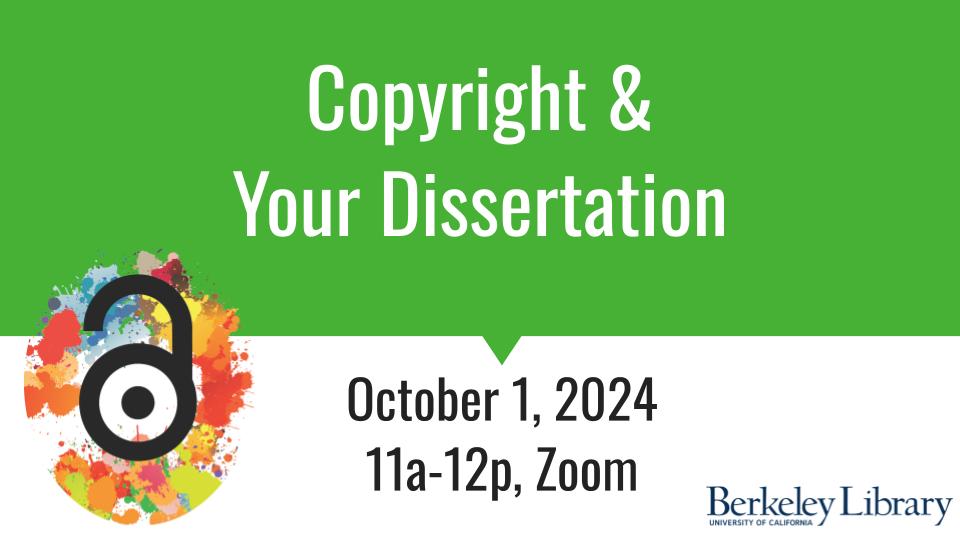
Date/Time: Tuesday, October 1, 2024, 11:00am–12:00pm Location: Zoom. RSVP.
This workshop will provide you with practical guidance for navigating copyright questions and other legal considerations for your dissertation or thesis. Whether you’re just starting to write or you’re getting ready to file, you can use our tips and workflow to figure out what you can use, what rights you have as an author, and what it means to share your dissertation online.
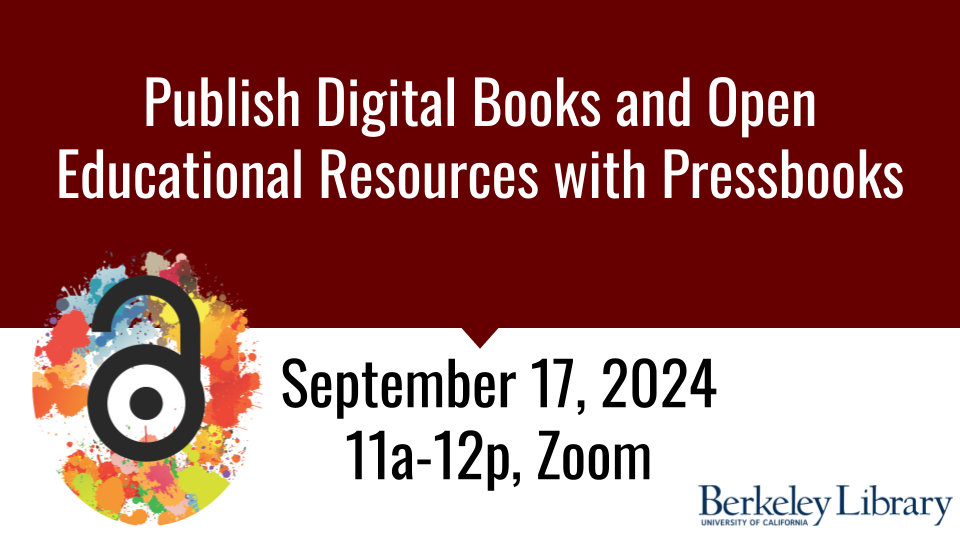
Date/Time: Tuesday, September 17, 2024, 11:00am–12:00pm Location: Zoom. RSVP.
If you’re looking to self-publish work of any length and want an easy-to-use tool that offers a high degree of customization, allows flexibility with publishing formats (EPUB, PDF), and provides web-hosting options, Pressbooks may be great for you. Pressbooks is often the tool of choice for academics creating digital books, open textbooks, and open educational resources, since you can license your materials for reuse however you desire. Learn why and how to use Pressbooks for publishing your original books or course materials. You’ll leave the workshop with a project already under way.
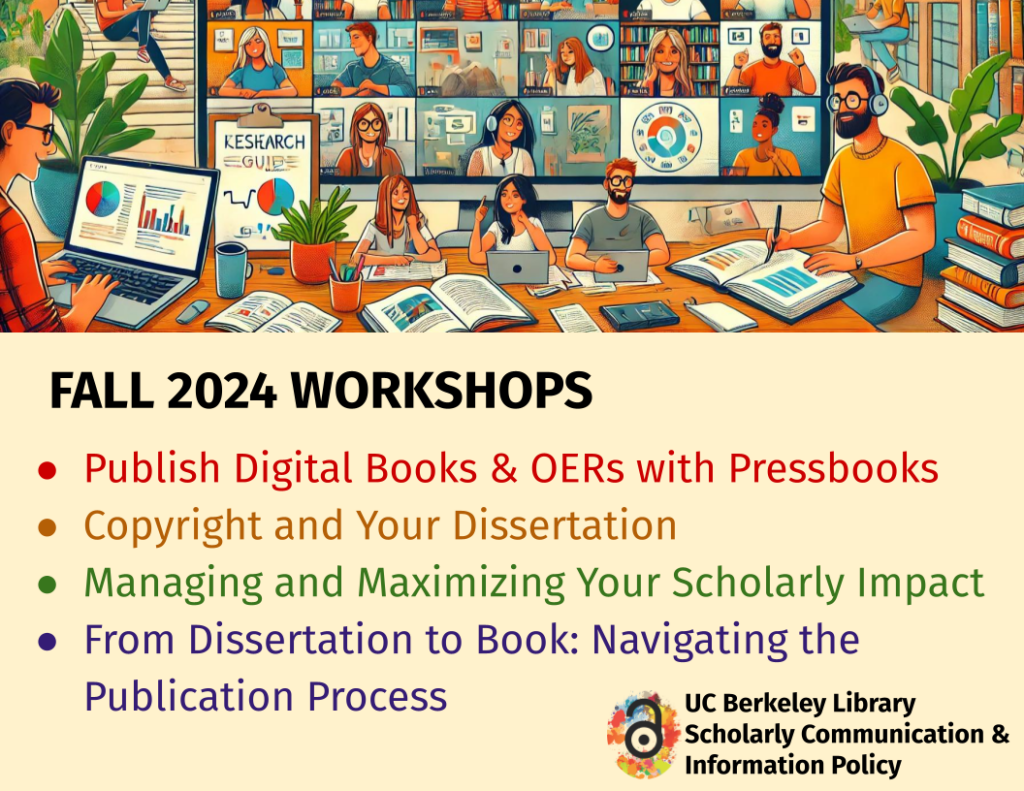
With the school year kicking off at UC Berkeley, the Library’s Scholarly Communication & Information Policy office is here to help faculty, students, and staff understand copyright and scholarly publishing with online resources, Zoom workshops, and consultations. Here’s what’s coming up this semester.
Workshops
Publish Digital Books & Open Educational Resources with Pressbooks
Date/Time: Tuesday, September 17, 2024, 11:00am–12:00pm. RSVP to get the Zoom link
If you’re looking to self-publish work of any length and want an easy-to-use tool that offers a high degree of customization, allows flexibility with publishing formats (EPUB, PDF), and provides web-hosting options, Pressbooks may be great for you. Pressbooks is often the tool of choice for academics creating digital books, open textbooks, and open educational resources, since you can license your materials for reuse however you desire. Learn why and how to use Pressbooks for publishing your original books or course materials. You’ll leave the workshop with a project already under way.
Copyright and Your Dissertation
Date/Time: Tuesday, October 1, 2024, 11:00am–12:00pm. RSVP to get the Zoom link
This workshop will provide you with practical guidance for navigating copyright questions and other legal considerations for your dissertation or thesis. Whether you’re just starting to write or you’re getting ready to file, you can use our tips and workflow to figure out what you can use, what rights you have as an author, and what it means to share your dissertation online.
Managing and Maximizing Your Scholarly Impact
Date/Time: Tuesday, October 15, 2024, 11:00am–12:00pm RSVP to get the Zoom link
This workshop will provide you with practical strategies and tips for promoting your scholarship, increasing your citations, and monitoring your success. You’ll also learn how to understand metrics, use scholarly networking tools, and evaluate journals and publishing options.
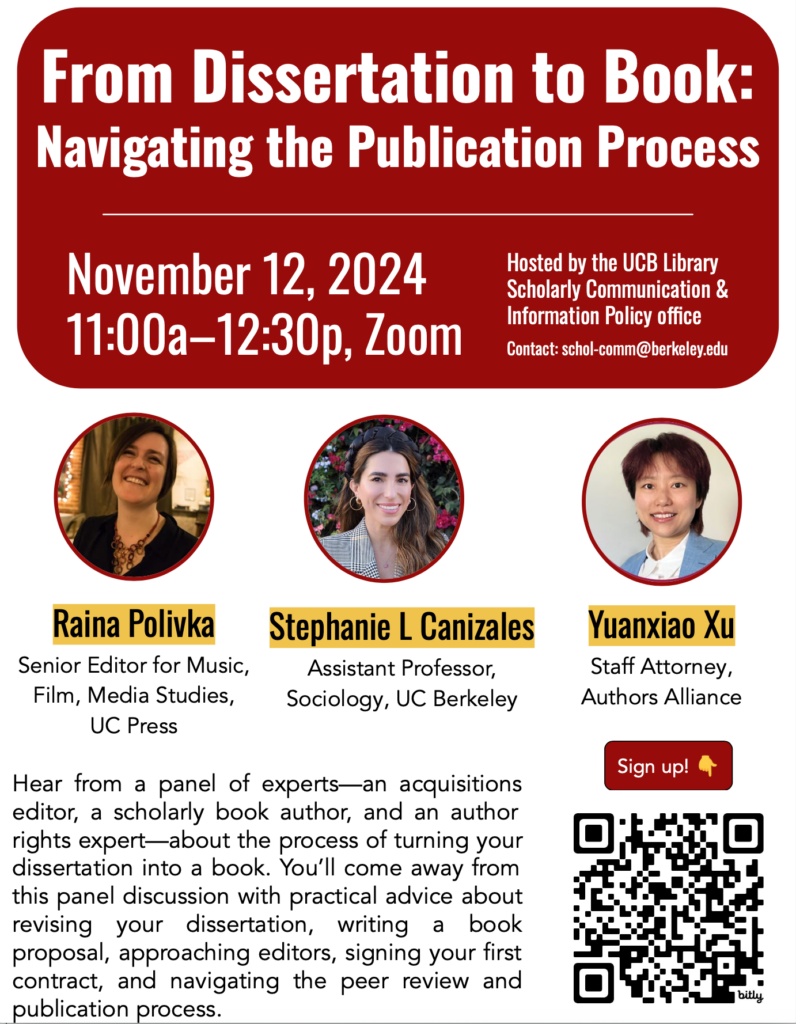
From Dissertation to Book: Navigating the Publication Process
Date/Time: Tuesday, November 12, 2024, 11:00am–12:30pm RSVP to get the Zoom link
Hear from a panel of experts—an acquisitions editor, a first-time book author, and an author rights expert—about the process of turning your dissertation into a book. You’ll come away from this panel discussion with practical advice about revising your dissertation, writing a book proposal, approaching editors, signing your first contract, and navigating the peer review and publication process.
Other ways we can help you
In addition to the workshops, we’re here to help answer a variety of questions you might have on intellectual property, digital publishing, and information policy.
Have a question about copyright and artificial intelligence (AI) in relation to research and scholarship? Or your rights and responsibilities in using library-licensed materials for AI use? View the AI page on our website for guidance.
Interested in publishing your research open access? UCB Library can help defray the costs of an article processing charge (up to $2,500) or book processing charge (up to $10,000). See the Berkeley Research Impact Initiative (BRII) for more information. And explore the various UC-wide open access agreements and discounts that can help UC corresponding authors publish their scholarship open access.
Do you want to create an open digital textbook? Take a look at UC Berkeley’s Open Book Publishing platform (anyone with a @berkeley.edu email can sign up for a free account), and get in touch with us about our Open Educational Resources (OER) grant program.
Keep an eye on the Library’s events calendar for more workshops and trainings.
Want help or more information? Send us an email at schol-comm@berkeley.edu. We can provide individualized support and personal consultations, online class instruction, presentations and workshops for small or large groups & classes, and customized support and training for departments and disciplines.
In the ever-evolving landscape of digital access to scholarly research, libraries face new challenges as they navigate the intersection of copyright law and contractual agreements. Academic institutions increasingly rely on digital content, and understanding how copyright exceptions and contract law interact is crucial for protecting the rights of libraries and our users.
Tim Vollmer (Scholarly Communication & Copyright Librarian, UC Berkeley), Sara Benson (Copyright Librarian and Associate Professor, University of Illinois-Urbana Champaign), Jonathan Band (copyright attorney and counsel to the Library Copyright Alliance), and Jim Neal (University Librarian Emeritus, Columbia University) presented on these issues at the 2024 American Library Association Annual Conference in San Diego. Our panel was titled When Copyright and Contracts Collide: Advocacy for Library and User Rights.
The Role of Copyright Exceptions
Sara set the stage for our discussion by describing the importance of limitations and exceptions to copyright that empower libraries, research, and teaching. For example, Section 108 of the U.S. Copyright Act allows libraries and archives to make limited copies of copyrighted materials for preservation, replacement, fulfilling interlibrary loan requests, and more. Fair use—Section 107 of the Act—permits limited use of copyrighted works without having to seek the copyright holder’s permission when the use is for purposes such as teaching, research, scholarship, reporting, criticism, or parody. Faculty, students, and academic authors leverage fair use when they incorporate copyrighted materials for teaching, research, and publishing. And the fair use exception has played an increasingly important role in facilitating new types of scholarly research, including text and data mining.
The Threat of Contractual Override
Despite these protections, contractual agreements can sometimes override copyright exceptions. Vendor licensing terms may include clauses that restrict activities such as text and data mining. And even though fair use is a statutory right (meaning it’s in the law) in the U.S., and even though there have been court cases that confirm that activities such as text data mining falls under fair use, there is no protection against the practice where private parties such as academic publishers “contract around” fair use for actions that already are lawful.
As a result, academic libraries are forced to negotiate and often pay significant sums each year to try to preserve fair use rights for campus scholars through the database and electronic content license agreements that they sign.
Jonathan discussed alternative international approaches to the problem of contractual override. The European Union, for example, has implemented directives that nullify contract terms which override specific copyright exceptions. Countries like Australia, New Zealand, and Norway have also adopted similar measures. However, the United States and Canada lack comprehensive contract override prevention laws, making it challenging to protect copyright exceptions at the national level.
Advocating for Fair Contracts in Library Licensing
Tim discussed how academic libraries are demanding license agreements that preserve fair use rights. But at the same time, libraries are already starting to see contract amendments put forth by scholarly publishers that attempt to impose outright bans on any use of artificial intelligence (AI) tools for the content we’re licensing from them. The challenge is that we know that researchers are using library-licensed materials for many AI uses in the context of nonprofit scholarship and research, and these uses should be a fair use, just as it’s fair use for researchers to conduct text data mining on licensed resources.
Library workers can smartly negotiate to protect the rights of instructors, students, and other academic community members to use library-licensed resources in the ways they need to conduct their teaching and research while simultaneously taking into consideration the concerns of publishers.
Moving Forward: A Coordinated Approach
To address the issue of contractual override, Jim suggested several approaches, including educating library stakeholders such as administrators and faculty, building constructive relationships with publishers, monitoring international developments, and pursuing legislative change to protect copyright exceptions.
The University of California Libraries are already collaborating on this and related issues with our colleagues. After outreach to several library and faculty committees, the UC’s Academic Senate sent a letter to UC President Michael Drake to advocate that the UC Libraries need to be able to negotiate to preserve fair use rights when licensing electronic resources—including the rights to conduct computational research and utilize AI tools in academic studies and scholarship. President Drake and UC System Provost and Executive Vice President for Academic Affairs Katherine S. Newman affirmed this commitment.
Please reach out to schol-comm@berkeley.edu with any questions. For more information, please see the links below.