
Senga Nengudi: Black Avant-Garde Visual and Performance Artist

As a continuation of our work for the Getty Research Institute’s African American Art History Initiative (AAAHI), Dr. Bridget Cooks and I conducted several oral history interviews with the avant-garde artist Senga Nengudi. This interview is one of several AAAHI oral histories exploring the lives and work of Los Angeles-based artists, and highlights Nengudi’s contributions to visual and performance art.
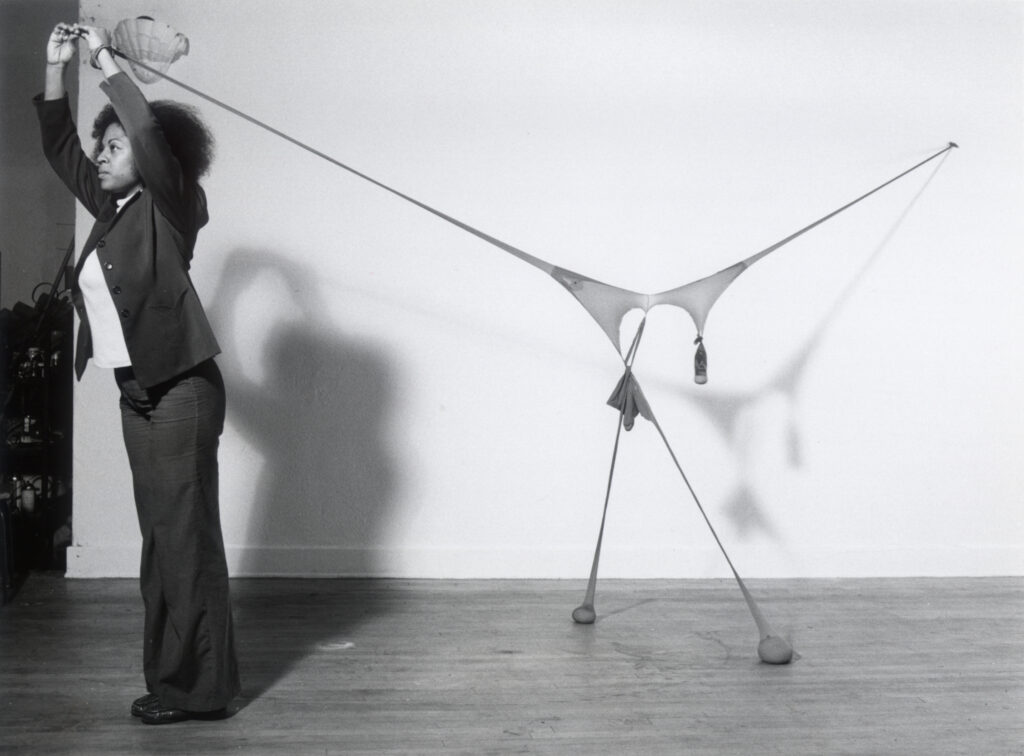
Senga Nengudi and her pantyhose sculptures.
Senga Nengudi setting up for a performance with R.S.V.P. X, 1976. Senga Nengudi Papers, Amistad Research Center, New Orleans. © Senga Nengudi.

Senga Nengudi is an avant-garde artist best known for her abstract sculpture and performance art. Nengudi was born in Chicago, Illinois, in 1943 and moved to Los Angeles, California, at a young age. She attended California State University, Los Angeles (CSULA) for both her undergraduate and master’s work, as well as completed a program at Waseda University in Tokyo, Japan. Nengudi was active in the avant-garde Black art scenes in Los Angeles and New York during the 1960s and 1970s, and was a member of the Studio Z Collective. She is best known for her R.S.V.P. (Répondez s’il vous plaît) Series featuring pantyhose, which she began in 1975. Nengudi is the recipient of many awards, including the Louis Comfort Tiffany Foundation Award in 2005, the Anonymous Was a Woman Award in 2005, the Denver Art Museum Key Award in 2019, and was elected as a member to the American Academy of Arts and Sciences in 2020. Find this interview and all our oral histories from the search feature on our home page. You can search by name, key word, and several other criteria.

Senga Nengudi was still in elementary school when she and her mother moved to Los Angeles in the early 1950s. Despite a brief stint in New York, for more than thirty years she lived in the greater Los Angeles area first as a child; as a student at CSULA; as an artist and active member of the Studio Z Collection; and as a young mother. That Nengudi called Los Angeles home for so long meant that her formative years of creative expression and early artistic networks sprang from the Southland. 

Looking back, Nengudi credits her mother with providing a creative foundation.

“…she was very, very, very conscious of the home and making something home, and so she would decorate the house. And then, say like three years later, she would repaint the walls, she would change the upholstery, she would do all those kinds of things. She was very aesthetically aware, as well as needed a particular beauty in her home to feel good.”

And Nengudi expressed her own creativity through several outlets, remembering, “It’s always been a deal between art and dance with me…” Indeed, during her undergraduate years at CSULA, she chose to major in art and minor in dance—a pairing which supports much of her work.

In the mid-1970s, Nengudi found an outlet to express her love of performance through the Studio Z Collective—a collective of artists interested in improvisation that continued into the 1980s. In addition to Nengudi, Studio Z was comprised of Houston Conwill, David Hammons, Maren Hassinger, and occasionally other artists including Franklin Parker and Ulysses Jenkins. Her relationships with these artists also had a great impact on Nengudi’s artistic career. Thinking of Studio Z’s contribution to her 1978 performance Ceremony for Freeway Fets, which took place under a freeway overpass on Pico Blvd., she muses that “we all kind of supported each other in our efforts.”

Nengudi also found early support from Los Angeles-based gallery owners like Greg Pitts at the Pearl C. Woods Gallery, as well as Brockman Gallery’s Alonzo and Dale Davis. In fact, Brockman Gallery’s dispersal of CETA [Comprehensive Employment and Training Act] funds helped employ artists like Nengudi and Maren Hassinger.

Hassinger remains Nengudi’s longtime creative collaborator. Nengudi recalls that the connection between the two was immediate, “We just kind of instantly became friends, because there was this commonality. She was involved with dance, she was involved with sculpture, all that kind of stuff.” And to why this collaboration with Hassinger has sustained both the passing of years and geographical distance, Nengudi explains:

“Because we believe so much in collaboration. We believe in unity. We believe in bringing the best out in each other…Even though our background is different, our interests are the same. It’s always been dance, performance, sculpture, movement, and this commitment to our art. And when we had some really funky times and we were 2,000 miles apart, the thing that held us together was this commitment to art. And so that kind of carried us through the most difficult things…So all these life events were going on, but the constant was our ability to connect and think and make happen.”
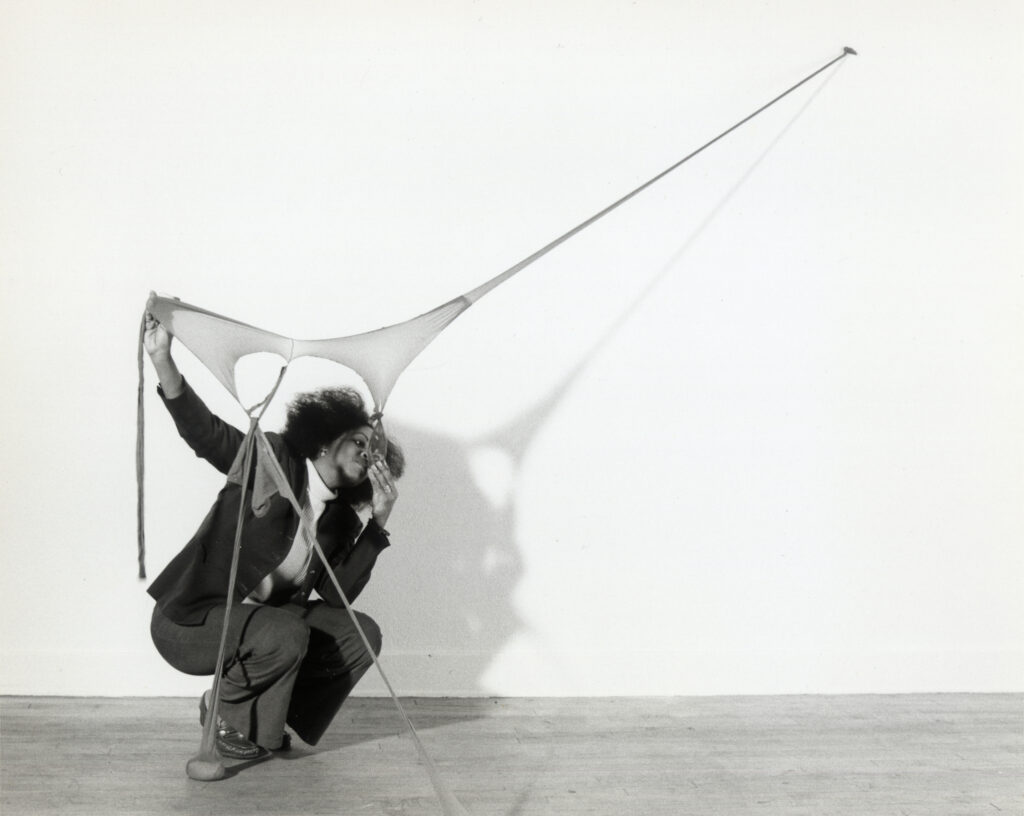
Senga Nengudi and her pantyhose sculptures.
Senga Nengudi setting up for a performance with R.S.V.P. X, 1976. Senga Nengudi Papers, Amistad Research Center, New Orleans. © Senga Nengudi.

Nengudi’s most recognizable series of work is R.S.V.P., which she started in the mid-1970s. The R.S.V.P. Series, or Répondez s’il vous plaît (respond, please), demonstrated Nengudi’s experimentation with nylon pantyhose. Importantly, Nengudi began working in this medium after the birth of her first son, when she was especially interested in the elastic nature of a woman’s body. She recalls, 

“So yes, the explorations were really exciting. I put eggs in them, I broke eggs in them…I used white glue, I used hot glue, which obviously didn’t last that long. I tried everything—resin. Again, it dissolved in the resin. So really, as I was developing the series, it was all about exploring the material…And it took a while to get to…the sand, where I just noticed that…once in the nylons, it had such sensuality to it, because it had this kind of natural body form from the weight of the sand.”

Given the experimental nature of her sand-filled nylon pieces, Nengudi explains, “I thought about them as sculpture first. I did not develop them thinking that I would perform in them.” But Nengudi eventually did embrace the performative potential of these sculptures, even engaging Hassinger to perform with them at the Pearl C. Woods Gallery in 1977 by entwining her body with the material, manipulating it, even dancing with it. 

Nengudi has lived in Colorado since the 1980s, and continues to stimulate audiences by creating work that plays with the line between sculpture, installation, and performance in space. However, she has also made significant contributions as an arts educator, especially at University of Colorado at Colorado Springs, and as an advocate of the arts. Namely, she established a community art gallery called ARTSpace in Colorado Springs so that “artists could show their work” and learn “what it takes to have an art exhibit.” The added bonus, of course, was that “the community could come in and see the artwork. It was right there for them.” For someone whose early exposure to creative expression was so formative to her artistic practice, this is a logical next step to engage new generations of artists and viewers. It also connects with her decades-long entreaty to audiences: “respond, please.”

To learn more about Senga Nengudi’s life and work, check out her oral history interview! Find this interview and all our oral histories from the search feature on our home page. You can search by name, key word, and several other criteria.


Richard Mayhew: Painting Mindscapes and Searching for Sensitivity

In March 2019, Dr. Bridget Cooks and I had the pleasure of conducting a series of oral history interviews with artist and educator Richard Mayhew for the Getty Research Institute’s African American Art History Initiative. Mayhew’s most recognizable work includes paintings of abstract and brightly-colored landscapes—what he calls mindscapes. 

mayhew
Richard Mayhew

Richard Mayhew is a painter, as well as a retired professor of art. He was born on Long Island, New York, and displayed an early interest in art. He studied at the Brooklyn Museum Art School, the Art Students League of New York, the Pratt Institute, and Columbia University. Mayhew received a John Hay Whitney Fellowship in 1958 to live and study in Europe in the early 1960s. He joined Spiral in 1963 and was a member of the Black Emergency Cultural Coalition (BECC). Mayhew has taught at many universities and art institutions, including Hunter College, Pennsylvania State University, San José State University, Sonoma State University, and University of California Santa Cruz. 

Find this interview and all our oral histories from the search feature on our home page. You can search by name, key word, and several other criteria.

Mayhew’s interview detailed his incredible life and inventive work, as well as his deep connections to communities of artists across the country, and indeed across generations. For instance, Mayhew was a member of a group of Black artists called Spiral, which met to discuss both their work and their connection to the Civil Rights Movement. Spiral started in 1963 at the urging of A. Philip Randolph of the Brotherhood of Sleeping Car Porters to “form a contingent of artists for the March on Washington” that same year. 

Mayhew recalls that “the original group of elders” in Spiral included Charles Alson, Romare Bearden, Norman Lewis, Felrath Hines, and Hale Woodruff. But this soon became an intergenerational group. In speaking about the formation of Spiral, Mayhew also remembers its network of visual and performing artists across the country: 

“But also, [A.] Philip Randolph wanted not just the visual artists, he wanted all African American artists that wouldn’t be in the New York area. So we called the artists in Missouri and Chicago and also Los Angeles about this idea that Philip Randolph wanted a contingent of artists. So they made contact with them over there. We didn’t have all the people together, so Ralph Ellison came there and he was talking about—I don’t remember all the names now of the composers, and also directors of the theaters in New York which were Afro-American. That was part of the idea, the contingent not just be the visual artists, but all the areas of arts in that area.”

Another unique aspect of this interview was Mayhew’s reflection on his African American and Indigenous backgrounds, and how they influenced his relationship to art and nature. In thinking about how his identity connected to his artistic vision, Mayhew explained,

“Mine was more out of the African American and Native American heritage, in terms of the love of nature and also the respect for nature, because nature’s involved in reinventing itself. That was what’s going on, in terms of African American and Native American sensibility. They constant[ly] reinvented themsel[ves] and constantly grew and matured and survived. That was my connection to nature and the fascination, almost until today. I’m still trying to paint that feeling.”

To learn more about Richard Mayhew’s life and work, read his oral history transcript here. Find this interview and all our oral histories from the search feature on our home page. You can search by name, key word, and several other criteria.


Merritt Price: Building the Design Department at the Getty

Merritt and Teddy
Merritt Price and Teddy Getty at the opening of the “J. Paul Getty Life and Legacy” exhibition, September 24, 2016. Courtesy of the J. Paul Getty Museum.

I’ve been interviewing for the J. Paul Getty Trust Oral History Project for several years, and it is a continual pleasure to learn about employees and operations across this large organization. But rarely do I come across a longtime employee whose work for the Getty Trust has taken them across departments, programs, and even physical sites. This is what made my interview with Merritt Price so unique. In fall 2020, I conducted a series of oral history interviews with Merritt Price, the former head of the Design Department (now Museum Design Department, 1995-2020).

Merritt Price is the former head of the Design Department (now Museum Design Department) at the J. Paul Getty Trust, which he ran from 1995-2020. Price grew up in Belleville, Ontario, Canada, and moved to Toronto in 1980 to attend the Ontario College of Art (now Ontario College of Art and Design). Price worked for several design firms in Toronto, including starting his own practice called Tangram, before accepting a position with the Art Gallery of Ontario in 1990. He began his work with the J. Paul Getty Trust in 1995, founding what was then the Exhibition Design Department. 

Find this interview and all our oral histories from the search feature on our home page. You can search by name, key word, and several other criteria.

When Merritt Price joined the Getty in 1995, he needed to build the then-Exhibition Design Department from the ground up. This involved defining the Department’s work as not only about aesthetic concerns like text labels and display cases, but also about a larger visitor experience—where museum goers walk and sit, and how they interact with the space. As such, Price assembled a multidisciplinary team to create “one-stop shopping” for design at the Getty Trust. 

In thinking about why it was important for the Getty to establish the Design Department, rather than rely on design consultants, Price explained, 

“I think it’s also noteworthy that working in-house at a museum, as opposed to being in a consulting office that might be doing design for museums or galleries, that you have a different perspective, because you’re right in it and you’re in it all the time. It’s a little bit more laboratory-like where your work product is right there outside the door in the gallery. You can walk through it, you can see visitors using it.”

Over the twenty-five years he worked at the Getty, Price and his team handled designs for major projects in the organization’s history. Indeed, Price’s first task included design work for the Getty Center, which opened to the public in 1997. In addition to addressing gallery spaces, Price also created a wayfinding system with signposts to orient visitors on the large Getty Center campus. He later worked on the redesigns at the Getty Villa. 

Price and his team also designed for exhibitions across the Getty Trust, including Devices of Wonder: From the World in a Box to Images on a Screen, Foundry to Finish: The Making of a Bronze Sculpture, and Michelangelo: Mind of the Master. However, Price was particularly involved in the exhibition J. Paul Getty Life and Legacy, for which he pitched the concept and led a team of curators in creating content. Listen as he explains the idea behind the show:

I have a background in museum work, and I felt confident speaking with Mr. Price about his vision for museum spaces and the practical necessities like spacing around pedestals. However, I still learned a great deal about technical innovations, as well as the impact of design both on exhibitions and on the other spaces in which visitors use—from trams to gift shops to restaurants. This interview was both personally enjoyable and is a great source of information about the construction and redesign of the Getty Center and the Getty Villa.

To learn more about Merritt Price’s life and work, read his oral history transcript here. Find this interview and all our oral histories from the search feature on our home page. You can search by name, key word, and several other criteria.