Bibliographie de la littérature française (BLF)

Bibliographie de la littérature française (BLF)

The UC Berkeley Library has initiated a database trial to the Bibliographie de la littérature française (BLF). The trial ends on March 31, 2025.

Originally part (from 1894) of the quarterly issues of the Revue d’Histoire littéraire de la France (RHLF), and since 2002, it has been an annual volume published in special editions. It gathers together references of French and Francophone literatures from the 16th century to the present day. The BLF was first published by Armand Colin until 1997; then by the Presses Universitaires de France; and since 2017 by Classiques Garnier.

Since 1996, the BLF has been the result of the joint work of a team at the Bibliothèque nationale de France, who is in charge of the indexing, and the Société d’histoire littéraire de France. The digital publisher of the BLF, Classiques Garnier Numérique, ensures the technical management and updates of the database.

The BLF is updated daily, as soon as new publications are indexed. Thanks to this, it constitutes a unique tool for researchers, teachers, students, and all those who are seeking to inform themselves about French literature, writers, subjects or periods. More than 200,000 detailed records from 1998 to the present day are currently online, including 105,000+ book chapters; 75,000+ journal articles; and 28,000+ reviews.

If you are accessing the resource from an off-campus location, please log in using proxy or VPN. Feedback is welcome and can be sent to cpotts@berkeley.edu at any time.
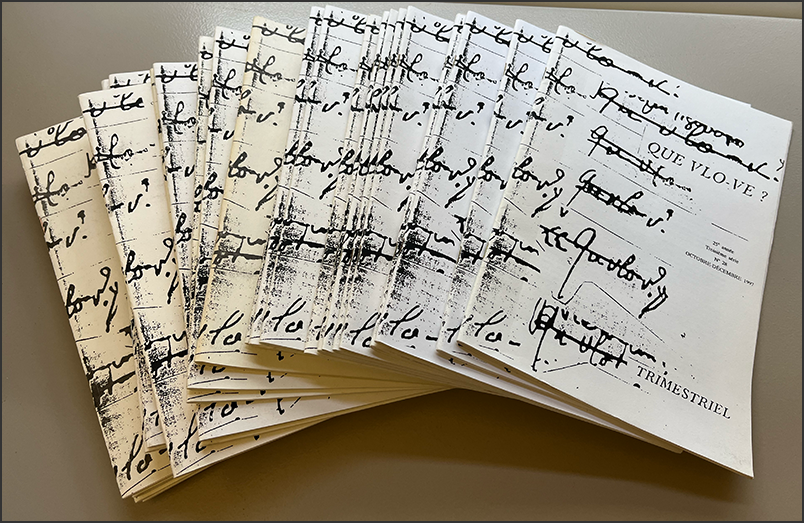
image of man typing
https://fr.freepik.com

Library event: Que vlo-ve? and Le Mot

Que vlo-ve ?
Various issues of the third series of Que vlo-ve ?

In these austere times where both financial resources and shelving space are limited, it has become a rare occasion when we are able to pursue full-runs of older periodicals. However, the recent acquisition of these two—one from France and the other from Belgium—in more or less the same time period has sparked the idea of hosting a hands-on journal presentation for those interested in interacting with the journals before the issues are processed, cataloged, bound, and stored in their distinct library locations.

Que vlo-ve?: bulletin de l’Association internationale des amis de Guillaume Apollinaire was published from January 1973 to 2004. Centered on the work of the celebrated 20th century French poet, playwright, short story writer, novelist and art critic of Polish descent, its intention was not to duplicate articles published in the annual Guillaume Apollinaire series by Lettres Modernes. Instead, it was meant to welcome articles that could not easily find a place, news of the association and of the museum as well as news that members of the scholarly society wished to disseminate internationally.

Le Mot
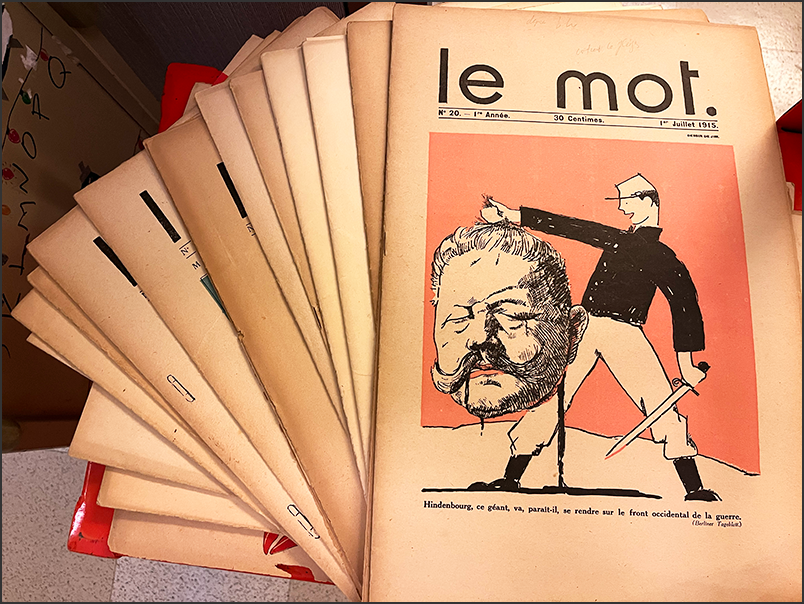
Issue number 20 (July 1, 1915) of Le Mot

Le Mot (1914-1915)

Sardonic and visually rich, this wartime French literary and artistic journal published by Jean Cocteau and Paul Iribe, was characterized by a restrained modernism and a fiercely nationalistic, anti-German perspective. Le Mot (The Word) was a wartime sequel to François Bernouard’s Schéhérazade: Album Mensuel d’Oeuvres Inédites d’Art et de Littérature (1909-11). Its primary purpose was to establish an entirely French artistic style and taste—anti-bourgeois and uninfluenced by German modernism.

Reports of the brutal treatment of noncombatants (such as mass executions that included women, small children, and the elderly) and damage to towns and cultural centers shocked the public, leading to a characterization, particularly within France, of the German soldiers as destructive and uncivilized “huns” particularly within wartime propaganda. The bi-monthly periodical included cover designs by not only Iribe and Cocteau but also Sem, Raoul Dufy, Léon Bakst, André Lhote, Albert Gleizes, and Pierre-Emile Legrain. Cocteau signed his drawings as Jim, the name of his dog. In August 1914, when war was declared with Germany, he was twenty-five years old. Like many patriotic young Frenchmen, Cocteau tried to enlist but was turned down because of his health. Looking for other ways to serve his country and the war effort, he collaborated with Iribe to launch Le Mot. As a teenager, Iribe drew illustrations for the popular caricature journal L’Assiette au Beurre (The Butter Plate), which ran from 1902 to 1912. He also freelanced for Le Témoin, Rire, Sourire and other periodicals and was enthusiastic about starting a satirical journal of his own.

Please join us for an interactive show and tell with special guest Willard Bohn, alumnus of the Department of French and Professor Emeritus of French and Comparative Literature at Illinois State University.

Thursday, February 6
4-5:30 pm
223 Doe Library (accessible through south end of the Heyns Reading Room)

No rsvp required.

—-
Claude H. Potts (he/him)
Librarian for Romance Language Collections


Revamped Guides for French/Francophone and Italian Literatures

decorative image

A recent overhaul of the two literary research guides for French and Francophone Literatures and Italian Literature & Criticism first created quite a long time ago will improve navigation and discovery in these vast print collections. Over the course of the past year, we have critically reviewed the former guides, weeded outdated resources, and replaced them with more current content with links to digital resources when available.

These two literature research guides are now benefiting from the LibGuides platform, which makes it much easier to revise than the former PDFs. Each guide is structured by sections for article databases, general guides and literary histories, reference tools, poetry, theater & performance, and literary periods. They interface seamlessly with related guides published by the UC Berkeley Library. For example, on the home page of each LibGuide, there is a prominent link to the lists of recently acquired publications in both French and Italian, making it even easier to stay current on new books in any particular call number range.

Because the guides are much easier to update, they encourage user interaction and invite community suggestions for inclusion (or deletion).

If you have time over the winter break, please take a whirl and let us know what you think. We’ll be unveiling a similar guide for Iberian Literatures & Criticism this spring!


New Book by Michael Lucey

What Proust Heard [book cover]

Michael Lucey offers a linguistic anthropological analysis of Proust’s In Search of Lost Time.

What happens when we talk? This deceptively simple question is central to Marcel Proust’s monumental novel In Search of Lost Time. Both Proust’s narrator and the novel that houses him devote considerable energy to investigating not just what people are saying or doing when they talk, but also what happens socioculturally through their use of language. Proust, in other words, is interested in what linguistic anthropologists call language-in-use.

Michael Lucey elucidates Proust’s approach to language-in-use in a number of ways: principally in relation to linguistic anthropology, but also in relation to speech act theory, and to Pierre Bourdieu’s sociology. The book also includes an interlude after each of its chapters that contextualizes Proust’s social-scientific practice of novel writing in relation to that of a number of other novelists, earlier and later, and from several different traditions, including Honoré de Balzac, George Eliot, Virginia Woolf, Nathalie Sarraute, and Rachel Cusk. Lucey is thus able to show how, in the hands of quite different novelists, various aspects of the novel form become instruments of linguistic anthropological analysis. The result introduces a different way of understanding language to literary and cultural critics and explores the consequences of this new understanding for the practice of literary criticism more generally.

[from publisher’s site]

Professor Lucey, who holds a joint appointment in the Departments of French and Comparative Literature, discussed his recent book with Suzanne Guerlac on April 6 through the Townsend Center’s Berkeley Book Chats. The event was recorded and is available online.


What Proust Heard: Novels and the Ethnography of Talk.
Chicago: University of Chicago Press, 2022.