Established in the Bay Area in 1998 under editors Jocelyn Saidenberg, Rodrigo Toscano, Hung Q. Tu, Krupskaya books (website) has been providing readers with experimental literature for almost three decades. The press prints both poetry and prose that “challenge traditional literary forms.”[1]
Nadezhda Konstantinovna Krupskaya, for whom this author assumes the press was named, was a Russian politician and theorist. They believed in social reform and would play significant roles in the Russian revolutions of 1917. Afterwards, she would be heavily involved in politics, particularly as regarding education.[2]
Following in Krupskaya’s call for social reform through education, Krupskaya Books focus on collaboration and responsibility, providing mixed-genre and adventurous works.
Readers can follow the press on their Instagram page for new book announcements or calls for manuscripts.
D.T. Robbins founded Rejection Letters Press in 2020. The idea for the press initially grew out of a joke about publishing fictional rejection letters after receiving a bevy of all-too-real letters.[1] Now, in 2025, the press has a selection of a phenomenal photographs and poetry online (see featured image above, captured in December 2025) as well as seven beautiful volumes of poetry and novels.[2]
While this Southern California press is not bound to a specific city, they host literary events in Los Angeles. Alongside book and poetry readings, the House hosts an annual “Rejection Week.” For this second event, their advertisements warned that there was “so much rejection, there [was] blood in the water.”[3] Readers can find out more about their events on their Instagram page.
In 1953, poet Lawrence Ferlinghetti and Peter D. Martin founded City Lights Books in San Francisco, near some incredible Italian bakeries (this author is unclear if that mattered to them). Established as “a literary meetingplace,” the bookstore was initially an all-paperback store focused on providing a space for alternative culture. Now a three-story edifice that does provide some new hardcovers, the store continues to offer a place for readers to soak up excellent literature.[1] They also hold readings and other literary events, about which readers can find information on Instagram.
Committed to offering experimental and alternative literature, City Lights and its staff have a firm stance against censorship and a “legacy of anti-authoritarian politics” [1]. Partly with that commitment in mind, the bookstore also became a publisher. Among the first of their output, they released Alan Ginsburg’s Howl (at Bancroft). Since then, they have released poetry, novels, and short-stories alongside non-fiction.
UC Berkeley and City Lights have had a special relationship for decades. Not only does UC Berkeley Library host most of City Lights outpouring, but Ferlinghetti also chose the Bancroft Library to host his personal papers (UC Library Search) as well as a considerable amount of City Lights Books photographs and other manuscript materials (OAC.)
You can, of course, also find out what we have in our circulating collections at UC Berkeley’s Doe Library through our UC Library publisher search.
Located in Sejatnga, Unceded Tongva Territory, South Whittier, CA, the publishing house Riot of Roses (webpage) tells their readers that they “publish books to heal and liberate others” and affirm that the press is “for the people.”[1]
Brenda Vaca founded Riot of Roses in 2021 to publish her first poetry collection. Vaca had completed her first manuscript with the Community Literature Initiative program out of South Los Angeles, CA and found her options for publishing limiting. In an interview with Canvas Rebel, Vaca explained that she wasn’t happy with the non-negotiable contract she received from an already-established publisher and wasn’t content publishing with a platform like Amazon, which wouldn’t end up in a library system.[2]
To address that problem for both herself and others, Vaca created Riot of Roses as a space for writers to amplify historical silenced voices.
In the handful of years since the press’ inception, Vaca has done wonderful work promoting it and the press’ authors. They attend poetry slams, book events, and more around their location in Sothern CA. Readers can find more information about their events on their Instagram page.
Books at UC Berkeley’s Doe Library
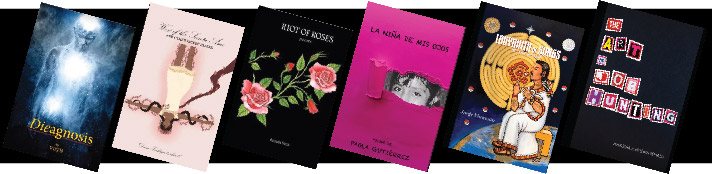
Here are a handful of Riot of Roses’ recent publications in Doe Library:
Concrete art and poetry—a radical avant-garde movement where the visual and spatial arrangement of words on the page carries as much weight as their literal meaning—emerged in Brazil during the 1950s, a time of rapid and transformative modernization. Professor Nathaniel Wolfson (Spanish & Portuguese) challenges the notion that concretism was socially passive, as some scholars have claimed. Instead, he presents it as the defining literary genre of the early information age.
Concrete Encoded: Poetry, Design, and the Cybernetic Imaginary in Brazil (Texas, 2025) examines how Brazilian poets, artists, and designers engaged with the rise of digital capitalism, forging a distinct cybernetic vision. Wolfson’s study reinterprets concretism—not just as Brazil’s most internationally influential artistic movement, but as a network connecting both prominent and overlooked figures. By mapping these creative exchanges, the book reveals broader, transnational conversations about technology and its critical possibilities.
Since its inception in January 2021, Abalone Mountain Press (https://www.abalonemountainpress.com) has published several phenomenal compilations of poetry and zines. Amber McCrary, the founder, operates the press on operates on the traditional lands of the Akimel O’odham.[1]
To delight, this semester (Spring 2025), UC Berkeley’s Doe Library put in an order for five of Abalone Mountain Press’s recent publications. The chapbooks, anthology, and zines will be located in Doe Library’s main stacks.
Taté Walker and Ohíya Walker, The Trickster Riots (Abalone Mountain Press, 2022).
Kinsale and Alice Mao, Hummingbird Heart, Pink (Abalone Mountain Press, 2022).
Take a look at these or other Abalone Mountain Press books in our UC Berkeley Library.
Additional Material
Several of these authors contributed to The Diné Reader: An Anthology of Navajo Literature. You can find an interview with Amber McCrary about the Press in the September 2022 issue of Poetry.
Insert Press was found in 2005 by Mathew Timmons to focus on interdisciplinary and/or hybrid works.[1] Initially, Insert Press focused on poetry in chapbook form, but over the following decade turned to increasingly toward “translation, poetics, artist books.”[2]
Kaya Press (https://kaya.com/) has been making space for voices in the Asian and Pacific Islander diasporic writers in the United States since 1994, when it was founded in New York City. Establishing itself as a “premier publisher of cutting-edge” literature, the Press moved to in USC Dornsife’s Department of American Studies and Ethnicity in Los Angeles in 2012 where it has continued releasing phenomenal material.[1]
The Press not only releases excellent novels and poetry, but also participates in book fairs, contributes to community activity, hosts author readings, and more.[2] Readers can find information about their events on their Instagram page.
You can find the majority of the Press’ catalog through the (UC Library Search) and access them in either in the UC Berkeley Main Stacks or the Ethnic Studies Library’s shelves.
Red points show Doe Library and the UC Berkeley Ethnic Studies Library building locations. Check out the UC Berkeley Library locations and Affiliate Libraries as a Google Map.
Map of Luso-African Literary Publishers by City generated by Bee Lehman
More than 80 works of literature from Angola, Cabo Verde, and Mozambique arrived in Doe Library last week. This selection of poetry, short stories, and novels in Portuguese was made possible through a generous 3-year grant from the Fundação para a Ciência e a Tecnologia (FCT) in Lisbon. The absence of Lusophone African literature from mainstream African literary studies (mostly in English and French) has been noted by contemporary scholars. These new works of post-colonial fiction and verse listed below are held by few academic libraries and reflect the UC Berkeley Library’s longstanding commitment to collect and make accessible underrepresented voices from across the world in more than 400 distinct languages. Please enjoy this curated list by book dealer Susanne Bach Books which provides a snapshot of the rich literary output from Lusophone Africa over the past three years:
100 poemas para Neto / Poetas da União dos Escritores Angolanos. Luanda, Angola: EAL – Edições de Angola, 2022.
Many of us, alongside reading poetry and novels or travel narratives, want to know about the context in which the author lived. Who were their families? Did they have a specific person of whom they dreamed when they wrote about love? Understanding the author can give us a better understanding of their meaning, their focus, and their world.
Unsurprisingly, I’d recommend starting with what other scholars have written. If those books don’t exist, or I am after a deeper understanding, I would start looking into what I could sketch out about the author and then look for unpublished papers in archival collections or other repositories using search interfaces such as ArchiveGrid or ArchiveFinder.
The Case Study: Angelina Weld Grimké
Portrait of Angelina W. Grimké from Negro Poets and their Poems (1923) via Wikimedia. | Public Domain.
For the purposes of this exploration, I’m going to look at one of my many favorite poets: Angelina Weld Grimké (Wikipedia). This poet, born in 1880 in Boston, wrote poignant poems about life and love, many of which were published in the 1910s. They died in 1958 in New York City.
Based on that information, I expect Grimké to have possibly written and received letters to and from family and publishers; to maybe have kept account books or diaries; and possibly to appear in or have created family papers.
There are other kinds of sources that might exist for our purposes as well, but I’m sticking to these for now.
Looking for Unpublished Materials
Unpublished material such as letters is usually held by archives; historical societies/museums; estates; or family/friends. The latter two can be a harder reach, but the first two usually try to let researchers know what they hold. With that aim, many archives upload their finding aids (here’s information from Bancroft Library about what a finding aid is) into collective search interfaces like ArchiveGrid and ArchiveFinder. To find additional ways to search archival collections, take a look at the Library Resource Guide History: Locating Archives.
To use either of those two databases, I usually recommend writing out a list of possible permutations of the person’s name. “Angelina Weld Grimké” might written as such, but it also might appear as:
Angelina Grimké
Angelina Weld Grimke
Angelina Grimke
Some English language search interfaces are designed to ignore accents, and some will fail a search if the characters in a name do not precisely mirror whatever a finding aid says.
Searching ArchiveGrid
OCLC runs this platform and, as far as library search interfaces go, I like it well enough. Do be aware that it sits behind a paywall and you must be logged in with your institution to use it.
Example of ArchiveGrid Landing Page from February 2025
Once I have the initial search page up, I usually start my search with the full, formal name; in this case (Angelina Weld Grimké) without quotation marks and with the accent over the “e.”
In this case, I got two results, one of which was the “Weld-Grimké family papers.” When I use the link to the University of Michigan’s finding aid, however, I find out that the collection, substantial at 14 linear feet, focuses on Angelina Weld Grimké’s grandparents, one of whom was abolitionist Angelina Grimké.
Example of ArchiveGrid Search Results screen from February 2025
The second result, relating to scholar and poet Akasha Hull, is actually more on point as Hull wrote about Angelina Weld Grimké. Based on the collection listed in New York Public Library’s finding aid, however, material about Angelina Weld Grimké is likely to be sparse as the “Scope and arrangement” section note that the collection covers a significant number of topics and the “Detailed description” only mentions Grimké once.
At this point, I ran the other permutations of the name and didn’t get any other relevant collections. So, I move on to the next resource.
Using ArchiveFinder
ProQuest runs ArchiveFinder and I am not a big fan of their interface, largely because of the layout. The point and goal of the interface is much the same, but different archives/repositories subscribe and use different interfaces, which means I need to search both for a wider results list.
So, I start with the same name and search for (Angelina Weld Grimké).
Example of ArchiveFinder Search Results screen from February 2025
The results here are much more directly on topic. I still get the Michigan result for the Weld family papers at the top. The following results, however, are new and include a collection called “Grimké, Angelina Weld” AND “Angelina Weld Grimké papers, 1887-1958” both at Howard. A few of the other collections, including Fisk University’s “Negro collection” appear to hold potentially interesting information.
Reading a Relevant Finding Aid
In deciding which collections to focus on, I read the associated finding aids, focusing first on description and size. For Howard’s “Grimké, Angelina Weld” (finding aid) is 8 linear feet and includes drafts as well as published material.
Example of what unlabeled archival boxes can look like in 2025. | CC0
Given the highly-relevant description, I then skim the rest of the finding aid, which includes folder and box level description. That means Howard hasn’t recorded information about every piece of information in the box, but you can get a great sense of what’s there. For example, the description for Box 38, folder 15:
Series F Notebooks Box 38-15 French vocabulary exercises, writings of prose and poetry, and recipes
suggests that it contains some poetry along with other types of material. That might not give a clear sense of what poetry is in there or how it’s presented, but something of interest is there! Or, I think it will be. My personal, vague, castle-in-the-sky hope is that there will be poems about food scrawled on whatever recipe information is there.
If there are only one or two papers that are of interest, then I’d likely check the archive’s information about rights and reproductions. If they have options for digital copies, I might request the page or two.
In this case, there are hundreds of items associated with the collection. Most archives won’t copy that number of pages for staff and resource reasons. In consequence,
I would consider a visit to the archive and read their informational pages on the subject. In this case, Howard’s Moorland-Springarn Research Center page on the subject suggests writing to them before making a research appointment.
Additional Steps
There are several additional approaches to finding additional material about an author. For Grimké, I’d head to historical newspaper sets such as the Library of Congress’ Chronicling America.
I would also take a look for government records in Ancestry.com (public libraries often have subscriptions, for Berkeley see here), the National Records and Archives Association, as well as check historical association centers around where Grimké was born, lived, and died.
There is a lot one can do to find information. Whether one wants to take those steps often depends on your time, funding, and how relevant the information is to your research.
If I’m focused on one author, then I’d likely try to find out what’s out there. If I’m looking for 100 people, I wouldn’t do in-depth research into each but focus on specific types of information.
Let your literature librarian know if you’d like to talk about research strategies for you.