Bancroft Quarterly Processing News

The archivists of The Bancroft Library are pleased to announce that in the past quarter (April-June 2023) we have opened the following Bancroft archival collections to researchers.


Western Americana collections:

The role of women in the Black movement conference materials (processed by Marjorie Bryer)

Jonathan Winters collection on campus and East Bay LGBT activism (processed by Marjorie Bryer)

Edward Miyakawa papers (processed by Marjorie Bryer)

YMCA of San Francisco, Chinatown branch records, approximately 1915-2010 (processed by Marjorie Bryer)

Nan Tucker McEvoy collection (processed by Jaime Henderson and Marjorie Bryer)

Joni Jacobs collection of mayoral campaign materials (processed by Lara Michels)

Louise Taber family papers (processed by Lara Michels and student processing assistant Malayna Chang)

Central American Labor Defense Network records (processed by Marjorie Bryer)

Elaine Dorfman papers and oral histories (processed by Presley Hubschmitt)

Oakland-Piedmont Jewish Community Center records (processed by Presley Hubschmitt)

B’nai B’rith, San Francisco Lodge No. 21 records (processed by Presley Hubschmitt)

Rosene Family papers (processed by Lara Michels)

Women’s American ORT, San Francisco Chapter records (processed by Presley Hubschmitt)

Jerome H. Bayer papers (processed by Presley Hubschmitt)

Keesling family collection of John Henry Barbat correspondence, photographs, and realia (processed by Lara Michels)

Joel Bolster correspondence, 1851-1852 (processed by Lara Michels)

Harold Dobbs scrapbooks and photo albums (additional processing and finding aid written by Lara Michels)

Keesling family collection of Stebbins family papers (processed by Lara Michels)

William R. Sanford and Charles T. Forbes correspondence and sketches related to Native American archaeology, Owens Valley, California (processed by Lara Michels)

Presbyterian Church in Chinatown, San Francisco, additions (2019-08-16) (processed by Lara Michels)

Sierra Club mountain registers and records, 1860-2005, additions (processed by Lara Michels)

Robert (Bob) Edward Rooker rodeo archive (processed by Jaime Henderson)

Warren Hinkle papers (digital files) (processed by Christina V. Fidler)

Vivian Low collection of materials on the Military Intelligence Service Language School, Chinese Division, 1945-2017 (digital files) (processed by Christina V. Fidler)

Judith Heumann papers (digital files) (processed by Christina V. Fidler)


Literary and Arts collections: 

Anne S. Perlman papers (processed by Marjorie Bryer)

Robert D. Brotherson collection of the Activist Group of Poets (processed by Marjorie Bryer)

Nancy Karp + Dancers records (processed by Jaime Henderson and Lara Michels)

Claire Van Vliet letters to Frederick W. Hegeman, 1977-1988 (processed by Lara Michels)

Kenneth Perkins papers (processed by Randal Brandt and Sterling Kinnell)


University Archives and Faculty Papers collections:

University of California, Berkeley, Department of Women’s Intercollegiate Athletics records (processed by Jessica Tai)

Harold Biswell papers (processed by Jessica Tai)

Joseph L. Sax papers (processed by Lara Michels)

Robert Tracy papers (processed by Michele Morgan and Lara Michels)

Jaroslav Joseph Polivka papers (processed by Lara Michels)

Lawrence Levine paper (digital files) (processed by Christina V. Fidler)

Jacqueline Ellen Violette de La Harpe papers (additions) (processed by Marjorie Bryer)


Pictorial collections:

Acción Latina and El Tecolote pictorial archive photographic print and poster collection (processed by Isabel Breskin with James Eason)

Fakir Musafar archive (processed by Lori Hines)

John S. Service photograph collection (processed by Isabel Breskin with James Eason)

Photographs from the Noël Sullivan papers (1 unprocessed box)

185 small pictorial collections and single items.


Collections currently in process include:

  • The papers of George Barlow, UC Berkeley ichthyologist, ethologist and evolutionary biologist (processing work by Jessica Tai)
  • The papers of Michael Paul Rogin, UC Berkeley political scientist notable for his critique of American imperialism (processing work by Marjorie Bryer)
  • University of California, Berkeley, American Cultures Center records (processing work by Jessica Tai)
  • Western Jewish History Center records (processing work by Presley Hubschmitt)
  • Acción Latina records (processing work by Marjorie Bryer)
  • Haas-Bransten-Rothman family papers (processing work by Presley Hubschmitt)


The Surprising Ink Recipe of an Ancient Scribe

By Leah Packard-Grams
Ancient History & Mediterranean Archaeology PhD student
Center for the Tebtunis Papyri


Writers in the modern world often have a favorite pen, a preferred color of ink, or quirky handwriting, and ancient writers were no different! Scribal habits are a topic of increasing interest among scholars who study the ancient Mediterranean, and UC Berkeley’s papyrus collection is full of possibilities for the topic that has set researchers abuzz.

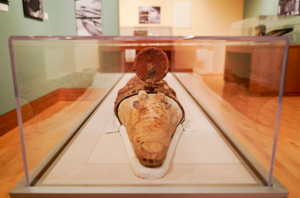
UC Berkeley’s collection of papyri, housed in the Center for the Tebtunis Papyri (CTP) on the fourth floor of The Bancroft Library, was excavated from the sands of Egypt 123 years ago, but it has often been remarked that the collection is rich enough to provide work for generations of scholars. The papyri provide crucial insights for our knowledge of daily life in Egypt and can illuminate individual priests, artisans, and scribes in extraordinary detail. One specific group of papyri caught my attention when CTP Director Todd Hickey mentioned it in a graduate course a few years ago: the archive of a scribe who worked for a local record-office in the 70-60s BCE. Since his name has not yet been deciphered from the surviving papyri, scholars refer to him as “Scribe X”. His papyri were found in the crocodile mummies excavated in Tebtunis, Egypt, on behalf of UC Berkeley over a century ago.

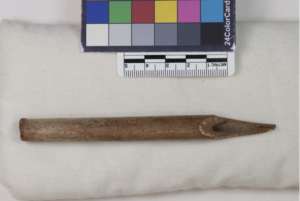
A crocodile mummy on display in the Object Lessons exhibit, Spring 2020A reed pen from Tebtunis held in the Hearst Museum at UC Berkeley, object no. 6-21420.
1. (Left: A crocodile mummy on display in the Object Lessons exhibit, Spring 2020. Right: a reed pen from Tebtunis held in the Hearst Museum at UC Berkeley, object no. 6-21420.)

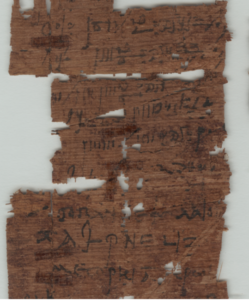
The Scribe X papyri have been examined by several scholars, and two of them have been published in full, while dozens of fragments remain to be edited.1 Previous researchers have found this archive to be unique: It not only represents the oldest collection of documents from a village record-office (grapheion in Greek), it also displays the earliest use of the reed pen (kalamos in Greek) to write the Demotic Egyptian script, which was traditionally written with a rush. The Egyptian scribes of this era did not use the reed pen for Demotic so far as we know, and it would be decades before the reed was used with regularity for the Demotic script. In other words, Scribe X had a favorite pen, and he used it even though it differentiated him from the other scribes around him. This prompted a question: If the scribe used an “atypical” writing instrument, was the ink he used likewise “atypical”? 

A selection of lines from Scribe X’s account papyrus P.Tebt.UC 2489, displaying Demotic and Greek written on the same document, both written with the reed pen.
2. (A selection of lines from Scribe X’s account papyrus P.Tebt.UC 2489, displaying Demotic and Greek written on the same document, both written with the reed pen.)

Previous studies by a team of researchers in Europe have proved that there was a shift when scribes began to add copper sulfate to ancient inks of this period in the region of Tebtunis.2 This was a development from the earlier Egyptian ink recipe of gum arabic, soot, and water. In later periods, metallic elements such as lead and copper were intentionally added to the ink to make it more durable. Did this innovative scribe use a more recent ink recipe, or the traditional gum-soot-water recipe? 

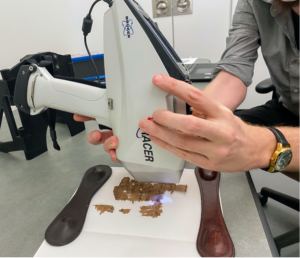
To find out, a chemical analysis using X-ray fluorescence spectrometry (XRF) was conducted in collaboration with UC Berkeley’s Archaeological Research Facility. One reason scholars favor the use of XRF for testing ancient objects is because it is nondestructive and extremely safe. A portable XRF spectrometer from the Archaeological Research Facility was brought to the Center for Tebtunis Papyri, where Dr Jesse Obert (a recent PhD from the Graduate Group in Ancient History and Mediterranean Archaeology) and I scanned multiple papyri from the Scribe X archive. The XRF spectrometer contains both an x-ray emitter with a precise 5 mm beam as well as a detector which identifies photons that are ejected from the atom when it is exposed to the x-rays. Different elements emit different photon signatures, and the detector “reads” the photon signatures to identify which elements are present in the atoms of the scanned area. We selected nine areas on one bilingual papyrus for scanning and included a number of uninscribed areas on the papyrus as a control. Several other papyrus fragments from the archive were also scanned in subsequent months.

Dr Jesse Obert performing the initial scan with the portable XRF

3. (Dr Jesse Obert performing the initial scan with the portable XRF)

The results of the scans were surprising: The machine did not detect any metallic elements in the ink whatsoever. From this information, we can infer that Scribe X used the traditional ink recipe without any of the ink additives that were popular in the era! Such a finding was unforeseen because studies of comparable papyri did not attest to the use of this ink. At the same time, however, it is somewhat un-surprising, because it is well known that Ancient Egyptian traditions in art, religion, language, and culture endured even beyond Alexander the Great’s conquest of Egypt in 332 BCE. What this project has proven is that this ancient ink recipe was one of these enduring traditions, holding on longer than previously thought in the area of Tebtunis. 

In April 2023, I presented this study in a poster for the annual meeting of the American Research Center in Egypt and received first place in the “Best Student Poster Competition.”3 More research on the archive is forthcoming (stay tuned for an upcoming feature in the Fall 2023 issue of Fiat Lux!). The project inspired me to get my own certification in XRF scanning, and my work with the archive has allowed me to become familiar with this scribe, his quirks, and his writing habits. The project and the prestigious award it has received are testaments to the open, collaborative attitude of UC Berkeley researchers working across disciplines and across the many research facilities and hubs across campus. I am extremely grateful to Dr Todd Hickey, Dr Jesse Obert, Dr Nicholas Tripcevich, and Directors of The Bancroft Library Charles Faulhaber and Kate Donovan, whose support and encouragement has enabled this project to come to fruition!

Notes

  1. The two papyri published thus far are edited by Parker 1972 and Muhs & Dieleman 2006. For assessment of the Demotic material, see Muhs 2009 and 2010. The Greek material was surveyed in Hoogendijk 2013.
  2. See the XRF ink study in Christiansen et al., 2017.
  3. See Packard-Grams 2023.


Sources

Christiansen, Thomas, et al. “Chemical Characterization of Black and Red Inks Inscribed on Ancient Egyptian Papyri: The Tebtunis Temple Library.” JAS Reports 17, 2017, pp. 208-219.

Hoogendijk, Francisca A.J.. “Greek Contracts Belonging to the Late Ptolemaic Tebtynis grapheion Archive?” in Das Fayyûm in Hellenismus und Kaiserzeit: Fallstudien zu multikulturellem Leben in der Antike, Carolin Arlt, Martin Andreas Stadler, and Ulrike Weinmann, eds., Wiesbaden: Harrassowitz Verlag, 2013, pp. 63-74.

Muhs, Brian. “The Berkeley Tebtunis Grapheion Archive,” in Actes du IXe Congrès des études démotiques, G. Widmer and D. Devauchelle, eds. BiEtud. 147. Cairo, 2009, pp. 243-252.

Muhs, Brian. “A Late Ptolemaic grapheion Archive in Berkeley,” in Proceedings of the Twenty-Fifth International Congress of Papyrology, Ann Arbor, 2007. American Studies in Papyrology, Ann Arbor, 2010, pp. 581-588.

Muhs, Brian, and Jacco Dieleman. “A Bilingual Account from Late Ptolemaic Tebtunis.”  Zeitschrift für Ägyptische Sprache und Altertumskunde, vol. 133, 2006, pp. 56-65.

Packard-Grams, L. . “New Pen & Old Ink: XRF Analysis of a Unique Archive from 1st c. BCE  Tebtunis,” X-Ray Fluorescence Reports: Archaeological Research Facility: UC Berkeley eScholarship Publications. 2023. https://escholarship.org/uc/item/25n2k5bn

Parker, R.A. “An Abstract of a Loan in Demotic from the Fayum.” Revue d’Égyptologie 24, 1972, pp. 129-136.


This week in Summer Reading

Book cover for Fuzz

Fuzz: When Nature Breaks the Law
Mary Roach

Fuzz is a fun, pop-science book, like much of Roach’s work. The premise is: What happens when animals transgress on human society in different ways and how do different places handle that. Human rules meet the natural world with sometimes funny, sad, or concerning results.

CATHERINE CRONQUIST BROWNING
Assistant Dean
Academic Programs, Equity & Inclusion
School of Information


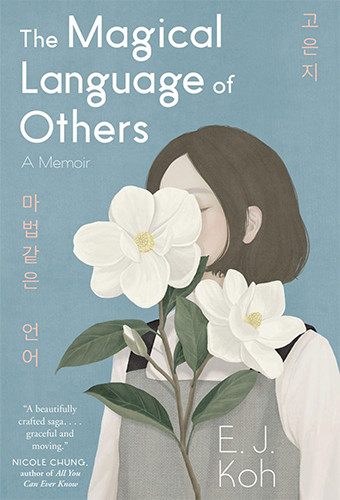
Book cover for The Magical Language of Others

The Magical Language of Others: A Memoir
E. J. Koh

As a young girl growing up in California, author E. J. Koh’s life is upended when her parents decide to return to their home country of South Korea, leaving her and her older brother behind to benefit from a life in America. Moving freely through time and space, Koh revisits this period of her life and beyond, building her memoir around the process of translating the (always unanswered) letters her mother would write to her. Through this literal process of “rewriting” her mother’s words, and the rules that hold a family together across generations, the book invites readers to embrace the imperfect but necessary role that language plays in enabling us to truly understand one another

BEN SPANBOCK
Lecturer
College Writing Programs


PhiloBiblon 2023 n. 5 (julio): Los Lucidarios de Sancho IV y otros manuscritos hispánicos de interés

Mario Cossío Olavide
Universidad de Salamanca/IEMYRhd
University of Minnesota/Center for Premodern Studies

Los Lucidarios

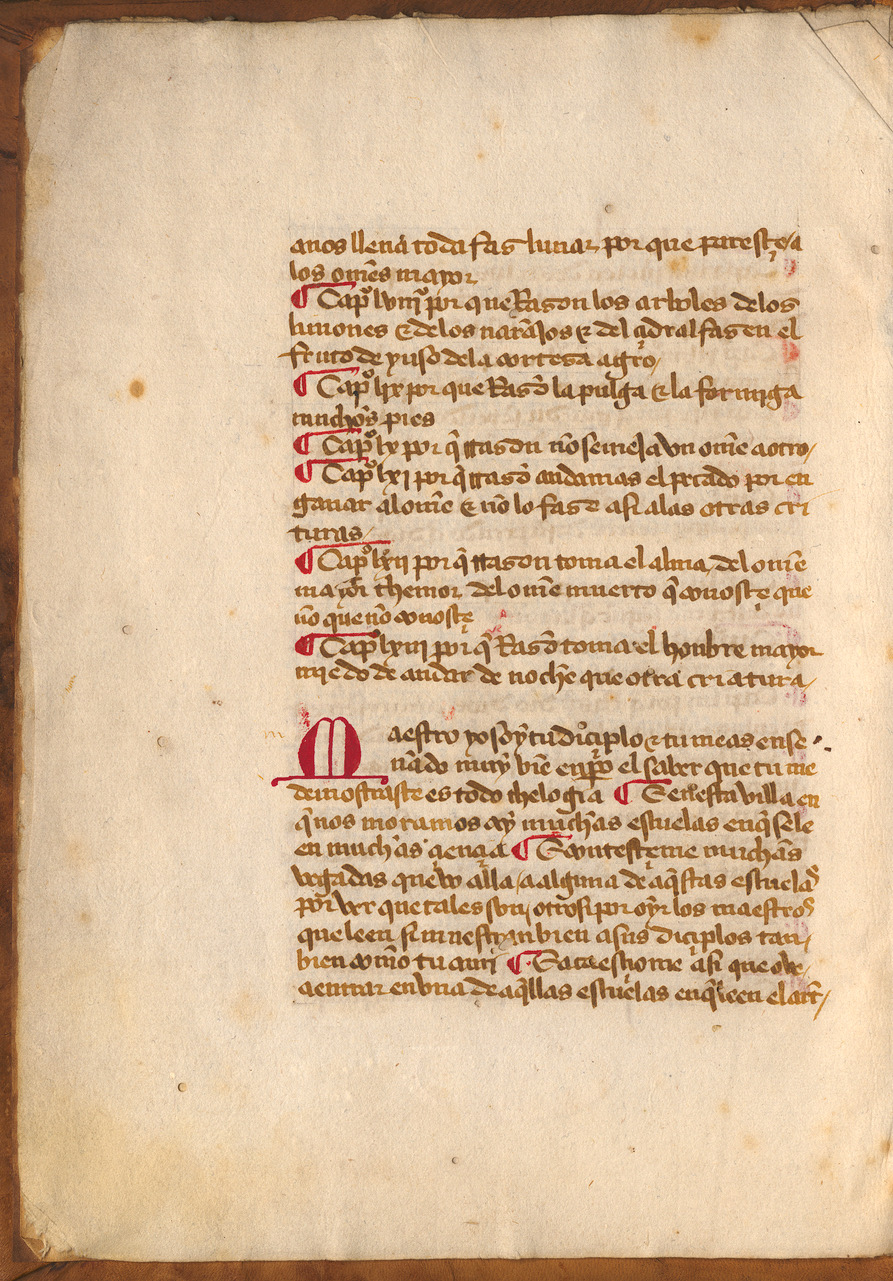
Cuando el célebre inspector de bibliotecas Henri Omont realizó el catálogo de los fondos de las bibliotecas públicas de Rouen, anotó que el manuscrito A283 de la Bibliothèque municipale –hoy Bibliothèque patrimoniale François Villon–, era un texto castellano del siglo XV al que le faltaba el título y que comenzaba en medio de la tabla de rúbricas. Tras la tabla, seguía el contenido de la obra, cuyas primeras líneas copió fielmente: “Maestro, yo soy tu discípulo e tú me as enseñado muy bien” (Catalogue générale, 184). El texto corresponde con el inicio del marco narrativo del Lucidario (BETA texid 1242).

Lucidario

Imagen 1. Rouen: Bibliothèque municipale, Ms A283, f. 2v

El manuscrito transmite el octavo testimonio conocido de esta obra auspiciada por Sancho IV, al que le he dado la sigla H (BETA manid 6360). Se trata de una copia posiblemente realizada en los talleres napolitanos de los reyes de Aragón y que llegó a Rouen gracias a la compra de manuscritos de Federico I de Nápoles realizada por el cardenal Georges d’Amboise durante el exilio del monarca en Tours (para una descripción completa de su contenido, véase Cossío Olavide, “Un nuevo manuscrito”).

A H hay que sumarle un noveno testimonio, I (BETA manid 3067), que identifiqué hace unas semanas. La existencia de este texto también pasó desapercibida por mucho tiempo. Se encontraba en la Biblioteca Ducal de Medinaceli y de él había dado cuenta Antonio Paz y Meliá con una enigmática nota en su parcial catálogo del fondo, entre los “manuscritos curiosos”: “Libro del rey Sancho IV – Diálogo entre maestro y discípulo (Letra del siglo XV)” (Serie 2: 537). Entre todas las obras de Sancho IV, esta descripción solo puede ser aplicada al Lucidario. Después de la venta de la biblioteca en 1964, el manuscrito pasó a la colección de Bartolomé March en Madrid y, tras la muerte de este, fue trasladado, junto al resto de manuscritos, a la Biblioteca de la Fundación Bartolomé March de Palma (sobre este manuscrito, véase Cossío Olavide, “Un nuevo testimonio”).

Resulta interesante resaltar que se trata de un testimonio tardío del Lucidario, de mediados del siglo XVI por su letra y filigranas, mientras que el cuatrocientos acumula seis testimonios de la obra. Hay dos fechados, A (BNE MSS/3369 [BETA manid 1434]) de 1455 y C (Real Bibl. II/793 [BETA manid 1435]) de 1477. D, el códice Puñonrostro (RAE Ms. 15 [BETA manid 1424]), puede ser datado por sus filigranas entre 1450 y 1460 (Cossío Olavide, “D (RAE 15)”). G (RAH Cód. 101 [BETA manid 2285]) es de finales de siglo, mientras que H (Rouen BM A283 [BETA manid 6360]) es de mediados de la centuria.

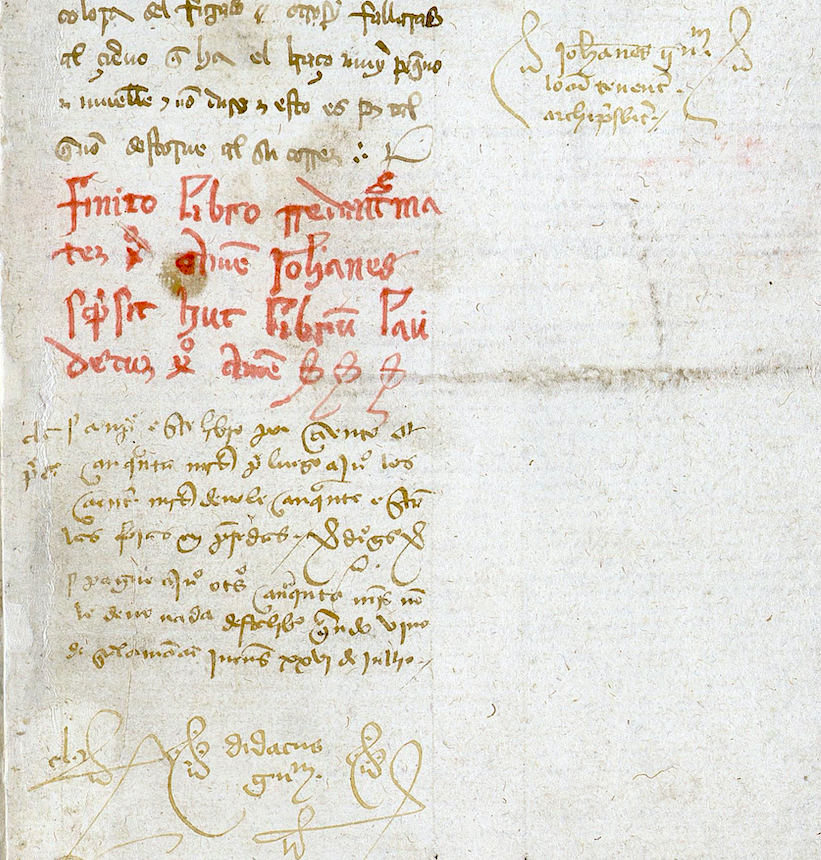
El testimonio B (Salamanca BU Ms. 1958 [BETA manid 1433]) fue durante largo tiempo considerado de este siglo, pero sus filigranas y la letra empleada –muy similar a la cancilleresca– apuntan que fue producido entre 1380 y 1410. Esto es reconfirmado por una nota de compra-venta en los últimos folios, acompañada por las firmas de sus antiguos posesores, dos maestros salmantinos de las primeras décadas del siglo XV. Didacus Gundisalvi, Diego González, catedrático de derecho en la Universidad de Salamanca hacia 1433, y un Johanes Gundisalvi, locum tenentem archipresbiter, que bien podría ser Juan González de Segovia, catedrático de derecho canónico, teólogo y representante de Juan II en el Concilio de Basilea.

Imagen 2. Detalle del fol. 104r del ms. 1958 de la Biblioteca General Histórica de la Universidad de Salamanca

Manuscritos hispánicos en colecciones europeas

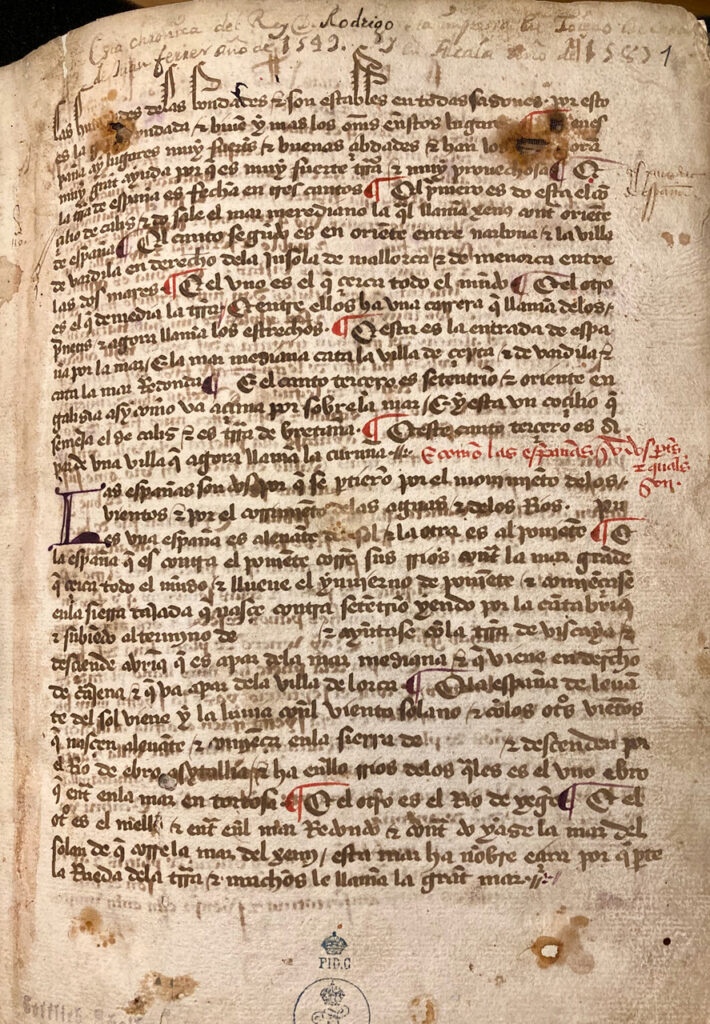
Un manuscrito recientemente redescubierto por Cossío Olavide y Romera Manzanares (“Nuevos testimonios”) es el Series Nova 12736 de la Biblioteca Nacional de Austria (BETA manid 6409), que transmite un testimonio parcial de la mal llamada Crónica del moro Rasis (BETA texid 1400) y de la Crónica sarracina (BETA texid 1462) de Pedro de Corral, datado entre 1460 y 1480.

Fol. 1r del ms. Series Nova 12736 de la Österreichische Nationalbibliothek
Imagen 3. Fol. 1r del ms. Series Nova 12736 de la Österreichische Nationalbibliothek

Además de estos textos, el manuscrito vienés transmite dos romances tempranos en el fol. 36r y la guarda pegada a la contratapa final: Virgilios y ¡Ay de mi Alhama! (o Paséabase el rey moro), según se dará cuenta en Cossío Olavide y Pichel (“Dos romances”).

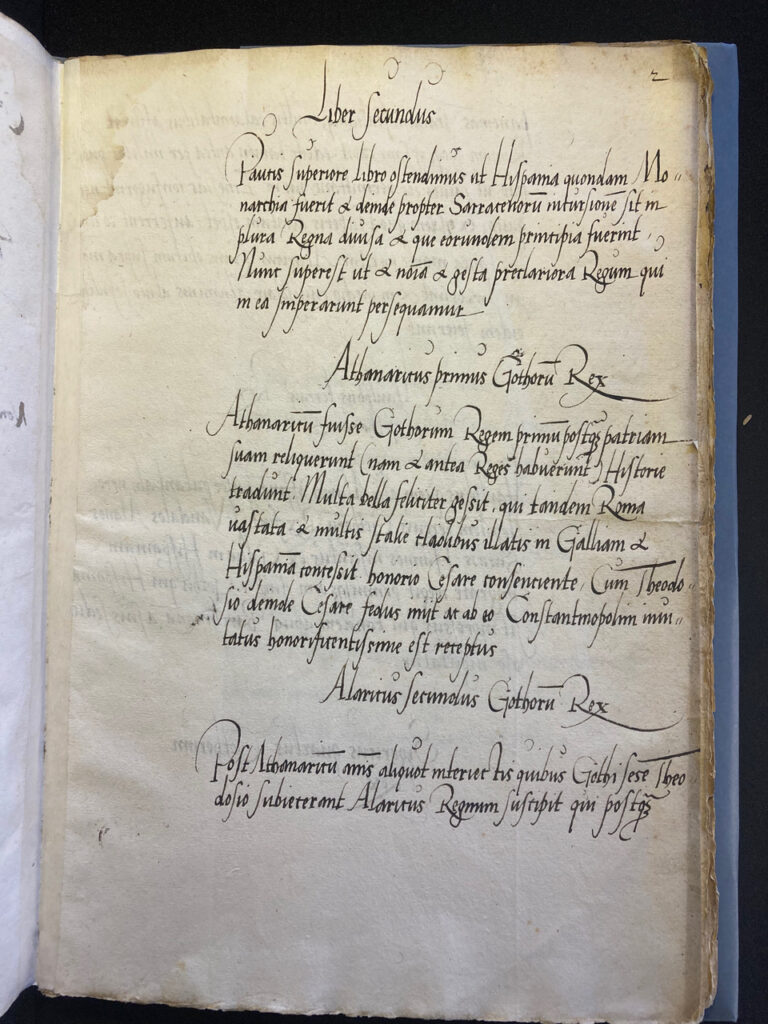
Otro texto de interés es el ms. 9221 de la misma biblioteca, un manuscrito facticio con doble numeración que transmite un repertorio de inscripciones sepulcrales alemanas (fols. 1r-73r) y un breve texto latino de formato analístico sobre los reyes visigodos (fols. 1rbis-10rbis). Aunque se trata de una copia del siglo XIX, parece estar vinculado con el Cronicón de Cardeña.

Fol. 2r-bis del ms. 9221 de la Österreichische Nationalbibliothek
Imagen 4. Fol. 2r-bis del ms. 9221 de la Österreichische Nationalbibliothek

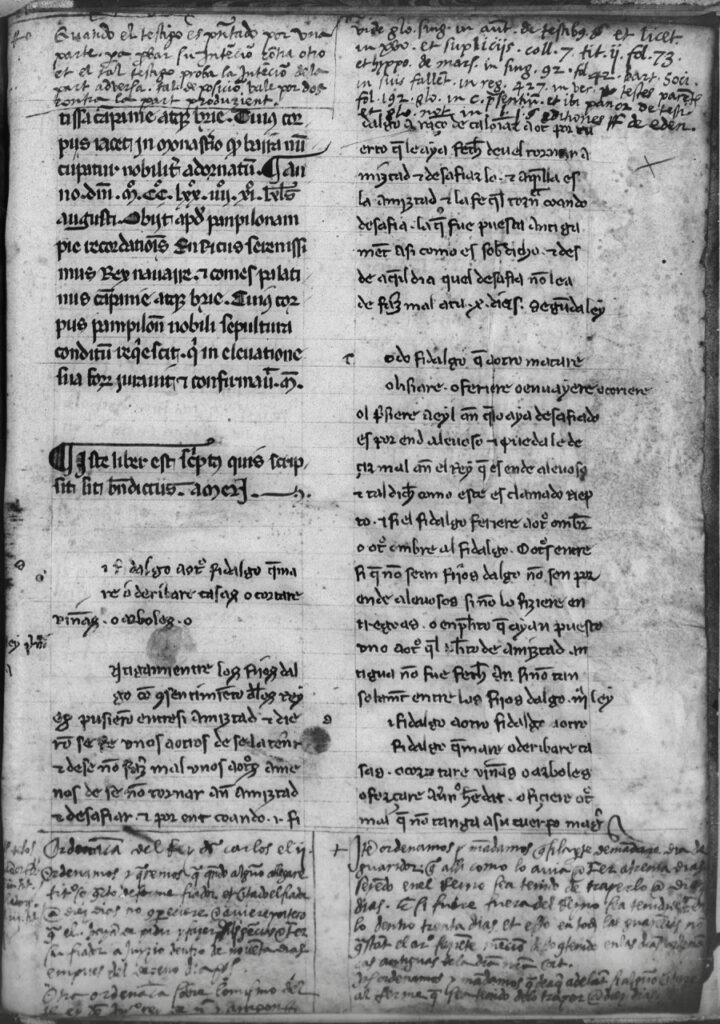
El manuscrito B702 de la Biblioteca Nacional de Suecia (BETA manid 4469) transmite la versión C del Fuero general de Navarra (BETA texid 1195), ampliado con disposiciones y textos legales añadidos, como el Amelloramiento de Philippe d’Evreux III (BETA texid 3192), estructura compartida por otros testimonios del fuero (BNE MSS/248 [BETA manid 1370] y MSS/ 6705 [BETA manid 3392], Biblioteca Regionale Universitaria di Catania ms. U009 [BETA manid 4600] y Real Biblioteca ms. II/1872 [BETA manid 3242]). Como estos, transmite en los fols. 114r-116v, una interpolación navarro-aragonesa del título de los retos del Fuero Real (libro 4, título 19), incorporada para cubrir un vacío legal en materia de justicia nobiliaria del Fuero general (véase Utrilla Utrilla, “Las interpolaciones” y Fradejas Rueda, “Una decepción”).

Fol. 114r del ms. B702 de la Kungliga Biblioteket, Estocolmo
Imagen 5. Fol. 114r del ms. B702 de la Kungliga Biblioteket, Estocolmo


Referencias

Cossío Olavide, Mario y Ricardo Pichel. “Dos romances tempranos en un manuscrito historiográfico del siglo XV: ¡Ay de mi Alhama! y Virgilios (con una nota sobre la lectura del Amadís primitivo).” Actas del VIII Congreso Internacional de la Asociación Convivio, en prensa.

Cossío Olavide, Mario. “D (RAE 15).” Lucidarios. Editando el Lucidario de Sancho IV. 18/01/2023, https://lucidarios.hypotheses.org/testimonios/d

_____. “Un nuevo manuscrito (Rouen, Bibliothèque municipale Villon ms. A283) y una nueva edición del Lucidario de Sancho IV.” e-Spania, vol. 44, 2023. https://doi.org/10.4000/e-spania.46735

_____. “Un nuevo testimonio del Lucidario: I.” Lucidarios. Editando el Lucidario de Sancho IV. 26/05/2023, https://lucidarios.hypotheses.org/2807

Fradejas Rueda, José Manuel. “Una decepción y un hallazgo. Una nueva copia del Fuero de Navarra.” Las Siete Partidas del Rey Sabio: una aproximación desde la filología digital y material, editado por José Manuel Fradejas Rueda, Enrique Jerez y Ricardo Pichel, Iberoamericana, 2021, pp. 138-43. https://doi.org/10.31819/9783968691503-011

Omont, Henri, editor. Catalogue général de manuscrits des bibliothèques publiques de France. Départaments, t. I. Rouen, Imprimerie nationale, 1886.

Paz y Meliá, Antonio. Series de los más importantes documentos del Archivo y Biblioteca del Excelentísimo Señor Duque de Medinaceli. 2 vols. Imprenta alemana e Imprenta de Blass, 1915-1922.

Romera Manzanares, Ana y Mario Cossío Olavide. “Vieron el escrito y mostráronlo. Nuevos testimonios de la Crónica del moro Rasis y de la Crónica sarracina.” Revista de literatura medieval, vol. 34, 2022, pp. 249-68. https://doi.org/10.37536/RLM.2022.34.1.87619

Utrilla Utrilla, Juan. “Las interporlaciones sobre reptorios en los manuscritos del Fuero general de Navarra.” Prínicpe de Viana. Anejo, no. 2-3, 1986, pp. 765-76.