As UC Berkeley’s new academic year gets underway, the Library’s Scholarly Communication & Information Policy office stands ready to guide faculty, students, and staff through the complexities of copyright law and academic publishing. Through digital resources, virtual workshops, and one-on-one consultations, we’re excited to share what this semester has in store.
Workshops
Copyright and Your Dissertation
Date/Time: Tuesday, September 16, 2025, 11:00am–12:00pm RSVP to get the Zoom link
This workshop will provide you with practical guidance for navigating copyright questions and other legal considerations for your dissertation or thesis. Whether you’re just starting to write or you’re getting ready to file, you can use our tips and workflow to figure out what you can use, what rights you have as an author, and what it means to share your dissertation online.
Managing and Maximizing Your Scholarly Impact
Date/Time: Tuesday, October 14, 2025, 11:00am–12:00pm RSVP to get the Zoom link
This workshop will provide you with practical strategies and tips for promoting your scholarship, increasing your citations, and monitoring your success. You’ll also learn how to understand metrics, use scholarly networking tools, and evaluate journals and publishing options.
From Dissertation to Book: Navigating the Publication Process
Date/Time: Tuesday, November 18, 2025 (11:00am–12:30pm) RSVP to get the Zoom link
Hear from a panel of experts—an acquisitions editor, a first-time book author, and an author rights expert—about the process of turning your dissertation into a book. You’ll come away from this panel discussion with practical advice about revising your dissertation, writing a book proposal, approaching editors, signing your first contract, and navigating the peer review and publication process.
Other ways we can help you
In addition to the workshops, we’re here to help answer a variety of questions you might have on intellectual property, digital publishing, and information policy.
Have a question about copyright and artificial intelligence (AI) in relation to research and scholarship? Or your rights and responsibilities in using library-licensed materials for AI use? View the AI page on our website for guidance.
Interested in publishing your research open access? UCB Library can help defray the costs of an article processing charge (up to $2,500) or book processing charge (up to $10,000). See the Berkeley Research Impact Initiative (BRII) for more information. And explore the various UC-wide open access agreements and discounts that can help UC corresponding authors publish their scholarship open access.
Do you want to create an open digital textbook? Take a look at UC Berkeley’s Open Book Publishing platform (anyone with a @berkeley.edu email can sign up for a free account).
Keep an eye on the Library’s events calendar for more workshops and trainings.
Want help or more information? Send us an email at schol-comm@berkeley.edu. We can provide individualized support and personal consultations, online class instruction, presentations and workshops for small or large groups & classes, and customized support and training for departments and disciplines.
A variety of UC Berkeley-authored books published open access.
UC Berkeley supports a variety of ways our authors can participate in open access publishing. At its heart, open access literature is “digital, online, free of charge, and free of most copyright and licensing restrictions” (Suber, 2019). Open access materials can be read and used by anyone.
But you might be wondering, why is UC Berkeley concerned about trying to make research more openly available and accessible? Well, one fundamental reason is that the research and teaching mission of the UC includes the aim of “transmitting advanced knowledge,” and as part of doing that, our faculty, researchers, and students create and share their scholarship.
This system of scholarly publishing includes traditional publications such as peer-reviewed academic articles, scholarly chapters or books, and conference proceedings. It also includes other types of publications such as digital projects, data sets and visualizations, and working papers.
In this blog post, we’ll provide an update on how the UC Berkeley Library is fostering open access book publishing. And we’ll also highlight the current progress on supporting OA publishing of scholarly articles.
Library Support for Open Access Books
We know that not all University of California authors are publishing journal articles, and many disciplines—such as arts, humanities, and social sciences—focus on the scholarly monograph as the preferred mode of publishing. Some open access book publishers charge authors (or an author’s institution) a fee in exchange for publishing the book open access, similar to the practice of academic journal publishers charging an “article processing charge” to make a scholarly article open access.
Book authors can realize a variety of benefits with open access publishing, including increasing the reach of their scholarship, building relationships within their academic discipline, garnering more citations, making their scholarly books more affordable for students, improving accessibility for print-disabled users, and more.
UC Berkeley is supporting authors who wish to publish their books open access. The library provides funding assistance and access to publishing platforms and tools for UCB authors to make their books OA.
Berkeley Research Impact Initiative books
The Berkeley Research Impact Initiative (BRII) is a program to foster broad public access to the work of UCB scholars by encouraging the Berkeley community to take advantage of open access publishing opportunities—including books and journal articles. BRII is the local open access fund that helps defray the costs associated with publishing open access books and research articles. For books, BRII can contribute up to $10,000 per book for it to be published open access. Below are recent UCB-authored books published with the assistance of BRII.
UC Berkeley Library continues to support open access book publishing via Luminos, the open access arm of the University of California Press. The Library membership with Luminos means that UC Berkeley authors who have books accepted for publication through the UC Press can publish their book open access with a heavily discounted book processing charge. When combined with additional funding support through BRII, a UC Berkeley book author could potentially publish their book open access with the costs being covered fully by the Library. Luminos books are published under Creative Commons licenses with free downloads.
Pressbooks platform & workshops
The UC Berkeley Library hosts an instance of Pressbooks (https://berkeley.pressbooks.pub/), an online platform through which the UC Berkeley community can create open access books, open educational resources (OER), and other types of digital scholarship. The Scholarly Communication & Information Policy (SCIP) office continues to offer an annual Pressbooks workshop and demo where participants can learn how to navigate the platform and create and publish their own eBooks and OERs.
UC contributing to the broader ecosystem of open access book publishing
A FY2024-25 goal of the UC Libraries is to strategically advance open scholarship by extending its support for OA book publishing. At the systemwide level, the UC is supporting several open access book publishing ventures, including Opening the Future, MIT’s Direct to Open, the University of Michigan Press’ Fund to Mission, the Open Book Collective, and more. These models secure investments from libraries and other stakeholders, and agree to publish some or all of their frontlist books open access, with limited or zero direct cost to the authors. The backlist books are made accessible to participating institutions.
The UC is also pursuing three pilot projects—with University of California Press, Duke University Press, and Oxford University Press—to enable the OA publication of UC-authored monographs. California Digital Library has also sponsored the opening of 35 UC-authored books included in the Big Ten Open Books collections.
Library Support for OA Journal Publishing
While the topic of this post focuses mainly on open access books, UC Berkeley (and the UC more generally) offers a wide range of support to help authors publish scholarly articles. The UC’s system wide Open Access Policies ensure that university-affiliated authors can deposit their final, peer-reviewed research articles into eScholarship, our institutional repository, immediately upon publication in a journal. Once they’re in eScholarship, the articles may be read by anyone for free.
As of August 2025, the University of California has 28 system-wide Open Access Publishing Agreements and Discounts with scholarly publishers. These agreements permit UC corresponding authors to publish open access in covered journals, with the publishing fees being covered in part (or in full) by the UC. In fiscal year 2024-25 UC Berkeley authors published 1,032 open access articles as a part of these system wide open access publishing agreements.
Locally, the UC Berkeley Library continues to offer the Berkeley Research Impact Initiative (BRII). This program helps UC Berkeley authors defray article processing charges (APCs) that are sometimes required to publish in fully open access journals (note that BRII doesn’t reimburse authors for publishing in “hybrid” journals—that is, subscription journals that simply offer a separate option to pay to make an individual article open access). This past year BRII provided funding for the publication of 44 open access articles. UC Berkeley authors can take advantage of BRII assistance where there is no other system wide open access agreement in place.
Wrapping up
In this post, we highlighted several ways that the University of California—and specifically UC Berkeley—is supporting scholarly authors to create and share open access books. In addition to providing financial assistance, platforms, and publishing guidance, the Library is committed to promoting the broader OA book publishing ecosystem. We’ll continue to explore a variety of approaches to support the UC Berkeley community (and beyond) who wish to publish books on open access terms.
If you’re interested to learn more about how you can create and publish an open access book, visit our website or send an email to schol-comm@berkeley.edu.
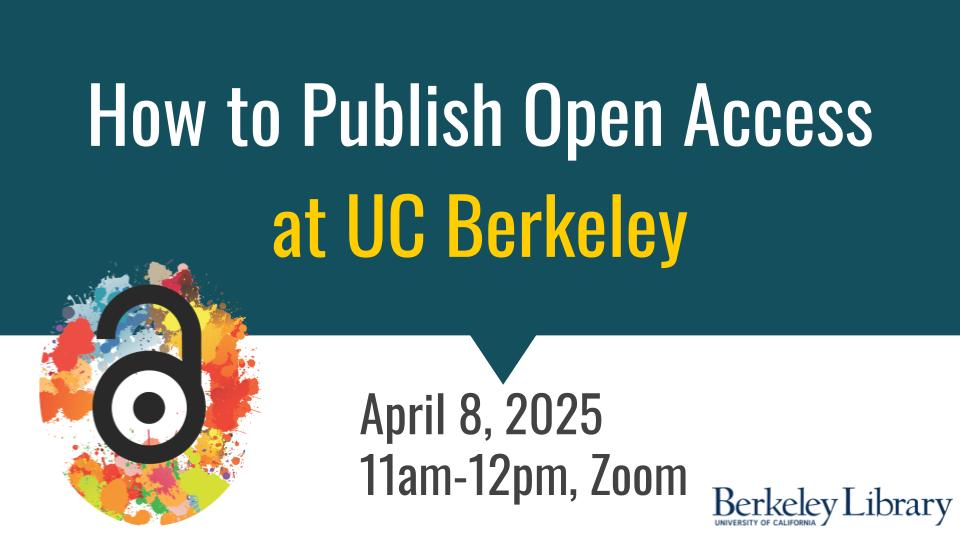
Date/Time: Tuesday, April 8, 11:00am–12:00pm Location: Zoom. RSVP.
Are you wondering what processes, platforms, and funding are available at UC Berkeley to publish your research open access (OA)? This workshop will provide practical guidance and walk you through all of the OA publishing options and funding sources you have on campus. We’ll explain: the difference between (and mechanisms for) self-depositing your research in the UC’s institutional repository vs. choosing publisher-provided OA; what funding is available to put toward your article or book charges if you choose a publisher-provided option; and the difference between funding coverage under the UC’s systemwide OA agreements vs. the Library’s funding program (Berkeley Research Impact Initiative). We’ll also give you practical tips and tricks to maximize your retention of rights and readership in the publishing process.