As UC Berkeley’s new academic year gets underway, the Library’s Scholarly Communication & Information Policy office stands ready to guide faculty, students, and staff through the complexities of copyright law and academic publishing. Through digital resources, virtual workshops, and one-on-one consultations, we’re excited to share what this semester has in store.
Workshops
Copyright and Your Dissertation
Date/Time: Tuesday, September 16, 2025, 11:00am–12:00pm RSVP to get the Zoom link
This workshop will provide you with practical guidance for navigating copyright questions and other legal considerations for your dissertation or thesis. Whether you’re just starting to write or you’re getting ready to file, you can use our tips and workflow to figure out what you can use, what rights you have as an author, and what it means to share your dissertation online.
Managing and Maximizing Your Scholarly Impact
Date/Time: Tuesday, October 14, 2025, 11:00am–12:00pm RSVP to get the Zoom link
This workshop will provide you with practical strategies and tips for promoting your scholarship, increasing your citations, and monitoring your success. You’ll also learn how to understand metrics, use scholarly networking tools, and evaluate journals and publishing options.
From Dissertation to Book: Navigating the Publication Process
Date/Time: Tuesday, November 18, 2025 (11:00am–12:30pm) RSVP to get the Zoom link
Hear from a panel of experts—an acquisitions editor, a first-time book author, and an author rights expert—about the process of turning your dissertation into a book. You’ll come away from this panel discussion with practical advice about revising your dissertation, writing a book proposal, approaching editors, signing your first contract, and navigating the peer review and publication process.
Other ways we can help you
In addition to the workshops, we’re here to help answer a variety of questions you might have on intellectual property, digital publishing, and information policy.
Have a question about copyright and artificial intelligence (AI) in relation to research and scholarship? Or your rights and responsibilities in using library-licensed materials for AI use? View the AI page on our website for guidance.
Interested in publishing your research open access? UCB Library can help defray the costs of an article processing charge (up to $2,500) or book processing charge (up to $10,000). See the Berkeley Research Impact Initiative (BRII) for more information. And explore the various UC-wide open access agreements and discounts that can help UC corresponding authors publish their scholarship open access.
Do you want to create an open digital textbook? Take a look at UC Berkeley’s Open Book Publishing platform (anyone with a @berkeley.edu email can sign up for a free account).
Keep an eye on the Library’s events calendar for more workshops and trainings.
Want help or more information? Send us an email at schol-comm@berkeley.edu. We can provide individualized support and personal consultations, online class instruction, presentations and workshops for small or large groups & classes, and customized support and training for departments and disciplines.
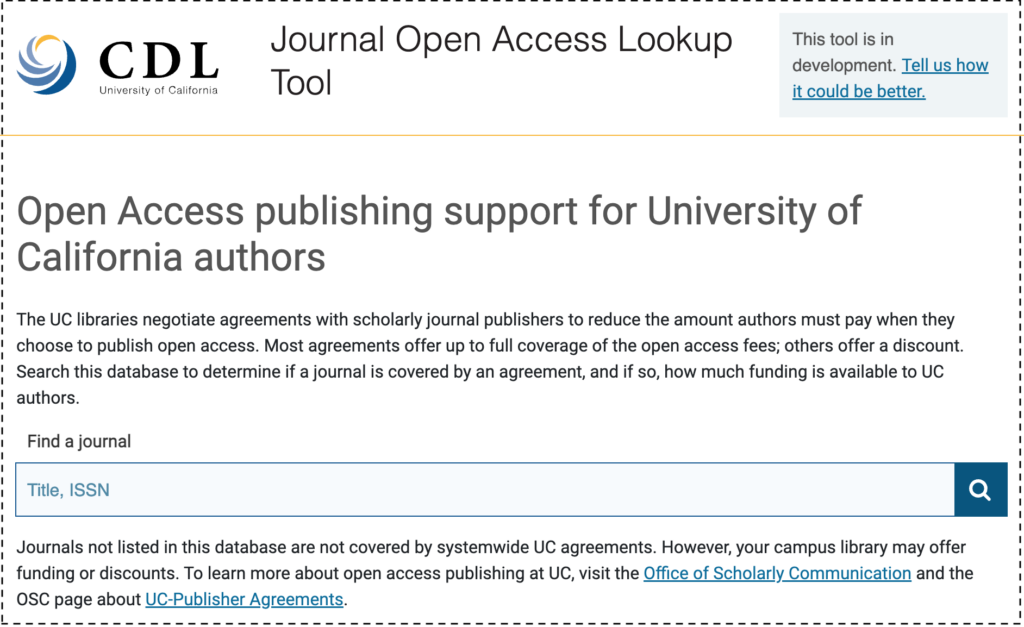
Today, California Digital Library launched the Journal Open Access Look-up Tool (JOLT).
What is it?
It’s a website (jolt.cdlib.org) that enables authors to search by a given journal title to determine whether it is eligible for financial support under one of UC’s systemwide open access publishing agreements. Recall that UC’s OA publishing agreements help defray the payment of open access fees in order to make UC scholarship freely available to readers around the world.
How does it work?
JOLT acts as a standard search bar. Users can search by journal title and ISSN. Journals with well-known abbreviations (e.g. “PLOS” for Public Library of Science) are searchable by their acronyms.
Journals in the search results will include one of three labels:
Full funding on request
Partial funding or discount
No support available
Clicking on a search result will expand it to reveal more details, including the specific level of funding provided, the publisher, and links to the agreement FAQ and payment workflow details on the Office of Scholarly Communication website. If a title search does not yield any results, it means the journal is not covered by an agreement.
Please contact the Scholarly Communication + Information Policy office at schol-comm@berkeley.edu if you have any questions.
This post provides information to UC Berkeley authors about programs that our Library and the UC system offer to help defray open access article processing charges. It also offers tips about how to plan or budget in advance for these fees when possible.
The University of California has been a long-time supporter of open access publishing—that is, making peer-reviewed scholarship available online without any financial, legal, or technical barriers. Just because the publishing outcome is open to be read at no cost, though, doesn’t mean the publishing enterprise as a whole is “free.” One of the most common ways for open access publishers to continue to finance their publishing and production of journals in the absence of selling subscriptions for access is to instead charge authors a fee to publish—moving from a publishing system based on paying to read to one based on paying to publish. Of course, not all methods of funding open access require authors to pay publication fees in this way. And in all cases (except those rare instances in which a publisher requests that you waive this right), the UC’s open access policy makes it possible for UC authors to share their author-accepted manuscript version of their articles on eScholarship, the UC’s research repository, immediately upon publication in a journal.
But when a publisher does charge a fee to publish, we want to help you understand what UC Berkeley resources are available—whether from your grant funds or the University of California Libraries—to help with those costs.
Typically publishers refer to author-facing fees as “article processing charges”, or “APCs”. APCs can range from a few hundred dollars all the way up to $10,000 or more for some select Nature journals.
UC authors may be able to cover or contribute to these fees by leveraging research accounts or grant funds (to the extent available). But there are also other University Library programs available to support payment when research accounts or grant funds are not available.
UC-wide open access publishing agreements will cover some (or all) APCs
UC corresponding authors can take advantage of funding opportunities to defray the cost of publishing their scholarship open access where their grant or other research funds come up short or are not available. The University of California libraries have entered into a growing number of systemwide transformative open access agreements with publishers. UC libraries’ transformative agreements aim to transform scholarly publishing by moving from a publication model based on subscription access to an open access model.
When a UC-affiliated corresponding author has an article accepted for publication in a journal with which the UC has an open access publishing agreement, the UC libraries will pay some or all of the associated publishing fee. So, when it comes time to pay the APC, the UC libraries will pay at least the first $1,000. If there’s any remaining balance due on the APC, the publisher’s payment system will ask if the UC author has grant funding available to cover the remainder. If the UC author cannot contribute the remaining balance, the UC libraries will pay the entire APC on their behalf. (Note: there are a few instances where the UC libraries will contribute a maximum of $1,000 toward the APC, such as Nature-branded titles.)
The UC maintains an updated list of Publisher OA Agreements and Discounts where you can explore which journals are available for partial or full APC coverage under the open access agreements.
The UC Berkeley Library-specific fund can reimburse open access fees for other fully open access journals
UC Berkeley’s Library also has a campus open access fund that UCB authors can use if they are publishing in a fully open access journal and are required to pay an APC. The Berkeley Research Impact Initiative (BRII) is open to any current UC Berkeley faculty, graduate student, postdoc, or academic staff who does not have other sources of funds to pay article processing charges. The BRII fund is available for journals other than those with which the UC has entered into a systemwide transformative open access agreement.
For BRII APC coverage to apply, the entire journal must be freely available to the public without subscription fees. BRII cannot cover fees for publishing in “hybrid” OA journals—which are subscription-based journals that only offer open access options if an author decides to pay an additional fee to make their individual article open access. BRII reimbursements are capped at $2,500 per article, and a UC Berkeley author can use BRII funds once per fiscal year.
How to plan in advance
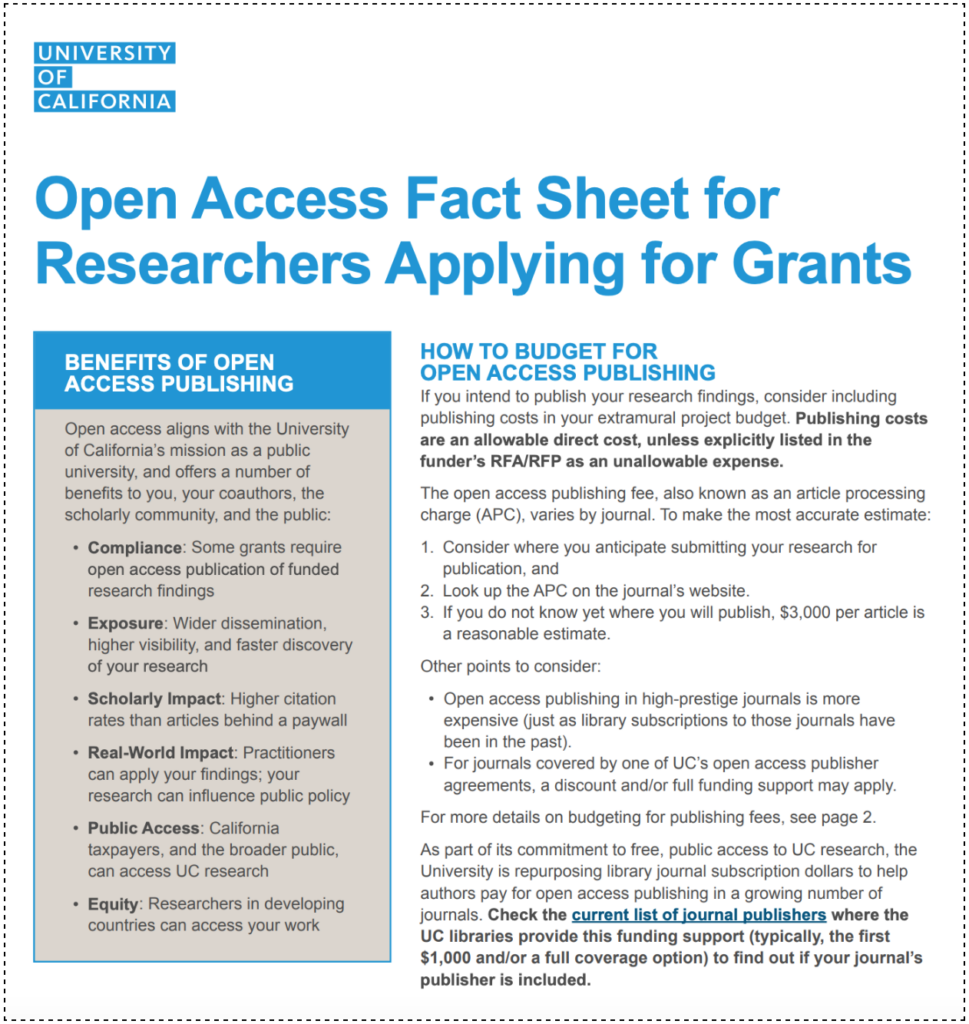
If your research is grant funded, it is important to think about publishing costs at the beginning of your research cycle and account for them in your grant applications and annual research budgeting. For grant recipients (such as researchers with funding from NIH, NSF, etc.), open access publishing costs generally are considered an allowable direct expense unless funders explicitly prohibit them. For more information on how and why to plan in advance, check out the Open Access Fact Sheet for Researchers Applying for Grants.
Click the image above to view the full guide “Open Access Fact Sheet for Researchers Applying for Grants”
Planning in advance allows you to be a partner in the publishing process. It allows the UC libraries to cover some of your article processing charge ($1,000) and, where possible, you to use grant or research funds to cover the rest. The more researchers are able to contribute, the farther the UC agreements can go in publishing more articles open access, and the better UC libraries are able to help provide financial support to researchers who do not have specific access to grant funds.
Most of the UC transformative open access agreements are set up to cover the full article processing charge should UC authors not have research or grant funds to contribute to making their journal articles open access. But there are a few journal titles and series within transformative agreements for which the libraries were unable to negotiate full coverage. For example, if a UC author has an article accepted in Nature Communications, the UC libraries cover only the first $1,000 of the article processing charge through the terms of the UC-Springer Nature transformative open access agreement. Since the current APC for Nature Communications is $6,290, then the UC author must pay the remainder of the fee ($5,290).
Another instance in which an author may need to pay a balance is when the author is publishing in a fully-open access journal not covered by a transformative agreement at all, and in turn when that journal’s article processing charge exceeds what can be covered through the BRII program. For instance, if a UC Berkeley author has an article accepted for publication in JAMA Network Open, the BRII program is capped at covering $2,500 of the article processing charge. Since the APC for JAMA Network Open is $3,000, then the UC Berkeley author must pay the remainder of the fee ($500).
Since both of the examples above are journals in which an APC is required in order to publish there, authors are responsible for securing the remainder of any publishing fees should the open access publication costs exceed the amount of UC libraries (or UC Berkeley Library’s) support.