Publisher Highlight: Kaya Press

Kaya press banner showcasing six colorful book covers
Tiger head with cigar logo
2025 Logo for Kaya Press

Kaya Press (https://kaya.com/) has been making space for voices in the Asian and Pacific Islander diasporic writers in the United States since 1994, when it was founded in New York City. Establishing itself as a “premier publisher of cutting-edge” literature, the Press moved to in USC Dornsife’s Department of American Studies and Ethnicity in Los Angeles in 2012 where it has continued releasing phenomenal material.[1]

The Press not only releases excellent novels and poetry, but also participates in book fairs, contributes to community activity, hosts author readings, and more.[2] Readers can find information about their events on their Instagram page.

Recent Kaya Press Books at UC Berkeley

Finding Kaya Press Books at UC Berkeley

You can find the majority of the Press’ catalog through the (UC Library Search) and access them in either in the UC Berkeley Main Stacks or the Ethnic Studies Library’s shelves.

Google map highlighting Ethnic Studies Library and Doe Library
Red points show Doe Library and the UC Berkeley Ethnic Studies Library building locations. Check out the UC Berkeley Library locations and Affiliate Libraries as a Google Map.

Endnotes

[1] “Kaya Press Moves from New York to USC Dornsife,” News and Events (blog), February 22, 2012, https://dornsife.usc.edu/news/stories/kaya-press-moves-from-new-york-to-usc-dornsife/.

[2] “About,” Kaya Press, accessed May 1, 2025, https://kaya.com/about/.


Documenting Italian-American Communities in California


Italians reading war news, North Beach, San Francisco
Photo by Harold Ellwood. Italians reading war news, North Beach, 1935. Fang family San Francisco Examiner Photograph Archive Negative Files. The Bancroft Library. UC Berkeley. BANC PIC 2006.029–NEG box 625, sleeve 092981_01

The UC Berkeley Library has rich collections pertaining to Italian-American communities in California. An online exhibition Italian Americans in California created in 2007 imparts little known facts about centuries of immigrants to the Golden State and is now archived on the Internet Archive’s Wayback Machine. Here are just a few from this marvelously researched exhibit:

  • Though small in number, Italians were some of the first European explorers and settlers of California. From 1687 to 1711, Father Eusebio Chino (probably pronounced Kee–no) traveled in northern Mexico and Lower California. He was the first person to prove that  Lower California was a peninsula, not an island. Other early Italian visitors to the shores of California were sailors and fishermen.
  • Though we often associate Italians in California with San Francisco, the initial Italian settlers established themselves in such diverse communities as Monterey, Stockton, and San Diego during the years of Spanish Rule. While the majority of Italians settled in the urban centers of the east, many, especially northern Italians came out west. As late as 1890, there were more Italian immigrants on the Pacific coast than in New England.
  • As early as the 1840s, settlers from Genoa began to arrive in the valleys of northern and central California after hearing their Ligurian (the region that includes Genoa) sailing relatives talk about how ideal the valleys were for vinting. Despite the fact that Liguria is not a major wine producing region in Italy, the wine industry in California was mostly built by Genoese.
  • The first significant wave of Italian immigrants came to California during the Gold Rush. Those who came quickly moved to buy land or work in service industries, rather than stay in the mines.
  • The majority of these Italian immigrants to California came from northern Italy. They began building communities, introduced Italian Opera to California in 1851, and founded an Italian language newspaper in San Francisco as early as 1859. Amadeo Giannini founded what became the Bank of America, first known as the Bank of Italy, in 1904 as a way for Italian immigrants to save and borrow small amounts, but the genius of his bank was the first use of branches put in locations closer to his customers.
  • The aftermath of the Gold Rush brought even more northern Italians to California. The ostentatious wealth of those who succeeded during the Gold Rush years brought with it a demand for stone and marble cutters from Italy to work on the mansions of the newly rich. The fishing grounds and warm climate began to attract Sicilian fishermen, especially in the Bay Area and San Diego.
  • San Francisco’s Little Italy bounced back from the 1906 earthquake in better shape than ever. At the same time, Italian immigrants had established themselves as the primary fishermen in the San Francisco Bay, and as a major agricultural force as well. Some children of the first wave of immigrants were coming of age in the 1900s to the 1930s, and these achieved greater success than their parents in law, politics, business, and agriculture, especially wine. 
  • The cultural contributions of generations of Italian Americans in San Francisco in particular is impressive. Writers such as Lawrence Ferlinghetti, Gregory Corso, Diane di Prima, Philip Lamantia and others fostered the Beat movement in the post-World War II years, rebelling against the conventions of mainstream American life (consumerism, racism, homophobia, etc.).

From Doe Library’s collection in the Main Stacks and NRLF, here are some noteworthy publications:

At the play [portraits of prominent San Franciscans, California]
Garibaldi, C. G. (active ca. ). At the Play [Portraits of Prominent San Franciscans, California]. Robert B. Honeyman, Jr. Collection of Early Californian and Western American Pictorial Material. The Bancroft Library. UC Berkeley. BANC PIC 1963.002:0501–E
Select Finding Aids from The Bancroft Library

Early California Italian-American Newspapers in The UC Berkeley Library

  • ll Corriere del Popolo. San Francisco, CA: Pedretti Bros., 1914-1943, 1948-1967 (lacks issues)
  • L’Eco d’Italia. San Francisco, CA: Pierino Mori, 1966-1980.
  • L’Italo-Americano. Los Angeles, CA: Scalabrini Fathers, 1985-2016. Online archive for 2012-present available via UCB only. Former titles: Eco d’Italia and Italo-Americano di Los Angeles
  • La Voce del Popolo. San Francisco, CA, 1868-1939.
Italian fisherman with no crabs at Fisherman's Wharf.
Italian fisherman with no crabs at Fisherman’s Wharf. Fang family San Francisco Examiner Photograph Archive Negative Files. The Bancroft Library. UC Berkeley. BANC PIC 2006.029–NEG box 644, sleeve 093662_02

See also the website for the Museo Italo Americano in San Francisco.


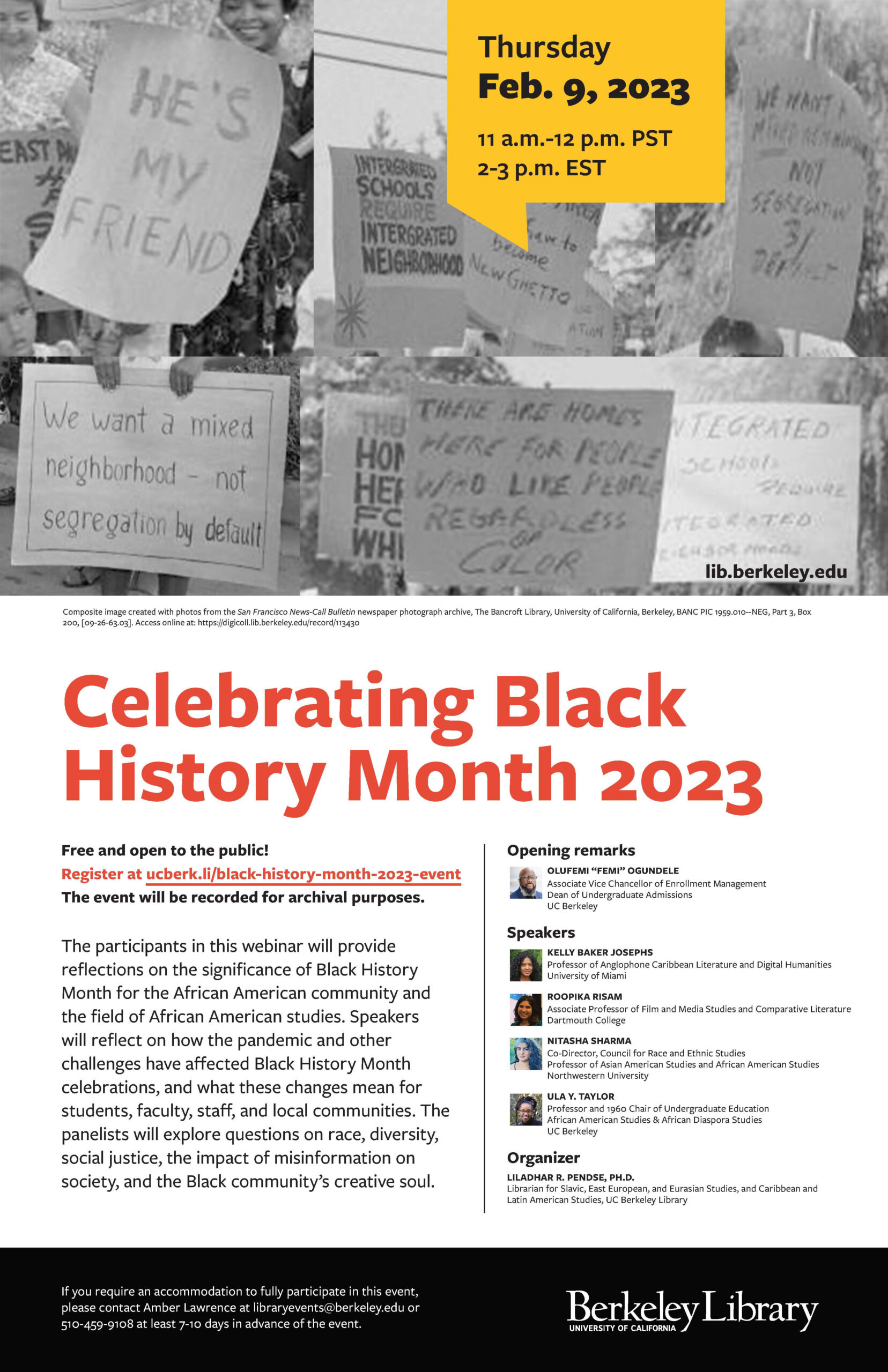
Black History Month Celebration at UC Berkeley Library on Thursday, February 9, 2022 (11 am to noon PST)

Date: February 9th, 2022 

Day: Thursday

Time: 11 am to 12 noon PST

Please register here: http://ucberk.li/black-history-month-2023-event

Opening Remarks:

Olufemi “Femi” Ogundele

Associate Vice Chancellor of Enrollment Management

Dean of Undergraduate Admissions

Confirmed Speakers:

Professor Ula Y. Taylor 

Professor & 1960 Chair of Undergraduate Education

African American Studies and African Diaspora Studies, UC Berkeley

Professor Nitasha Sharma

Director, Asian American Studies Program; Co-Director, Council for Race and Ethnic Studies

Professor of Asian American Studies and African American Studies at Northwestern University

Associate Editor, American Quarterly

Professor Roopika Risam

Associate Professor of Film and Media Studies and Comparative Literature at Dartmouth College, where she is part of the Digital Humanities and Social Engagement Cluster.

Professor Kelly Baker Josephs

Anglophone Caribbean Literature and Digital Humanities, Department of English, University of Miami

Both Professors Risam and Josephs will speak about the Digital Black Atlantic project.