“I Am Your Brother”: The Pain and Uncertainty of Distance in the Ancient World (P.Tebt. II 583)

by Morgan Koo

Morgan Koo is a senior at UC Berkeley double majoring in History and Ancient Greek and Roman Studies. While her main interests lie in late Second Temple Judaism and early Christianity, Morgan also enjoys the sociocultural aspects of the Ancient Mediterranean such as ancient seafaring & communication.

Life in the 21st century has unparalleled luxuries which ease the pain and inconvenience of distance. Improved technology allows for instantaneous communication with loved ones and relatively quick travel over large distances. Homer’s Odyssey, which has recently experienced a renewed relevance, reminds modern readers of the difficulties of being away from home. For ancient peoples, seafaring was often dangerous—even without the interference of angry deities determined to thwart their homecoming. There was the constant threat of unpredictable and harsh weather patterns, encounters with pirates, and arrival in foreign lands with potentially hostile inhabitants. Much like Odysseus’ frequent invocations of the gods during harsh storms and disembarkation in strange, new lands, a second century C.E. soldier’s letter written on papyrus thanks Lord Serapis, a syncretic Greco-Egyptian deity, for having saved him from danger out at sea (“I thank Lord Serapis that when I was in danger at sea he saved me straight away,” εὐχαριστῶ τῷ κυρίῳ Σεράπιδι ὅτι μου κινδυνεύσαντος εἰς θάλασσαν ἔσωσε εὐθέως: BGU II 423, lines 6-8). However, another letter on papyrus (P.Tebt. II 583) which found its way back home to Tebtunis, a village in Egypt, reveals another pain caused by the uncertainty of distance.

A tan papyrus with cursive greek writing on it on a white background
(P.Tebt. II 583)

Sometime after 217 C.E., Aurelius Polion, a soldier in the Roman army’s Second Adriutrix Legion, wrote back home to his family in Tebtunis (full text here). The central concern of the letter is his family’s silence despite his own devotion to them. Accusatory superlatives and juxtapositions pervade the beginning portion of the letter to express his incessant concern for his family in contrast to their complete absence: 

Superlative/Juxtapositional Language in Aurelius Polion’s Letter

Aurelius Polion:

  • prays for family’s health day and night (ν̣υκτ̣ὸς̣ κ̣α̣ὶ̣ [ἡ]μ̣[έρα]ς̣, line 5)
  • always (πάντοτε) makes worship to all (πᾶ̣σ̣ι) the gods for them (line 5-6)
  • writes his letters at all times (πάντοτε) and does not stop (οὐκ ἀναπάω̣μαι (= ἀναπαύομαι)) bearing them within his soul (line 6-8)
  • even while away in Pannonia, he continued to send letters often (π̣ο̣λλάκεις (= πολλάκις), line 12)
His Family: 

  • do not hold him in their mind (κατὰ νοῦ (= νοῦν) με οὐχ (= οὐκ) ἔχεται (= ἔχετε), line 7)
  • never (οὐ[δ]έ̣ποτέ̣) wrote to him about themselves (line 10)
  • never (οὐδέποτε) reply to his letters (line 13) 
  • consider Polion as a stranger (ὡς ξένον, line 15-16)

The troubled soldier illustrates the stark difference between his undying care and their apparent silence. Without any word back from home, the sense of estrangement appears particularly palpable.

While Polion complains about the injustice of his family’s silence, the letter also carries an underlying anxiety: 

“… ἐγὼ δ̣[ὲ] μεριμνῶ περ̣ὶ ἡ̣μῶν (= ὑμῶν) ὅτι λαβ̣όν̣<τες> ἀ̣[π’] ἐμοῦ γράμ̣ατα̣ (= γράμματα) π̣ο̣λλάκεις (= πολλάκις) οὐδέποτέ μοι ἀντ[ε]γράψατε εἵνα (= ἵνα) εἰδώ̣[τ]ε̣ς (= εἰδῶ) πῶς ἡμᾶς (= ὑμᾶς) …” (lines 11-13).
“… And I am worried about you because, although you received letters from me often, never do you write back to me in order that I might know how you are …” (lines 11-13).

The soldier subsequently reveals that he had previously sent six other letters (line 20). Being far from home, the uncertainty of his family’s well-being torments his mind. The soldier was left isolated without any comfort by reply. One could imagine the questions pervading the soldier’s conscience: Was his family intentionally ignoring him? Did something cause them to be unable to write? Were they alive and well? In any case, the uncomfortable silence roused the soldier to threaten his family with a return home:

“ … ἠ δὲ ὑμεῖς

με κατὰ νοῦ μ[ὴ ἔχοι]τε, λήψωμαι (= λήψομαι) κομείατον (= κομμεᾶτον) πα-

[ρὰ] τοῦ ὑπατεικοῦ (= ὑπατικοῦ), καὶ ἐλεύσομαι πρὸς ὑμᾶς εἵνα (= ἵνα) εἰδῆ-

τε ἐμὲ εἶναι ἀδελφὸν ἡμῶν (= ὑμῶν) …” (lines 20-23).

“ … and if you (pl).

do not hold me in your mind, I will take a leave of absence from

the consular officer, and I will go towards you in order that you might know

me to be your brother …” (lines 20-23).

While framed as a trip to re-establish his role in the family, the urgency and drastic action suggest a need for assurance of his family’s presence and well-being. 

Among the most puzzling portions of the letter are lines 17-19, where the soldier reveals his involuntary participation in the army:

“ … ἐγὼ δὲ εἱμεῖν (= ὑμῖν) (sc. εἶπον)

τρ[έπ]ειν οὐκ ἑκὸν [. . .]πειατεις εἰς [τ]ὴν στρατείαν (= στρατίαν),

ἀλλὰ μετενό[ησ]α τῶν . ου ἐξῆλθα ἀφ’ ὑμῶν” (lines 17-19).

“ … And I (said) to you

That I did not go willingly …  into the army,

But I regretted that … I departed from you.” (lines 17-19).

The fragmented papyrus leaves much to the imagination. Under what circumstances did Aurelius Polion join the army? Was he forced by Roman officials? By his own family? Does this involuntary service have any relation to his anxiety regarding the family’s well-being or his inability to reach them? 

a timeline showing the major events relating the dating of P.Tebt. 583

Because Aurelius Polion’s letter was found in Tebtunis, we can ascertain that his letter did indeed arrive home. Letters from his family, in the most ideal circumstance, may have struggled to reach Polion. It was much easier for letters to be sent to a home—which is not subject to constant movement like an army. Thanks to the scholarship of István Kovács, we are able to approximate the letter’s date and locate the Legio II Adiutrix, the army legion that Polion joined. In lines 21-22 of the letter, Aurelius Polion mentions a consular officer from whom he plans to request a leave of absence. Pannonia had been under rule of praetorian governorship until 214 C.E. and was then under the authority of a consular officer. Thus, the letter must be written after 214 C.E. In line 12, Polion locates himself in Pannonia. Caracalla led the Legio II Adiutrix in a campaign against the Parthians between 214 and 217 C.E.; accordingly, the letter’s dating is extended to follow after 217 C.E.

The Greek historian Herodian recorded that Caracalla entered the Egyptian city of Alexandria around 215 C.E. to recruit additional soldiers for his phalanx against the Parthians. It is possible that Polion joined the army on this occasion. Additionally, both Cassius Dio’s Roman History and Herodian’s History of the Roman Empire document Caracalla’s massacre of Alexandrian men around 215 C.E. Such a violent event could be cause for concern. Unfortunately, this letter alone cannot give us clear answers.

What can be known is that communication with loved ones over long distances was often difficult. The sense of alienation could foster a natural anxiety. Stationed in Eastern Europe, Aurelius Polion was separated from his family by a vast sea in both the literal and metaphorical sense. In a manner much similar to this soldier’s, our temporal distance shrouds our ability to understand the reality of his circumstance. We cannot do much but wonder whether a letter was finally sent back to Polion or whether he made his journey home. And, if he did, what he may have found upon arrival.

Bibliography

Adamson, Grant. “A Letter from a Soldier in Pannonia,” BASP 49, 2012, pp. 79-94.

Herodianus. Roman History (History of the Empire from the Time of Marcus).* Livius: https://www.livius.org/sources/content/herodian-s-roman-history/  *see esp. 4.8-9.

Kovács, István. “Brief eines Legionärs aus Pannonien (P. Tebt. 2.583) Philologische und Gattungsanalyse,” Byzanz und das Abendland III. Studia Byzantino-Occidentalia, 2015, pp. 257-281.

Mócsy, András. Pannonia and Upper Moesia: A History of the Middle Danube Provinces of the Roman Empire. Sheppard Frere, transl. Routledge, 1974.

Ptolemaeus, Claudius. Geographica.* ToposText: https://topostext.org/work/209  *see esp. 2.14.1


Writing History: Undergraduate Research Papers Investigate Ancient Papyri

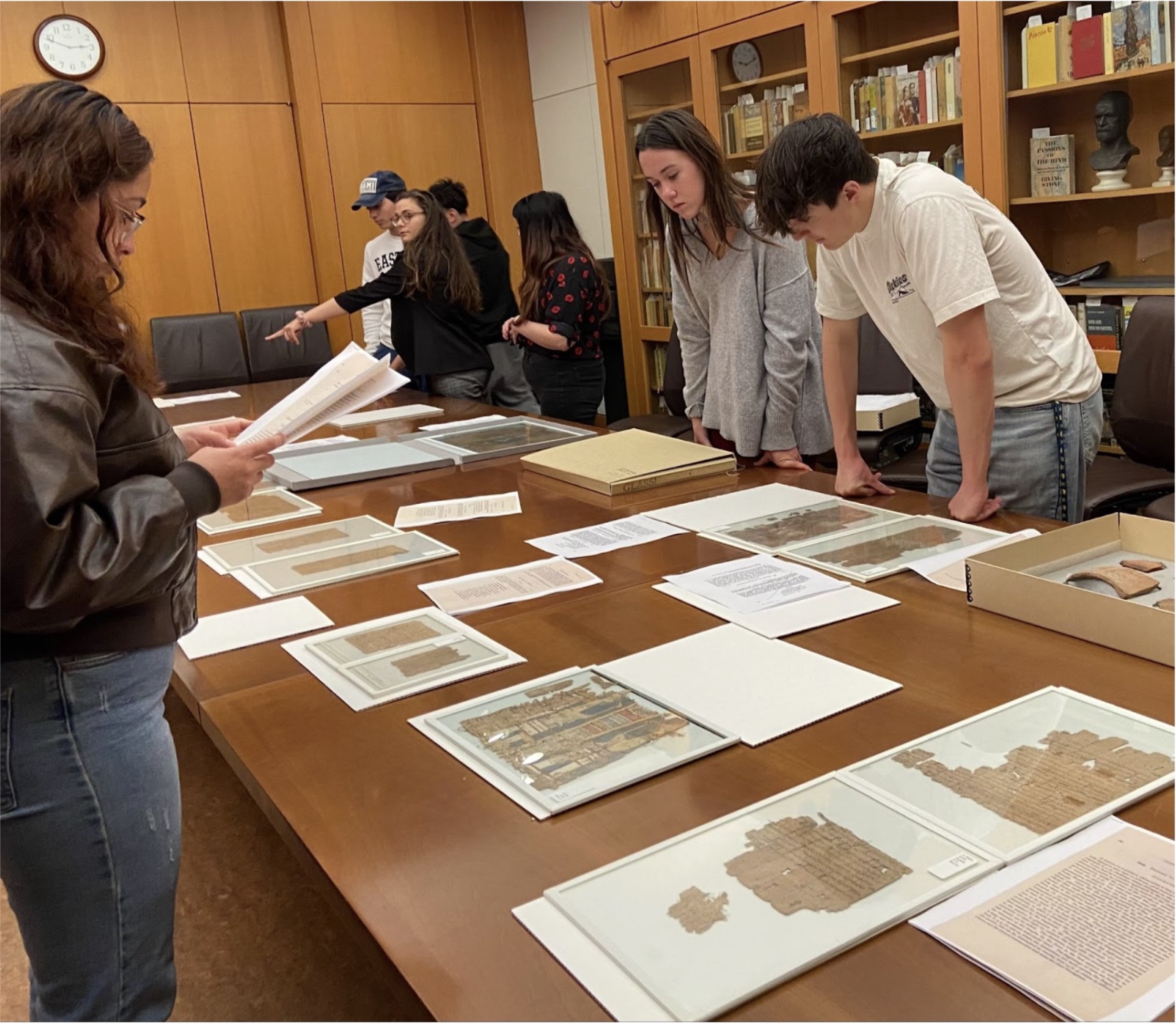
(Students examine papyri and ostraca during their class visit. Photo by Lee Anne Titangos.)

Writing History: Undergraduate Research Papers Investigate Ancient Papyri

Leah Packard-Grams, Center for the Tebtunis Papyri

This semester, students enrolled in the writing course “Writing History” (AHMA-R1B) got the chance to work as ancient detectives. As their instructor, I asked them each to write a research paper about one of the various ancient documents held in the Center for the Tebtunis Papyri in The Bancroft Library. After examining their options in a class visit, they each chose a papyrus or ostracon to write about. Students were given modern translations of the papyri and ostraca to read, making the ancient texts accessible.  

Students Use Interdisciplinary Approaches

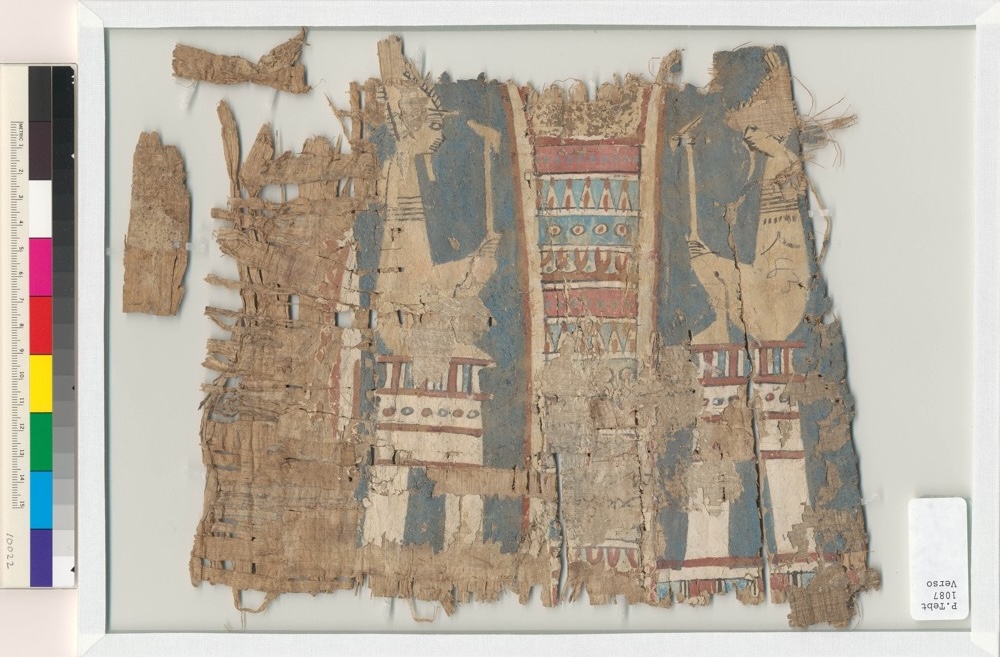
The papyri, ostraca, and artifacts from Tebtunis at UC Berkeley were excavated from the site in 1899-1900, and the material has been an asset for Berkeley’s research and teaching collections for over a century. However, with over 26,000 fragments of papyrus, about two dozen ostraca, and many artifacts in the Hearst Museum, there is still plenty of work to be done! Students noticed new things in these artifacts: senior Chloe Logan, for example, described the painting on the reverse side of an inscribed papyrus for the very first time; it had been ignored by scholars for decades despite several scholarly citations of the text on the other side. P.Tebt.1087 was used as part of mummy cartonnage, a sort of ancient papier-mâché that was painted to decorate the casing of the mummy. Cartonnage was made by gluing together layers of previously-used papyrus and then painting over the gessoed surface. Her paper examines both the painted side of the papyrus as well as the inscribed side. Using an art-historical approach for the painted side and an economic-historical approach to analyze the content of the financial account on the other side, she wrote an interdisciplinary study of the piece that considered both sides of the artifact, and considered this as an example of ancient recycling. 

P.Tebt.1087
(P.Tebt.1087 was used as part of mummy cartonnage, a sort of ancient papier-mâché that was painted to decorate the casing of the mummy. Photo courtesy of the Center for the Tebtunis Papyri, The Bancroft Library, UC Berkeley. https://digicoll.lib.berkeley.edu/record/231074?ln=en#?xywh=-255%2C-345%2C5081%2C3674 )
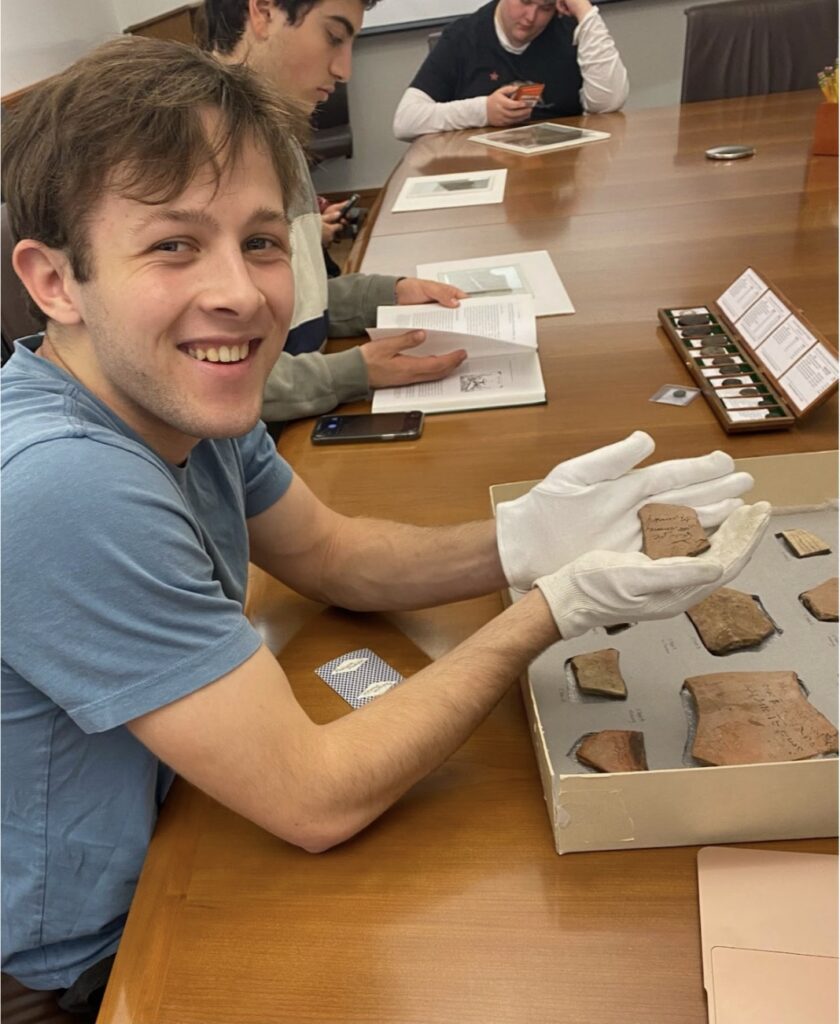
(Ian McLendon holds O.Tebt. 4, a receipt of beer. Behind him, Nicolas Iosifidis and Wilder Burke research and photograph papyri.)

Ian McLendon compared receipts and tags for beer on ostraca in the collection (an ostracon is a broken potsherd reused as a writing surface). His paper examined the ways beer was used in ritual dining in Tebtunis, and compared the types of documents that record the beverage’s use, cost, and delivery.  He even examined some ancient coins to see what it would have been like to pay for beer using drachmai and obols, the ancient currency in use in Ptolemaic Egypt.

Mastering Demons

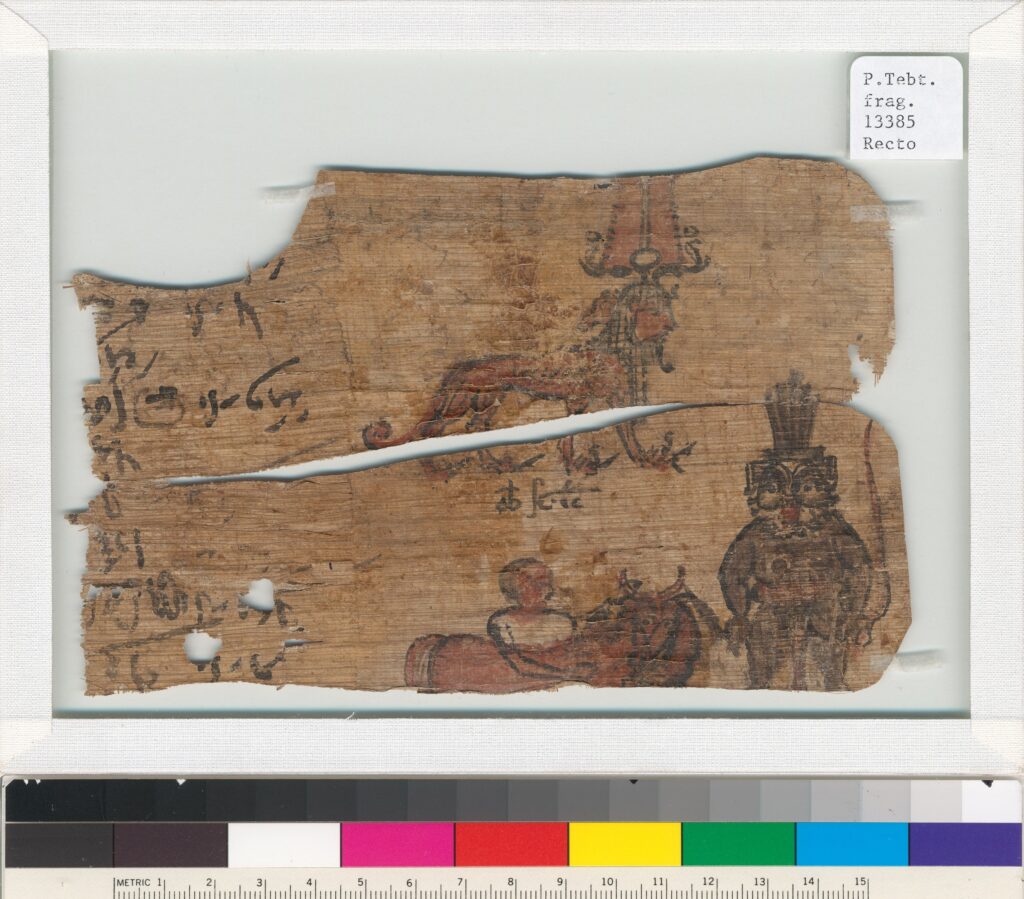
P.Tebt.frag. 13385
(P.Tebt.frag. 13385 is an illustrated papyrus depicting three deities. Tutu is depicted as a lion with a crowned, human head and having snakes and knives at his paws– powerful symbols meant to keep demons at bay. Photo courtesy of the Center for the Tebtunis Papyri, The Bancroft Library, UC Berkeley. https://digicoll.lib.berkeley.edu/record/231444?ln=en#?xywh=-419%2C-117%2C3234%2C2338 )

Nicolas Iosifidis was also inspired by an illustration on a papyrus. Tutu, the “master of demons,” was an apotropaic, protective deity in ancient Egypt who defended against forces of chaos who would do harm to humans. In the papyrus, he is depicted as having a human head, a leonine body, and has snakes and knives in his paws– perhaps even in place of his fingers! His headdress and double-plumed crown also contribute to the awe-inspiring effect of this formidable deity. Iosifidis sees Tutu as an opportunity to examine our deeper selves and master our own demons, asking the question, “Is there something else we can acquire from it [the papyrus] as did people back then?” His paper offers an analysis of the exact role of the master of demons, writing that “Tutu doesn’t protect by killing [demons], but rather controlling or taming them.” The god Tutu, for Iosifidis, represents the timeless struggle between “the good and the bad” that exists within us all.

Reading Between the Lines 

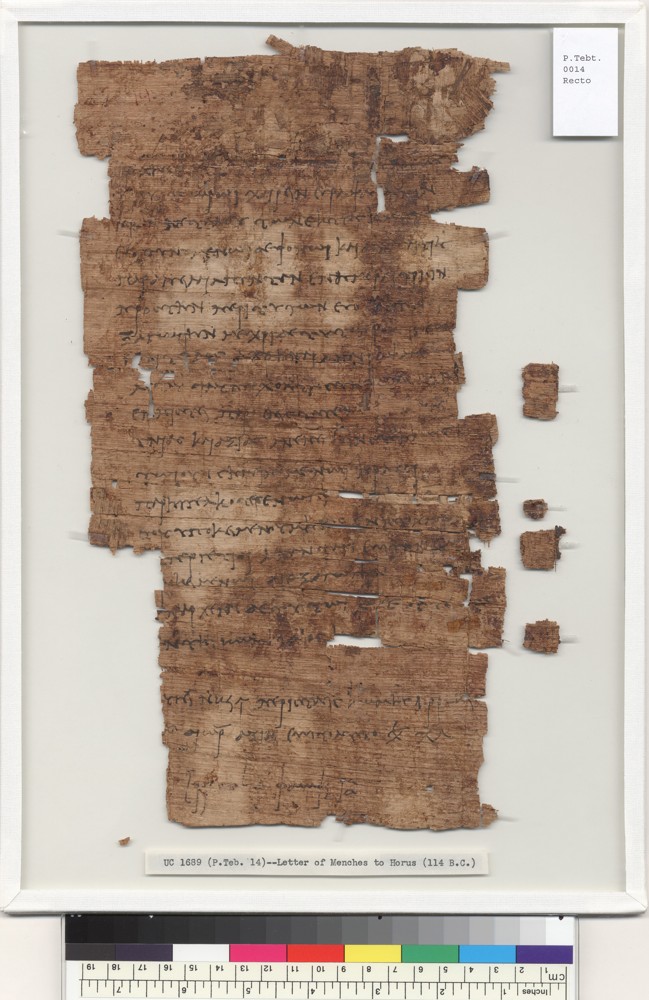
Reading their papers, I was struck in particular by the students’ enthusiastic comments on the significance of these papyri to broader human history. Alex Moyer chose a papyrus that dealt with the investigation into a murder that occurred in 114 BCE, observing that despite the unfortunate universality of homicide throughout human history, “What distinguishes each society from any other is their approach to investigating and handling murders.” His papyrus, P.Tebt. 1.14, is a letter from a village scribe that offers insight into the process of confiscating the property of an accused person until he can be tried and sentenced. Instead of apprehending him, the village scribe was instructed to “arrange for [his property] to be placed on bond” (lines 9-10). Moyer writes about the value of this papyrus as comparative evidence: “Due to the fair condition and legibility of the papyrus, it is able to act as a figurative time capsule, allowing us to compare and contrast with other societies, including our own, and view how human civilization’s attitude and handling of murders have changed over time.” 

P.Tebt. 1.14
(P.Tebt. 1.14, photo courtesy of the Center for the Tebtunis Papyri, The Bancroft Library, UC Berkeley. https://digicoll.lib.berkeley.edu/record/231712?ln=en#?xywh=-2051%2C-257%2C7104%2C5137 )

Victor Flores decided to write about the same papyrus, and was surprised at how this papyrus challenges our perception of the job of an “ancient scribe.” He writes, “These village scribes are not your ordinary scribes, but rather carry a distinct number of tasks like arranging for the bond in order for somebody to confiscate valuables along with carrying out a wide variety of administrative tasks for the government beyond simply writing.” The “village scribe” wasn’t simply a copyist or secretary as one might suppose, and this papyrus is good evidence that allows us to ascertain the roles of scribes!

Student Perspectives

Working with the papyri in The Bancroft Library, I have found that there is a feeling, almost indescribable, when you look at an ancient artifact and really take the time to appreciate what lies before you. Staring up at you is a ghost– a physical echo– that reverberates across the millennia. The artifact before you has survived by sheer luck, and we are fortunate that it remains at all. I tried to convey this to my students, and in their papers, I found that students wanted to write about what it was like to study the papyri up close. This was unprompted by me, and I was astounded at the care and reflection they undertook to share their own perspectives: 

Chloe Logan (class of 2024, writing about the cartonnage fragment): “I must remark how fortunate we are to have an incredible artifact in such good condition as a window to the distant past. I hope we will have more research on the verso side of this astonishing relic.” [Indeed, it is being studied by a scholar in Europe for publication soon!]

Ethan Schiffman (class of 2027): “I enjoyed visiting the Bancroft Library and seeing the large Tebtunis Papyrus collection. I can now better appreciate the magnitude of the time-consuming task of the care involved in preserving the fragile papyri and the difficulties in translating and editing these texts.”

John Soejoto (class of 2027): “By exploring each papyrus, even if only a vague or unproven hypothesis is formed, historians increase the existing body of knowledge and give the future academic community further means to discover the history of bygone ages.”

Wilder Brix Burke (class of 2027): “[Seeing the papyrus in person after studying it for so long] brought a new perspective, a real understanding of the physical lengths such a text had gone to simply exist before me, 2000 years (and some change) later. It also speaks to the impressive ability of UC Berkeley as a whole that undergraduate students get to observe the most unique and fascinating parts of campus. I am grateful for the opportunity to see history before my eyes. These are the moments that remind me why I am a CAL student. Go bears!”

P.Tebt. 1.33
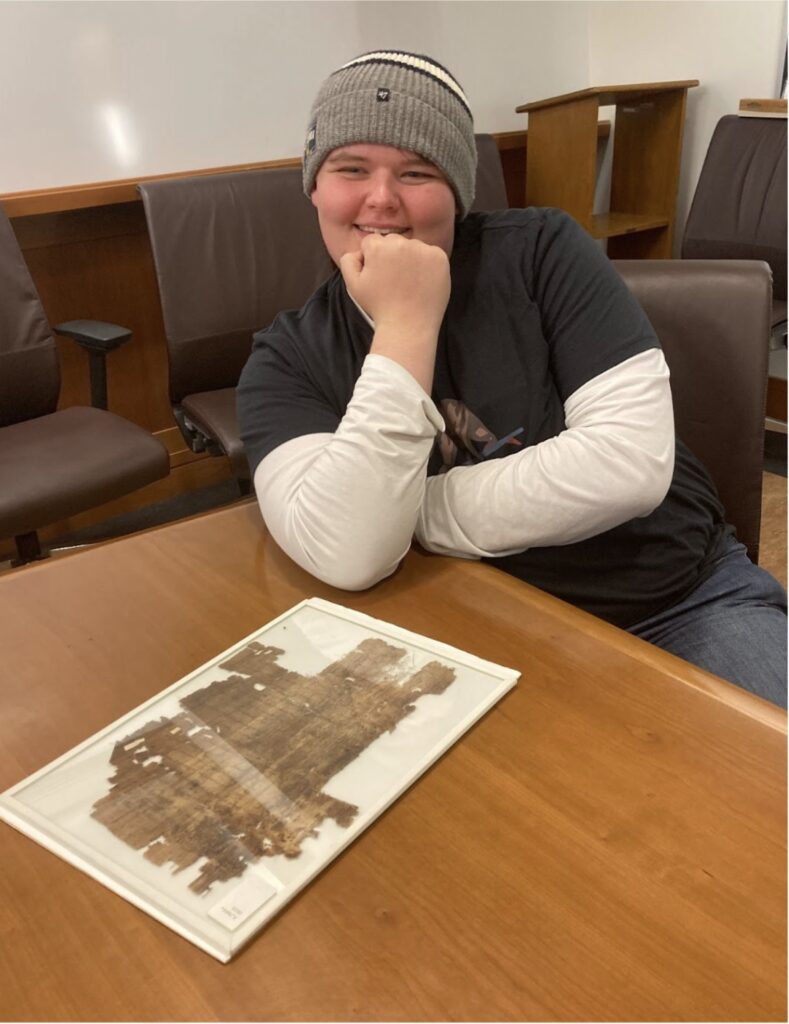
(Wilder Brix Burke poses with his chosen papyrus concerning the visit of a Roman senator to the town of Tebtunis, P.Tebt. 1.33.)