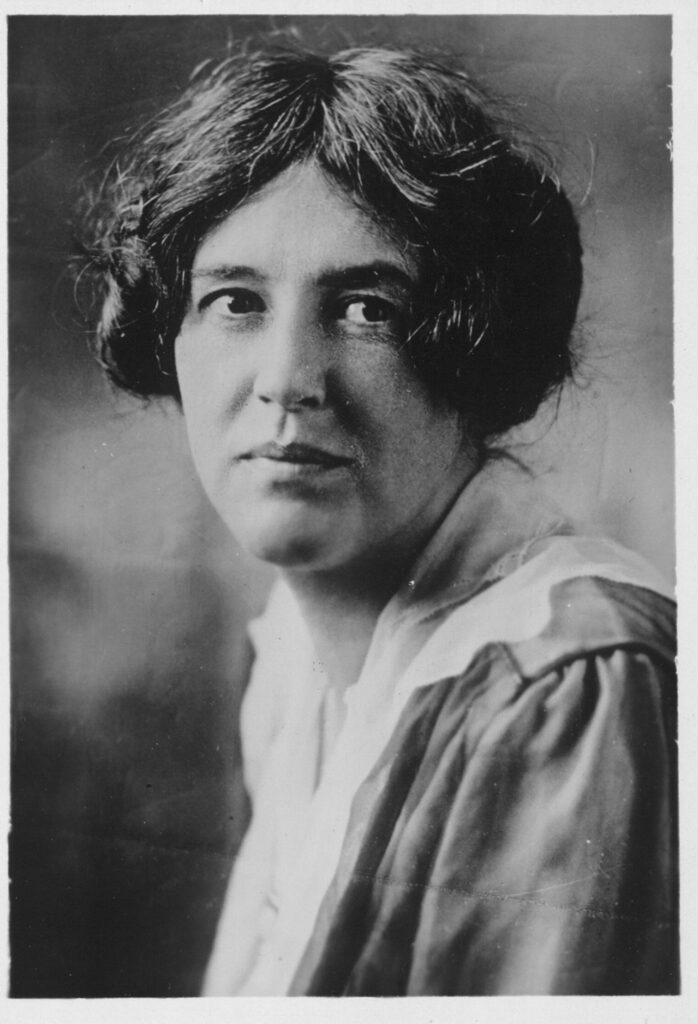
Sara Bard Field, born in 1882 to a strict orthodox Christian family, was a poet and prominent early member of the suffragist movement. A series of interviews with Field, conducted by the UC Berkeley Oral History Center in the late 1950s through the early 1960s—barely a decade before her death in 1974—reveals a woman of striking political acuity and deep concern about the world’s inequities. In her oral history, Sara Bard Field (Wood): Poet and Suffragist, Field recounts her storied life: from a childhood stifled by her father’s overbearing presence, to disillusionment with orthodox religion in her adult life, to a growing interest in local politics that eventually culminated in her involvement with suffragist activism at a national scale.
“I kept saying to myself again and again, until women get the vote they’re not going to be much of a power in society.”
Photo courtesy of the Library of Congress. [ca. 1915] Title: Mrs. Sara Bard Field, of San Francisco, is one of the most eloquent and gifted speakers of the Congressional Union for Woman Suffrage and the National Woman’s Party. She is a kinswoman of Eugene Field, the well known poet. Collection: Records of the National Woman’s Party. (Harris & Ewing, Washington, D.C., Photographer)Field spent much of her early adult life abroad; she was married in her late teens to her first husband, Reverend Albert Ehrgott—a relationship with an almost twenty-year age gap—and accompanied him on his ministry work overseas. Upon returning to the US, Field became involved in local politics in Cleveland, Ohio before assisting with several national suffrage campaigns and joining the National Women’s Party. Following a move to Portland, Oregon, Field became acquainted with lawyer and political activist Charles Erskine Scott Wood; the two later married and lived together on their estate “The Cats” in Los Gatos, California.
Field speaks frequently of her interest in the arts, a fascination which began at a very young age. “My mother tells of me at four,” she says, “of hearing me improvise as I sang my baby brother to sleep. I’d begin with a song that was known and that had been taught to me, then I would start improvising.” In her later years, Field published several poems and poetry collections, evidence of a lifelong passion for poetry which began in childhood with, if not “a knowledge of its beauty, at least a sense of the beauty” that poetic writing conveys.
Aside from her longstanding interest in writing, Field remained invested in politics and social issues. Field’s later activism was informed in part by her travels in India and elsewhere with Albert Ehrgott, where she developed insights about social inequity and what she referred to as the “almost frightening sense of the inadequacy of the capitalist system.”
According to Field, “hard as it was, I feel it was one of the great, at least if not turning points. . . in my thinking, it was a curse on my mind to think about social conditions in the world, because for the first time in my life I saw starving people mingling in the crowd.” She recalls feeling a sense of inherent wrongness at witnessing the mass exportation of food and other goods from India while the country’s colonial administration remained “indifferent to people who were starving in a land in which they lived and were exploiting.”
At the same time, Field was also wrestling with the dissolution of her steadfast relationship with faith. Field describes her dissatisfaction with the widespread practice of conversion in predominantly Buddhist countries and the idea that people “had to become Christian to be good. They were already good.”
These experiences formed the foundation for Field’s further involvement with women’s suffrage campaigns in the US and prepared her for activism at the national scale, first as a state campaign organizer in Oregon and later as a country-wide spokesperson for the National Women’s Party. Thinking back to the origins of the suffrage movement and lack of support initially available to the movement’s members, Field offers her perspective on the early days of the fight for suffrage:
I want to say again, you who are young and have been born into a time when women are in politics, when they have the power of the vote, I think you can’t realize what an obstacle it was to women, not only to action but to learn more, because they didn’t have any reason, as it were, or any field to exercise their interest, and this I kept saying to myself again and again, until women get the vote they’re not going to be much of a power in society.
When discussing the motives behind her decision to join the suffrage movement, Field recollects her own childhood, which was marred by shame and the extreme lack of clarity surrounding women’s roles that defined her family life. She recalls learning from her own experiences as a young, naive minister’s wife and advocating for educating young women about the world. Speaking specifically about marriage and the expectations it entails—children, sex, and the responsibilities of a spouse—Field expresses her wish that young women not struggle the same way she did as a result of a lack of knowledge:
I told women that in the course of my days, young as I was. “They should be told,” I said, “and they should be told thoroughly and not given any impression that you are afraid of telling them because then they’ll get it mixed in crazy ideas and they’ll learn it from sources they shouldn’t learn it from.”
She remembers in particular an interaction with a woman whom she met in Huronia Beach as a young adult, whose name she cannot remember but whose words stuck with her and helped inform her perspective on liberation. Says Field, “Here was a woman who was a person in her own right regardless of anybody else and that’s what she wanted everybody else to be, of course. I remember she said to me that day—she talked to me about my fear of my father. She said, ‘You know, you can’t imagine how bad it is for a person to feel that anybody else could hurt them inside. Your father can’t hurt you inside. You’re a person.’”
“I think few young people in their lives, especially a girl who had wanted to go to college and didn’t get to college, have such a chance for awakening experiences outside of books, outside of the academic world.”
Field’s insights illuminate the reality of many suffrage activists, who often struggled to establish a balance between devoting themselves fully to a cause while at the same time meeting the requirements of personal and family life. Reflecting on the commitments required by the movement, Field notes the expectation of “utter impersonality when there is a work greater than ourselves to be done,” something that requires “much sacrifice and effort.”
Sara Bard Field’s oral history is long—the final publication numbers just under 700 pages—and provides an incredible amount of insight into the life of an intelligent and politically active woman in a time that was not always welcoming to Field and her contemporaries. In her own words, “I think few young people in their lives, especially a girl who had wanted to go to college and didn’t get to college, have such a chance for awakening experiences outside of books, outside of the academic world.”
Field’s testimony is full of observations about the social and political reality of the world in the early twentieth century. She details the record of her travels in Southeast Asia and later across the US as a suffrage activist, preserving a wealth of information useful for historians and curious readers alike.
Shannon White
You can find the interview mentioned here and all our oral histories from the search feature on our home page. Search by name, keyword, and several other criteria.
Shannon White is currently a fourth-year student at UC Berkeley studying Ancient Greek and Latin. They are an undergraduate research apprentice in the Nemea Center under Professor Kim Shelton and a member of the editing staff for the Berkeley Undergraduate Journal of Classics. Shannon works as an editorial assistant for the Oral History Center.
Related Resources from The Bancroft Library
This interview is part of the Suffragists Oral History Project. For interested parties, these interviews also tie in quite nicely with several other projects in the Oral History Center’s collection, including the Women Political Leaders oral histories and the Rosie the Riveter World War II American Home Front Oral History Project. Many of the interviews from these projects coincide in time, presenting detailed and intimate accounts of women’s careers and lives during the twentieth century. My article “Voices of a Movement: The Oral History Center’s Suffragists Oral History Project” offers an overview of several narrators involved in the Suffragists Oral History Project, including Sara Bard Field. In addition, The Berkeley Remix podcast has a season dedicated to women in politics, and Episode 1, “Gaining the Vote,” makes use of several oral histories from the Suffragists project.
The Bancroft Library contains several collections of material from Sara Bard Field and Charles Erskine Scott Wood, including photographs, personal papers, speeches, and published writing. Here are some:
Sara Bard Field papers, 1927–1956 (BANC MSS 79/46 c)
The Speech of Sara Bard Field, presented to Congress on behalf of the women of the nation, 1921. p JK1896 .F5
Charles Erskine Scott Wood papers, 1914–1942 (BANC MSS C-H 106)
The Pale Woman by Sara Bard Field. Bancroft (NRLF) ; x F855.2 .F436 1927 Copy 2
About the Oral History Center
The Oral History Center of The Bancroft Library preserves voices of people from all walks of life, with varying political perspectives, national origins, and ethnic backgrounds. We are committed to open access and our oral histories and interpretive materials are available online at no cost to scholars and the public. You can find our oral histories from the search feature on our home page. Search by name, keyword, and several other criteria. Sign up for our monthly newsletter featuring think pieces, new releases, podcasts, Q&As, and everything oral history. Access the most recent articles from our home page or go straight to our blog home.
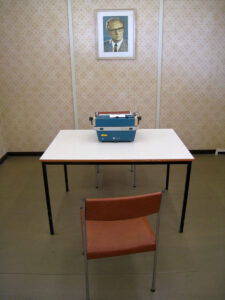
Interview room at Marienborn, a border crossing of the former German Democratic Republic. Photograph by Erich Honecker, 2009
“It is a spoken account, offered by the interviewee in response to questioning, and as such it is reflective, partisan, deeply involved, and irreplaceable.” This quotation is part of a description of what we at the Oral History Center do. It sits at the beginning of every oral history we publish. It was written by Willa Baum, the longtime director of the Regional Oral History Office (the former name of the OHC until 2015). It highlights quite beautifully the conceptual foundation of modern oral history: the deliberate exploration of the unique, subjective historical truths of individuals. While oral history was once considered a poor evidentiary cousin to official records stored in archives, academic oral historians from the 1960s on proclaimed proudly the value of subjective evidence. It was the subjectivity itself that was to be recorded and studied. At the same time, oral historians promised to expand the archive by interviewing people whose views had not been recorded in archives or studied by historians. So, there are two related ideas: oral history as a practice of inclusion that diversifies and enriches the archive, and a belief that the historical record can be made more accurate, more true, by conceiving of it as a living, evolving, contentious space in which there is little in the way of a settled, single consensus about what actually happened. “What actually happened” is a translation of a phrase coined by German historian Leopold Von Ranke, who regarded government documents as the apex of authoritative sources because he saw the 19th-century nation state as the prime mover of history. When I took historical methods courses ages ago, this phrase was trotted out by professors as a particularly primitive, dated, and possibly morally bankrupt form of reasoning. History is about power, the professors would argue, written by the winners, erasing the views and the experiences of the excluded. What mattered in modern historiography was making sure that different experiences and viewpoints were represented in the historical record, and in the interpretations of the historical record.
Recognizing that history is about power, oral historians evolved practices for sharing authority with interviewees, whom we in the field refer to as “narrators” to highlight their authority as originators of a narrative, as opposed to passive sources for an interview. Sharing authority might involve planning an interview far in advance with the narrator, apportioning time to topics, putting up guardrails, and sharing the text of the transcript after the interview to permit them to reflect on their own words and correct them if necessary, or to protect themselves or others from anticipated harm. I call this process the construction of the “deliberate self.” With all the pressure and stimulation of undergoing a recorded interview in real time, even the most seasoned and trained speakers can, in a moment, misrepresent themselves, speak in a disorganized fashion, and mischaracterize what they remember. This is the spontaneous self. To be ethical, and above all trustworthy, interviewers should give narrators the opportunity to see themselves in their own words and refashion them to better represent themselves and the past for posterity. This works well if oral historians are already aligned more or less with their narrators with respect to what is known and how what is known is understood. This “shared authority,” to use oral historian Michael Frisch’s term, is part of what practitioners call the co-construction of oral history.
But what happens when a single, official narrative of state history is washed away by a revolution, and what remains is the collective trauma of decades of misinformation, surveillance, and punishment? How does one conduct interviews in this space? More importantly, how does one interpret what is said?
Over the past four years, I have conducted interviews with a group of Czech physicists. This project evolved into an exploration of how a scientific community functioned under a totalitarian order. The Czechoslovak Academy of Science and courageous scientists emerged as important spaces and agents that supported intellectual diversity and underground political activism. Scientific orientations and a certain form of asceticism underpinned political activism against dogma, propaganda, and the repression of fellow scientists and citizens. These interviews highlighted the contributions of scientists to the underground political movements established before the Velvet Revolution and to the democratic political order that followed.
Why was I doing this research? I study “scientists in trouble.” I am interested in the ways in which a scientist’s commitment to objective truth – a truth completely separate from the background, ideology, beliefs, and values of people – plays out in the messy political world in which scientists must live and operate. What happens when an individual scientist’s commitment to scientific truth clashes with powerful political forces? It could be the Iowa dairy industry during World War II or the Communist Party in Czechoslovakia. In the latter case, what is the relationship between a scientist’s commitment to objective truth and the demands in a totalitarian society of an absolute commitment to dogma? In my conversations with these narrators, and with scholars and students in the Czech Republic, I was confronted by a different understanding of the value of oral history from what we have constructed in the United States and a few other countries.
Last fall, I conducted two workshops on oral history methods, for faculty and oral historians at the Czech Academy of Sciences in Prague and for graduate students at Masaryk University in Brno. My primary motivation for doing this work was to use oral history to meet the challenges of a difficult past and of an increasingly difficult present, one in which state-sponsored versions of the truth pose grave threats to democracies in Central and Eastern Europe. I was also considering the value of oral testimony in the historical shadow of a police state, where many official records from the totalitarian period have now been destroyed. Finally, I wanted to share ideas about the role of trauma in these stories – the difficulty of telling stories that, to this day, are not supposed to be told in Czechia.
But it was when I came to lead the training in Brno for graduate students in a history department that I learned about the implications of a particular form of collective trauma for the practice of oral history with populations who lived under or in the shadow of totalitarianism. After I explained the involved process of co-construction of an oral history from beginning to end, the importance of sharing transcripts with narrators, for example, a hand went up. “My adviser told me not to share the transcripts with the narrators.” Why? Part of the project this student was undertaking was to interview former members of the Czechoslovakian secret police. I said to the class that transcripts should be shared with narrators if possible. The student replied, “Why should we share anything with them? We give them more consideration than they ever gave us!” I trotted out my explanation of the “deliberate self.” Another student spoke, “If you say something in court, it’s in the record forever. You can’t erase it.” Still another said, “If you give them the opportunity to see how they really look, they will cut everything of any historical value out, and we will have nothing!”
I took my time to respond. “This type of interviewing will work, exactly once. But when you break trust with narrators, the reputation of your process, and those of anyone else claiming to do oral history, for that matter, will be tarnished in direct proportion to the notoriety of the exposure of the narrators’ hidden stories.” (Full disclosure, I said this at the time much more awkwardly than what I wrote here, but I am asserting my prerogative to reconstruct my narrative.)
The discipline of oral history relies on multiple narratives to tell a composite, textured story of perspectives about how complex phenomena can be understood, and framed. It was oral historians from Italy, a nation with a comparably complex political history as Czechoslovakia’s, who helped shape the field of modern oral history. For Alessandro Portelli and Luisa Passerini, oral history was the analysis and interpretation of the complex interplay between memory and recorded history. Portelli studied collective memory and press reports about labor protests in Italy. He wrote about how narrators transposed the death of a protestor at the hands of the police to a different protest about a different cause that actually happened four years later. Passerini wrote about the deafening silence in the life histories of those who described a “before” and an “after” of the Italian fascist period.
With these kinds of approaches in mind, I offered some suggestions to the Czech students. If you are disturbed by what you perceive as false narratives, lies to whitewash the narrator’s complicity in an evil political order, you can do at least two things. You can interview those who suffered at the hands of the police, explore the consequences of surveillance and interrogation on families of the suspected and accused, and/or you could also serve as a trustworthy partner of narrators whose deeds and perspectives you find abhorrent, but in the process potentially produce a more candid text than might otherwise be obtained through spontaneous revelations in some kind of interview trap. Then, you could interpret the alignment and differences among those perspectives. Allowing these perspectives to talk to one another through your historical interpretation is one way to understand oral history work.
So, were these graduate students chastened and enlightened, having been brought up to date on the latest best practices in oral history from the United States via postwar Italy?
Not necessarily.
The modern oral history method, this careful co-construction of the story between interviewer and narrator, is in my opinion the best way to interview the survivors of trauma and to collect and archive their stories. It gives the narrators control, the absence of which is at the center of trauma, which offers the potential to be a salve for the wounds of the past.
I wonder, however, if there isn’t some kind of American exceptionalism, or Italian exceptionalism, to this version of oral history practice. The evolution of the discipline or practice of oral history is towards diversity and inclusion, both in terms of sources of narratives and the ways in which narratives may be cultivated, framed, archived, or disseminated. Truth is plural, and the plural truths stand in contrast to one another. It’s a model of history as mosaic, not a king’s chronicle. In fact, the value of oral truth is that it comes from a narrator, filtered by the narrator’s history, memory, background, and position in the world.
When I did my initial interviews for the Czech physics project, one thing that struck me was that, of all the books smuggled into Czechoslovakia, the most important to this group was the works of Karl Popper. Karl Popper is a philosopher, known in some sectors of the academy for his rigid definitions of the mechanisms of science and the nature of scientific truth. More recently, some historians have pointed to Popper’s right-of-center political commitments as evidence that a belief in positive knowledge independent of the knower – that is, a truth that is not a matter of perspective, of background, or of prior knowledge – is a tool and a smokescreen for right-wing hegemony.
And yet, the people’s struggle, in Czechoslovakia, the poet’s revolution of Vaclav Havel, was fought by people who took this definition of truth as their north star. It is not hard to understand why.
It is not just the narrator who is traumatized in the Czech Republic, and so many other places; it is an entire society. The source of the trauma is more than the narrator’s experience of a lack of control in their past; it is the fundamental interdiction of independent meaning-making that is the lifeblood of a totalitarian state. It was the insistence on a daily truth that brooked no examination, discussion, or independent verification that so scarred those who are trying to tell their stories in Czechia now. One of the critiques of social science and humanities research is that the instrument of knowing cannot really know itself. How can humans really know humans the way we measure the chemical composition of matter? But that kind of objective clarity is in a way what these young historians in Czechia want. The heat of this discussion came in part from the problem of interviewers interviewing other interviewers about their interviewing practices. Oral history practice evolved partly in response to the historic menace of the interview: the confession, the interrogation, the Inquisition, self-incrimination through recorded, and always in some way compelled, speech. The tables turned, the student viewed the formerly powerful as liars, now minimizing, erasing, or justifying their practices as police interrogators. Is historical truth here a salve or a weapon? Can it be both?
It is often said that testimony about trauma has been a path to healing. Witness the Truth and Reconciliation Commission in South Africa in the 1990s (though the results of that process are still being evaluated). But what if a society is still very much stuck on the truth part? One of the students came up to me after the workshop and apologized. “I don’t think we as a society are ready yet for your high ethical standards.” There was not a hint of sarcasm in his statement, though maybe there should have been.
This encounter with post-Velvet Revolution graduate students in Czechia did not change my mind about current oral history best practice as I understand it. Making the narrator feel safe and in control is the best guarantor of their representation of themselves and what they experienced. But in our search for plural truths, we need to respect the fact that one person’s truth is often a claim to “capital T” truth, not a perspective or opinion, and that their participation in an oral history project can be part of their battle against obfuscation, propaganda, erasure, and lies. That goes for both the narrator and the interviewer. So we need to be careful when we consider the epistemology of oral history, and reflect on what objective truth means to many individuals and communities, as a matter of cultural and actual life and death. And we might further consider the extent to which our commitment to co-construction shapes both the archive and a historian’s interpretive freedom. If trust-as-alignment is paramount, how much room is there for skepticism, comparison, or independent evaluation? Fortunately, oral history is an evolving field, and it is through these encounters with meaning-making in different contexts that we stumble towards our provisional truth of what we think we know about ourselves and what we do, much as Karl Popper once claimed was the ideal practice of science.
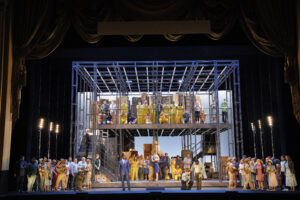
Performance of Fidelio, San Francisco Opera, 2021, photograph courtesy of Cory Weaver
It is with great pride and pleasure that we announce the launch of four new oral histories with San Francisco Opera, continuing a collaboration with the Oral History Center that reaches back decades. In 1973, interviewer Suzanne Riess sat down for interviews with Julian Bagley, who met H.G. Wells and Marian Anderson during his forty years working at the War Memorial Opera House from its opening in 1932! In 1999, Oral History Center interviewer Caroline Crawford conducted an oral history with tenor, voice teacher, and impresario James Schwabacher, whose relationship with San Francisco Opera went back to the 1940s. The San Francisco Opera has benefited from very stable leadership over the past century, with only two general directors during the first sixty years of its existence. This oral history project gained momentum in the 1980s with a three-volume oral history with Kurt Herbert Adler, who was general director of the Opera from 1953 until 1981, and those who knew and worked with him.
In the 2000s, Crawford conducted a number of interviews documenting the conception, creation, planning, management, rehearsal, and performance of an opera commissioned by the Company, John Adams’ Dr. Atomic. For the oral history project Doctor Atomic: The Making of an American Opera, Crawford interviewed composer John Adams, general director of the San Francisco Opera Pamela Rosenberg, music director Sir Donald Runnicles, who conducted the world premiere, music administrator Clifford “Kip” Cranna, and chorus director Ian Robertson. In 2011, Crawford created and oral history with star mezzo-soprano Frederica “Flicka” von Stade, exploring in depth a career in opera performance.
In 2018, we undertook dramaturg emeritus Kip Cranna’s oral history, this time to capture his long career with the opera as a music scholar/ administrator and dramaturg, including his familiarity with the tenures of general directors Kurt Herbert Adler, Terence McEwen, Lotfi Mansouri, Pamela Rosenberg, and David Gockley.
The oral history with general director David Gockley (2006-16) showcased his transformative promotion of “American music theater” that he had pioneered at the Houston Grand Opera. In his time at San Francisco, Gockley focused on dissolving the boundary between opera as high culture and a more democratic and inclusive notion of music theater. He was also an important impresario of new, original compositions by American composers, often in American historical settings.
The oral history with general director Pamela Rosenberg (2001-2006), Gockley’s predecessor, revealed a different approach to opera administration. Although raised and educated in Venezuela and California, Rosenberg spent her entire career in opera administration in Europe, and brought a European sensibility and enthusiasm for adventurous productions to San Francisco. As she began her term in 2001, Rosenberg faced the impact of 9/11 and the dot.com recession. Despite these challenges, she pressed forward with high-risk, high-reward premieres and productions.
The Oral History Center also explored the intersection of San Francisco Opera with the broader community in an interview with Opera Board member Sylvia Lindsey. She was asked to join the Opera Board in 1987, and since then has held a number of positions on committees, in particular to do with education and outreach. She has been a vital force in bringing young people to the opera, but she also fostered inclusion and belonging among the staff and visiting musicians and performers, long before these terms came to stand for common institutional practices. The interview touches on her multiple roles with several arts organizations, highlighting a key facet of her importance as a connector, bringing different people together towards a common purpose.
The pursuit of an art form that is hundreds of years old in the world center of up-to-the-minute technological trends and innovation may seem to be paradoxical, and even a bit quixotic. But the San Francisco Opera is an American story of modernity, resilience, and adaptation. It is about the transplantation of cultural forms from Europe, nurtured early on by many Italian immigrants to the city. It is also about would-be performers growing up in smalltown USA, seeing Beverly Sills on late-night talk shows, and wondering if they too might one day undertake something so grand and beautiful as a calling. But it is also about the ways in which art forms and their institutions can signal and in some ways exemplify elitism, and the efforts of the Opera to move beyond this unintentional cultural positioning through outreach, education, and initiatives of inclusion and diversity. Ultimately, these stories are about broadening the idea of what opera can be, for the performers, for the audiences, and for young people who talk to a singer who visits their schools, attend a performance, see themselves represented on stage, and perhaps dream one day to perform.
This most recent set of interviews is an in-depth exploration of what it means to do art. Creativity is of course the lifeblood of composition, performance, production, and, dare I say, administration. But this project is very much about the drama of the work of performance in all its dimensions. The audience experience of opera performance is certainly visceral. Those soundwaves hit you in your chest. You are, after all, sitting inside the giant horn that is the War Memorial Opera House. The melodies and harmonies open your heart, and the dramatic performance threatens to break it. But what emerges after talking for hours with people who make each of those performances work flawlessly every night is that this art is constructed and expressed on a knife’s edge. The stage manager’s calls sound like an air-traffic controller calmly landing dozens of jets at once. A prima donna falls sick the day of, and a cover, or understudy, steps in to sing a four-hour opera. Many, many things can go wrong at any moment, but the audience experience is only a musical and dramatic catharsis. Radiate out from the excitement behind the scenes of every performance, and you can see the larger drama in which the Opera finds itself: the ups and downs of the market and the tragedies of war and disease that impact the Company, its audience, and the wider community. In short, these interviews are very much about what art means, now and for the ages. For the past one hundred years the San Francisco Opera has been making meaning and beauty for its evolving communities. May it continue to do so long into the future.
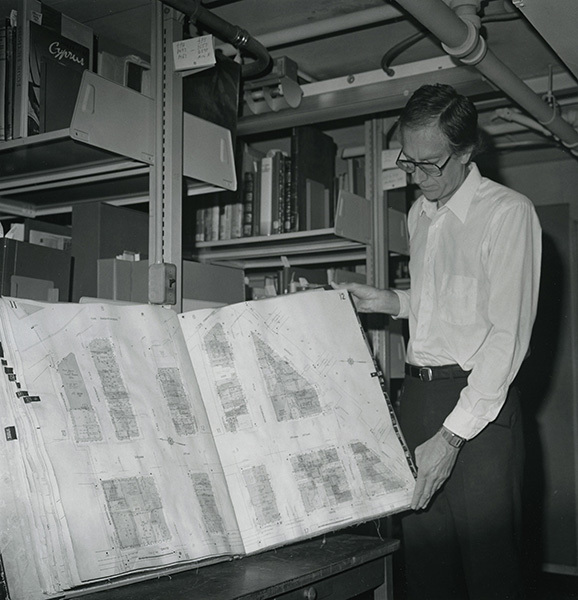
Phil Hoehn, with a Sanborn atlas, Bancroft Library, May 1990. Photograph: Mary-Ellen Jones (BANC PIC 19xx.349).
Longtime UC Berkeley Maps and Earth Sciences Librarian Phil Hoehn passed away on February 6, 2023, from complications of colon cancer. He was 81 years old.
Raymond Philip Hoehn, Jr. was born in Cape Girardeau, Missouri on October 23, 1941, the son of Raymond Philip Hoehn and Florentine Jeanne Hoehn. Following World War II, the Hoehn family moved west to southern California and Phil grew up in Pomona. Inheriting a love of maps from his grandfather, he majored in geography at UCLA. In 1967, Phil earned an MLS from UC Berkeley and began his career as the Map Librarian at UC Berkeley’s Bancroft Library in 1969. He was then asked to assume responsibility for the map collection of the General Library, and managed both collections for several years. When the Map Library was merged with the Earth Sciences map collection, Phil was tapped to lead the new combined unit, eventually known as the Earth Sciences and Map Library, and did so until his retirement in 1996.
Phil counted among his favorite accomplishments at Berkeley the development and management of the California Maps Project, an ambitious effort funded by a grant from the U.S. Department of Education to catalog and re-classify some 21,000 maps held in the collections of UC Berkeley and UCLA. Randal Brandt, currently Head of Cataloging at the Bancroft Library, was the project cataloger. “Phil hired me into my first professional position,” he recalled. “He mentored me, encouraged me, and supported me in the early years of my career. He also taught me how to catalog maps, which has been a part of nearly every job I’ve held since then. I can honestly say that I owe my professional career to Phil.”
One of the innovative decisions that Phil made during the project was to include geographic location data in records that describe California Land Case Maps. These diseños, rough manuscript maps, were used as evidence in the court cases which determined the validity of Spanish and Mexican land grants once California was ceded to the United States. Without the online tools of today, determining correct longitude and latitude data for the ranchos represented on the land case maps was not a simple task in the early 1990s.
Although this work was time-consuming, Phil’s decision paid huge dividends several years later when the Bancroft Library undertook the digitization of the maps. When discussing the significance of this metadata, Bancroft Interim Deputy Director Mary Elings, who directed the digitization project, noted the bridge that has been made between the handiwork of 19th century amateur cartographers and contemporary Geographic Information Systems in an important aspect of California history: “Adding the longitude and latitude to the Land Case Map records provided helpful information for researchers in geo-referencing the digitized historic maps, which in turn helps current researchers using GIS systems in their work.”
After he retired from Berkeley, Phil headed down the Peninsula and held the position of map bibliographer at Stanford University’s Branner Earth Sciences Library & Map Collections from 1996 to 2000. At Stanford he performed collection development and maintenance, provided reference assistance, and worked to promote university-wide awareness of the map collections and services. Subsequently, from 2000 until 2007 he served as consulting librarian at the David Rumsey Map Collection (now the David Rumsey Map Center at Stanford), where he created thousands of detailed catalog records for digitized maps.
Never one to spend much time “retired,” Phil then launched a second career as a volunteer map cataloger, first at the California Genealogical Society and then at the California Historical Society. In 2020, a CHS blog post described Phil’s work:
In June 2015, Phil Hoehn … took on the daunting task of organizing the California Historical Society’s vast map collection … over 45 drawers of flat sheet maps dating back to at least 1800 (including maps in atlases and books where cartographers depicted California as an island) as well as early mining, railroad, and irrigation maps, bound volumes of Sanborn Fire Insurance maps, and boxes of large rolled maps spanning all the counties in California. During the four years Phil worked reviewing, researching, cataloging, and rehousing the maps he discovered many unique titles, some that appear in only a few other collections in the world. Many of the works, by such prominent surveyors and cartographers as William Eddy, Herman Ehrenberg, Jasper O’Farrell, and August Chevalier, document the birth and growth of the city of San Francisco … [Phil] leaves nearly 4,000 maps now accessible to researchers. From foldout ones in rare books to enormous rolled maps that practically took a village to bring up from the vaults, Phil has discovered, cataloged, preserved, and documented them all.
Frances Kaplan, until recently Director of Library & Collections at the California Historical Society, expanded on Phil’s impact, saying “It is due to his efforts that the entire map collection at CHS is now cataloged and searchable. Along the way he discovered some rare ones and his work inspired the [current] map exhibit.” The exhibit, “Mapping a Changing California: From the Seventeenth to the Twentieth Century,” is on view through March 11, 2023.
Phil joined the Western Association of Map Libraries (WAML) in 1969, which was just two years after its first meeting took place. Phil was an active member of WAML his entire career. He found that the benefits of WAML membership included getting good practical advice from friendly, experienced colleagues. Phil also emerged as a wheeler and dealer who obtained many great maps for the UC Berkeley Library by participating in WAML duplicate exchanges. He viewed membership as a form of therapy and described WAML meetings as good places to voice local problems and concerns among like-minded individuals.
Phil had a direct hand in the founding of the California Map Society. Together with Diane M. T. North, who was then a Ph.D candidate at UC Davis, he co-convened a meeting at the Bancroft Library in May 1978, which was the inaugural gathering of the California Map Society. North recalled her long relationship with Phil: “Phil’s knowledge of and deep enthusiasm for maps, all maps, seemed boundless. Anyone privileged to have the opportunity to be guided by him and work alongside him benefited from his professionalism, patience, generosity, and quiet sense of humor.”
Phil had a longstanding interest in fire insurance maps, including local California maps, produced by the Dakin Publishing Company and he published on the subject. His most important publication, compiled together with William S. Peterson-Hunt and Evelyn L. Woodruff, is a reference tool of enduring value to map librarians and researchers, the Union List of Sanborn Fire Insurance Maps Held by Institutions in the United States and Canada, originally published in 2 volumes by the Western Association of Map Libraries in 1976-1977. The Earth Sciences and Map Library maintains an updated online version on its website which documents Phil’s hard work.
Will Murdoch, a book cataloger at the California Historical Society, who worked with Phil from 2015 until 2019, shared his memories of Phil:
He was my mentor and work colleague in the CHS Library. I cataloged books and Phil processed the maps in that collection. We shared a lot of fun discoveries with each other and learned about the depth of the CHS archives. It was an education for me as Phil’s background was extensive and he was so kind to share his knowledge with me. I miss him and our work together there.
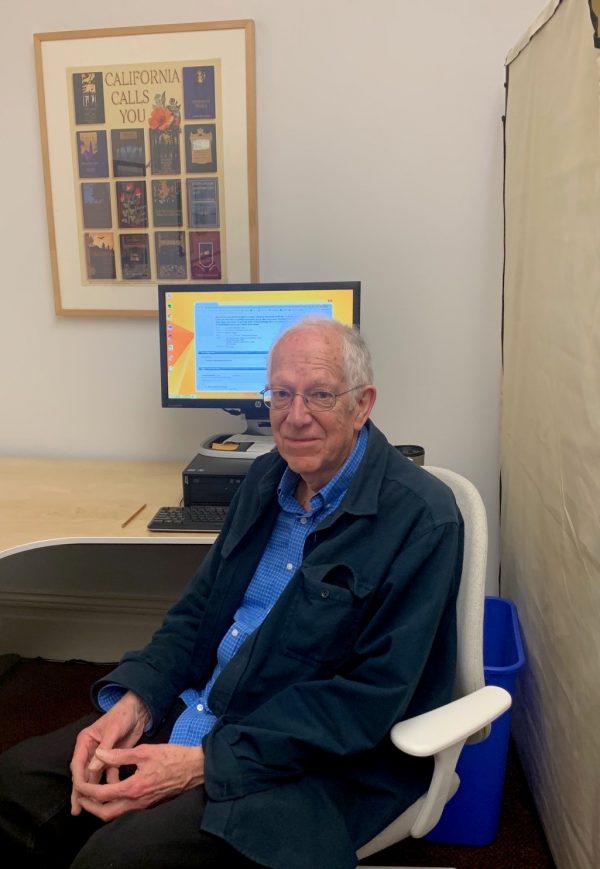
Phil Hoehn at the California Historical Society, 2020. Photograph: Frances Kaplan.
Phil Hoehn played an important role in building the rich and diverse map collections on the Berkeley campus. As a map librarian, map bibliographer, metadata specialist Phil was instrumental in providing expert resource discovery for cartographic resources at many institutions throughout the Bay Area. More important than his professional qualities, however, Phil excelled as a colleague, mentor, and friend. Everyone who knew him and worked with him was made better for the experience.