
– This post is a guest post by Annabel Barry, Ph.D. candidate at UC Berkeley and class.
Members of the spring 2025 class of English R1A: The Marriage Plot in Irish Literature, taught by Annabel Barry, worked together to curate a virtual exhibition of Irish rare books and manuscripts in the Bancroft Library’s Special Collections. The class explored how marriage in Irish literature from the nineteenth century to today represents not merely a private bond between individuals, but also a malleable metaphor that takes on public meanings, reflecting shared social aspirations and anxieties. While reading and discussing literary texts in which marriage straddles the boundary between private and public, students simultaneously explored the public humanities, or how humanistic research can be made accessible to audiences beyond the university.
Each student was assigned to research and draft an exhibition label for a unique object from the Bancroft Library related to an author from the course. Students were invited to use their interpretations of their objects to explore their individual interests—from economics to music. They then worked in small groups to revise and arrange their labels to create a coherent narrative arc. Along the way, they benefitted from the generous assistance of Bancroft Library Information and Instruction Specialist Lee Anne Titangos, who helped to select and present materials, and Literature and Digital Humanities Librarian Bee Lehman, who introduced students to using ArcGIS StoryMaps as a virtual exhibition platform.
Below are abridged versions of some of the exhibition labels featured in the virtual exhibition. The full exhibition is available to university affiliates with a CalNet ID at this link. To access the site, simply click “Your ArcGIS organization’s URL,” type “cal” in the text box, click continue, and input your CalNet ID and password.
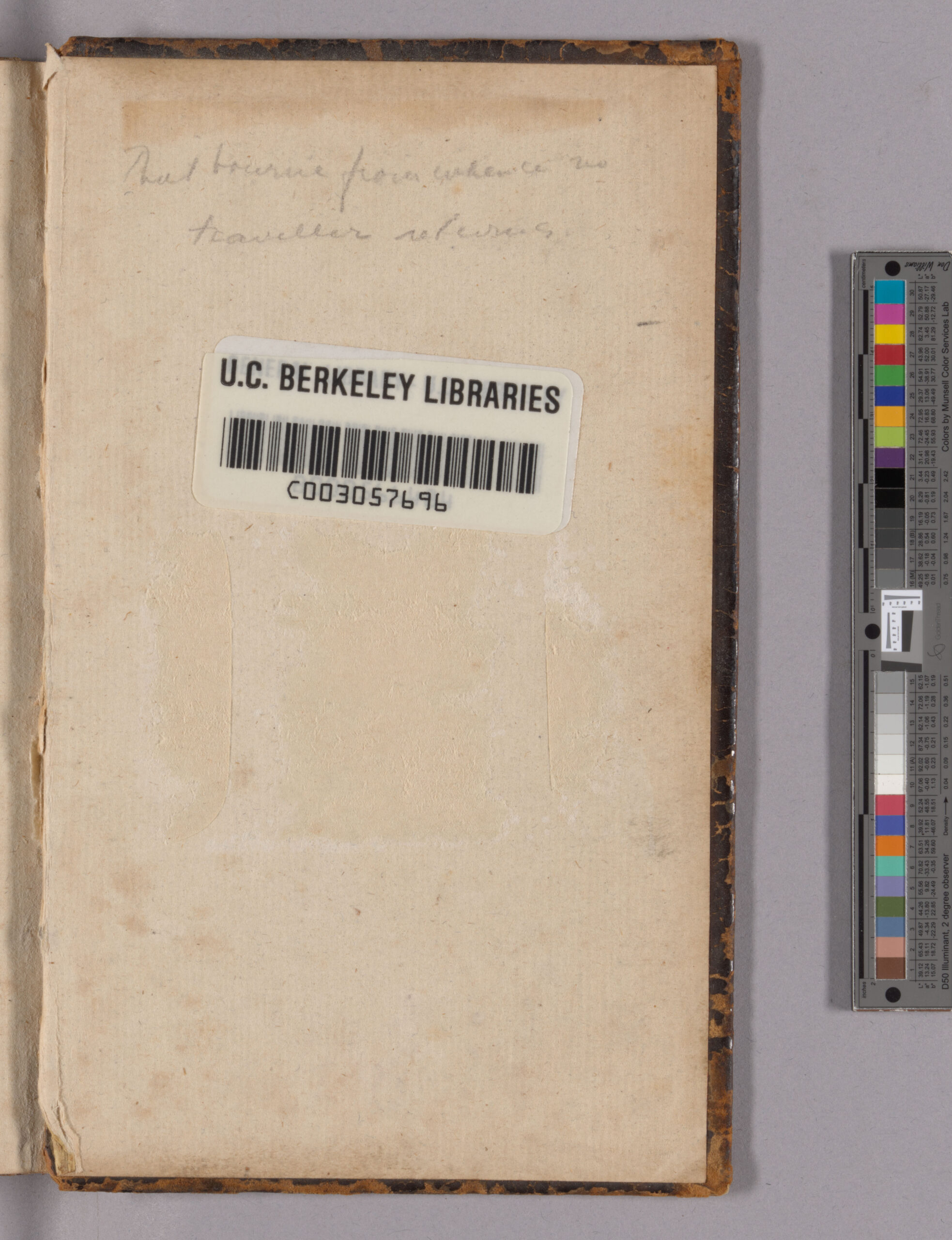
“That bourne from whence no traveller returns” by Naila Talib
Sydney Owenson, Lady Morgan (c.1781 – 1859) | The Wild Irish Girl first three-decker edition | 1806 | Published by Richard Phillips
When initially published in 1806 by Richard Phillips, Sydney Owenson’s The Wild Irish Girl was printed and distributed in a three-volume format, a strategy that was used to entice readers to buy multiple volumes to complete the story they started. The previous owner of this particular copy had to purchase the bindings with gold-laced engravings visible in the first and third volumes separately from the actual printed text itself. The intricate and high-quality design of the bindings indicates that they valued the text. The newer and simpler binding on the second volume is evidence of the Bancroft Library’s preservation efforts as the previous spine and binding may have been old and worn out, and so they replaced it with a newer, simpler binding. The yellowing and browning of the pages show that the volumes were viewed and handled by readers and researchers, causing the material to degrade overtime.
At the back of the book, an annotation written in pencil by a previous reader or owner reads “That bourne from whence no traveller returns.” This quote is uttered by Glorvina during a scene where the characters encounter a traditional Irish funeral; her remark is in reference to a famous Hamlet soliloquy where he says, “The undiscovered country from whose bourn / No traveler returns.” Through this phrase, Shakespeare both metaphorically and poetically communicates the idea that once someone has passed away, they can no longer come back into existence. In this context, the word “bourne” means “boundary” or “destination,” and thus Glorvina is recognizing the finality of death and a sentiment of uncertainty associated with what comes after death for the individual whose funeral they had just encountered.
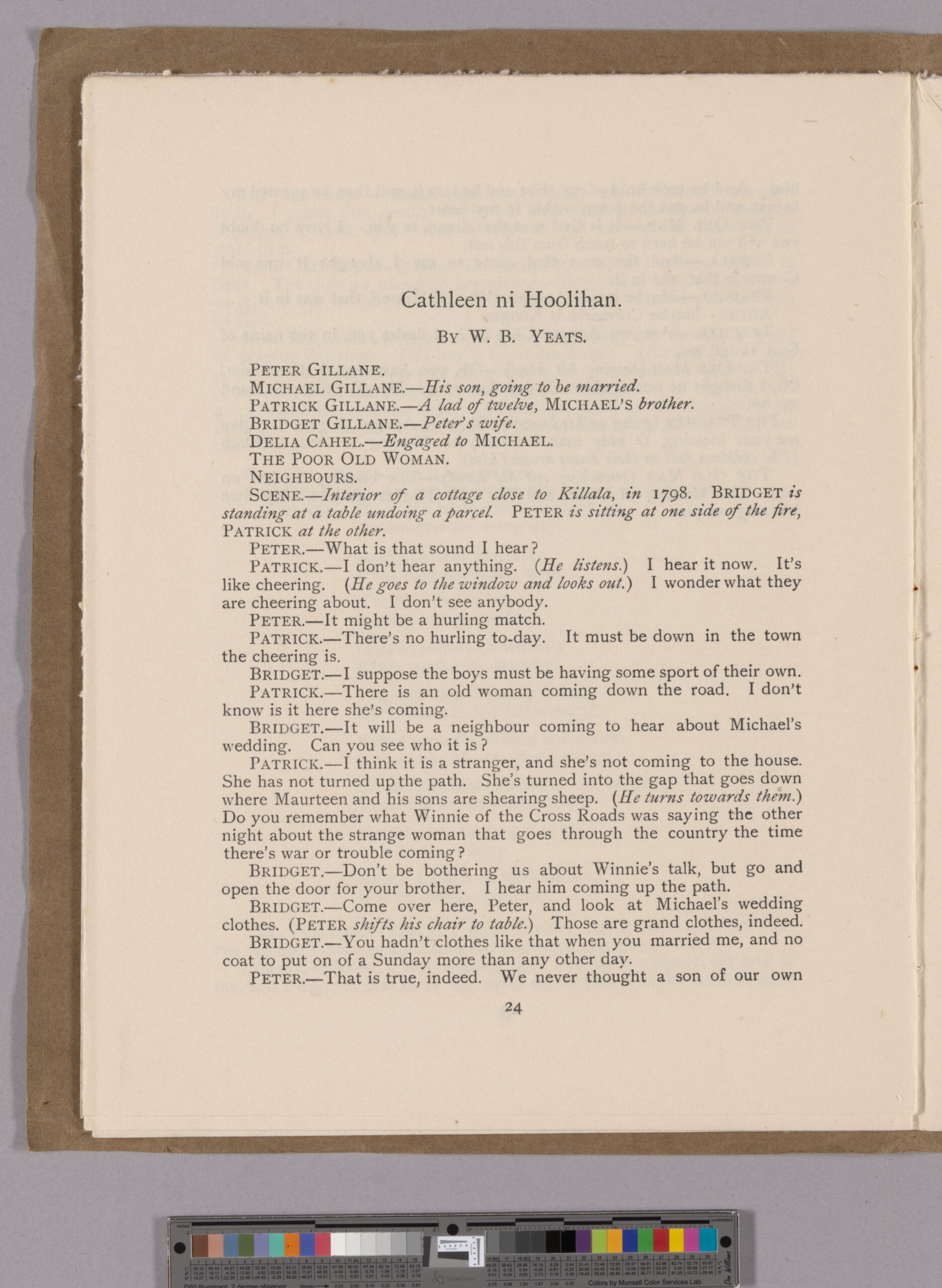
“Samhain: Scarcity and Symbolism” by Sofia Aquino
Isabella Augusta, Lady Gregory (1852-1932) and William Butler Yeats (1865-1939) | First publication of Cathleen ni Houlihan in Samhain: An Occasional Review, issue 2 of 7 | October 1902 | Published by Sealy, Bryers, & Walker and T. Fisher Unwin
Samhain, an irregularly published theater magazine (1901-1908), was founded and edited by poet-playwright W.B. Yeats as part of his collaboration with Lady Gregory to promote Irish culture and nationalism through founding the Abbey Theatre. In its first issue, Yeats explains the title’s significance: “I have called this little collection of writings Samhain, the old name for the beginning of winter, because our plays this year are in October, and because our Theater is coming to an end in its present shape.”
Samhain’s binding—soft, thin cardboard stitched with thread—reflected the financial struggles of the Irish Literary Revival. The Irish Literary Theater, a precursor to the Abbey Theatre, had disbanded in 1902 due to a lack of funding, underscoring the need for a government-subsidized national theater. This goal was accomplished in 1925 when the Abbey Theatre became the first state-subsidized theatre in the English-speaking world.
Most notably, this issue featured the first publication of Cathleen ni Houlihan, a nationalist play co-written by Yeats and Lady Gregory, though only Yeats was credited upon publication—a reflection of how Gregory’s contributions to Irish drama were often overlooked despite her significant influence. The play’s exploration of economic sacrifice mirrors the circumstances of its own creation. Just as Michael must choose between financial security or sacrificing all for Irish nationalism, Yeats and Gregory, who worked with limited resources and no government support, staged the play despite financial hardship, believing in its necessity for a country in need of inspiration.

“Bound by Myth and Melody” by Chloe Yuan
Isabella Augusta, Lady Gregory (1852-1932) and William Butler Yeats (1865-1939) | The Hour-Glass, Cathleen ni Houlihan, The Pot of Broth: Volume Two of Plays for an Irish Theatre | 1904 | Published by A.H. Bullen
Published by A.H. Bullen in London, this 1904 edition compiles three of Yeats’s plays: The Hour-Glass, Cathleen ni Houlihan, and The Pot of Broth. The spine, inscribed with Yeats’s name and the publisher A.H. Bullen of London, reflects the intersection of Irish literary nationalism and the British publishing industry.
The musical annotations remind us that these plays were composed as living works, meant to be heard and felt, a fusion of Ireland’s literary and musical heritage. Among the printed words of Cathleen ni Houlihan and The Pot of Broth, a striking detail emerges: musical notation embedded within the text. These passages indicate that music was not merely an ornament in the plays of Yeats and Gregory but a vital storytelling device. The presence of melody within the printed script underscores the oral tradition of Irish folklore, where song carried historical memory, rebellion, and lamentation. In Cathleen ni Houlihan, the mysterious old woman begins to sing a haunting tune, recalling those who have died for Ireland. The inclusion of sheet music in the book suggests that the play’s performance was intended to be a multisensory experience, reinforcing the theme of national sacrifice through the emotional resonance of the song.

“Inside the Mind of Seamus Heaney” by Anonymous
Seamus Heaney (1939-2013) | Notebook with manuscript drafts of poems, with revisions and annotations | 1970-1971 | Seamus Heaney Poems Collection
This 1970–71 notebook written by Seamus Heaney reveals the layered and often nonlinear process behind his poetry. Heaney wrote during a moment of deep political unrest; the conflict in Northern Ireland was just beginning, and a civil war loomed. From Berkeley, California, Heaney grappled with the growing tension back home.
Pages 86 and 87 of this notebook contain early drafts of Seamus Heaney’s poem “The Other Side,” published in 1972. The poem’s central theme is a Protestant neighbor living across a river, physically close, yet socially and ideologically distant. The river functions as both a literal border and a symbolic divide, reflecting Heaney’s concerns with religious identity, land, and division in a fractured Ireland.
Heaney’s shift in title, from “Fordings” to “Dreamer at the Ford” to “The Other Side,” marks a change in emphasis. “Fordings” is pastoral and descriptive, while “The Other Side” introduces political weight. The final title gestures toward separation and opposition, making the poem’s political dimensions more legible. This produces a tension: while the framing becomes more political, the language within the poem retracts from directness. That dual movement, toward both clarity and obscurity, reflects Heaney’s position as a poet caught between intimacy and distance, between naming a boundary and refusing to cross it.
“A Spark of Inspiration” by Ryan Luftman
Seamus Heaney (1939-2013) | Manuscript draft of “Gifts of Rain,” on back of working syllabus for English 161: Recent British & American Poetry, and later typescript draft | 1971 | Seamus Heaney Poems Collection
Heaney’s syllabus for his course on British and American Poetry serves as a perfect physical representation of his time at Berkeley. At Berkeley, Heaney continued his poetic pursuits both as an artist and a learner. We can see this explicitly through the syllabus as Heaney adds readings by James Dickery and Elizabeth Bishop to his list, showing active exploration of poets. More interestingly, flipping over the syllabus reveals a spectacular insight into Heaney’s mind.
On the back of the syllabus is a working draft of a brand-new poem, “A Gift of Rain” (later published as “Gifts of Rain”). Here we see the original iterations of what ends up being the first and third stanza of the final poem. Across the manuscript and typescript drafts, we can see how Heaney moves from a very personal poem to one with a more general address. Heaney makes changes like “my skin” to “his pelt,” “your” to “their.” Examining the contents of the poem, it seems Heaney begins writing about personal experiences of places from his youth after rainfall and changes them to a more general experience, allowing him to build up the more metaphorical tone of the poem. This is a common theme in Heaney’s work: he takes personal experiences and beliefs and alters them to have greater appeal to a wider audience.
Image reproduction was supported by a Daniel E. Koshland, Jr. Course Development Grant (for more information, click here).